|
시장보고서
상품코드
2083365
하이브리드 선박용 발전기 시장 기회, 성장 촉진요인, 업계 동향 분석 및 예측(2026-2035년)Hybrid Marine Gensets Market Opportunity, Growth Drivers, Industry Trend Analysis, and Forecast 2026 - 2035 |
||||||

세계의 하이브리드 선박용 발전기 시장은 2025년에 1억 4,850만 달러 규모에 달하고, 2035년까지 CAGR 11.4%로 성장하여 4억 3,990만 달러에 달할 것으로 추정됩니다.
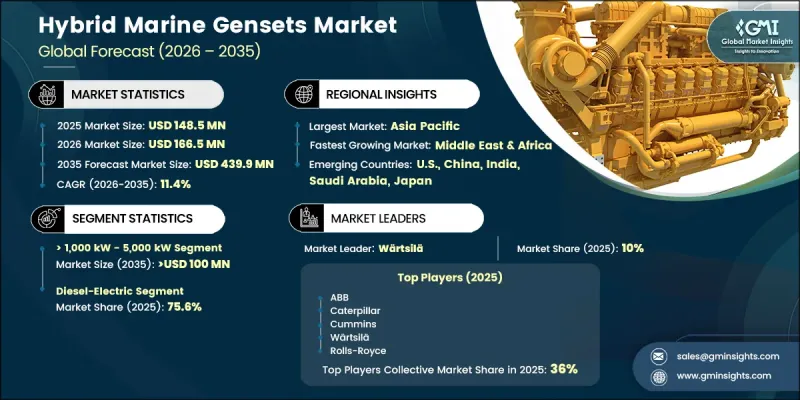
이 시장의 성장은 해운 사업 전반에 걸친 배출 규제 강화와 해운 업계의 탈탄소화에 대한 전 세계적인 관심 고조에 힘입어 가속화되고 있습니다. 온실가스 배출 감축을 목표로 하는 규제 체계에 따라, 선박 운항 사업자들은 보다 친환경적인 추진 및 전력 솔루션으로의 전환을 요구받고 있으며, 이에 따라 하이브리드 시스템의 도입이 가속화되고 있습니다. 신흥국의 인구 증가와 산업 확장에 힘입어 해상 무역 활동이 활발해지면서, 효율적인 해상 운송 인프라에 대한 수요가 더욱 증가하고 있습니다. 이와 동시에, 관광 활동의 확대, 특히 크루즈 여행과 페리 운송의 증가가 선박 이용률 향상과 선단의 현대화에 기여하고 있습니다. 하이브리드 선박용 발전기는 기존의 디젤 또는 가스를 연료로 하는 발전 방식과 통합형 에너지 저장 시스템을 결합함으로써, 연료 효율을 높이는 동시에 환경에 미치는 영향을 줄입니다. 운용 효율, 에너지 최적화 및 지속가능한 해운 운영에 대한 관심이 높아짐에 따라, 상선과 레저용 선박을 막론하고 하이브리드 구성으로의 전환이 더욱 가속화되고 있습니다. 에너지 자원 및 원자재 등의 상품을 포함한 국제 무역량의 증가 역시 첨단 선박용 동력 시스템의 장기적인 도입을 뒷받침하고 있습니다.
| 시장 범위 | |
|---|---|
| 시작 연도 | 2025년 |
| 예측 기간 | 2026-2035년 |
| 개시 금액 | 1억 4,850만 달러 |
| 예측 금액 | 4억 3,990만 달러 |
| CAGR | 11.4% |
2025년 기준으로, 디젤·전기 하이브리드형 선박용 발전기 부문은 시장 점유율의 75.6%를 차지했습니다. 이 구성은 연료 소비량과 배기가스를 줄이면서도 운항의 유연성을 높일 수 있기 때문에 널리 채택되고 있습니다. 이를 통해, 특히 항만에서의 조선 등 저부하 운항 시 선박은 디젤 발전 모드와 전기 추진 모드를 효율적으로 전환할 수 있게 되어, 효율 향상과 환경 규제 준수가 촉진됩니다.
출력 1,000kW-5,000 kW 부문은 2035년까지 1억 달러에 달할 것으로 예상됩니다. 이 카테고리의 수요는 상선, 호화 요트, 여객선 등 다양한 선박에 적합하다는 점에 힘입어 증가하고 있습니다. 세계 해상 무역의 확대, 에너지 수요의 증가, 그리고 해상 관광 활동의 확대가 중·대형 선박 등급의 도입을 지속적으로 뒷받침하고 있습니다.
미국의 하이브리드 선박용 발전기 시장은 2025년에 1,900만 달러 규모를 기록했습니다. 시장 확대는 해양 탐사 활동의 활성화와 심해 작업에 사용되는 특수 선박의 도입 증가에 힘입어 이루어지고 있습니다. 업스트림 부문의 석유·가스 사업이 견조한 성장세를 보이고 있으며, 미개발 해상 매장량에 대한 지속적인 관심이 이어짐에 따라 첨단 선박용 동력 시스템에 대한 수요는 더욱 증가하고 있습니다.
자주 묻는 질문
목차
제1장 조사 방법과 범위
제2장 주요 요약
제3장 업계 인사이트
제4장 경쟁 구도
제5장 시장 규모 및 예측 : 출력 정격별, 2022-2035년
제6장 시장 규모 및 예측 : 유형별, 2022-2035년
제7장 시장 규모 및 예측 : 용도별, 2022-2035년
제8장 시장 규모 및 예측 : 지역별, 2022-2035년
제9장 기업 개요
KSM 26.07.20The Global Hybrid Marine Gensets Market was valued at USD 148.5 million in 2025 and is estimated to grow at a CAGR of 11.4% to reach USD 439.9 million by 2035.
The market growth is influenced by tightening emission regulations across maritime operations and increasing global focus on decarbonization in the shipping industry. Regulatory frameworks targeting reduced greenhouse gas emissions are pushing vessel operators toward cleaner propulsion and power solutions, accelerating the adoption of hybrid systems. Rising maritime trade activity, supported by population growth and industrial expansion in developing economies, is further strengthening demand for efficient marine transport infrastructure. In parallel, expanding tourism activity, particularly cruise-based travel and ferry transportation, is contributing to higher vessel utilization and fleet modernization. Hybrid marine gensets combine conventional diesel or gas-based generation with integrated energy storage systems, improving fuel efficiency while reducing environmental impact. The growing emphasis on operational efficiency, energy optimization, and sustainable marine operations is reinforcing the shift toward hybrid configurations across commercial and recreational vessels. Increasing international trade volumes involving commodities such as energy resources and raw materials is also supporting the long-term deployment of advanced marine power systems.
| Market Scope | |
|---|---|
| Start Year | 2025 |
| Forecast Year | 2026-2035 |
| Start Value | $148.5 Million |
| Forecast Value | $439.9 Million |
| CAGR | 11.4% |
The diesel-electric hybrid marine gensets segment accounted for 75.6% share in 2025. This configuration is widely adopted due to its ability to reduce fuel consumption and emissions while improving operational flexibility. It enables vessels to switch efficiently between diesel generation and electric propulsion modes, particularly during low-load operations such as harbor maneuvering, thereby enhancing efficiency and supporting compliance with environmental regulations.
The 1,000 kW to 5,000 kW power rating segment is expected to reach USD 100 million by 2035. Demand in this category is driven by its suitability for a wide range of vessels, including commercial fleets, luxury yachts, and passenger ships. Growth in global seaborne trade, increasing energy requirements, and expanding maritime tourism activity continue to support adoption across medium-to-large vessel classes.
United States Hybrid Marine Gensets Market was valued at USD 19 million in 2025. Market expansion is supported by rising offshore exploration activity and increasing deployment of specialized vessels used in deepwater operations. Strong growth in upstream oil and gas activity and continued interest in untapped offshore reserves are further strengthening demand for advanced marine power systems.
Key companies operating in the global hybrid marine gensets market include ABB, Wartsila, Rolls-Royce, Caterpillar, Cummins, AB Volvo Penta, Yanmar Holdings, Mitsubishi Heavy Industries, Scania, NIDEC CORPORATION, ZF Friedrichshafen AG, BAE Systems, Anglo Belgian Corporation, ELIN Motoren, Everllence, Genesal Energy, Molabo, Nanni, Steyr Motors AG, and Zenoro. Companies in the hybrid marine gensets market are focusing on improving fuel efficiency and reducing emissions through continuous innovation in hybrid propulsion and energy management systems. A strong emphasis is placed on integrating advanced battery storage technologies with conventional generator systems to optimize vessel performance across varying load conditions. Manufacturers are expanding partnerships with shipbuilders and marine operators to secure long-term supply contracts and strengthen project pipelines. Investment in R&D is centered on enhancing system reliability, compact design, and modular architecture to support diverse vessel applications. Companies are also prioritizing compliance with evolving international emission standards by developing low-carbon and fuel-flexible solutions.
Table of Contents
Chapter 1 Methodology & Scope
- 1.1 Research approach
- 1.2 Quality commitments
- 1.2.1 GMI AI policy & data integrity commitment
- 1.2.1.1 Source consistency protocol
- 1.2.1 GMI AI policy & data integrity commitment
- 1.3 Research trail & confidence scoring
- 1.3.1 Research trail components
- 1.3.2 Scoring components
- 1.4 Data collection
- 1.4.1 Partial list of primary sources
- 1.5 Data mining sources
- 1.5.1 Paid sources
- 1.5.1.1 Sources, by region
- 1.5.1 Paid sources
- 1.6 Base estimates and calculations
- 1.6.1 Base year calculation for any one approach
- 1.7 Market estimates & forecasts parameters
- 1.8 Forecast model
- 1.8.1 Quantified market impact analysis
- 1.8.1.1 Mathematical impact of growth parameters on forecast
- 1.8.1 Quantified market impact analysis
- 1.9 Research transparency addendum
- 1.9.1 Source attribution framework
- 1.9.2 Quality assurance metrics
- 1.9.3 Our commitment to trust
- 1.10 Market definitions
Chapter 2 Executive Summary
- 2.1 Industry synopsis, 2022 - 2035
- 2.1.1 Business trends
- 2.1.2 Power rating trends
- 2.1.3 Type trends
- 2.1.4 Application trends
- 2.1.5 Regional trends
Chapter 3 Industry Insights
- 3.1 Industry ecosystem analysis
- 3.1.1 Raw material availability & sourcing analysis
- 3.1.2 Manufacturing capacity assessment
- 3.1.3 Supply chain resilience & risk factors
- 3.1.4 Distribution network analysis
- 3.2 Industry impact forces
- 3.2.1 Growth drivers
- 3.2.2 Industry pitfalls & challenges
- 3.3 Regulatory landscape
- 3.4 Growth potential analysis
- 3.5 Porter's analysis
- 3.5.1 Bargaining power of suppliers
- 3.5.2 Bargaining power of buyers
- 3.5.3 Threat of new entrants
- 3.5.4 Threat of substitutes
- 3.6 PESTEL analysis
- 3.6.1 Political factors
- 3.6.2 Economic factors
- 3.6.3 Social factors
- 3.6.4 Technological factors
- 3.6.5 Legal factors
- 3.6.6 Environmental factors
- 3.7 Cost structure analysis of hybrid marine gensets
- 3.8 Emerging opportunities & trends
- 3.9 Growth in untapped markets & applications
- 3.10 Investment analysis & future prospects
- 3.11 Price trend analysis (USD/Unit) (Driven by Primary Research)
- 3.11.1 By region (Driven by Primary Research)
- 3.11.2 By type (Driven by Primary Research)
- 3.12 Impact of AI & Generative AI on the market (Driven by Primary Research)
- 3.12.1 AI-Driven production optimization (Driven by Primary Research)
- 3.12.2 Predictive maintenance & fault detection (Driven by Primary Research)
Chapter 4 Competitive Landscape, 2026
- 4.1 Introduction
- 4.2 Company market share analysis, by region, 2025
- 4.2.1 North America
- 4.2.2 Europe
- 4.2.3 Asia Pacific
- 4.2.4 Middle East & Africa
- 4.2.5 Latin America
- 4.3 Competitive analysis of major market players
- 4.4 Competitive positioning matrix
- 4.5 Key developments
- 4.5.1 Mergers & acquisitions
- 4.5.2 Partnerships & collaborations
- 4.5.3 New product launches
- 4.5.4 Expansion plans & funding
- 4.6 Company tier benchmarking
- 4.6.1 Tier classification criteria & qualifying thresholds
- 4.6.2 Tier positioning matrix by revenue, geography & innovation
Chapter 5 Market Size and Forecast, By Power Rating, 2022 - 2035 (USD Million & Units)
- 5.1 Key trends
- 5.2 ≤ 1,000 kW
- 5.3 > 1,000 kW - 5,000 kW
- 5.4 > 5,000 kW - 10,000 kW
- 5.5 > 10,000 kW - 20,000 kW
- 5.6 > 20,000 kW
Chapter 6 Market Size and Forecast, By Type, 2022 - 2035 (USD Million & Units)
- 6.1 Key trends
- 6.2 Diesel-electric
- 6.3 Gas-electric
- 6.4 Others
Chapter 7 Market Size and Forecast, By Application, 2022 - 2035 (USD Million & Units)
- 7.1 Key trends
- 7.2 Merchant
- 7.3 Offshore
- 7.4 Cruise & ferry
- 7.5 Navy
- 7.6 Others
Chapter 8 Market Size and Forecast, By Region, 2022 - 2035 (USD Million & Units)
- 8.1 Key trends
- 8.2 North America
- 8.2.1 U.S.
- 8.2.2 Canada
- 8.3 Europe
- 8.3.1 Germany
- 8.3.2 UK
- 8.3.3 Italy
- 8.3.4 Norway
- 8.3.5 France
- 8.3.6 Russia
- 8.3.7 Denmark
- 8.3.8 Netherlands
- 8.3.9 Belgium
- 8.4 Asia Pacific
- 8.4.1 China
- 8.4.2 Japan
- 8.4.3 India
- 8.4.4 South Korea
- 8.4.5 Australia
- 8.4.6 Vietnam
- 8.4.7 Singapore
- 8.5 Middle East & Africa
- 8.5.1 Saudi Arabia
- 8.5.2 UAE
- 8.5.3 Iran
- 8.5.4 Angola
- 8.5.5 Egypt
- 8.5.6 South Africa
- 8.6 Latin America
- 8.6.1 Brazil
- 8.6.2 Argentina
- 8.6.3 Mexico
Chapter 9 Company Profiles
- 9.1 ABB
- 9.2 AB Volvo Penta
- 9.3 Anglo Belgian Corporation
- 9.4 BAE Systems
- 9.5 Caterpillar
- 9.6 Cummins
- 9.7 ELIN Motoren
- 9.8 Everllence
- 9.9 Genesal Energy
- 9.10 Mitsubishi Heavy Industries
- 9.11 Molabo
- 9.12 Nanni
- 9.13 NIDEC CORPORATION
- 9.14 Rolls-Royce
- 9.15 Scania
- 9.16 Steyr Motors AG
- 9.17 Wartsila
- 9.18 Yanmar Holdings
- 9.19 Zenoro
- 9.20 ZF Friedrichshafen AG