

|
시장보고서
상품코드
2083373
산업용 팬 및 블로어 시장 기회, 성장 촉진요인, 업계 동향 분석 및 예측(2026-2035년)Industrial Fans and Blowers Market Opportunity, Growth Drivers, Industry Trend Analysis, and Forecast 2026 - 2035 |
||||||

세계의 산업용 팬·블로어 시장은 2025년에 100억 달러 규모에 달하며, CAGR 5.5%로 성장하며, 2035년까지 171억 달러에 달할 것으로 예측됩니다.
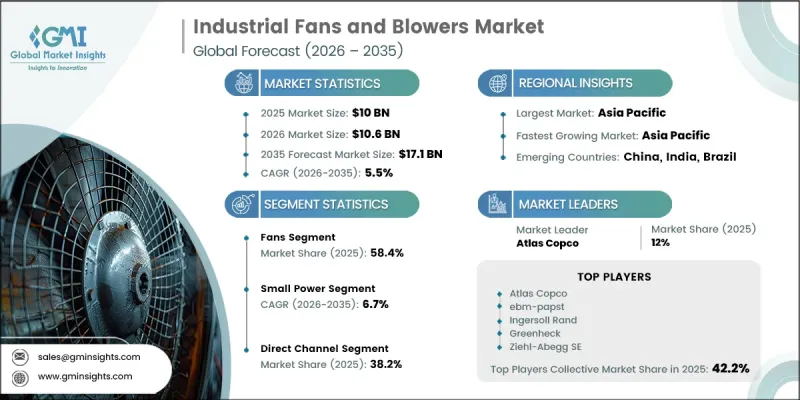
시장의 성장은 산업 인프라에 대한 투자 확대, 생산 시설의 현대화 진전, 그리고 에너지 효율이 뛰어난 공기 이동 솔루션에 대한 관심 증가에 힘입어 이루어지고 있습니다. 다양한 업종의 제조사들은 업무 효율 향상, 공정 성능 최적화, 그리고 에너지 소비량 감축을 도모하기 위해 첨단 환기, 냉각 및 공기 처리 시스템에 대한 투자를 확대하고 있습니다. 전자 정류 모터 기술로의 전환이 진행되고 있으며, 지능형 모니터링 플랫폼의 통합이 확대되고 있는 점도 업계 상황을 더욱 변화시키고 있습니다. 신흥 국가에서의 산업 활동 확대는 기류 제어 장비에 대한 막대한 수요를 지속적으로 창출하고 있는 반면, 성숙한 시장에서는 더욱 엄격해진 효율 기준을 충족하기 위해 기존 시스템의 업그레이드에 주력하는 경향이 강해지고 있습니다. 제조 시설의 확장, 디지털 인프라 프로젝트, 그리고 대규모 가공 업무의 확대에 힘입어 산업용 팬 및 송풍기에 대한 장기적인 수요가 지원되고 있습니다. 동시에, 자동화된 생산 환경이나 첨단 산업 시설에서 소형 열 관리 솔루션의 도입이 확대되면서 제조업체들에게 새로운 비즈니스 기회가 창출되고 있습니다. 견고한 성장 전망이 있는 반면, 맞춤형 산업용 환기 시스템은 초기 투자 비용이 높기 때문에 특히 설비의 즉각적인 업그레이드보다 유지보수 최적화를 우선시하는 업계에서는 교체 주기가 길어질 가능성이 있습니다.
| 시장 범위 | |
|---|---|
| 시작연도 | 2025년 |
| 예측 기간 | 2026-2035년 |
| 시작 금액 | 100억 달러 |
| 예측 금액 | 171억 달러 |
| CAGR | 5.5% |
2025년, 팬 부문은 58.4%의 점유율을 차지했습니다. 이러한 선도적인 위상은 효율적인 기류, 냉각, 환기 및 공정 지원 기능이 필수적인 수많은 산업 분야에서 폭넓게 채택되고 있는 데서 비롯됩니다. 팬 시스템은 그 범용성과 신뢰성, 그리고 다양한 기류 및 압력 요구 사항에 대응할 수 있는 능력 덕분에 산업 시설 전반에 걸쳐 널리 사용되고 있습니다. 산업의 현대화 및 에너지 효율이 높은 운영에 대한 지속적인 투자가 예측 기간 중 이 부문의 지속적인 성장을 지원할 것으로 예상됩니다.
저출력 부문은 2025년에 22.8%의 시장 점유율을 차지할 것으로 예상되며, 2035년까지 연평균 성장률(CAGR) 6.7%로 성장할 것으로 전망됩니다. 기술적으로 고도로 발전된 산업 환경에서 소형 기류 솔루션에 대한 수요가 증가함에 따라 이 부문의 성장이 주도되고 있습니다. 정밀한 풍량 제어, 에너지 효율, 저소음 및 자동화된 시설 관리 시스템과의 호환성이 요구되는 용도가 수요를 점점 더 견인하고 있습니다. 산업 운영의 자동화와 디지털 연결이 진전됨에 따라 고효율 소출력 환기 설비에 대한 수요는 계속해서 증가하고 있으며, 이는 해당 부문의 견고한 장기 성장 전망을 지원하고 있습니다.
2025년, 북미의 산업용 팬·블로어 시장은 34%의 점유율을 차지하며, 미국은 매출과 설치 대수 양면에서 가장 큰 국내 시장이 되었습니다. 이 지역의 성장은 산업의 현대화, 에너지 효율화 노력, 그리고 시설 최적화 프로그램에 대한 지속적인 투자를 통해 이끌리고 있습니다. 각 조직이 운영 비용 절감과 시스템 성능 향상에 점점 더 주력하고 있는 가운데, 제조, 가공, 인프라 및 산업 운영 등 각 분야에서 수요는 계속해서 견고한 양상을 보이고 있습니다. 첨단 기류 관리 기술의 도입 확대와 지속가능성에 대한 관심 증대가 해당 지역 전체 시장의 지속적인 성장을 지원할 것으로 예상됩니다.
자주 묻는 질문
목차
제1장 조사 방법
제2장 개요
제3장 업계 인사이트
제4장 경쟁 구도
제5장 시장 추산·예측 : 제품 유형별, 2022-2035년
제6장 시장 추산·예측 : 출력별, 2022-2035년
제7장 시장 추산·예측 : 용도별, 2022-2035년
제8장 시장 추산·예측 : 최종사용자별, 2022-2035년
제9장 시장 추산·예측 : 유통 채널별, 2022-2035년
제10장 시장 추산·예측 : 지역별, 2022-2035년
제11장 기업 개요
KSA 26.07.21The Global Industrial Fans and Blowers Market was valued at USD 10 billion in 2025 and is estimated to grow at a CAGR of 5.5% to reach USD 17.1 billion by 2035.
Market growth is supported by rising investments in industrial infrastructure, increasing modernization of production facilities, and growing emphasis on energy-efficient air movement solutions. Manufacturers across multiple industries are investing in advanced ventilation, cooling, and air-handling systems to improve operational efficiency, optimize process performance, and reduce energy consumption. The ongoing transition toward electronically commutated motor technologies and the integration of intelligent monitoring platforms are further transforming the industry landscape. Growing industrial activity in emerging economies continues to create substantial demand for airflow management equipment, while mature markets are increasingly focused on upgrading existing systems to meet stricter efficiency standards. Expansion of manufacturing facilities, digital infrastructure projects, and large-scale processing operations is sustaining long-term demand for industrial fans and blowers. At the same time, increasing adoption of compact thermal management solutions within automated production environments and advanced industrial facilities is creating new opportunities for manufacturers. Despite strong growth prospects, higher upfront investment requirements for customized industrial ventilation systems can extend replacement cycles, particularly in industries that prioritize maintenance optimization over immediate equipment upgrades.
| Market Scope | |
|---|---|
| Start Year | 2025 |
| Forecast Year | 2026-2035 |
| Start Value | $10 Billion |
| Forecast Value | $17.1 Billion |
| CAGR | 5.5% |
The fans segment held 58.4% share in 2025. Its leadership position is supported by widespread adoption across numerous industrial applications where efficient airflow, cooling, ventilation, and process support functions are essential. Fan systems are extensively utilized throughout industrial facilities due to their versatility, reliability, and ability to meet varying airflow and pressure requirements. Continued investments in industrial modernization and energy-efficient operations are expected to support sustained growth for this segment over the forecast period.
The small power segment accounted for 22.8% share in 2025 and is projected to grow at a CAGR of 6.7% through 2035. Rising demand for compact airflow solutions across technologically advanced industrial environments is a key factor driving segment expansion. Applications requiring precise airflow control, energy efficiency, reduced noise levels, and compatibility with automated facility management systems are increasingly contributing to demand. As industrial operations become more automated and digitally connected, the need for highly efficient small-power ventilation equipment continues to increase, supporting strong long-term growth prospects for the segment.
North America Industrial Fans and Blowers Market accounted for 34% share in 2025, with the United States representing the largest national market in terms of both revenue generation and installed equipment base. Regional growth is being driven by continued investment in industrial modernization, energy efficiency initiatives, and facility optimization programs. Demand remains strong across manufacturing, processing, infrastructure, and industrial operations as organizations increasingly focus on reducing operating costs and improving system performance. Growing adoption of advanced airflow management technologies and increasing emphasis on sustainability are expected to support continued market expansion throughout the region.
Major companies operating in the global industrial fans and blowers market include Systemair AB, Howden Group, Atlas Copco, Greenheck Fan Corporation, Ingersoll Rand, Aerzen GmbH, Soler & Palau (S&P) Ventilation Group, TLT-Turbo GmbH, Ziehl-Abegg SE, ebm-papst GmbH & Co. KG, New York Blower Company, Twin City Fan Companies Ltd., Rosenberg Ventilatoren GmbH, Robinson Fans Inc., Nicotra Gebhardt, SPX Technologies / EAM Division, Samsung Electronics Company, CG Power and Industrial Solutions Ltd., Shenyang Blower Works Group Corporation, and AirPro Fan & Blower Company. Companies operating in the industrial fans and blowers market are adopting a variety of strategic initiatives to strengthen their market position and expand their global reach. Product innovation remains a primary focus, with manufacturers investing heavily in energy-efficient technologies, intelligent control systems, and advanced motor solutions to meet evolving customer requirements. Many companies are integrating digital monitoring capabilities, predictive maintenance technologies, and IoT-enabled features into their product portfolios to improve performance and reduce operating costs for end users. Strategic partnerships, acquisitions, and regional expansion efforts are helping organizations broaden their customer base and strengthen distribution networks.
Table of Contents
Chapter 1 Research Methodology
- 1.1 Research approach
- 1.2 Quality Commitments
- 1.2.1 GMI AI policy & data integrity commitment
- 1.2.1.1 Source consistency protocol
- 1.2.1 GMI AI policy & data integrity commitment
- 1.3 Research Trail & Confidence Scoring
- 1.3.1 Research Trail Components
- 1.3.2 Scoring Components
- 1.4 Data Collection
- 1.4.1 Partial list of primary sources
- 1.5 Data mining sources
- 1.5.1 Paid sources
- 1.5.1.1 Sources, by region
- 1.5.1 Paid sources
- 1.6 Base estimates and calculations
- 1.6.1 Base year calculation for any one approach
- 1.7 Forecast model
- 1.7.1 Quantified market impact analysis
- 1.7.1.1 Mathematical impact of growth parameters on forecast
- 1.7.1 Quantified market impact analysis
- 1.8 Research transparency addendum
- 1.8.1 Source attribution framework
- 1.8.2 Quality assurance metrics
- 1.8.3 Our commitment to trust
Chapter 2 Executive Summary
- 2.1 Industry 360° synopsis, 2022 - 2035
- 2.2 Key market trends
- 2.2.1 Regional
- 2.2.2 Product type
- 2.2.3 Power
- 2.2.4 End Use
- 2.2.5 Application
- 2.2.6 Distribution Channel
Chapter 3 Industry Insights
- 3.1 Industry ecosystem analysis
- 3.1.1 Factor affecting the value chain
- 3.1.2 Profit margin analysis
- 3.1.3 Disruptions
- 3.1.4 Future outlook
- 3.1.5 Manufacturers
- 3.1.6 Distributors
- 3.2 Supplier landscape
- 3.3 Key news & initiatives
- 3.4 Technology & Innovation Landscape
- 3.5 Regulatory landscape
- 3.6 Impact on forces
- 3.6.1 Growth drivers
- 3.6.2 Industry pitfalls & challenges
- 3.6.3 Opportunities
- 3.7 Porter’s analysis
- 3.8 PESTEL analysis
- 3.9 Pricing analysis (driven by primary research)
- 3.9.1 Historical Price Trend Analysis, 2019-2024 (Driven by Primary Research)
- 3.9.2 Pricing Strategy by Player Type (Driven by Primary Research)
- 3.10 Trade data analysis (driven by paid database)
- 3.10.1 Import/Export Volume & Value Trends (HS Code 8414) (Driven by Primary Research)
- 3.10.2 Key Trade Corridors & Tariff Impact (Driven by Primary Research)
- 3.11 Impact of AI & Generative AI on the Industrial Fans & Blowers Market
- 3.11.1 AI-Driven Disruption of Existing Business Models
- 3.11.2 GenAI Use Cases & Adoption Roadmap by Segment
- 3.11.3 Risks, Limitations & Regulatory Considerations
- 3.12 Capacity & Production Landscape (Driven by Primary Research)
- 3.12.1 Manufacturing Capacity Installed by Region & Key Producer (Driven by Primary Research)
- 3.12.2 Capacity Utilization Rates & Expansion Pipelines
Chapter 4 Competitive Landscape, 2025
- 4.1 Introduction
- 4.2 Company market share analysis
- 4.3 Competitive positioning matrix
- 4.4 Strategic outlook matrix
- 4.5 Competitive analysis of major market players
- 4.6 Key developments
- 4.6.1 Mergers & acquisitions
- 4.6.2 Partnerships & collaborations
- 4.6.3 New product launches
- 4.6.4 Expansion plans
Chapter 5 Market Estimates and Forecast, By Product type, 2022 - 2035 (USD Billion, Thousand Units)
- 5.1 Key trends
- 5.2 Fans
- 5.2.1 Axial Fans
- 5.2.1.1 Propeller Fans
- 5.2.1.2 Tube Axial Fans
- 5.2.1.3 Vane Axial Fans
- 5.2.2 Centrifugal Fans
- 5.2.2.1 Forward-Curved Blade Fans
- 5.2.2.2 Backward-Curved / Backward-Inclined Blade Fans
- 5.2.2.3 Radial Blade Fans
- 5.2.3 Mixed Flow Fans
- 5.2.4 Cross Flow Fans
- 5.2.1 Axial Fans
- 5.3 Blowers
- 5.3.1 Centrifugal Blowers
- 5.3.2 Positive Displacement Blowers
- 5.3.2.1 Roots / Lobe Blowers
- 5.3.2.2 Screw Blowers
- 5.3.2.3 Sliding Vane Blowers
Chapter 6 Market Estimates and Forecast, By Power, 2022 - 2035 (USD Billion, Thousand Units)
- 6.1 Key trends
- 6.2 Up to 5 kW (Small Capacity)
- 6.3 5 kW - 100 kW (Medium Capacity)
- 6.4 100 kW - 500 kW (Large Capacity)
- 6.5 Above 500 kW (Heavy Industrial / Mission-Critical)
Chapter 7 Market Estimates and Forecast, By Application, 2022 - 2035 (USD Billion, Thousand Units)
- 7.1 Key trends
- 7.2 HVAC & Ventilation
- 7.2.1 Commercial Buildings
- 7.2.2 Industrial Facilities
- 7.2.3 Data Centers & Clean Rooms
- 7.3 Power Generation
- 7.3.1 Thermal Power
- 7.3.2 Nuclear power
- 7.3.3 Renewable Energy
- 7.4 Oil, Gas & Petrochemical
- 7.4.1 Upstream
- 7.4.2 Midstream
- 7.4.3 Downstream
- 7.5 Mining & Minerals Processing
- 7.5.1 Underground Mine Ventilation & Cooling
- 7.5.2 Surface Mining & Minerals Processing
- 7.6 Chemical Processing
- 7.7 Water & Waste water Treatment
- 7.8 Cement & Construction Materials
- 7.9 Food & Beverage
- 7.10 Pulp, Paper & Printing
- 7.11 Others (Textile, Rubber, Plastics, Agriculture)
Chapter 8 Market Estimates and Forecast, By End User, 2022 - 2035 (USD Billion, Thousand Units)
- 8.1 Key trends
- 8.2 Industrial
- 8.2.1 Heavy Industry - Steel, Aluminum, Metals
- 8.2.2 Process Industry - Chemical, Pharma, Food Production
- 8.2.3 Energy & Utilities - Power Plants, Refineries, LNG Terminals
- 8.3 Commercial
- 8.3.1 Office and retail buildings
- 8.3.2 Hospitality and healthcare facilities
- 8.4 Municipality and infrastructure
- 8.4.1 Waste water treatment plant
- 8.4.2 Tunnel, subway and public infrastructure
Chapter 9 Market Estimates and Forecast, By Distribution Channel, 2022 - 2035 (USD Billion, Thousand Units)
- 9.1 Key trends
- 9.2 Direct
- 9.3 Indirect
Chapter 10 Market Estimates & Forecast, By Region, 2022 - 2035, (USD Billion, Thousand Units)
- 10.1 Key trends
- 10.2 North America
- 10.2.1 U.S.
- 10.2.2 Canada
- 10.3 Europe
- 10.3.1 Germany
- 10.3.2 U.K.
- 10.3.3 France
- 10.3.4 Italy
- 10.3.5 Spain
- 10.4 Asia Pacific
- 10.4.1 China
- 10.4.2 India
- 10.4.3 Japan
- 10.4.4 South Korea
- 10.4.5 Australia
- 10.5 Latin America
- 10.5.1 Brazil
- 10.5.2 Mexico
- 10.5.3 Argentina
- 10.6 MEA
- 10.6.1 UAE
- 10.6.2 Saudi Arabia
- 10.6.3 South Africa
Chapter 11 Company Profiles
- 11.1 Global players
- 11.1.1 ebm-papst GmbH & Co. KG
- 11.1.2 Greenheck Fan Corporation
- 11.1.3 Soler & Palau (S&P) Ventilation Group
- 11.1.4 Ziehl-Abegg SE
- 11.1.5 Systemair AB
- 11.1.6 Howden Group
- 11.1.7 Ingersoll Rand
- 11.1.8 Samsung Electronics company
- 11.2 Regional players
- 11.2.1 Atlas Copco
- 11.2.2 Aerzen GmbH
- 11.2.3 SPX Technologies / EAM Division
- 11.2.4 Twin City Fan Companies Ltd.
- 11.2.5 TLT-Turbo GmbH
- 11.2.6 Nicotra Gebhardt
- 11.2.7 New York Blower Company
- 11.2.8 CG Power and Industrial Solutions
- 11.3 Emerging players
- 11.3.1 Shenyang Blower Works Group Corporation
- 11.3.2 Robinson Fans Inc.
- 11.3.3 AirPro Fan & Blower Company
- 11.3.4 Rosenberg Ventilatoren GmbH


