

|
시장보고서
상품코드
2083386
의료 영상용 인공지능 시장 기회, 성장 촉진요인, 업계 동향 분석 및 예측(2026-2035년)Artificial Intelligence in Medical Imaging Market Opportunity, Growth Drivers, Industry Trend Analysis, and Forecast 2026 - 2035 |
||||||

세계의 의료 영상용 AI 시장은 2025년에 21억 달러로 평가되어 23.9%의 CAGR로 확대하며, 2035년까지 196억 달러에 달할 것으로 추정되고 있습니다.
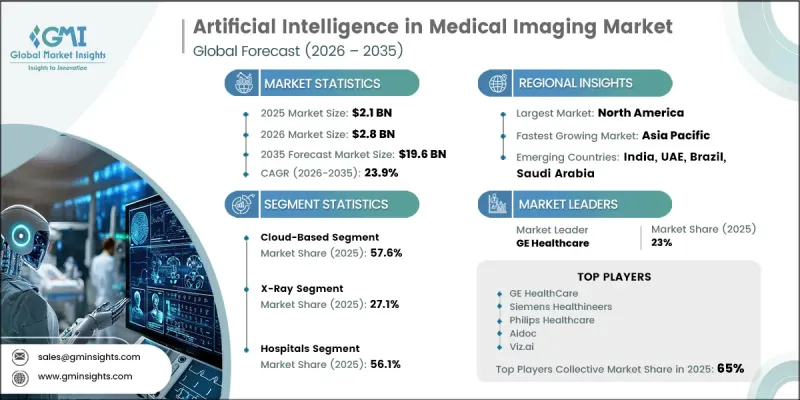
딥러닝 기술이 임상 영상 진단 워크플로우에 깊이 통합됨에 따라 시장은 급속한 변화를 겪고 있으며, 진단 정확도와 업무 효율이 크게 향상되고 있습니다. AI를 활용한 영상 진단 솔루션은 암, 신경학, 심장학 등 각 분야에서 질환의 조기 발견을 지원하고, 진단 해석의 편차를 줄이며, 치료 계획 수립을 강화하기 위해 점점 더 널리 활용되고 있습니다. 임상 검증 연구 및 동료 심사를 거친 연구를 통해 첨단 알고리즘이 여러 영상 모달리티에서 경험이 풍부한 영상의학과 전문의에 필적하는 진단 성능을 달성할 수 있음이 지속적으로 입증되고 있습니다. AI 기반 진단 툴에 대한 규제 당국의 승인이 확대됨에 따라 병원내 도입이 가속화되고 있으며, 주요 의료 시스템에서의 보험 적용 범위도 확대되고 있습니다. 이와 더불어 의료 기술 제공업체, 영상 진단 기기 제조사, 학술기관 및 초기 단계의 혁신 기업으로부터의 투자가 증가함에 따라 제품 개발 주기가 가속화되고 응용 분야도 확대되고 있습니다. 국립 생의학 기관의 자금 지원 구상을 포함한 공공 부문의 연구 지원은 영상 재구성, 심장 진단 및 다중 모달 데이터 통합 분야의 혁신을 지속적으로 촉진하고 있습니다. 의료 시스템이 정밀 의료와 효율성을 우선시하는 가운데, AI를 활용한 영상 진단은 전 세계 시장에서 현대 진단 인프라의 핵심 요소로 자리매김하고 있습니다.
| 시장 범위 | |
|---|---|
| 시작연도 | 2025년 |
| 예측 기간 | 2026-2035년 |
| 시작 금액 | 21억 달러 |
| 예측 금액 | 196억 달러 |
| CAGR | 23.9% |
2025년에는 클라우드 기반 도입 부문이 시장 점유율의 57.6%를 차지했습니다. 클라우드 인프라는 알고리즘의 신속한 도입, 확장 가능한 연산 능력, 원활한 소프트웨어 업데이트, 초기 투자 비용 절감 등의 장점 덕분에 점점 더 선호되고 있습니다. 이러한 장점 덕분에 클라우드 기반 솔루션은 대규모 온프레미스형 컴퓨팅 시스템을 갖추지 않은 의료 시설에 특히 적합하며, 다양한 의료 환경에서 보다 광범위한 도입을 가능하게 하고 있습니다.
2025년에는 병원 부문이 56.1%의 점유율을 차지했습니다. 병원은 첨단 영상 진단 인프라, 많은 환자 수, 그리고 디지털 헬스 분야에 대한 투자에 대한 조직적인 역량이 뛰어나기 때문에 여전히 주요 최종사용자 환경으로 자리 잡고 있습니다. 대규모 의료 네트워크와 대학병원은 기업급 AI 영상 진단 시스템의 초기 도입처이며, 이곳에서는 뛰어난 영상 처리 능력을 바탕으로 통합, 라이선싱, 워크플로우 혁신에 드는 비용이 정당화되고 있습니다.
2025년, 북미 의료 영상 분야의 AI 시장은 43.8%의 점유율을 차지하며, 지역별로는 가장 높은 점유율을 유지했습니다. 이 지역의 선도적 지위는 규제 당국의 승인을 받은 AI 영상 솔루션의 광범위한 도입, 병원의 적극적인 IT 투자, 그리고 진단 정확도와 업무 효율성을 우선시하는 확립된 보상 제도에 의해 지원되고 있습니다. 이 지역의 수익 대부분은 미국이 차지하고 있지만, 캐나다에서는 첨단 임상 영상 기술에 중점을 둔 국가 차원의 디지털 헬스 구상을 통해 도입이 지속적으로 확대되고 있습니다.
자주 묻는 질문
목차
제1장 조사 방법과 범위
제2장 개요
제3장 업계 인사이트
제4장 경쟁 구도
제5장 시장 추산·예측 : 배포별, 2022-2035년
제6장 시장 추산·예측 : 모달리티별, 2022-2035년
제7장 시장 추산·예측 : 적응증별, 2022-2035년
제8장 시장 추산·예측 : 용도별, 2022-2035년
제9장 시장 추산·예측 : 최종 용도별, 2022-2035년
제10장 시장 추산·예측 : 지역별, 2022-2035년
제11장 기업 개요
KSA 26.07.21The Global AI in Medical Imaging Market was valued at USD 2.1 billion in 2025 and is estimated to grow at a CAGR of 23.9% to reach USD 19.6 billion by 2035.
The market is undergoing rapid transformation as deep learning technologies become deeply embedded into clinical imaging workflows, significantly improving diagnostic accuracy and operational efficiency. AI-enabled imaging solutions are increasingly being used to support early disease identification, reduce variability in diagnostic interpretation, and enhance treatment planning across oncology, neurology, and cardiology applications. Clinical validation studies and peer-reviewed research continue to demonstrate that advanced algorithms can achieve diagnostic performance levels comparable to experienced radiologists across multiple imaging modalities. Growing regulatory acceptance of AI-based diagnostic tools is accelerating hospital adoption and expanding reimbursement pathways in major healthcare systems. In parallel, rising investments from healthcare technology providers, imaging equipment manufacturers, academic institutions, and early-stage innovators are accelerating product development cycles and broadening application areas. Public sector research support, including funding initiatives from national biomedical agencies, continues to advance innovation in imaging reconstruction, cardiac diagnostics, and multi-modal data integration. As healthcare systems prioritize precision medicine and efficiency, AI-based imaging is becoming a core component of modern diagnostic infrastructure across global markets.
| Market Scope | |
|---|---|
| Start Year | 2025 |
| Forecast Year | 2026-2035 |
| Start Value | $2.1 Billion |
| Forecast Value | $19.6 Billion |
| CAGR | 23.9% |
The cloud-based deployment segment accounted for 57.6% share in 2025. Cloud infrastructure is increasingly preferred due to its ability to support rapid algorithm deployment, scalable computing power, seamless software updates, and reduced upfront capital requirements. These advantages make cloud-based solutions especially suitable for healthcare facilities that lack large-scale on-premise computing systems, enabling broader adoption across diverse healthcare environments.
The hospital segment held a 56.1% share in 2025. Hospitals remain the primary end-use setting due to their advanced imaging infrastructure, high patient volumes, and strong institutional capacity for digital health investments. Large healthcare networks and academic medical centers are among the earliest adopters of enterprise-scale AI imaging systems, where high imaging throughput justifies the cost of integration, licensing, and workflow transformation.
North America AI in Medical Imaging Market accounted for 43.8% share in 2025, maintaining the largest regional share. The region's leadership is supported by widespread deployment of regulatory-cleared AI imaging solutions, strong hospital IT investment, and established reimbursement structures that prioritize diagnostic accuracy and operational efficiency. The United States represents most regional revenue, while Canada continues to expand adoption through national-level digital health initiatives focused on advanced clinical imaging technologies.
Major companies operating in the global AI in medical imaging market include Philips Healthcare, GE HealthCare, Siemens Healthineers, Fujifilm Holdings, Canon Medical Systems, Aidoc, Viz.ai, Qure.ai, Lunit, RapidAI, Annalise.ai, Subtle Medical, Tempus Radiology, Rad AI, and Cleerly Inc. Companies in the AI in medical imaging market are strengthening their market position through continuous advancement of AI algorithms, expansion of clinical validation studies, and integration of solutions into existing hospital imaging workflows. Many players are prioritizing partnerships with hospitals, academic institutions, and healthcare networks to accelerate real-world deployment and improve algorithm training using large-scale imaging datasets. Strategic collaborations with medical device manufacturers and cloud service providers are enabling scalable and interoperable platforms. Companies are also focusing on regulatory approvals across multiple regions to expand commercialization opportunities.
Table of Contents
Chapter 1 Methodology & Scope
- 1.1 Market scope and definitions
- 1.2 Research approach
- 1.3 Quality commitments
- 1.3.1 GMI AI policy & data integrity commitment
- 1.3.1.1 Source consistency protocol
- 1.3.1 GMI AI policy & data integrity commitment
- 1.4 Research trail & confidence scoring
- 1.4.1 Research trail components
- 1.4.2 Scoring components
- 1.5 Data collection
- 1.5.1 Partial list of primary sources
- 1.6 Data mining sources
- 1.6.1 Paid sources
- 1.6.1.1 Sources, by region
- 1.6.1 Paid sources
- 1.7 Base estimates and calculations
- 1.7.1 Base year calculation for any one approach
- 1.8 Forecast model
- 1.8.1 Quantified market impact analysis
- 1.8.1.1 Mathematical impact of growth parameters on forecast
- 1.8.1 Quantified market impact analysis
- 1.9 Research transparency addendum
- 1.9.1 Source attribution framework
- 1.9.2 Quality assurance metrics
- 1.9.3 Our commitment to trust
Chapter 2 Executive Summary
- 2.1 Industry 3600 synopsis
- 2.1.1 Business trends
- 2.1.2 Deployment trends
- 2.1.3 Modality trends
- 2.1.4 Indication trends
- 2.1.5 Application trends
- 2.1.6 End use trends
- 2.1.7 Regional trends
- 2.2 CXO perspectives: Strategic imperatives
Chapter 3 Industry Insights
- 3.1 Industry ecosystem analysis
- 3.2 Industry impact forces
- 3.2.1 Growth drivers
- 3.2.1.1 Technological advancements in AI
- 3.2.1.2 Shortage of radiologists accelerating the AI adoption
- 3.2.1.3 Improved diagnostic accuracy and treatment planning
- 3.2.1.4 Rising R&D investment supporting innovation and market expansion
- 3.2.2 Industry pitfalls and challenges
- 3.2.2.1 Slow regulatory approval process
- 3.2.2.2 Risk of patient safety concerns due to AI-driven diagnostic errors
- 3.2.3 Market opportunities
- 3.2.3.1 Expansion of AI-enabled population screening and preventive healthcare
- 3.2.3.2 Integration of AI imaging platforms with multimodal clinical data ecosystems
- 3.2.1 Growth drivers
- 3.3 Growth potential analysis
- 3.4 Technology and innovation landscape
- 3.4.1 Current technological trends
- 3.4.2 Emerging technologies
- 3.5 Pricing trend analysis (Driven by primary research)
- 3.6 Regulatory landscape (Driven by primary research)
- 3.6.1 North America
- 3.6.2 Europe
- 3.6.3 Asia Pacific
- 3.6.4 Latin America
- 3.6.5 MEA
- 3.7 Porter's analysis
- 3.8 PESTEL analysis
- 3.9 Future market trends
- 3.10 Impact of AI and Generative AI on the market (Driven by primary research)
- 3.11 Investment & funding analysis (Driven by primary research)
- 3.12 PACS integration
- 3.12.1 PACS-based AI integration into radiology systems
- 3.12.2 AI-driven workflow optimization and reporting efficiency
- 3.13 FDA-Cleared AI landscape
- 3.13.1 Expansion of FDA-cleared AI imaging solutions
- 3.13.2 Increasing approvals driving market adoption
- 3.14 Reimbursement landscape
- 3.14.1 AI reimbursement trends and adoption drivers
- 3.14.2 CMS reimbursement pathways supporting AI imaging
- 3.14.3 NTAP approvals enabling adoption in critical imaging applications
Chapter 4 Competitive Landscape, 2025
- 4.1 Introduction
- 4.2 Company market share analysis (Driven by primary research)
- 4.2.1 North America
- 4.2.2 Europe
- 4.2.3 Asia Pacific
- 4.3 Company matrix analysis
- 4.4 Competitive analysis of major market players
- 4.5 Competitive positioning matrix
- 4.6 Key developments
- 4.6.1 Merger and acquisition
- 4.6.2 Partnership and collaboration
- 4.6.3 New product launches
- 4.6.4 Expansion plans
Chapter 5 Market Estimates and Forecast, By Deployment, 2022 - 2035 ($ Mn)
- 5.1 Key trends
- 5.2 Cloud-based
- 5.3 On-premises
Chapter 6 Market Estimates and Forecast, By Modality, 2022 - 2035 ($ Mn)
- 6.1 Key trends
- 6.2 X-ray
- 6.3 Computed tomography (CT)
- 6.4 Magnetic Resonance Imaging (MRI)
- 6.5 Ultrasound imaging
- 6.6 Molecular imaging
- 6.7 Nuclear imaging
- 6.8 Other modalities
Chapter 7 Market Estimates and Forecast, By Indication, 2022 - 2035 ($ Mn)
- 7.1 Key trends
- 7.2 Breast imaging
- 7.3 Lung imaging
- 7.4 Neurology
- 7.5 Cardiovascular applications
- 7.6 Liver imaging
- 7.7 Orthopedics
- 7.8 Other indications
Chapter 8 Market Estimates and Forecast, By Application, 2022 - 2035 ($ Mn)
- 8.1 Key trends
- 8.2 Diagnostic decision support
- 8.3 Radiation therapy planning
- 8.4 Surgical & interventional planning
- 8.5 Longitudinal disease monitoring
- 8.6 Clinical research & trials
- 8.7 Other applications
Chapter 9 Market Estimates and Forecast, By End Use, 2022 - 2035 ($ Mn)
- 9.1 Key trends
- 9.2 Hospitals
- 9.3 Clinics
- 9.4 Diagnostic centers
- 9.5 Other end users
Chapter 10 Market Estimates and Forecast, By Region, 2022 - 2035 ($ Mn)
- 10.1 Key trends
- 10.2 North America
- 10.2.1 U.S.
- 10.2.2 Canada
- 10.3 Europe
- 10.3.1 Germany
- 10.3.2 France
- 10.3.3 UK
- 10.3.4 Spain
- 10.3.5 Italy
- 10.3.6 Netherlands
- 10.4 Asia Pacific
- 10.4.1 China
- 10.4.2 Japan
- 10.4.3 India
- 10.4.4 Australia
- 10.4.5 South Korea
- 10.5 Latin America
- 10.5.1 Brazil
- 10.5.2 Mexico
- 10.5.3 Argentina
- 10.6 Middle East & Africa
- 10.6.1 Saudi Arabia
- 10.6.2 South Africa
- 10.6.3 UAE
Chapter 11 Company Profiles
- 11.1 GE HealthCare
- 11.2 Siemens Healthineers
- 11.3 Philips Healthcare
- 11.4 Canon Medical Systems
- 11.5 Fujifilm Holdings
- 11.6 Aidoc
- 11.7 Viz.ai
- 11.8 RapidAI
- 11.9 Tempus Radiology
- 11.10 Lunit
- 11.11 Qure.ai
- 11.12 Annalise.ai
- 11.13 Subtle Medical
- 11.14 Rad AI
- 11.15 Cleerly


