

|
시장보고서
상품코드
2101593
자동차 재활용 시장 기회, 성장요인, 업계 동향 분석 및 예측(2026-2035년)Vehicle Recycling Market Opportunity, Growth Drivers, Industry Trend Analysis, and Forecast 2026 - 2035 |
||||||

세계의 자동차 재활용 시장은 2025년에 888억 달러 규모에 달하며, CAGR 6.1%로 성장하며, 2035년까지 1,564억 달러에 달할 것으로 추정되고 있습니다.
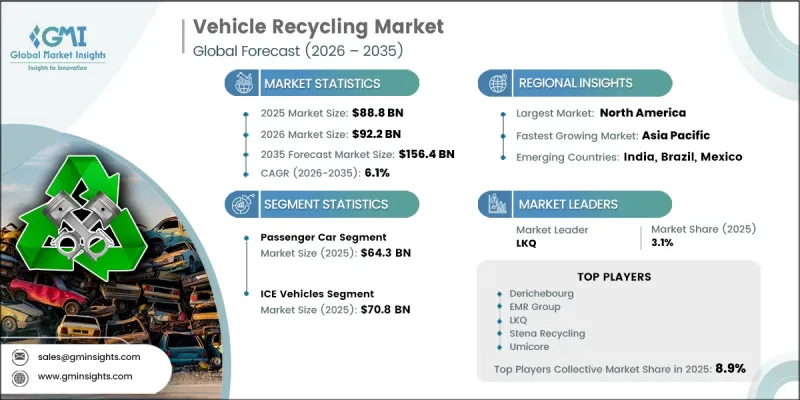
자동차 재활용 업계 전반의 성장은 폐차(ELV)에 관한 규제 강화, 전기자동차의 보급 확대, 그리고 제조 업계에서 회수된 철금속 및 비철금속에 대한 수요 증가에 힘입고 있습니다. 전기자동차 보유 대수가 지속적으로 확대되고 있는 것은 귀중한 배터리 소재를 회수할 새로운 기회를 창출하며, 재활용 업체에게 중요한 수입원이 되고 있습니다. 각국 정부가 폐차 처리 및 자원 회수에 관한 요건을 지속적으로 강화하고 있는 만큼, 규제적 노력은 전 세계에서 체계적인 자동차 재활용 사업 전개를 지원하는 가장 강력한 요인 중 하나로 남아 있습니다. 2022년 이후, 중요 광물 재활용에 초점을 맞춘 30건 이상의 정책 조치가 전 세계에서 도입되어 보다 체계적인 재활용 관행으로의 전환이 촉진되고 있습니다. 이러한 긍정적인 추세에도 불구하고 비공식 재활용 사업의 존재로 인해 일부 지역에서는 조직적인 시장 진입 기업의 확장이 여전히 제한되고 있습니다. 비공식 재활용 업체들은 대개 규정 준수 비용이 낮게 유지되므로 고철 재료나 재사용 가능한 자동차 부품에 대해 더 경쟁력 있는 가격을 제시할 수 있습니다. 환경 기준이 지속적으로 발전하고 재활용 자재에 대한 수요가 증가함에 따라 전 세계 자동차 재활용 시장은 공식적인 재활용 인프라에 대한 투자 확대와 자원 회수 능력 향상으로 인해 혜택을 볼 것으로 예상됩니다.
| 시장 범위 | |
|---|---|
| 시작연도 | 2025년 |
| 예측 기간 | 2026-2035년 |
| 개시 금액 | 888억 달러 |
| 예측액 | 1,564억 달러 |
| CAGR | 6.1% |
승용차 부문은 72.4%의 점유율을 차지하며, 2025년에는 643억 달러 규모의 시장을 형성했습니다. 이 부문이 주도적인 위치를 유지하고 있는 이유는 승용차가 전 세계 운행 차량 중 가장 큰 점유율을 차지하고 있기 때문입니다. 또한 기존 소형 차량을 대상으로 확립된 해체 및 자재 회수 프로세스도 업무 효율 향상에 기여하고 있으며, 재활용 사업자가 대량의 차량을 처리하면서 자재 회수율을 극대화함으로써 부문 전체의 안정적인 수익 창출을 지원하고 있습니다.
내연기관 차량 부문은 2025년에 79.7%의 점유율을 차지하며 708억 달러에 달했습니다. 이러한 선도적 지위는 전 세계 차량 보유 대수에서 내연기관 차량이 여전히 압도적인 비율을 차지하고 있다는 점과, 기존 파워트레인을 위해 특별히 설계된 재활용 시스템의 성숙도를 반영합니다. 확립된 해체 공정, 최적화된 회수 작업, 그리고 효율적인 자재 분리가 내연기관 차량 재활용의 경제적 실현 가능성을 지속적으로 지원하고 있습니다. 또한 기존 처리 인프라 덕분에 재활용 사업자들은 귀중한 자동차 자재를 효율적으로 회수할 수 있게 되어, 시장 전체 수익에 대한 이 부문의 막대한 기여도를 더욱 공고히 하고 있습니다.
미국 자동차 재활용 시장은 2025년에 315억 달러에 달했습니다. 시장 성장은 세계 최대 규모의 노후화된 승용차 보유 대수에 의해 지속적으로 지원되고 있으며, 이는 처리 대상인 폐차의 안정적인 공급을 창출하고 있습니다. 미국의 잘 구축된 공식 재활용 인프라와 자동차 재활용 업체 및 금속 가공 시설 간의 견고한 협력 관계가 맞물려, 자재 회수 효율을 지속적으로 높이고 있으며, 이는 자동차 재활용 시장의 장기적인 확장을 지원하고 있습니다.
자주 묻는 질문
목차
제1장 조사 방법
제2장 개요
제3장 업계 인사이트
제4장 경쟁 구도
제5장 시장 추산·예측 : 차량별, 2022-2035년
제6장 시장 추산·예측 : 추진력별, 2022-2035년
제7장 시장 추산·예측 : 수입원별, 2022-2035년
제8장 시장 추산·예측 : 지역별, 2022-2035년
제9장 기업 개요
KSA 26.07.31The Global Vehicle Recycling Market was valued at USD 88.8 billion in 2025 and is estimated to grow at a CAGR of 6.1% to reach USD 156.4 billion by 2035.
Growth across the vehicle recycling industry is supported by increasingly stringent end-of-life vehicle (ELV) regulations, rising electric vehicle adoption, and stronger demand for recovered ferrous and non-ferrous metals from manufacturing industries. The continued expansion of electric vehicle fleets is creating new opportunities for recovering valuable battery materials, adding an important source of revenue for recyclers. Regulatory initiatives remain one of the strongest factors encouraging the development of organized vehicle recycling operations worldwide, as governments continue to strengthen requirements related to end-of-life vehicle processing and resource recovery. Since 2022, more than 30 policy measures focused on critical mineral recycling have been introduced globally, supporting the transition toward more structured recycling practices. Despite these favorable developments, the presence of informal recycling operations continues to limit the expansion of organized market participants in several regions. Informal recyclers often operate with lower compliance costs, allowing them to offer more competitive pricing for scrap materials and reusable vehicle components. As environmental standards continue to evolve and demand for recycled materials increases, the global vehicle recycling market is expected to benefit from greater investment in formal recycling infrastructure and improved resource recovery capabilities.
| Market Scope | |
|---|---|
| Start Year | 2025 |
| Forecast Year | 2026-2035 |
| Start Value | $88.8 Billion |
| Forecast Value | $156.4 Billion |
| CAGR | 6.1% |
The passenger car segment held 72.4% share, generating USD 64.3 billion in 2025. The segment maintains its leading position because passenger cars represent the largest share of vehicles in operation worldwide. Established dismantling and material recovery processes for conventional light vehicles also contribute to higher operational efficiency, enabling recyclers to process large volumes while maximizing material recovery and supporting consistent revenue generation across the segment.
The ICE vehicle segment represented 79.7% share in 2025, reaching USD 70.8 billion. This leadership reflects the continued dominance of internal combustion engine vehicles within the global vehicle fleet and the maturity of recycling systems designed specifically for conventional powertrains. Well-established dismantling processes, optimized recovery operations, and efficient material separation continue to support the economic viability of recycling ICE vehicles. The existing processing infrastructure also enables recyclers to recover valuable automotive materials efficiently, reinforcing the segment's substantial contribution to overall market revenue.
United States Vehicle Recycling Market reached USD 31.5 billion in 2025. Market growth continues to be supported by one of the world's largest populations of aging passenger vehicles, creating a consistent supply of end-of-life vehicles for processing. The country's well-developed formal recycling infrastructure, combined with strong integration between vehicle recyclers and metal processing facilities, continues to strengthen material recovery efficiency and support the long-term expansion of the vehicle recycling market.
Major companies operating in the global vehicle recycling market include LKQ Corporation, EMR Group, Stena Recycling, Derichebourg, Sims Limited, Toyota Tsusho, Umicore, Redwood Materials, Glencore Battery Recycling, INDRA Automobile Recycling, Galloo Group, Kuusakoski Group, Keiaisha, ASM Auto Recycling, Fenix Parts, IGAR Reciclagem, Rosmerta Recycling, Eccel Recycling, Autocirc, and CERO Recycling. Companies operating in the vehicle recycling market are strengthening their competitive position by expanding recycling capacity, investing in advanced material recovery technologies, and improving processing efficiency across dismantling operations. Many organizations continue to prioritize automation, digital tracking systems, and optimized sorting technologies to increase recovery rates and improve operational performance. Strategic investments in battery recycling capabilities, sustainable processing methods, and resource recovery infrastructure are helping companies capture new revenue opportunities while meeting evolving regulatory requirements. Businesses are also expanding partnerships across the automotive value chain to secure a stable supply of end-of-life vehicles and recyclable materials.
Table of Contents
Chapter 1 Methodology
- 1.1 Research approach
- 1.2 Quality Commitments
- 1.2.1 GMI AI policy & data integrity commitment
- 1.3 Research Trail & Confidence Scoring
- 1.3.1 Research Trail Components
- 1.3.2 Scoring Components
- 1.4 Data Collection
- 1.5 Data mining sources
- 1.5.1 Paid sources
- 1.6 Base estimates and calculations
- 1.6.1 Base year calculation
- 1.7 Forecast model
- 1.7.1 Quantified market impact analysis
- 1.8 Research transparency addendum
- 1.8.1 Source attribution framework
- 1.8.2 Quality assurance metrics
- 1.8.3 Our commitment to trust
Chapter 2 Executive Summary
- 2.1 Industry 360° synopsis
- 2.2 Key market trends
- 2.2.1 Regional
- 2.2.2 Vehicle
- 2.2.3 Propulsion
- 2.2.4 Revenue Stream
- 2.3 TAM analysis, 2026-2035
- 2.4 CXO perspectives: Strategic imperatives
Chapter 3 Industry Insights
- 3.1 Industry ecosystem analysis
- 3.1.1 Supplier landscape
- 3.1.2 Profit margin
- 3.1.3 Cost structure
- 3.1.4 Value addition at each stage
- 3.1.5 Factor affecting the value chain
- 3.1.6 Disruptions
- 3.2 Industry impact forces
- 3.2.1 Growth drivers
- 3.2.1.1 Stringent ELV Regulations & Recycling Targets Boosting Formal Sector Growth
- 3.2.1.2 Rising Demand for Secondary Raw Materials from Steel Mills, Battery Makers & OEMs
- 3.2.1.3 Rapid EV Growth Creating High-Value Battery Recovery Opportunities
- 3.2.1.4 Aging Global Vehicle Fleet Expanding End-of-Life Vehicle Volumes
- 3.2.2 Industry pitfalls and challenges
- 3.2.2.1 Competition from Informal & Unorganized Recycling Sectors
- 3.2.2.2 High Investment Needs for Advanced Sorting & EV Battery Processing Infrastructure
- 3.2.3 Market opportunities
- 3.2.3.1 Critical Mineral Recovery from EV Traction Batteries
- 3.2.3.2 EPR Frameworks Creating New Processing Fee Revenue Opportunities
- 3.2.1 Growth drivers
- 3.3 Technology and innovation landscape
- 3.3.1 Current technological trends
- 3.3.1.1 Mechanical Dismantling & Depollution Systems
- 3.3.1.2 Magnetic Separation Technology
- 3.3.2 Emerging technologies
- 3.3.2.1 AI-Based Robotic Vehicle Dismantling
- 3.3.2.2 Advanced EV Battery Recycling Technologies
- 3.3.1 Current technological trends
- 3.4 Growth potential analysis
- 3.5 Regulatory landscape
- 3.5.1 North America
- 3.5.1.1 US - U.S. Environmental Protection Agency (EPA)
- 3.5.1.2 Canada - Environment and Climate Change Canada (ECCC)
- 3.5.2 Europe
- 3.5.2.1 EU - European Commission (EC)
- 3.5.2.2 Germany - German Federal Environment Agency
- 3.5.3 Asia Pacific
- 3.5.3.1 China - Ministry of Ecology and Environment (MEE)
- 3.5.3.2 India - Ministry of Road Transport and Highways (MoRTH)
- 3.5.4 LATAM
- 3.5.4.1 Brazil - IBAMA
- 3.5.4.2 Chile - Ministerio del Medio Ambiente (MMA)
- 3.5.5 MEA
- 3.5.5.1 UAE - Environment Agency - Abu Dhabi (EAD)
- 3.5.5.2 Saudi Arabia - National Center for Environmental Compliance (NCEC)
- 3.5.1 North America
- 3.6 Porter's analysis
- 3.7 PESTEL analysis
- 3.8 Cost breakdown analysis
- 3.9 Patent analysis (Driven by Primary Research)
- 3.10 Scrap Collection Network Analysis
- 3.10.1 Regional Differences in Scrap Collection Networks
- 3.10.2 Role of Informal vs. Organized Scrap Collectors
- 3.10.3 Digitalization of Scrap Collection Networks
- 3.11 Evolution of the End-of-Life Vehicle (ELV) Ecosystem
- 3.11.1 Shift from Traditional Scrapping to Circular Economy Models
- 3.11.2 Impact of ELV Regulations and Policy Frameworks
- 3.11.3 Evolution of Vehicle Dismantling and Processing Technologies
- 3.11.4 Transformation Driven by Electric Vehicles (EVs)
- 3.12 Impact of AI & generative AI on the market
- 3.12.1 AI-driven disruption of existing business models
- 3.12.2 GenAI use cases & adoption roadmap by segment
- 3.12.3 Risks, limitations & regulatory considerations
- 3.13 Forecast assumptions & scenario analysis (Driven by Primary Research)
- 3.13.1 Base Case- Key Macro & Industry Variables Driving CAGR
- 3.13.2 Optimistic Scenarios- Favorable macro and industry tailwinds
- 3.13.3 Pessimistic Scenario - Macroeconomic slowdown or industry headwinds
Chapter 4 Competitive Landscape, 2025
- 4.1 Introduction
- 4.2 Company market share analysis
- 4.2.1 North America
- 4.2.2 Europe
- 4.2.3 Asia Pacific
- 4.2.4 LATAM
- 4.2.5 MEA
- 4.3 Competitive analysis of major market players
- 4.4 Competitive positioning matrix
- 4.5 Key developments
- 4.5.1 Mergers & acquisitions
- 4.5.2 Partnerships & collaborations
- 4.5.3 New product launches
- 4.5.4 Expansion plans and funding
- 4.6 Company tier benchmarking
- 4.6.1 Tier classification criteria & qualifying thresholds
- 4.6.2 Tier positioning matrix by revenue, geography & innovation
Chapter 5 Market Estimates and Forecast, By Vehicle, 2022 - 2035 ($ Mn)
- 5.1 Key trends
- 5.2 Passenger cars
- 5.2.1 SUV
- 5.2.2 Hatchback
- 5.2.3 Sedan
- 5.3 Commercial vehicles
- 5.3.1 Light Commercial Vehicles (LCV)
- 5.3.2 Medium Commercial Vehicles (MCV)
- 5.3.3 Heavy Commercial Vehicles (HCV)
- 5.4 Two-Wheelers
Chapter 6 Market Estimates and Forecast, By Propulsion, 2022 - 2035 ($ Mn)
- 6.1 Key trends
- 6.2 ICE
- 6.3 Electric & Hybrid
Chapter 7 Market Estimates and Forecast, By Revenue Stream, 2022 - 2035 ($ Mn)
- 7.1 Key trends
- 7.2 Ferrous Metal Recovery
- 7.2.1 Carbon Steel
- 7.2.2 Cast Iron
- 7.2.3 Stainless Steel
- 7.3 Non-Ferrous Metal Recovery
- 7.3.1 Aluminum
- 7.3.2 Copper
- 7.3.3 Lead
- 7.3.4 Zinc
- 7.3.5 Others
- 7.4 Reusable Parts & Components
- 7.5 Remanufactured Components
- 7.6 Non-Metallic Material Recovery
- 7.7 EV Battery Recovery & Repurposing
- 7.8 Others
Chapter 8 Market Estimates & Forecast, By Region, 2022 - 2035 ($ Mn)
- 8.1 Key trends
- 8.2 North America
- 8.2.1 US
- 8.2.2 Canada
- 8.3 Europe
- 8.3.1 Germany
- 8.3.2 UK
- 8.3.3 France
- 8.3.4 Italy
- 8.3.5 Spain
- 8.3.6 Netherlands
- 8.3.7 Belgium
- 8.3.8 Sweden
- 8.3.9 Poland
- 8.4 Asia Pacific
- 8.4.1 China
- 8.4.2 India
- 8.4.3 Japan
- 8.4.4 South Korea
- 8.4.5 Australia
- 8.4.6 Thailand
- 8.4.7 Indonesia
- 8.4.8 Malaysia
- 8.5 Latin America
- 8.5.1 Brazil
- 8.5.2 Mexico
- 8.5.3 Argentina
- 8.5.4 Chile
- 8.6 MEA
- 8.6.1 South Africa
- 8.6.2 Saudi Arabia
- 8.6.3 UAE
Chapter 9 Company Profiles
- 9.1 Global players
- 9.1.1 LKQ
- 9.1.2 EMR
- 9.1.3 Stena Recycling
- 9.1.4 Derichebourg
- 9.1.5 Sims
- 9.1.6 Toyota Tsusho
- 9.1.7 Umicore
- 9.1.8 Redwood Materials
- 9.1.9 Glencore Battery Recycling
- 9.2 Regional players
- 9.2.1 INDRA Automobile Recycling
- 9.2.2 Galloo
- 9.2.3 Kuusakoski
- 9.2.4 Keiaisha
- 9.2.5 ASM Auto Recycling
- 9.2.6 Fenix Parts
- 9.3 Emerging players
- 9.3.1 IGAR Reciclagens
- 9.3.2 Rosmerta Recycling
- 9.3.3 Eccel Recycling
- 9.3.4 Autocirc
- 9.3.5 CERO Recycling


