|
시장보고서
상품코드
2101876
석유 및 가스용 공기분리장치 시장 기회, 성장 촉진요인, 업계 동향 분석 및 예측(2026-2035년)Oil and Gas Air Separation Unit Market Opportunity, Growth Drivers, Industry Trend Analysis, and Forecast 2026 - 2035 |
||||||

세계의 석유 및 가스용 공기분리장치 시장은 2025년에 9억 6,010만 달러 규모에 달하고, CAGR 5.7%로 성장하여 2035년까지 16억 7,000만 달러에 달할 것으로 추정됩니다.
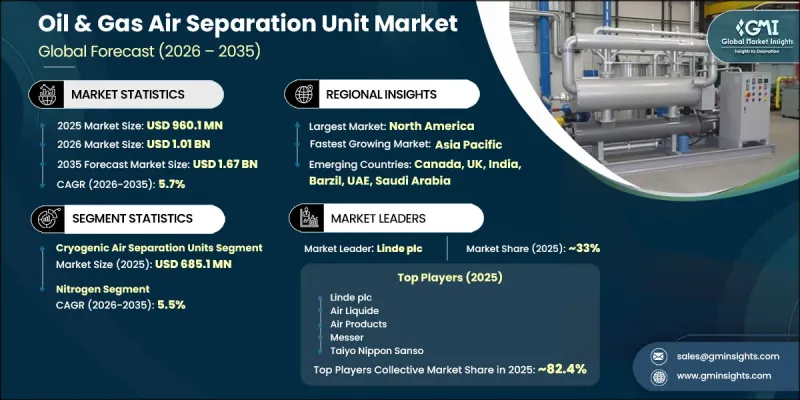
에너지 기업들이 운영 효율과 공정 최적화를 뒷받침하는 신뢰성 높은 가스 생산 기술에 대한 투자를 지속함에 따라, 전 세계 석유 및 가스용 공기분리장치 시장은 꾸준한 성장을 이루고 있습니다. 증산 기술(EOR) 프로젝트의 개발 확대, 정유소 개보수, 석유화학 플랜트의 생산능력 확대, 그리고 신흥 저탄소 에너지 인프라 구축이 진행됨에 따라 첨단 공기 분리 시스템에 대한 수요는 계속해서 증가하고 있습니다. 또한, 각 제조사들은 설치 유연성을 높이고 인프라가 제한된 장소에서의 운영을 지원하는 모듈식 및 스키드 장착형 솔루션에 대한 관심이 높아지고 있음을 실감하고 있습니다. 현장 내 산업용 가스 생산에 대한 관심이 높아지고 있는 것은, 운송 요건을 줄이고 공급 신뢰성을 향상시킴으로써 도입을 더욱 촉진하고 있습니다. 에너지 인프라 현대화에 대한 지속적인 투자와 더불어, 주요 산업 공정에서의 산소, 질소, 아르곤 수요 증가가 맞물려 장기적인 시장 성장을 지속적으로 뒷받침하고 있습니다. 공기 분리 설비의 지속적인 기술 발전과 산업용 가스의 용도 확대는 예측 기간 동안 전 세계 석유 및 가스용 공기 분리 설비 시장에 호재를 가져올 것으로 예상됩니다.
| 시장 범위 | |
|---|---|
| 시작 연도 | 2025년 |
| 예측 기간 | 2026-2035년 |
| 시작 시점 시장 규모 | 9억 6,010만 달러 |
| 예측액 | 16억 7,000만 달러 |
| CAGR | 5.7% |
극저온 공기분리장치 부문은 2025년에 6억 8,510만 달러의 매출을 기록하며 시장 점유율의 71.4%를 차지했습니다. 극저온 기술은 까다로운 석유·가스 용도에 필요한 고순도 산업용 가스를 공급할 수 있기 때문에 계속해서 시장을 주도하고 있습니다. 매우 높은 순도의 산소와 질소를 안정적으로 생산할 수 있는 능력 덕분에 다양한 운영 공정에서 널리 채택되고 있습니다. 고성능 가스 분리 기술에 대한 지속적인 투자와 산업 용도의 확장으로 인해, 시장에서 극저온 공기분리장치의 주도적 지위는 더욱 강화되고 있습니다.
질소 부문은 2025년에 45.8%의 점유율을 차지했으며, 2035년까지 연평균 성장률(CAGR) 5.5%로 성장할 것으로 전망됩니다. 질소는 석유·가스 사업 전반에 걸쳐 폭넓게 활용되고 있기 때문에 이 부문은 계속해서 가장 큰 점유율을 유지하고 있습니다. 화학적 안정성, 운영상의 유연성, 그리고 다양한 산업 공정을 뒷받침하는 능력 덕분에 질소는 에너지 밸류체인 전반에 걸쳐 필수적인 요소로 자리 잡고 있습니다. 신뢰할 수 있는 산업용 가스 솔루션에 대한 수요 증가는 질소의 시장 내 주도적 지위를 더욱 공고히 하며, 전 세계 석유·가스 사업의 장기적인 성장을 지속적으로 뒷받침하고 있습니다.
2025년, 북미의 석유 및 가스용 공기분리장치 시장은 27.2%의 점유율을 차지하며 2억 6,130만 달러의 시장 규모를 기록했습니다. 이 지역의 성장은 석유·가스 생산에 대한 지속적인 투자, 에너지 인프라 확충, 산업용 가스 소비 증가, 그리고 첨단 공기 분리 기술의 도입 확대에 힘입고 있습니다. 에너지 시설의 지속적인 현대화와 청정에너지 프로젝트에 대한 투자 확대로 인해 북미 전역의 공기분리장치에 대한 수요는 계속해서 증가하고 있습니다.
자주 묻는 질문
목차
제1장 조사 방법과 범위
제2장 주요 요약
제3장 업계 인사이트
제4장 경쟁 구도
제5장 시장 추정 및 예측 : 기술 유형별, 2022-2035년
제6장 시장 추정 및 예측 : 가스 생산 유형별, 2022-2035년
제7장 시장 추정 및 예측 : 용량별, 2022-2035년
제8장 시장 추정 및 예측 : 용도별, 2022-2035년
제9장 시장 추정 및 예측 : 최종사용자별, 2022-2035년
제10장 시장 추정 및 예측 : 지역별, 2022-2035년
제11장 기업 개요
KSM 26.08.05The Global Oil & Gas Air Separation Unit Market was valued at USD 960.1 million in 2025 and is estimated to grow at a CAGR of 5.7% to reach USD 1.67 billion by 2035.
The global oil & gas air separation unit market is experiencing steady growth as energy companies continue investing in reliable gas production technologies that support operational efficiency and process optimization. Rising development of enhanced oil recovery projects, refinery upgrades, petrochemical capacity expansion, and emerging low-carbon energy infrastructure continues to strengthen demand for advanced air separation systems. Manufacturers are also witnessing increasing interest in modular and skid-mounted solutions that offer greater installation flexibility and support operations in locations with limited infrastructure. Growing emphasis on-site industrial gas generation is further encouraging adoption by reducing transportation requirements and improving supply reliability. Continuous investment in energy infrastructure modernization, combined with increasing demand for oxygen, nitrogen, and argon across critical industrial processes, continues to reinforce long-term market growth. Ongoing technological improvements in air separation equipment and expanding industrial gas applications are expected to create favorable opportunities for the global oil & gas air separation unit market throughout the forecast period.
| Market Scope | |
|---|---|
| Start Year | 2025 |
| Forecast Year | 2026-2035 |
| Start Value | $960.1 Million |
| Forecast Value | $1.67 Billion |
| CAGR | 5.7% |
The cryogenic air separation units segment generated USD 685.1 million in 2025, accounting for 71.4% share. Cryogenic technology continues to dominate the market because it delivers the high-purity industrial gases required for demanding oil and gas applications. Its ability to consistently produce oxygen and nitrogen with exceptional purity levels supports widespread adoption across multiple operational processes. Continued investment in high-performance gas separation technologies and expanding industrial applications further strengthen the leading position of cryogenic air separation units within the market.
The nitrogen segment held 45.8% share in 2025 and is expected to grow at a CAGR of 5.5% through 2035. The segment continues to maintain the largest share because nitrogen serves a broad range of applications throughout oil and gas operations. Its chemical stability, operational flexibility, and ability to support multiple industrial processes make it an essential component across the energy value chain. Growing demand for dependable industrial gas solutions continues to reinforce nitrogen's market leadership and support long-term growth across global oil and gas operations.
North America Oil & Gas Air Separation Unit Market accounted for 27.2% share in 2025, generating USD 261.3 million. Regional growth is supported by continued investment in oil and gas production, expanding energy infrastructure, increasing industrial gas consumption, and rising adoption of advanced air separation technologies. Ongoing modernization of energy facilities and growing investment in cleaner energy projects continue to strengthen demand for air separation units across North America.
Major companies operating in the global oil & gas air separation unit market include Air Liquide, Linde plc, Air Products and Chemicals, Inc., Messer, and Taiyo Nippon Sanso Corporation. Companies operating in the global oil & gas air separation unit market focus on expanding production capabilities, advancing technology, and strengthening regional presence to improve their competitive position. Manufacturers continue investing in research and development to enhance gas purity, improve energy efficiency, and optimize overall system performance. Many companies broaden their product portfolios by offering modular and customized air separation solutions that address evolving customer requirements across oil and gas operations. Strategic collaborations, long-term supply agreements, and investments in manufacturing capacity help strengthen customer relationships and expand market reach. Businesses also prioritize digital monitoring technologies, predictive maintenance capabilities, and process automation to improve operational reliability and reduce lifecycle costs.
Table of Contents
Chapter 1 Methodology & Scope
- 1.1 scope & definitions
- 1.2 Research design
- 1.2.1 Research approach
- 1.2.2 Data collection methods
- 1.3 Base estimates and calculations
- 1.3.1 Base year calculation
- 1.3.2 Market estimates & forecasts parameters
- 1.4 Forecast Model
- 1.4.1 Key trends for market estimates
- 1.4.2 Quantified market impact analysis
- 1.4.2.1 Mathematical impact of growth parameters on forecast
- 1.4.3 Scenario analysis framework
- 1.5 Primary research and validation
- 1.5.1 Some of the primary sources (but not limited to)
- 1.6 Data mining sources
- 1.6.1 Paid Sources
- 1.7 Primary research and validation
- 1.7.1 Primary sources
- 1.8 Research Trail & confidence scoring
- 1.8.1 Research trail components
- 1.8.2 Scoring components
- 1.9 Research transparency addendum
- 1.9.1 Source attribution framework
- 1.9.2 Quality assurance metrics
- 1.10 Our commitment to trust
Chapter 2 Executive Summary
- 2.1 Industry 360° synopsis
- 2.2 Key market trends
- 2.2.1 Regional
- 2.2.2 Technology type
- 2.2.3 Gas output type
- 2.2.4 Capacity
- 2.2.5 Application
- 2.2.6 End user
Chapter 3 Industry Insights
- 3.1 Industry ecosystem analysis
- 3.1.1 Supplier landscape
- 3.1.2 Profit margin
- 3.1.3 Value addition at each stage
- 3.1.4 Factor affecting the value chain
- 3.2 Industry impact forces
- 3.2.1 Growth drivers
- 3.2.1.1 Rising demand for oxygen in enhanced oil recovery (EOR) operations
- 3.2.1.2 Expansion of global refining & petrochemical capacity requiring on-site nitrogen & oxygen supply
- 3.2.1.3 Growth of clean hydrogen & low-carbon ammonia projects driving large-scale oxygen demand
- 3.2.1.4 Increasing adoption of modular ASUs for remote oilfields & offshore platforms
- 3.2.2 Industry pitfalls & challenges
- 3.2.2.1 Electricity price volatility compressing margins on fixed-price gas supply contracts
- 3.2.2.2 Tightening carbon footprint regulations on energy-intensive ASU operations (EU ETS, carbon pricing)
- 3.2.2.3 Operational complexity & unplanned downtime risks in cryogenic ASU systems
- 3.2.2.4 Skilled workforce shortages for advanced ASU operations & maintenance
- 3.2.3 Opportunities
- 3.2.3.1 Emergence of ASU-as-a-service & tolling/leased supply models for mid-scale operators
- 3.2.3.2 Digitalization of ASU operations (IoT, AI-based predictive maintenance) as a differentiator
- 3.2.3.3 Integration of ASUs in carbon capture, utilization & storage (CCUS) projects within oil & gas
- 3.2.3.4 Offshore & floating ASU demand from deepwater & remote field developments
- 3.2.1 Growth drivers
- 3.3 Growth potential analysis
- 3.4 Future market trends
- 3.5 Technology and innovation landscape
- 3.5.1 Current technological trends
- 3.5.2 Emerging technologies
- 3.6 Regulatory landscape
- 3.6.1 Standards and compliance requirements
- 3.6.2 Regional regulatory frameworks
- 3.6.3 Certification standards
- 3.7 Trade data analysis (HS Code Chapter 84, 8421.39, 8419.60)
- 3.7.1 Import/export volume & value trends
- 3.7.2 Key trade corridors & tariff impact
- 3.8 Pricing analysis
- 3.8.1 Historical price trend analysis (driven by primary research)
- 3.8.2 Pricing strategy by player type (premium / value / mass market)
- 3.9 Impact of AI & generative AI on the market
- 3.9.1 AI-driven disruption of existing business models
- 3.9.2 GenAI use cases & adoption roadmap by segment
- 3.9.3 Risks, limitations & regulatory considerations
- 3.10 Porter's analysis
- 3.11 PESTEL analysis
Chapter 4 Competitive Landscape, 2025
- 4.1 Introduction
- 4.2 Company market share analysis
- 4.2.1 By Region
- 4.2.1.1 North America
- 4.2.1.2 Europe
- 4.2.1.3 Asia Pacific
- 4.2.1.4 Latin America
- 4.2.1.5 Middle East & Africa
- 4.2.1 By Region
- 4.3 Company matrix analysis
- 4.4 Competitive analysis of major market players
- 4.5 Competitive positioning matrix
- 4.6 Key developments
- 4.6.1 Mergers & acquisitions
- 4.6.2 Partnerships & collaborations
- 4.6.3 New product launches
- 4.6.4 Expansion plans
Chapter 5 Market Estimates & Forecast, By Technology Type, 2022 - 2035, (USD Million) (Thousand Units)
- 5.1 Key trends
- 5.2 Cryogenic air separation units
- 5.3 Non-cryogenic air separation units
Chapter 6 Market Estimates & Forecast, By Gas Output Type, 2022 - 2035, (USD Million) (Thousand Units)
- 6.1 Key trends
- 6.2 Nitrogen
- 6.3 Oxygen
- 6.4 Argon
- 6.5 Others (Krypton, Xenon, Neon)
Chapter 7 Market Estimates & Forecast, By Capacity, 2022 - 2035, (USD Million) (Thousand Units)
- 7.1 Key trends
- 7.2 Below 100 TPD
- 7.3 100-400 TPD
- 7.4 Above 400 TPD
Chapter 8 Market Estimates & Forecast, By Application, 2022 - 2035, (USD Million) (Thousand Units)
- 8.1 Key trends
- 8.2 Refining
- 8.3 Enhanced oil recovery
- 8.4 Natural gas processing
- 8.5 LNG
- 8.6 Petrochemicals
- 8.7 GTL
Chapter 9 Market Estimates & Forecast, By End User, 2022 - 2035, (USD Million) (Thousand Units)
- 9.1 Key trends
- 9.2 Upstream
- 9.3 Midstream
- 9.4 Downstream
Chapter 10 Market Estimates & Forecast, By Region, 2022 - 2035, (USD Million) (Thousand Units)
- 10.1 Key trends
- 10.2 North America
- 10.2.1 U.S.
- 10.2.2 Canada
- 10.3 Europe
- 10.3.1 Germany
- 10.3.2 UK
- 10.3.3 France
- 10.3.4 Italy
- 10.3.5 Spain
- 10.4 Asia Pacific
- 10.4.1 China
- 10.4.2 India
- 10.4.3 Japan
- 10.4.4 South Korea
- 10.4.5 Australia
- 10.4.6 Indonesia
- 10.4.7 Malaysia
- 10.5 Latin America
- 10.5.1 Brazil
- 10.5.2 Mexico
- 10.5.3 Argentina
- 10.6 MEA
- 10.6.1 Saudi Arabia
- 10.6.2 UAE
- 10.6.3 South Africa
Chapter 11 Company Profiles
- 11.1 Top Global Players
- 11.1.1 Linde plc
- 11.1.2 Air Liquide S.A.
- 11.1.3 Air Products & Chemicals, Inc.
- 11.1.4 Taiyo Nippon Sanso Corporation (Nippon Sanso Holdings)
- 11.1.5 Messer Group GmbH
- 11.2 Regional Champions
- 11.2.1 SIAD Macchine Impianti S.p.A.
- 11.2.2 Sichuan Air Separation Plant Group Co., Ltd.
- 11.2.3 Kaifeng Air Separation Group Co., Ltd.
- 11.2.4 Yingde Gases Group Co., Ltd.
- 11.2.5 INOX Air Products Ltd.
- 11.2.6 Gulf Cryo
- 11.3 Emerging Players
- 11.3.1 Enerflex Ltd.
- 11.3.2 Universal Industrial Gases, Inc. (UIG)
- 11.3.3 CRYOTEC Anlagenbau GmbH
- 11.3.4 Ranch Cryogenics, Inc.
- 11.3.5 MVS Engineering Pvt. Ltd.