|
시장보고서
상품코드
2109130
이축 자이로 안정화 시장 비즈니스 기회, 성장요인, 업계 동향 분석 및 예측(2026-2035년)Dual-Axis Gyro Stabilized Market Opportunity, Growth Drivers, Industry Trend Analysis, and Forecast 2026 - 2035 |
||||||

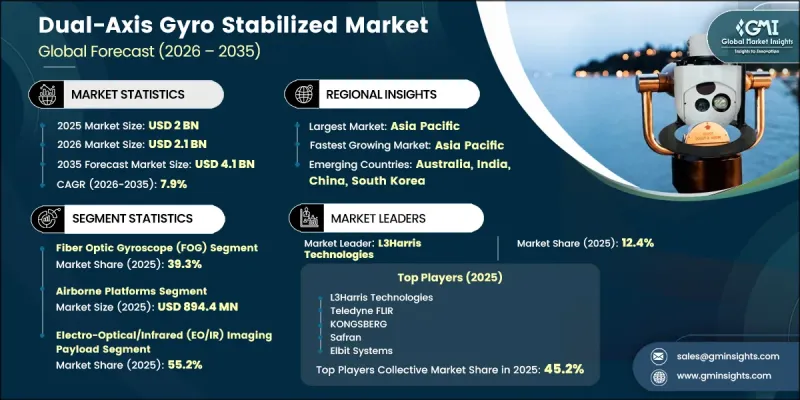
세계의 이축 자이로 안정화 시장은 2025년에 20억 달러로 평가되었고, CAGR 7.9%로 성장하여 2035년까지 41억 달러에 이를 것으로 예측됩니다.
방위, 보안, 감시 각 분야에서 높은 안정성을 갖춘 영상 시스템 및 고정밀 추적 시스템에 대한 수요가 증가함에 따라, 해당 시장은 꾸준한 성장을 이어가고 있습니다. 고도의 정보·감시·정찰(ISR) 능력에 대한 투자 확대에 더해, 무인 시스템 및 원격 조작 플랫폼의 도입 확대가 맞물리면서 시장 수요는 계속해서 가속화되고 있습니다. 국경 경비, 국토 안보, 해상 감시, 중요 인프라 감시에 대한 관심이 높아짐에 따라, 동적인 운용 환경에서도 정확한 영상 촬영과 표적 관측을 보장하는 첨단 안정화 기술의 도입이 촉진되고 있습니다. 국방 현대화 프로그램 증가와 전기광학 및 적외선 영상 기술에 대한 지속적인 투자도 시장 성장을 더욱 뒷받침하고 있습니다. 또한, 내비게이션 시스템, 경량 안정화 플랫폼, 센서 통합 분야의 기술 발전으로 운용 성능이 향상됨과 동시에 임무의 효율성도 높아지고 있습니다.
| 시장 범위 | |
|---|---|
| 개시 연도 | 2025년 |
| 예측 기간 | 2026-2035년 |
| 초기 시장 규모 | 20억 달러 |
| 예측액 | 41억 달러 |
| CAGR | 7.9% |
2025년, 광섬유 자이로스코프(FOG) 부문은 39.3%의 점유율을 차지했습니다. 이 부문은 뛰어난 측정 정밀도, 높은 작동 신뢰성, 그리고 전자기 간섭에 대한 우수한 내성 덕분에 계속해서 지배적인 위치를 유지하고 있습니다. 움직이는 기계 부품이 없습니다는 점도 수명 연장, 유지보수 요구 사항 감소, 그리고 가혹한 작동 조건 하에서의 안정적인 성능에 기여하고 있습니다. 광섬유 센싱 기술의 지속적인 발전과 더불어, 국방 및 산업용 분야에서 정밀한 동작 안정화에 대한 수요가 증가함에 따라, 예측 기간 동안 해당 부문의 성장이 더욱 가속화될 것으로 전망됩니다.
항공기 탑재 플랫폼 부문은 2025년에 8억 9,440만 달러 시장 규모를 기록했습니다. 항공기 탑재 감시 플랫폼에 안정화 이미징 시스템의 도입이 확대되면서, 계속해서 견조한 시장 수요를 뒷받침하고 있습니다. 지속적인 이동 중에도 영상의 선명도를 유지할 수 있는 고안정성 전기광학 및 적외선 페이로드에 대한 수요가 증가함에 따라, 2축 안정화 기술의 채택이 더욱 확대되고 있습니다. 이러한 시스템은 진동이나 플랫폼 이동으로 인한 영향을 최소화함으로써 표적 관측, 정밀 추적 및 실시간 정보 수집 능력을 대폭 향상시킵니다. 첨단 항공 감시 능력에 대한 투자 확대, 항공 감시 활동의 확대, 그리고 방위 항공 기술의 지속적인 현대화가 이 부문의 지속적인 성장을 견인할 것으로 예측됩니다. 경량 페이로드의 통합과 영상 성능의 지속적인 향상 또한 항공기 탑재 용도 전반에 걸친 채택을 촉진하고 있습니다.
2025년, 북미의 2축 자이로 안정화 시장은 28.1%의 점유율을 차지했습니다. 이 지역 시장 확대는 첨단 감시 기술에 대한 투자 증가, 국방 현대화 노력, 그리고 고정밀 안정화 시스템에 대한 수요 증가에 힘입고 있습니다. 정보 수집, 국경 경비, 지속적 감시 및 상황 인식 능력 향상에 대한 관심이 높아지고 있는 점이 기술 제공업체들에게 계속해서 호기를 창출하고 있습니다. 또한, 이 지역은 견조한 국방 지출, 지속적인 기술 혁신, 그리고 확고한 입지를 구축한 항공우주 및 방위 제조업체들의 존재로부터도 혜택을 받고 있습니다. 첨단 영상 시스템, 자율형 플랫폼, 통합 감시 솔루션에 대한 지속적인 투자를 통해 예측 기간 동안 이 지역 시장 성장이 유지될 것으로 전망됩니다.
자주 묻는 질문
목차
제1장 조사 방법과 범위
제2장 주요 요약
제3장 업계 인사이트
제4장 경쟁 구도
제5장 시장 추산 및 예측 : 쟈이로 기술별, 2022년-2035년
제6장 시장 추산 및 예측 : 페이로드 유형별, 2022년-2035년
제7장 시장 추산 및 예측 : 도입 플랫폼별, 2022년-2035년
제8장 시장 추산 및 예측 : 용도별, 2022년-2035년
제9장 시장 추산 및 예측 : 최종사용자별, 2022년-2035년
제10장 시장 추산 및 예측 : 지역별, 2022년-2035년
제11장 기업 개요
LSHThe Global Dual Axis Gyro-Stabilized Market was valued at USD 2 billion in 2025 and is estimated to grow at a CAGR of 7.9% to reach USD 4.1 billion by 2035.
The market is witnessing consistent expansion due to the increasing need for highly stable imaging and precision tracking systems across defense, security, and surveillance applications. Growing investments in advanced intelligence, surveillance, and reconnaissance (ISR) capabilities, together with the expanding deployment of unmanned systems and remotely operated platforms, continue to accelerate market demand. The increasing focus on border protection, homeland security, maritime surveillance, and critical infrastructure monitoring is encouraging greater adoption of advanced stabilization technologies that ensure accurate image capture and target observation in dynamic operating conditions. Rising defense modernization programs and continuous investments in electro-optical and infrared imaging technologies are further supporting market growth. In addition, technological advancements in navigation systems, lightweight stabilization platforms, and sensor integration are improving operational performance while enhancing mission effectiveness.
| Market Scope | |
|---|---|
| Start Year | 2025 |
| Forecast Year | 2026-2035 |
| Start Value | $2 Billion |
| Forecast Value | $4.1 Billion |
| CAGR | 7.9% |
The fiber optic gyroscope (FOG) segment captured a 39.3% share in 2025. The segment continues to maintain its dominant position due to its exceptional measurement accuracy, high operational reliability, and superior resistance to electromagnetic interference. The absence of moving mechanical components also contributes to longer service life, lower maintenance requirements, and consistent performance under demanding operating conditions. Continuous advancements in fiber optic sensing technology, combined with the growing demand for precise motion stabilization across defense and industrial applications, are expected to strengthen the segment's growth over the forecast period.
The airborne platforms segment generated USD 894.4 million in 2025. Rising deployment of stabilized imaging systems across airborne surveillance platforms continues to support strong market demand. The need for highly stable electro-optical and infrared payloads capable of maintaining image clarity during continuous movement is encouraging greater adoption of dual-axis stabilization technologies. These systems significantly improve target observation, precision tracking, and real-time intelligence collection by minimizing the impact of vibration and platform movement. Increasing investments in advanced airborne surveillance capabilities, expanding aerial monitoring operations, and ongoing modernization of defense aviation technologies are expected to drive continued growth within this segment. Continuous improvements in lightweight payload integration and imaging performance are also enhancing adoption across airborne applications.
North America Dual-Axis Gyro-Stabilized Market held a 28.1% share in 2025. Market expansion across the region is supported by increasing investments in advanced surveillance technologies, defense modernization initiatives, and growing demand for high-precision stabilization systems. Rising focus on intelligence gathering, border security, persistent surveillance, and enhanced situational awareness continues to create favorable opportunities for technology providers. The region also benefits from strong defense spending, ongoing technological innovation, and the presence of well-established aerospace and defense manufacturers. Continued investment in advanced imaging systems, autonomous platforms, and integrated surveillance solutions is expected to sustain regional market growth throughout the forecast period.
Major companies operating in the global dual-axis gyro stabilized market include Moog Inc., Safran, AeroVironment, Elbit Systems, BAE Systems, KONGSBERG, Leonardo DRS, L3Harris Technologies, Northrop Grumman, Teledyne FLIR, ASELSAN, CONTROP Precision Technologies, Edge Autonomy, Exail (formerly iXblue), Israel Aerospace Industries (IAI), iMAR Navigation GmbH, SOMAG AG Jena, and Threod Systems. These companies continue to strengthen their market presence through ongoing investments in advanced stabilization technologies, product innovation, and the development of high-performance surveillance solutions that address evolving operational requirements across defense and security sectors. Companies operating in the global dual-axis gyro stabilized market are focusing on continuous product innovation, advanced sensor integration, and precision stabilization technologies to strengthen their competitive position. Manufacturers are investing heavily in research and development to improve imaging accuracy, reduce system weight, enhance operational reliability, and increase platform compatibility across diverse applications. Strategic collaborations with defense organizations, aerospace manufacturers, and system integrators are helping companies expand their customer base and strengthen long-term business relationships. Market participants increase investments in manufacturing capabilities, software development, and artificial intelligence-enabled tracking solutions to improve system performance and operational efficiency. Expansion into emerging regional markets, enhancement of aftermarket support services, and the introduction of customized stabilization solutions further reinforce their competitive advantage.
Table of Contents
Chapter 1 Methodology and Scope
- 1.1 Market scope and definition
- 1.2 Research design
- 1.2.1 Research approach
- 1.2.2 Data collection methods
- 1.3 Data mining sources
- 1.3.1 Global
- 1.3.2 Regional/Country
- 1.4 Base estimates and calculations
- 1.4.1 Base year calculation
- 1.4.2 Key trends for market estimation
- 1.5 Primary research and validation
- 1.5.1 Primary sources
- 1.6 Forecast model
- 1.7 Research assumptions and limitations
Chapter 2 Executive Summary
- 2.1 Industry 360° synopsis, 2022 - 2035
- 2.2 Key market trends
- 2.2.1 Gyro technology trends
- 2.2.2 Payload type trends
- 2.2.3 Deployment platform trends
- 2.2.4 Application trends
- 2.2.5 End-user trends
- 2.2.6 Regional trends
- 2.3 TAM Analysis, 2026-2035
- 2.4 CXO perspectives: Strategic imperatives
Chapter 3 Industry Insights
- 3.1 Industry ecosystem analysis
- 3.1.1 Supplier Landscape
- 3.1.2 Profit Margin
- 3.1.3 Cost structure
- 3.1.4 Value addition at each stage
- 3.1.5 Factor affecting the value chain
- 3.1.6 Disruptions
- 3.2 Industry impact forces
- 3.2.1 Growth drivers
- 3.2.1.1 Increasing demand for intelligence, surveillance, and reconnaissance (ISR) capabilities
- 3.2.1.2 Increasing deployment of UAVs and remotely piloted platforms
- 3.2.1.3 Growing border and homeland-security surveillance requirements
- 3.2.1.4 Expansion of maritime surveillance and situational-awareness operations
- 3.2.1.5 Growing demand for high-precision EO/IR imaging and accurate target tracking
- 3.2.2 Industry pitfalls and challenges
- 3.2.2.1 High cost and technical complexity of precision stabilization systems
- 3.2.2.2 Payload weight, size, power consumption, and stabilization performance trade-offs
- 3.2.3 Market opportunities
- 3.2.3.1 Development of lightweight and miniaturized gyro-stabilized systems
- 3.2.3.2 Integration of AI-enabled target tracking and advanced EO/IR payloads
- 3.2.1 Growth drivers
- 3.3 Growth potential analysis
- 3.4 Regulatory landscape
- 3.4.1 North America
- 3.4.2 Europe
- 3.4.3 Asia Pacific
- 3.4.4 Latin America
- 3.4.5 Middle East & Africa
- 3.5 Porter's analysis
- 3.6 PESTEL analysis
- 3.7 Technology and Innovation landscape
- 3.7.1 Current technological trends
- 3.7.2 Emerging technologies
- 3.8 Price trends
- 3.8.1 By region
- 3.8.2 By product
- 3.9 Pricing Strategies
- 3.10 Emerging Business Models
- 3.11 Compliance Requirements
- 3.12 Patent and IP analysis
Chapter 4 Competitive Landscape, 2025
- 4.1 Introduction
- 4.2 Company market share analysis
- 4.2.1 By region
- 4.2.1.1 North America
- 4.2.1.2 Europe
- 4.2.1.3 Asia Pacific
- 4.2.1.4 Latin America
- 4.2.1.5 Middle East & Africa
- 4.2.2 Market concentration analysis
- 4.2.1 By region
- 4.3 Competitive benchmarking of key players
- 4.3.1 Financial performance comparison
- 4.3.1.1 Revenue
- 4.3.1.2 Profit margin
- 4.3.1.3 R&D
- 4.3.2 Product portfolio comparison
- 4.3.2.1 Product range breadth
- 4.3.2.2 Technology
- 4.3.2.3 Innovation
- 4.3.3 Geographic presence comparison
- 4.3.3.1 Global footprint analysis
- 4.3.3.2 Service network coverage
- 4.3.3.3 Market penetration by region
- 4.3.4 Competitive positioning matrix
- 4.3.4.1 Leaders
- 4.3.4.2 Challengers
- 4.3.4.3 Followers
- 4.3.4.4 Niche players
- 4.3.5 Strategic outlook matrix
- 4.3.1 Financial performance comparison
- 4.4 Key developments
- 4.4.1 Mergers and acquisitions
- 4.4.2 Partnerships and collaborations
- 4.4.3 Technological advancements
- 4.4.4 Expansion and investment strategies
- 4.4.5 Digital transformation initiatives
- 4.5 Emerging/ startup competitors landscape
Chapter 5 Market Estimates and Forecast, By Gyro Technology, 2022 - 2035 (USD Million)
- 5.1 Key trends
- 5.2 Ring laser gyroscope (RLG)
- 5.3 Fiber optic gyroscope (FOG)
- 5.4 MEMS gyroscope
- 5.5 Others
Chapter 6 Market Estimates and Forecast, By Payload Type, 2022 - 2035 (USD Million)
- 6.1 Key trends
- 6.2 Electro-optical/infrared (EO/IR) imaging payload
- 6.3 Radar & antenna stabilization payload
- 6.4 Laser-based payload
- 6.5 Weapon/effector payload
- 6.6 Acoustic payload
- 6.7 Scientific & environmental sensor payload
Chapter 7 Market Estimates and Forecast, By Deployment Platform, 2022 - 2035 (USD Million)
- 7.1 Key trends
- 7.2 Airborne platforms
- 7.3 Land-based platforms
- 7.4 Naval/marine platforms
- 7.5 Space-based platforms
Chapter 8 Market Estimates and Forecast, By Application, 2022 - 2035 (USD Million)
- 8.1 Key trends
- 8.2 Intelligence, surveillance & reconnaissance (ISR)
- 8.3 Targeting & fire control
- 8.4 Communication & antenna stabilization
- 8.5 Navigation & guidance
- 8.6 Mapping, surveying & inspection
- 8.7 Border & perimeter security
- 8.8 Search & rescue (SAR) operations
- 8.9 Scientific research & environmental monitoring
- 8.10 Others
Chapter 9 Market Estimates and Forecast, By End-User, 2022 - 2035 (USD Million)
- 9.1 Key trends
- 9.2 Defense & military
- 9.3 Homeland security & law enforcement
- 9.4 Aerospace
- 9.5 Maritime & naval
- 9.6 Commercial & industrial
- 9.7 Media & entertainment
- 9.8 Research & scientific organizations
Chapter 10 Market Estimates and Forecast, By Region, 2022 - 2035 (USD Million)
- 10.1 Key trends
- 10.2 North America
- 10.2.1 U.S.
- 10.2.2 Canada
- 10.3 Europe
- 10.3.1 Germany
- 10.3.2 UK
- 10.3.3 France
- 10.3.4 Spain
- 10.3.5 Italy
- 10.4 Asia Pacific
- 10.4.1 China
- 10.4.2 India
- 10.4.3 Japan
- 10.4.4 Australia
- 10.4.5 South Korea
- 10.5 Latin America
- 10.5.1 Brazil
- 10.5.2 Mexico
- 10.5.3 Argentina
- 10.6 Middle East and Africa
- 10.6.1 South Africa
- 10.6.2 Saudi Arabia
- 10.6.3 UAE
Chapter 11 Company Profiles
- 11.1 Global Key Players
- 11.1.1 L3Harris Technologies
- 11.1.2 Teledyne FLIR
- 11.1.3 KONGSBERG
- 11.1.4 Safran
- 11.1.5 Elbit Systems
- 11.2 Regional key players
- 11.2.1 North America
- 11.2.1.1 Moog Inc.
- 11.2.1.2 AeroVironment
- 11.2.1.3 Leonardo DRS
- 11.2.1.4 Northrop Grumman
- 11.2.1.5 Edge Autonomy
- 11.2.2 Asia Pacific
- 11.2.2.1 ASELSAN
- 11.2.2.2 Israel Aerospace Industries (IAI)
- 11.2.3 Europe
- 11.2.3.1 Exail (formerly iXblue)
- 11.2.3.2 BAE Systems
- 11.2.1 North America
- 11.3 Niche Players/Disruptors
- 11.3.1 CONTROP Precision Technologies
- 11.3.2 iMAR Navigation GmbH
- 11.3.3 SOMAG AG Jena
- 11.3.4 Threod Systems