

|
시장보고서
상품코드
2109133
공항 항행 보조 시설 시장 기회, 성장 촉진요인, 업계 동향 분석 및 예측(2026-2035년)Airport Navigational Aids (NAVAIDs) Market Opportunity, Growth Drivers, Industry Trend Analysis, and Forecast 2026 - 2035 |
||||||

세계의 공항 항행 보조 시설 시장은 2025년에 33억 달러 규모로 평가되었고, CAGR 4.9%로 성장하여 53억 달러에 이를 것으로 예측됩니다.
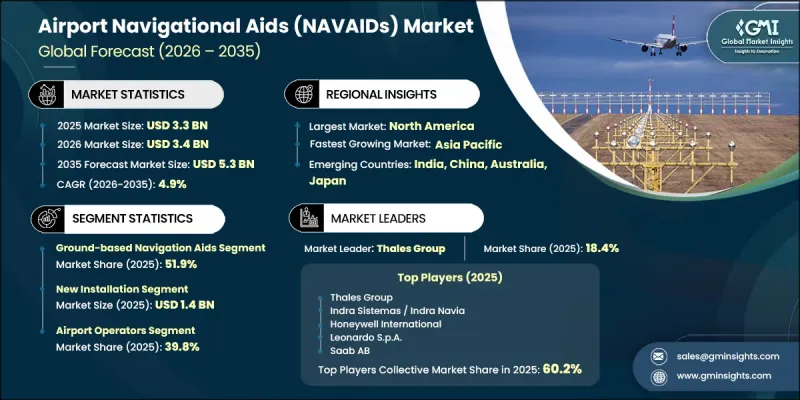
세계 공항들이 운항 안전성 향상, 항공 교통 관리 능력 강화, 그리고 증가하는 항공기 운항을 지원하기 위한 항법 인프라 업그레이드에 주력하고 있어, 해당 시장은 꾸준한 성장을 이루고 있습니다. 여객 수 증가, 운항 횟수 확대, 그리고 현대화 노력에 힘입어 공항들은 첨단 항법 기술에 대한 투자를 촉진하고 있습니다. 위성을 활용한 성능 중심의 항법 솔루션 도입 확대는 정확성, 신뢰성, 효율성을 향상시킴으로써 공항 운영을 혁신하고 있습니다. 동시에 GNSS(전지구위치확인시스템) 장애에 대한 우려가 커지는 가운데, 항공기 운항을 중단 없이 보장할 수 있는 신뢰성 높은 백업 항법 시스템의 중요성이 커지고 있습니다. 또한 공항에서는 혹독한 기상 조건이나 시야 불량 상황에서도 안전한 운항을 지원하기 위해 정밀 착륙 능력과 유도 시스템 개선을 최우선 과제로 삼고 있습니다. 항공 인프라의 지속적인 확충과 차세대 항법 기술에 대한 투자가 맞물리면서, 공항용 항법 보조 장치 시장에는 지속적인 기회가 창출될 것으로 예측됩니다. 이러한 동향에 따라 공항 및 항공 당국은 항법 네트워크 강화와 공역 관리 전반의 개선을 추진하고 있습니다.
| 시장 범위 | |
|---|---|
| 시작 연도 | 2025년 |
| 예측 기간 | 2026-2035년 |
| 시작 금액 | 33억 달러 |
| 예측 금액 | 53억 달러 |
| CAGR | 4.9% |
공항 인프라 업그레이드를 위한 투자 증가와 항공기 안전에 대한 중요성 인식 제고가 공항 항행 보조 시설 시장의 확장을 뒷받침하는 주요 요인으로 작용하고 있습니다. 공항에서는 증가하는 항공기 이착륙을 관리하면서 운영 효율성을 높이기 위해 활주로 시스템, 접근 시설 및 항법 인프라 강화가 진행되고 있습니다. 또한, 성능 기반 항법 솔루션의 도입 확대와 위성 신호가 끊겼을 때 신뢰할 수 있는 대체 항법 수단에 대한 수요 증가도 시장 성장을 더욱 뒷받침하고 있습니다. 항공 당국은 운영의 연속성을 유지하고 항공기의 안전한 유도를 확보하기 위해 기존 항법 인프라 강화에 힘쓰고 있습니다.
2025년에는 지상형 항법 지원 장치 부문이 51.9%의 점유율을 차지하며 선두를 유지했습니다. 이 부문의 우위는 정확한 항공기 진입, 착륙 및 항법 지원을 제공하는 데 있어 지상형 시스템이 계속해서 중요시되고 있다는 점에 기반을 두고 있습니다. ILS, VOR, DME 등의 기술은 여전히 공항 항법 인프라에서 필수적인 요소입니다. GNSS 활용에 따른 과제와 진행 중인 현대화 프로그램으로 인해, 국제공항 및 지역공항에서의 지상형 항법 솔루션에 대한 수요는 앞으로도 지속될 것으로 예측됩니다.
신규 설치 부문은 2025년에 14억 달러 시장 규모를 기록했습니다. 이 부문의 성장은 공항 개발 활동의 활성화와 항공 인프라 확장에 따른 첨단 항법 장비에 대한 수요 증가에 힘입은 것입니다. 신규 설치에는 접근, 착륙 및 공항 운영 중 항공기를 확실하게 유도하도록 설계된 다양한 항법 기술과 지원 시스템이 포함됩니다. 항공 교통량 증가와 지역 공항 네트워크의 확장이 새로 도입되는 항법 지원 시스템에 대한 수요 증가에 기여하고 있습니다.
2025년, 북미의 공항 항행 보조 시설 시장은 30.7%의 점유율을 차지했습니다. 지역적 성장은 항공기 이착륙 횟수 증가, 공항 현대화 프로그램, 그리고 첨단 항공 교통 관리 솔루션 도입 확대에 힘입고 있습니다. 항법 인프라 업그레이드에 대한 투자는 공역의 효율화와 항공 안전 향상에 기여하고 있습니다. 이 지역의 항공 관련 기관들은 신뢰할 수 있는 항공기 운항을 지원하기 위해 ILS, DME, VOR, GBAS 등의 시스템 강화를 추진하고 있습니다. 비행 활동 증가와 GNSS 관련 장애 가능성으로 인해 항법 시스템의 내장애성에 대한 관심이 높아지고 있는 점도 북미 전역의 인프라 투자를 더욱 촉진하고 있습니다.
자주 묻는 질문
목차
제1장 조사 방법과 범위
제2장 주요 요약
제3장 업계 인사이트
제4장 경쟁 구도
제5장 시장 규모 및 예측 : 시스템 유형별(2022-2035년)
제6장 시장 규모 및 예측 : 제공 제품별(2022-2035년)
제7장 시장 규모 및 예측 : 전개 형태별(2022-2035년)
제8장 시장 규모 및 예측 : 용도별(2022-2035년)
제9장 시장 규모 및 예측 : 최종 사용자별(2022-2035년)
제10장 시장 규모 및 예측 : 지역별(2022-2035년)
제11장 기업 개요
KTH 26.08.20The Global Airport Navigational Aids Market was valued at USD 3.3 billion in 2025 and is estimated to grow at a CAGR of 4.9% to reach USD 5.3 billion by 2035.
The market is witnessing steady growth as airports worldwide focus on improving operational safety, enhancing air traffic management capabilities, and upgrading navigation infrastructure to support rising aircraft activity. Increasing passenger travel, higher flight volumes, and modernization initiatives are encouraging airports to invest in advanced navigational technologies. The growing adoption of satellite-based and performance-oriented navigation solutions is transforming airport operations by improving accuracy, reliability, and efficiency. At the same time, concerns related to GNSS disruptions are increasing the importance of dependable backup navigation systems that can ensure uninterrupted aircraft movement. Airports are also prioritizing precision landing capabilities and improved guidance systems to support safe operations during challenging weather and visibility conditions. The continuous expansion of aviation infrastructure, combined with investments in next-generation navigation technologies, is expected to create sustained opportunities for the airport navigational aids market. These developments are encouraging airports and aviation authorities to strengthen their navigation networks and improve overall airspace management.
| Market Scope | |
|---|---|
| Start Year | 2025 |
| Forecast Year | 2026-2035 |
| Start Value | $3.3 Billion |
| Forecast Value | $5.3 Billion |
| CAGR | 4.9% |
Increasing investments in airport infrastructure upgrades and the growing emphasis on aircraft safety are key factors supporting the expansion of the airport navigational aids market. Airports are enhancing runway systems, approach facilities, and navigation infrastructure to manage increasing aircraft movements while improving operational efficiency. The rising implementation of performance-based navigation solutions and the need for reliable navigation alternatives during satellite signal interruptions are further supporting market growth. Aviation authorities are strengthening conventional navigation infrastructure to maintain operational continuity and ensure safe aircraft guidance.
The ground-based navigation aids segment accounted for 51.9% share in 2025, maintaining its leading position. The segment's dominance is supported by the continued importance of ground-based systems in providing accurate aircraft approach, landing, and navigation support. Technologies such as ILS, VOR, and DME remain essential components of airport navigation infrastructure. Growing requirements for dependable navigation systems during GNSS availability challenges, along with ongoing modernization programs, are expected to sustain demand for ground-based navigation solutions across international and regional airports.
The new installation segment generated USD 1.4 billion in 2025. Growth in this segment is supported by increasing airport development activities and the rising need for advanced navigation equipment in expanding aviation infrastructure. New installations include various navigation technologies and supporting systems designed to provide reliable aircraft guidance during approach, landing, and airport operations. Increasing air traffic volumes and the expansion of regional airport networks are contributing to greater demand for newly deployed navigational aid systems.
North America Airport Navigational Aids Market accounted for 30.7% share in 2025. Regional growth is being supported by increasing aircraft movements, airport modernization programs, and rising adoption of advanced air traffic management solutions. Investments in navigation infrastructure upgrades are helping improve airspace efficiency and aviation safety. Aviation organizations in the region are enhancing systems such as ILS, DME, VOR, and GBAS to support reliable aircraft operations. Growing attention toward navigation system resilience due to increased flight activity and potential GNSS-related disruptions is further encouraging infrastructure investments across North America.
Major companies operating in the global airport navigational aids market include ADB Safegate, Aerodata AG, Astronics DME, BEL, Collins Aerospace (RTX), ERA a.s., Frequentis AG, Honeywell International, Indra Sistemas / Indra Navia, Intelcan Technosystems, Leonardo S.p.A., Nautel, Norwegian Special Mission, Rohde & Schwarz, Saab AB, and Thales Group. Companies operating in the airport navigational aids market are strengthening their market presence through technological innovation, strategic partnerships, and expansion of product portfolios. Leading players are focusing on developing advanced navigation solutions with improved accuracy, reliability, and compatibility with modern airport systems. Businesses are investing in research and development to enhance satellite-based and ground-based navigation technologies while addressing growing requirements for operational resilience. Companies are also forming collaborations with airports, aviation authorities, and infrastructure providers to secure long-term projects and expand global reach.
Table of Contents
Chapter 1 Methodology and Scope
- 1.1 Market scope and definition
- 1.2 Research design
- 1.2.1 Research approach
- 1.2.2 Data collection methods
- 1.3 Data mining sources
- 1.3.1 Global
- 1.3.2 Regional/Country
- 1.4 Base estimates and calculations
- 1.4.1 Base year calculation
- 1.4.2 Key trends for market estimation
- 1.5 Primary research and validation
- 1.5.1 Primary sources
- 1.6 Forecast model
- 1.7 Research assumptions and limitations
Chapter 2 Executive Summary
- 2.1 Industry 360° synopsis, 2022 - 2035
- 2.2 Key market trends
- 2.2.1 System type trends
- 2.2.2 Offering trends
- 2.2.3 Deployment mode trends
- 2.2.4 Application trends
- 2.2.5 End-user trends
- 2.2.6 Regional trends
- 2.3 TAM Analysis, 2026-2035
- 2.4 CXO perspectives: Strategic imperatives
Chapter 3 Industry Insights
- 3.1 Industry ecosystem analysis
- 3.1.1 Supplier Landscape
- 3.1.2 Profit Margin
- 3.1.3 Cost structure
- 3.1.4 Value addition at each stage
- 3.1.5 Factor affecting the value chain
- 3.1.6 Disruptions
- 3.2 Industry impact forces
- 3.2.1 Growth drivers
- 3.2.1.1 Increasing global air passenger traffic and aircraft movements
- 3.2.1.2 Rising investments in airport infrastructure modernization
- 3.2.1.3 Growing adoption of performance-based and satellite navigation
- 3.2.1.4 Increasing GNSS interference and demand for resilient backup NAVAIDs
- 3.2.1.5 Rising focus on precision approach and low-visibility operations
- 3.2.2 Industry pitfalls and challenges
- 3.2.2.1 High cost of advanced NAVAID installation and modernization
- 3.2.2.2 GNSS interference and vulnerability to jamming and spoofing
- 3.2.3 Market opportunities
- 3.2.3.1 Development of resilient and hybrid navigation infrastructure
- 3.2.3.2 Expansion of precision approach systems at regional and emerging airports
- 3.2.1 Growth drivers
- 3.3 Growth potential analysis
- 3.4 Regulatory landscape
- 3.4.1 North America
- 3.4.2 Europe
- 3.4.3 Asia Pacific
- 3.4.4 Latin America
- 3.4.5 Middle East & Africa
- 3.5 Porter's analysis
- 3.6 PESTEL analysis
- 3.7 Technology and Innovation landscape
- 3.7.1 Current technological trends
- 3.7.2 Emerging technologies
- 3.8 Price trends
- 3.8.1 By region
- 3.8.2 By product
- 3.9 Pricing Strategies
- 3.10 Emerging Business Models
- 3.11 Compliance Requirements
- 3.12 Patent and IP analysis
Chapter 4 Competitive Landscape, 2025
- 4.1 Introduction
- 4.2 Company market share analysis
- 4.2.1 By region
- 4.2.1.1 North America
- 4.2.1.2 Europe
- 4.2.1.3 Asia Pacific
- 4.2.1.4 Latin America
- 4.2.1.5 Middle East & Africa
- 4.2.2 Market concentration analysis
- 4.2.1 By region
- 4.3 Competitive benchmarking of key players
- 4.3.1 Financial performance comparison
- 4.3.1.1 Revenue
- 4.3.1.2 Profit margin
- 4.3.1.3 R&D
- 4.3.2 Product portfolio comparison
- 4.3.2.1 Product range breadth
- 4.3.2.2 Technology
- 4.3.2.3 Innovation
- 4.3.3 Geographic presence comparison
- 4.3.3.1 Global footprint analysis
- 4.3.3.2 Service network coverage
- 4.3.3.3 Market penetration by region
- 4.3.4 Competitive positioning matrix
- 4.3.4.1 Leaders
- 4.3.4.2 Challengers
- 4.3.4.3 Followers
- 4.3.4.4 Niche players
- 4.3.5 Strategic outlook matrix
- 4.3.1 Financial performance comparison
- 4.4 Key developments
- 4.4.1 Mergers and acquisitions
- 4.4.2 Partnerships and collaborations
- 4.4.3 Technological advancements
- 4.4.4 Expansion and investment strategies
- 4.4.5 Digital transformation initiatives
- 4.5 Emerging/ startup competitors landscape
Chapter 5 Market Estimates and Forecast, By System Type, 2022 - 2035 (USD Million)
- 5.1 Key trends
- 5.2 Ground-based navigation aids
- 5.3 Satellite-based navigation aids
- 5.4 Visual navigation aids
Chapter 6 Market Estimates and Forecast, By Offering, 2022 - 2035 (USD Million)
- 6.1 Key trends
- 6.2 Hardware
- 6.3 Software
- 6.4 Services
Chapter 7 Market Estimates and Forecast, By Deployment, 2022 - 2035 (USD Million)
- 7.1 Key trends
- 7.2 New Installation
- 7.3 Retrofit & Modernization
Chapter 8 Market Estimates and Forecast, By Application, 2022 - 2035 (USD Million)
- 8.1 Key trends
- 8.2 Navigation & positioning
- 8.3 Approach & landing guidance
- 8.4 Surface movement guidance
Chapter 9 Market Estimates and Forecast, By End-User, 2022 - 2035 (USD Million)
- 9.1 Key trends
- 9.2 Airport operators
- 9.3 Aviation authorities & ANSPs
- 9.4 Defense organizations
- 9.5 Private airport operators
Chapter 10 Market Estimates and Forecast, By Region, 2022 - 2035 (USD Million)
- 10.1 Key trends
- 10.2 North America
- 10.2.1 U.S.
- 10.2.2 Canada
- 10.3 Europe
- 10.3.1 Germany
- 10.3.2 UK
- 10.3.3 France
- 10.3.4 Spain
- 10.3.5 Italy
- 10.4 Asia Pacific
- 10.4.1 China
- 10.4.2 India
- 10.4.3 Japan
- 10.4.4 Australia
- 10.4.5 South Korea
- 10.5 Latin America
- 10.5.1 Brazil
- 10.5.2 Mexico
- 10.5.3 Argentina
- 10.6 Middle East and Africa
- 10.6.1 South Africa
- 10.6.2 Saudi Arabia
- 10.6.3 UAE
Chapter 11 Company Profiles
- 11.1 Global Key Players
- 11.1.1 Thales Group
- 11.1.2 Indra Sistemas / Indra Navia
- 11.1.3 Honeywell International
- 11.1.4 Leonardo S.p.A.
- 11.1.5 Saab AB
- 11.2 Regional key players
- 11.2.1 North America
- 11.2.1.1 Intelcan Technosystems
- 11.2.1.2 Nautel
- 11.2.1.3 Astronics DME
- 11.2.1.4 Collins Aerospace (RTX)
- 11.2.2 Asia Pacific
- 11.2.2.1 BEL
- 11.2.3 Europe
- 11.2.3.1 ADB SAFEGATE
- 11.2.3.2 Frequentis AG
- 11.2.3.3 Rohde & Schwarz
- 11.2.1 North America
- 11.3 Niche Players/Disruptors
- 11.3.1 ERA a.s.
- 11.3.2 Aerodata AG
- 11.3.3 Norwegian Special Mission


