

|
시장보고서
상품코드
2109154
소규모 LNG 시장 기회, 성장요인, 업계 동향 분석 및 예측(2026-2035년)Small Scale LNG Market Opportunity, Growth Drivers, Industry Trend Analysis, and Forecast 2026 - 2035 |
||||||

세계의 소규모 LNG 시장은 2025년에 122억 달러로 평가되었고, CAGR 7.5%로 성장하여 2035년까지 257억 달러에 이를 것으로 추정되고 있습니다.
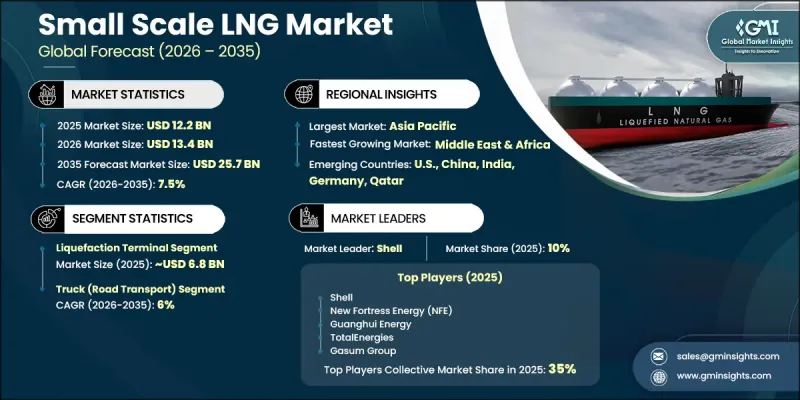
운송, 산업 활동, 발전 등 각 분야에서 유연하고 분산형인 천연가스 공급 솔루션에 대한 수요가 증가함에 따라, 소규모 LNG 산업은 꾸준한 성장을 이루고 있습니다. 시장 확대는 환경 규제 강화, LNG 벙커링 인프라의 지속적인 확충, 그리고 파이프라인망이 제한된 지역에서의 신뢰할 수 있는 에너지 공급에 대한 수요 증가에 힘입고 있습니다. 기존 액체 연료에서 소규모 LNG로의 전환은 뛰어난 경제성과 다양한 산업 분야에서 배출량 감축이 점점 더 중요시되고 있다는 점에 의해 촉진되고 있습니다. 많은 개발도상국 및 외딴 지역 시장에서 소규모 LNG는 기존 파이프라인 인프라를 이용할 수 없거나 경제적으로 실현 불가능한 지역에 천연가스를 공급하기 위한 효과적인 대안으로 자리 잡고 있습니다. 가상 파이프라인 네트워크, 모듈식 재기화 기술, 그리고 ISO 컨테이너를 이용한 운송의 채택 확대에 따라 새로운 최종 사용자들의 천연가스 접근성이 확대됨과 동시에, 전 세계 소규모 LNG 시장의 상업적 범위도 넓어지고 있습니다. 이러한 요인들은 계속해서 양호한 장기 성장 기회를 창출하며, 다양한 지역 시장에서 소규모 LNG 솔루션의 보다 광범위한 채택을 뒷받침하고 있습니다.
| 시장 범위 | |
|---|---|
| 개시 연도 | 2025년 |
| 예측 기간 | 2026-2035년 |
| 개시 연도 시장 규모 | 122억 달러 |
| 예측액 | 257억 달러 |
| CAGR | 7.5% |
2025년에는 액화 터미널 부문이 시장 점유율의 55.9%를 차지하고, 68억 달러의 매출을 기록하며, 2035년까지 연평균 성장률(CAGR) 6.7%를 나타낼 것으로 예측됩니다. 액화 시설은 천연가스를 액화 형태로 변환하여 운송, 분산형 발전, 산업용 소비 및 선박용 연료 공급(벙커링)에 활용함으로써 소규모 LNG 공급망의 생산 기반으로서의 역할을 수행하고 있습니다. 모듈식 및 중규모 액화 플랜트의 도입 확대에 따라 공급 능력이 지속적으로 강화되는 동시에 운영상의 유연성이 향상되어, 지역 시장 전반에서 LNG의 접근성이 확대되고 있습니다.
트럭 운송 부문은 2025년에 40.3%의 점유율을 차지할 것으로 예상되며, 2035년까지 연평균 성장률(CAGR) 6%로 성장할 것으로 전망됩니다. 극저온 탱크로리는 액화 시설이나 수입 터미널에서 산업용 고객, 위성 배송 스테이션, 지역 가스 네트워크로 LNG를 운송하는 데 있어 여전히 선호되는 수단입니다. 육상 기반 LNG 물류 인프라의 지속적인 확대로 인해 공급망 효율이 향상되고 배송 유연성이 높아지면서, 운송, 산업 및 상업 용도에서의 소규모 LNG 도입이 더욱 확대되고 있습니다.
북미의 소규모 LNG 시장은 2025년에 22%의 점유율을 차지할 것으로 예상되며, 2035년까지 연평균 성장률(CAGR) 6.4%로 성장할 것으로 전망됩니다. 이 지역 시장 성장은 풍부한 국내 천연가스 자원, 원료의 원활한 확보, 그리고 운송 및 산업 수요를 충족하기 위한 액화 인프라에 대한 투자 확대에 힘입고 있습니다. LNG 유통 네트워크의 지속적인 확충과 대체 연료로서의 LNG 상업적 도입 확대는 지역 시장의 성장을 뒷받침할 뿐만 아니라, 여러 최종 이용 산업에 걸친 분산형 천연가스 공급 솔루션의 가용성을 높이고 있습니다.
자주 묻는 질문
목차
제1장 조사 방법과 범위
제2장 주요 요약
제3장 업계 인사이트
제4장 경쟁 구도
제5장 시장 규모와 예측 : 터미널별, 2022년-2035년
제6장 시장 규모와 예측 : 공급 형태별, 2022년-2035년
제7장 시장 규모와 예측 : 용도별, 2022년-2035년
제8장 시장 규모와 예측 : 최종 용도별, 2022년-2035년
제9장 시장 규모와 예측 : 지역별, 2022년-2035년
제10장 기업 개요
LSH 26.08.14The Global Small Scale LNG Market was valued at USD 12.2 billion in 2025 and is estimated to grow at a CAGR of 7.5% to reach USD 25.7 billion by 2035.
The small scale LNG industry is experiencing steady growth as demand increases for flexible and decentralized natural gas supply solutions across transportation, industrial operations, and power generation applications. Market expansion is supported by stricter environmental regulations, continued development of LNG bunkering infrastructure, and rising demand for reliable energy supplies in regions with limited pipeline connectivity. The transition from conventional liquid fuels to small-scale LNG is being encouraged by its favorable operating economics and the growing emphasis on lowering emissions across multiple industries. In many developing and remote markets, small-scale LNG has become an effective alternative for delivering natural gas where traditional pipeline infrastructure is either unavailable or economically impractical. The increasing adoption of virtual pipeline networks, modular regasification technologies, and ISO container-based transportation is extending natural gas accessibility to new end users while expanding the commercial reach of the global small scale LNG market. These factors continue to create favorable long-term growth opportunities and support wider adoption of small-scale LNG solutions across diverse geographic markets.
| Market Scope | |
|---|---|
| Start Year | 2025 |
| Forecast Year | 2026-2035 |
| Start Value | $12.2 Billion |
| Forecast Value | $25.7 Billion |
| CAGR | 7.5% |
The liquefaction terminals segment accounted for 55.9% share in 2025, generating USD 6.8 billion, and is expected to grow at a CAGR of 6.7% through 2035. Liquefaction facilities serve as the production foundation of small-scale LNG supply chains by converting natural gas into liquefied form for transportation, distributed power generation, industrial consumption, and bunkering applications. The growing deployment of modular and mid-scale liquefaction plants continues to strengthen supply capabilities while improving operational flexibility and expanding LNG availability across regional markets.
The truck delivery segment held 40.3% share in 2025 and is projected to grow at a CAGR of 6% through 2035. Cryogenic tanker trucks remain the preferred method for transporting LNG from liquefaction facilities and import terminals to industrial customers, satellite distribution stations, and local gas networks. The continued expansion of road-based LNG logistics infrastructure is improving supply chain efficiency, increasing delivery flexibility, and supporting broader adoption of small-scale LNG across transportation, industrial, and commercial applications.
North America Small Scale LNG Market held 22% share in 2025 and is forecast to grow at a CAGR of 6.4% through 2035. Regional market growth is supported by abundant domestic natural gas resources, favorable feedstock availability, and increasing investments in liquefaction infrastructure serving transportation and industrial demand. Continued development of LNG distribution networks and expanding commercial adoption of LNG as an alternative fuel are strengthening regional market growth while improving the availability of decentralized natural gas supply solutions across multiple end-use industries.
Major companies operating in the global small scale LNG market include Shell plc, TotalEnergies, Linde, Engie, Honeywell International, Sempra Infrastructure Partners, Gasum, Hoegh LNG Holdings, Excelerate Energy, Pavilion Energy, GAIL (India) Limited, Stabilis Solutions, Galileo Technologies, CryoPur, Cryostar, New Fortress Energy, Eagle LNG Partners, Guanghui Energy, Kunlun Energy, Equinor, Skangas, Snam, ENI, Anthony Veder, Stolt-Nielsen Gas, Pivotal LNG, and Wartsila. Companies operating in the small scale LNG market are strengthening their market position by expanding liquefaction capacity, investing in modular LNG infrastructure, and enhancing distribution networks to improve supply reliability. Manufacturers and service providers are focusing on technological advancements that increase operational efficiency, reduce transportation costs, and support flexible LNG delivery solutions. Strategic partnerships with industrial customers, energy providers, and infrastructure developers are helping companies broaden their market presence and secure long-term supply agreements. Businesses are also investing in virtual pipeline systems, LNG bunkering infrastructure, storage facilities, and regasification technologies to expand geographic coverage and improve customer access.
Table of Contents
Chapter 1 Methodology & Scope
- 1.1 Research approach
- 1.2 Quality commitments
- 1.2.1 GMI AI policy & data integrity commitment
- 1.2.1.1 Source consistency protocol
- 1.2.1 GMI AI policy & data integrity commitment
- 1.3 Research trail & confidence scoring
- 1.3.1 Research trail components
- 1.3.2 Scoring components
- 1.4 Data collection
- 1.4.1 Partial list of primary sources
- 1.5 Data mining sources
- 1.5.1 Paid sources
- 1.5.1.1 Sources, by region
- 1.5.1 Paid sources
- 1.6 Base estimates and calculations
- 1.6.1 Base year calculation for any one approach
- 1.7 Market estimates & forecasts parameters
- 1.8 Forecast model
- 1.8.1 Quantified market impact analysis
- 1.8.1.1 Mathematical impact of growth parameters on forecast
- 1.8.1 Quantified market impact analysis
- 1.9 Research transparency addendum
- 1.9.1 Source attribution framework
- 1.9.2 Quality assurance metrics
- 1.9.3 Our commitment to trust
- 1.10 Market definitions
Chapter 2 Executive Summary
- 2.1 Industry synopsis, 2022 - 2035
- 2.1.1 Business trends
- 2.1.2 Terminal trends
- 2.1.3 Mode of supply trends
- 2.1.4 Application trends
- 2.1.5 End use trends
- 2.1.6 Regional trends
Chapter 3 Industry Insights
- 3.1 Industry ecosystem analysis
- 3.1.1 Feedstock sourcing & gas supply agreements analysis
- 3.1.2 Liquefaction & processing layer
- 3.1.3 Storage, logistics & distribution infrastructure
- 3.1.4 End-use integration & customer analysis
- 3.2 Regulatory landscape
- 3.3 Industry impact forces
- 3.3.1 Growth drivers
- 3.3.2 Industry pitfalls & challenges
- 3.4 Growth potential analysis
- 3.5 Porter's analysis
- 3.5.1 Bargaining power of suppliers
- 3.5.2 Bargaining power of buyers
- 3.5.3 Threat of new entrants
- 3.5.4 Threat of substitutes
- 3.6 PESTEL analysis
- 3.6.1 Political factors
- 3.6.2 Economic factors
- 3.6.3 Social factors
- 3.6.4 Technological factors
- 3.6.5 Legal factors
- 3.6.6 Environmental factors
- 3.7 Investment & funding analysis
- 3.7.1 Capital investment trends in small-scale LNG infrastructure
- 3.7.2 Government grants & subsidies
- 3.8 Trade data analysis (Driven by Primary Research)
- 3.8.1 Lng import & export
- 3.8.2 Key trade corridors
- 3.8.3 Tariff structures & trade policy impact
- 3.9 Impact of AI & Generative AI on the market
- 3.9.1 AI-Driven disruption of existing business models
- 3.9.2 GenAI use cases & adoption roadmap
- 3.9.3 Risks, limitations & regulatory considerations
- 3.10 Sustainability initiatives & industry 4.0 integration
- 3.11 Future outlook & strategic opportunities
- 3.11.1 Market evolution roadmap
- 3.11.2 Emerging applications analysis
- 3.11.3 Technology convergence analysis
Chapter 4 Competitive Landscape, 2026
- 4.1 Introduction
- 4.2 Company market share analysis, by region, 2025
- 4.2.1 North America
- 4.2.2 Europe
- 4.2.3 Asia Pacific
- 4.2.4 Middle East & Africa
- 4.2.5 Latin America
- 4.3 Key developments
- 4.3.1 Key partnerships & collaborations
- 4.3.2 Major M&A activities
- 4.3.3 Product innovations & launches
- 4.3.4 Market expansion strategies
- 4.4 Competitive positioning matrix
- 4.4.1 Tier classification criteria & qualifying thresholds
- 4.4.2 Tier positioning matrix by revenue, geography & innovation
Chapter 5 Market Size and Forecast, By Terminal, 2022 - 2035 (USD Million)
- 5.1 Key trends
- 5.2 Liquefaction terminal
- 5.2.1 Peak-shaving plants
- 5.2.2 Industrial liquefaction units
- 5.2.3 Satellite & modular liquefaction stations
- 5.2.4 Stranded gas monetization liquid facilities
- 5.3 Regasification terminal
- 5.3.1 Satellite Regasification Units (SRUS)
- 5.3.2 Virtual pipeline endpoint regasification station
- 5.3.3 Marine & port regasification facilities
Chapter 6 Market Size and Forecast, By Mode of Supply, 2022 - 2035 (USD Million)
- 6.1 Key trends
- 6.2 Truck (Road Transport)
- 6.3 Trans-shipment & Marine Bunkering
- 6.4 ISO Containers (Multi-Modal)
- 6.5 Virtual Pipeline
- 6.6 Rail Tanks
Chapter 7 Market Size and Forecast, By Application, 2022 - 2035 (USD Million)
- 7.1 Key trends
- 7.2 Transportation
- 7.3 Industrial Feedstock
- 7.4 Power Generation
- 7.5 Marine Bunkering
- 7.6 Others
Chapter 8 Market Size and Forecast, By End Use, 2022 - 2035 (USD Million)
- 8.1 Key trends
- 8.2 Mining & Heavy Industry
- 8.3 Oil & Gas
- 8.4 Utilities & IPPs
- 8.5 Shipping & Marine Operators
- 8.6 Others
Chapter 9 Market Size and Forecast, By Region, 2022 - 2035 (USD Million)
- 9.1 Key trends
- 9.2 North America
- 9.2.1 U.S.
- 9.2.2 Canada
- 9.2.3 Mexico
- 9.3 Europe
- 9.3.1 UK
- 9.3.2 Germany
- 9.3.3 France
- 9.3.4 Spain
- 9.3.5 Norway
- 9.3.6 Italy
- 9.4 Asia Pacific
- 9.4.1 China
- 9.4.2 Japan
- 9.4.3 South Korea
- 9.4.4 India
- 9.4.5 Indonesia
- 9.4.6 Singapore
- 9.4.7 Thailand
- 9.5 Middle East & Africa
- 9.5.1 UAE
- 9.5.2 Saudi Arabia
- 9.5.3 Qatar
- 9.5.4 Turkey
- 9.5.5 South Africa
- 9.5.6 Nigeria
- 9.5.7 Algeria
- 9.6 Latin America
- 9.6.1 Brazil
- 9.6.2 Argentina
Chapter 10 Company Profiles
- 10.1 Shell plc
- 10.2 New Fortress Energy (NFE)
- 10.3 Guanghui Energy
- 10.4 TotalEnergies
- 10.5 Gasum Group
- 10.6 Kunlun Energy (CNOOC)
- 10.7 Equinor
- 10.8 Excelerate Energy
- 10.9 Linde
- 10.10 Engie
- 10.11 Hoegh LNG Holdings
- 10.12 Stabilis Solutions
- 10.13 Galileo Technologies
- 10.14 Snam
- 10.15 GAIL (India) Limited
- 10.16 Pavilion Energy
- 10.17 Sempra Infrastructure
- 10.18 Eagle LNG Partners
- 10.19 Honeywell International
- 10.20 Cryostar
- 10.21 Anthony Veder Group
- 10.22 Stolt-Nielsen
- 10.23 Pivotal LNG
- 10.24 Wartsila


