
|
시장보고서
상품코드
2109170
집수 및 배수 시스템 시장 기회, 성장 촉진요인, 산업 동향 분석 및 예측(2026-2035년)Water Harvesting and Distribution System Market Opportunity, Growth Drivers, Industry Trend Analysis, and Forecast 2026 - 2035 |
||||||

세계의 집수 및 배수 시스템 시장은 2025년에 67억 1,000만 달러로 평가되었고 CAGR 8.1%로 성장하여 146억 5,000만 달러에 이를 것으로 추정되고 있습니다.
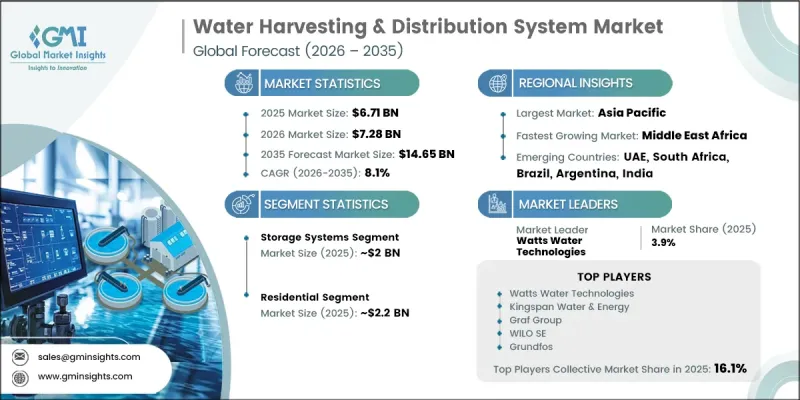
선진국과 개발도상국을 막론하고 지속 가능한 수자원 인프라에 대한 투자가 지속적으로 증가하고 있어, 전 세계 빗물 수집 및 배수 시스템 시장은 확대되고 있습니다. 수자원 관련 프로젝트에 대한 자금 조달은 공공 자금 프로그램, 인프라 투자 이니셔티브, 그리고 장기적인 물 안보 향상을 위한 민간 자본에 힘입어 점점 더 다양해지고 있습니다. 이러한 폭넓은 재정적 지원으로 인해 빗물 저류 및 배수 밸류체인 전반에 걸쳐 사업을 전개하는 제조업체, 기술 제공업체, 시스템 통합사업자에게 안정적인 비즈니스 기회가 창출되고 있습니다. 동시에, 첨단 디지털 기술의 급속한 도입으로 인해 기존의 물 인프라는 실시간 운영 인사이트를 제공할 수 있는 지능형 네트워크 시스템으로 변모하고 있습니다. IoT를 활용한 모니터링, 자동화된 유량 관리, AI를 활용한 분석을 통합함으로써 사업자는 시스템 성능을 향상시키고, 소비 패턴을 모니터링하며, 운영상의 이상을 파악하고, 수질 관리를 강화할 수 있게 됩니다. 이러한 첨단 기능은 물 손실 감소, 운영 효율성 향상, 규제 준수 강화 및 유지 관리 비용 절감에 기여합니다. 스마트 물 관리 솔루션에 대한 수요 증가와 지속적인 인프라 현대화가 맞물려 전 세계 집수 및 배수 시스템 시장의 장기적인 성장을 뒷받침할 것으로 예측됩니다.
| 시장 범위 | |
|---|---|
| 시작 연도 | 2025년 |
| 예측 기간 | 2026-2035년 |
| 시작 연도 시장 규모 | 67억 1,000만 달러 |
| 예측 금액 | 146억 5,000만 달러 |
| CAGR | 8.1% |
저수 시스템 부문은 2025년에 20억 달러의 매출을 기록했으며, 2026년부터 연평균 성장률(CAGR) 5.2%로 성장할 것으로 전망됩니다. 효율적인 저수는 지속 가능한 물 관리에 있어 여전히 중요한 요소이므로, 해당 부문은 전 세계 집수 및 배수 시스템 시장에서 계속해서 중요한 위치를 차지하고 있습니다. 주거, 상업, 산업 각 분야에서 신뢰할 수 있는 저수 인프라에 대한 수요가 증가하고 있어, 첨단 저수 기술에 대한 지속적인 투자를 뒷받침하고 있습니다. 시스템의 내구성, 저수 용량 및 운영 효율성 향상으로 인해 예측 기간 동안 해당 부문의 성장이 더욱 가속화될 것으로 예측됩니다.
상업 부문은 2025년에 29%의 시장 점유을을 차지했으며, 57억 달러에 달했습니다. 시장 확대는 지속 가능한 건축 방식의 보급, 기업의 환경 보호 노력 강화, 그리고 부지 내 물 관리 시스템에 대한 투자 증가에 의해 주도되고 있습니다. 수도 요금 급등과 자원 효율적 이용에 대한 중요성 증대가 맞물리면서, 상업용 부동산 소유주들은 장기적인 운영 효율을 높이고 전반적인 물 소비량을 줄이는 빗물 이용 솔루션에 대한 투자를 확대되고 있습니다.
2025년 기준, 미국의 빗물 이용 및 배수 시스템 시장은 85.5%의 점유율을 차지했습니다. 미국 시장 성장은 지속 가능한 물 관리 솔루션에 대한 수요 증가, 현대적인 물 인프라에 대한 투자 확대, 그리고 상업 및 공공시설 개발에서 빗물 이용 기술의 채택 확대에 힘입고 있습니다. 자원 보전, 인프라 현대화, 그리고 친환경 건설 방식에 대한 지속적인 중시 덕분에, 예측 기간 동안 미국은 지역 시장에서 주도적인 입지를 더욱 공고히할 것으로 예측됩니다.
자주 묻는 질문
목차
제1장 조사 방법과 범위
제2장 주요 요약
제3장 업계 인사이트
제4장 경쟁 구도
제5장 시장 규모 및 예측 : 시스템 유형별(2022-2035년)
제6장 시장 규모 및 예측 : 수확 방법별(2022-2035년)
제7장 시장 규모 및 예측 : 용도별(2022-2035년)
제8장 시장 규모 및 예측 : 지역별(2022-2035년)
제9장 기업 개요
KTH 26.08.20The Global Water Harvesting & Distribution System Market was valued at USD 6.71 billion in 2025 and is estimated to grow at a CAGR of 8.1% to reach USD 14.65 billion by 2035.
The global water harvesting & distribution system market is expanding as investments in sustainable water infrastructure continue to rise across both developed and developing economies. Funding for water-related projects is becoming increasingly diverse, supported by public financing programs, infrastructure investment initiatives, and private capital directed toward improving long-term water security. This broad financial support is creating a stable pipeline of opportunities for manufacturers, technology providers, and system integrators operating throughout the water harvesting and distribution value chain. At the same time, rapid adoption of advanced digital technologies is transforming conventional water infrastructure into intelligent network systems capable of delivering real-time operational insights. The integration of IoT-enabled monitoring, automated flow management, and AI-powered analytics allows operators to improve system performance, monitor consumption patterns, identify operational irregularities, and enhance water quality management. These advanced capabilities help reduce water losses, improve operational efficiency, strengthen regulatory compliance, and lower maintenance costs. Growing demand for smart water management solutions, combined with continued infrastructure modernization, is expected to support long-term expansion of the global water harvesting & distribution system market.
| Market Scope | |
|---|---|
| Start Year | 2025 |
| Forecast Year | 2026-2035 |
| Start Value | $6.71 Billion |
| Forecast Value | $14.65 Billion |
| CAGR | 8.1% |
The storage systems segment generated USD 2 billion in 2025 and is anticipated to grow at a CAGR of 5.2% between 2026 and 2035. The segment continues to hold a significant position in the global water harvesting & distribution system market as efficient water storage remains a critical component of sustainable water management. Increasing demand for dependable storage infrastructure across residential, commercial, and industrial applications is supporting continued investments in advanced storage technologies. Improvements in system durability, storage capacity, and operational efficiency are expected to further strengthen the segment's growth throughout the forecast period.
The commercial segment accounted for a 29% share in 2025 and is projected to reach USD 5.7 billion by 2035. Market expansion is being driven by increasing adoption of sustainable building practices, stronger environmental commitments among businesses, and rising investments in on-site water management systems. Higher water utility costs and growing emphasis on efficient resource utilization are also encouraging commercial property owners to invest in water harvesting solutions that improve long-term operational efficiency and reduce overall water consumption.
U.S. Water Harvesting & Distribution System Market accounted for an 85.5% share in 2025. The country's market growth is supported by increasing demand for sustainable water management solutions, expanding investments in modern water infrastructure, and growing adoption of water harvesting technologies across commercial and institutional developments. Continued emphasis on resource conservation, infrastructure modernization, and environmentally responsible construction practices is expected to reinforce the country's leadership within the regional market throughout the forecast period.
Major companies operating in the global water harvesting & distribution system market include Xylem Inc., Grundfos, WILO SE, Watts Water Technologies, Mueller Water Products, Itron Inc., Rain Bird Corporation, Sintex Industries Ltd., Graf Group, Kingspan Water & Energy, 3P Technik Filtersysteme GmbH, Bushmans Group, Pioneer Water Tanks Pty Ltd., CST Industries Inc., WaterGen Ltd., Uravu Labs, Stormsaver Ltd., Wahaso LLC, Aquacell Pty Ltd., Rainmaker Holland, and Majik Water. Companies operating in the water harvesting & distribution system market are strengthening their market position by investing in advanced water management technologies, expanding product portfolios, and integrating smart monitoring capabilities into their solutions. Manufacturers are focusing on digital innovation through IoT-enabled systems, automated controls, and data-driven analytics that improve operational efficiency and reduce water losses. Strategic partnerships with infrastructure developers, engineering firms, and government agencies are helping companies expand their project pipelines and strengthen regional market presence. Businesses are also increasing investments in research and development to improve system reliability, sustainability, and energy efficiency..
Table of Contents
Chapter 1 Methodology & Scope
- 1.1 Research approach
- 1.2 Quality Commitments
- 1.2.1 GMI AI policy & data integrity commitment
- 1.2.1.1 Source consistency protocol
- 1.2.1 GMI AI policy & data integrity commitment
- 1.3 Research Trail & Confidence Scoring
- 1.3.1 Research Trail Components
- 1.3.2 Scoring Components
- 1.4 Data Collection
- 1.4.1 Partial list of primary sources
- 1.5 Data mining sources
- 1.5.1 Paid sources
- 1.5.1.1 Sources, by region
- 1.5.1 Paid sources
- 1.6 Base estimates and calculations
- 1.6.1 Base year calculation for any one approach
- 1.7 Forecast model
- 1.7.1 Quantified market impact analysis
- 1.7.1.1 Mathematical impact of growth parameters on forecast
- 1.7.1 Quantified market impact analysis
- 1.8 Research transparency addendum
- 1.8.1 Source attribution framework
- 1.8.2 Quality assurance metrics
- 1.8.2.1 Our commitment to trust
Chapter 2 Executive Summary
- 2.1 Industry 360° synopsis, 2022 – 2035
- 2.2 Key market trends
- 2.2.1 Region
- 2.2.2 System Type
- 2.2.3 Harvesting Method
- 2.2.4 Application
Chapter 3 Industry Insights
- 3.1 Industry ecosystem analysis
- 3.2 Supply chain analysis
- 3.2.1 Key Raw Material Sourcing (Plastics, Concrete, Steel, Membranes)
- 3.2.2 Supply Chain Risk Assessment & Disruption Mapping
- 3.2.3 Nearshoring & Localization Trends in Manufacturing
- 3.3 Industry Impact Forces
- 3.3.1 Market drivers
- 3.3.1.1 Acute Global Water Scarcity Driven by Climate Change & Population Growth
- 3.3.1.2 Stringent Green Building Codes & Government Water Harvesting Mandates
- 3.3.1.3 Rising Demand for Water Self-Sufficiency in Agriculture & Industry
- 3.3.1.4 Declining System Costs & Improved Technology Accessibility
- 3.3.2 Market restraints
- 3.3.2.1 High Initial Capital Investment & Lifecycle Maintenance Costs
- 3.3.2.2 Shortage of Trained Installation & System Integration Professionals
- 3.3.3 Market opportunities
- 3.3.3.1 Smart IoT-Enabled Water Monitoring & Autonomous Distribution Systems
- 3.3.3.2 Rapid Urbanization & Smart City Infrastructure Projects in Emerging Markets
- 3.3.3.3 Integration with Net-Zero & Circular Water Economy Initiatives
- 3.3.3.4 Modular & Scalable System Designs for Decentralized Applications
- 3.3.1 Market drivers
- 3.4 Growth potential analysis
- 3.5 Technology & innovation landscape
- 3.5.1 Emerging Technologies in Water Harvesting
- 3.5.2 Smart Distribution & Automation Technologies
- 3.5.3 Material Innovations (Tanks, Pipes, Filtration Media)
- 3.5.4 Technology Readiness Level (TRL) Assessment
- 3.6 Regulatory framework
- 3.6.1 Global Water Conservation Regulations & Policies
- 3.6.2 Green Building Codes & LEED/BREEAM Requirements
- 3.6.3 Regional Regulatory Mandates (North America, Europe, Asia Pacific)
- 3.6.4 Product Certification & Compliance Standards (NSF, ISO)
- 3.7 Future market trends
- 3.8 Pricing analysis (driven by primary research)
- 3.8.1 Historical Price Trend Analysis (Driven by Primary Research)
- 3.8.2 Pricing Strategy by Player Type (Premium / Value / Cost-plus) (Driven by Primary Research)
- 3.8.3 Component-Level Price Benchmarking (Tanks, Pumps, Filters, Controls)
- 3.9 Trade data analysis (driven by primary research)
- 3.9.1 Import/Export Volume & Value Trends by Component Category (Driven by Primary Research)
- 3.9.2 Key Trade Corridors & Tariff Impact on System Cost (Driven by Primary Research)
- 3.10 Impact of AI & generative AI on the market
- 3.10.1 AI-Driven Disruption of Existing Business Models
- 3.10.2 GenAI Use Cases & Adoption Roadmap by Segment
- 3.10.2.1 Predictive Maintenance in Distribution Networks
- 3.10.2.2 AI-Optimized System Design & Sizing
- 3.10.2.3 Smart Leak Detection & Water Quality Monitoring
- 3.10.3 Risks, Limitations & Regulatory Considerations
- 3.11 Porter’s analysis
- 3.12 PESTEL analysis
Chapter 4 Competitive Landscape, 2025
- 4.1 Introduction
- 4.2 Company market share analysis
- 4.2.1 By Region
- 4.2.1.1 North America
- 4.2.1.2 Europe
- 4.2.1.3 Asia Pacific
- 4.2.1.4 Latin America
- 4.2.1.5 Middle East and Africa
- 4.2.1 By Region
- 4.3 Company matrix analysis
- 4.4 Competitive analysis of major market players
- 4.5 Competitive positioning matrix
- 4.6 Key developments
- 4.6.1 Mergers & acquisitions
- 4.6.2 Partnerships & collaborations
- 4.6.3 New product launches
- 4.6.4 Expansion plans
Chapter 5 Market Estimates and Forecast, By System Type, 2022 - 2035 (USD Billion)
- 5.1 Key Trends
- 5.2 Collection & Catchment Systems
- 5.2.1 Gutter & Downspout Systems
- 5.2.2 Conveyance Channels & Swales
- 5.2.3 First-Flush Diverter Systems
- 5.2.4 Flat Roof & Green Roof Collection Systems
- 5.3 Storage Systems
- 5.3.1 Above-Ground Tanks
- 5.3.1.1 Polyethylene Tanks
- 5.3.1.2 Steel Tanks
- 5.3.1.3 Fiberglass Tanks
- 5.3.2 Underground Cisterns & Modular Storage
- 5.3.2.1 Concrete Cisterns
- 5.3.2.2 Modular Plastic Crate Systems
- 5.3.3 Retention & Detention Ponds
- 5.3.1 Above-Ground Tanks
- 5.4 Filtration & Treatment Systems
- 5.4.1 Sediment & Screen Filters
- 5.4.2 Activated Carbon Filters
- 5.4.3 UV Purification Units
- 5.4.4 Membrane Filtration Systems
- 5.4.5 Multi-Stage Treatment Units
- 5.5 Distribution Systems
- 5.5.1 Pumps (Submersible, Centrifugal, Pressure-Boosting)
- 5.5.2 Pipes, Valves & Fittings
- 5.5.3 Pressure Regulation & Flow Control Devices
- 5.5.4 Water Meters & Metering Infrastructure
- 5.6 Monitoring & Control Systems
- 5.6.1 IoT Sensors & Remote Monitoring Platforms
- 5.6.2 SCADA & Automated Control Systems
- 5.6.3 Water Quality Monitoring Devices
- 5.6.4 Smart Leak Detection Systems
Chapter 6 Market Estimates and Forecast, By Harvesting Method, 2022 - 2035 (USD Billion)
- 6.1 Key Trends
- 6.2 Rooftop Rainwater Harvesting
- 6.2.1 Residential Rooftop Systems
- 6.2.2 Commercial & Institutional Rooftop Systems
- 6.2.3 Industrial Rooftop Systems
- 6.3 Surface Runoff Harvesting
- 6.3.1 Open Drainage Collection Systems
- 6.3.2 Paved Catchment (Roads, Parking Lots) Systems
- 6.3.3 Unpaved & Agricultural Catchment Systems
- 6.3.4 Retention & Detention Basin Systems
- 6.4 Stormwater Harvesting
- 6.4.1 Urban Stormwater Capture & Reuse Systems
- 6.4.2 Stormwater Treatment & Filtration Integration
- 6.4.3 Stormwater Harvesting for Non-Potable Reuse
- 6.5 Fog & Dew Collection
- 6.5.1 Mesh-Based Fog Collector Arrays
- 6.5.2 Radiative Cooling Dew Condensation Systems
- 6.5.3 Regional Deployment (MENA, Sub-Saharan Africa, Coastal Arid Zones)
- 6.6 Hybrid Systems
- 6.6.1 Integrated Rooftop & Surface Collection Systems
- 6.6.2 Rainwater Harvesting with Groundwater Recharge Systems
- 6.6.3 Smart Monitoring-Enabled Combined Catchment Systems
Chapter 7 Market Estimates and Forecast, By Application, 2022 - 2035 (USD Billion)
- 7.1 Key Trends
- 7.2 Residential
- 7.2.1 Single-Family Homes
- 7.2.2 Multi-Family & Apartment Complexes
- 7.2.3 Luxury & Custom Residential (Premium Systems)
- 7.3 Commercial
- 7.3.1 Office Buildings & Corporate Campuses
- 7.3.2 Hotels & Hospitality
- 7.3.3 Educational Institutions (Schools, Universities)
- 7.3.4 Healthcare Facilities & Hospitals
- 7.3.5 Retail Centers & Shopping Complexes
- 7.4 Industrial
- 7.4.1 Manufacturing Plants & Processing Facilities
- 7.4.2 Data Centers (Cooling Water Reuse)
- 7.4.3 Logistics & Warehousing Complexes
- 7.5 Agricultural
- 7.5.1 Open Field Irrigation Systems
- 7.5.2 Greenhouse & Controlled-Environment Agriculture
- 7.5.3 Livestock & Aquaculture Facilities
- 7.5.4 Municipal & Government
- 7.5.5 Public Building & Infrastructure Projects
- 7.5.6 Urban Water Management & Smart City Programs
- 7.5.7 Emergency & Disaster Relief Water Supply Systems
Chapter 8 Market Estimates & Forecast, By Region, 2022 – 2035, (USD Billion)
- 8.1 Key trends
- 8.2 North America
- 8.2.1 U.S.
- 8.2.2 Canada
- 8.3 Europe
- 8.3.1 Germany
- 8.3.2 U.K.
- 8.3.3 France
- 8.3.4 Italy
- 8.3.5 Spain
- 8.4 Asia Pacific
- 8.4.1 China
- 8.4.2 India
- 8.4.3 Japan
- 8.4.4 South Korea
- 8.4.5 Australia
- 8.5 Latin America
- 8.5.1 Brazil
- 8.5.2 Mexico
- 8.5.3 Argentina
- 8.6 MEA
- 8.6.1 UAE
- 8.6.2 Saudi Arabia
- 8.6.3 South Africa
Chapter 9 Company Profiles
- 9.1 Global Leader
- 9.1.1 Xylem Inc
- 9.1.2 Grundfos
- 9.1.3 WILO SE
- 9.1.4 Watts Water Technologies
- 9.1.5 Mueller Water Products
- 9.1.6 Itron Inc.
- 9.1.7 Rain Bird Corporation
- 9.2 Regional Players
- 9.2.1 Sintex Industries Ltd
- 9.2.2 Graf Group
- 9.2.3 Kingspan Water & Energy
- 9.2.4 3P Technik Filtersysteme GmbH
- 9.2.5 Bushmans Group
- 9.2.6 Pioneer Water Tanks Pty Ltd
- 9.2.7 CST Industries Inc.
- 9.3 Emerging Players
- 9.3.1 WaterGen Ltd
- 9.3.2 Uravu Labs
- 9.3.3 Stormsaver Ltd
- 9.3.4 Wahaso LLC
- 9.3.5 Aquacell Pty Ltd
- 9.3.6 Rainmaker Holland
- 9.3.7 Majik Water

(주말 및 공휴일 제외)


