

|
시장보고서
상품코드
2109231
상업용 및 집합주택용 히트펌프 시장 기회, 성장요인, 업계 동향 분석 및 예측(2026-2035년)Commercial and Multi-Family Heat Pump Market Opportunity, Growth Drivers, Industry Trend Analysis, and Forecast 2026 - 2035 |
||||||

세계의 상업용 및 집합주택용 히트펌프 시장은 2025년에 298억 달러로 평가되었고, 2035년까지 연평균 복합 성장률(CAGR) 14.3%로 성장하여 1,109억 달러에 이를 것으로 추정되고 있습니다.
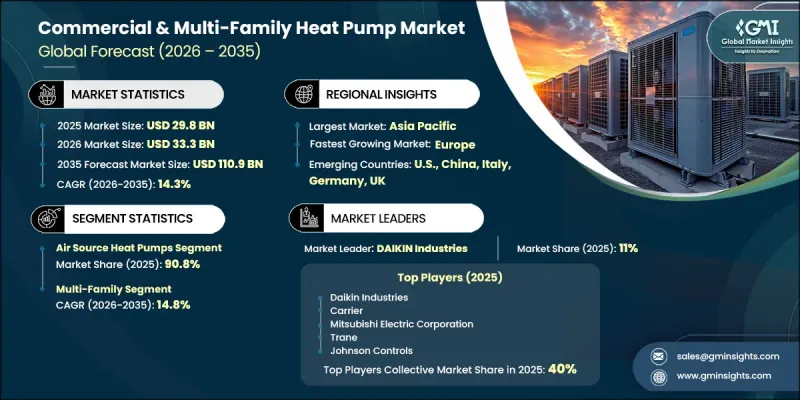
규제 체계가 저배출형 건축 기술을 점점 더 뒷받침하는 한편, 장기적인 지속가능성 목표가 건설 업계 전반의 투자 판단을 재편함에 따라 시장 성장은 계속해서 가속화되고 있습니다. 재정 지원 정책을 통해 프로젝트의 경제성이 더욱 향상되어, 신규 개발 및 개보수 프로젝트 모두에서 히트 펌프 시스템의 도입이 광범위하게 촉진되고 있습니다. 또한 지속적인 기술 혁신을 통해 시스템의 효율성, 신뢰성 및 연중 가동 능력이 강화되면서, 히트펌프는 대규모 건축 용도에서 점점 더 매력적인 솔루션으로 자리 잡고 있습니다. 더불어 운영비 절감, 에너지 효율 향상, 그리고 지속적으로 발전하는 건축 성능 기준 준수가 더욱 중요시되면서 시장 확장을 지속적으로 뒷받침하고 있습니다. 지속적인 제품 혁신, 장비의 접근성 확대, 그리고 전기 난방 솔루션에 대한 투자 증가가 맞물려 예측 기간 동안 업계의 지속적인 성장에 유리한 여건을 조성하고 있으며, 상업용 및 공동주택용 히트펌프 시장은 장기적으로 상당한 성장이 예상됩니다. 재정적 인센티브 프로그램, 세제 혜택, 그리고 체계적인 보조금 제도를 통해 히트 펌프 시스템의 총 도입 비용이 대폭 낮아지면서 북미 및 서유럽 전역에서 보급이 가속화되고 있습니다. 동시에, 히트펌프 기술이 지능형 빌딩 제어 플랫폼에 통합됨에 따라 상업용 부동산 소유주의 운영 효율성이 획기적으로 향상되었습니다. 첨단 제어 플랫폼을 통해 중앙 집중식 에너지 관리 시스템과의 원활한 연동이 가능해졌으며, 건물 운영자는 자동화된 운영 제어를 통해 설비 성능 향상, 에너지 소비 최적화 및 시스템 전반의 효율 향상을 실현할 수 있게 되었습니다.
| 시장 범위 | |
|---|---|
| 개시 연도 | 2025년 |
| 예측 기간 | 2026-2035년 |
| 개시 연도 시장 규모 | 298억 달러 |
| 예측액 | 1,109억 달러 |
| CAGR | 14.3% |
공기원 열펌프(ASHP) 부문은 2025년에 90.8%의 점유율을 차지할 것으로 예상되며, 2035년까지 연평균 성장률(CAGR) 14.8%로 성장할 것으로 전망됩니다. 이 시장의 주도적 지위는 설치 요건의 간소화, 생산 규모 확대를 통한 제조 비용의 지속적인 절감, 그리고 더 광범위한 운전 조건에서의 성능 지속적 향상에 힘입어 유지되고 있습니다. 이러한 장점 덕분에 전 세계 상업시설 및 공동 주택에서의 공기원 기술 도입이 지속적으로 촉진되고 있습니다.
다세대 주택용도 부문은 2025년에 49.9%를 차지할 것으로 예상되며, 2035년까지 연평균 성장률(CAGR) 14.8%로 성장할 것으로 전망됩니다. 시장 확대는 북미 및 아시아태평양의 주택 개발 활동 증가와 밀접한 관련이 있으며, 이는 더욱 엄격해진 에너지 효율 요건과 완전 전기화 건축 설계의 채택 확대에 힘입은 것입니다. 이러한 장기적인 건설 동향은 주택 부문 전반에 걸쳐 히트펌프 설치에 대한 견조한 수요를 지속적으로 창출하고 있습니다.
북미의 상업용 및 다세대 주택용 히트펌프 시장은 2025년에 21.9%의 점유율을 차지할 것으로 예상되며, 2035년까지 연평균 성장률(CAGR) 8.1%로 확대될 것으로 전망됩니다. 미국은 유리한 정부 인센티브 프로그램, 진화하는 건축 규정, 그리고 상업용 및 주거용 건물 전반에 걸쳐 에너지 효율이 높은 난방 기술의 도입을 촉진하는 광범위한 정책 이니셔티브에 힘입어, 계속해서 이 지역 내 최대 수요원으로 자리매김하고 있습니다.
세계 상업용 및 공동주택용 히트펌프 시장에서 사업을 전개하는 주요 기업으로는 보쉬 써모테크놀로지, 캐리어, 다이킨 공업, 후지쯔 제너럴, 글렌 딤플렉스 그룹, 그리 일렉트릭 어플라이언스, 존슨 컨트롤스, 켄사 히트펌프, 레녹스, LG전자, 로킨버, 미데아(Midea), 미쓰비시 전기, 니베 인더스트리 AB, 옥스너, Panasonic Corporation, 림 매뉴팩처링, 삼성, 슈티벨 엘트론 GmbH & Co. KG, 트레인, 그리고 바이란트 그룹 등이 있습니다. 상업용 및 공동주택용 히트펌프 시장에서 사업을 전개하는 각 기업은 제품 혁신을 최우선으로 하고, 제조 능력을 확대하며, 전체 제품 포트폴리오의 에너지 효율을 향상시킴으로써 시장 내 입지를 지속적으로 강화하고 있습니다. 많은 제조업체들이 시스템 성능 향상, 운영 비용 절감, 그리고 변화하는 규제 요건에 대응하기 위해 첨단 히트펌프 기술에 투자하고 있습니다. 유통업체, 시공업체, 기술 제공업체와의 전략적 제휴는 기업이 시장 내 영향력을 확대하는 동시에 고객 지원 체계를 강화하는 데 도움이 되고 있습니다. 또한 각 기업은 제품의 신뢰성, 디지털 연결성 및 시스템 전반의 지능화를 향상시키기 위해 연구 개발에 대한 투자도 늘리고 있습니다.
자주 묻는 질문
목차
제1장 조사 방법과 범위
제2장 주요 요약
제3장 업계 인사이트
제4장 경쟁 구도
제5장 시장 규모와 예측 : 제품별, 2022년-2035년
제6장 시장 규모와 예측 : 용도별, 2022년-2035년
제7장 시장 규모와 예측 : 설치 형태별, 2022년-2035년
제8장 시장 규모와 예측 : 지역별, 2022년-2035년
제9장 기업 개요
LSH 26.08.14The Global Commercial & Multi-Family Heat Pump Market was valued at USD 29.8 billion in 2025 and is estimated to grow at a CAGR of 14.3% to reach USD 110.9 billion by 2035.
Market growth continues to accelerate as regulatory frameworks increasingly support low-emission building technologies while long-term sustainability objectives reshape investment decisions throughout the construction sector. Financial support mechanisms have further improved project economics, encouraging broader deployment of heat pump systems across both new developments and retrofit projects. Ongoing technological advancements have also strengthened system efficiency, reliability, and year-round operating capabilities, making heat pumps an increasingly attractive solution for large-scale building applications. In addition, greater emphasis on reducing operating expenses, improving energy efficiency, and complying with evolving building performance standards continues to reinforce market expansion. Continuous product innovation, wider equipment availability, and rising investments in electrified heating solutions are collectively creating favorable conditions for sustained industry growth throughout the forecast timeline, positioning the commercial & Multi-Family Heat Pump Market for significant long-term expansion. Financial incentive programs, tax benefits, and structured subsidy initiatives have significantly lowered the overall cost of installing heat pump systems, accelerating adoption across North America and Western Europe. At the same time, the incorporation of heat pump technologies into intelligent building control platforms has transformed operational efficiency for commercial property owners. Advanced control platforms now enable seamless communication with centralized energy management systems, allowing building operators to improve equipment performance, optimize energy consumption, and enhance overall system efficiency through automated operational control.
| Market Scope | |
|---|---|
| Start Year | 2025 |
| Forecast Year | 2026-2035 |
| Start Value | $29.8 Billion |
| Forecast Value | $110.9 Billion |
| CAGR | 14.3% |
The air source heat pumps (ASHPs) segment captured a 90.8% share in 2025 and is forecast to grow at a 14.8% CAGR through 2035. Their market leadership is supported by simplified installation requirements, continued reductions in manufacturing costs through production scale, and ongoing improvements in performance across a wider range of operating conditions. These advantages continue to strengthen the adoption of air source technologies across commercial and multi-family applications worldwide.
The multi-family application segment accounted for 49.9% in 2025 and is forecast to grow at 14.8% CAGR through 2035. Market expansion remains closely associated with increasing residential development activity across North America and Asia Pacific, supported by stricter energy efficiency requirements and growing adoption of fully electrified building designs. These long-term construction trends continue to generate favorable demand for heat pump installations throughout the residential sector.
North America Commercial & Multi-Family Heat Pump Market held 21.9% share in 2025 and is expected to expand at a CAGR of 8.1% through 2035. The United States continues to represent the largest source of regional demand, supported by favorable government incentive programs, evolving construction regulations, and broader policy initiatives that encourage the deployment of energy-efficient heating technologies across commercial and residential buildings.
The leading companies operating in the global commercial & multi-family heat pump market include Bosch Thermotechnology Corp., Carrier, DAIKIN INDUSTRIES, FUJITSU GENERAL, Glen Dimplex Group, Gree Electric Appliances, Johnson Controls, Kensa Heat Pumps, Lennox, LG Electronics, Lochinvar, Midea, Mitsubishi Electric Corporation, NIBE Industrier AB, OCHSNER, Panasonic Corporation, Rheem Manufacturing, SAMSUNG, STIEBEL ELTRON GmbH & Co. KG, Trane, and Vaillant Group. Companies operating in the commercial & multi-family heat pump market continue to strengthen their market position by prioritizing product innovation, expanding manufacturing capabilities, and improving energy efficiency across their product portfolios. Many manufacturers are investing in advanced heat pump technologies designed to enhance system performance, reduce operating costs, and support evolving regulatory requirements. Strategic partnerships with distributors, contractors, and technology providers are helping companies expand market reach while strengthening customer support networks. Businesses are also increasing investments in research and development to improve product reliability, digital connectivity, and overall system intelligence.
Table of Contents
Chapter 1 Methodology & Scope
- 1.1 Research approach
- 1.2 Quality commitments
- 1.2.1 GMI AI policy & data integrity commitment
- 1.2.1.1 Source consistency protocol
- 1.2.1 GMI AI policy & data integrity commitment
- 1.3 Research trail & confidence scoring
- 1.3.1 Research trail components
- 1.3.2 Scoring components
- 1.4 Data collection
- 1.4.1 Partial list of primary sources
- 1.5 Data mining sources
- 1.5.1 Paid sources
- 1.5.1.1 Sources, by region
- 1.5.1 Paid sources
- 1.6 Base estimates and calculations
- 1.6.1 Base year calculation for any one approach
- 1.7 Market estimates & forecasts parameters
- 1.8 Forecast model
- 1.8.1 Quantified market impact analysis
- 1.8.1.1 Mathematical impact of growth parameters on forecast
- 1.8.1 Quantified market impact analysis
- 1.9 Research transparency addendum
- 1.9.1 Source attribution framework
- 1.9.2 Quality assurance metrics
- 1.9.3 Our commitment to trust
- 1.10 Market definitions
Chapter 2 Executive Summary
- 2.1 Industry synopsis, 2022 - 2035
- 2.1.1 Business trends
- 2.1.2 Product trends
- 2.1.3 Application trends
- 2.1.4 Installation trends
- 2.1.5 Regional trends
Chapter 3 Industry Insights
- 3.1 Industry ecosystem analysis
- 3.1.1 Raw material & component sourcing analysis
- 3.1.2 Factors affecting the value chain
- 3.1.3 Disruptions
- 3.2 Regulatory landscape
- 3.2.1 North America
- 3.2.2 Europe
- 3.2.3 Asia Pacific
- 3.2.4 Middle East & Africa
- 3.2.5 Latin America
- 3.3 Industry impact forces
- 3.3.1 Growth drivers
- 3.3.1.1 Accelerating building decarbonization mandates
- 3.3.1.2 Encouraging financial incentive programs
- 3.3.1.3 Expanding cold-climate performance capabilities
- 3.3.1.4 Rising commercial construction and urban housing development
- 3.3.2 Industry pitfalls and challenges
- 3.3.2.1 High upfront capital cost
- 3.3.2.2 Limited availability of skilled professionals coupled with limited adoption in long-standing buildings
- 3.3.1 Growth drivers
- 3.4 Growth potential analysis
- 3.5 Technology and innovation landscape
- 3.5.1 Current technological trends
- 3.6 Porter's analysis
- 3.6.1 Bargaining power of suppliers
- 3.6.2 Bargaining power of buyers
- 3.6.3 Threat of new entrants
- 3.6.4 Threat of substitute
- 3.6.5 Intensity of competitive rivalry
- 3.7 PESTEL analysis
- 3.7.1 Political factors
- 3.7.2 Economic factors
- 3.7.3 Social factors
- 3.7.4 Technological factors
- 3.7.5 Environmental factors
- 3.7.6 Legal factors
- 3.8 Cost structure analysis of commercial & multi-family heat pump (Driven by Primary Research)
- 3.9 Price trend analysis, 2022-2035 (USD/Unit) (Driven by Primary Research)
- 3.9.1 By product
- 3.9.2 By region
- 3.10 Impact of AI and generative AI on the market (Driven by primary research)
- 3.10.1 AI-driven disruption of existing business models
- 3.10.2 GenAI use cases & adoption roadmap by segment
- 3.10.3 Risks, limitations & regulatory considerations
- 3.11 Emerging opportunities & trends
- 3.12 Digitalization and IoT integration
- 3.13 Investment analysis & future outlook
Chapter 4 Competitive Landscape, 2026
- 4.1 Introduction
- 4.2 Company market share analysis, by region, 2025
- 4.2.1 North America
- 4.2.2 Europe
- 4.2.3 Asia Pacific
- 4.2.4 Middle East & Africa
- 4.2.5 Latin America
- 4.3 Competitive analysis of major market players
- 4.4 Competitive positioning matrix
- 4.5 Key developments
- 4.5.1 Mergers & acquisitions
- 4.5.2 Partnerships & collaborations
- 4.5.3 New product launches
- 4.5.4 Expansion plans and funding
- 4.6 Company tier benchmarking
- 4.6.1 Tier classification criteria & qualifying thresholds
- 4.6.2 Tier positioning matrix by revenue, geography & innovation
Chapter 5 Market Size and Forecast, By Product, 2022 - 2035 (USD Million, '000 Units)
- 5.1 Key trends
- 5.2 Air source
- 5.3 Ground source
- 5.4 Water source
Chapter 6 Market Size and Forecast, By Application, 2022 - 2035 (USD Million, '000 Units)
- 6.1 Key trends
- 6.2 Multi family
- 6.3 Commercial
- 6.3.1 Education
- 6.3.2 Healthcare
- 6.3.3 Retail
- 6.3.4 Logistics & transportation
- 6.3.5 Offices
- 6.3.6 Hospitality
- 6.3.7 Others
Chapter 7 Market Size and Forecast, By Installation, 2022 - 2035 (USD Million, '000 Units)
- 7.1 Key trends
- 7.2 New construction
- 7.3 Retrofit
Chapter 8 Market Size and Forecast, By Region, 2022 - 2035 (USD Million, '000 Units)
- 8.1 Key trends
- 8.2 North America
- 8.2.1 U.S.
- 8.2.2 Canada
- 8.3 Europe
- 8.3.1 Austria
- 8.3.2 Norway
- 8.3.3 Denmark
- 8.3.4 Finland
- 8.3.5 France
- 8.3.6 Germany
- 8.3.7 Italy
- 8.3.8 Switzerland
- 8.3.9 Spain
- 8.3.10 Sweden
- 8.3.11 UK
- 8.3.12 Netherlands
- 8.4 Asia Pacific
- 8.4.1 China
- 8.4.2 Japan
- 8.4.3 Australia
- 8.4.4 South Korea
- 8.5 Middle East & Africa
- 8.5.1 Saudi Arabia
- 8.5.2 Turkey
- 8.5.3 South Africa
- 8.6 Latin America
- 8.6.1 Brazil
- 8.6.2 Mexico
- 8.6.3 Argentina
Chapter 9 Company Profiles
- 9.1 Bosch Thermotechnology Corp.
- 9.2 Carrier
- 9.3 DAIKIN INDUSTRIES
- 9.4 FUJITSU GENERAL
- 9.5 Glen Dimplex Group
- 9.6 Gree Electric Appliances
- 9.7 Johnson Controls
- 9.8 Kensa Heat Pumps
- 9.9 Lennox
- 9.10 LG Electronics
- 9.11 Lochinvar
- 9.12 Midea
- 9.13 Mitsubishi Electric Corporation
- 9.14 NIBE Industrier AB
- 9.15 OCHSNER
- 9.16 Panasonic Corporation
- 9.17 Rheem Manufacturing
- 9.18 SAMSUNG
- 9.19 STIEBEL ELTRON GmbH & Co. KG
- 9.20 Trane
- 9.21 Vaillant Group


