|
시장보고서
상품코드
2109234
BFS(Blow-Fill-Seal Packaging) 패키징 시장 비즈니스 기회, 성장요인, 업계 동향 분석 및 예측(2026-2035년)Blow-Fill-Seal (BFS) Packaging Market Opportunity, Growth Drivers, Industry Trend Analysis, and Forecast 2026 - 2035 |
||||||

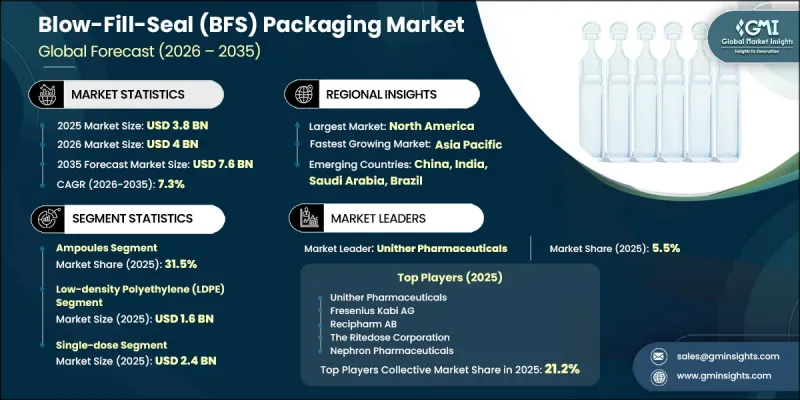
세계의 BFS(Blow-Fill-Seal Packaging) 패키징 시장은 2025년에 38억 달러로 평가되었고, CAGR 7.3%로 성장하여 2035년까지 76억 달러에 이를 것으로 예측됩니다.
제약 제조업체들이 첨단 포장 기술에 대한 투자를 지속적으로 확대함에 따라, 전 세계 블로우-필-씰(BFS) 포장 산업은 성장하고 있습니다. 무균 의약품 포장에 대한 수요 증가, 제조 품질 기준의 엄격화, 방부제 미사용 및 단일 투여형 의약품 형태에 대한 선호도 상승이 시장 성장을 뒷받침하고 있습니다. 바이오의약품, 백신 및 기타 무균 의약품의 생산 증가로 인해, 제조, 운송, 보관의 전 과정에 걸쳐 제품의 무결성을 유지할 수 있는 신뢰성 높은 포장 솔루션에 대한 지속적인 수요가 발생하고 있습니다. 또한, 업계에서 경량이며 친환경적인 포장재에 대한 관심이 높아지고 있는 점도 BFS 기술의 보급을 뒷받침하고 있습니다. 무균 제조 공정과 자동화의 지속적인 개선은 생산 효율을 높이는 동시에 오염 위험을 줄임으로써 시장을 더욱 강화하고 있습니다. 제품 품질과 무균 제조 관행에 대한 규제 당국의 지속적인 강조로 인해 첨단 BFS 포장 시스템에 대한 투자가 가속화되고 있으며, 제약 업계 전반에 걸쳐 전 세계 블로우-필-씰(BFS) 포장 시장은 장기적인 지속적 성장 궤도에 올라 있습니다.
| 시장 범위 | |
|---|---|
| 개시 연도 | 2025년 |
| 예측 기간 | 2026-2035년 |
| 초기 시장 규모 | 38억 달러 |
| 예측액 | 76억 달러 |
| CAGR | 7.3% |
블로우-필-씰(BFS) 포장 시장은 여러 치료 분야에서 무균 의약품 포장에 대한 수요가 증가함에 따라 계속해서 성장세를 보이고 있습니다. 각 제조업체는 공급망 전반에 걸쳐 제품의 품질을 유지하면서 신뢰할 수 있는 무균 보호 기능을 제공하는 포장 기술을 우선시하고 있습니다. 동시에, 무균 제조 공정 및 오염 관리에 관한 규제 요건이 강화됨에 따라 첨단 BFS 포장 기술의 도입이 더욱 촉진되고 있습니다. 공정 검증, 제조 효율성 및 고품질 무균 생산 능력에 대한 지속적인 투자가 전 세계 블로우-필-씰(BFS) 포장 산업의 확장을 더욱 뒷받침하고 있습니다.
2025년에는 앰플 부문이 31.5%의 점유율을 차지했습니다. 이 포장 형태는 높은 무균성과 제품 보호를 실현하면서도 안전한 1회 투여용 포장을 제공하기 때문에 계속해서 주도적인 위치를 유지하고 있습니다. 외부 오염에 대한 뛰어난 차단 성능, 제품 안정성 연장, 대규모 무균 제조 공정과의 호환성이 이 포장 방식의 광범위한 채택을 지속적으로 뒷받침하고 있습니다. 또한, 엄격한 의약품 포장 기준을 충족하는 능력 역시 업계 전반에 걸쳐 앰플 기반 BFS 포장 솔루션에 대한 수요를 강화하고 있습니다.
저밀도 폴리에틸렌(LDPE) 부문은 2025년에 16억 달러 시장 규모를 기록했습니다. LDPE는 뛰어난 유연성, 내화학성, 충전 용이성 및 BFS 제조 공정과의 적합성으로 인해 여전히 선호되는 소재입니다. 무균 포장 상태를 유지하는 입증된 성능과 비용 효율적인 대규모 생산 능력이 결합되어, 전반적인 의약품 포장 용도에서 폭넓은 채택을 지속적으로 뒷받침하고 있습니다. 규제 당국의 지속적인 승인 및 신뢰할 수 있는 가공 특성은 전 세계 블로우-필-씰(BFS) 포장 시장에서 LDPE의 선도적 지위를 더욱 공고히 하고 있습니다.
2025년, 북미의 블로우-필-씰(BFS) 포장 시장은 33.1%의 점유율을 차지했습니다. 지역 시장의 성장은 견고한 의약품 제조거점, 엄격한 품질 기준, 그리고 무균 의약품 포장 솔루션에 대한 수요 증가에 힘입고 있습니다. 첨단 무균 제조 기술에 대한 지속적인 투자와 무균 의약품 생산 확대에 힘입어, 이 지역 전체에서 BFS 포장 시스템에 대한 수요는 계속해서 증가하고 있습니다. 지원적인 규제 체계와 의약품 제조 시설의 지속적인 현대화 또한 북미 전역에서 시장의 지속적인 확장에 더욱 기여하고 있습니다.
자주 묻는 질문
목차
제1장 조사 방법과 범위
제2장 주요 요약
제3장 업계 인사이트
제4장 경쟁 구도
제5장 시장 추산 및 예측 : 컨테이너 유형별, 2022년-2035년
제6장 시장 추산 및 예측 : 소재별, 2022년-2035년
제7장 시장 추산 및 예측 : 제형별, 2022년-2035년
제8장 시장 추산 및 예측 : 용도별, 2022년-2035년
제9장 시장 추산 및 예측 : 최종 이용 산업별, 2022년-2035년
제10장 시장 추산 및 예측 : 지역별, 2022년-2035년
제11장 기업 개요
LSHThe Global Blow-Fill-Seal Packaging Market was valued at USD 3.8 billion in 2025 and is estimated to grow at a CAGR of 7.3% to reach USD 7.6 billion by 2035.
The global blow-fill-seal packaging industry is expanding as pharmaceutical manufacturers continue to increase investments in advanced sterile packaging technologies. Rising demand for aseptic drug packaging, stricter manufacturing quality standards, and the growing preference for preservative-free and single-dose drug delivery formats are supporting market growth. Increasing production of biologics, vaccines, and other sterile pharmaceutical products is creating sustained demand for reliable packaging solutions capable of maintaining product integrity throughout manufacturing, transportation, and storage. In addition, the industry's growing focus on lightweight and environmentally responsible packaging materials is encouraging wider adoption of BFS technology. Continuous improvements in aseptic manufacturing processes and automation are further strengthening the market by enhancing production efficiency while reducing contamination risks. Ongoing regulatory emphasis on product quality and sterile manufacturing practices is accelerating investment in advanced BFS packaging systems, positioning the global blow-fill-seal packaging market for sustained long-term growth across the pharmaceutical industry.
| Market Scope | |
|---|---|
| Start Year | 2025 |
| Forecast Year | 2026-2035 |
| Start Value | $3.8 Billion |
| Forecast Value | $7.6 Billion |
| CAGR | 7.3% |
The blow-fill-seal packaging market continues to gain momentum due to increasing demand for sterile pharmaceutical packaging across multiple therapeutic applications. Manufacturers are prioritizing packaging technologies that provide reliable aseptic protection while maintaining product quality throughout the supply chain. At the same time, stricter regulatory expectations surrounding sterile manufacturing processes and contamination control are encouraging greater adoption of advanced BFS packaging technologies. Continuous investments in process validation, manufacturing efficiency, and high-quality aseptic production capabilities are further supporting expansion of the global blow-fill-seal packaging industry.
The ampoules segment accounted for a 31.5% share in 2025. This packaging format continues to maintain its leading position because it provides secure unit-dose packaging while supporting high levels of sterility and product protection. Strong barrier performance against external contamination, extended product stability, and compatibility with large-scale aseptic manufacturing processes continue to support widespread adoption. The ability to satisfy rigorous pharmaceutical packaging standards also strengthens demand for ampoule-based BFS packaging solutions across the industry.
The low-density polyethylene (LDPE) segment captured USD 1.6 billion in 2025. LDPE remains the preferred material because of its excellent flexibility, chemical resistance, ease of dispensing, and compatibility with BFS manufacturing processes. Its proven performance in maintaining sterile packaging conditions, combined with cost-effective large-scale production capabilities, continues to support broad adoption across pharmaceutical packaging applications. Continued regulatory acceptance and reliable processing characteristics further reinforce LDPE's leadership within the global blow-fill-seal packaging market.
North America Blow-Fill-Seal Packaging Market held a 33.1% share in 2025. Regional market growth is supported by a strong pharmaceutical manufacturing base, rigorous quality standards, and increasing demand for sterile drug packaging solutions. Ongoing investment in advanced aseptic manufacturing technologies and expanding production of sterile pharmaceutical products continue to strengthen demand for BFS packaging systems throughout the region. Supportive regulatory frameworks and continued modernization of pharmaceutical manufacturing facilities are further contributing to sustained market expansion across North America.
Prominent companies operating in the global blow-fill-seal packaging market include Adragos Pharma, Amanta Healthcare Ltd., Asept Pak Inc., BioCina, Birgi Mefar Group (Mefar), CDM Lavoisier, Curida AS, Fresenius Kabi AG, GlaxoSmithKline plc (GSK), Horizon Pharmaceuticals Inc., Jubilant Pharma, Nanjing Aureole Pharmaceutical Co., Ltd., Nephron Pharmaceuticals, Recipharm AB, Rommelag GmbH & Co. KG, Sentiss Pharma Pvt. Ltd., The Ritedose Corporation, Unicep Packaging LLC, Unither Pharmaceuticals, and Woodstock Sterile Solutions. Companies operating in the blow-fill-seal packaging market are strengthening their market position by investing in advanced aseptic manufacturing technologies, expanding production capacity, and enhancing packaging quality to meet evolving pharmaceutical requirements. Many manufacturers are focusing on product innovation, automation, and process optimization to improve operational efficiency while maintaining strict sterility standards. Strategic collaborations with pharmaceutical companies, contract manufacturing organizations, and healthcare providers are helping expand customer reach and accelerate commercialization of new packaging solutions. Businesses are also increasing investments in sustainable packaging materials, regulatory compliance, and research and development to improve product performance.
Table of Contents
Chapter 1 Methodology and Scope
- 1.1 Market scope and definition
- 1.2 Research design
- 1.2.1 Research approach
- 1.2.2 Data collection methods
- 1.3 Data mining sources
- 1.3.1 Global
- 1.3.2 Regional/Country
- 1.4 Base estimates and calculations
- 1.4.1 Base year calculation
- 1.4.2 Key trends for market estimation
- 1.5 Primary research and validation
- 1.5.1 Primary sources
- 1.6 Forecast model
- 1.7 Research assumptions and limitations
Chapter 2 Executive Summary
- 2.1 Industry 360° synopsis, 2022 – 2035
- 2.2 Key market trends
- 2.2.1 Container type trends
- 2.2.2 Material type trends
- 2.2.3 Dosage type trends
- 2.2.4 Application trends
- 2.2.5 End-use industry trends
- 2.2.6 Regional trends
- 2.3 TAM Analysis, 2026-2035
- 2.4 CXO perspectives: Strategic imperatives
Chapter 3 Industry Insights
- 3.1 Industry ecosystem analysis
- 3.1.1 Supplier Landscape
- 3.1.2 Profit Margin
- 3.1.3 Cost structure
- 3.1.4 Value addition at each stage
- 3.1.5 Factor affecting the value chain
- 3.1.6 Disruptions
- 3.2 Industry impact forces
- 3.2.1 Growth drivers
- 3.2.1.1 Growing demand for sterile pharmaceutical and biologics packaging
- 3.2.1.2 Stringent aseptic manufacturing regulations and pharmaceutical packaging compliance
- 3.2.1.3 Increasing adoption of single-dose and preservative-free drug delivery systems
- 3.2.1.4 Expansion of global vaccine manufacturing and injectable therapeutics
- 3.2.1.5 Rising focus on sustainable and lightweight pharmaceutical packaging solutions
- 3.2.2 Industry pitfalls and challenges
- 3.2.2.1 High capital investment and equipment validation costs
- 3.2.2.2 Limited compatibility with certain drug formulations and packaging materials
- 3.2.3 Market opportunities
- 3.2.3.1 Expansion of biologics, biosimilars, and injectable therapeutics manufacturing
- 3.2.3.2 Growing adoption of sustainable and recyclable pharmaceutical packaging solutions
- 3.2.1 Growth drivers
- 3.3 Growth potential analysis
- 3.4 Pricing Analysis (Driven by Primary Research)
- 3.4.1 Historical Price Trend Analysis
- 3.4.2 Pricing Strategy by Player Type (Premium / Value / Cost-plus)
- 3.5 Regulatory landscape
- 3.5.1 North America
- 3.5.2 Europe
- 3.5.3 Asia Pacific
- 3.5.4 Latin America
- 3.5.5 Middle East & Africa
- 3.6 Porter’s analysis
- 3.7 PESTEL analysis
- 3.8 Trade Data Analysis (Based on Paid Database)
- 3.8.1 Import/Export Volume & Value Trends
- 3.8.2 Key Trade Corridors & Tariff Impact
- 3.9 Impact of AI & Generative AI on the Market (Driven by Primary Research)
- 3.9.1 AI-Driven Disruption of Existing Business Models
- 3.9.2 GenAI Use Cases & Adoption Roadmap by Segment
- 3.10 Capacity & Production Landscape (Driven by Primary Research)
- 3.10.1 Production Capacity by Key Producer
- 3.10.2 Capacity Utilization Rates & Expansion Pipelines
Chapter 4 Competitive Landscape, 2025
- 4.1 Company market share analysis, 2025
- 4.1.1 By Region
- 4.1.1.1 North America
- 4.1.1.2 Europe
- 4.1.1.3 Asia-Pacific
- 4.1.1.4 Latin America
- 4.1.1.5 Middle East and Africa
- 4.1.2 Market Concentration Analysis
- 4.1.1 By Region
- 4.2 Competitive analysis of major market players
- 4.3 Competitive positioning matrix
- 4.4 Key developments
- 4.4.1 Mergers & acquisitions
- 4.4.2 Partnerships & collaborations
- 4.4.3 New product launches
- 4.4.4 Expansion plans and funding
- 4.5 Company tier benchmarking
- 4.5.1 Tier classification criteria & qualifying thresholds
- 4.5.2 Tier positioning matrix by revenue, geography & innovation
Chapter 5 Market Estimates and Forecast, By Container Type, 2022 – 2035 (USD Million)
- 5.1 Key trends
- 5.2 Ampoules
- 5.3 Bottles
- 5.4 Vials
- 5.5 Bellows containers
- 5.6 Others
Chapter 6 Market Estimates and Forecast, By Material Type, 2022 – 2035 (USD Million)
- 6.1 Key trends
- 6.2 Low-density polyethylene (LDPE)
- 6.3 High-density polyethylene (HDPE)
- 6.4 Polypropylene (PP)
- 6.5 Cyclic olefin copolymer / cyclic olefin polymer (COC/COP)
- 6.6 Others
Chapter 7 Market Estimates and Forecast, By Dosage Type, 2022 – 2035 (USD Million)
- 7.1 Key trends
- 7.2 Single-dose
- 7.3 Multi-dose
Chapter 8 Market Estimates and Forecast, By Application, 2022 – 2035 (USD Million)
- 8.1 Key trends
- 8.2 Ophthalmic products
- 8.3 Inhalation & respiratory products
- 8.4 Injectable & parenteral products
- 8.5 Oral liquid products
- 8.6 Irrigation & dialysis solutions
- 8.7 Others
Chapter 9 Market Estimates and Forecast, By End-Use Industry, 2022 – 2035 (USD Million)
- 9.1 Key trends
- 9.2 Pharmaceutical & biotechnology
- 9.3 Diagnostics
- 9.4 Veterinary
- 9.5 Food & beverage
- 9.6 Cosmetics & personal care
- 9.7 Others
Chapter 10 Market Estimates and Forecast, By Region, 2022 – 2035 (USD Million)
- 10.1 Key trends
- 10.2 North America
- 10.2.1 U.S.
- 10.2.2 Canada
- 10.3 Europe
- 10.3.1 Germany
- 10.3.2 UK
- 10.3.3 France
- 10.3.4 Spain
- 10.3.5 Italy
- 10.4 Asia Pacific
- 10.4.1 China
- 10.4.2 India
- 10.4.3 Japan
- 10.4.4 Australia
- 10.4.5 South Korea
- 10.5 Latin America
- 10.5.1 Brazil
- 10.5.2 Mexico
- 10.5.3 Argentina
- 10.6 Middle East and Africa
- 10.6.1 South Africa
- 10.6.2 Saudi Arabia
- 10.6.3 UAE
Chapter 11 Company Profiles
- 11.1 Global Key Players
- 11.1.1 Unither Pharmaceuticals
- 11.1.2 Fresenius Kabi AG
- 11.1.3 Recipharm AB
- 11.1.4 The Ritedose Corporation
- 11.1.5 Nephron Pharmaceuticals
- 11.2 Regional key players
- 11.2.1 North America
- 11.2.1.1 Woodstock Sterile Solutions
- 11.2.1.2 Unicep Packaging LLC
- 11.2.1.3 Horizon Pharmaceuticals Inc.
- 11.2.1.4 Asept Pak Inc.
- 11.2.2 Asia Pacific
- 11.2.2.1 Sentiss Pharma Pvt. Ltd.
- 11.2.2.2 Nanjing Aureole Pharmaceutical Co., Ltd.
- 11.2.2.3 Birgi Mefar Group (Mefar)
- 11.2.2.4 Jubilant Pharma
- 11.2.2.5 Amanta Healthcare Ltd.
- 11.2.3 Europe
- 11.2.3.1 BioCina
- 11.2.3.2 CDM Lavoisier
- 11.2.3.3 Curida AS
- 11.2.3.4 Adragos Pharma
- 11.2.3.5 Rommelag GmbH & Co. KG
- 11.2.1 North America
- 11.3 Niche Players/Disruptors
- 11.3.1 GlaxoSmithKline plc (GSK)