

|
시장보고서
상품코드
2109286
선박용 엔진 모니터링 시스템 시장 : 시장 기회, 성장요인, 업계 동향 분석 및 예측(2026-2035년)Marine Engine Monitoring System Market Opportunity, Growth Drivers, Industry Trend Analysis, and Forecast 2026 - 2035 |
||||||

세계의 선박용 엔진 모니터링 시스템 시장은 2025년에 11억 5,000만 달러로 평가되었고, CAGR 5.2%로 성장할 전망이며, 2035년까지 18억 7,000만 달러에 이를 것으로 추정되고 있습니다.
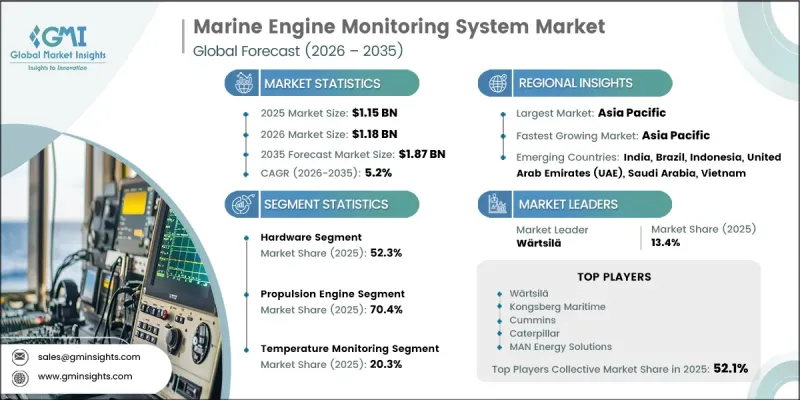
선박의 효율 향상, 예측 유지보수 능력 강화, 그리고 엔진 성능의 실시간 추적 실현에 대한 관심 증가가 선박용 엔진 모니터링 시스템 시장의 성장을 견인하고 있습니다. 해상 운송 활동 증가, 지속적인 선단 갱신, 그리고 배기가스, 운항 안전, 연료 소비에 관한 전 세계적인 엄격한 기준이 시장 발전에 기여하고 있습니다. 해사 분야에서의 디지털 기술 채택 확대에 따라 선박 운항 사업자들은 장비의 신뢰성을 향상시키고, 유지보수 요건을 최소화하며, 운영 비용을 절감하는 첨단 모니터링 솔루션 도입을 적극적으로 추진하고 있습니다. 선주와 운항 사업자가 운항 최적화를 지속적으로 우선시하는 가운데, 선박용 엔진 모니터링 시스템은 현대 선단 관리에 필수적인 기술로 자리 잡고 있습니다. 이러한 솔루션은 의사 결정 개선, 엔진 신뢰성 향상, 그리고 보다 효율적인 해상 운항을 지원하는 데 도움이 됩니다.
| 시장 범위 | |
|---|---|
| 개시 연도 | 2025년 |
| 예측 기간 | 2026-2035년 |
| 초기 시장 규모 | 11억 5,000만 달러 |
| 예측액 | 18억 7,000만 달러 |
| CAGR | 5.2% |
선박용 엔진 모니터링 시스템은 첨단 하드웨어 및 소프트웨어 플랫폼을 통해 온도, 압력, 진동 수준, 연료 소비량, 배기가스, 속도, 출력 성능 등 엔진과 관련된 중요한 정보를 지속적으로 수집 및 분석하도록 설계되었습니다. 이러한 시스템은 실시간 인사이트를 제공하여 운영자가 이상을 식별하고, 엔진 효율을 향상시키며, 연료 소비량을 절감하고, 예기치 못한 고장을 방지할 수 있도록 지원합니다. 해운사가 선단의 생산성 향상과 선박 가동 중단 시간 단축에 주력함에 따라, 첨단 모니터링 기술은 선박 운항에서 점점 더 중요해지고 있습니다. 원격 모니터링 솔루션, 클라우드 기반 플랫폼, 인공지능, 데이터 분석의 도입이 진행됨에 따라 예측 유지보수 계획 수립 및 전반적인 자산 관리 개선이 가능해져 시장 성장을 더욱 촉진하고 있습니다.
하드웨어 부문은 2025년에 52.3%의 점유율을 차지한 것으로 평가되었으며, 2026-2035년 연평균 성장률(CAGR) 3.5%로 성장할 것으로 전망됩니다. 이 부문에는 감시 인프라의 기반을 구성하는 엔진 센서, 제어 장치, 통신 시스템, 데이터 기록 장치 등 필수적인 물리적 구성 요소가 포함됩니다. 이러한 구성 요소는 실시간 데이터 수집, 고장 식별, 시스템 간 통신 및 선내 자동화 플랫폼과의 통합을 지원합니다. 신조선 및 개조 프로젝트에서의 도입 증가가 하드웨어 수요를 뒷받침하고 있습니다. 이는 운항 사업자들이 예측 유지보수 기능과 IMO 배출 가스 규제를 준수하기를 요구하고 있기 때문입니다. ABB, 콘스버그, 발티라 등 주요 선박 기술 공급업체들은 모니터링 기능을 강화하기 위해 추진 시스템 및 보조 엔진 시스템에 첨단 센서 기술을 통합하고 있습니다.
2026년에는 추진 엔진 부문이 70.2%의 점유율을 차지하며, 다양한 선박 용도에서 그 중요성이 부각되었습니다. 연료 효율 향상, 예측 유지보수 프로그램, 배기가스 감축 노력에 대한 투자 확대에 따라 추진 엔진 모니터링 시스템에 대한 수요는 계속해서 증가하고 있습니다. 선박 운항 사업자들은 추진 시스템의 성능을 평가하고, 운영 효율을 높이며, 진화하는 환경 기준을 준수하기 위해 첨단 모니터링 솔루션을 점점 더 많이 도입하고 있습니다. 상업용 선단, 해군 용도, 여객선 및 전반적인 해양 사업 전반에 걸쳐 신뢰할 수 있는 엔진 성능 데이터에 대한 수요가 높아지고 있는 것이 이 부문의 성장을 지속적으로 뒷받침하고 있습니다.
중국의 선박용 엔진 모니터링 시스템 시장은 2025년에 37.8%의 점유율을 차지하며 1억 5,000만 달러 규모 시장을 기록했습니다. 중국의 선도적 지위는 해운 분야의 디지털화, 스마트 선박 기술, 그리고 첨단 선단 관리 솔루션에 대한 막대한 투자에 힘입은 것입니다. 중국의 해운 사업자들은 연료 효율 향상, 유지보수 비용 절감, 그리고 환경 규제 준수를 강화하기 위해 엔진 모니터링 기술 도입을 점점 더 확대되고 있습니다. 중국의 광범위한 해상 운송 네트워크와 스마트 해운 인프라에 대한 집중이 확대됨에 따라, 실시간 모니터링 및 예측 유지보수 시스템에 대한 강력한 수요가 지속적으로 창출되고 있습니다.
자주 묻는 질문
목차
제1장 조사 방법
제2장 주요 요약
제3장 업계 인사이트
제4장 경쟁 구도
제5장 시장 추산 및 예측 : 컴포넌트별(2022-2035년)
제6장 시장 추산 및 예측 : 엔진별(2022-2035년)
제7장 시장 추산 및 예측 : 모니터링별(2022-2035년)
제8장 시장 추산 및 예측 : 최종 용도별(2022-2035년)
제9장 시장 추산 및 예측 : 전개 형태별(2022-2035년)
제10장 시장 추산 및 예측 : 판매 채널별(2022-2035년)
제11장 시장 추산 및 예측 : 지역별(2022-2035년)
제12장 기업 개요
AJY 26.08.18The Global Marine Engine Monitoring System Market was valued at USD 1.15 billion in 2025 and is estimated to grow at a CAGR of 5.2% to reach USD 1.87 billion by 2035.
The increasing focus on improving vessel efficiency, enhancing predictive maintenance capabilities, and enabling real-time engine performance tracking is driving the growth of the marine engine monitoring system market. Rising maritime transportation activities, ongoing fleet upgrades, and strict global standards related to emissions, operational safety, and fuel consumption are contributing to market development. The growing adoption of digital technologies in the marine sector is encouraging ship operators to integrate advanced monitoring solutions that improve equipment dependability, minimize maintenance requirements, and lower operational expenses. As vessel owners and operators continue prioritizing operational optimization, marine engine monitoring systems are becoming an essential technology for modern fleet management. These solutions help improve decision-making, enhance engine reliability, and support more efficient maritime operations.
| Market Scope | |
|---|---|
| Start Year | 2025 |
| Forecast Year | 2026-2035 |
| Start Value | $1.15 Billion |
| Forecast Value | $1.87 Billion |
| CAGR | 5.2% |
Marine engine monitoring systems are designed to continuously collect and analyze important engine-related information, including temperature, pressure, vibration levels, fuel usage, emissions, speed, and power performance through advanced hardware and software platforms. These systems deliver real-time insights that allow operators to identify irregularities, improve engine efficiency, reduce fuel consumption, and avoid unexpected failures. With shipping companies focusing on increasing fleet productivity and reducing vessel downtime, advanced monitoring technologies are becoming increasingly important in marine operations. The rising adoption of remote monitoring solutions, cloud-based platforms, artificial intelligence, and data analytics is further strengthening market growth by enabling predictive maintenance planning and improving overall asset management.
The hardware segment accounted for a 52.3% share in 2025 and is anticipated to grow at a CAGR of 3.5% from 2026 to 2035. This segment includes essential physical components such as engine sensors, control units, communication systems, and data recording equipment that form the foundation of monitoring infrastructure. These components support real-time data collection, fault identification, system communication, and integration with onboard automation platforms. Increasing installations in newly constructed vessels and retrofit projects are supporting hardware demand as operators seek predictive maintenance capabilities and compliance with IMO emission requirements. Major marine technology providers, including ABB, Kongsberg, and Wartsila, are incorporating advanced sensor technologies into propulsion and auxiliary engine systems to enhance monitoring capabilities.
The propulsion engine segment held a 70.2% share in 2026, highlighting its importance across a wide range of marine applications. Demand for propulsion engine monitoring systems continues to increase due to growing investments in fuel efficiency improvements, predictive maintenance programs, and emission reduction initiatives. Vessel operators are increasingly adopting advanced monitoring solutions to evaluate propulsion system performance, improve operational efficiency, and maintain compliance with evolving environmental standards. The need for reliable engine performance data across commercial fleets, naval applications, passenger vessels, and offshore operations continues to support segment expansion.
China Marine Engine Monitoring System Market accounted for a 37.8% share, generating USD 150 million in 2025. The country's leading position is supported by significant investments in maritime digitalization, smart vessel technologies, and advanced fleet management solutions. Shipping operators in China are increasingly implementing engine monitoring technologies to enhance fuel efficiency, reduce maintenance expenses, and improve compliance with environmental regulations. The country's extensive maritime transportation network and expanding focus on intelligent shipping infrastructure continue to generate strong demand for real-time monitoring and predictive maintenance systems.
Major players operating in the global marine engine monitoring system industry are Kongsberg Maritime, Siemens, ABB, MAN Energy Solutions, Wartsila, Caterpillar, Cummins, Mitsubishi, and General Electric. Companies operating in the marine engine monitoring system market are focusing on strategies such as technological innovation, strategic partnerships, product development, and integration of advanced digital capabilities to strengthen their market presence. Key players are investing in artificial intelligence, cloud-based analytics, remote monitoring solutions, and automation technologies to improve system performance and provide more accurate predictive maintenance insights. Businesses are also expanding their product portfolios by developing advanced sensor technologies and integrated monitoring platforms that address the evolving requirements of modern fleets. Collaborations with shipbuilders, marine operators, and technology providers are helping companies increase adoption across commercial and industrial maritime sectors. Additionally, companies are emphasizing regulatory compliance, energy efficiency improvements, and customized solutions to gain a competitive advantage and strengthen their long-term position in the market.
Table of Contents
Chapter 1 Research Methodology
- 1.1 Research approach
- 1.2 Quality Commitments
- 1.2.1 GMI AI policy & data integrity commitment
- 1.2.1.1 Source consistency protocol
- 1.2.1 GMI AI policy & data integrity commitment
- 1.3 Research Trail & Confidence Scoring
- 1.3.1 Research Trail Components
- 1.3.2 Scoring Components
- 1.4 Data Collection
- 1.4.1 Partial list of primary sources
- 1.5 Data mining sources
- 1.5.1 Paid sources
- 1.5.1.1 Sources, by region
- 1.5.1 Paid sources
- 1.6 Base estimates and calculations
- 1.6.1 Base year calculation for any one approach
- 1.7 Forecast model
- 1.7.1 Quantified Market impact analysis
- 1.7.1.1 Mathematical impact of growth parameters on forecast
- 1.7.1 Quantified Market impact analysis
- 1.8 Research transparency addendum
- 1.8.1 Source attribution framework
- 1.8.2 Quality assurance metrics
- 1.8.3 Our commitment to trust
Chapter 2 Executive Summary
- 2.1 Industry 360° synopsis, 2022 - 2035
- 2.2 Key Market trends
- 2.2.1 Region
- 2.2.2 Component
- 2.2.3 Engine
- 2.2.4 Monitoring
- 2.2.5 Application
- 2.2.6 End Use
- 2.2.7 Deployment
- 2.2.8 Sales Channel
- 2.3 TAM Analysis, 2026-2035
- 2.4 CXO perspectives: Strategic imperatives
Chapter 3 Industry Insights
- 3.1 Industry ecosystem analysis
- 3.1.1 Supplier landscape
- 3.1.2 Profit margin analysis
- 3.1.3 Cost structure
- 3.1.4 Value addition at each stage
- 3.1.5 Factor affecting the value chain
- 3.1.6 Disruptions
- 3.2 Industry impact forces
- 3.2.1 Growth drivers
- 3.2.1.1 Stringent IMO & MARPOL Emission Regulations Mandating Continuous Engine Monitoring
- 3.2.1.2 Rising Adoption of IoT-Enabled Smart Sensors & AI-Driven Predictive Maintenance
- 3.2.1.3 Growth in International Seaborne Trade & Global Commercial Fleet Expansion
- 3.2.1.4 Increasing Naval Defense Budgets Driving Demand for Advanced Vessel Monitoring
- 3.2.2 Industry pitfalls and challenges
- 3.2.2.1 Fluctuations in Oil & Gas Prices Affecting Fleet Capex Decisions
- 3.2.2.2 Shipping Overcapacity & Declining Freight Rates Constraining Monitoring Budgets
- 3.2.2.3 Skilled Workforce Shortage for Onboard System Operation & Data Interpretation
- 3.2.3 Market opportunities
- 3.2.3.1 Growing Adoption of Cloud-Based Remote Monitoring-as-a-Service (RMaaS) Models
- 3.2.3.2 Expansion of LNG & Dual-Fuel Fleet Creating Demand for Specialized Monitoring
- 3.2.3.3 Rise in Inland Waterway Vessel Monitoring Deployments
- 3.2.3.4 Digital Twin Integration for Continuous Real-Time Engine Performance Optimization
- 3.2.1 Growth drivers
- 3.3 Technology and innovation landscape
- 3.3.1 Current technological trends
- 3.3.1.1 IoT-Enabled Smart Sensor Networks
- 3.3.1.2 AI-Based Predictive Maintenance Platforms
- 3.3.1.3 Real-Time Engine Condition Monitoring Systems
- 3.3.1.4 Cloud-Based Fleet & Remote Monitoring Platforms
- 3.3.2 Emerging technologies
- 3.3.2.1 Digital Twin-Based Engine Monitoring
- 3.3.2.2 Edge AI for Onboard Diagnostics
- 3.3.2.3 Autonomous Self-Healing Monitoring Systems
- 3.3.2.4 Federated Data Analytics & Standardized Vessel Data Exchange Platforms
- 3.3.1 Current technological trends
- 3.4 Growth potential analysis
- 3.5 Pricing Analysis (Driven by primary research)
- 3.5.1 Historical Price Trend Analysis
- 3.5.2 Pricing Strategy by Player Type
- 3.6 Regulatory landscape
- 3.6.1 North America
- 3.6.1.1 International Maritime Organization
- 3.6.1.2 Environmental Protection Agency
- 3.6.1.3 American Bureau of Shipping
- 3.6.2 Europe
- 3.6.2.1 European Commission
- 3.6.2.2 European Maritime Safety Agency
- 3.6.2.3 International Energy Agency
- 3.6.3 Asia Pacific
- 3.6.3.1 Ministry of Land, Infrastructure, Transport and Tourism
- 3.6.3.2 Ministry of Industry and Information Technology
- 3.6.3.3 Maritime and Port Authority of Singapore
- 3.6.4 Latin America
- 3.6.4.1 Superintendence of Electricity and Fuels
- 3.6.4.2 Brazilian Navy Directorate of Ports and Coasts
- 3.6.4.3 National Waterway Transport Agency
- 3.6.5 Middle East & Africa
- 3.6.5.1 UAE Ministry of Energy and Infrastructure
- 3.6.5.2 Dubai Maritime Authority
- 3.6.5.3 South African Maritime Safety Authority
- 3.6.1 North America
- 3.7 Porter's analysis
- 3.8 PESTEL analysis
- 3.9 Patent analysis (Driven by primary research)
- 3.10 Cost breakdown analysis
- 3.11 Trade Data Analysis (Based on Paid Database)
- 3.11.1 Import/Export Volume & Value Trends
- 3.11.2 Key Trade Corridors & Tariff Impact
- 3.12 Capacity & production landscape (driven by primary research)
- 3.12.1 Production capacity by region & key manufacturer
- 3.12.2 Capacity utilization rates & expansion pipelines
- 3.13 Impact of AI & generative AI on the market
- 3.13.1 AI-driven disruption of existing business models
- 3.13.2 GenAI use cases & adoption roadmap by segment
- 3.13.3 Risks, limitations & regulatory considerations
- 3.14 Sustainability and environmental aspects
- 3.14.1 Sustainable practices
- 3.14.2 Waste reduction strategies
- 3.14.3 Energy efficiency in production
- 3.14.4 Eco-friendly Initiatives
- 3.14.5 Carbon footprint considerations
- 3.15 Forecast assumptions & scenario analysis (Driven by primary research)
- 3.15.1 Base Case key macro & industry variables driving CAGR
- 3.15.2 Optimistic Scenarios-Favorable macro and industry tailwinds
- 3.15.3 Pessimistic Scenario-Macroeconomic slowdown or industry headwinds
Chapter 4 Competitive Landscape, 2025
- 4.1 Introduction
- 4.2 Company Market share analysis (value and volume), 2022-2025
- 4.2.1 North America
- 4.2.2 Europe
- 4.2.3 Asia Pacific
- 4.2.4 LATAM
- 4.2.5 MEA
- 4.3 Top 10 Company production & sales analysis, 2022-2035
- 4.4 Competitive positioning matrix
- 4.5 Key developments
- 4.5.1 Mergers & acquisitions
- 4.5.2 Partnerships & collaborations
- 4.5.3 New Product Launches
- 4.5.4 Expansion Plans and funding
- 4.6 Company tier benchmarking
- 4.6.1 Tier classification criteria & qualifying thresholds
- 4.6.2 Tier positioning matrix by revenue, geography & innovation
Chapter 5 Market Estimates & Forecast, By Component, 2022 - 2035 (USD Mn, Units)
- 5.1 Key trends
- 5.2 Hardware
- 5.2.1 Sensors & Transducers
- 5.2.2 Controllers & PLCs
- 5.2.3 Display & HMI Units
- 5.2.4 Communication Modules
- 5.2.5 Alarm & Safety Systems
- 5.3 Software
- 5.3.1 Data Analytics & Visualization Platforms
- 5.3.2 Predictive Maintenance Software
- 5.3.3 Fleet Management Software
- 5.3.4 Emission Monitoring & Compliance Software
- 5.3.5 Remote Monitoring Platforms
- 5.4 Services
- 5.4.1 Installation & Integration Services
- 5.4.2 Maintenance & Calibration Services
- 5.4.3 Remote Monitoring-as-a-Service
- 5.4.4 Consulting & Training Services
Chapter 6 Market Estimates & Forecast, By Engine, 2022 - 2035 (USD Mn, Units)
- 6.1 Key trends
- 6.2 Propulsion Engine
- 6.2.1 Diesel Engine
- 6.2.2 Gas Turbine Engine
- 6.2.3 Dual-Fuel Engine
- 6.2.4 Nuclear Power Engine
- 6.3 Auxiliary Engine
Chapter 7 Market Estimates & Forecast, By Monitoring, 2022 - 2035 (USD Mn, Units)
- 7.1 Key trends
- 7.2 Temperature Monitoring
- 7.3 Pressure Monitoring
- 7.4 Vibration Monitoring
- 7.5 Fuel Consumption Monitoring
- 7.6 Emission Monitoring
- 7.7 Speed & Power Output Monitoring
Chapter 8 Market Estimates & Forecast, By End Use, 2022 - 2035 (USD Mn, Units)
- 8.1 Key trends
- 8.2 Commercial Vessels
- 8.2.1 Bulk Carriers & General Cargo Ships (corrected for MECE)
- 8.2.2 Tankers
- 8.2.3 Container Ships
- 8.3 Naval Vessels
- 8.4 Passenger Vessels
- 8.4.1 Cruise Ships
- 8.4.2 Ferries
- 8.5 Offshore Support Vessels (OSV)
- 8.6 Others
Chapter 9 Market Estimates & Forecast, By Deployment, 2022 - 2035 (USD Mn, Units)
- 9.1 Key trends
- 9.2 Onboard Monitoring
- 9.3 Remote Monitoring
Chapter 10 Market Estimates & Forecast, By Sales Channel, 2022 - 2035 (USD Mn, Units)
- 10.1 Key trends
- 10.2 OEM
- 10.3 Aftermarket
Chapter 11 Market Estimates & Forecast, By Region, 2022 - 2035 (USD Mn, Units)
- 11.1 Key trends
- 11.2 North America
- 11.2.1 US
- 11.2.2 Canada
- 11.3 Europe
- 11.3.1 Germany
- 11.3.2 UK
- 11.3.3 France
- 11.3.4 Italy
- 11.3.5 Spain
- 11.3.6 Russia
- 11.3.7 Norway
- 11.3.8 Netherlands
- 11.3.9 Sweden
- 11.4 Asia Pacific
- 11.4.1 China
- 11.4.2 India
- 11.4.3 Japan
- 11.4.4 Australia
- 11.4.5 South Korea
- 11.4.6 Singapore
- 11.4.7 Thailand
- 11.4.8 Indonesia
- 11.4.9 Vietnam
- 11.5 Latin America
- 11.5.1 Brazil
- 11.5.2 Mexico
- 11.5.3 Argentina
- 11.6 MEA
- 11.6.1 South Africa
- 11.6.2 Saudi Arabia
- 11.6.3 UAE
- 11.6.4 Turkey
Chapter 12 Company Profiles
- 12.1 Global Players
- 12.1.1 Wartsila
- 12.1.2 Everllence
- 12.1.3 Rolls-Royce
- 12.1.4 Caterpillar
- 12.1.5 Cummins
- 12.1.6 ABB
- 12.1.7 Kongsberg Gruppen
- 12.1.8 Emerson Electric
- 12.2 Regional Players
- 12.2.1 HD Hyundai Marine Solution
- 12.2.2 Mitsubishi Heavy Industries Engine & Turbocharger
- 12.2.3 NORIS
- 12.2.4 Danfoss IXA
- 12.2.5 Monico
- 12.2.6 CMR
- 12.2.7 Valmet
- 12.3 Emerging Players
- 12.3.1 TecnoVeritas
- 12.3.2 AST Reygar
- 12.3.3 Propulsion Analytics
- 12.3.4 Jason Marine
- 12.3.5 Scania


