

|
시장보고서
상품코드
2109300
로그 스플리터 시장 : 시장 비즈니스 기회, 성장요인, 업계 동향 분석 및 예측(2026-2035년)Log Splitters Market Opportunity, Growth Drivers, Industry Trend Analysis, and Forecast 2026 - 2035 |
||||||

세계의 로그 스플리터 시장은 2025년에 23억 달러 규모로 평가되었고, CAGR 4.6%로 성장할 전망이며, 2035년까지 36억 달러에 이를 것으로 추정되고 있습니다.
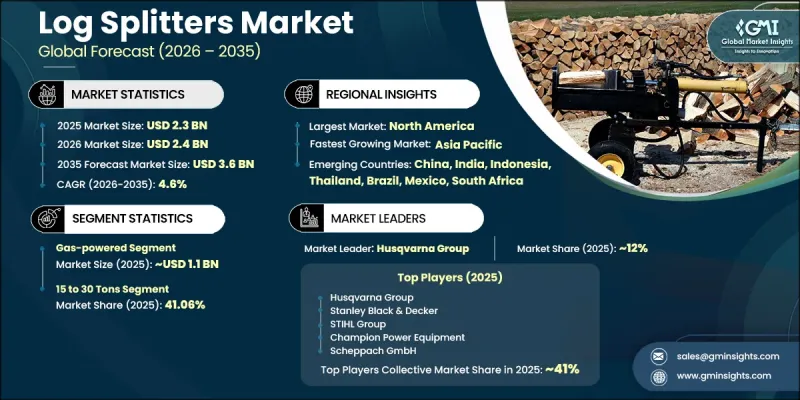
로그 스플리터 시장의 성장은 주거, 상업, 산업 각 부문에서 효율적인 장작 가공에 대한 안정적인 수요에 힘입고 있습니다. 동시에, 전동 장비의 채택 확대와 대용량 로그 스플리터에 대한 수요 증가가 업계의 제품 구성을 변화시키고 있습니다. 로그 스플리터는 목재 가공 작업의 생산성 향상, 수작업 경감, 그리고 작업 안전성 향상에 없어서는 안 될 장비로 자리매김하고 있습니다. 기존의 수작업과 비교했을 때, 이러한 기계는 신체적 부담과 작업 현장의 위험을 줄이면서 더 신속하고 안정적인 성능을 발휘합니다. 대량의 목재를 효율적으로 처리할 수 있으므로 지속적인 장작 생산이 필요한 사용자나 상업적인 목재 가공 사업에 적합합니다. 또한, 전력 효율 향상, 내구성 강화, 사용자 친화적인 조작성, 생산성 향상에 초점을 맞춘 기술적 진보가 시장 수요를 지속적으로 뒷받침하고 있습니다. 각 제조업체들도 변화하는 고객의 선호도에 대응하면서, 다양한 최종 이용 산업에서의 업무 효율 향상을 지원하는 첨단 제품 설계를 도입하고 있습니다.
| 시장 범위 | |
|---|---|
| 개시 연도 | 2025년 |
| 예측 기간 | 2026-2035년 |
| 초기 시장 규모 | 23억 달러 |
| 예측액 | 36억 달러 |
| CAGR | 4.6% |
환경적 지속가능성과 책임 있는 산림 관리는 로그 스플리터 시장의 발전에 지속적으로 영향을 미치고 있습니다. 산림 자원 보호와 지속 가능한 목재 벌채 관행 촉진을 목적으로 한 규제 조치로 인해 효율적인 목재 가공 장비의 도입이 더욱 촉진되고 있습니다. 또한, 환경 의식이 높아짐에 따라 임업 및 장작 생산 활동 전반에서 폐기물 최소화와 자원 활용도 향상에 대한 관심이 높아지고 있습니다. 온실가스 배출 및 환경 보전에 대한 우려가 업계의 우선 과제를 계속해서 형성하는 가운데, 기업과 최종 사용자는 효율적인 목재 가공을 지원함과 동시에 보다 지속 가능한 운영 관행에 기여하는 설비에 대한 투자를 추진하고 있습니다.
가솔린 구동 부문은 2025년에 11억 달러 시장 규모를 기록했습니다. 가솔린 구동 장비는 충전 인프라가 필요 없이 높은 절단력, 긴 가동 시간, 그리고 신뢰할 수 있는 성능을 발휘하기 때문에 이 부문은 계속해서 시장을 주도하고 있습니다. 이러한 장점 덕분에 가솔린 구동 로그 스플리터는 대량의 장작을 다루는 가정용 사용자뿐만 아니라 지속적인 생산성이 필요한 상업용 사업자에게도 적합합니다. 고객들의 높은 인지도, 장비의 폭넓은 접근성, 그리고 확립된 유통 및 서비스 네트워크가 이 부문 시장 리더십을 더욱 공고히 하고 있습니다.
2025년에는 15-30톤 부문이 시장 점유율의 41.06%를 차지하며 9억 5,000만 달러의 매출을 기록했습니다. 이 부문은 전문 사용자와 중규모 상업용 목재 가공 사업 모두의 요구 사항을 충족하는 균형 잡힌 성능 특성을 장점으로 가지고 있습니다. 이 용량 범위의 장비는 절단력, 운영 효율성, 생산성을 효과적으로 결합하고 있어 다양한 크기의 통나무를 가공하는 데 적합할 뿐만 아니라, 가혹한 사용 조건에서도 일관된 처리 능력을 유지할 수 있습니다.
미국 로그 스플리터 시장은 2025년에 7억 3,000만 달러에 달했습니다. 미국의 선도적 지위는 가정에서의 장작 소비가 널리 보급되어 있다는 점, 성숙한 판매점 및 유통망, 그리고 확립된 상업 임업 및 조경 산업에 의해 뒷받침되고 있습니다. 장작 가공 장비에 대한 안정적인 계절적 수요에 더해, 임업 사업 및 아웃도어 장비에 대한 지속적인 투자가 맞물리면서 미국 시장에서 사업을 전개하는 제조업체들에게 계속해서 유리한 성장 기회를 창출하고 있습니다.
자주 묻는 질문
목차
제1장 조사 방법 및 범위
제2장 주요 요약
제3장 업계 인사이트
제4장 경쟁 구도
제5장 시장 추산 및 예측 : 제품 유형별(2022-2035년)
제6장 시장 추산 및 예측 : 적재 톤수별(2022-2035년)
제7장 시장 추산 및 예측 : 향해별(2022-2035년)
제8장 시장 추산 및 예측 : 최종 사용자별(2022-2035년)
제9장 시장 추산 및 예측 : 유통 채널별(2022-2035년)
제10장 시장 추산 및 예측 : 지역별(2022-2035년)
제11장 기업 개요
AJY 26.08.20The Global Log Splitters Market was valued at USD 2.3 billion in 2025 and is estimated to grow at a CAGR of 4.6% to reach USD 3.6 billion by 2035.
Growth in the log splitters market is supported by the steady requirement for efficient firewood processing across residential, commercial, and industrial sectors. At the same time, increasing adoption of electric-powered equipment and growing demand for higher-capacity log splitters are reshaping the industry's product landscape. Log splitters have become essential equipment for improving productivity, minimizing manual labor, and enhancing operational safety during wood processing activities. Compared with traditional manual methods, these machines deliver faster, more consistent performance while reducing physical effort and workplace risks. Their ability to process large volumes of timber efficiently makes them suitable for users requiring continuous firewood production as well as commercial wood-processing operations. In addition, technological improvements focused on greater power efficiency, enhanced durability, user-friendly operation, and improved productivity continue to strengthen market demand. Manufacturers are also introducing advanced product designs that address changing customer preferences while supporting greater operational efficiency across multiple end-use industries.
| Market Scope | |
|---|---|
| Start Year | 2025 |
| Forecast Year | 2026-2035 |
| Start Value | $2.3 Billion |
| Forecast Value | $3.6 Billion |
| CAGR | 4.6% |
Environmental sustainability and responsible forestry management continue to influence the development of the log splitters market. Regulatory measures aimed at protecting forest resources and promoting sustainable wood harvesting practices are encouraging greater adoption of efficient wood-processing equipment. Growing environmental awareness has also increased the focus on minimizing waste and improving resource utilization throughout forestry and firewood production activities. As concerns surrounding greenhouse gas emissions and environmental preservation continue to shape industry priorities, businesses and end users are investing in equipment that supports efficient timber processing while contributing to more sustainable operational practices.
The gas-powered segment generated USD 1.1 billion in 2025. The segment continues to lead because gas-powered equipment delivers high splitting force, extended operating time, and dependable performance without requiring charging infrastructure. These advantages make gas-powered log splitters well suited for residential users handling large volumes of firewood as well as commercial operators requiring continuous productivity. Strong customer familiarity, broad equipment availability, and established distribution and service networks continue to reinforce the segment's market leadership.
The 15 to 30 tons segment accounted for 41.06% share in 2025, generating USD 950 million. This segment benefits from balanced performance characteristics that satisfy the requirements of both professional users and mid-sized commercial wood-processing operations. Equipment within this capacity range provides an effective combination of splitting power, operational efficiency, and productivity, making it suitable for processing a wide variety of log sizes while supporting consistent throughput across demanding applications.
United States Log Splitters Market reached USD 730 million in 2025. The country's leadership is supported by widespread residential firewood consumption, a mature dealer and distribution network, and a well-established commercial forestry and landscaping industry. Consistent seasonal demand for firewood processing equipment, combined with ongoing investments in forestry operations and outdoor equipment, continues to create favorable growth opportunities for manufacturers operating within the U.S. market.
Key companies participating in the global log splitters market include Husqvarna Group, AriensCo, Champion Power Equipment Inc., STIHL Group, Stanley Black & Decker, Wallenstein Equipment Inc., Timberwolf Manufacturing Corp., Swisher Acquisition Inc., POSCH Gesellschaft m.b.H., Scheppach GmbH, Snow Joe LLC, WEN Products, YARDMAX, Boss Industrial Inc., Iron & Oak, Jiashan Superpower Tools Co., Ltd., Uniforest d.o.o., Dirty Hand Tools, RABAUD SAS, HAKKI PILKE, and JAPA. Companies operating in the log splitters market are strengthening their market position by expanding product portfolios with electric, battery-powered, and high-capacity models that address evolving customer requirements. Manufacturers continue to invest in product innovation focused on improved efficiency, enhanced safety features, greater durability, and easier operation. Strategic partnerships with distributors and dealers, along with expansion into new regional markets, are helping companies increase their customer reach. Many manufacturers are also strengthening after-sales service capabilities, offering extended warranties, and improving spare parts availability to enhance customer satisfaction.
Table of Contents
Chapter 1 Methodology and Scope
- 1.1 Research approach
- 1.2 Quality Commitments
- 1.2.1 GMI AI policy & data integrity commitment
- 1.2.1.1 Source consistency protocol
- 1.2.1 GMI AI policy & data integrity commitment
- 1.3 Research Trail & Confidence Scoring
- 1.3.1 Research Trail Components
- 1.3.2 Scoring Components
- 1.4 Data Collection
- 1.4.1 Partial list of primary sources
- 1.5 Data mining sources
- 1.5.1 Paid sources
- 1.5.1.1 Sources, by region
- 1.5.1 Paid sources
- 1.6 Base estimates and calculations
- 1.6.1 Base year calculation for any one approach
- 1.7 Forecast model
- 1.7.1 Quantified market impact analysis
- 1.7.1.1 Mathematical impact of growth parameters on forecast
- 1.7.1 Quantified market impact analysis
- 1.8 Research transparency addendum
- 1.8.1 Source attribution framework
- 1.8.2 Quality assurance metrics
- 1.8.3 Our commitment to trust
Chapter 2 Executive Summary
- 2.1 Industry 360° synopsis
- 2.2 Key market trends
- 2.2.1 Regional
- 2.2.2 Product Type
- 2.2.3 Tonnage Capacity
- 2.2.4 Orientation
- 2.2.5 End User
- 2.2.6 Distribution Channel
Chapter 3 Industry Insights
- 3.1 Industry ecosystem analysis
- 3.1.1 Supplier landscape
- 3.1.2 Profit margin
- 3.1.3 Value addition at each stage
- 3.1.4 Factor affecting the value chain
- 3.2 Industry impact forces
- 3.2.1 Growth drivers
- 3.2.2 Industry pitfalls & challenges
- 3.2.3 Opportunities
- 3.3 Growth potential analysis
- 3.3.1 Price volatility and market unpredictability
- 3.3.2 Quality assurance and equipment reliability concerns
- 3.4 Future market trends
- 3.5 Technology and innovation landscape
- 3.5.1 Current technological trends
- 3.5.2 Emerging technologies
- 3.6 Pricing Analysis (Driven by Primary Research)
- 3.6.1 Historical Price Trend Analysis (Driven by Primary Research)
- 3.6.2 Pricing Strategy by Player Type (Premium/Value/Cost-plus) (Driven by Primary Research)
- 3.6.3 Average Selling Price by Product Type & Capacity
- 3.7 Regulatory landscape
- 3.7.1 Standards and compliance requirements
- 3.7.2 Regional regulatory frameworks
- 3.7.3 Certification standards
- 3.8 Porter’s analysis
- 3.9 PESTEL analysis
- 3.10 Trade Data Analysis (Driven by Primary Research)
- 3.10.1 Import/Export Volume & Value Trends by Region (HS Code Level) (Driven by Primary Research)
- 3.10.2 Key Trade Corridors (China–North America, China–Europe) & Tariff Impact (Driven by Primary Research)
- 3.11 Impact of AI & Generative AI on the Log Splitters Market
- 3.11.1 AI-Driven Disruption of Existing Business Models
- 3.11.2 GenAI Use Cases & Adoption Roadmap by Segment
- 3.11.3 Risks, Limitations & Regulatory Considerations
- 3.12 Capacity and Production Landscape (Driven by Primary Research)
- 3.12.1 Installed Capacity by Country and Key Producer (Driven by Primary Research)
- 3.12.2 Capacity Utilization Rates and Expansion Pipelines (Driven by Primary Research)
Chapter 4 Competitive Landscape, 2025
- 4.1 Introduction
- 4.2 Company market share analysis
- 4.2.1 By region
- 4.2.1.1 North America
- 4.2.1.2 Europe
- 4.2.1.3 Asia Pacific
- 4.2.1.4 Latin America
- 4.2.1.5 Middle East and Africa
- 4.2.1 By region
- 4.3 Company matrix analysis
- 4.4 Competitive analysis of major market players
- 4.5 Competitive positioning matrix
- 4.6 Key developments
- 4.6.1 Mergers & acquisitions
- 4.6.2 Partnerships & collaborations
- 4.6.3 New product launches
- 4.6.4 Expansion plans
Chapter 5 Market Estimates & Forecast, By Product Type, 2022 – 2035, (USD Billion) (Thousand Units)
- 5.1 Key trends
- 5.2 Gas-Powered
- 5.3 Electric
- 5.4 Manual/Hydraulic
- 5.5 PTO-Driven
Chapter 6 Market Estimates & Forecast, By Tonnage Capacity, 2022 – 2035, (USD Billion) (Thousand Units)
- 6.1 Key trends
- 6.2 Less than 15 Tons
- 6.3 15 to 30 Tons
- 6.4 Above 30 Tons
Chapter 7 Market Estimates & Forecast, By Orientation, 2022 – 2035, (USD Billion) (Thousand Units)
- 7.1 Key trends
- 7.2 Horizontal
- 7.3 Vertical
- 7.4 Dual/Multi-Position
Chapter 8 Market Estimates & Forecast, By End User, 2022 – 2035, (USD Billion) (Thousand Units)
- 8.1 Key trends
- 8.2 Residential
- 8.3 Commercial
Chapter 9 Market Estimates & Forecast, By Distribution Channel, 2022 – 2035, (USD Billion) (Thousand Units)
- 9.1 Key trends
- 9.2 Direct Sales
- 9.3 Indirect Sales
Chapter 10 Market Estimates and Forecast, By Region, 2022 – 2035 (USD Billion) (Thousand Units)
- 10.1 Key trends
- 10.2 North America
- 10.2.1 U.S.
- 10.2.2 Canada
- 10.3 Europe
- 10.3.1 Germany
- 10.3.2 UK
- 10.3.3 France
- 10.3.4 Italy
- 10.3.5 Spain
- 10.4 Asia Pacific
- 10.4.1 China
- 10.4.2 Japan
- 10.4.3 India
- 10.4.4 Australia
- 10.4.5 South Korea
- 10.5 Latin America
- 10.5.1 Brazil
- 10.5.2 Mexico
- 10.5.3 Argentina
- 10.6 Middle East and Africa
- 10.6.1 South Africa
- 10.6.2 Saudi Arabia
- 10.6.3 UAE
Chapter 11 Company Profiles
- 11.1 Top Global Player
- 11.1.1 Husqvarna Group
- 11.1.2 Stanley Black & Decker
- 11.1.3 STIHL Group
- 11.1.4 Champion Power Equipment Inc.
- 11.1.5 Scheppach GmbH
- 11.1.6 POSCH Gesellschaft m.b.H.
- 11.2 Regional Player
- 11.2.1 RABAUD SAS
- 11.2.2 HAKKI PILKE
- 11.2.3 JAPA
- 11.2.4 AriensCo
- 11.2.5 Timberwolf Manufacturing Corp.
- 11.2.6 Wallenstein Equipment Inc.
- 11.2.7 Jiashan Superpower Tools Co., Ltd.
- 11.3 Emerging Players
- 11.3.1 YARDMAX
- 11.3.2 Boss Industrial Inc.
- 11.3.3 WEN Products
- 11.3.4 Swisher Acquisition Inc.
- 11.3.5 Uniforest d.o.o.
- 11.3.6 Dirty Hand Tools
- 11.3.7 Snow Joe LLC
- 11.3.8 Iron & Oak


