

|
시장보고서
상품코드
2121105
자동차 제조 설비 시장 기회, 성장 촉진요인, 업계 동향 분석 및 예측(2026-2035년)Auto Manufacturing Equipment Market Opportunity, Growth Drivers, Industry Trend Analysis, and Forecast 2026 - 2035 |
||||||

세계의 자동차 제조 설비 시장은 2025년에 336억 달러 규모에 달하고, CAGR 5.1%로 성장하여 2035년까지 552억 달러에 달할 것으로 예측됩니다.
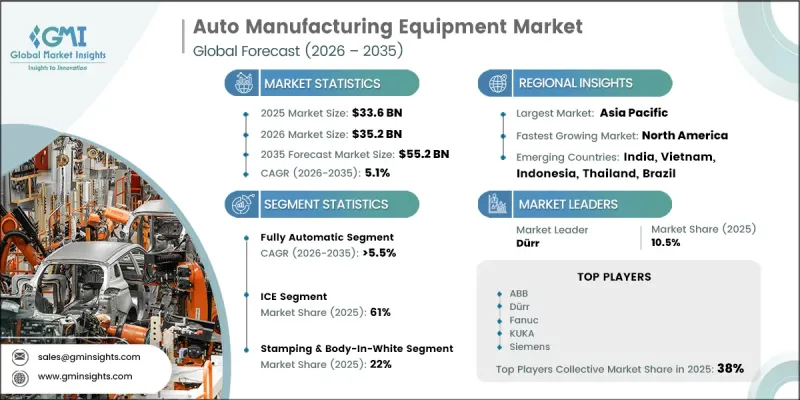
전기자동차(EV) 제조 프로그램이 지속적으로 확대됨에 따라 자동차 제조사들은 생산 기계에 대한 설비 투자를 늘리고 있습니다. 새로운 차량 플랫폼으로의 전환에 따라 최신 생산 요건을 충족할 수 있는 전용 설비에 대한 수요가 발생하고 있습니다. 배터리 팩 조립, e-드라이브 부품 생산, 고속 용접, 정밀 가공 및 자동 테스트는 자동차 제조 업무에서 점점 더 중요해지고 있습니다. 자동차 제조사들이 새로운 플랫폼을 도입하고 생산 설비를 갱신함에 따라, 설비 공급업체들은 첨단 기계 및 자동화 기술에 대한 수요가 증가하고 있음을 실감하고 있습니다. 또한 각 제조사는 변화하는 차량 아키텍처에 대응하면서도 효율성, 일관성 및 처리량을 향상시킬 수 있는 생산 시스템을 원하고 있습니다. 따라서 전동화 차량 생산에 대한 투자 확대는 자동차 업계 전반의 설비 구매 의사결정에 영향을 미치고 있습니다. 동시에, 기존 차량 프로그램의 제조 활동이 지속됨에 따라, 이미 정착된 생산 기계에 대한 수요도 유지되고 있습니다. 이러한 동향을 반영하여, 각 설비 제조사들은 기술력을 확대하고, 진화하는 자동차 생산 요건과 기존 요건 모두에 대응할 수 있는 솔루션 개발을 추진하고 있습니다.
| 시장 범위 | |
|---|---|
| 시작 연도 | 2025년 |
| 예측 기간 | 2026-2035년 |
| 개시 금액 | 336억 달러 |
| 예측 금액 | 552억 달러 |
| CAGR | 5.1% |
2025년에는 완전 자동화 부문이 49%의 점유율을 차지했으며, 2026년부터 2035년까지 연평균 성장률(CAGR) 5.5%로 성장할 것으로 전망됩니다. 자동차 OEM 각사는 일관된 사이클 타임을 유지하면서 제조 처리량을 향상시키기 위해 완전 자동화 생산 장비 도입을 더욱 확대하고 있습니다. 자동화 시스템은 인적 개입을 최소화하면서 기계 가공, 용접, 조립, 도장, 검사 등의 작업을 수행할 수 있습니다. 이러한 수준의 자동화를 통해 제조사는 생산량을 늘리면서도 안정적인 제품 품질을 유지할 수 있게 됩니다. 따라서 제조 효율과 생산 일관성을 높이려는 노력이 강화되면서 완전 자동 자동차 생산 설비의 지속적인 도입이 촉진되고 있습니다.
내연기관(ICE) 부문은 2025년에 61%의 점유율을 차지했으며, 2026년부터 2035년까지 연평균 성장률(CAGR) 4%로 점유율을 확대할 것으로 전망됩니다. 특히 신흥 시장이나 비용 중시 시장에서 내연기관 차량(ICE VEHICLES)의 제조가 지속됨에 따라, 엔진, 변속기, 배기 시스템, 연료 시스템 생산에 사용되는 설비에 대한 수요가 유지될 것으로 전망됩니다. 예측 기간 동안 지속적인 자동차 생산 수요가 내연기관 관련 제조 공정을 위해 설계된 기계에 대한 투자를 뒷받침할 것으로 보입니다.
아시아태평양의 자동차 제조 설비 시장은 2025년에 42%의 점유율을 기록하며 142억 달러의 시장 규모를 달성했습니다. 이 지역의 견고한 입지는 광범위한 자동차 제조 기반과 확립된 공급망과 밀접한 관련이 있습니다. 중국, 일본, 인도, 한국에는 자동차 OEM 및 부품 공급업체가 집중되어 있어 생산 기계 및 공장 자동화 솔루션에 대한 막대한 수요를 창출하고 있습니다. 이들 국가에서 대규모 자동차 제조 사업의 지속적인 존재가 전 세계 자동차 제조 설비 산업에서 아시아태평양의 주도적인 위치를 뒷받침하고 있습니다.
자주 묻는 질문
목차
제1장 조사 방법
제2장 주요 요약
제3장 업계 인사이트
제4장 경쟁 구도, 2025-2026년
제5장 시장 추정 및 예측 : 장비별, 2022-2035년
제6장 시장 추정 및 예측 : 조작 모드별, 2022-2035년
제7장 시장 추정 및 예측 : 제조 단계별, 2022-2035년
제8장 시장 추정 및 예측 : 최종 용도별, 2022-2035년
제9장 시장 추정 및 예측 : 추진력별, 2022-2035년
제10장 시장 추정 및 예측 : 차량별, 2022-2035년
제11장 시장 추정 및 예측 : 지역별, 2022-2035년
제12장 기업 개요
KSM 26.09.03The Global Auto Manufacturing Equipment Market was valued at USD 33.6 billion in 2025 and is estimated to grow at a CAGR of 5.1% to reach USD 55.2 billion by 2035.
Automotive manufacturers are increasing capital spending on production machinery as electric vehicle manufacturing programs continue to expand. The transition toward new vehicle platforms is creating demand for specialized equipment capable of supporting modern production requirements. Battery pack assembly, e-drive component production, high-speed welding, precision machining, and automated testing are becoming increasingly important within automotive manufacturing operations. As automakers introduce new platforms and update production facilities, equipment suppliers are experiencing stronger demand for advanced machinery and automation technologies. Manufacturers are also seeking production systems that can improve efficiency, consistency, and throughput while supporting changing vehicle architectures. Growing investment in electrified vehicle production is therefore influencing equipment purchasing decisions across the automotive industry. At the same time, continued manufacturing activity across conventional vehicle programs is sustaining demand for established production machinery. These developments are encouraging equipment manufacturers to expand their technology capabilities and develop solutions that can address both evolving and established automotive production requirements.
| Market Scope | |
|---|---|
| Start Year | 2025 |
| Forecast Year | 2026-2035 |
| Start Value | $33.6 Billion |
| Forecast Value | $55.2 Billion |
| CAGR | 5.1% |
The fully automatic segment held a 49% share in 2025 and is forecast to grow at a CAGR of 5.5% from 2026 to 2035. Automotive OEMs are increasingly adopting fully automated production machinery to raise manufacturing throughput while maintaining consistent cycle times. Automated systems can perform machining, welding, assembly, painting, and inspection operations with limited human intervention. This level of automation allows manufacturers to increase production volumes while maintaining consistent output quality. Growing efforts to improve manufacturing efficiency and production consistency are therefore supporting the continued adoption of fully automatic automotive production equipment.
The ICE segment captured 61% share in 2025 and is forecast to grow at a CAGR of 4% share from 2026 to 2035. Continued manufacturing of internal combustion engine vehicles, particularly across emerging and cost-sensitive markets, is expected to sustain demand for equipment used in the production of engines, transmissions, exhaust systems, and fuel systems. Ongoing vehicle production requirements will continue to support investments in machinery designed for ICE-related manufacturing processes throughout the forecast period.
Asia Pacific Auto Manufacturing Equipment Market recorded a 42% share, generating USD 14.2 billion in 2025. The region's strong position is closely linked to its extensive automotive manufacturing base and established supply networks. China, Japan, India, and South Korea have significant concentrations of automotive OEMs and component suppliers, creating substantial demand for production machinery and factory automation solutions. The continued presence of large-scale automotive manufacturing operations across these countries is supporting Asia Pacific's leading position in the global auto manufacturing equipment industry.
Prominent companies operating in the global auto manufacturing equipment market include Siemens, ABB, FANUC, Bosch Rexroth, KUKA, Durr, Yaskawa, ATS, Comau, and Schuler. Companies in the global auto manufacturing equipment market are strengthening their market positions through automation innovation, product development, strategic partnerships, and expansion of manufacturing capabilities. Equipment manufacturers are investing in advanced automation technologies to help automotive producers improve throughput, production consistency, and operational efficiency. Companies are also developing flexible machinery capable of supporting changing vehicle architectures and evolving manufacturing requirements. Strategic collaborations with automotive OEMs and technology providers are helping equipment suppliers improve their solutions and strengthen customer relationships. Manufacturers are expanding their product portfolios across robotics, machining, assembly, welding, inspection, and other production technologies to address a wider range of automotive applications. Regional expansion is another important strategy as companies seek opportunities in high-growth automotive manufacturing markets. Investments in digital manufacturing, intelligent automation, and integrated production systems are also helping suppliers differentiate their offerings. By combining technological innovation with stronger service capabilities and broader geographic reach, market participants are working to secure long-term contracts and strengthen their competitive foothold in the global auto manufacturing equipment industry.
Table of Contents
Chapter 1 Methodology
- 1.1 Research approach
- 1.2 Quality Commitments
- 1.2.1 GMI AI policy & data integrity commitment
- 1.2.1.1 Source consistency protocol
- 1.2.1 GMI AI policy & data integrity commitment
- 1.3 Research Trail & Confidence Scoring
- 1.3.1 Research Trail Components
- 1.3.2 Scoring Components
- 1.4 Data Collection
- 1.4.1 Partial list of primary sources
- 1.5 Data mining sources
- 1.5.1 Paid sources
- 1.5.2 Sources, by region
- 1.6 Base estimates and calculations
- 1.6.1 Base year calculation
- 1.7 Forecast model
- 1.7.1 Quantified market impact analysis
- 1.7.1.1 Mathematical impact of growth parameters on forecast
- 1.7.1 Quantified market impact analysis
- 1.8 Research transparency addendum
- 1.8.1 Source attribution framework
- 1.8.2 Quality assurance metrics
- 1.8.3 Our commitment to trust
Chapter 2 Executive Summary
- 2.1 Industry 360° synopsis, 2022 – 2035
- 2.2 Key market trends
- 2.2.1 Regional
- 2.2.2 Equipment
- 2.2.3 Mode of Operation
- 2.2.4 Manufacturing Stage
- 2.2.5 Propulsion
- 2.2.6 End Use
- 2.2.7 Vehicle
- 2.3 TAM Analysis, 2027-2035
- 2.4 CXO perspectives: Strategic imperatives
Chapter 3 Industry Insights
- 3.1 Industry ecosystem analysis
- 3.1.1 Supplier landscape
- 3.1.2 Profit margin analysis
- 3.1.3 Cost structure
- 3.1.4 Value addition at each stage
- 3.1.5 Factor affecting the value chain
- 3.1.6 Disruptions
- 3.2 Industry impact forces
- 3.2.1 Growth drivers
- 3.2.1.1 Accelerating EV production programs driving demand for new & dedicated manufacturing equipment
- 3.2.1.2 Industry 4.0 & smart factory initiatives accelerating automation investment
- 3.2.1.3 Rising global vehicle production volumes & OEM capacity expansion
- 3.2.1.4 Increasing adoption of lightweight materials (aluminum, CFRP) requiring advanced forming equipment
- 3.2.2 Industry pitfalls and challenges
- 3.2.2.1 High capital investment requirements & long payback periods limiting SME adoption
- 3.2.2.2 Trade tariffs inflating cost of imported robots, CNC systems & control electronics
- 3.2.2.3 Cybersecurity vulnerabilities in connected & AI-enabled manufacturing systems
- 3.2.3 Market opportunities
- 3.2.3.1 Gigafactory buildout creating greenfield equipment demand for battery & e-drive manufacturing
- 3.2.3.2 Retrofitting & modernization of legacy ICE production lines for hybrid/EV platforms
- 3.2.3.3 Growth of vehicle production in emerging markets (India, Southeast Asia, Mexico)
- 3.2.3.4 Collaborative robots (cobots) unlocking automation for Tier-2 & Tier-3 suppliers
- 3.2.1 Growth drivers
- 3.3 Growth potential analysis
- 3.4 Technology and innovation landscape
- 3.4.1 Current technological trends
- 3.4.1.1 AI-enabled industrial robotics
- 3.4.1.2 High-speed CNC machining systems
- 3.4.1.3 Automated welding and joining systems
- 3.4.1.4 Servo-driven stamping and press systems
- 3.4.1.5 Automated painting and surface treatment systems
- 3.4.1.6 Machine vision-based quality inspection
- 3.4.2 Emerging technologies
- 3.4.2.1 AI-driven autonomous manufacturing systems
- 3.4.2.2 Collaborative robots (Cobots)
- 3.4.2.3 Autonomous mobile robots (AMRs)
- 3.4.2.4 AI-powered machine vision and defect detection
- 3.4.2.5 Additive manufacturing for automotive components and tooling
- 3.4.2.6 Digital twin-based virtual commissioning
- 3.4.1 Current technological trends
- 3.5 Price analysis, 2022-2035 (Driven by Primary Research)
- 3.5.1 Historical Price Trend Analysis
- 3.5.2 Pricing Strategy by Player Type (Premium / Value / Cost-plus)
- 3.6 Regulatory landscape
- 3.6.1 North America
- 3.6.1.1 Occupational Safety and Health Administration (OSHA) Machine Guarding Requirements
- 3.6.1.2 Environmental Protection Agency (EPA) Emission Standards for Industrial Equipment
- 3.6.1.3 National Fire Protection Association (NFPA) Industrial Machinery Safety Standards
- 3.6.1.4 American National Standards Institute (ANSI) B11 Machinery Safety Standards
- 3.6.1.5 Canadian Centre for Occupational Health and Safety (CCOHS) Machinery Safety Requirements
- 3.6.1.6 Canadian Standards Association (CSA) Machinery Safety Standards
- 3.6.2 Europe
- 3.6.2.1 EU Machinery Regulation
- 3.6.2.2 CE Marking Compliance
- 3.6.2.3 REACH (Registration, Evaluation, Authorisation and Restriction of Chemicals)
- 3.6.2.4 RoHS (Restriction of Hazardous Substances) Directive
- 3.6.2.5 EU Electromagnetic Compatibility (EMC) Directive
- 3.6.3 Asia Pacific
- 3.6.3.1 China Compulsory Certification (CCC)
- 3.6.3.2 China GB Standards for Industrial Machinery Safety
- 3.6.3.3 India Machinery and Electrical Equipment Safety Standards
- 3.6.3.4 Bureau of Indian Standards (BIS) Industrial Machinery Standards
- 3.6.3.5 Japanese Industrial Standards (JIS) for Industrial Machinery
- 3.6.4 Latin America
- 3.6.4.1 Brazilian National Institute of Metrology (INMETRO) Machinery Certification Requirements
- 3.6.4.2 Brazilian Regulatory Standards (NR) for Machinery and Work Equipment Safety
- 3.6.4.3 Brazilian NR-12 Machinery Safety Regulation
- 3.6.4.4 Mexican NOM Machinery Safety Standards
- 3.6.5 Middle East & Africa
- 3.6.5.1 GCC Standardization Organization (GSO) Machinery Safety Requirements
- 3.6.5.2 Saudi Standards, Metrology and Quality Organization (SASO) Industrial Machinery Standards
- 3.6.5.3 Saudi Technical Regulations for Machinery Safety
- 3.6.5.4 South African National Regulator for Compulsory Specifications (NRCS)
- 3.6.1 North America
- 3.7 Porter’s analysis
- 3.8 PESTEL analysis
- 3.9 Cost breakdown analysis, 2022
- 3.10 Patent analysis (Driven by Primary Research)
- 3.11 Trade data analysis (Driven by Paid Research)
- 3.11.1 Import/export volume & value trends, 2022-2025
- 3.11.2 Key trade corridors & tariff impact
- 3.12 Capacity & production landscape (Driven by Primary Research)
- 3.12.1 Installed capacity by region & key producer
- 3.12.2 Capacity utilization rates & expansion pipelines
- 3.13 Impact of AI & generative AI on the market
- 3.13.1 AI-driven disruption of existing business models
- 3.13.2 GenAI use cases & adoption roadmap by segment
- 3.13.3 Risks, limitations & regulatory considerations
- 3.14 Sustainability and environmental aspects
- 3.14.1 Sustainable practices
- 3.14.2 Waste reduction strategies
- 3.14.3 Energy efficiency in production
- 3.14.4 Eco-friendly Initiatives
- 3.14.5 Carbon footprint considerations
- 3.15 Forecast assumptions & scenario analysis (Driven by Primary Research)
- 3.15.1 Base Case — key macro & industry variables driving CAGR
- 3.15.2 Optimistic Scenarios — Favorable macro and industry tailwinds
- 3.15.3 Pessimistic Scenario — Macroeconomic slowdown or industry headwinds
Chapter 4 Competitive Landscape, 2025-2026
- 4.1 Introduction
- 4.2 Company market share analysis, 2022-2025 (Revenue & Volume)
- 4.2.1 North America
- 4.2.2 Europe
- 4.2.3 Asia Pacific
- 4.2.4 LATAM
- 4.2.5 MEA
- 4.3 Top 10 Company production & sales analysis, 2022-2035
- 4.4 Competitive analysis of major market players
- 4.5 Competitive positioning matrix
- 4.6 Key developments
- 4.6.1 Mergers & acquisitions
- 4.6.2 Partnerships & collaborations
- 4.6.3 New Product Launches
- 4.6.4 Expansion Plans and funding
- 4.7 Company tier benchmarking
- 4.7.1 Tier classification criteria & qualifying thresholds
- 4.7.2 Tier positioning matrix by revenue, geography & innovation
Chapter 5 Market Estimates & Forecast, By Equipment, 2022 - 2035 ($Mn, Units)
- 5.1 Key trends
- 5.2 CNC Machines
- 5.2.1 Machining Centers
- 5.2.2 Lathes
- 5.2.3 Milling Machines
- 5.2.4 Drilling & Grinding Machines
- 5.3 Industrial Robots
- 5.3.1 Articulated Robots
- 5.3.2 SCARA Robots
- 5.3.3 Collaborative Robots (Cobots)
- 5.3.4 Cartesian & Delta Robots
- 5.4 Welding Equipment
- 5.4.1 Arc Welding Systems
- 5.4.2 Resistance & Spot Welding Systems
- 5.4.3 Laser Welding Systems
- 5.4.4 Ultrasonic Welding Systems
- 5.5 Stamping & Press Machines
- 5.5.1 Mechanical Stamping Presses
- 5.5.2 Hydraulic Stamping Presses
- 5.5.3 Servo-Driven Presses
- 5.6 Injection Molding Machines
- 5.6.1 Hydraulic Injection Molding Machines
- 5.6.2 Electric Injection Molding Machines
- 5.6.3 Hybrid Injection Molding Machines
- 5.7 Conveyor & Material Handling Systems
- 5.7.1 Roller & Belt Conveyors
- 5.7.2 Chain & Overhead Conveyors
- 5.7.3 Automated Guided Vehicles (AGVs)
- 5.7.4 Autonomous Mobile Robots (AMRs)
- 5.8 Painting & Surface Treatment Systems
- 5.8.1 Electrocoating (E-coat) Systems
- 5.8.2 Powder Coating Systems
- 5.8.3 Robotic Spray Booths & Painting Lines
- 5.8.4 Sealant & Adhesive Application Systems
- 5.9 Assembly & Quality Control Equipment
- 5.9.1 End-of-Line (EOL) Testing Systems
- 5.9.2 Dimensional Inspection & CMM Systems
- 5.9.3 Machine Vision & AI-Powered Inspection Systems
- 5.9.4 Leak Detection & NVH Testing Equipment
Chapter 6 Market Estimates & Forecast, By Mode of Operation, 2022 - 2035 ($Mn, Units)
- 6.1 Key trends
- 6.2 Fully Automatic
- 6.3 Semi-Automatic
- 6.4 Manual
Chapter 7 Market Estimates & Forecast, By Manufacturing Stage, 2022 - 2035 ($Mn, Units)
- 7.1 Key trends
- 7.2 Stamping & Body-in-White
- 7.3 Painting & Surface Treatment
- 7.4 Powertrain & E-Drive Assembly
- 7.5 Final Assembly
- 7.6 Quality Control & Testing
- 7.7 Material Handling & Intra-Plant Logistics
Chapter 8 Market Estimates & Forecast, By End Use, 2022 - 2035 ($Mn, Units)
- 8.1 Key trends
- 8.2 OEM Assembly Plants
- 8.3 Tier-1 Suppliers
- 8.4 Tier-2 & Tier-3 Suppliers
- 8.5 EV & Battery Gigafactories
Chapter 9 Market Estimates & Forecast, By Propulsion, 2022 - 2035 ($Mn)
- 9.1 Key trends
- 9.2 ICE
- 9.3 BEV
- 9.4 PHEV
- 9.5 HEV
- 9.6 Others
Chapter 10 Market Estimates & Forecast, By Vehicle, 2022 - 2035 ($Mn)
- 10.1 Key trends
- 10.2 Passenger Cars
- 10.2.1 Hatchback
- 10.2.2 Sedan
- 10.2.3 SUV
- 10.3 Commercial Vehicle
- 10.3.1 Light duty
- 10.3.2 Medium duty
- 10.3.3 Heavy duty
Chapter 11 Market Estimates & Forecast, By Region, 2022 - 2035 ($Mn, Units)
- 11.1 Key trends
- 11.2 North America
- 11.2.1 US
- 11.2.2 Canada
- 11.3 Europe
- 11.3.1 UK
- 11.3.2 Germany
- 11.3.3 France
- 11.3.4 Italy
- 11.3.5 Spain
- 11.3.6 Russia
- 11.3.7 Nordics
- 11.4 Asia Pacific
- 11.4.1 China
- 11.4.2 India
- 11.4.3 Japan
- 11.4.4 South Korea
- 11.4.5 Southeast Asia
- 11.4.5.1 Indonesia
- 11.4.5.2 Malaysia
- 11.4.5.3 Singapore
- 11.4.5.4 Thailand
- 11.4.5.5 Vietnam
- 11.4.6 ANZ
- 11.5 Latin America
- 11.5.1 Brazil
- 11.5.2 Argentina
- 11.5.3 Mexico
- 11.6 MEA
- 11.6.1 UAE
- 11.6.2 Saudi Arabia
- 11.6.3 South Africa
Chapter 12 Company Profiles
- 12.1 Global Players
- 12.1.1 ABB
- 12.1.2 ATS
- 12.1.3 Bosch Rexroth
- 12.1.4 Comau
- 12.1.5 DMG Mori
- 12.1.6 Durr
- 12.1.7 FANUC
- 12.1.8 KUKA
- 12.1.9 Mitsubishi Electric
- 12.1.10 Omron
- 12.1.11 Rockwell Automation
- 12.1.12 Siemens
- 12.1.13 TRUMPF
- 12.1.14 Yaskawa Electric
- 12.2 Regional Players
- 12.2.1 EMAG
- 12.2.2 FFT Produktionssysteme
- 12.2.3 GROB-WERKE
- 12.2.4 Komax
- 12.2.5 Schuler
- 12.2.6 Wuxi Lead Intelligent Equipment


