
|
시장보고서
상품코드
2121126
마리골드 꽃 생산 및 루테인 공급망 시장 기회, 성장 촉진요인, 업계 동향 분석 및 예측(2026-2035년)Marigold Flower Production and Lutein Supply Chain Market Opportunity, Growth Drivers, Industry Trend Analysis, and Forecast 2026 - 2035 |
||||||

세계의 마리골드 꽃 생산 및 루테인 공급망 시장은 2025년에 3억 8,300만 달러로 평가되며, CAGR 7%로 성장하여 2035년까지 7억 5,260만 달러에 달할 것으로 추정됩니다.
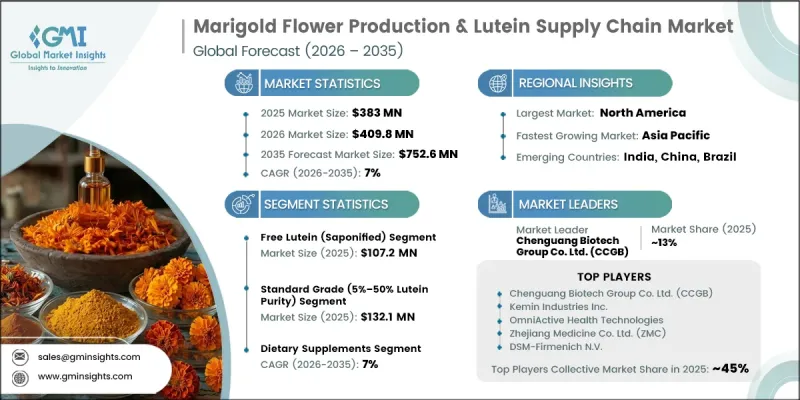
이 시장은 전 세계 생산 및 소비 패턴을 변화시키고 있는 여러 가지 장기적인 수요 촉진요인에 힘입어 지속적으로 확대되고 있습니다. 고령화가 진행됨에 따라 시력 건강을 지원하는 영양 성분에 대한 수요가 증가하고 있을 뿐만 아니라, 디지털 화면에 장시간 노출됨에 따라 다양한 연령대에서 눈 건강 유지 제품의 사용이 촉진되고 있습니다. 규제 측면의 발전에 따라 영유아용 영양식품 및 기능성 식품에서 루테인의 승인 용도가 확대되고 있어, 제조사들에게 더 많은 비즈니스 기회가 창출되고 있습니다. 동시에 천연 유래 식품 원료에 대한 선호도가 높아짐에 따라, 합성 착색료에서 마리골드 유래 대체품으로의 전환이 가속화되고 있습니다. 인도와 중국은 합쳐서 전 세계 생 마리골드 꽃 공급량의 85% 이상을 차지하고 있는 반면, 북미와 유럽은 고부가가치 가공 루테인 원료의 주요 시장으로 자리 잡고 있어, 전 세계적으로 연계되면서도 지역별로 특화된 밸류체인이 형성되고 있습니다. 아시아태평양 전체에서 체계화된 소매 채널을 통한 영양 보조제 판매 확대가 해당 지역의 소비를 더욱 부추기고 있습니다. 또한, 이 지역은 세계 최대의 추출 능력과 가장 빠르게 증가하는 수요를 모두 갖추고 있어, 2035년까지의 향후 시장 확대에 있어 주요 원동력으로서의 입지를 확고히 하고 있습니다.
| 시장 범위 | |
|---|---|
| 시작 연도 | 2025년 |
| 예측 기간 | 2026-2035년 |
| 개시 금액 | 3억 8,300만 달러 |
| 예측 금액 | 7억 5,260만 달러 |
| CAGR | 7% |
자유 루테인(비누화) 부문은 2025년에 1억 720만 달러의 매출을 기록했습니다. 이는 에스테르계 루테인에 비해 생체 이용률이 향상되어, 소프트젤이나 정제를 포함한 성인 눈 건강 지원 보충제 제형에 가장 적합하기 때문에 선호되고 있기 때문입니다. 표준화되고 고품질의 유리 루테인 원료에 대한 업계의 강력한 수요는 영양 보충제 제조 분야에서의 광범위한 채택을 지속적으로 촉진하고 있으며, 마리골드 꽃 생산 및 루테인 공급망 시장 전반에 걸쳐 이 부문의 주도적 지위를 공고히 하고 있습니다.
영양 보조제 부문은 2025년에 1억 6,660만 달러를 차지했으며, 루테인을 주성분으로 하는 영양 제품에 대한 신뢰를 강화한 광범위한 과학적 연구를 바탕으로 2026년부터 2035년까지 연평균 성장률(CAGR) 7%로 성장할 것으로 전망됩니다. 예방 의학에 대한 소비자의 지속적인 관심과 눈 건강에 대한 인식 제고가 맞물려, 선진국 및 신흥 시장 전반에서 루테인이 풍부하게 함유된 영양 보조제에 대한 안정적인 수요가 촉진되고 있으며, 이는 예측 기간 동안 지속적인 성장을 뒷받침하고 있습니다.
북미의 마리골드 꽃 생산 및 루테인 공급망 시장은 2025년에 1억 2,560만 달러 규모를 기록했습니다. 이 지역의 선도적 지위는 미국에서 확립된 영양 보조 식품 산업과, 보충제,식품, 영유아용 영양식품 각 분야에서 원료 혁신을 뒷받침하는 안정적인 규제 환경에 의해 지탱되고 있습니다. 시중에 판매되는 다양한 영양 제품 라인업과 건강 지향적 성분에 대한 소비자의 꾸준한 수요가 맞물려, 지역 공급망 전반에서 사업을 전개하는 원료 제조업체에게 계속해서 호기를 창출하고 있습니다.
자주 묻는 질문
목차
제1장 조사 방법과 범위
제2장 주요 요약
제3장 업계 인사이트
제4장 경쟁 구도
제5장 시장 추정 및 예측 : 제품 형태별, 2022-2035년
제6장 시장 추정 및 예측 : 순도별, 2022-2035년
제7장 시장 추정 및 예측 : 용도별, 2022-2035년
제8장 시장 추정 및 예측 : 공급망 단계별, 2022-2035년
제9장 시장 추정 및 예측 : 지역별, 2022-2035년
제10장 기업 개요
KSM 26.09.03The Global Marigold Flower Production & Lutein Supply Chain Market was valued at USD 383 million in 2025 and is estimated to grow at a CAGR of 7% to reach USD 752.6 million by 2035.
The market continues to advance because of multiple long-term demand drivers that are reshaping both production and consumption patterns worldwide. Growing elderly populations are increasing demand for nutritional ingredients that support vision health, while prolonged exposure to digital screens is encouraging greater use of eye wellness products across different age groups. Regulatory developments are broadening the approved use of lutein in infant nutrition and functional food applications, creating additional commercial opportunities for manufacturers. At the same time, rising preference for naturally derived food ingredients is accelerating the replacement of synthetic color additives with marigold-derived alternatives. India and China collectively contribute more than 85% of the global raw marigold flower supply, whereas North America and Europe represent the primary markets for high-value processed lutein ingredients, creating a globally connected yet regionally specialized supply chain. Expanding dietary supplement distribution through organized retail channels across Asia Pacific is further supporting regional consumption. The region also combines the world's largest extraction capacity with the fastest-growing demand, reinforcing its position as the primary engine of future market expansion through 2035.
| Market Scope | |
|---|---|
| Start Year | 2025 |
| Forecast Year | 2026-2035 |
| Start Value | $383 Million |
| Forecast Value | $752.6 Million |
| CAGR | 7% |
The free lutein (saponified) segment generated USD 107.2 million in 2025, owing to the preferred choice as it offers improved bioavailability compared with ester-based lutein, making it well suited for adult eye health supplement formulations, including softgels and tablets. Strong industry preference for standardized, high-quality free lutein ingredients continues to support widespread adoption across dietary supplement manufacturing, reinforcing the segment's leading position within the overall marigold flower production & lutein supply chain market.
The dietary supplements segment accounted for USD 166.6 million in 2025 and is projected to grow at a 7% CAGR between 2026 and 2035 owing to the extensive scientific research that has strengthened confidence in lutein-based nutritional products. Continuous consumer interest in preventive health, combined with growing awareness of eye wellness, is encouraging consistent demand for lutein-enriched dietary supplements across developed and emerging markets, supporting sustained growth throughout the forecast period.
North America Marigold Flower Production & Lutein Supply Chain Market captured USD 125.6 million in 2025. Regional leadership is supported by the well-established dietary supplement industry in the United States and a stable regulatory environment that encourages ingredient innovation across supplements, food products, and infant nutrition applications. A broad portfolio of commercially available nutritional products, together with consistent consumer demand for health-focused ingredients, continues to create favorable opportunities for ingredient manufacturers operating throughout the regional supply chain.
Major companies operating in the global marigold flower production & lutein supply chain market include Chenguang Biotech Group Co., Ltd. (CCGB), Kemin Industries, Inc., OmniActive Health Technologies, DSM-Firmenich N.V., Zhejiang Medicine Co., Ltd. (ZMC), Divi's Nutraceuticals (Divi's Laboratories Ltd.), Synthite Industries Ltd., AVT Natural Products Ltd., Plant Lipids Pvt. Ltd., Olive Lifesciences Pvt. Ltd., Bio-gen Extracts Pvt. Ltd., Biomax Life Sciences Ltd., Lycored Ltd., Hunan Huakang Biotech Inc., and Aturex Nutritionals. Companies participating in the marigold flower production & lutein supply chain market are strengthening their competitive position by expanding extraction capacity, improving processing efficiency, and investing in advanced purification technologies to enhance product quality and consistency. Many manufacturers are building long-term sourcing relationships with marigold growers to secure reliable raw material availability while reducing supply chain risks. Businesses are also broadening their product portfolios to address demand from dietary supplements, functional foods, infant nutrition, and natural color applications. Strategic geographic expansion, partnerships with ingredient distributors, and stronger regional manufacturing capabilities are helping companies improve market access.
Table of Contents
Chapter 1 Methodology & Scope
- 1.1 Market scope and definition
- 1.2 Research design
- 1.2.1 Research approach
- 1.2.2 Data collection methods
- 1.3 Data mining sources
- 1.3.1 Global
- 1.3.2 Regional/Country
- 1.4 Base estimates and calculations
- 1.4.1 Base year calculation
- 1.4.2 Key trends for market estimation
- 1.5 Primary research and validation
- 1.5.1 Primary sources
- 1.6 Forecast model
- 1.7 Research assumptions and limitations
Chapter 2 Executive Summary
- 2.1 Industry 360° synopsis
- 2.2 Key market trends
- 2.2.1 Product form
- 2.2.2 Purity grade
- 2.2.3 Application
- 2.2.4 Supply Chain Stage
- 2.2.5 Regional
- 2.3 TAM Analysis, 2026-2035
- 2.4 CXO perspectives: Strategic imperatives
- 2.5 Future outlook and strategic recommendations
Chapter 3 Industry Insights
- 3.1 Industry ecosystem analysis
- 3.1.1 Supplier landscape
- 3.1.2 Profit margin
- 3.1.3 Value addition at each stage
- 3.1.4 Factor affecting the value chain
- 3.1.5 Disruptions
- 3.2 Industry impact forces
- 3.2.1 Growth drivers
- 3.2.2 Industry pitfalls and challenges
- 3.2.3 Market opportunities
- 3.3 Growth potential analysis
- 3.4 Regulatory landscape
- 3.4.1 North America
- 3.4.2 Europe
- 3.4.3 Asia Pacific
- 3.4.4 Latin America
- 3.4.5 Middle East & Africa
- 3.5 Porter’s analysis
- 3.6 PESTEL analysis
- 3.7 Technology and innovation landscape
- 3.7.1 Current technological trends
- 3.7.2 Emerging technologies
- 3.8 Price trends
- 3.8.1 By region
- 3.8.2 By product form
- 3.9 Future market trends
- 3.10 Patent landscape
- 3.11 Trade statistics (HS code)
- 3.11.1 Major importing countries
- 3.11.2 Major exporting countries
- 3.12 Sustainability and environmental aspects
- 3.12.1 Sustainable practices
- 3.12.2 Waste reduction strategies
- 3.12.3 Energy efficiency in production
- 3.12.4 Eco-friendly initiatives
Chapter 4 Competitive Landscape, 2025
- 4.1 Introduction
- 4.2 Company market share analysis
- 4.2.1 By region
- 4.2.1.1 North America
- 4.2.1.2 Europe
- 4.2.1.3 Asia Pacific
- 4.2.1.4 LATAM
- 4.2.1.5 MEA
- 4.2.1 By region
- 4.3 Company matrix analysis
- 4.4 Competitive analysis of major market players
- 4.5 Competitive positioning matrix
- 4.6 Key developments
- 4.6.1 Mergers & acquisitions
- 4.6.2 Partnerships & collaborations
- 4.6.3 New product launches
- 4.6.4 Expansion plans
Chapter 5 Market Estimates and Forecast, By Product Form, 2022–2035 (USD Million) (Kilo Tons)
- 5.1 Key trends
- 5.2 Free Lutein (Saponified)
- 5.3 Lutein Ester
- 5.4 Marigold Oleoresin
- 5.5 Lutein Beadlets
- 5.6 Lutein Powder/Crystalline
- 5.7 Lutein Oil Suspension
Chapter 6 Market Estimates and Forecast, By Purity Grade, 2022–2035 (USD Million) (Kilo Tons)
- 6.1 Key trends
- 6.2 Standard Grade (5%–50% Lutein Purity)
- 6.3 High Purity Grade (≥80% Lutein Purity)
- 6.4 Food Grade (50%–79% Lutein Purity)
Chapter 7 Market Estimates and Forecast, By Application, 2022–2035 (USD Million) (Kilo Tons)
- 7.1 Key trends
- 7.2 Dietary Supplements
- 7.3 Food & Beverages
- 7.4 Animal Feed
- 7.5 Pharmaceuticals
- 7.6 Cosmetics & Personal Care
- 7.7 Others
Chapter 8 Market Estimates and Forecast, By Supply Chain Stage, 2022–2035 (USD Million) (Kilo Tons)
- 8.1 Key trends
- 8.2 Midstream (Extraction & Processing)
- 8.3 Downstream (Formulation & Distribution)
- 8.4 Upstream (Cultivation & Harvesting)
Chapter 9 Market Estimates and Forecast, By Region, 2022–2035 (USD Million) (Kilo Tons)
- 9.1 Key trends
- 9.2 North America
- 9.2.1 U.S.
- 9.2.2 Canada
- 9.3 Europe
- 9.3.1 Germany
- 9.3.2 UK
- 9.3.3 France
- 9.3.4 Spain
- 9.3.5 Italy
- 9.3.6 Rest of Europe
- 9.4 Asia Pacific
- 9.4.1 China
- 9.4.2 India
- 9.4.3 Japan
- 9.4.4 Australia
- 9.4.5 South Korea
- 9.4.6 Rest of Asia Pacific
- 9.5 Latin America
- 9.5.1 Brazil
- 9.5.2 Mexico
- 9.5.3 Argentina
- 9.5.4 Rest of Latin America
- 9.6 Middle East and Africa
- 9.6.1 Saudi Arabia
- 9.6.2 South Africa
- 9.6.3 UAE
- 9.6.4 Rest of Middle East and Africa
Chapter 10 Company Profiles
- 10.1 Chenguang Biotech Group Co., Ltd. (CCGB)
- 10.2 Kemin Industries, Inc.
- 10.3 OmniActive Health Technologies
- 10.4 DSM-Firmenich N.V.
- 10.5 Zhejiang Medicine Co., Ltd. (ZMC)
- 10.6 Divi's Nutraceuticals (Divi's Laboratories Ltd.)
- 10.7 Synthite Industries Ltd.
- 10.8 AVT Natural Products Ltd.
- 10.9 Plant Lipids Pvt. Ltd.
- 10.10 Olive Lifesciences Pvt. Ltd.
- 10.11 Bio-gen Extracts Pvt. Ltd.
- 10.12 Biomax Life Sciences Ltd.
- 10.13 Lycored Ltd.
- 10.14 Hunan Huakang Biotech Inc.
- 10.15 Aturex Nutritionals


