

|
시장보고서
상품코드
2121178
보트 및 선박 텔레매틱스 시장 기회, 성장 촉진요인, 업계 동향 분석 및 예측(2026-2035년)Boat and Ship Telematics Market Opportunity, Growth Drivers, Industry Trend Analysis, and Forecast 2026 - 2035 |
||||||

세계의 보트 및 선박 텔레매틱스 시장은 2025년에 67억 달러 규모에 달하고, CAGR 9.5%로 성장하여 2035년에는 163억 달러에 달할 것으로 예측됩니다.
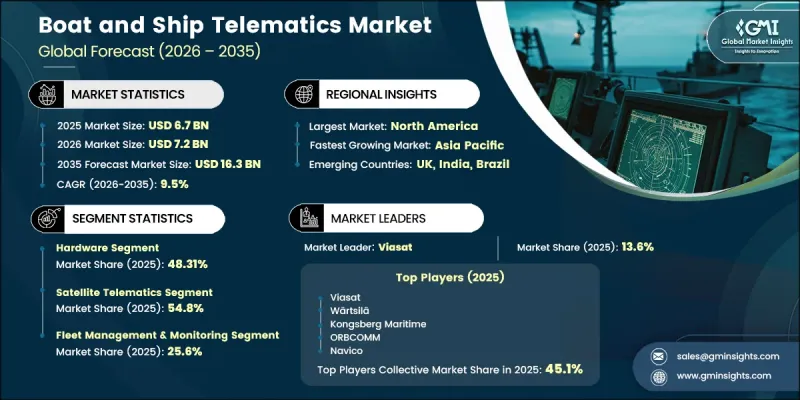
해상 안전 요건의 강화와 점점 더 엄격해지는 환경 규제로 인해 커넥티드 선박 기술에 대한 강력한 수요가 발생하고 있습니다. 규제 당국은 운항 모니터링, 배기가스 관리, 선박 보안, 연료 효율 및 환경 보고를 더욱 중시하게 되어 선단 운영자들에게 첨단 텔레매틱스 솔루션 도입을 촉진하고 있습니다. 이러한 시스템을 통해 운영자는 최신 선박 데이터에 접근할 수 있게 되어 운항 가시성을 높이는 동시에 규제 보고 요건도 충족할 수 있게 됩니다. 해사 환경 기준의 지속적인 발전으로 인해 해운 업계 전반에 걸쳐 커넥티드 모니터링 기능에 대한 수요가 더욱 높아질 것으로 예상됩니다. 동시에, 급등하는 연료비와 증가하는 운영 비용으로 인해 선박 운항 사업자들은 선단의 효율화를 도모하고 불필요한 지출을 억제해야 하는 압박을 받고 있습니다. 텔레매틱스 기술은 선박 운항 상황에 대한 더 깊은 인사이트를 제공하여, 기업이 자산 성과, 연료 소비량, 항로 설정 및 선단의 가동률에 대해 더 정보에 기반한 의사결정을 내릴 수 있도록 지원합니다. 상업 운항 사업자들이 비용 최적화, 자산 생산성 및 운항 투명성을 점점 더 우선시함에 따라, 예측 기간 동안 보트 및 선박용 텔레매틱스 솔루션의 도입이 가속화될 것으로 예상됩니다.
| 시장 범위 | |
|---|---|
| 시작 연도 | 2025년 |
| 예측 기간 | 2026-2035년 |
| 개시 금액 | 67억 달러 |
| 예측 금액 | 163억 달러 |
| CAGR | 9.5% |
2025년에는 하드웨어 부문이 48.31%의 점유율을 차지했습니다. 선내 통신, 위치 측정, 감시 및 제어 기기에 대한 꾸준한 수요가 해당 부문의 주도적 지위를 지속적으로 뒷받침하고 있습니다. 선박 소유주와 선단 운영 사업자들은 GPS/GNSS 수신기, AIS 트랜스폰더, 위성 통신 단말기, 선내 센서, 선박용 안테나, 텔레매틱스 제어 장치에 대한 투자를 확대하고 있습니다. 이러한 하드웨어 구성요소는 선박 관련 정보의 수집, 전송, 처리에 필요한 인프라를 제공합니다. 항해 성능, 선단 가시성, 엔진 모니터링, 연료 관리 및 규제 요건에 대한 중요성이 높아짐에 따라 사업자들은 선내 장비의 현대화를 추진하고 있습니다. 상업용 및 레저용 모두에서 커넥티드 선박 인프라의 확대도 하드웨어 수요에 기여하고 있습니다. 해운 사업자들이 더욱 신뢰할 수 있고 통합된 모니터링 기능을 추구하는 가운데, 첨단 텔레매틱스 하드웨어의 도입은 앞으로도 시장 발전의 주요 요인으로 남아 있을 것으로 예상됩니다.
2025년, 위성 텔레매틱스 분야는 54.8%의 점유율을 차지했습니다. 이 분야는 지상 네트워크의 커버리지가 제한적이거나 아예 없는 해역에서도 통신 및 데이터 전송을 유지할 수 있는 위성 연결의 이점을 활용하고 있습니다. 이러한 기능 덕분에 광범위한 지리적 영역에서 운항하며 안정적인 연결성을 필요로 하는 선박에게 위성 기반 텔레매틱스는 특히 중요합니다. 위성 솔루션은 선박 추적, 항법, 통신, 선단 관리, 규제 요건 등 해운 분야의 핵심 기능을 지원합니다. 광범위한 커버리지 덕분에 선박이 기존 통신 인프라의 범위를 벗어난 해역을 항해하는 경우에도 운항 사업자는 중요한 선박 정보에 계속 접근할 수 있습니다. 장거리 해상 활동의 지속적인 확대와 신뢰할 수 있는 선박 연결에 대한 수요 증가로 인해, 예측 기간 동안 위성 텔레매틱스가 주도적인 위치를 유지할 것으로 예상됩니다.
미국의 보트 및 선박 텔레매틱스 시장은 83.6%의 점유율을 차지하며, 2025년에는 19억 달러 규모의 시장을 기록했습니다. 미국의 확고한 입지는 상업 해운 활동의 규모, 확립된 수상 운송 인프라, 발전된 레저용 보트 산업, 그리고 커넥티드 선박 기술의 보급이 진행되고 있음을 반영합니다. 이 지역의 사업자들은 선박 운항의 가시성을 높이고 보다 효율적인 선단 관리를 지원하기 위해 텔레매틱스 플랫폼 도입을 점점 더 확대하고 있습니다. 확립된 해양 기술 생태계의 존재와 운항 효율 및 규제 준수에 대한 관심 증가 또한 시장 발전을 뒷받침하고 있습니다.
자주 묻는 질문
목차
제1장 조사 방법과 범위
제2장 주요 요약
제3장 업계 인사이트
제4장 경쟁 구도
제5장 시장 추정 및 예측 : 구성요소별, 2022-2035년
제6장 시장 추정 및 예측 : 기술별, 2022-2035년
제7장 시장 추정 및 예측 : 기능별, 2022-2035년
제8장 시장 추정 및 예측 : 선박 유형별, 2022-2035년
제9장 시장 추정 및 예측 : 판매 채널별, 2022-2035년
제10장 시장 추정 및 예측 : 지역별, 2022-2035년
제11장 기업 개요
KSM 26.09.03The Global Boat and Ship Telematics Market was valued at USD 6.7 billion in 2025 and is estimated to grow at a CAGR of 9.5% to reach USD 16.3 billion by 2035.
Rising maritime safety requirements and increasingly stringent environmental regulations are creating strong demand for connected vessel technologies. Regulatory authorities are placing greater emphasis on operational monitoring, emissions management, vessel security, fuel efficiency, and environmental reporting, encouraging fleet operators to integrate advanced telematics solutions. These systems give operators access to timely vessel data and help them improve operational visibility while supporting regulatory reporting requirements. The continuous evolution of maritime environmental standards is expected to further increase the need for connected monitoring capabilities across the shipping industry. At the same time, higher fuel expenses and rising operating costs are pushing vessel operators to improve fleet efficiency and control unnecessary expenditures. Telematics technology can provide greater insight into vessel operations, enabling companies to make more informed decisions regarding asset performance, fuel consumption, routing, and fleet utilization. As commercial operators increasingly prioritize cost optimization, asset productivity, and operational transparency, the adoption of boat and ship telematics solutions is expected to accelerate throughout the forecast period.
| Market Scope | |
|---|---|
| Start Year | 2025 |
| Forecast Year | 2026-2035 |
| Start Value | $6.7 Billion |
| Forecast Value | $16.3 Billion |
| CAGR | 9.5% |
The hardware segment accounted for the 48.31% share in 2025. Strong demand for onboard communication, positioning, monitoring, and control equipment continues to support the segment's leading position. Vessel owners and fleet operators are increasing investments in GPS/GNSS receivers, AIS transponders, satellite communication terminals, onboard sensors, marine antennas, and telematics control units. These hardware components provide the infrastructure required to collect, transmit, and process vessel-related information. Growing emphasis on navigation performance, fleet visibility, engine monitoring, fuel management, and regulatory requirements is encouraging operators to modernize onboard equipment. The expansion of connected vessel infrastructure across both commercial and recreational applications is also contributing to hardware demand. As maritime operators seek more reliable and integrated monitoring capabilities, the deployment of advanced telematics hardware is expected to remain a major component of market development.
The satellite telematics segment held 54.8% share in 2025. The segment benefits from the ability of satellite connectivity to maintain communication and data transmission across maritime areas where terrestrial networks provide limited or no coverage. This capability makes satellite-based telematics particularly important for vessels that operate across broad geographic areas and require consistent connectivity. Satellite solutions support essential maritime functions, including vessel tracking, navigation, communication, fleet supervision, and regulatory requirements. Their broad coverage enables operators to maintain access to critical vessel information even when ships travel outside conventional communication infrastructure. Continued expansion of long-distance maritime activities and growing demand for reliable vessel connectivity are expected to sustain the leading position of satellite telematics during the forecast period.
United States Boat and Ship Telematics Market held an 83.6% share, generating USD 1.9 billion in 2025. The country's strong position reflects the scale of its commercial maritime activities, established water transportation infrastructure, developed recreational boating industry, and growing acceptance of connected vessel technologies. Operators across the region are increasingly adopting telematics platforms to gain improved visibility into vessel operations and support more efficient fleet management. The presence of an established maritime technology ecosystem and increasing attention toward operational efficiency and regulatory compliance are also supporting market development.
Major companies operating in the global boat and ship telematics industry include Wartsila, Furuno Electric, ORBCOMM, Saab, Iridium Communications, Garmin, Kongsberg Maritime, Viasat, Thales, Navico Group, KVH Industries, Inmarsat, L3Harris Technologies, and other prominent industry participants. Companies in the boat and ship telematics market are pursuing several strategies to expand their market foothold and strengthen their competitive positions. Leading participants are investing in product development to improve connectivity, data accuracy, monitoring capabilities, automation, and system integration. Companies are also expanding their technology portfolios by combining telematics hardware, software, communication infrastructure, and analytics capabilities into more comprehensive solutions. Strategic collaborations, technology partnerships, distribution agreements, and geographic expansion are helping market participants reach new customer groups and strengthen regional coverage. Businesses are also focusing on improving platform scalability and interoperability so operators can integrate telematics technologies with existing maritime systems. Continued investment in research and development allows companies to introduce more efficient and reliable solutions while responding to changing regulatory requirements. In addition, providers are emphasizing customer support, service capabilities, and customized solutions to improve retention and build long-term relationships. These strategies are helping companies increase adoption, broaden their customer base, and reinforce their positions in the growing boat and ship telematics market.
Table of Contents
Chapter 1 Methodology & Scope
- 1.1 Research approach
- 1.2 Quality Commitments
- 1.2.1 GMI AI policy & data integrity commitment
- 1.2.1.1 Source consistency protocol
- 1.2.1 GMI AI policy & data integrity commitment
- 1.3 Research Trail & Confidence Scoring
- 1.3.1 Research Trail Components
- 1.3.2 Scoring Components
- 1.4 Data Collection
- 1.4.1 Partial list of primary sources
- 1.5 Data mining sources
- 1.5.1 Paid sources
- 1.5.1.1 Sources, by region
- 1.5.1 Paid sources
- 1.6 Base estimates and calculations
- 1.6.1 Base year calculation
- 1.7 Forecast
- 1.7.1 Quantified market impact analysis
- 1.7.1.1 Mathematical impact of growth parameters on forecast
- 1.7.1 Quantified market impact analysis
- 1.8 Research transparency addendum
- 1.8.1 Source attribution framework
- 1.8.2 Quality assurance metrics
- 1.8.3 Our commitment to trust
Chapter 2 Executive Summary
- 2.1 Industry 360° synopsis
- 2.2 Key market trends
- 2.2.1 Regional
- 2.2.2 Component
- 2.2.3 Technology
- 2.2.4 Function
- 2.2.5 Vessel Type
- 2.2.6 Sales Channel
- 2.3 TAM Analysis, 2026-2035
- 2.4 CXO perspectives: Strategic imperatives
Chapter 3 Industry Insights
- 3.1 Industry ecosystem analysis
- 3.1.1 Supplier landscape
- 3.1.2 Cost structure
- 3.1.3 Profit margin
- 3.1.4 Value addition at each stage
- 3.1.5 Vertical integration trends
- 3.1.6 Disruptors
- 3.2 Industry impact forces
- 3.2.1 Growth drivers
- 3.2.1.1 Stringent maritime safety and environmental regulations
- 3.2.1.2 Fuel-efficiency and operating-cost reduction priorities
- 3.2.1.3 Growth in global seaborne trade
- 3.2.1.4 Maritime digitalization and automation
- 3.2.2 Market Restraints
- 3.2.2.1 High upfront costs for telematics deployment and retrofitting existing vessels.
- 3.2.2.2 Limited and expensive connectivity in remote offshore and deep-sea regions.
- 3.2.3 Market Opportunities
- 3.2.3.1 Rising demand for autonomous and remotely operated vessels is creating new opportunities for advanced telematics platforms.
- 3.2.3.2 Expansion of smart ports and digital maritime infrastructure is increasing the need for connected vessel solutions.
- 3.2.3.3 Growing adoption of predictive maintenance and AI-driven analytics offers significant potential for reducing vessel downtime.
- 3.2.3.4 Increasing digitalization of fishing fleets and inland waterways presents untapped growth opportunities for telematics providers.
- 3.2.1 Growth drivers
- 3.3 Growth potential analysis
- 3.4 Pricing Analysis (Driven by Primary Research)
- 3.4.1 Historical Price Trend Analysis, 2022-2025
- 3.4.2 Pricing Strategy by Player Type (Premium / Value / Cost-plus)
- 3.5 Regulatory landscape
- 3.5.1 North America
- 3.5.1.1 United States Coast Guard – Vessel Monitoring & AIS Regulations
- 3.5.1.2 Federal Communications Commission – Maritime Radio & Satellite Communication
- 3.5.2 Europe
- 3.5.2.1 European Maritime Safety Agency – SafeSeaNet & Maritime Digital Services
- 3.5.2.2 European Union – EU MRV Regulation
- 3.5.3 Asia-Pacific
- 3.5.3.1 Maritime and Port Authority of Singapore – Digital Port & Smart Shipping Regulations
- 3.5.3.2 Ministry of Land, Infrastructure, Transport and Tourism – Maritime Safety & Vessel Equipment Standards
- 3.5.4 Latin America
- 3.5.4.1 Brazilian Navy – Maritime Traffic & Vessel Monitoring Regulations
- 3.5.4.2 Maritime Authority of Panama – Vessel Registration & Maritime Safety Requirements
- 3.5.5 Middle East & Africa
- 3.5.5.1 Saudi Ports Authority (Mawani) – Smart Ports & Maritime Digitalization Regulations
- 3.5.5.2 South African Maritime Safety Authority – Vessel Tracking & Maritime Safety
- 3.5.1 North America
- 3.6 Technology and Innovation landscape
- 3.6.1 Current technologies
- 3.6.1.1 Satellite-Based Telematics & Connectivity
- 3.6.1.2 Cellular (4G/5G) Telematics
- 3.6.1.3 AIS-Based Vessel Tracking & Monitoring
- 3.6.1.4 GNSS/GPS-Based Positioning & Navigation
- 3.6.2 Emerging technologies
- 3.6.2.1 AI-Powered Predictive Maintenance & Vessel Analytics
- 3.6.2.2 IoT-Enabled Smart Vessel Telematics
- 3.6.2.3 Edge Computing for Real-Time Vessel Data Processing
- 3.6.2.4 Autonomous Vessel Telematics & Remote Operations
- 3.6.1 Current technologies
- 3.7 Porter’s analysis
- 3.8 PESTEL analysis
- 3.9 Cost breakdown analysis, 2025
- 3.10 Patent analysis (Driven by Primary Research)
- 3.11 Impact of AI & generative AI on the market
- 3.11.1 AI-Driven Disruption of Existing Business Models
- 3.11.2 GenAI use cases & adoption roadmap by segment
- 3.11.3 Risks, Limitations & Regulatory Considerations
- 3.12 Sustainability and environmental aspects
- 3.12.1 Sustainable practices
- 3.12.2 Waste reduction strategies
- 3.12.3 Energy efficiency in production
- 3.12.4 Eco-friendly Initiatives
- 3.12.5 Carbon footprint considerations
- 3.13 Forecast assumptions & scenario analysis (Driven by Primary Research)
- 3.13.1 Base Case - key macro & industry variables driving CAGR
- 3.13.2 Optimistic Scenarios - Favorable Macro and Industry Tailwinds
- 3.13.3 Pessimistic Scenario - Macroeconomic slowdown or industry headwinds
Chapter 4 Competitive Landscape, 2025
- 4.1 Introduction
- 4.2 Company market share analysis
- 4.2.1 North America
- 4.2.2 Europe
- 4.2.3 Asia-Pacific
- 4.2.4 Latin America
- 4.2.5 Middle East & Africa
- 4.3 Competitive positioning matrix
- 4.4 Key developments
- 4.4.1 Mergers & acquisitions
- 4.4.2 Partnerships & collaborations
- 4.4.3 New product launches
- 4.4.4 Expansion plans and funding
- 4.5 Company tier benchmarking
- 4.5.1 Tier classification criteria & qualifying thresholds
- 4.5.2 Tier positioning matrix by revenue, geography & innovation
Chapter 5 Market Estimates & Forecast, By Component, 2022 - 2035 ($Mn)
- 5.1 Key trends
- 5.2 Hardware
- 5.2.1 GPS & Navigation Systems
- 5.2.2 Sensors & IoT Devices
- 5.2.3 Satellite Transponders & Antennas
- 5.2.4 Communication Modems & Systems
- 5.2.5 Onboard Display & Interface Devices
- 5.3 Software
- 5.3.1 Fleet Management Software
- 5.3.2 Route Optimization Platforms
- 5.3.3 Remote Monitoring & Diagnostics Software
- 5.3.4 Predictive Maintenance Applications
- 5.3.5 Security & Surveillance Software
- 5.4 Services
- 5.4.1 Installation & Integration Services
- 5.4.2 Managed Connectivity Services
- 5.4.3 Data Analytics & Reporting Services
Chapter 6 Market Estimates & Forecast, By Technology, 2022 - 2035 ($Mn)
- 6.1 Key trends
- 6.2 Satellite Telematics
- 6.3 Cellular Telematics
- 6.4 Hybrid Systems
Chapter 7 Market Estimates & Forecast, By Function, 2022 - 2035 ($Mn)
- 7.1 Key trends
- 7.2 Navigation & Positioning
- 7.3 Fleet Management & Monitoring
- 7.4 Safety & Security
- 7.5 Communication & Connectivity
- 7.6 Environmental Compliance & Reporting
- 7.7 Cargo & Asset Tracking
Chapter 8 Market Estimates & Forecast, By Vessel Type, 2022 - 2035 ($Mn)
- 8.1 Key trends
- 8.2 Commercial Cargo
- 8.3 Passenger
- 8.4 Fishing & Aquaculture
- 8.5 Offshore & Energy
- 8.6 Government & Military
- 8.7 Leisure & Recreational Boats
Chapter 9 Market Estimates & Forecast, By Sales Channel, 2022 - 2035 ($Mn)
- 9.1 Key trends
- 9.2 OEM & Shipyard Integration
- 9.3 Aftermarket & Retrofit
Chapter 10 Market Estimates & Forecast, By Region, 2022 - 2035 ($Mn)
- 10.1 North America
- 10.1.1 US
- 10.1.2 Canada
- 10.2 Europe
- 10.2.1 UK
- 10.2.2 Germany
- 10.2.3 France
- 10.2.4 Italy
- 10.2.5 Spain
- 10.2.6 Belgium
- 10.2.7 Netherlands
- 10.2.8 Sweden
- 10.2.9 Russia
- 10.3 Asia Pacific
- 10.3.1 China
- 10.3.2 India
- 10.3.3 Japan
- 10.3.4 Australia
- 10.3.5 Singapore
- 10.3.6 South Korea
- 10.3.7 Vietnam
- 10.3.8 Indonesia
- 10.3.9 Thailand
- 10.4 Latin America
- 10.4.1 Brazil
- 10.4.2 Mexico
- 10.4.3 Argentina
- 10.5 MEA
- 10.5.1 South Africa
- 10.5.2 Saudi Arabia
- 10.5.3 UAE
Chapter 11 Company Profiles
- 11.1 Global Players
- 11.1.1 KVH Industries
- 11.1.2 Iridium Communications
- 11.1.3 Viasat
- 11.1.4 Saab
- 11.1.5 Kongsberg Maritime
- 11.1.6 Wartsila
- 11.1.7 Furuno Electric
- 11.1.8 Garmin
- 11.1.9 Thales
- 11.1.10 L3Harris Technologies
- 11.2 Regional Players
- 11.2.1 Raymarine
- 11.2.2 Intellian Technologies
- 11.2.3 SRT Marine Systems
- 11.2.4 Kpler
- 11.2.5 Pole Star Global
- 11.2.6 ShipIn Systems
- 11.2.7 CLS
- 11.2.8 Anschutz
- 11.2.9 ComNav Marine
- 11.2.10 Jotron


