

|
시장보고서
상품코드
2121182
지상 지원 장비 시장 기회, 성장 촉진요인, 업계 동향 분석 및 예측(2026-2035년)Ground Support Equipment Market Opportunity, Growth Drivers, Industry Trend Analysis, and Forecast 2026 - 2035 |
||||||

세계의 지상 지원 장비 시장은 2025년에 96억 달러 규모에 달하고, 2035년까지 CAGR 6.1%로 성장하여 171억 달러에 달할 것으로 추정됩니다.
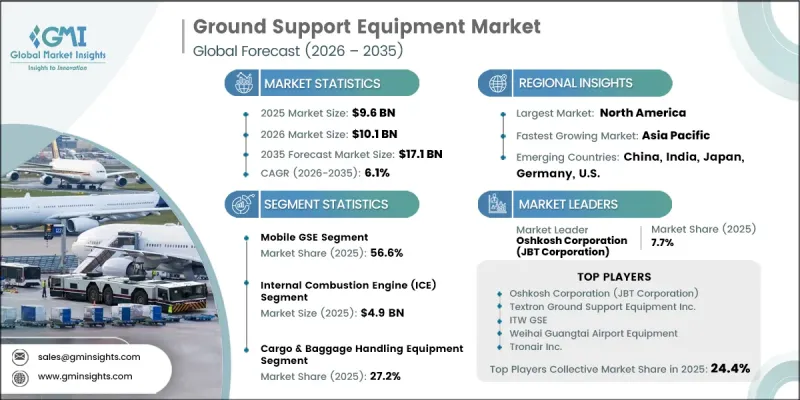
이 시장은 공항 인프라 개발 확대, 전 세계 항공기 운항 증가, 항공기 처리 과정의 신속화에 대한 중요성 증대, 전동 지상 지원 장비 도입 확대, 그리고 지속가능한 항공 운항을 뒷받침하는 환경 기준의 강화에 힘입어 꾸준한 성장을 이루고 있습니다. 공항 시설의 지속적인 확장 및 현대화 노력에 힘입어, 공항 및 항공 사업자들은 효율성, 안전성 및 운영 성과를 향상시키는 첨단 지상 지원 장비에 대한 투자를 촉진하고 있습니다. 승객 수 증가, 화물 운송 수요 확대, 항공기 이착륙 횟수 증가는 신뢰할 수 있는 지상 취급 솔루션에 대한 수요를 견인하고 있습니다. 또한, 항공 업계 이해관계자들은 배출량 감축, 에너지 효율 향상 및 환경 지속가능성 목표 달성을 지원하기 위해 전동식 지상 지원 장비로의 전환을 가속화하고 있습니다. 현대 공항에서는 첨단 핸들링 기술, 디지털 솔루션 및 더 깨끗한 대체 장비를 통해 운영 역량 향상에 점점 더 집중하고 있습니다. 공항, 항공사, 서비스 제공업체가 효율적인 지상 운영, 턴어라운드 성능 향상 및 지속가능한 항공 관행을 지속적으로 우선시함에 따라, 이러한 동향은 지상 지원 장비 시장에 유리한 성장 기회를 창출하고 있습니다.
| 시장 범위 | |
|---|---|
| 시작 연도 | 2025년 |
| 예측 기간 | 2026-2035년 |
| 개시 금액 | 96억 달러 |
| 예측 금액 | 171억 달러 |
| CAGR | 6.1% |
2025년에는 이동식 지상 지원 장비(GSE) 부문이 56.6%의 점유율을 차지하며 계속해서 주도적인 위치를 유지했습니다. 이 부문의 성장은 항공기 정비 속도 향상 및 운영상의 유연성 증대에 대한 수요 증가, 그리고 전 세계 항공기 운항 증가에 힘입어 이루어지고 있습니다. 이동식 지상 지원 장비는 공항의 각 운영 구역에서 효율적인 이동 및 배치 능력을 제공하여, 지연 감소와 항공기 취급의 전반적인 효율성 향상에 기여하고 있습니다. 항공사 및 공항 운영 사업자들이 배출량 감축과 환경 지속가능성 목표 달성에 주력하는 가운데, 전동식 이동형 GSE 솔루션에 대한 투자 확대가 이 부문의 성장을 더욱 뒷받침하고 있습니다.
내연기관(ICE) 부문은 2025년에 49억 달러의 매출을 기록했습니다. ICE를 탑재한 지상 지원 장비는 가혹한 공항 운영 환경을 견디고, 까다로운 작업 환경에서도 신뢰할 수 있는 성능을 발휘할 수 있어 계속해서 견조한 수요를 유지하고 있습니다. 디젤 및 가솔린 엔진을 동력원으로 하는 기존형 장비는 확립된 인프라, 운영상의 익숙함, 강력한 출력, 그리고 주유 시스템의 정비 등의 이유로 여전히 널리 사용되고 있습니다. 이러한 요인들로 인해 민간 항공 시설 및 국방 관련 공항 운영에서 이 부문은 계속해서 큰 존재감을 보이고 있습니다.
2025년, 북미 지상 지원 장비 시장은 29.2%의 점유율을 차지했습니다. 이 지역 시장은 선진적인 항공 인프라의 존재, 항공 여행의 증가, 그리고 공항, 항공사, 장비 제조사의 지속적인 투자로 인해 확대되고 있습니다. 화물 운송 수요 증가, 진행 중인 공항 개선 프로그램, 그리고 항공 배출 가스 감축에 대한 관심 고조가 지능형 기술 및 친환경 지상 지원 솔루션의 도입을 촉진하고 있습니다. 디지털 연결형 및 전동식 장비의 도입 확대는 북미 전역의 공항 운영 현대화를 더욱 가속화하고 있습니다.
자주 묻는 질문
목차
제1장 조사 방법과 범위
제2장 주요 요약
제3장 업계 인사이트
제4장 경쟁 구도
제5장 시장 추정 및 예측 : 유형별, 2022-2035년
제6장 시장 추정 및 예측 : 전원별, 2022-2035년
제7장 시장 추정 및 예측 : 장비 유형별, 2022-2035년
제8장 시장 추정 및 예측 : 자동화 레벨별, 2022-2035년
제9장 시장 추정 및 예측 : 최종사용자별, 2022-2035년
제10장 시장 추정 및 예측 : 지역별, 2022-2035년
제11장 기업 개요
KSM 26.09.03The Global Ground Support Equipment Market was valued at USD 9.6 billion in 2025 and is estimated to grow at a CAGR of 6.1% to reach USD 17.1 billion by 2035.
The market is experiencing steady growth due to increasing airport infrastructure development, rising global aircraft activity, growing emphasis on faster aircraft handling processes, increasing adoption of electric ground support fleets, and stricter environmental standards supporting sustainable aviation operations. Continuous expansion of airport facilities and modernization initiatives are encouraging airports and aviation operators to invest in advanced ground support equipment that improves efficiency, safety, and operational performance. Growing passenger volumes, increasing cargo transportation requirements, and higher aircraft movement levels are driving demand for reliable ground handling solutions. Aviation stakeholders are also accelerating the transition toward electric ground support equipment to reduce emissions, improve energy efficiency, and support environmental sustainability objectives. Modern airports are increasingly focusing on upgrading operational capabilities through advanced handling technologies, digital solutions, and cleaner equipment alternatives. These developments are creating favorable growth opportunities for the Ground Support Equipment Market as airports, airlines, and service providers continue to prioritize efficient ground operations, improved turnaround performance, and sustainable aviation practices.
| Market Scope | |
|---|---|
| Start Year | 2025 |
| Forecast Year | 2026-2035 |
| Start Value | $9.6 Billion |
| Forecast Value | $17.1 Billion |
| CAGR | 6.1% |
The mobile GSE segment accounted for a 56.6% share in 2025, maintaining its leading position. Growth in this segment is supported by increasing demand for faster aircraft servicing, improved operational flexibility, and rising aircraft activity worldwide. Mobile ground support equipment provides efficient movement and deployment capabilities across airport operating areas, helping reduce delays and improve overall aircraft handling efficiency. Increasing investment in electric mobile GSE solutions is further strengthening segment growth as airlines and airport operators focus on reducing emissions and meeting environmental sustainability objectives.
The internal combustion engine (ICE) segment generated USD 4.9 billion in 2025. ICE-based ground support equipment continues to maintain strong demand because of its ability to support intensive airport operations and deliver reliable performance under demanding working conditions. Conventional equipment powered by diesel and gasoline engines remains widely used due to established infrastructure, operational familiarity, strong power output, and availability of fueling systems. These factors continue to support the segment's significant presence across commercial aviation facilities and defense-related airport operations.
North America Ground Support Equipment Market accounted for 29.2% share in 2025. The regional market is expanding due to the presence of advanced aviation infrastructure, increasing air travel activity, and continuous investments by airports, airlines, and equipment manufacturers. Rising cargo transportation demand, ongoing airport improvement programs, and increased focus on reducing aviation emissions are encouraging the adoption of intelligent technologies and environmentally efficient ground support solutions. Growing implementation of digitally connected and electrically powered equipment is further supporting the modernization of airport operations throughout North America.
Major companies operating in the global ground support equipment market include AERO Specialties, Air+MAK Industries Inc., ATEC Inc., Charlatte Manutention, Cobus Industries, Eagle Tugs, ITW GSE, Oshkosh Corporation (JBT Corporation), Rheinmetall AG, Sinfonia Technology Co. Ltd., Textron Ground Support Equipment Inc., TLD Group, Tronair Inc., Unitron, LP, and Weihai Guangtai Airport Equipment. Companies operating in the ground support equipment market are strengthening their market positions through product innovation, sustainable technology development, and strategic expansion initiatives. Manufacturers are focusing on designing advanced ground support solutions that improve operational efficiency, reduce emissions, and support airport automation. Investments in electric and digitally enabled equipment are increasing as companies aim to address sustainability goals and evolving aviation requirements. Strategic partnerships, acquisitions, technology collaborations, and regional expansion efforts are helping organizations improve their global presence and strengthen their product capabilities. Companies are also enhancing research and development activities to introduce energy-efficient systems, improve equipment reliability, and integrate smart technologies into ground handling operations.
Table of Contents
Chapter 1 Methodology and Scope
- 1.1 Market scope and definition
- 1.2 Research design
- 1.2.1 Research approach
- 1.2.2 Data collection methods
- 1.3 Data mining sources
- 1.3.1 Global
- 1.3.2 Regional/Country
- 1.4 Base estimates and calculations
- 1.4.1 Base year calculation
- 1.4.2 Key trends for market estimation
- 1.5 Primary research and validation
- 1.5.1 Primary sources
- 1.6 Forecast model
- 1.7 Research assumptions and limitations
Chapter 2 Executive Summary
- 2.1 Industry 360° synopsis, 2022 – 2035
- 2.2 Key market trends
- 2.2.1 Type trends
- 2.2.2 Power Source Trends
- 2.2.3 Equipment type trends
- 2.2.4 Automation level trends
- 2.2.5 End-User Trend
- 2.2.6 Regional trends
- 2.3 TAM Analysis, 2026-2035
- 2.4 CXO perspectives: Strategic imperatives
Chapter 3 Industry Insights
- 3.1 Industry ecosystem analysis
- 3.1.1 Supplier Landscape
- 3.1.2 Profit Margin
- 3.1.3 Cost structure
- 3.1.4 Value addition at each stage
- 3.1.5 Factor affecting the value chain
- 3.1.6 Disruptions
- 3.2 Industry impact forces
- 3.2.1 Growth drivers
- 3.2.1.1 Expansion of airport infrastructure and modernization projects
- 3.2.1.2 Rising global air passenger and cargo traffic
- 3.2.1.3 Growing adoption of electric ground support equipment (eGSE)
- 3.2.1.4 Increasing automation and digitalization of ground operations
- 3.2.1.5 Stringent environmental regulations and decarbonization initiatives
- 3.2.2 Industry pitfalls and challenges
- 3.2.2.1 High capital investment and equipment replacement costs
- 3.2.2.2 Stringent environmental and operational compliance requirements
- 3.2.3 Market opportunities
- 3.2.3.1 Expansion of electric ground support equipment (eGSE) fleets
- 3.2.3.2 Integration of automation, telematics, and autonomous technologies
- 3.2.1 Growth drivers
- 3.3 Growth potential analysis
- 3.4 Regulatory landscape
- 3.4.1 North America
- 3.4.2 Europe
- 3.4.3 Asia Pacific
- 3.4.4 Latin America
- 3.4.5 Middle East & Africa
- 3.5 Porter’s analysis
- 3.6 PESTEL analysis
- 3.7 Technology and Innovation landscape
- 3.7.1 Current technological trends
- 3.7.2 Emerging technologies
- 3.8 Price trends
- 3.8.1 By region
- 3.8.2 By product
- 3.9 Pricing Strategies
- 3.10 Emerging Business Models
- 3.11 Compliance Requirements
- 3.12 Patent and IP analysis
Chapter 4 Competitive Landscape, 2025
- 4.1 Introduction
- 4.2 Company market share analysis
- 4.2.1 By region
- 4.2.1.1 North America
- 4.2.1.2 Europe
- 4.2.1.3 Asia Pacific
- 4.2.1.4 Latin America
- 4.2.1.5 Middle East & Africa
- 4.2.2 Market concentration analysis
- 4.2.1 By region
- 4.3 Competitive benchmarking of key players
- 4.3.1 Financial performance comparison
- 4.3.1.1 Revenue
- 4.3.1.2 Profit margin
- 4.3.1.3 R&D
- 4.3.2 Product portfolio comparison
- 4.3.2.1 Product range breadth
- 4.3.2.2 Technology
- 4.3.2.3 Innovation
- 4.3.3 Geographic presence comparison
- 4.3.3.1 Global footprint analysis
- 4.3.3.2 Service network coverage
- 4.3.3.3 Market penetration by region
- 4.3.4 Competitive positioning matrix
- 4.3.4.1 Leaders
- 4.3.4.2 Challengers
- 4.3.4.3 Followers
- 4.3.4.4 Niche players
- 4.3.5 Strategic outlook matrix
- 4.3.1 Financial performance comparison
- 4.4 Key developments
- 4.4.1 Mergers and acquisitions
- 4.4.2 Partnerships and collaborations
- 4.4.3 Technological advancements
- 4.4.4 Expansion and investment strategies
- 4.4.5 Digital transformation initiatives
- 4.5 Emerging/ startup competitors landscape
Chapter 5 Market Estimates and Forecast, By Type, 2022 – 2035 (USD Million)
- 5.1 Key trends
- 5.2 Mobile GSE
- 5.2.1 Self-propelled equipment
- 5.2.2 Towable equipment
- 5.3 Fixed/stationary GSE
- 5.3.1 Passenger boarding bridges
- 5.3.2 Fixed ground power units
- 5.3.3 Fixed pre-conditioned air systems
Chapter 6 Market Estimates and Forecast, By Power Source, 2022 – 2035 (USD Million)
- 6.1 Key trends
- 6.2 Electric
- 6.2.1 Battery-electric systems (lithium-ion)
- 6.2.2 Battery-electric systems (lead-acid)
- 6.2.3 Grid-powered systems
- 6.3 Internal combustion engine (ICE)
- 6.4 Hybrid
Chapter 7 Market Estimates and Forecast, By Equipment Type, 2022 – 2035 (USD Million)
- 7.1 Key trends
- 7.2 Aircraft movement & positioning equipment
- 7.2.1 Pushback tractors
- 7.2.2 Luggage tugs
- 7.2.3 Chocks & wheel restraints
- 7.2.4 Others
- 7.3 Cargo & baggage handling equipment
- 7.3.1 Belt loaders
- 7.3.2 Container & pallet loaders
- 7.3.3 Cargo dollies & baggage carts
- 7.3.4 Conveyor systems
- 7.3.5 Others
- 7.4 Passenger handling equipment
- 7.4.1 Passenger boarding bridges (PBBs)
- 7.4.2 Passenger stairs
- 7.4.3 Apron buses
- 7.4.4 Others
- 7.5 Aircraft servicing equipment
- 7.5.1 Ground power units (GPUs)
- 7.5.2 Pre-conditioned air units (PCAs/ACUs)
- 7.5.3 Fuel trucks & refueling systems
- 7.5.4 Others
- 7.6 Aircraft safety & maintenance equipment
- 7.6.1 Air start units (ASUs)
- 7.6.2 Deicing & anti-icing equipment
- 7.6.3 Maintenance stands & platforms
- 7.6.4 Others
- 7.7 Others
Chapter 8 Market Estimates and Forecast, By Automation Level, 2022 – 2035 (USD Million)
- 8.1 Key trends
- 8.2 Conventional/manual-operated GSE
- 8.3 Semi-automated GSE (Telematics & IoT-Enabled)
- 8.4 Autonomous GSE (AGVS)
- 8.4.1 Autonomous tugs & tractors
- 8.4.2 Autonomous baggage vehicles
- 8.4.3 Autonomous maintenance equipment
Chapter 9 Market Estimates and Forecast, By End-user, 2022 – 2035 (USD Million)
- 9.1 Key trends
- 9.2 Airlines
- 9.3 Cargo operators
- 9.4 Ground handlers & leasing companies
- 9.5 Military
- 9.6 Industrial
- 9.7 Others
Chapter 10 Market Estimates and Forecast, By Region, 2022 – 2035 (USD Million)
- 10.1 Key trends
- 10.2 North America
- 10.2.1 U.S.
- 10.2.2 Canada
- 10.3 Europe
- 10.3.1 Germany
- 10.3.2 UK
- 10.3.3 France
- 10.3.4 Spain
- 10.3.5 Italy
- 10.4 Asia Pacific
- 10.4.1 China
- 10.4.2 India
- 10.4.3 Japan
- 10.4.4 Australia
- 10.4.5 South Korea
- 10.5 Latin America
- 10.5.1 Brazil
- 10.5.2 Mexico
- 10.5.3 Argentina
- 10.6 Middle East and Africa
- 10.6.1 South Africa
- 10.6.2 Saudi Arabia
- 10.6.3 UAE
Chapter 11 Company Profiles
- 11.1 Global Key Players
- 11.1.1 Oshkosh Corporation (JBT Corporation)
- 11.1.2 Textron Ground Support Equipment Inc.
- 11.1.3 ITW GSE
- 11.1.4 Weihai Guangtai Airport Equipment
- 11.1.5 Tronair Inc.
- 11.2 Regional key players
- 11.2.1 North America
- 11.2.1.1 AERO Specialties
- 11.2.1.2 Unitron, LP
- 11.2.2 Asia Pacific
- 11.2.2.1 Sinfonia Technology Co. Ltd.
- 11.2.2.2 Air+MAK Industries Inc.
- 11.2.3 Europe
- 11.2.3.1 Charlatte Manutention
- 11.2.3.2 Cobus Industries
- 11.2.3.3 Rheinmetall AG
- 11.2.3.4 TLD Group
- 11.2.1 North America
- 11.3 Niche Players/Disruptors
- 11.3.1 ATEC Inc.
- 11.3.2 Cavotec SA


