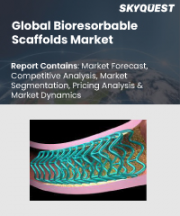
|
시장보고서
상품코드
2012367
생체흡수성 스텐트 시장 : 소재별, 제품 유형별, 분해 시간별, 용도별, 최종 사용자별, 유통 채널별 예측(2026-2032년)Bioabsorbable Stents Market by Material, Product Type, Degradation Time, Application, End User, Distribution Channel - Global Forecast 2026-2032 |
||||||
 360iResearch
생체흡수성 스텐트 시장은 2025년에 6억 756만 달러로 평가되었고 2026년에는 6억 4,565만 달러로 성장하여 CAGR 6.63%로 성장을 지속하여, 2032년까지 9억 5,271만 달러에 이를 것으로 예측됩니다.
| 주요 시장 통계 | |
|---|---|
| 기준 연도 : 2025년 | 6억 756만 달러 |
| 추정 연도 : 2026년 | 6억 4,565만 달러 |
| 예측 연도 : 2032년 | 9억 5,271만 달러 |
| CAGR(%) | 6.63% |
생체흡수성 스텐트 혁신의 잠재력과 미래 - 차세대 환자 치료를 위한 심혈관 중재시술의 발전 가능성
생체흡수성 스텐트 분야는 심혈관 중재술의 혁신적 최전선으로 부상하고 있으며, 영구적인 금속 임플란트의 오랜 숙제를 해결할 수 있는 잠재력을 가지고 있습니다. 기존 동맥벽에 고정되어 있는 스텐트와 달리 생체흡수성 스텐트는 서서히 분해되기 때문에 이물질이 장기간 체내에 남아있지 않고 혈관 기능이 회복될 수 있는 가능성을 제공합니다. 이러한 전환은 중재적 심장의학의 패러다임 전환을 의미하며, 성공의 지표를 단순한 개존율에서 자연적 혈관 운동 회복과 후기 합병증 최소화로 재정의하는 것을 의미합니다.
생체흡수성 스텐트 개발 및 임상 도입의 전망을 재정의하는 획기적인 발전과 파괴적 기술
재료 과학의 발전으로 생체흡수성 스텐트는 개념적 프로토타입에서 상업적으로 실용적인 옵션으로 발전했습니다. 초기 폴리머 매트릭스에서 차세대 금속 합금으로의 전환으로 방사형 강성이 향상되고 흡수 동역학이 제어되었습니다. 동시에, 새로운 표면 처리와 약물 용출성 코팅을 통해 오랜 기간의 과제였던 신생 내막 증식을 해결하고, 일시적인 기계적 지원의 장점과 국소 약물 요법을 결합했습니다.
2025년 미국의 신규 관세가 생체흡수성 스텐트 공급망 및 시장 역학에 미치는 광범위한 영향에 대한 분석
2025년 초, 마그네슘, 특수 폴리머 등 주요 원자재에 대한 미국의 새로운 관세 도입은 전 세계 공급망 전체에 파급효과를 일으켰습니다. 수입 관세로 인해 중요한 합금과 단량체의 단가가 상승함에 따라 제조업체는 즉각적인 비용 압박에 직면했습니다. 이러한 관세는 국내 생산을 보호하기 위한 것이었지만, 의도치 않게 조달 전략과 자재 조달 모델을 빠르게 재검토하는 결과를 초래했습니다.
생체흡수성 스텐트를 재료 구성, 제품 유형, 분해 시간, 임상 용도, 최종 사용자별로 분류하여 얻을 수 있는 중요한 인사이트
재료 구성의 차이가 스카폴드의 성능을 결정짓는 요소로 부상하고 있으며, 금속계와 폴리머계 카테고리가 제품 포트폴리오를 형성하고 있습니다. 금속 기반 제품군에서는 엔지니어들이 철계 합금을 활용하여 제어된 반경 방향 강도와 예측 가능한 부식 특성을 보장하는 반면, 마그네슘 기반 시스템은 흡수를 가속화하고 염증을 최소화하는 데 도움을 줍니다. 아연 기반 블렌드는 중간 균형을 이루고, 제어된 서비스 수명과 기계적 유연성을 제공합니다. 폴리머계 설계에서 폴리-L-락트산 스캐폴드는 이미 확립된 벤치마크가 되었습니다. 폴리카프로락톤, 폴리디옥사논, 폴리글리콜산의 병행된 기술 혁신으로 다양한 분해 기간과 특수한 병변 형태에 맞는 생역학적 특성을 제공합니다.
북미, 유럽, 중동 및 아프리카, 아시아태평양의 생체흡수성 스텐트 채택을 형성하는 지역별 고유한 동향 및 성장 요인 탐색
북미와 남미에서는 탄탄한 임상 인프라와 유리한 상환 제도가 생체흡수성 스캐폴드 기술의 조기 도입을 촉진하고 있습니다. 미국은 여전히 주요 혁신 및 임상시험의 중심지이며, 일부 라틴아메리카 시장에서는 심혈관 질환의 유병률 증가와 의료 접근성 향상으로 인해 관심이 높아지고 있습니다. 이러한 첨단 연구와 환자층 확대라는 이중적 역학관계는 이 지역의 전략적 중요성을 더욱 강화시키고 있습니다.
생체흡수성 스텐트 제조업체의 주요 경쟁 전략, R&D 제휴, 혁신적인 제품 파이프라인에 대한 이해
주요 의료기기 개발 기업들은 특수 합금 연구와 차세대 고분자 공학에 대한 투자를 강화하고 있습니다. 다국적 스텐트 제조업체와 첨단 소재 기업과의 제휴를 통해 직경 방향의 지지력을 최적화하면서 분해 속도를 제어하는 독자적인 배합을 개발했습니다. 동시에 새로운 스캐폴드 플랫폼을 벤치 테스트 및 동물 모델에서 검증하기 위해 학술 기관과 제휴 계약을 맺는 기업도 늘고 있습니다.
전략적 혁신을 통해 업계 리더가 생체흡수성 스텐트의 상업적 성공과 임상 도입을 가속화할 수 있는 실용적인 로드맵을 제시합니다.
변화하는 임상 및 규제 환경을 최대한 활용하기 위해 업계 관계자들은 기계적 무결성과 예측 가능한 생체흡수성을 모두 갖춘 첨단 소재 개발 프로그램을 우선순위에 두어야 합니다. 차세대 합금 및 폴리머 링커에 대한 전략적 집중은 제품 차별화를 통해 오랜 숙제인 성능 트레이드오프 문제를 해결할 수 있습니다.
전문가 인터뷰, 2차 자료, 정성 및 정량 분석을 결합한 조사 방법론의 세부 사항: 신뢰도 높은 조사 결과 제공
당사의 분석은 인터벤션 심장 전문의, 재료 과학자, 공급망 경영진과의 심층 인터뷰를 통해 생체흡수성 스텐트에 대한 실제 관점을 포착했습니다. 이러한 1차 인터뷰 외에도 규제 문서, 임상시험 등록 정보, 특허 출원, 심사 문헌에 대한 심층적인 검토가 이루어졌습니다.
주요 연구 결과와 전략적 과제를 통합하여 생체흡수성 스텐트의 혁신, 임상 도입 및 시장 성숙을 위한 향후 경로를 파악할 수 있습니다.
생체흡수성 스텐트의 진화는 재료 기술 혁신, 혈관 복원 치료에 대한 임상적 요구, 업계의 전략적 협력의 융합을 반영하고 있습니다. 금속 및 고분자 과학의 발전으로 스캐폴드의 성능이 향상되었고, 제조 기술의 정교화로 정밀한 형상 설계와 필요에 따른 약물 용출 기능을 구현할 수 있게 되었습니다.
자주 묻는 질문
목차
제1장 서문
제2장 조사 방법
제3장 주요 요약
제4장 시장 개요
제5장 시장 인사이트
제6장 미국 관세의 누적 영향, 2025년
제7장 AI의 누적 영향, 2025년
제8장 생체흡수성 스텐트 시장 : 소재별
제9장 생체흡수성 스텐트 시장 : 제품 유형별
제10장 생체흡수성 스텐트 시장 : 분해 기간별
제11장 생체흡수성 스텐트 시장 : 용도별
제12장 생체흡수성 스텐트 시장 : 최종 사용자별
제13장 생체흡수성 스텐트 시장 : 유통 채널별
제14장 생체흡수성 스텐트 시장 : 지역별
제15장 생체흡수성 스텐트 시장 : 그룹별
제16장 생체흡수성 스텐트 시장 : 국가별
제17장 미국의 생체흡수성 스텐트 시장
제18장 중국의 생체흡수성 스텐트 시장
제19장 경쟁 구도
JHS 26.04.30The Bioabsorbable Stents Market was valued at USD 607.56 million in 2025 and is projected to grow to USD 645.65 million in 2026, with a CAGR of 6.63%, reaching USD 952.71 million by 2032.
| KEY MARKET STATISTICS | |
|---|---|
| Base Year [2025] | USD 607.56 million |
| Estimated Year [2026] | USD 645.65 million |
| Forecast Year [2032] | USD 952.71 million |
| CAGR (%) | 6.63% |
Uncovering the Promise and Potential of Bioabsorbable Stent Innovations Driving Cardiovascular Intervention Toward Next-Generation Patient Care
The field of bioabsorbable stents has emerged as a transformative frontier within cardiovascular intervention, promising to resolve long-standing limitations of permanent metallic implants. Unlike traditional stents that remain lodged within the arterial wall, bioabsorbable designs enable gradual degradation, offering patients the prospect of restored vessel function without long-term foreign body presence. This transition represents a paradigm shift in interventional cardiology, redefining success metrics from mere patency rates to the restoration of natural vasomotion and minimized late-stage complications.
Historically, the adoption of bioabsorbable scaffold technology has been tempered by material challenges, including mechanical strength, controlled degradation, and biocompatibility. However, continuous improvements in alloy processing, polymer chemistry, and analytical imaging have unlocked renewed confidence among clinicians and device makers. Today's research landscape is characterized by interdisciplinary collaborations that refine scaffold architecture down to the microscopic level, ensuring reliable radial support through the critical healing window before resorption commences.
This executive summary distills key observations from recent clinical outcomes, supply chain analyses, and competitive positioning. By tracing the evolution of scaffold design, evaluating emerging regulatory dynamics, and highlighting pivotal industry maneuvers, this introduction sets the stage for an in-depth exploration of the factors shaping the next generation of bioabsorbable stents.
Revolutionary Advances and Disruptive Technologies Redefining the Landscape of Bioabsorbable Stent Development and Clinical Implementation
Advances in material science have propelled bioabsorbable stents from conceptual prototypes to commercially viable options. The transition from early polymer matrices to next-generation metal alloys has enhanced radial force and controlled resorption kinetics. At the same time, novel surface treatments and drug-eluting coatings have addressed the perennial challenge of neointimal hyperplasia, marrying the benefits of transient mechanical support with localized pharmacotherapy.
Manufacturing innovations have also played a critical role in redefining the landscape. Precision laser cutting and additive manufacturing techniques enable intricate scaffold geometries that optimize fluid dynamics and endothelialization. Concurrently, bioresorbable polymer blends now incorporate specialized linkers that modulate degradation rates, ensuring structural integrity throughout the vascular remodeling phase.
Clinically, these technological advances have intersected with enhanced procedural guidance systems. High-definition intravascular imaging and computational fluid modeling facilitate personalized stent selection and deployment, reducing the incidence of malapposition and scaffold recoil. Collectively, these transformative shifts mark a new era in which bioabsorbable stents no longer represent an aspirational concept but a practical therapeutic option under broader clinical consideration.
Analyzing the Far-Reaching Consequences of Newly Imposed United States Tariffs on Bioabsorbable Stent Supply Chains and Market Dynamics in 2025
Early in 2025 the introduction of new United States tariffs on key raw materials including magnesium and specialty polymers reverberated across global supply chains. Manufacturers faced immediate cost pressures as import duties raised the unit cost of critical alloys and monomers. Although these levies aimed to protect domestic production, they inadvertently fueled a rapid reassessment of sourcing strategies and material procurement models.
As tariffs took effect, device developers evaluated the cumulative impact on production economics and pricing models. The heightened input costs necessitated a shift toward localized alloy fabrication and intensified collaboration with domestic polymer suppliers. In some cases, organizations accelerated long-term commitments with regional foundries to secure favorable pricing and reduce exposure to import duty fluctuations.
Moreover, these policy changes spurred a wave of strategic integration. Several stent providers began exploring in-house polymer synthesis capabilities and joint ventures with alloy foundries. Such vertical alignment not only offset regulatory cost burdens but also enabled tighter control over material specifications and quality assurance. Ultimately the evolving tariff environment affirmed the critical importance of supply chain resilience in sustaining bioabsorbable stent innovation.
Illuminating Critical Insights from Segmenting Bioabsorbable Stents by Material Composition Product Type Degradation Time Clinical Application and End User
Distinct material compositions have emerged as defining factors in scaffold performance, with metal-based and polymer-based categories shaping product portfolios. In the metal-based cohort engineers leverage iron-based alloys for managed radial strength and predictable corrosion profiles while magnesium-based systems deliver accelerated resorption and minimal inflammation. Zinc-based blends strike an intermediate balance, offering controlled service life and mechanical flexibility. For polymer-based designs, poly-L-lactic acid scaffolds represent the established benchmark. Concurrent innovations in polycaprolactone, polydioxanone, and polyglycolic acid provide varied degradation windows and tailored biomechanical properties for specialized lesion morphologies.
Beyond material differentiation, the distinction between drug-eluting and non-drug-eluting stents continues to influence clinical utility. Drug-eluting variants incorporate antiproliferative agents that mitigate neointimal hyperplasia, improving long-term vessel patency. Non-drug-eluting scaffolds offer simplicity and cost advantages in low-risk patients or small-vessel applications where minimal pharmacotherapy suffices.
Degradation kinetics also inform product positioning. Scaffolds engineered to dissolve within less than twelve months accommodate rapid vessel healing, while options designed for twelve to twenty-four months support more complex lesions requiring extended scaffolding. Systems with resorption profiles exceeding two years maintain mechanical integrity for protracted intervals, addressing chronic occlusions and high-stress vascular segments.
Clinical applications span from coronary artery disease management to neurovascular interventions, pediatric congenital anomalies, and peripheral arterial disease treatments. This breadth underscores the technology's versatility but also demands tailored scaffold characteristics for each anatomical context.
Diverse end-user settings further shape adoption patterns. Academic and research institutions drive early-phase evaluations and protocol development, ambulatory surgical centers optimize procedural efficiency, high-volume cardiac centers focus on outcome standardization, and hospitals integrate bioabsorbable scaffolds into multidisciplinary care pathways.
Finally the distribution landscape continues to evolve, with traditional hospital procurement complemented by emerging digital platforms that streamline access and support remote training. This dual-channel model enhances reach while preserving critical in-person service and education components.
Exploring Distinct Regional Dynamics and Growth Drivers Shaping Adoption of Bioabsorbable Stents Across Americas Europe Middle East Africa and Asia Pacific
In the Americas, robust clinical infrastructure and favorable reimbursement frameworks have fostered early uptake of bioabsorbable scaffold technology. The United States remains the primary innovation and trial hub, while select Latin American markets demonstrate growing interest fueled by rising cardiovascular disease prevalence and improving healthcare access. This dual dynamic of high-end research and expanding patient outreach reinforces the region's strategic importance.
Europe, the Middle East, and Africa exhibit considerable heterogeneity shaped by diverse regulatory regimes and health technology assessment processes. Western European nations combine rigorous clinical evidence requirements with streamlined European Union pathways, creating a balanced environment for scaffold introduction. Conversely, markets in the Gulf Cooperation Council and sub-Saharan Africa reflect uneven adoption driven by infrastructure variability and prioritization of acute care spending. Nevertheless, regional initiatives to bolster cardiovascular services and collaborative procurement consortia are gradually nurturing a more receptive ecosystem.
Asia-Pacific stands out for its unparalleled patient volumes and rapid hospital modernization efforts. In China and India, government incentives for indigenously developed medical technologies have accelerated local polymer and alloy development. Japan and South Korea complement this momentum with strong clinical trial infrastructure and regulatory alignment to global standards. Across Southeast Asia and Oceania, growing disease burden and expanding cardiac intervention programs signal an expanding addressable base for bioabsorbable stent solutions.
Unveiling the Leading Competitive Strategies R&D Collaborations and Innovative Product Pipelines Driving Bioabsorbable Stent Manufacturers Forward
Leading device developers are intensifying investments in specialized alloy research and next-generation polymer engineering. Partnerships between multinational stent manufacturers and advanced materials firms have yielded proprietary formulations that optimize radial support while controlling degradation rates. Concurrently, a growing number of companies are inking collaborative agreements with academic institutions to validate new scaffold platforms in bench and animal models.
Recent consortiums and research alliances have also accelerated the integration of drug-release technologies. By combining expertise in pharmacology, polymer science, and surface fabrication, these partnerships aim to extend the therapeutic window of antiproliferative medications and enhance endothelial recovery. Such collective endeavors reflect a trend toward shared innovation ecosystems rather than isolated R&D silos.
Beyond laboratory alliances, a series of mergers and acquisitions have reshaped competitive trajectories. Established cardiovascular device firms have acquired startups with differentiated bioresorbable offerings to augment their product suites and accelerate clinical market entry. These consolidation moves underscore the sector's emphasis on scale, regulatory expertise, and comprehensive distribution capabilities.
Additionally, several leading stent providers have inaugurated innovation funds and incubators dedicated to early-stage scaffold concepts. By nurturing startup ecosystems and providing co-development resources, they aim to replenish their pipelines with disruptive ideas and retain first-mover advantages.
Empowering Industry Leaders with Actionable Roadmaps to Accelerate Commercial Success and Clinical Adoption of Bioabsorbable Stents Through Strategic Innovation
To capitalize on evolving clinical and regulatory landscapes, industry participants should prioritize advanced material development programs that balance mechanical integrity with predictable bioresorption. Strategic focus on next-generation alloys and polymer linkers will differentiate offerings and address persistent performance trade-offs.
Stakeholders must also bolster supply chain resilience by diversifying vendor relationships and exploring regional manufacturing hubs for critical feedstocks. Vertical integration models and long-term offtake agreements can mitigate the impact of tariff fluctuations and ensure uninterrupted production capacity.
Engaging closely with key opinion leaders and trial institutions will be essential for building compelling clinical evidence. Early demonstration of favorable safety and efficacy profiles through investigator-initiated studies can streamline regulatory interactions and strengthen reimbursement dossiers.
Finally, expanding digital distribution channels alongside traditional hospital networks will enhance reach and facilitate remote training programs. Innovative e-platforms that combine product ordering with interactive physician education will support adoption in both mature and emerging markets.
Detailing a Research Methodology That Combines Expert Interviews Secondary Data and Qualitative Quantitative Analysis to Deliver Insight Credibility
Our analysis draws on in-depth interviews with interventional cardiologists, materials scientists, and supply chain executives to capture real-world perspectives on bioabsorbable stents. These primary conversations were complemented by detailed reviews of regulatory documents, clinical trial registries, patent filings, and peer-reviewed literature.
Secondary research encompassed government healthcare reports, industry white papers, and conference proceedings to ensure an extensive contextual foundation. Data from cardiology societies and professional associations provided additional validation of procedural volumes and clinical preferences.
Qualitative insights were systematically translated into quantitative metrics through structured expert panels and weighted scoring models. This combined approach enabled robust cross-validation of findings and identification of high-impact trends.
Throughout the research process, methodological rigor was maintained via peer review and iterative feedback loops with domain specialists. Quality assurance protocols ensured that all data sources met predefined reliability and relevance criteria.
Synthesizing Key Findings and Strategic Imperatives to Illuminate the Path Forward for Bioabsorbable Stent Innovation Clinical Adoption and Market Maturation
The evolution of bioabsorbable stents reflects a convergence of material innovations, clinical demand for restorative vessel therapies, and strategic industry collaboration. Advances in metal and polymer science have enhanced scaffold performance, while refinements in manufacturing enable precise geometries and tailored drug-eluting capabilities.
Segment-specific insights reveal that performance profiles vary widely across material types, degradation windows, clinical indications, end-user settings, and distribution pathways. Regional analyses highlight distinct adoption patterns in the Americas, Europe Middle East & Africa, and Asia-Pacific, each driven by local healthcare infrastructure, regulatory priorities, and reimbursement models.
Competitive dynamics center on strategic partnerships, R&D alliances, and targeted acquisitions that expand pipelines and accelerate time-to-market. To sustain momentum, industry leaders must invest in resilient supply chains, cultivate clinical evidence, and embrace digital engagement strategies.
Taken together these findings illuminate a clear strategic path for organizations seeking to lead in the bioabsorbable stent arena. Executing on these imperatives will drive both near-term impact and long-term growth as the field advances toward standard of care adoption and broader patient benefit.
Table of Contents
1. Preface
- 1.1. Objectives of the Study
- 1.2. Market Definition
- 1.3. Market Segmentation & Coverage
- 1.4. Years Considered for the Study
- 1.5. Currency Considered for the Study
- 1.6. Language Considered for the Study
- 1.7. Key Stakeholders
2. Research Methodology
- 2.1. Introduction
- 2.2. Research Design
- 2.2.1. Primary Research
- 2.2.2. Secondary Research
- 2.3. Research Framework
- 2.3.1. Qualitative Analysis
- 2.3.2. Quantitative Analysis
- 2.4. Market Size Estimation
- 2.4.1. Top-Down Approach
- 2.4.2. Bottom-Up Approach
- 2.5. Data Triangulation
- 2.6. Research Outcomes
- 2.7. Research Assumptions
- 2.8. Research Limitations
3. Executive Summary
- 3.1. Introduction
- 3.2. CXO Perspective
- 3.3. Market Size & Growth Trends
- 3.4. Market Share Analysis, 2025
- 3.5. FPNV Positioning Matrix, 2025
- 3.6. New Revenue Opportunities
- 3.7. Next-Generation Business Models
- 3.8. Industry Roadmap
4. Market Overview
- 4.1. Introduction
- 4.2. Industry Ecosystem & Value Chain Analysis
- 4.2.1. Supply-Side Analysis
- 4.2.2. Demand-Side Analysis
- 4.2.3. Stakeholder Analysis
- 4.3. Porter's Five Forces Analysis
- 4.4. PESTLE Analysis
- 4.5. Market Outlook
- 4.5.1. Near-Term Market Outlook (0-2 Years)
- 4.5.2. Medium-Term Market Outlook (3-5 Years)
- 4.5.3. Long-Term Market Outlook (5-10 Years)
- 4.6. Go-to-Market Strategy
5. Market Insights
- 5.1. Consumer Insights & End-User Perspective
- 5.2. Consumer Experience Benchmarking
- 5.3. Opportunity Mapping
- 5.4. Distribution Channel Analysis
- 5.5. Pricing Trend Analysis
- 5.6. Regulatory Compliance & Standards Framework
- 5.7. ESG & Sustainability Analysis
- 5.8. Disruption & Risk Scenarios
- 5.9. Return on Investment & Cost-Benefit Analysis
6. Cumulative Impact of United States Tariffs 2025
7. Cumulative Impact of Artificial Intelligence 2025
8. Bioabsorbable Stents Market, by Material
- 8.1. Metal-based Bioabsorbable Stents
- 8.1.1. Iron-based
- 8.1.2. Magnesium-based
- 8.1.3. Zinc-based Alloys
- 8.2. Polymer-based Bioabsorbable Stents
- 8.2.1. Poly-L-lactic acid (PLLA)
- 8.2.2. Polycaprolactone (PCL)
- 8.2.3. Polydioxanone (PDO)
- 8.2.4. Polyglycolic acid (PGA)
9. Bioabsorbable Stents Market, by Product Type
- 9.1. Drug-Eluting
- 9.2. Non-Drug-Eluting
10. Bioabsorbable Stents Market, by Degradation Time
- 10.1. 12-24 months
- 10.2. Less than 12 months
- 10.3. More 24 months
11. Bioabsorbable Stents Market, by Application
- 11.1. Coronary Artery Disease (CAD)
- 11.2. Neurovascular Disease
- 11.3. Pediatric Applications
- 11.4. Peripheral Artery Disease (PAD)
12. Bioabsorbable Stents Market, by End User
- 12.1. Academic & Research Institutions
- 12.2. Ambulatory Surgical Centers
- 12.3. Cardiac Centers
- 12.4. Hospitals
13. Bioabsorbable Stents Market, by Distribution Channel
- 13.1. Offline
- 13.2. Online
14. Bioabsorbable Stents Market, by Region
- 14.1. Americas
- 14.1.1. North America
- 14.1.2. Latin America
- 14.2. Europe, Middle East & Africa
- 14.2.1. Europe
- 14.2.2. Middle East
- 14.2.3. Africa
- 14.3. Asia-Pacific
15. Bioabsorbable Stents Market, by Group
- 15.1. ASEAN
- 15.2. GCC
- 15.3. European Union
- 15.4. BRICS
- 15.5. G7
- 15.6. NATO
16. Bioabsorbable Stents Market, by Country
- 16.1. United States
- 16.2. Canada
- 16.3. Mexico
- 16.4. Brazil
- 16.5. United Kingdom
- 16.6. Germany
- 16.7. France
- 16.8. Russia
- 16.9. Italy
- 16.10. Spain
- 16.11. China
- 16.12. India
- 16.13. Japan
- 16.14. Australia
- 16.15. South Korea
17. United States Bioabsorbable Stents Market
18. China Bioabsorbable Stents Market
19. Competitive Landscape
- 19.1. Market Concentration Analysis, 2025
- 19.1.1. Concentration Ratio (CR)
- 19.1.2. Herfindahl Hirschman Index (HHI)
- 19.2. Recent Developments & Impact Analysis, 2025
- 19.3. Product Portfolio Analysis, 2025
- 19.4. Benchmarking Analysis, 2025
- 19.5. Abbott Laboratories
- 19.6. Arterius Ltd
- 19.7. B. Braun SE
- 19.8. BIOTRONIK SE & Co. KG
- 19.9. Boston Scientific Corporation
- 19.10. Cardionovum GmbH
- 19.11. Elixir Medical Corporation
- 19.12. ELLA - CS, s.r.o.
- 19.13. JW Medical Systems Ltd. Biosensors International Group, Ltd.
- 19.14. Kaneka Corporation
- 19.15. Kyoto Medical Planning Co. Ltd.
- 19.16. Lepu Medical Technology Co. Ltd.
- 19.17. Meril Life Sciences
- 19.18. Microport Scientific Corporation
- 19.19. OrbusNeich Medical Group Holdings Limited
- 19.20. Q3 Medical Group
- 19.21. Reva Medical
- 19.22. SafeGuard Surgical, Inc.
- 19.23. Shandong Hua'an Biotechnology
- 19.24. Sino Medical Sciences Technology Inc.
- 19.25. Svelte Medical Systems Inc
- 19.26. Terumo Corporation
- 19.27. WEGO HEALTHCARE (SHENZHEN) CO., LTD
- 19.28. Zorion Medical Inc.