
|
시장보고서
상품코드
1893728
보호복 시장 : 재료 유형별, 용도별, 최종 사용자 유형별, 최종 이용 산업별 예측(-2030년)Protective Clothing Market by Material Type (Aramid & Blends, Polyolefin & Blends), Application (Thermal, Chemical), End-User Type (Personal, Industrial), End-Use Industry (Construction, Manufacturing, Oil & Gas, and Mining) - Global Forecast to 2030 |
||||||

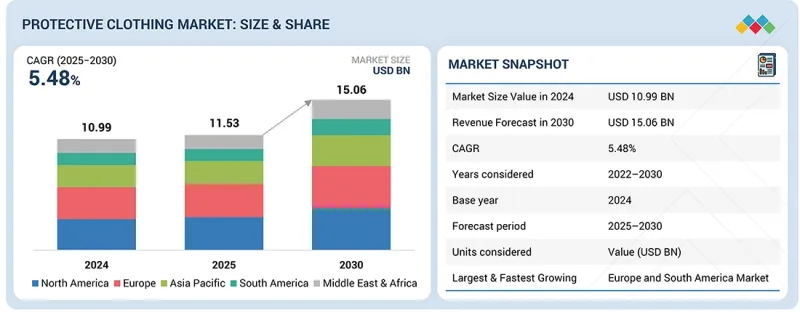
세계 보호복 시장 규모는 2024년에 109억 9,000만 달러로 평가되었고, 2030년까지 150억 6,000만 달러에 이를 것으로 예측되며, 2025-2030년에 CAGR은 5.48%를 나타낼 전망입니다.
| 조사 범위 | |
|---|---|
| 조사 대상 기간 | 2022-2030년 |
| 기준 연도 | 2024년 |
| 예측 기간 | 2025-2030년 |
| 단위 | 100만 달러 |
| 부문 | 재료 유형, 용도, 최종 사용자 유형, 최종 이용 산업, 지역 |
| 대상 지역 | 아시아태평양, 유럽, 북미, 중동, 아프리카, 남미 |
"방호복 재료와 기능적 디자인의 발전이 보호복 시장을 견인합니다."
섬유 공학의 지속적인 진보로 보호 복은 가볍고 강인한 유연한 보호 정장으로 진화하여 복잡한 작업 환경에 대한 적응성이 향상되었습니다. 아라미드 섬유, 첨단 폴리에틸렌, 특수 블렌드 등의 고성능 섬유는 열, 화염, 연마제, 부식성 화학제품에 대한 보호 성능을 향상시키면서 통기성과 쾌적성을 유지하고 있으며, 장시간 착용에도 적합합니다. 코팅 및 라미네이션은 부피가 크지 않고 불침투성을 향상시키고, 인체공학을 기반으로 한 재단은 육체적으로 가혹한 작업에서 가동 영역을 확장합니다.
또한 주조 작업에 유용한 용융 금속 비말 방호와 전자 기기 제조에서 높은 유용성을 발휘하는 정전기 방지 가공 등 특정 부문을 위한 혁신도 나타납니다. 수동 보호 기능 외에도 특히 가혹한 환경과 원격지에서 작업하기 위해 통신 기능과 환경 센서가 내장 된 작업복도 등장하고 있습니다. 이러한 진보는 변화하는 위험인자에 대응하는 동시에, 보호복 채택의 옛부터의 장벽인 착용시의 불쾌감에도 대처하고 있습니다. 작업하기 쉬운 의복을 개발함으로써 기업은 보호복의 상시 착용률을 높이고 직장의 안전성을 직접 향상시키고 있습니다.
폴리아미드 부문은 세계의 보호복 시장에서 금액 기준으로 세 번째로 큰 부문이 되었습니다.
폴리아미드 패브릭은 마모에 대한 매우 높은 내성과 연마 표면 및 기계적 마찰과의 지속적인 접촉을 받더라도 유지되는 내구성으로 우수한 보호복 성능을 발휘합니다. 폴리아미드 보호복은 건설, 제조, 광업 등 일상적으로 마모가 발생하는 많은 산업에서 효과를 발휘하여 충분한 물리적 내마모성을 제공합니다. 이 내구성은 폴리아미드 섬유 및 직물을 얇게 하거나 찢거나 흐트러지기 어려워 장기간 사용할 수 있어 교체 비용을 줄여줍니다. 내구성은 보호복을 조달할 때 조직이 안전성과 비용 우선순위를 보장하는 요소가 되기 때문에 폴리아미드는 수명이 단축된 상황에서도 내구성이 향상된 의류에 최적의 선택이 됩니다.
2024년, 시인성 부문이 보호복 시장에서 금액 기준으로 2위의 점유율을 차지했습니다.
2024년, 시인성 용도가 보호복 시장에서 제2위의 점유율을 차지했습니다. 교통에 미치는 영향을 최소화하고 엄격한 일정에 대응하기 위해 지자체 및 산업 부문의 많은 작업이 야간과 이른 아침에 실시되는 경향이 커지고 있습니다. 이 야간 작업 증가에 따라 저조도 환경이나 인공 조명 하에서도 높은 시인성을 제공하는 보호복에 대한 수요가 높아지고 있습니다. 최근 반사 기술의 진보로 의복은 다각적으로 시인 가능해지고 휘도를 유지할 수 있기 때문에 도로 수리, 유틸리티, 긴급 서비스에 종사하는 작업자의 안전성이 향상되고 있습니다. 물류 허브, 항만 및 운송 시스템에서 24시간 운영 빈도는 야간 안전에 대한 엄격한 성능 요구 사항을 충족하는 시인성 의류에 대한 수요를 창출하고 있습니다.
"남미가 보호복 시장에서 금액 기준으로 가장 성장이 빠른 지역이 될 것으로 추정됩니다."
광업, 석유 및 가스, 건설, 제조에 있어서의 남미의 산업 성장이, 동지역에서의 내구성이 높은 보호복 수요를 촉진하고 있습니다. 이러한 산업은 고온, 화학, 기계적 위험 등 높은 위험을 수반하므로 전용 장비가 필요합니다. 브라질, 칠레, 페루 등의 국가에서는 노동 안전 규제의 시행이 강화되고 기업에 고품질의 보호복에 대한 투자가 권장되고 있습니다. 산업 프로젝트의 규모와 복잡성이 증가함에 따라, 고용주는 기동성을 유지하면서 최대한의 위험 보호를 제공하는 의류를 찾고 있습니다. 이 위험하고 고위험한 환경에서 노동자 보호의 중시가 시장 채택을 더욱 촉진하고 있으며, 특히 이 지역의 변동하는 기후 조건과 작업 환경에 대응하도록 설계된 의류가 주목받고 있습니다.
이 보고서는 세계 보호복 시장에 대한 조사 분석을 통해 주요 촉진요인과 억제요인, 제품 개발 및 혁신, 경쟁 구도에 대한 지식을 제공합니다.
자주 묻는 질문
목차
제1장 서론
제2장 조사 방법
제3장 주요 요약
제4장 중요한 지견
- 보호복 시장에서의 매력적인 기회
- 보호복 시장 : 지역별
- 유럽의 보호복 시장 : 재료별, 국가별
- 지역의 분석 : 방호복 시장, 용도별
- 지역의 분석 : 방호복 시장, 최종 이용 산업별
- 보호복 시장 : 국가별
제5장 시장 개요
- 시장 역학
- 성장 촉진요인
- 억제 요인
- 기회
- 과제
- Porter's Five Forces 분석
- 주요 이해관계자와 구매 기준
- 거시경제지표
제6장 업계 동향
- 공급망 분석
- 가격 설정 분석
- 고객사업에 영향을 주는 동향/혼란
- 생태계 분석
- 기술 분석
- 주요 기술
- 보완 기술
- 사례 연구 분석
- 무역 분석
- 수입 시나리오(HS 코드 621010)
- 수출 시나리오(HS 코드 621010)
- 규제 상황
- 규제기관, 정부기관, 기타 조직
- 규제 프레임워크
- 주요 회의 및 이벤트
- 투자 및 자금조달 시나리오
- 특허 분석
- 접근
- 문헌 유형
- 주요 출원자
- 관할 분석
- 2025년 미국 관세의 영향 - 보호복 시장
- 주요 관세율
- 가격의 영향 분석
- 국가/지역에 미치는 영향
- 최종 이용 산업에 대한 영향
- 보호복 시장에 대한 AI/생성형 AI의 영향
제7장 보호복 시장 : 재료 유형별
- 아라미드 및 혼방
- 폴리올레핀 및 혼방
- 폴리아미드
- PBI
- 초고분자량 폴리에틸렌
- 면섬유
- 라미네이트 폴리에스터
- 기타 재료 유형
제8장 보호복 시장 : 용도별
- 열
- 화학
- 기계
- 생물학적/방사선
- 시인성
- 기타 용도
제9장 보호복 시장 : 최종 사용자별
- 개인
- 산업
제10장 보호복 시장 : 최종 이용 산업별
- 석유 및 가스
- 건설
- 제조
- 의료
- 소방 및 법 집행
- 광업
- 군사
- 창고 및 물류
- 기타 최종 이용 산업
제11장 보호복 시장 : 지역별
- 아시아태평양
- 중국
- 인도
- 일본
- 한국
- 호주
- 북미
- 미국
- 캐나다
- 멕시코
- 유럽
- 독일
- 프랑스
- 이탈리아
- 영국
- 러시아
- 스페인
- 중동 및 아프리카
- 사우디아라비아
- 아랍에미리트(UAE)
- 이라크
- 남미
제12장 경쟁 구도
- 주요 진입기업의 전략/강점
- 시장 점유율 분석
- 수익 분석
- 기업 평가 매트릭스 : 주요 기업(2024년)
- 기업 평가 매트릭스 : 스타트업/중소기업(2024년)
- 브랜드/제품 비교 분석
- 기업 평가 및 재무 지표
- 경쟁 시나리오
제13장 기업 프로파일
- 주요 기업
- 3M COMPANY
- DUPONT DE NEMOURS, INC.
- ANSELL LIMITED
- LAKELAND INDUSTRIES, INC.
- TEIJIN LIMITED
- SIOEN INDUSTRIES NV
- PROTECTIVE INDUSTRIAL PRODUCTS, INC.
- TENCATE PROTECTIVE FABRICS
- PBI PERFORMANCE PRODUCTS, INC.
- WL GORE & ASSOCIATES, INC.
- 스타트업/중소기업
- LION GROUP, INC.
- MSA SAFETY INCORPORATED
- WORKWEAR OUTFITTERS, LLC
- LOGISTIK UNICORP INC.
- MALLCOM INDIA LIMITED
- GLOBUS
- KLEIN TOOLS, INC.
- NEWTEX INDUSTRIES, INC.
- HYDROWEAR BV
- ALPHA PRO TECH, LTD.
- RADIANS, INC.
- NATIONAL SAFETY APPAREL
- LINDSTROM GROUP
- KAPPLER, INC.
- BALLYCLARE INTERNATIONAL
제14장 인접 시장과 관련 시장
- 제한 사항
- 개인보호구(PPE) 시장
- 시장 정의
- 시장 개요
- 개인용 보호구 시장 :지역별
제15장 부록
SHW 26.01.06The protective clothing market size was USD 10.99 billion in 2024 and is projected to reach USD 15.06 billion by 2030, at a CAGR of 5.48%, between 2025 and 2030.
| Scope of the Report | |
|---|---|
| Years Considered for the Study | 2022-2030 |
| Base Year | 2024 |
| Forecast Period | 2025-2030 |
| Units Considered | Value (USD Million) |
| Segments | Material Type, Application, End-User Type, End-Use Industry and Region |
| Regions covered | Asia Pacific, Europe, North America, Middle East & Africa, and South America |
"Advances in Protective Clothing Materials and Functional Design to Drive Protective Clothing Market"
Ongoing advancements in textile engineering are turning protective clothing into lighter, stronger, more pliable protective suits that can better adapt to complex work settings. High-performance fibers like aramids, advanced polyethylene, and specialized blends deliver enhanced protection against heat, flames, abrasives, and corrosive chemicals, but remain breathable and comfortable for long-day wear. Coatings and laminates increase impermeability without bulk, and ergonomic tailoring boosts range of motion for physically saturating work.
There are even sector-specific innovations appearing, like in molten metal splash protection, which is useful for foundry work, or antistatic finishes, which find great utility in electronics manufacturing. Beyond passive protection, a few garments now include integrated communications capabilities or environmental sensors, particularly when working in extremes or in remote locations. These advancements keep up with shifting hazard profiles, and they also tackle one of the oldest barriers to protective apparel adoption, which is wearer discomfort. By making clothes that are easier to work with, companies are increasing the likelihood of constant use, which directly makes the workplace safer.
The polyamide segment was the third-largest segment, in terms of value, of the global protective clothing market.
Polyamide fabrics provide excellent protection clothing performance because of their remarkably high ability to resist abrasion, along with the durability of the garments that is retained despite continual contact with abrasive surfaces or mechanical friction. Polyamide garments are effective in many applications, especially in the construction, manufacturing, and mining industries, where this type of wear occurs on a continual basis, providing acceptable physical wear resistance. This durability means that the polyamide fibres and fabrics do not thin, tear, or fray too easily, and will service the user longer, at less cost to replace. Given that durability gives organizations an assurance in safety and cost prioritisation when sourcing protective clothing, polyamide provides the best options for clothing with enhanced durability during reduced service life.
The visibility segment accounted for the second-largest share in the protective clothing market, in terms of value, in 2024.
The visibility application held the second largest share of the protective clothing market in 2024. An increasing share of municipal and industrial work is ultimately accomplished at night or early in the morning to minimize interference in traffic and meet strict schedules. The resulting increase in nighttime operations has created greater demand for protective clothing that provides high visibility in low light and under artificial illumination. Recent improvements in retro-reflective technology allow garments to be seen from multiple angles and maintain brightness, thereby providing more safety for workers doing road repairs, utility work or providing emergency services. The frequency of around-the-clock operations in logistics hubs, ports, and transportation systems is also building demand for visibility clothing that can meet strict performance expectations for nighttime safety.
"South America is estimated to be the fastest growing region in the protective clothing market, in terms of value."
South America's industrial growth in mining, oil & gas, construction and manufacturing is driving the need for durable protective clothing in the region. These industries are high-risk, including heat, chemicals and mechanical hazards, requiring dedicated equipment. In places like Brazil, Chile, and Peru, occupational safety rules are being enforced more, and companies are being encouraged to invest in high quality protective clothing. With industrial projects growing in size and complexity, employers are looking for apparel that offers maximum hazard protection with mobility. This emphasis on protecting workers in perilous and high-hazard environments is further propelling market adoption, especially apparel designed to handle the region's fluctuating weather and operational conditions.
- By Company Type: Tier 1 - 55%, Tier 2 - 25%, and Tier 3 - 20%
- By Designation: Directors - 50%, Managers - 30%, and Others - 20%
- By Region: North America - 40%, Europe - 35%, Asia Pacific - 20%, Rest of World - 5%
The key players profiled in the report include 3M Company (US), DuPont de Nemours, Inc. (US), Ansell Limited (Australia), Lakeland Industries, Inc. (US), TEIJIN LIMITED (Japan), Protective Industrial Products, Inc. (US), TenCate Protective Fabrics (Netherlands), PBI Performance Products, Inc. (US), Sioen Industries NV (Belgium), and W. L. Gore & Associates, Inc. (US).
Research Coverage
This report segments the market for protective clothing based on material type, application, end-user type, end-user type, end-use industry and region and provides estimations of value (USD Million) for the overall market size across various regions. A detailed analysis of key industry players has been conducted to provide insights into their business overviews, services, and key strategies, associated with the market for protective clothing.
Reasons to Buy this Report
This research report is focused on various levels of analysis - industry analysis (industry trends), market share analysis of top players, and company profiles, which together provide an overall view of the competitive landscape, emerging and high-growth segments of the protective clothing market; high-growth regions; and market drivers, restraints, and opportunities.
The report provides insights into the following points:
- Market Penetration: Comprehensive information on protective clothing offered by top players in the global market
- Analysis of key drivers: (Rising workplace safety regulations across industries, surge in demand from oil & gas and chemical sectors, and growth in construction and infrastructure projects) restraints (limited awareness in small and medium enterprises and complex maintenance and cleaning requirements) opportunities (growing demand for sustainable and eco-friendly fabric and rising need for flame-resistant clothing in renewable energy projects) and challenges (difficulty in customizing clothing for niche industrial applications and slow adoption rates in cost-sensitive markets) influencing the growth of protective clothing market.
- Product Development/Innovation: Detailed insights on upcoming technologies, research & development activities, and new product & service launches in the protective clothing market
- Market Development: Comprehensive information about lucrative emerging markets - the report analyzes the markets for protective clothing across regions.
- Market Diversification: Exhaustive information about new products, untapped regions, and recent developments in the global protective clothing market
- Competitive Assessment: In-depth assessment of market shares, strategies, products, and manufacturing capabilities of leading players in the protective clothing market.
TABLE OF CONTENTS
1 INTRODUCTION
- 1.1 STUDY OBJECTIVES
- 1.2 MARKET DEFINITION
- 1.3 STUDY SCOPE
- 1.3.1 MARKETS COVERED AND REGIONAL SCOPE
- 1.3.2 INCLUSIONS AND EXCLUSIONS
- 1.3.3 MARKET DEFINITION AND INCLUSIONS, BY MATERIAL TYPE
- 1.3.4 MARKET DEFINITION AND INCLUSIONS, BY APPLICATION
- 1.3.5 MARKET DEFINITION AND INCLUSIONS, BY END-USER TYPE
- 1.3.6 MARKET DEFINITION AND INCLUSIONS, BY END-USE INDUSTRY
- 1.3.7 YEARS CONSIDERED
- 1.3.8 CURRENCY CONSIDERED
- 1.4 STAKEHOLDERS
- 1.5 SUMMARY OF CHANGES
2 RESEARCH METHODOLOGY
- 2.1 RESEARCH DATA
- 2.1.1 SECONDARY DATA
- 2.1.2 PRIMARY DATA
- 2.1.2.1 Key primary participants
- 2.1.2.2 Key industry insights
- 2.1.2.3 Breakdown of primary interviews
- 2.2 MARKET SIZE ESTIMATION
- 2.2.1 BOTTOM-UP APPROACH
- 2.2.2 TOP-DOWN APPROACH
- 2.3 DATA TRIANGULATION
- 2.4 GROWTH FORECAST
- 2.4.1 SUPPLY-SIDE ANALYSIS
- 2.4.2 DEMAND-SIDE ANALYSIS
- 2.5 ASSUMPTIONS
- 2.6 LIMITATIONS
- 2.7 RISK ASSESSMENT
3 EXECUTIVE SUMMARY
4 PREMIUM INSIGHTS
- 4.1 ATTRACTIVE OPPORTUNITIES FOR PLAYERS IN PROTECTIVE CLOTHING MARKET
- 4.2 PROTECTIVE CLOTHING MARKET, BY REGION
- 4.3 EUROPE: PROTECTIVE CLOTHING MARKET, BY MATERIAL TYPE AND COUNTRY
- 4.4 REGIONAL ANALYSIS: PROTECTIVE CLOTHING MARKET, BY APPLICATION
- 4.5 REGIONAL ANALYSIS: PROTECTIVE CLOTHING MARKET, BY END-USE INDUSTRY
- 4.6 PROTECTIVE CLOTHING MARKET, BY COUNTRY
5 MARKET OVERVIEW
- 5.1 INTRODUCTION
- 5.2 MARKET DYNAMICS
- 5.2.1 DRIVERS
- 5.2.1.1 Workplace safety concerns
- 5.2.1.2 Rising industrial hazards to fuel demand
- 5.2.1.3 Growing demand from hazard-intensive laboratories
- 5.2.2 RESTRAINTS
- 5.2.2.1 Regulatory compliance adds complexity
- 5.2.2.2 High costs of specialized protective clothing
- 5.2.3 OPPORTUNITIES
- 5.2.3.1 Rising demand from emerging economies
- 5.2.3.2 Eco-friendly protective clothing solutions
- 5.2.4 CHALLENGES
- 5.2.4.1 Customization demands outpace standard production
- 5.2.1 DRIVERS
- 5.3 PORTER'S FIVE FORCES ANALYSIS
- 5.3.1 THREAT OF NEW ENTRANTS
- 5.3.2 THREAT OF SUBSTITUTES
- 5.3.3 BARGAINING POWER OF SUPPLIERS
- 5.3.4 BARGAINING POWER OF BUYERS
- 5.3.5 INTENSITY OF COMPETITIVE RIVALRY
- 5.4 KEY STAKEHOLDERS AND BUYING CRITERIA
- 5.4.1 KEY STAKEHOLDERS IN BUYING PROCESS
- 5.4.2 BUYING CRITERIA
- 5.5 MACROECONOMIC INDICATORS
- 5.5.1 GDP TRENDS AND FORECAST
6 INDUSTRY TRENDS
- 6.1 SUPPLY CHAIN ANALYSIS
- 6.2 PRICING ANALYSIS
- 6.2.1 INDICATIVE SELLING PRICE TREND OF PROTECTIVE CLOTHING, BY REGION, 2022-2030
- 6.3 TRENDS/DISRUPTIONS IMPACTING CUSTOMER BUSINESS
- 6.4 ECOSYSTEM ANALYSIS
- 6.5 TECHNOLOGY ANALYSIS
- 6.5.1 KEY TECHNOLOGIES
- 6.5.1.1 Multi-layer fabric engineering
- 6.5.1.2 Membrane and coating technology
- 6.5.2 COMPLEMENTARY TECHNOLOGIES
- 6.5.2.1 Phase change materials
- 6.5.1 KEY TECHNOLOGIES
- 6.6 CASE STUDY ANALYSIS
- 6.6.1 OPTIMIZING SAFETY APPAREL COMPLIANCE WITH 3M COMPANY'S COVERALL SOLUTIONS
- 6.6.2 STREAMLINING GLOVE PROCUREMENT FOR OIL DRILLING GIANT
- 6.7 TRADE ANALYSIS
- 6.7.1 IMPORT SCENARIO (HS CODE 621010)
- 6.7.2 EXPORT SCENARIO (HS CODE 621010)
- 6.8 REGULATORY LANDSCAPE
- 6.8.1 REGULATORY BODIES, GOVERNMENT AGENCIES, AND OTHER ORGANIZATIONS
- 6.8.2 REGULATORY FRAMEWORK
- 6.8.2.1 OSHA Protective Clothing Standard (29 CFR 1910)
- 6.8.2.2 ISO 45001:2018 - Occupational Health and Safety Management Systems
- 6.9 KEY CONFERENCES AND EVENTS
- 6.10 INVESTMENT AND FUNDING SCENARIO
- 6.11 PATENT ANALYSIS
- 6.11.1 APPROACH
- 6.11.2 DOCUMENT TYPES
- 6.11.3 TOP APPLICANTS
- 6.11.4 JURISDICTION ANALYSIS
- 6.12 IMPACT OF 2025 US TARIFF - PROTECTIVE CLOTHING MARKET
- 6.12.1 INTRODUCTION
- 6.12.2 KEY TARIFF RATES
- 6.12.3 PRICE IMPACT ANALYSIS
- 6.12.4 IMPACT ON COUNTRY/REGION
- 6.12.4.1 US
- 6.12.4.2 Europe
- 6.12.4.3 Asia Pacific
- 6.12.5 IMPACT ON END-USE INDUSTRIES
- 6.13 IMPACT OF AI/GEN AI ON PROTECTIVE CLOTHING MARKET
7 PROTECTIVE CLOTHING MARKET, BY MATERIAL TYPE
- 7.1 INTRODUCTION
- 7.2 ARAMID & BLENDS
- 7.2.1 ENHANCED DURABILITY AND STRENGTH TO BOOST DEMAND
- 7.3 POLYOLEFIN & BLENDS
- 7.3.1 RISING DEMAND FOR MATERIALS WITH SUPERIOR PROPERTIES TO DRIVE MARKET
- 7.4 POLYAMIDE
- 7.4.1 HIGH TENSILE STRENGTH AND DURABILITY TO SPUR MARKET DEMAND
- 7.5 PBI
- 7.5.1 RISING DEMAND FOR HIGH-PERFORMANCE FLAME-RESISTANT MATERIALS TO SUPPORT MARKET GROWTH
- 7.6 UHMW POLYETHYLENE
- 7.6.1 GROWING NEED FOR LIGHTWEIGHT, HIGH-STRENGTH FIBERS TO ACCELERATE DEMAND
- 7.7 COTTON FIBERS
- 7.7.1 RISING PREFERENCE FOR COMFORTABLE AND AFFORDABLE PROTECTIVE FABRICS TO PROPEL MARKET
- 7.8 LAMINATED POLYESTERS
- 7.8.1 ADVANCEMENTS IN COATED AND LAMINATED FABRICS TO DRIVE DEMAND
- 7.9 OTHER MATERIAL TYPES
8 PROTECTIVE CLOTHING MARKET, BY APPLICATION
- 8.1 INTRODUCTION
- 8.2 THERMAL
- 8.2.1 RISING NEED FOR ADVANCED HEAT- AND FLAME-RESISTANT APPAREL ACROSS HIGH-RISK INDUSTRIES TO DRIVE MARKET
- 8.3 CHEMICAL
- 8.3.1 STRINGENT SAFETY REGULATIONS TO FUEL MARKET GROWTH
- 8.4 MECHANICAL
- 8.4.1 INDUSTRIAL EXPANSION AND HEAVY-DUTY OPERATIONS TO BOOST MARKET GROWTH
- 8.5 BIOLOGICAL/RADIATION
- 8.5.1 GROWING SAFETY IMPERATIVES IN HIGH-RISK ENVIRONMENTS TO DRIVE MARKET
- 8.6 VISIBILITY
- 8.6.1 GROWING INFRASTRUCTURE PROJECTS TO INCREASE DEMAND
- 8.7 OTHER APPLICATIONS
9 PROTECTIVE CLOTHING MARKET, BY END-USER TYPE
- 9.1 INTRODUCTION
- 9.2 PERSONAL
- 9.2.1 EXPANDING OUTDOOR AND RECREATIONAL ACTIVITIES TO FUEL DEMAND FOR PERSONAL PROTECTION
- 9.3 INDUSTRIAL
- 9.3.1 INDUSTRIAL EXPANSION IN EMERGING ECONOMIES TO ACCELERATE MARKET GROWTH
10 PROTECTIVE CLOTHING MARKET, BY END-USE INDUSTRY
- 10.1 INTRODUCTION
- 10.2 OIL & GAS
- 10.2.1 MULTI-HAZARD OPERATIONAL COMPLEXITY AND WORKFORCE EFFICIENCY TO DRIVE MARKET
- 10.3 CONSTRUCTION
- 10.3.1 RISING ON-SITE RISKS AND REGULATORY PRESSURE TO FUEL MARKET GROWTH
- 10.4 MANUFACTURING
- 10.4.1 OPERATIONAL SAFETY PRIORITIES PUSH MARKET FOR NEXT-GENERATION PROTECTIVE WEAR
- 10.5 HEALTHCARE/MEDICAL
- 10.5.1 SURGE IN HIGH-RISK CLINICAL PROCEDURES TO SUPPORT MARKET GROWTH
- 10.6 FIREFIGHTING & LAW ENFORCEMENT
- 10.6.1 OPERATIONAL COMPLEXITY TO FUEL DEMAND FOR TECHNOLOGICALLY ADVANCED PROTECTIVE CLOTHING
- 10.7 MINING
- 10.7.1 RISING OCCUPATIONAL HAZARDS TO DRIVE DEMAND
- 10.8 MILITARY
- 10.8.1 RISING DEFENSE BUDGETS AND MODERNIZATION EFFORTS TO DRIVE MARKET
- 10.9 WAREHOUSE & LOGISTICS
- 10.9.1 RAPID E-COMMERCE GROWTH AND WAREHOUSE AUTOMATION TO FUEL MARKET GROWTH
- 10.10 OTHER END-USE INDUSTRIES
11 PROTECTIVE CLOTHING MARKET, BY REGION
- 11.1 INTRODUCTION
- 11.2 ASIA PACIFIC
- 11.2.1 CHINA
- 11.2.1.1 Manufacturing power and safety mandates to support market growth
- 11.2.2 INDIA
- 11.2.2.1 Labor-intensive industries to drive market
- 11.2.3 JAPAN
- 11.2.3.1 Compliance and innovation to propel demand
- 11.2.4 SOUTH KOREA
- 11.2.4.1 Strategic sector growth spurs adoption of multi-hazard protective clothing
- 11.2.5 AUSTRALIA
- 11.2.5.1 Extreme climate and industrial conditions to drive demand
- 11.2.1 CHINA
- 11.3 NORTH AMERICA
- 11.3.1 US
- 11.3.1.1 Regulatory compliance and safety awareness to fuel market growth
- 11.3.2 CANADA
- 11.3.2.1 Healthcare industry dominance and safety protocols to support market growth
- 11.3.3 MEXICO
- 11.3.3.1 Rising manufacturing activity to drive demand
- 11.3.1 US
- 11.4 EUROPE
- 11.4.1 GERMANY
- 11.4.1.1 Expanding manufacturing base to drive market
- 11.4.2 FRANCE
- 11.4.2.1 Strengthened healthcare protocols to fuel market growth
- 11.4.3 ITALY
- 11.4.3.1 Rising safety awareness to propel market growth
- 11.4.4 UK
- 11.4.4.1 Multi-hazard exposure in oil & gas to accelerate market expansion
- 11.4.5 RUSSIA
- 11.4.5.1 Diverse climate and harsh industrial environments to drive innovation in market
- 11.4.6 SPAIN
- 11.4.6.1 Growing industrialization and manufacturing sector to drive demand
- 11.4.1 GERMANY
- 11.5 MIDDLE EAST & AFRICA
- 11.5.1 SAUDI ARABIA
- 11.5.1.1 Expanding oil & gas and petrochemical operations to strengthen demand
- 11.5.2 UAE
- 11.5.2.1 Industrial investments and economic diversification to accelerate market demand
- 11.5.3 IRAQ
- 11.5.3.1 Oil & gas dominance and infrastructure rehabilitation to fuel market growth
- 11.5.1 SAUDI ARABIA
- 11.6 SOUTH AMERICA
- 11.6.1 BRAZIL
- 11.6.1.1 Industrial growth to drive adoption
- 11.6.1 BRAZIL
12 COMPETITIVE LANDSCAPE
- 12.1 INTRODUCTION
- 12.2 KEY PLAYER STRATEGIES/RIGHT TO WIN
- 12.2.1 STRATEGIES ADOPTED BY KEY PROTECTIVE CLOTHING MANUFACTURERS, JANUARY 2020-JULY 2025
- 12.3 MARKET SHARE ANALYSIS
- 12.4 REVENUE ANALYSIS
- 12.5 COMPANY EVALUATION MATRIX: KEY PLAYERS, 2024
- 12.5.1 STARS
- 12.5.2 EMERGING LEADERS
- 12.5.3 PERVASIVE PLAYERS
- 12.5.4 PARTICIPANTS
- 12.5.5 COMPANY FOOTPRINT: KEY PLAYERS, 2024
- 12.5.5.1 Company footprint
- 12.5.5.2 Region footprint
- 12.5.5.3 Material type footprint
- 12.5.5.4 End-user type footprint
- 12.5.5.5 Application footprint
- 12.5.5.6 End-use industry footprint
- 12.6 COMPANY EVALUATION MATRIX: STARTUPS/SMES, 2024
- 12.6.1 PROGRESSIVE COMPANIES
- 12.6.2 RESPONSIVE COMPANIES
- 12.6.3 DYNAMIC COMPANIES
- 12.6.4 STARTING BLOCKS
- 12.6.5 COMPETITIVE BENCHMARKING: STARTUPS/SMES, 2024
- 12.6.5.1 Detailed list of key startups/SMEs
- 12.6.5.2 Competitive benchmarking of key startups/SMEs
- 12.7 BRAND/PRODUCT COMPARISON ANALYSIS
- 12.8 COMPANY VALUATION AND FINANCIAL METRICS
- 12.9 COMPETITIVE SCENARIO
- 12.9.1 PRODUCT LAUNCHES
- 12.9.2 DEALS
- 12.9.3 EXPANSIONS
- 12.9.4 OTHER DEVELOPMENTS
13 COMPANY PROFILES
- 13.1 KEY PLAYERS
- 13.1.1 3M COMPANY
- 13.1.1.1 Business overview
- 13.1.1.2 Products/Solutions/Services offered
- 13.1.1.3 MnM view
- 13.1.1.3.1 Key strengths
- 13.1.1.3.2 Strategic choices
- 13.1.1.3.3 Weaknesses and competitive threats
- 13.1.2 DUPONT DE NEMOURS, INC.
- 13.1.2.1 Business overview
- 13.1.2.2 Products/Solutions/Services offered
- 13.1.2.3 Recent developments
- 13.1.2.3.1 Deals
- 13.1.2.3.2 Expansions
- 13.1.2.3.3 Other developments
- 13.1.2.4 MnM view
- 13.1.2.4.1 Key strengths
- 13.1.2.4.2 Strategic choices
- 13.1.2.4.3 Weaknesses and competitive threats
- 13.1.3 ANSELL LIMITED
- 13.1.3.1 Business overview
- 13.1.3.2 Products/Solutions/Services offered
- 13.1.3.3 Recent developments
- 13.1.3.3.1 Deals
- 13.1.3.3.2 Other developments
- 13.1.3.4 MnM view
- 13.1.3.4.1 Key strengths
- 13.1.3.4.2 Strategic choices
- 13.1.3.4.3 Weaknesses and competitive threats
- 13.1.4 LAKELAND INDUSTRIES, INC.
- 13.1.4.1 Business overview
- 13.1.4.2 Products/Solutions/Services offered
- 13.1.4.3 Recent developments
- 13.1.4.3.1 Deals
- 13.1.4.3.2 Expansions
- 13.1.4.4 MnM view
- 13.1.4.4.1 Key strengths
- 13.1.4.4.2 Strategic choices
- 13.1.4.4.3 Weaknesses and competitive threats
- 13.1.5 TEIJIN LIMITED
- 13.1.5.1 Business overview
- 13.1.5.2 Products/Solutions/Services offered
- 13.1.5.3 Recent developments
- 13.1.5.3.1 Deals
- 13.1.5.4 MnM view
- 13.1.5.4.1 Key strengths
- 13.1.5.4.2 Strategic choices
- 13.1.5.4.3 Weaknesses and competitive threats
- 13.1.6 SIOEN INDUSTRIES NV
- 13.1.6.1 Business overview
- 13.1.6.2 Products/Solutions/Services offered
- 13.1.6.3 Recent developments
- 13.1.6.3.1 Product launches
- 13.1.7 PROTECTIVE INDUSTRIAL PRODUCTS, INC.
- 13.1.7.1 Business overview
- 13.1.7.2 Products/Solutions/Services offered
- 13.1.7.3 Recent developments
- 13.1.7.3.1 Deals
- 13.1.8 TENCATE PROTECTIVE FABRICS
- 13.1.8.1 Business overview
- 13.1.8.2 Products/Solutions/Services offered
- 13.1.9 PBI PERFORMANCE PRODUCTS, INC.
- 13.1.9.1 Business overview
- 13.1.9.2 Products/Solutions/Services offered
- 13.1.10 W. L. GORE & ASSOCIATES, INC.
- 13.1.10.1 Business overview
- 13.1.10.2 Products/Solutions/Services offered
- 13.1.10.3 Recent developments
- 13.1.10.3.1 Product launches
- 13.1.1 3M COMPANY
- 13.2 STARTUPS/SMES
- 13.2.1 LION GROUP, INC.
- 13.2.2 MSA SAFETY INCORPORATED
- 13.2.3 WORKWEAR OUTFITTERS, LLC
- 13.2.4 LOGISTIK UNICORP INC.
- 13.2.5 MALLCOM INDIA LIMITED
- 13.2.6 GLOBUS
- 13.2.7 KLEIN TOOLS, INC.
- 13.2.8 NEWTEX INDUSTRIES, INC.
- 13.2.9 HYDROWEAR B.V.
- 13.2.10 ALPHA PRO TECH, LTD.
- 13.2.11 RADIANS, INC.
- 13.2.12 NATIONAL SAFETY APPAREL
- 13.2.13 LINDSTROM GROUP
- 13.2.14 KAPPLER, INC.
- 13.2.15 BALLYCLARE INTERNATIONAL
14 ADJACENT & RELATED MARKETS
- 14.1 INTRODUCTION
- 14.2 LIMITATIONS
- 14.3 PERSONAL PROTECTIVE EQUIPMENT MARKET
- 14.3.1 MARKET DEFINITION
- 14.3.2 MARKET OVERVIEW
- 14.3.3 PERSONAL PROTECTIVE EQUIPMENT MARKET, BY REGION
- 14.3.3.1 Europe
- 14.3.3.2 North America
- 14.3.3.3 Asia Pacific
- 14.3.3.4 Middle East & Africa
- 14.3.3.5 South America
15 APPENDIX
- 15.1 DISCUSSION GUIDE
- 15.2 KNOWLEDGESTORE: MARKETSANDMARKETS' SUBSCRIPTION PORTAL
- 15.3 CUSTOMIZATION OPTIONS
- 15.4 RELATED REPORTS
- 15.5 AUTHOR DETAILS


