|
시장보고서
상품코드
1906296
가스 감지 시장 : 구성부품별, 알람 컨피규레이션별, 전력별, 통신 프로토콜별, 접속성별, 디바이스 유형별, 설치 유형별, 가스 유형별, 기술별, 업계별, 지역별 - (-2030년)Gas Detection Market by installation (fixed, portable), device (single gas, multi-gas), technology (electrochemical, catalytic, MOS, Infrared, Photoionization), gas type (Oxygen, carbon monoxide, carbon dioxide, ammonia, VOCs) - Global Forecast to 2030 |
||||||

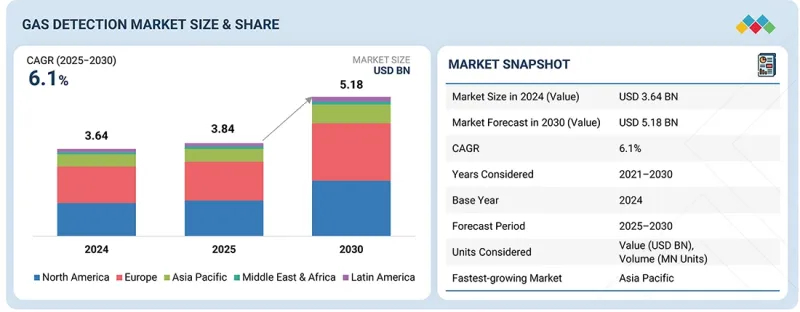
가스 감지 시장 규모는 2025년에 38억 4,000만 달러, 2030년까지 51억 8,000만 달러 규모에 이를 것으로 예측되며, 2025-2030년 CAGR 6.1%로 성장할 전망입니다.
가스 감지 시장은 세계 안전 규제 환경 강화에 힘입어 성장하고 있습니다. 산업 사업자에게는 OSHA, ATEX, IECEx 및 각국의 고유한 표준을 준수하는 것이 필수 조건이 되었습니다. 가스 누출, 폭발, 유해물질 노출 사고가 증가함에 따라 경영진은 직원, 자산, 브랜드 평판을 보호하기 위해 첨단 감지 인프라를 우선적으로 도입해야 합니다.
| 조사 범위 | |
|---|---|
| 조사 대상 기간 | 2021-2030년 |
| 기준 연도 | 2024년 |
| 예측 기간 | 2025-2030년 |
| 대상 단위 | 금액(10억 달러) |
| 부문 | 구성부품별, 경보 설정별, 전력별, 통신 프로토콜별, 접속성별, 디바이스 유형별, 설치 유형별, 가스 유형별, 기술별, 업계별, 지역별 |
| 대상 지역 | 북미, 유럽, 아시아태평양, 기타 지역 |
석유 및 가스, 화학, 제약, 산업 및 제조, 발전, 광업의 급속한 산업 확대로 인해 확장 가능한 멀티 가스 모니터링 시스템에 대한 수요가 더욱 증가하고 있습니다. 동시에 아시아태평양의 강력한 산업화와 인프라 성장으로 인해 도입률이 계속 증가하고 있습니다. 적외선 감지, IoT 지원 장치, 클라우드 기반 분석, 무선 연결 안전 플랫폼 등의 기술 발전으로 감지 기술은 사후 대응적인 컴플라이언스 도구에서 예측 가능한 운영 자산으로 변모하고 있습니다. 또한, 신흥 수소, 바이오가스, 청정에너지 생태계에는 특수 고성능 센서가 필요하며, 새로운 수익원을 창출하고 있습니다. 이러한 요인들이 결합되어 가스 감지가 운영 탄력성 및 위험 관리의 핵심 요소로 자리매김하고 있습니다.
고정 설치형 부문은 위험한 산업 환경에서 지속적이고 정밀한 모니터링의 중요한 역할을 바탕으로 2025년부터 2030년까지 가스 감지 시장에서 가장 큰 점유율을 차지할 것으로 예측됩니다. 석유 및 가스, 화학, 발전, 대규모 제조 등의 산업에서는 고정식 감지기를 우선적으로 채택하고 있습니다. 이는 처리 장치, 압축기 스테이션, 저장 터미널, 밀폐된 공간 등 작은 누출도 심각한 운영 장애나 안전 사고로 이어질 수 있는 고위험 구역에서 24시간 모니터링을 실현하기 위함입니다. 이러한 설치는 플랜트 제어 시스템, SCADA 네트워크, 비상 정지 메커니즘과 직접 연계되어 엄격한 IECEx, ATEX, OSHA 표준 준수를 강화합니다. 시설의 규모 확대와 자동화가 진행되는 가운데, 고정식 시스템은 휴대용 장비에 비해 뛰어난 신뢰성, 빠른 응답 시간, 장기적인 수명주기 성능을 제공합니다. 또한, IoT, 진단 기능, 예지보전을 활용한 커넥티드 플랜트로의 전환은 지속적인 데이터 스트림을 공급할 수 있는 고정식 센서에 유리합니다. 이러한 요소들이 결합되어 고정식 설치는 산업용 가스 안전 인프라의 기반으로서 확고한 입지를 구축하고 있습니다.
전기화학 기술은 산소, 일산화탄소, 황화수소, 염소, 암모니아 등 다양한 독성 가스를 산업 환경에서 감지하는 데 있어 가장 신뢰할 수 있고 비용 효율적이며 널리 채택된 솔루션이기 때문에 가스 감지 시장에서 가장 큰 점유율을 유지할 것으로 예측됩니다. 전기화학 센서는 안전에 중요한 작업을 관리할 때 높은 감도, 빠른 응답 시간, 우수한 선택성을 제공하는 동시에 장비 비용과 유지보수 주기를 관리할 수 있는 범위 내로 낮춰줍니다. 특히 석유 및 가스, 화학, 폐수 처리, 제조 시설에서 휴대용 및 고정식 가스 감지 시스템과의 호환성을 통해 시장 침투를 더욱 확대할 수 있습니다. 규제 당국의 노출 한계치 강화와 유독가스 연속 모니터링 의무화에 따라 검증된 전기화학식 감지기에 대한 수요가 증가하고 있습니다. 또한, 센서의 소형화, 교정 간격의 장기화, 작동 수명 연장 등의 기술 발전으로 총소유비용(TCO)이 개선되고 있습니다. 다재다능하고 광범위한 적용 범위를 갖춘 전기화학 기술은 독성 가스 감지의 표준 선택으로서 앞으로도 시장의 핵심을 차지할 것입니다.
아시아태평양은 중국, 인도, 한국, 동남아시아의 급속한 산업화, 대규모 인프라 개발, 제조 생태계 확대로 인해 가스 감지 시장에서 가장 큰 점유율을 차지할 것으로 예측됩니다. 석유 및 가스 정제, 석유화학, 발전, 광업, 전자제품 제조 등의 산업이 전례 없는 속도로 확장됨에 따라 이 지역의 경영진은 안전 자동화에 대한 투자를 크게 늘리고 있습니다. 산업안전 규제 강화와 산업재해의 빈번한 발생이 맞물려 고정식 및 휴대용 가스 감지 시스템 도입이 가속화되고 있습니다. 또한, 재생 에너지, 수소 생산, LNG 인프라에 대한 이 지역의 강력한 추진은 다중 가스 감지, 적외선 감지, 전기화학 감지 시스템을 포함한 첨단 감지 기술에 대한 새로운 고부가가치 수요를 창출하고 있습니다. 비용에 대한 인식이 높고 대량 수요가 예상되는 이 지역 시장 역학은 주요 세계 벤더들이 제조 및 유통의 현지화를 추진하는 요인으로 작용하고 있습니다. 이러한 요인들로 인해 아시아태평양은 향후 10년간 전 세계 가스 감지 매출에서 가장 빠르게 성장하고 가장 큰 기여를 하는 지역이 될 것으로 예측됩니다.
Honeywell International Inc.(미국), MSA(미국), Dragerwerk AG & Co. KGaA(독일), Industrial Scientific(미국), Halma Plc(영국) 등 주요 기업들도 이 보고서에서 다룰 예정입니다.
본 보고서 구매의 장점
이 보고서는 시장 리더와 신규 시장 진출기업에게 전체 가스 감지 시장 및 하위 부문의 수익에 대한 가장 정확한 예측을 제공합니다. 이해관계자들이 경쟁 구도를 이해하고, 사업 포지셔닝을 최적화하고 적절한 시장 진출 전략을 수립하는 데 도움이 되는 통찰력을 얻을 수 있도록 지원합니다. 또한, 시장 동향을 파악하고 주요 촉진요인, 억제요인, 기회, 과제에 대한 정보를 제공합니다.
이 보고서는 다음 사항에 대한 통찰력을 제공합니다.
- 가스 감지 시장의 주요 촉진요인(세계 안전 및 환경 규제 강화, 산업화 및 자동화 발전), 저해요인(높은 설치 및 유지보수 비용, 기술적 제약), 기회요인(스마트 팩토리 및 커넥티드 워커 솔루션의 성장, 신흥 산업 확대), 과제(통합의 복잡성, 열악한 운영 환경) 분석
- 제품 개발 및 혁신 : 가스 감지 시장의 향후 기술 동향, 연구개발 활동, 신제품 출시에 대한 상세 분석
- 시장 동향 : 수익성 높은 시장에 대한 종합적인 정보. 이 보고서는 다양한 지역의 가스 감지 시장을 분석합니다.
- 시장 다각화 : 가스 감지 시장의 신제품 출시, 미개척 지역, 최근 동향, 투자에 대한 종합적인 정보를 제공합니다.
- 경쟁사 평가: Honeywell International Inc.(미국), MSA(미국), Dragerwerk AG & Co. KGaA(독일), Industrial Scientific(미국), Halma Plc(영국) 등 가스감지 시장 내 주요 기업의 시장 점유율 성장전략, 제공 제품에 대한 상세한 평가
자주 묻는 질문
목차
제1장 서론
제2장 주요 요약
제3장 프리미엄 인사이트
제4장 시장 개요
- 시장 역학
- 성장 촉진요인
- 성장 억제요인
- 기회
- 과제
제5장 업계 동향
- Porter의 Five Forces 분석
- 밸류체인 분석
- 생태계 분석
- 가격 분석
- 무역 분석
- 2025년-2026년 주요 컨퍼런스 및 이벤트
- 고객의 비즈니스에 영향을 미치는 동향/혼란
- 투자 및 자금조달 시나리오
- 사례 연구 분석
- 2025년 미국 관세가 가스 감지 시장에 미치는 영향
제6장 기술 진보, AI 별 영향, 특허, 혁신
- 주요 기술
- 보완적 기술
- 기술 로드맵
- 특허 분석
- 생성/AI가 가스 감지 시장에 미치는 영향
제7장 규제 상황
- 지역 규제와 컴플라이언스
- 규제기관, 정부기관 및 기타 조직
- 표준
제8장 고객 상황과 구매 행동
- 의사결정 프로세스
- 구입자 이해관계자와 구입 평가 기준
- 채택 장벽과 내부 과제
- 시장 수익성
제9장 가스 감지 시장 변혁 동향과 전개 모델
- 주소 지정 가능한 시스템과 주소 지정 불가능한 시스템
- 설치 및 통합 요건
- 배터리 기술과 동작시간
- 무선 접속
- 데이터 로깅
- LEL와 UEL 모니터링
제10장 가스 감지 시장(구성부품별)
- 하드웨어
- 소프트웨어 및 서비스
- 데이터 시각화 및 분석 소프트웨어
제11장 가스 감지 시장 센서 유형과 기술
- 포인트 검출기(고정 단일 포인트 감시)
- 오픈 패스 검출기(레이저/적외선 빔 시스템)
- 초음파 감지기(음파 별 누출 검출용)
- 전기화학 센서(유독 가스 및 산소용)
- 촉매 센서
- 금속 산화물 반도체 센서(MOS)
- 적외선(IR) 센서(탄화수소 및 CO2 감지 용)
- 광학 센서
- 기타
- 초음파 가스 누출 감지기
- 수소염 이온화 검출기(FID)
- 열전도율 센서
제12장 가스 감지 시장(경보 설정 별)
- 단일 단계 경보
- 이중 단계 경보 및 다중 단계 경보
- 잠금식 경보
- 자동 재설정 경보
- 무음 경보
- 시청각 경보
제13장 가스 감지 시장(전력별)
- AC 전력
- DC 전력
- 배터리
- 충전식 배터리
- 태양광발전
- 에너지수확기술
- 하이브리드 파워
- 본질적으로 안전한 전력 회로
제14장 가스 감지 시장(통신 프로토콜별)
- 유선 프로토콜
- 무선 프로토콜
제15장 가스 감지 시장(접속성별)
- 유선
- 무선&IoT 대응
제16장 가스 감지 시장 일반적인 응용 분야
- 산업 프로세스 안전
- 환경 대기질 모니터링
- 폐쇄 공간 모니터링
- 누출 검출 및 수리
- 파이프라인 보관 및 안전
- 배출가스 규제
- 실내공기질
- 긴급 대응 및 화재 안전
- 안전 및 가스 위험성
제17장 가스 감지 시장(디바이스 유형별)
- 싱글 가스
- 멀티 가스
제18장 가스 감지 시장(설치 유형별)
- 고정형
- 가동형
제19장 가스 감지 시장(가스 유형별)
- 산소(O2)
- 일산화탄소(CO)
- 이산화탄소(CO2)
- 암모니아(NH3)
- 염소(CL2)
- 황화수소(H2S)
- 질소산화물(NOX)
- 휘발성 유기 화합물(VOCS)
- 메탄(CH4)
- 탄화수소
- 수소(H2)
제20장 가스 감지 시장(기술별)
- 전기화학
- MOS/솔리드 스테이트
- 촉매
- 광이온화
- 적외선
- 기타
제21장 가스 감지 시장(업계별)
- 석유 및 가스
- 화학제품 및 석유화학제품
- 광업
- 제조업 및 산업
- 발전
- 건축 및 건설
- 기타
제22장 가스 감지 시장(지역별)
- 북미
- 북미의 거시경제 전망
- 미국
- 캐나다
- 멕시코
- 유럽
- 유럽의 거시경제 전망
- 독일
- 영국
- 프랑스
- 이탈리아
- 기타
- 아시아태평양
- 아시아태평양의 거시경제 전망
- 중국
- 일본
- 한국
- 인도
- 기타
- 기타 지역
- 기타 지역 거시경제 전망
- 중동
- 아프리카
- 남미
제23장 경쟁 구도
- 개요
- 주요 시장 진출기업의 전략/강점, 2021년-2025년
- 매출 분석, 2020년-2024년
- 시장 점유율 분석, 2024년
- 브랜드 비교
- 기업 평가 매트릭스 : 주요 시장 진출기업, 2024년
- 기업 평가 매트릭스 : 스타트업/중소기업, 2024년
- 기업 평가와 재무 지표
- 경쟁 시나리오
제24장 기업 개요
- 주요 시장 진출기업
- HONEYWELL INTERNATIONAL INC
- MSA
- DRAGERWERK AG & CO. KGAA
- INDUSTRIAL SCIENTIFIC
- HALMA PLC
- ABB
- SIEMENS
- TELEDYNE TECHNOLOGIES INCORPORATED
- EMERSON ELECTRIC CO
- THERMO FISHER SCIENTIFIC INC
- 기타 기업
- YOKOGAWA ELECTRIC CORPORATION
- PEM-TECH, INC
- GFG
- GLOBAL DETECTION SYSTEMS CORP
- INTERNATIONAL GAS DETECTORS
- RKI INSTRUMENTS
- NEW COSMOS ELECTRIC CO.,LTD.
- TERRA UNIVERSAL INC.
- DETECTOR ELECTRONICS, LLC
- CALIBRATION TECHNOLOGIES, LLC
- MARTEK MARINE
- BLACKLINE SAFETY CORP
- RIKEN KEIKI CO., LTD
- GEWEE
- SAMON AB
- 남미 주요 기업
- PREVENTGAS-GAS DETECTION SYSTEM
- DETECTOR DO BRASIL LTDA.(SUPPLIER)
- GENERAL INSTRUMENTS-ENGINEERING, REPRESENTATIONS AND TRADE LTD.(SUPPLIER)
- NOETEC S.R.L.(SUPPLIER)
- DRAGERWERK AG & CO. KGAA.
- HONEYWELL INTERNATIONAL INC.(DASTEC S.R.L)
- MSA SAFETY INC.
제25장 조사 방법
제26장 부록
LSH 26.01.22The gas detection market is projected to be valued at USD 3.84 billion in 2025 and USD 5.18 billion by 2030, registering a CAGR of 6.1% from 2025 to 2030. The gas detection market is propelled by a tightening global safety and regulatory environment, where compliance with OSHA, ATEX, IECEx, and country-specific norms has become non-negotiable for industrial operators. Rising incidents of gas leaks, explosions, and toxic exposures are pushing CXOs to prioritize advanced detection infrastructure to safeguard workforce, assets, and brand reputation.
| Scope of the Report | |
|---|---|
| Years Considered for the Study | 2021-2030 |
| Base Year | 2024 |
| Forecast Period | 2025-2030 |
| Units Considered | Value (USD Billion) |
| Segments | By installation type, device type, gas type, technology type, vertical, and region |
| Regions covered | North America, Europe, APAC, RoW |
Rapid industrial expansion across oil & gas, chemicals, pharmaceuticals, industrial and manufacturing, power generation, and mining is further amplifying demand for scalable, multi-gas monitoring systems. Parallelly, Asia Pacific's strong industrialization and infrastructure growth continue to elevate adoption rates. Technological advancements, including infrared sensing, IoT-enabled devices, cloud-based analytics, and wireless connected safety platforms, are transforming detection from a reactive compliance tool into a predictive operational asset. Additionally, emerging hydrogen, biogas, and clean energy ecosystems require specialized, high-performance sensors, creating new revenue streams. Collectively, these forces are reinforcing gas detection as a critical pillar of operational resilience and risk management.
"Fixed segment is likely to contribute largest market share of the gas detection market from 2025 to 2030."
The fixed installation type segment is expected to account for a largest share of the gas detection market from 2025 to 2030, driven by its critical role in continuous, high-accuracy monitoring across hazardous industrial environments. Industries such as oil & gas, chemicals, power generation, and large-scale manufacturing prioritize fixed detectors because they provide round-the-clock coverage in high-risk zones, including processing units, compressor stations, storage terminals, and confined spaces, where even minor leaks can lead to major operational or safety incidents. These installations integrate directly with plant control systems, SCADA networks, and emergency shutdown mechanisms, strengthening compliance with stringent IECEx, ATEX, and OSHA standards. As facilities scale and adopt more automation, fixed systems offer superior reliability, faster response times, and longer lifecycle performance compared to portable devices. Furthermore, the shift toward connected plants leveraging IoT, diagnostics, and predictive maintenance favors fixed sensors that can deliver continuous data streams. Collectively, these factors anchor fixed installations as the backbone of industrial gas safety infrastructure.
"Electrochemical technology segment is expected to record a significant share from 2025 to 2030."
Electrochemical technology is expected to maintain the largest share of the gas detection market because it remains the most reliable, cost-effective, and widely adopted solution for detecting a broad spectrum of toxic gases, including oxygen, carbon monoxide, hydrogen sulfide, chlorine, and ammonia, across industrial environments. For managing safety-critical operations, electrochemical sensors deliver high sensitivity, fast response times, and strong selectivity while keeping device costs and maintenance cycles manageable. Their compatibility with both portable and fixed gas detection systems further expands market penetration, particularly in oil & gas, chemicals, wastewater, and manufacturing facilities. As regulatory agencies tighten exposure limits and enforce continuous toxic gas monitoring, demand for proven electrochemical detectors strengthens. Additionally, advancements in sensor miniaturization, longer calibration intervals, and extended operational life are improving total cost of ownership. Combined with their versatility and broad application footprint, electrochemical technologies will continue to anchor the market as the default choice for toxic gas detection.
"Asia Pacific accounted for the largest share of the gas detection market in 2024."
The Asia-Pacific region is expected to command the largest share of the gas detection market, driven by rapid industrialization, large-scale infrastructure development, and the expansion of manufacturing ecosystems across China, India, South Korea, and Southeast Asia. CXOs in the region are significantly increasing investments in safety automation as industries such as oil & gas refining, petrochemicals, power generation, mining, and electronics manufacturing scale at unprecedented rates. The tightening of occupational safety regulations, alongside the rising frequency of industrial accidents, is accelerating the adoption of both fixed and portable gas detection systems. Furthermore, the APAC region's strong push toward renewable energy, hydrogen production, and LNG infrastructure is creating new, high-value demand for advanced detection technologies, including multi-gas, infrared, and electrochemical systems. The region's cost-sensitive yet high-volume market dynamics also attract leading global vendors to localize manufacturing and distribution. Collectively, these forces position Asia-Pacific as the fastest-growing and largest contributor to global gas detection revenues over the coming decade.
- By Company Type: Tier 1 - 38%, Tier 2 - 28%, and Tier 3 - 34%
- By Designation: C-level Executives - 40%, Directors - 30%, and Others - 30%
- By Region: North America - 35%, Europe - 35%, Asia Pacific- 20%, and RoW - 10%
Prominent players profiled in this report include Honeywell International Inc. (US), MSA (US), Dragerwerk AG & Co. KGaA (Germany) , Industrial Scientific (US) and Halma Plc (UK).
Report Coverage
The report defines, describes, and forecasts the gas detection market based on installation type (fixed, portable), Gas Type( Oxygen (O2), carbon monoxide (CO), carbon dioxide (CO2), ammonia (NH3), chlorine (Cl), hydrogen sulfide (H2S), nitrogen oxide (NOx), volatile organic compounds (VOCs), sulfur dioxide (SO2), methane (CH4), hydrocarbons, hydrogen.) Device Type (Single-use, Multi-use), Vertical (Oil & Gas, Mining, Manufacturing & Industrial, Chemical & Petrochemical, Power generation, Building & Construction and Others) and region (North America, Europe, Asia Pacific, RoW). It provides detailed information regarding drivers, restraints, opportunities, and challenges influencing market growth. It also analyzes competitive developments such as acquisitions, product launches, expansions, and actions carried out by key players to grow in the market.
Reasons to Buy This Report
The report will help the market leaders/new entrants with information on the closest approximations of the revenue for the overall gas detection market and the subsegments. The report will help stakeholders understand the competitive landscape and gain more insight to position their business better and plan suitable go-to-market strategies. The report also helps stakeholders understand the market's pulse and provides information on key drivers, restraints, opportunities, and challenges.
The report will provide insights into the following points:
- Analysis of key drivers (Stringent global safety and environmental regulations, Rising industrialization and automation), restraints (High installation and maintenance costs, technical limitations), opportunities (Growth of smart factories and connected worker solutions, Emerging industrial expansion), and challenges (Integration complexities, Harsh operating environments) in the gas detection market
- Product developments/innovations: Detailed insights into upcoming technologies, research & development activities, and new product launches in the gas detection market
- Market developments: Comprehensive information about lucrative markets; the report analyses the gas detection market across various regions
- Market diversification: Exhaustive information about new products launched, untapped geographies, recent developments, and investments in the gas detection market
- Competitive assessment: In-depth assessment of market share, growth strategies, and offering of leading players, including Honeywell International Inc. (US), MSA (US), Dragerwerk AG & Co. KGaA (Germany), Industrial Scientific (US) and Halma Plc (UK).in the gas detection market.
TABLE OF CONTENTS
1 INTRODUCTION
- 1.1 STUDY OBJECTIVES
- 1.2 MARKET DEFINITION
- 1.3 STUDY SCOPE
- 1.3.1 MARKETS COVERED AND REGIONAL SCOPE
- 1.3.2 INCLUSIONS AND EXCLUSIONS
- 1.3.3 YEARS CONSIDERED
- 1.3.4 CURRENCY CONSIDERED
- 1.3.5 UNIT CONSIDERED
- 1.3.6 LIMITATIONS
- 1.4 STAKEHOLDERS
2 EXECUTIVE SUMMARY
- 2.1 KEY INSIGHTS AND MARKET HIGHLIGHTS
- 2.2 KEY MARKET PARTICIPANTS: INSIGHTS AND STRATEGIC DEVELOPMENTS
- 2.3 DISRUPTIVE TRENDS SHAPING MARKET
- 2.4 HIGH-GROWTH SEGMENTS & EMERGING FRONTIERS
- 2.5 SNAPSHOT: GLOBAL MARKET SIZE, GROWTH RATE, AND FORECAST
3 PREMIUM INSIGHTS
- 3.1 ATTRACTIVE OPPORTUNITIES FOR PLAYERS IN GAS DETECTION MARKET
- 3.2 GAS DETECTION MARKET IN ASIA PACIFIC, BY COUNTRY AND INSTALLATION TYPE
- 3.3 GAS DETECTION MARKET, BY VERTICAL
- 3.4 GAS DETECTION MARKET, BY REGION
4 MARKET OVERVIEW
- 4.1 INTRODUCTION
- 4.2 MARKET DYNAMICS
- 4.2.1 DRIVERS
- 4.2.1.1 Stringent global safety and regulatory compliance
- 4.2.1.2 Rapid industrialization and urbanization
- 4.2.1.3 Increased volatility in demanding applications
- 4.2.2 RESTRAINTS
- 4.2.2.1 High installation and maintenance costs
- 4.2.2.2 Technical limitations
- 4.2.3 OPPORTUNITIES
- 4.2.3.1 Development of advanced detection technologies
- 4.2.3.2 Transition of systems toward AI, IoT and wireless technologies
- 4.2.3.3 Growth of smart factories and connected worker solutions
- 4.2.4 CHALLENGES
- 4.2.4.1 Integration complexities
- 4.2.4.2 Harsh operating environments
- 4.2.1 DRIVERS
5 INDUSTRY TRENDS
- 5.1 PORTER'S FIVE FORCES ANALYSIS
- 5.1.1 INTENSITY OF COMPETITIVE RIVALRY
- 5.1.2 BARGAINING POWER OF SUPPLIERS
- 5.1.3 BARGAINING POWER OF BUYERS
- 5.1.4 THREAT OF NEW ENTRANTS
- 5.1.5 THREAT OF SUBSTITUTES
- 5.2 VALUE CHAIN ANALYSIS
- 5.3 ECOSYSTEM ANALYSIS
- 5.4 PRICING ANALYSIS
- 5.4.1 AVERAGE SELLING PRICE OF KEY PLAYERS, BY INSTALLATION TYPE
- 5.4.2 AVERAGE SELLING PRICE TREND OF GAS DETECTION SYSTEMS, BY VERTICAL
- 5.4.3 AVERAGE SELLING PRICE TREND OF GAS DETECTION SYSTEMS, BY DEVICE TYPE
- 5.4.4 AVERAGE SELLING PRICE TREND OF FIXED INSTALLATION TYPE, BY REGION
- 5.5 TRADE ANALYSIS
- 5.5.1 IMPORT DATA (HS CODE 902710)
- 5.5.2 EXPORT DATA (HS CODE 902710)
- 5.6 KEY CONFERENCES AND EVENTS, 2025-2026
- 5.7 TRENDS/DISRUPTIONS IMPACTING CUSTOMER BUSINESS
- 5.8 INVESTMENT AND FUNDING SCENARIO
- 5.9 CASE STUDY ANALYSIS
- 5.9.1 IGD IMPLEMENTS GAS DETECTION FOR UNDERGROUND CAR PARKS: THE NATIONAL THEATRE
- 5.9.2 HYDROGEN SULFIDE (H2S) DETECTION AT A MIDDLE EASTERN OIL REFINERY
- 5.9.3 AMMONIA LEAK DETECTION AT CUISINE SOLUTIONS COLD STORAGE FACILITY, VIRGINIA (JULY 2024)
- 5.9.4 MSA INSTALLS CONNECTED GAS DETECTION AT RIMROCK ENERGY
- 5.9.5 DRAGER - HYDROGEN DETECTION AT AIR LIQUIDE "TRAILBLAZER" PLANT
- 5.9.6 DRAGER - FIRE & RESCUE SERVICES HYDROGEN CYANIDE DETECTION
- 5.10 IMPACT OF 2025 US TARIFF ON GAS DETECTION MARKET
- 5.10.1 INTRODUCTION
- 5.10.2 KEY TARIFF RATES
- 5.10.3 PRICE IMPACT ANALYSIS
- 5.10.4 KEY IMPACTS ON VARIOUS COUNTRY/REGION
- 5.10.4.1 US
- 5.10.4.2 Europe
- 5.10.4.3 Asia Pacific
- 5.10.5 END-USE INDUSTRY IMPACT
6 TECHNOLOGICAL ADVANCEMENTS, AI-DRIVEN IMPACT, PATENTS, AND INNOVATIONS
- 6.1 KEY TECHNOLOGIES
- 6.1.1 INFRARED (IR) SENSING
- 6.1.2 LASER ABSORPTION SPECTROSCOPY TECHNOLOGIES
- 6.1.3 PHOTOACOUSTIC SENSING
- 6.1.4 SEMICONDUCTOR/MOS/SOLID-STATE
- 6.2 COMPLEMENTARY TECHNOLOGIES
- 6.2.1 AI & PREDICTIVE ANALYTICS
- 6.2.2 IOT & WIRELESS NETWORKS
- 6.2.3 CLOUD PLATFORMS & DIGITAL TWINS
- 6.3 TECHNOLOGY ROADMAP
- 6.4 PATENT ANALYSIS
- 6.5 IMPACT OF GEN/AI ON GAS DETECTION MARKET
- 6.5.1 INTRODUCTION
- 6.5.2 TOP USE CASES AND MARKET POTENTIAL
- 6.5.2.1 Leak detection & hazard prevention (industrial safety)
- 6.5.2.2 Missions monitoring & environmental compliance
- 6.5.2.3 Smart buildings & connected worker safety
- 6.5.2.4 Process optimization & predictive maintenance
- 6.5.2.5 Residential & commercial indoor air quality monitoring
- 6.5.3 BEST PRACTICES
- 6.5.3.1 Case study
- 6.5.4 INTERCONNECT ADJACENT ECOSYSTEM
- 6.5.5 CLIENTS' READINESS TO ADOPT GENERATIVE AI/AI IN GAS DETECTION MARKET
7 REGULATORY LANDSCAPE
- 7.1 REGIONAL REGULATIONS AND COMPLIANCE
- 7.1.1 REGULATORY BODIES, GOVERNMENT AGENCIES, AND OTHER ORGANIZATIONS
- 7.1.2 STANDARDS
- 7.1.2.1 AS4641
- 7.1.2.2 ISO 19891-1
- 7.1.2.3 Restriction of Hazardous Substances Directive
- 7.1.2.4 ATmosphere EXplosible
- 7.1.2.5 Edison Testing Laboratories
- 7.1.2.6 Safety Integrity Level 1
- 7.1.2.7 Material Safety Data Sheet
- 7.1.2.8 National and regional legislation
- 7.1.2.9 List of standards for gas detection offerings
8 CUSTOMER LANDSCAPE & BUYING BEHAVIOR
- 8.1 DECISION-MAKING PROCESS
- 8.2 BUYER STAKEHOLDERS AND BUYING EVALUATION CRITERIA
- 8.2.1 KEY STAKEHOLDERS IN BUYING PROCESS
- 8.2.2 BUYING CRITERIA
- 8.3 ADOPTION BARRIERS & INTERNAL CHALLENGES
- 8.4 MARKET PROFITABILITY
- 8.4.1 REVENUE POTENTIAL
- 8.4.2 COST DYNAMICS
- 8.4.3 MARGIN OPPORTUNITIES, BY VERTICAL
9 TRANSFORMATIVE TRENDS AND DEPLOYMENT MODELS IN GAS DETECTION MARKET
- 9.1 INTRODUCTION
- 9.2 ADDRESSABLE VS. NON-ADDRESSABLE SYSTEMS
- 9.3 INSTALLATION AND INTEGRATION REQUIREMENTS
- 9.4 BATTERY TECHNOLOGY AND RUNTIME
- 9.5 WIRELESS CONNECTIVITY
- 9.6 DATA LOGGING
- 9.7 LEL AND UEL MONITORING
10 GAS DETECTION MARKET, BY COMPONENT
- 10.1 INTRODUCTION
- 10.2 HARDWARE
- 10.2.1 SENSORS
- 10.2.2 CONTROLLERS
- 10.2.3 TRANSMITTERS
- 10.2.4 ALARMS & SIGNALLING DEVICES
- 10.2.5 DISPLAY MODULES
- 10.2.6 COMMUNICATION INTERFACES (MODBUS, HART, ETC.)
- 10.2.7 ACCESSORIES
- 10.3 SOFTWARE & SERVICES
- 10.4 DATA VISUALIZATION AND ANALYTICS SOFTWARE
- 10.4.1 REMOTE MONITORING PLATFORMS
- 10.4.2 PREDICTIVE MAINTENANCE AND SERVICES
11 SENSOR TYPES AND TECHNOLOGIES IN GAS DETECTION MARKET
- 11.1 INTRODUCTION
- 11.2 POINT DETECTORS (FIXED SINGLE-POINT MONITORING)
- 11.3 OPEN-PATH DETECTORS (LASER/INFRARED BEAM SYSTEMS)
- 11.4 ULTRASONIC DETECTORS (FOR LEAK DETECTION VIA SOUND WAVES)
- 11.5 ELECTROCHEMICAL SENSORS (FOR TOXIC GASES AND OXYGEN)
- 11.6 CATALYTIC SENSORS
- 11.6.1 CATALYTIC BEAD
- 11.6.2 CATALYTIC PELLISTOR
- 11.6.3 LOWER EXPLOSIVE LIMIT (LEL) DETECTION
- 11.6.4 PHOTOIONIZATION DETECTORS (PID) FOR VOC DETECTION
- 11.6.5 PID TECHNOLOGY
- 11.6.6 VOLATILE ORGANIC COMPOUNDS (VOC) DETECTION
- 11.7 METAL OXIDE SEMICONDUCTOR SENSORS (MOS)
- 11.8 INFRARED (IR) SENSORS (FOR HYDROCARBON AND CO2 DETECTION)
- 11.8.1 POINT IR AND OPEN-PATH IR TECHNOLOGY
- 11.8.2 NON-DISPERSIVE INFRARED (NDIR) SYSTEMS
- 11.9 OPTICAL SENSORS
- 11.9.1 TUNABLE DIODE LASER ABSORPTION SPECTROSCOPY (TDLAS)
- 11.10 OTHER SENSOR TYPES
- 11.10.1 ULTRASONIC GAS LEAK DETECTORS
- 11.10.2 FLAME IONIZATION DETECTORS (FID)
- 11.10.3 THERMAL CONDUCTIVITY SENSORS
12 GAS DETECTION MARKET, BY ALARM CONFIGURATION
- 12.1 INTRODUCTION
- 12.2 SINGLE-STAGE ALARM
- 12.3 TWO-STAGE ALARM AND MULTI-STAGE ALARM
- 12.4 LATCHING ALARM
- 12.5 SELF-RESETTING ALARM
- 12.6 SILENT ALARM
- 12.7 AUDIO-VISUAL ALARMS
13 GAS DETECTION MARKET, BY POWER SOURCE
- 13.1 INTRODUCTION
- 13.2 AC-POWERED
- 13.3 DC-POWERED
- 13.4 BATTERY-POWERED
- 13.5 RECHARGEABLE BATTERY
- 13.6 SOLAR-POWERED
- 13.7 ENERGY HARVESTING
- 13.8 HYBRID-POWERED
- 13.9 INTRINSICALLY SAFE POWER CIRCUITS
14 GAS DETECTION MARKET, BY COMMUNICATION PROTOCOL
- 14.1 INTRODUCTION
- 14.2 WIRED PROTOCOLS
- 14.2.1 MODBUS RTU
- 14.2.2 HART
- 14.2.3 PROFIBUS
- 14.2.4 ETHERNET/IP
- 14.2.5 FOUNDATION FIELDBUS
- 14.3 WIRELESS PROTOCOL
- 14.3.1 WI-FI
- 14.3.2 BLUETOOTH LOW ENERGY
- 14.3.3 ZIGBEE
- 14.3.4 LORAWAN
- 14.3.5 CELLULAR LPWAN
- 14.3.6 SATELLITE CONNECTIVITY (FOR REMOTE INDUSTRIAL SITES)
15 GAS DETECTION MARKET, BY CONNECTIVITY
- 15.1 INTRODUCTION
- 15.2 WIRED
- 15.3 WIRELESS & IOT-ENABLED
16 COMMON APPLICATION AREAS IN GAS DETECTION MARKET
- 16.1 INTRODUCTION
- 16.2 INDUSTRIAL PROCESS SAFETY
- 16.3 ENVIRONMENTAL AIR QUALITY MONITORING
- 16.4 CONFINED SPACE MONITORING
- 16.5 LEAK DETECTION AND REPAIR
- 16.6 PIPELINE STORAGE AND SAFETY
- 16.7 EMISSIONS CONTROL
- 16.8 INDOOR AIR QUALITY
- 16.9 EMERGENCY RESPONSE AND FIRE SAFETY
- 16.10 SAFETY AND GAS HAZARDS
17 GAS DETECTION MARKET, BY DEVICE TYPE
- 17.1 INTRODUCTION
- 17.2 SINGLE GAS
- 17.2.1 GROWING WORKFORCE SAFETY COMPLIANCE MANDATES ACROSS HIGH-RISK SECTORS TO DRIVE GROWTH
- 17.3 MULTI-GAS
- 17.3.1 HIGH DEMAND FOR ACCURATE, PORTABLE, AND REAL-TIME GAS DETECTION IN INDUSTRIAL SETTINGS TO BOOST SEGMENT
18 GAS DETECTION MARKET, BY INSTALLATION TYPE
- 18.1 INTRODUCTION
- 18.2 FIXED
- 18.2.1 RISING INVESTMENTS IN PROCESS AUTOMATION, NEED FOR UNATTENDED 24/7 MONITORING, AND COMPLIANCE MANDATES - KEY SEGMENT DRIVERS
- 18.2.2 WALL-MOUNTED
- 18.2.3 STATIONARY
- 18.3 PORTABLE 128 18.3.1 IOT CONNECTIVITY, CLOUD ANALYTICS, RUGGED SENSORS, AND WIRELESS DATA LOGGING ACCELERATE PORTABLE DEVICE USAGE
- 18.3.2 BODY-WORN/WEARABLE
- 18.3.3 HANDHELD
- 18.3.4 VEHICLE-MOUNTED
- 18.3.5 ROBOT-MOUNTED
- 18.3.6 DRONE-INTEGRATED
19 GAS DETECTION MARKET, BY GAS TYPE
- 19.1 INTRODUCTION
- 19.2 OXYGEN (O2)
- 19.2.1 RISING SAFETY PROTOCOLS IN CONFINED SPACES AND HEALTHCARE FACILITIES TO DRIVE DEMAND
- 19.3 CARBON MONOXIDE (CO)
- 19.3.1 WORKPLACE SAFETY AND INDUSTRIAL FACILITY MONITORING TO FUEL ADOPTION
- 19.4 CARBON DIOXIDE (CO2)
- 19.4.1 INDUSTRIAL AUTOMATION AND INDOOR AIR QUALITY MANAGEMENT TO BOOST DEPLOYMENT
- 19.5 AMMONIA (NH3)
- 19.5.1 GROWTH IN REFRIGERATION, FERTILIZERS, AND CHEMICAL PLANTS NECESSITATES CONTINUOUS AMMONIA MONITORING
- 19.6 CHLORINE (CL2)
- 19.6.1 INCREASING WATER TREATMENT AND CHEMICAL PROCESSING OPERATIONS TO DRIVE SEGMENT
- 19.7 HYDROGEN SULFIDE (H2S)
- 19.7.1 OIL & GAS, WASTEWATER, AND CHEMICALS - KEY INDUSTRIES THAT REQUIRE H2S MONITORING TO ENSURE WORKER SAFETY
- 19.8 NITROGEN OXIDE (NOX)
- 19.8.1 ENVIRONMENTAL COMPLIANCE REQUIREMENTS FOR COMBUSTION-BASED INDUSTRIAL OPERATIONS TO DRIVE DEMAND
- 19.9 VOLATILE ORGANIC COMPOUNDS (VOCS)
- 19.9.1 CHEMICAL MANUFACTURING AND INDUSTRIAL PROCESS EMISSIONS TO FUEL ADOPTION
- 19.10 METHANE (CH4)
- 19.10.1 OIL & GAS, MINING, AND LANDFILL SAFETY NECESSITATE LEAK DETECTION
- 19.11 HYDROCARBONS
- 19.11.1 PETROLEUM AND PETROCHEMICAL PLANTS DRIVE HYDROCARBON GAS DETECTION TO PREVENT FIRES AND EXPLOSIONS
- 19.12 HYDROGEN (H2)
- 19.12.1 EXPANSION OF HYDROGEN FUEL TECHNOLOGIES AND CLEAN ENERGY INFRASTRUCTURE - MAJOR SEGMENT DRIVER
20 GAS DETECTION MARKET, BY TECHNOLOGY
- 20.1 INTRODUCTION
- 20.2 ELECTROCHEMICAL
- 20.2.1 INCREASING ADOPTION FOR TOXIC GAS MONITORING AND OXYGEN DEFICIENCY DETECTION TO BOOST SEGMENT
- 20.3 MOS/SOLID-STATE
- 20.3.1 SMART HOME, AUTOMOTIVE CABIN AIR MONITORING, AND INDOOR AIR-QUALITY DEVICES TO ACCELERATE DEMAND
- 20.4 CATALYTIC
- 20.4.1 LOW LATENCY AND REAL-TIME FLAMMABLE GAS DETECTION - KEY DRIVER
- 20.5 PHOTOIONIZATION
- 20.5.1 REGULATORY IMPOSITION OF VOC EMISSIONS AND HAZARDOUS INDUSTRIAL CHEMICAL EXPOSURE LIMITS TO BOOST ADOPTION
- 20.6 INFRARED
- 20.6.1 HIGH ACCURACY, ZERO OXYGEN DEPENDENCY, AND IMMUNITY TO SENSOR DEPLOYMENT IN AUTOMATION-DRIVEN INDUSTRIES - KEY DRIVERS
- 20.7 OTHERS
- 20.7.1 DEMAND DRIVEN BY PREDICTIVE MAINTENANCE, LEAK LOCALIZATION, AND REMOTE ASSET MONITORING IN HIGH-VALUE INFRASTRUCTURE
21 GAS DETECTION MARKET, BY VERTICAL
- 21.1 INTRODUCTION
- 21.2 OIL & GAS
- 21.2.1 NEED FOR REAL-TIME CONTINUOUS MONITORING IN UPSTREAM, MIDSTREAM, AND DOWNSTREAM APPLICATIONS TO DRIVE SEGMENT
- 21.2.2 UPSTREAM
- 21.2.3 MIDSTREAM
- 21.2.4 DOWNSTREAM
- 21.3 CHEMICAL & PETROCHEMICAL
- 21.3.1 RISING NEED TO MONITOR HIGHLY TOXIC, FLAMMABLE, AND CORROSIVE GASES
- 21.4 MINING
- 21.4.1 RISING NEED TO PREVENT FIRE, TOXIC EXPOSURE, AND VENTILATION FAILURE INCIDENTS
- 21.4.2 SURFACE MINING
- 21.4.3 UNDERGROUND MINING
- 21.5 MANUFACTURING & INDUSTRIAL
- 21.5.1 AUTOMOTIVE, ELECTRONICS, SEMICONDUCTORS, AND FOOD & BEVERAGE TO DRIVE DEMAND FOR GAS DETECTION
- 21.5.2 AUTOMOTIVE
- 21.5.3 SEMICONDUCTOR & ELECTRONICS
- 21.5.4 FOOD & BEVERAGES
- 21.5.5 PHARMACEUTICALS & HEALTHCARE
- 21.6 POWER GENERATION
- 21.6.1 SHIFT TOWARD HYDROGEN-BLENDED FUEL FOR DECARBONIZATION TO BOOST DEMAND
- 21.6.2 THERMAL POWER PLANTS
- 21.6.3 NUCLEAR POWER PLANTS
- 21.6.4 RENEWABLE ENERGY FACILITIES
- 21.6.5 COMBINED HEAT AND POWER PLANTS
- 21.7 BUILDING & CONSTRUCTION
- 21.7.1 DEPLOYMENT IN COMMERCIAL, RESIDENTIAL, AND INDUSTRIAL BUILDINGS TO SUPPORT MARKET GROWTH
- 21.7.2 COMMERCIAL
- 21.7.3 RESIDENTIAL
- 21.7.4 PARKING GARAGES AND TUNNELS
- 21.7.5 HVAC INTEGRATION
- 21.7.6 SMART INTEGRATION
- 21.8 OTHER VERTICALS
- 21.8.1 NEED FOR GREENHOUSE GAS MANAGEMENT AND EMERGENCY PREPAREDNESS TO ACCELERATE MARKET GROWTH
22 GAS DETECTION MARKET, BY REGION
- 22.1 INTRODUCTION
- 22.2 NORTH AMERICA
- 22.2.1 MACROECONOMIC OUTLOOK FOR NORTH AMERICA
- 22.2.2 US
- 22.2.2.1 Stringent regulations and increasing focus on modernizing technologies to fuel market growth
- 22.2.3 CANADA
- 22.2.3.1 Rising focus on upgrading infrastructure to accelerate demand
- 22.2.4 MEXICO
- 22.2.4.1 Rapid industrialization, significant investments in oil & gas refineries, and growing automotive sector to spur demand
- 22.3 EUROPE
- 22.3.1 MACROECONOMIC OUTLOOK FOR EUROPE
- 22.3.2 GERMANY
- 22.3.2.1 Integration of gas detection systems into automotive manufacturing sector to fuel market growth
- 22.3.3 UK
- 22.3.3.1 Deployment of continuous monitoring systems to foster market growth
- 22.3.4 FRANCE
- 22.3.4.1 Upgrade from conventional detectors to smart, connected, multi-gas, and wireless systems to drive market
- 22.3.5 ITALY
- 22.3.5.1 Adoption of advanced detectors in manufacturing & industrial sector to support market growth
- 22.3.6 REST OF EUROPE
- 22.4 ASIA PACIFIC
- 22.4.1 MACROECONOMIC OUTLOOK FOR ASIA PACIFIC
- 22.4.2 CHINA
- 22.4.2.1 Increasing regulatory pressure and rapid energy sector transformation to support market growth
- 22.4.3 JAPAN
- 22.4.3.1 Stringent regulatory oversight and workplace-safety enforcement to propel market
- 22.4.4 SOUTH KOREA
- 22.4.4.1 Deployment of gas detection systems in concentrated industrial bases to boost demand
- 22.4.5 INDIA
- 22.4.5.1 Massive infrastructure and industrial expansion to spike demand
- 22.4.6 REST OF ASIA PACIFIC
- 22.5 ROW
- 22.5.1 MACROECONOMIC OUTLOOK FOR ROW
- 22.5.2 MIDDLE EAST
- 22.5.2.1 Industrial automation and regional expansion to foster growth
- 22.5.3 AFRICA
- 22.5.3.1 Expansion of oil, gas, and mining industries to boost market
- 22.5.4 SOUTH AMERICA
- 22.5.4.1 Advancing gas detection systems for safety management in automotive, oil & gas, and mining to fuel market
- 22.5.4.2 Brazil
- 22.5.4.3 Argentina
- 22.5.4.4 Rest of South America
23 COMPETITIVE LANDSCAPE
- 23.1 OVERVIEW
- 23.2 KEY PLAYER STRATEGIES/RIGHT TO WIN, 2021-2025
- 23.3 REVENUE ANALYSIS, 2020-2024
- 23.4 MARKET SHARE ANALYSIS, 2O24
- 23.5 BRAND COMPARISON
- 23.6 COMPANY EVALUATION MATRIX: KEY PLAYERS, 2024
- 23.6.1 STARS
- 23.6.2 EMERGING LEADERS
- 23.6.3 PERVASIVE PLAYERS
- 23.6.4 PARTICIPANTS
- 23.6.5 COMPANY FOOTPRINT: KEY PLAYERS, 2024
- 23.6.5.1 Company footprint
- 23.6.5.2 Region footprint
- 23.6.5.3 Installation type footprint
- 23.6.5.4 Device type footprint
- 23.6.5.5 Vertical footprint
- 23.7 COMPANY EVALUATION MATRIX: STARTUPS/SMES, 2024
- 23.7.1 PROGRESSIVE COMPANIES
- 23.7.2 RESPONSIVE COMPANIES
- 23.7.3 DYNAMIC COMPANIES
- 23.7.4 STARTING BLOCKS
- 23.7.5 COMPETITIVE BENCHMARKING: STARTUPS/SMES, 2024
- 23.7.5.1 Detailed list of key startups/SMEs
- 23.7.6 COMPETITIVE BENCHMARKING: STARTUPS/SMES, 2024
- 23.7.6.1 Competitive benchmarking of key startups/SMEs
- 23.8 COMPANY VALUATION AND FINANCIAL METRICS
- 23.9 COMPETITIVE SCENARIO
- 23.9.1 PRODUCT LAUNCHES
- 23.9.2 DEALS
24 COMPANY PROFILES
- 24.1 KEY PLAYERS
- 24.1.1 HONEYWELL INTERNATIONAL INC
- 24.1.1.1 Business overview
- 24.1.1.2 Products/Solutions/Services offered
- 24.1.1.3 Recent developments
- 24.1.1.3.1 Deals
- 24.1.1.4 MnM view
- 24.1.1.4.1 Right to win
- 24.1.1.4.2 Strategic choices
- 24.1.1.4.3 Weaknesses & competitive threats
- 24.1.2 MSA
- 24.1.2.1 Business overview
- 24.1.2.2 Products/Solutions/Services offered
- 24.1.2.3 Recent developments
- 24.1.2.3.1 Product launches
- 24.1.2.3.2 Deals
- 24.1.2.4 MnM view
- 24.1.2.4.1 Right to win
- 24.1.2.4.2 Strategic choices
- 24.1.2.4.3 Weaknesses & competitive threats
- 24.1.3 DRAGERWERK AG & CO. KGAA
- 24.1.3.1 Business overview
- 24.1.3.2 Products/Solutions/Services offered
- 24.1.3.3 Recent developments
- 24.1.3.3.1 Product launches
- 24.1.3.4 MnM view
- 24.1.3.4.1 Right to win
- 24.1.3.4.2 Strategic choices
- 24.1.3.4.3 Weaknesses & competitive threats
- 24.1.4 INDUSTRIAL SCIENTIFIC
- 24.1.4.1 Business overview
- 24.1.4.2 Products/Solutions/Services offered
- 24.1.4.3 Recent developments
- 24.1.4.3.1 Product launches
- 24.1.4.3.2 Deals
- 24.1.4.4 MnM view
- 24.1.4.4.1 Right to win
- 24.1.4.4.2 Strategic choices
- 24.1.4.4.3 Weaknesses & competitive threats
- 24.1.5 HALMA PLC
- 24.1.5.1 Business overview
- 24.1.5.2 Products/Solutions/Services offered
- 24.1.5.3 Recent developments
- 24.1.5.3.1 Product launches
- 24.1.5.3.2 Deals
- 24.1.5.4 MNM view
- 24.1.5.4.1 Right to win
- 24.1.5.4.2 Strategic choices
- 24.1.5.4.3 Weaknesses & competitive threats
- 24.1.6 ABB
- 24.1.6.1 Business overview
- 24.1.6.2 Products/Solutions/Services offered
- 24.1.6.3 Recent developments
- 24.1.6.3.1 Product launches
- 24.1.6.3.2 Deals
- 24.1.7 SIEMENS
- 24.1.7.1 Business overview
- 24.1.7.2 Products/Solutions/Services offered
- 24.1.7.3 Recent developments
- 24.1.7.3.1 Product launches
- 24.1.8 TELEDYNE TECHNOLOGIES INCORPORATED
- 24.1.8.1 Business overview
- 24.1.8.2 Products/Solutions/Services offered
- 24.1.8.3 Recent developments
- 24.1.8.3.1 Product launches
- 24.1.8.3.2 Deals
- 24.1.9 EMERSON ELECTRIC CO
- 24.1.9.1 Business overview
- 24.1.9.2 Products/Solutions/Services offered
- 24.1.9.3 Recent developments
- 24.1.9.3.1 Product launches
- 24.1.10 THERMO FISHER SCIENTIFIC INC
- 24.1.10.1 Business overview
- 24.1.10.2 Products/Solutions/Services offered
- 24.1.10.3 Recent developments
- 24.1.10.3.1 Product launches
- 24.1.1 HONEYWELL INTERNATIONAL INC
- 24.2 OTHER PLAYERS
- 24.2.1 YOKOGAWA ELECTRIC CORPORATION
- 24.2.2 PEM-TECH, INC
- 24.2.3 GFG
- 24.2.4 GLOBAL DETECTION SYSTEMS CORP
- 24.2.5 INTERNATIONAL GAS DETECTORS
- 24.2.6 RKI INSTRUMENTS
- 24.2.7 NEW COSMOS ELECTRIC CO.,LTD.
- 24.2.8 TERRA UNIVERSAL INC.
- 24.2.9 DETECTOR ELECTRONICS, LLC
- 24.2.10 CALIBRATION TECHNOLOGIES, LLC
- 24.2.11 MARTEK MARINE
- 24.2.12 BLACKLINE SAFETY CORP
- 24.2.13 RIKEN KEIKI CO., LTD
- 24.2.14 GEWEE
- 24.2.15 SAMON AB
- 24.3 KEY PLAYERS IN SOUTH AMERICA
- 24.3.1 PREVENTGAS - GAS DETECTION SYSTEM
- 24.3.2 DETECTOR DO BRASIL LTDA. (SUPPLIER)
- 24.3.3 GENERAL INSTRUMENTS - ENGINEERING, REPRESENTATIONS AND TRADE LTD. (SUPPLIER)
- 24.3.4 NOETEC S.R.L.(SUPPLIER)
- 24.3.5 DRAGERWERK AG & CO. KGAA.
- 24.3.6 HONEYWELL INTERNATIONAL INC. (DASTEC S.R.L)
- 24.3.7 MSA SAFETY INC.
25 RESEARCH METHODOLOGY
- 25.1 RESEARCH APPROACH
- 25.1.1 SECONDARY AND PRIMARY RESEARCH
- 25.1.2 SECONDARY DATA
- 25.1.2.1 List of major secondary sources
- 25.1.2.2 Key data from secondary sources
- 25.1.3 PRIMARY DATA
- 25.1.3.1 Intended interview participants
- 25.1.3.2 List of key primary interview participants
- 25.1.3.3 Breakdown of primaries
- 25.1.3.4 Key data from primary sources
- 25.1.3.5 Key industry insights
- 25.2 MARKET SIZE ESTIMATION METHODOLOGY
- 25.2.1 BOTTOM-UP APPROACH
- 25.2.1.1 Approach to arrive at market size using bottom-up analysis (demand side)
- 25.2.2 TOP-DOWN APPROACH
- 25.2.2.1 Approach to arrive at market size using top-down analysis (supply side)
- 25.2.1 BOTTOM-UP APPROACH
- 25.3 DATA TRIANGULATION
- 25.4 RESEARCH ASSUMPTIONS
- 25.5 RESEARCH LIMITATIONS
- 25.6 RISK ASSESSMENT
26 APPENDIX
- 26.1 DISCUSSION GUIDE
- 26.2 KNOWLEDGESTORE: MARKETSANDMARKETS' SUBSCRIPTION PORTAL
- 26.3 CUSTOMIZATION OPTIONS
- 26.4 RELATED REPORTS
- 26.5 AUTHOR DETAILS