|
시장보고서
상품코드
2022833
마이크로스피어 시장 예측(-2031년) : 유형별, 원재료별, 용도별Microspheres Market by Type (Hollow, Solid), Raw Material (Glass, Ceramic, Fly Ash, Polymer, Metallic), Application (Building & Construction, Medical Technology, Cosmetics & Personal Care, Automotive, Oil & Gas) - Global Forecast to 2031 |
||||||

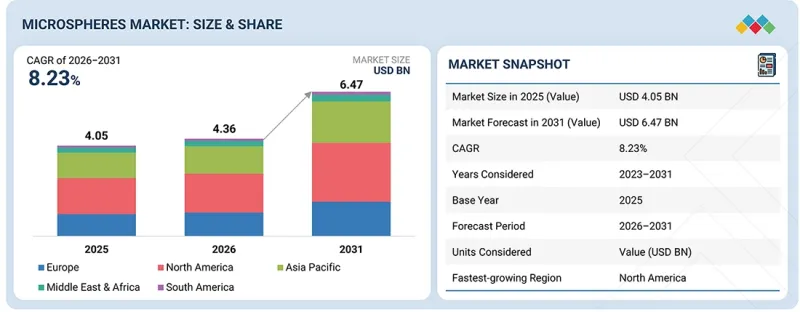
세계의 마이크로스피어 시장 규모는 2026년에 추정 43억 6,000만 달러로, 2031년까지 64억 7,000만 달러에 달할 것으로 예측되며, 2026-2031년에 CAGR로 8.23%의 성장이 전망되고 있습니다.
| 조사 범위 | |
|---|---|
| 조사 대상 기간 | 2023-2031년 |
| 기준연도 | 2025년 |
| 예측 기간 | 2026-2031년 |
| 단위 | 100만/10억 달러 |
| 부문 | 유형, 원재료, 용도, 지역 |
| 대상 지역 | 아시아태평양, 유럽, 북미, 중동 및 아프리카, 남미 |
"환경 및 지속가능성에 대한 규제 강화가 마이크로스피어 시장의 성장을 가속화하고 있습니다. "
다양한 산업 분야에서 마이크로스피어에 대한 수요는 정부의 환경 규제 강화와 지속가능성에 대한 노력에 의해 촉진되고 있습니다. 정부와 규제 당국은 배출량 감소, 에너지 효율 향상, 재료 소비 감소를 위해 더 엄격한 규제를 도입하고 있습니다. 이에 따라 제조업체들은 현재 기준보다 가볍고 단열성이 뛰어나며 성능 기준을 충족하는 제품을 생산할 수 있는 재료를 사용하도록 권장하고 있습니다. 이러한 목표를 달성하기 위한 하나의 수단으로 마이크로스피어의 활용을 들 수 있습니다. 마이크로스피어는 다양한 응용분야에서 제품의 밀도를 낮추면서 열효율을 향상시킵니다. 또한 많은 기업이 자사의 지속가능성 목표를 달성하기 위해 환경 부하를 줄이고 자원 최적화를 추진하고 있습니다. 규제 요건 준수와 장기적인 지속가능성 목표를 동시에 달성할 수 있는 효과적인 수단으로서 마이크로스피어의 중요성이 더욱 부각되고 있는 것은 이러한 컴플라이언스의 중요성이 더욱 커졌기 때문입니다.
"유형별로는 고체 부문이 예측 기간 중 높은 CAGR을 기록할 것으로 예상됩니다. "
예측 기간 중 솔리드 부문은 중공 부문보다 높은 CAGR을 보일 것으로 예상됩니다. 고체 마이크로스피어의 인기가 높아지는 주요 원인은 첨단 재료 설계와 공정 효율을 지원하는 능력에 있습니다. 고체 마이크로스피어의 일관된 입자 구조는 제제 거동에 대한 제어력을 향상시켜 현대 제조 공정에서 정확성과 재현성으로 이어집니다. 또한 고체 마이크로스피어는 자동 생산 시스템과의 원활한 통합을 촉진하고, 모든 산업 분야에 걸쳐 확장성을 제공합니다. 다양한 작업 환경에서 안정적인 성능을 발휘하는 재료에 대한 수요가 증가하고 있는 것도 고체 마이크로스피어의 빠른 보급을 촉진하고 있습니다.
"용도별로는 생명과학 부문이 예측 기간 중 두 번째로 높은 성장률을 기록할 것으로 예상됩니다. "
진단 키트 및 임상 검사 환경에서 마이크로스피어는 항체, 단백질 및 기타 생물학적 물질의 운반체로서 분석 및 검출 플랫폼에서 사용되므로 필수적인 구성 요소입니다. 마이크로스피어의 크기 일관성과 표면 특성은 검사 결과의 정확성과 재현성 향상에 기여합니다. 임상 실험실과 연구소 모두에서 마이크로스피어를 이용한 분석법을 채택함으로써 질병을 식별하는 보다 신속하고 신뢰할 수 있는 방법이 개발되었습니다. 의료 시스템이 정확하고 효과적인 진단 검사 제공에 초점을 맞추고 있는 가운데, 마이크로스피어는 진단 응용 분야에서 점점 더 중요한 역할을 하고 있으며, 생명과학 응용 분야에서 마이크로스피어에 대한 수요가 증가하고 있습니다.
"유럽은 2025년 세계 마이크로스피어 시장에서 3번째로 높은 점유율을 차지할 것으로 예상됩니다. "
2025년 유럽은 금액 기준으로 전체 마이크로스피어 시장에서 3번째로 큰 점유율을 차지했습니다. 유럽에서는 주로 현지의 엄격한 규제와 환경 목표 때문에 건물의 에너지 효율이 중요하게 여겨지고 있습니다. 마이크로비즈는 단열성을 높이고 에너지 손실을 최소화하기 위해 건축자재, 페인트, 코팅에 널리 이용되고 있습니다. 이러한 소재는 실내 온도를 효과적으로 조절할 수 있으며, 냉난방에 대한 의존도를 낮출 수 있습니다. 건축업자들은 높은 성능을 제공하면서도 유럽연합(EU)의 규제 요건을 충족하는 데 도움이 되는 솔루션에 관심을 갖고 있습니다. 마이크로스피어는 재료의 무게를 최소화하여 많은 현대식 건물의 건설에 기여하고 있습니다. 따라서 에너지 효율이 높은 건물에 대한 수요가 증가함에 따라 이 지역내 주거 및 상업 프로젝트에서 마이크로스피어의 사용도 증가하고 있습니다.
세계의 마이크로스피어 시장에 대해 조사 분석했으며, 주요 촉진요인 및 저해요인, 제품 개발 및 혁신, 경쟁 구도 등의 정보를 전해드립니다.
자주 묻는 질문
목차
제1장 서론
제2장 개요
제3장 중요 인사이트
제4장 시장 개요
제5장 업계 동향
제6장 기술의 진보, AI에 의한 영향, 특허, 혁신
제7장 규제 상황과 지속가능성 구상
제8장 고객 상황과 구매 행동
제9장 마이크로스피어 시장 : 원재료별
제10장 마이크로스피어 시장 : 유형별
제11장 마이크로스피어 시장 : 용도별
제12장 마이크로스피어 시장 : 지역별
제13장 경쟁 구도
제14장 기업 개요
제15장 조사 방법
제16장 부록
KSA 26.05.14The microspheres market is estimated to be USD 4.36 billion in 2026 and is projected to reach USD 6.47 billion by 2031, at a CAGR of 8.23% between 2026 and 2031.
| Scope of the Report | |
|---|---|
| Years Considered for the Study | 2023-2031 |
| Base Year | 2025 |
| Forecast Period | 2026-2031 |
| Units Considered | Value (USD Million/Billion) |
| Segments | Type, Raw Material, Application, and Region |
| Regions covered | Asia Pacific, Europe, North America, Middle East & Africa, and South America |
"Increasing environmental and sustainability regulations to accelerate microspheres market growth."
The demand for microspheres across a variety of industries is being driven by an increase in environmental regulations and sustainability initiatives by governments. Governments, along with regulatory agencies, are implementing stricter regulations to reduce emissions, increase energy efficiency, and decrease material consumption; this leads manufacturers toward using materials that can create products that are lighter in weight and insulate better than current standards, yet still meet performance criteria. One avenue for achieving these goals is the use of microspheres, which reduce the density of products while increasing thermal efficiency across a wide range of applications. Furthermore, many companies are attempting to meet their own sustainability targets, which drive them to reduce their environmental impact and optimize their resources. It is this increased importance of compliance that will elevate microspheres as a viable means of achieving both compliance with regulatory requirements and long-term sustainability goals.
"By type, the solid segment is expected to witness a higher CAGR during the forecast period."
The solid segment is projected to witness a higher CAGR than the hollow segment during the forecast period. The growing popularity of solid microspheres is primarily due to their ability to support advanced material design and process efficiency. The consistent particle structure of solid microspheres will provide greater control over formulation behavior, which relates to precision and repeatability in modern manufacturing processes. Solid microspheres will also facilitate smoother integration into automated production systems, providing scalability across all industries. The accelerating demand for materials that provide stable performance over a range of operating environments is also driving the rapid adoption of solid microspheres.
"By application, the life science segment is projected to register the second-fastest growth during the forecast period."
By application, the life science segment is projected to witness the second-highest CAGR between 2026 and 2031. In the diagnostic kit and lab testing environments, microspheres are an essential component since they are used as carriers of antibodies, proteins, and other biological materials within assays and detection platforms. The uniformity of their size and the surface properties of microspheres help improve the accuracy and repeatability of test results. In both clinical laboratory and research environments, the use of microsphere-based assays has led to the development of faster and more reliable ways to identify disease. As healthcare systems focus on producing accurate and effective diagnostic tests, microspheres are playing an increasing role in diagnostic applications, driving the demand for microspheres in life science applications.
"Europe accounted for the third-largest share of the global microspheres market in 2025."
Europe held the third-largest share in the overall microspheres market, in terms of value, in 2025. Europe highly values energy efficiency in buildings, primarily because of the tight regulations and environmental targets that have been followed in the region. Microspheres are extensively utilized in building materials, paints, and coatings to enhance thermal insulation and minimize energy loss. Such materials enable effective regulation of indoor temperatures, thereby reducing reliance on heating and cooling. Builders are interested in finding solutions that can help them meet the regulatory requirements of the European Union (EU) while providing high levels of performance. By minimizing the weight of materials, microspheres help in the construction of many modern buildings. Therefore, as the demand for energy-efficient buildings grows, so does the use of microspheres in both residential and commercial projects within the region.
- By Company Type: Tier 1 - 55%, Tier 2 - 25%, and Tier 3 - 20%
- By Designation: Directors - 50%, Managers - 30%, and Others - 20%
- By Region: North America - 40%, Europe - 35%, Asia Pacific - 20%, RoW- 5%
The key players profiled in the report include 3M Company (US), Nouryon (Netherlands), Thermo Fisher Scientific Inc. (US), Potters Industries LLC (US), Merck KGaA (Germany), Diasorin S.p.A. (Italy), Merit Medical Systems, Inc. (US), Terumo Corporation (Japan), Jiangsu NOVORAY New Material Co., Ltd. (China), and Kureha Corporation (Japan).
Study Coverage
This report segments the market for microspheres based on type, raw material, application, and region, and provides estimations of value (in USD million) for the overall market size across various regions. A detailed analysis of key industry players has been conducted to provide insights into their business overviews, services, and key strategies associated with the microspheres market.
Reasons to Buy this Report
This research report is focused on various levels of analysis-industry analysis (industry trends), market share analysis of top players, and company profiles, which together provide an overall view of the competitive landscape, emerging and high-growth segments of the microspheres market, high-growth regions, and market drivers, restraints, and opportunities.
The report provides insights into the following points:
- Market Penetration: Comprehensive information on microspheres offered by top players in the global market
- Analysis of key drivers: (Demand for lightweight & high-performance materials, rising demand in medical & drug delivery applications), restraints (Raw material price volatility, high production and capital costs), opportunities (Expansion in biomedical and pharmaceutical fields, advancing sustainable and biodegradable microsphere solutions) and challenges (Complex manufacturing processes, limitations in scaling production) influencing the growth of microspheres market
- Product Development/Innovation: Detailed insights on upcoming technologies, research & development activities, and new product & service launches in the microspheres market
- Market Development: Comprehensive information about lucrative emerging markets-the report analyzes the market for microspheres across regions.
- Market Diversification: Exhaustive information about new products, untapped regions, and recent developments in the global microspheres market
- Competitive Assessment: In-depth assessment of market shares, strategies, products, and manufacturing capabilities of leading players in the microspheres market
TABLE OF CONTENTS
1 INTRODUCTION
- 1.1 STUDY OBJECTIVES
- 1.2 MARKET DEFINITION
- 1.3 STUDY SCOPE
- 1.3.1 MARKETS COVERED AND REGIONAL SCOPE
- 1.3.2 INCLUSIONS AND EXCLUSIONS
- 1.3.3 MARKET DEFINITION AND INCLUSIONS, BY TYPE
- 1.3.4 MARKET DEFINITION AND INCLUSIONS, BY RAW MATERIAL
- 1.3.5 MARKET DEFINITION AND INCLUSIONS, BY APPLICATION
- 1.3.6 YEARS CONSIDERED
- 1.3.7 CURRENCY CONSIDERED
- 1.4 STAKEHOLDERS
- 1.5 SUMMARY OF CHANGES
2 EXECUTIVE SUMMARY
- 2.1 KEY INSIGHTS AND MARKET HIGHLIGHTS
- 2.2 KEY MARKET PARTICIPANTS: MAPPING OF STRATEGIC DEVELOPMENTS
- 2.3 DISRUPTIVE TRENDS IN MICROSPHERES MARKET
- 2.4 HIGH-GROWTH SEGMENTS
- 2.5 REGIONAL SNAPSHOT: MARKET SIZE, GROWTH RATE, AND FORECAST
3 PREMIUM INSIGHTS
- 3.1 ATTRACTIVE OPPORTUNITIES FOR PLAYERS IN MICROSPHERES MARKET
- 3.2 MICROSPHERES MARKET, BY RAW MATERIAL AND REGION
- 3.3 MICROSPHERES MARKET, BY TYPE
- 3.4 MICROSPHERES MARKET, BY COUNTRY
4 MARKET OVERVIEW
- 4.1 INTRODUCTION
- 4.2 MARKET DYNAMICS
- 4.2.1 DRIVERS
- 4.2.1.1 Demand for lightweight & high-performance materials
- 4.2.1.2 Rising demand in medical & drug delivery applications
- 4.2.2 RESTRAINTS
- 4.2.2.1 Raw material price volatility
- 4.2.2.2 High production and capital costs
- 4.2.3 OPPORTUNITIES
- 4.2.3.1 Expansion in biomedical and pharmaceutical fields
- 4.2.3.2 Advancing sustainable and biodegradable microsphere solutions
- 4.2.4 CHALLENGES
- 4.2.4.1 Complex manufacturing processes
- 4.2.4.2 Limitations in scaling production
- 4.2.1 DRIVERS
- 4.3 INTERCONNECTED MARKETS AND CROSS-SECTOR OPPORTUNITIES
- 4.3.1 INTERCONNECTED MARKETS
- 4.3.2 CROSS-SECTOR OPPORTUNITIES
5 INDUSTRY TRENDS
- 5.1 PORTER'S FIVE FORCES ANALYSIS
- 5.1.1 THREAT OF NEW ENTRANTS
- 5.1.2 THREAT OF SUBSTITUTES
- 5.1.3 BARGAINING POWER OF SUPPLIERS
- 5.1.4 BARGAINING POWER OF BUYERS
- 5.1.5 INTENSITY OF COMPETITIVE RIVALRY
- 5.2 MACROECONOMIC INDICATORS
- 5.2.1 INTRODUCTION
- 5.2.2 GDP TRENDS AND FORECAST
- 5.2.3 TRENDS IN GLOBAL CONSTRUCTION INDUSTRY
- 5.2.4 TRENDS IN GLOBAL PAINTS & COATINGS INDUSTRY
- 5.2.5 TRENDS IN GLOBAL MEDICAL & LIFE SCIENCE INDUSTRY
- 5.2.6 TRENDS IN GLOBAL COSMETICS & PERSONAL CARE INDUSTRY
- 5.2.7 TRENDS IN GLOBAL AUTOMOTIVE INDUSTRY
- 5.2.8 TRENDS IN GLOBAL OIL & GAS INDUSTRY
- 5.3 SUPPLY CHAIN ANALYSIS
- 5.4 ECOSYSTEM ANALYSIS
- 5.5 TRADE ANALYSIS
- 5.5.1 IMPORT SCENARIO (HS CODE 701820)
- 5.5.2 EXPORT SCENARIO (HS CODE 701820)
- 5.6 KEY CONFERENCES & EVENTS IN 2026-2027
- 5.7 TRENDS/DISRUPTIONS IMPACTING CUSTOMERS' BUSINESSES
- 5.8 INVESTMENT AND FUNDING SCENARIO
- 5.9 CASE STUDY ANALYSIS
- 5.9.1 HIGH-PERFORMANCE COOL ROOF COATING ENABLED BY EXPANDABLE MICROSPHERES
- 5.9.2 LIGHTWEIGHT TPO COMPONENTS ENABLED BY GLASS MICROSPHERES
- 5.9.3 ADVANCED WINE CORK SOLUTIONS ENABLED BY EXPANDABLE MICROSPHERES OF NOURYON
- 5.10 IMPACT OF 2025 US TARIFF - MICROSPHERES MARKET
- 5.10.1 INTRODUCTION
- 5.10.2 KEY TARIFF RATES
- 5.10.3 PRICE IMPACT ANALYSIS
- 5.10.4 IMPACT ON COUNTRY/REGION
- 5.10.4.1 US
- 5.10.4.2 Europe
- 5.10.4.3 Asia Pacific
- 5.10.5 IMPACT ON APPLICATIONS
6 TECHNOLOGICAL ADVANCEMENTS, AI-DRIVEN IMPACT, PATENTS, AND INNOVATIONS
- 6.1 KEY EMERGING TECHNOLOGIES
- 6.1.1 POLYMERIZATION TECHNOLOGY
- 6.1.2 THERMAL SPHEROIDIZATION
- 6.2 COMPLEMENTARY TECHNOLOGIES
- 6.2.1 MICROFLUIDICS
- 6.2.2 SURFACE FUNCTIONALIZATION TECHNOLOGIES
- 6.3 TECHNOLOGY/PRODUCT ROADMAP
- 6.3.1 SHORT-TERM (2025-2027)
- 6.3.2 MID-TERM (2027-2030) | EXPANSION & STANDARDIZATION
- 6.3.3 LONG-TERM (2030-2035+)
- 6.4 PATENT ANALYSIS
- 6.4.1 APPROACH
- 6.4.2 DOCUMENT TYPE
- 6.4.3 TOP APPLICANTS
- 6.4.4 JURISDICTION ANALYSIS
- 6.5 IMPACT OF AI/GEN AI
- 6.5.1 TOP USE CASES AND MARKET POTENTIAL
- 6.5.2 BEST PRACTICES IN MICROSPHERES PROCESSING
- 6.5.3 CASE STUDIES OF AI IMPLEMENTATION IN MICROSPHERES MARKET
- 6.5.4 INTERCONNECTED ADJACENT ECOSYSTEM AND IMPACT ON MARKET PLAYERS
- 6.5.5 CLIENTS' READINESS TO ADOPT GENERATIVE AI IN MICROSPHERES MARKET
7 REGULATORY LANDSCAPE AND SUSTAINABILITY INITIATIVES
- 7.1 REGIONAL REGULATIONS AND COMPLIANCE
- 7.1.1 REGULATORY BODIES, GOVERNMENT AGENCIES, AND OTHER ORGANIZATIONS
- 7.1.2 INDUSTRY STANDARDS
- 7.2 SUSTAINABILITY INITIATIVES
- 7.2.1 RESOURCE EFFICIENCY & LIGHTWEIGHTING
- 7.2.2 ENVIRONMENTAL SAFETY & COMPLIANCE
- 7.3 SUSTAINABILITY IMPACT AND REGULATORY POLICY INITIATIVES
- 7.4 CERTIFICATIONS, LABELING, AND ECO-STANDARDS
8 CUSTOMER LANDSCAPE & BUYER BEHAVIOR
- 8.1 DECISION-MAKING PROCESS
- 8.2 BUYER STAKEHOLDERS AND BUYING EVALUATION CRITERIA
- 8.2.1 KEY STAKEHOLDERS IN BUYING PROCESS
- 8.2.2 BUYING CRITERIA
- 8.3 ADOPTION BARRIERS & INTERNAL CHALLENGES
- 8.4 UNMET NEEDS IN VARIOUS APPLICATIONS
9 MICROSPHERES MARKET, BY RAW MATERIAL
- 9.1 INTRODUCTION
- 9.2 GLASS MICROSPHERES
- 9.3 POLYMER MICROSPHERES
- 9.4 CERAMIC MICROSPHERES
- 9.5 FLY ASH MICROSPHERES
- 9.6 METALLIC MICROSPHERES
- 9.7 OTHER MICROSPHERES
10 MICROSPHERES MARKET, BY TYPE
- 10.1 INTRODUCTION
- 10.2 HOLLOW MICROSPHERES
- 10.3 SOLID MICROSPHERES
11 MICROSPHERES MARKET, BY APPLICATION
- 11.1 INTRODUCTION
- 11.2 BUILDING & CONSTRUCTION
- 11.2.1 LOW DENSITY AND THERMAL INSULATION DRIVING MICROSPHERES ADOPTION
- 11.3 MEDICAL TECHNOLOGY
- 11.3.1 RISING USE OF MICROSPHERES IN DRUG DELIVERY AND MEDICAL TREATMENTS
- 11.4 LIFE SCIENCE & BIOTECHNOLOGY
- 11.4.1 INCREASING USE OF MICROSPHERES IN DIAGNOSTICS, RESEARCH, AND BIOTECHNOLOGY APPLICATIONS
- 11.5 PAINTS & COATINGS
- 11.5.1 ENHANCED PERFORMANCE AND INSULATION BENEFITS DRIVING MARKET
- 11.6 COSMETICS & PERSONAL CARE
- 11.6.1 SHIFT TOWARD SUSTAINABLE ALTERNATIVES
- 11.7 OIL & GAS
- 11.7.1 OPERATIONAL EFFICIENCY AND LIGHTWEIGHT FLUID SYSTEMS ENCOURAGING ADOPTION
- 11.8 AUTOMOTIVE
- 11.8.1 LIGHTWEIGHTING AND PERFORMANCE ENHANCEMENT PROPELLING MARKET GROWTH
- 11.9 AEROSPACE
- 11.9.1 ENABLING LIGHTWEIGHT AND HIGH-PERFORMANCE MATERIALS IN AEROSPACE APPLICATION
- 11.10 OTHER APPLICATIONS
12 MICROSPHERES MARKET, BY REGION
- 12.1 INTRODUCTION
- 12.2 NORTH AMERICA
- 12.2.1 US
- 12.2.1.1 Strong industrial base and end-use demand driving market
- 12.2.2 CANADA
- 12.2.2.1 Oil & gas leadership and R&D expansion supporting market growth
- 12.2.3 MEXICO
- 12.2.3.1 Manufacturing expansion and industrial demand supporting microspheres adoption
- 12.2.1 US
- 12.3 EUROPE
- 12.3.1 GERMANY
- 12.3.1.1 Technological advancement and industrial demand strengthening market
- 12.3.2 FRANCE
- 12.3.2.1 Strong industrial applications and established manufacturing ecosystems
- 12.3.3 UK
- 12.3.3.1 Advanced healthcare ecosystem and industrial applications shaping market
- 12.3.4 ITALY
- 12.3.4.1 Diverse industrial applications and automotive shift influencing market
- 12.3.5 SPAIN
- 12.3.5.1 Industrial expansion and emerging life science applications driving market
- 12.3.1 GERMANY
- 12.4 ASIA PACIFIC
- 12.4.1 CHINA
- 12.4.1.1 Industrial expansion and strong production base driving market
- 12.4.2 JAPAN
- 12.4.2.1 Established automotive and medical sectors supporting market
- 12.4.3 INDIA
- 12.4.3.1 Rapid market expansion and growing industrial applications
- 12.4.4 SOUTH KOREA
- 12.4.4.1 Rapid industrialization and technological advancements driving market
- 12.4.1 CHINA
- 12.5 MIDDLE EAST & AFRICA
- 12.6 SOUTH AMERICA
- 12.6.1 BRAZIL
- 12.6.1.1 Dominant regional position and expanding industrial applications
- 12.6.1 BRAZIL
13 COMPETITIVE LANDSCAPE
- 13.1 INTRODUCTION
- 13.2 KEY PLAYERS' STRATEGIES/RIGHT TO WIN, JANUARY 2021-MARCH 2026
- 13.3 MARKET SHARE ANALYSIS, 2025
- 13.4 REVENUE ANALYSIS, 2023-2025
- 13.5 COMPANY EVALUATION MATRIX: KEY PLAYERS, 2025
- 13.5.1 STARS
- 13.5.2 EMERGING LEADERS
- 13.5.3 PERVASIVE PLAYERS
- 13.5.4 PARTICIPANTS
- 13.5.5 COMPANY FOOTPRINT: KEY PLAYERS, 2025
- 13.5.5.1 Company footprint
- 13.5.5.2 Region footprint
- 13.5.5.3 Type footprint
- 13.5.5.4 Raw material footprint
- 13.5.5.5 Application footprint
- 13.6 COMPANY EVALUATION MATRIX: STARTUPS/SMES, 2025
- 13.6.1 PROGRESSIVE COMPANIES
- 13.6.2 RESPONSIVE COMPANIES
- 13.6.3 DYNAMIC COMPANIES
- 13.6.4 STARTING BLOCKS
- 13.6.5 COMPETITIVE BENCHMARKING: STARTUPS/SMES, 2025
- 13.6.5.1 Detailed list of key startups/SMES
- 13.6.5.2 Competitive benchmarking of key startups/SMEs
- 13.7 BRAND/PRODUCT COMPARISON
- 13.8 COMPANY VALUATION AND FINANCIAL METRICS
- 13.9 COMPETITIVE SCENARIO
- 13.9.1 PRODUCT LAUNCHES
- 13.9.2 DEALS
- 13.9.3 EXPANSIONS
14 COMPANY PROFILES
- 14.1 KEY PLAYERS
- 14.1.1 3M COMPANY
- 14.1.1.1 Business overview
- 14.1.1.2 Products/Solutions/Services offered
- 14.1.1.3 Recent developments
- 14.1.1.3.1 Deals
- 14.1.1.4 MnM view
- 14.1.1.4.1 Key strengths
- 14.1.1.4.2 Strategic choices
- 14.1.1.4.3 Weaknesses and competitive threats
- 14.1.2 NOURYON
- 14.1.2.1 Business overview
- 14.1.2.2 Products/Solutions/Services offered
- 14.1.2.3 Recent developments
- 14.1.2.3.1 Product launches
- 14.1.2.3.2 Deals
- 14.1.2.3.3 Expansions
- 14.1.2.4 MnM view
- 14.1.2.4.1 Key strengths
- 14.1.2.4.2 Strategic choices
- 14.1.2.4.3 Weaknesses and competitive threats
- 14.1.3 THERMO FISHER SCIENTIFIC INC.
- 14.1.3.1 Business overview
- 14.1.3.2 Products/Solutions/Services offered
- 14.1.3.3 MnM view
- 14.1.3.3.1 Key strengths
- 14.1.3.3.2 Strategic choices
- 14.1.3.3.3 Weaknesses and competitive threats
- 14.1.4 POTTERS INDUSTRIES LLC
- 14.1.4.1 Business overview
- 14.1.4.2 Products/Solutions/Services offered
- 14.1.4.3 Recent developments
- 14.1.4.3.1 Deals
- 14.1.4.3.2 Expansions
- 14.1.4.4 MnM view
- 14.1.4.4.1 Right to win
- 14.1.4.4.2 Strategic choices
- 14.1.4.4.3 Weaknesses and competitive threats
- 14.1.5 MERCK KGAA
- 14.1.5.1 Business overview
- 14.1.5.2 Products/Solutions/Services offered
- 14.1.5.3 MnM view
- 14.1.5.3.1 Key strengths
- 14.1.5.3.2 Strategic choices
- 14.1.5.3.3 Weaknesses and competitive threats
- 14.1.6 DIASORIN S.P.A.
- 14.1.6.1 Business overview
- 14.1.6.2 Products/Services/Solutions offered
- 14.1.6.3 Recent developments
- 14.1.6.3.1 Product launches
- 14.1.6.3.2 Deals
- 14.1.7 MERIT MEDICAL SYSTEMS, INC.
- 14.1.7.1 Business overview
- 14.1.7.2 Products/Services/Solutions offered
- 14.1.7.3 Recent developments
- 14.1.7.3.1 Product launches
- 14.1.8 TERUMO CORPORATION
- 14.1.8.1 Business overview
- 14.1.8.2 Products/Services/Solutions offered
- 14.1.8.3 Recent developments
- 14.1.8.3.1 Product launches
- 14.1.8.3.2 Deals
- 14.1.9 JIANGSU NOVORAY NEW MATERIAL CO., LTD.
- 14.1.9.1 Business overview
- 14.1.9.2 Products/Services/Solutions offered
- 14.1.10 KUREHA CORPORATION
- 14.1.10.1 Business overview
- 14.1.10.2 Products/Services/Solutions offered
- 14.1.1 3M COMPANY
- 14.2 STARTUP/SMES
- 14.2.1 TRELLEBORG AB
- 14.2.2 CHASE CORPORATION
- 14.2.3 SINOSTEEL MAANSHAN NEW MATERIAL TECHNOLOGY CO., LTD.
- 14.2.4 MOMENTIVE PERFORMANCE MATERIALS INC.
- 14.2.5 SUZHOU NANOMICRO TECHNOLOGY CO., LTD.
- 14.2.6 POLYSCIENCES, INC.
- 14.2.7 MITSUI CHEMICALS, INC.
- 14.2.8 ZHENGZHOU HOLLOWLITE MATERIALS CO., LTD.
- 14.2.9 MATSUMOTO YUSHI SEIYAKU CO., LTD.
- 14.2.10 SIGMUND LINDNER GMBH
- 14.2.11 LINGSHOU COUNTY KEHUI MICA CO., LTD.
- 14.2.12 LAMBERTI S.P.A.
- 14.2.13 OMYA INTERNATIONAL AG
- 14.2.14 CRERAX SCIENCE AND TECHNOLOGY CO., LTD.
- 14.2.15 WAYTOP MICROSPHERES CO., LTD.
15 RESEARCH METHODOLOGY
- 15.1 RESEARCH DATA
- 15.1.1 SECONDARY DATA
- 15.1.1.1 Key data from secondary sources
- 15.1.2 PRIMARY DATA
- 15.1.2.1 Key data from primary sources
- 15.1.2.2 Key primary participants
- 15.1.2.3 Breakdown of primary interviews
- 15.1.2.4 Key industry insights
- 15.1.1 SECONDARY DATA
- 15.2 MARKET SIZE ESTIMATION
- 15.2.1 BOTTOM-UP APPROACH
- 15.2.2 TOP-DOWN APPROACH
- 15.3 GROWTH FORECAST
- 15.3.1 SUPPLY-SIDE ANALYSIS
- 15.3.2 DEMAND-SIDE ANALYSIS
- 15.4 DATA TRIANGULATION
- 15.5 FACTOR ANALYSIS
- 15.6 RESEARCH ASSUMPTIONS
- 15.7 RESEARCH LIMITATIONS
- 15.8 RISK ASSESSMENT
16 APPENDIX
- 16.1 DISCUSSION GUIDE
- 16.2 KNOWLEDGESTORE: MARKETSANDMARKETS' SUBSCRIPTION PORTAL
- 16.3 CUSTOMIZATION OPTIONS
- 16.4 RELATED REPORTS
- 16.5 AUTHOR DETAILS