
|
시장보고서
상품코드
2070354
이식 진단 시장 : 제품 및 서비스별(기기, 소프트웨어), 기술별(PCR, NGS), 용도별(진단(감염증, HLA), 연구), 유형별(고형 장기(심장), 골수), 최종사용자별(병원), 지역별 - 세계 예측(-2031년)Transplant Diagnostics Market by Product & Service (Instrument, Software), Technology (PCR, NGS), Application [Diagnostic (Infectious Disease, HLA) Research], Type [Solid Organ (Heart), Bone Marrow], End User (Hospital) & Region -Global Forecast to 2031 |
||||||

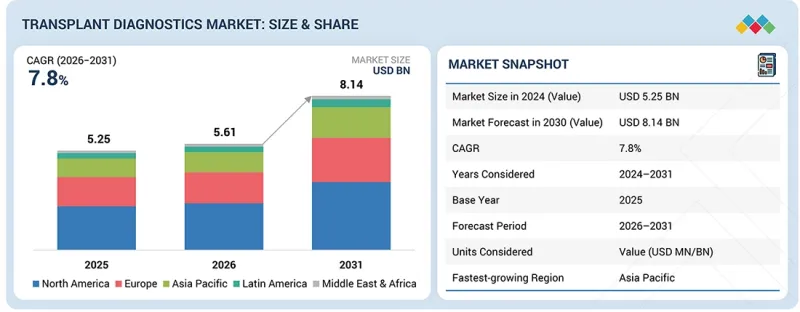
이식 진단 시장 규모는 2026년에 약 56억 1,000만 달러로 평가되었으며, 2031년에는 81억 4,000만 달러에 달하고, CAGR 7.8%로 확대될 것으로 예상됩니다.
장기 이식 수술 건수의 증가로 인해 기증자와 수혜자의 적합성 검사, 조직 적합성 검사, 감염증 검사, 혈액 프로파일링 등 다양한 검사 기법에 대한 수요가 증가하고 있습니다.
| 조사 범위 | |
|---|---|
| 조사 대상 기간 | 2026-2031년 |
| 기준 연도 | 2025년 |
| 예측 기간 | 2026-2031년 |
| 단위 | 금액(달러) |
| 부문 | 제품 및 서비스, 기술, 용도, 유형, 최종사용자 |
| 대상 지역 | 북미, 유럽, 아시아태평양, 라틴아메리카, 중동 및 아프리카 |
또한, PCR(중합효소 연쇄 반응)이나 NGS(차세대 염기서열 분석)와 같은 분자진단 기술의 도입 확대가 시장 성장을 더욱 뒷받침하고 있습니다. 이러한 기술은 높은 검사 효율, 신속한 결과 보고, 실시간 검체 분석과 같은 장점을 가지고 있습니다. 또한, 이식편 거부 반응의 위험을 줄이고 이식 치료 성과를 높이는 데 있어 분자진단 기술의 장점에 대한 인식이 높아진 점도 시장 확대에 기여하고 있습니다.
“용도별로 보면 진단 용도 부문이 예측 기간 동안 가장 높은 성장률을 보일 것으로 예상됩니다.”
진단 용도 부문은 2025년에 가장 높은 성장률을 보일 것으로 예상됩니다. 이러한 성장은 주로 분자 검사 기술의 발전과, 병원체 검출 및 조직 적합성 검사에서 이러한 기법의 활용 확대에 기인한 것입니다. 또한, 이식이 필요한 만성 질환의 발생률 증가 역시 이식 진단 제품 및 서비스에 대한 수요를 끌어올리고 있습니다. 또한, 이식 후에는 유전성 질환이나 병원체 감염의 위험이 높아지기 때문에 기증자와 수혜자 간의 효과적인 적합성 검사 및 이식 후 모니터링의 필요성이 입증되고 있습니다. 또한, 이식편 거부 반응의 위험을 줄이고 이식 예후를 개선하는 데 있어 정확한 이식 진단의 중요성이 널리 인식되게 된 점도 이 부문의 성장에 기여하고 있습니다.
“이식 유형별로는 고형 장기 이식 부문이 2025년 이식 진단 시장에서 가장 큰 시장 점유율을 차지했습니다.”
이 부문의 점유율이 높은 주요 이유는, 주로 고형 장기 이식 수술 중 기증자와 수혜자의 적합성 검사, 감염증 검사, 조직 적합성 검사, 유전체 프로파일링, 혈액 프로파일링 등 다양한 목적으로 이식 진단 제품이 점점 더 많이 활용되고 있기 때문입니다. 또한, 장기 이식 수술 건수의 증가, 정부의 지원적 규제, 이식이 필요한 만성 질환 및 장애의 유병률 상승, 이식 진단 기술의 발전도 이 부문의 성장을 더욱 뒷받침하고 있습니다.
“아시아태평양은 예측 기간 동안 시장에서 가장 빠르게 성장할 것으로 보입니다.”
아시아태평양은 2025년에 가장 빠른 성장세를 보일 것으로 예상됩니다. 이러한 성장은 주로 의료비 증가, 의료 인프라의 급속한 확충, 첨단 진단 기술의 보급 확대, 아시아태평양 신흥국들의 눈부신 경제 성장에 힘입어 이루어지고 있습니다. 또한, 고령 인구 증가, 이식이 필요한 만성 질환의 유병률 상승, 중국, 인도, 일본 등 국가에서 의료 시스템의 현대화를 위한 정부 주도의 노력 확대와 같은 요인들도 시장 확대를 더욱 뒷받침하고 있습니다. 또한, 일본에서 이식 관련 시술에 국민건강보험이 적용되고 있으며, 아시아태평양 전체에서 급성장하고 있는 의료 관광 산업도 해당 지역의 이식 진단 시장 성장에 기여하고 있습니다.
본 보고서에서는 전 세계 이식 진단 시장을 조사하여, 시장 개요, 시장 성장에 영향을 미치는 다양한 요인에 대한 분석, 기술 및 특허 동향, 법규제 환경, 사례 연구, 시장 규모 추정 및 전망, 각종 분류·지역/주요 국가별 상세 분석, 경쟁 현황, 주요 기업 개요 등을 정리하고 있습니다.
자주 묻는 질문
목차
제1장 소개
제2장 주요 요약
제3장 주요 인사이트
제4장 시장 개요
제5장 업계 동향
제6장 기술의 진보, AI의 영향, 특허, 혁신, 향후 응용
제7장 지속가능성과 규제 상황
제8장 고객 상황과 구매 행동
제9장 이식 진단 시장 : 제품 및 서비스별
제10장 이식 진단 시장 : 기술별
제11장 이식 진단 시장 : 용도별
제12장 이식 진단 시장 : 유형별
제13장 이식 진단 시장 : 최종사용자별
제14장 이식 진단 시장 : 지역별
제15장 경쟁 구도
제16장 기업 개요
제17장 조사 방법
제18장 부록
KSM 26.07.02The market for transplant diagnostics is valued at around USD 5.61 billion in 2026 and is expected to reach USD 8.14 billion by 2031, at a growth rate of 7.8%. The growing number of organ transplantation procedures is driving the demand for various testing methods, including donor-recipient compatibility testing, histocompatibility testing, infectious disease testing, and blood profiling.
| Scope of the Report | |
|---|---|
| Years Considered for the Study | 2026-2031 |
| Base Year | 2025 |
| Forecast Period | 2026-2031 |
| Units Considered | Value (USD billion) |
| Segments | Product & Service, Technology, Application, Type, and End User |
| Regions covered | North America, Europe, Asia Pacific, Latin America, and the Middle East & Africa |
Additionally, the rising adoption of molecular diagnostic technologies, such as PCR (polymerase chain reaction) and NGS (next-generation sequencing), is further fueling market growth. These technologies offer advantages such as high procedural efficacy, quick turnaround times, and real-time sample analysis. Furthermore, increasing awareness of the benefits of molecular diagnostic techniques in reducing the risk of graft rejection and improving transplantation outcomes is also contributing to market expansion.
"The diagnostic applications segment is expected to witness the fastest growth rate in the transplant diagnostics market, by application, during the forecast period."
Based on application, the transplant diagnostics market is divided into diagnostic applications and research applications. In 2025, the diagnostic applications segment is expected to experience the fastest growth in the transplant diagnostics market. This growth is primarily due to advancements in molecular assay techniques and the increasing use of these procedures for pathogen detection and histocompatibility testing. Additionally, the rising incidence of chronic diseases that require transplantation is boosting demand for transplant diagnostic products and services. There is also a greater risk of genetic disorders and pathogen infections following transplantation, which supports the need for effective donor-recipient compatibility testing and post-transplant monitoring. Furthermore, growing awareness of the importance of accurate transplant diagnostics in reducing the risks of graft rejection and improving transplantation outcomes is contributing to the expansion of this segment.
"The solid organ transplantation segment accounted for the largest market share in the transplant diagnostics market, by type, in 2025."
Based on transplant type, the transplant diagnostics market is divided into solid organ transplantation, stem cell transplantation, soft tissue transplantation, and bone marrow transplantation. In 2025, the solid organ transplantation segment led the transplant diagnostics market. This segment's significant share is mainly due to the growing use of transplant diagnostic products for various purposes, including donor-recipient compatibility testing, infectious disease testing, histocompatibility testing, genomic profiling, and blood profiling during solid organ transplantation procedures. Moreover, the increasing number of organ transplantation procedures, supportive government regulations, the rising prevalence of chronic diseases and disorders requiring transplantation, and technological advancements in transplant diagnostics are further contributing to the growth of this segment.
"The Asia Pacific is the fastest-growing market for transplant diagnostics during the forecast period."
Based on region, the transplant diagnostics market is divided into North America, Europe, Asia Pacific, Latin America, and the Middle East & Africa. In 2025, the Asia Pacific region is expected to see the fastest growth in the transplant diagnostics market. This growth is primarily driven by increased healthcare spending, rapid advances in healthcare infrastructure, greater adoption of advanced diagnostic technologies, and significant economic growth in emerging Asia-Pacific countries. Additionally, factors such as a rising elderly population, an increased prevalence of chronic diseases requiring transplants, and growing government initiatives to modernize healthcare systems in countries like China, India, and Japan are further supporting market expansion. Furthermore, Japan's provision of universal healthcare coverage for transplantation-related procedures and the burgeoning medical tourism industry across Asia Pacific countries are also contributing to the growth of the transplant diagnostics market in the region.
The breakup of the profile of primary participants in the transplant diagnostics market:
- By Company Type: Tier 1 (40%), Tier 2 (30%), and Tier 3 (30%)
- By Designation: C-level Executives (27%), Directors (18%), and Other Designations (55%)
- By Region: North America (51%), Europe (21%), Asia Pacific (18%), Latin America (6%), and the Middle East & Africa (4%)
The key players in the molecular infectious disease testing market are Thermo Fisher Scientific Inc. (US), F. Hoffmann-La Roche Ltd. (Switzerland), Bio-Rad Laboratories, Inc. (US), QIAGEN N.V. (Netherlands), bioMerieux (France), Becton, Dickinson and Company (US), Illumina, Inc. (US), DiaSorin S.p.A. (Italy), CAREDX, INC. (US), Werfen (Spain), Hologic, Inc. (US), Merck KGaA (Germany), Eurobio Scientific (France), Biofortuna Limited (UK), BAG Diagnostics GmbH (Germany), Fujirebio (Japan), HistoGenetics LLC (US), PacBio (US), TBG Biotechnology Corp (Taiwan), Scisco Genetics, Inc. (US), inno-train Diagnostik GmbH (Germany), Bionobis (France), Takara Bio Inc. (Japan), Krishgen Biosystems Private Limited (India), and Prolmmune Ltd. (UK).
Research Coverage:
This research report categorizes the transplant diagnostics market by product & service (reagents & consumables, instruments, and software & services), technology {molecular assays [PCR-based molecular assays (real-time PCR, sequence-specific primer-PCR, sequence-specific oligonucleotide-PCR, and other PCR-based molecular assays), sequencing-based molecular assays (Sanger sequencing, next-generation sequencing, and other sequencing-based molecular assays)] and non-molecular assays}, application {diagnostic applications [pre-transplantation diagnostics (infectious disease testing, histocompatibility testing, and blood profiling) and post-transplantation diagnostics] and research applications}, transplant type [solid organ transplantation (kidney transplantation, liver transplantation, heart transplantation, lung transplantation, pancreas transplantation, and other organ transplantation), stem cell transplantation, soft tissue transplantation, and bone marrow transplantation], end user (hospitals & transplant centers, research & academic institutes, and independent reference laboratories), and region (North America, Europe, Asia Pacific, Latin America, and the Middle East & Africa). This report provides a comprehensive overview of the key factors driving growth in the transplant diagnostics market, including drivers, restraints, opportunities, and challenges. It offers an in-depth analysis of the major industry players, highlighting their business models, available solutions, key strategies, recent acquisitions, and agreements. Additionally, the report includes a competitive analysis of emerging startups in the transplant diagnostics market.
Reasons to Buy this Report:
The report will assist market leaders and new entrants in the transplant diagnostics industry by providing estimated revenue figures for the overall market and its subsegments. It aims to help stakeholders understand the competitive landscape, allowing them to position their businesses more effectively and develop appropriate go-to-market strategies. Additionally, the report offers insights into the market dynamics, including key drivers, restraints, opportunities, and challenges.
The report provides insights into the following pointers:
- Analysis of key drivers (increasing number of transplant procedures, advancements in molecular diagnostic technologies, increasing public-private funding for transplant research, and rising prevalence of infectious diseases), restraints (high cost of advanced molecular diagnostic techniques and limited access to advanced transplant diagnostic infrastructure in emerging economies), opportunities (increasing adoption of cross-matching and chimerism testing and growing awareness regarding organ donation and transplantation), and challenges (gap between organ donor availability and transplant demand) influencing the growth of the transplant diagnostics market.
- Product Development/Innovation: Detailed insights on upcoming technologies, research & development activities, and new product launches in the transplant diagnostics market.
- Market Development: Comprehensive information about lucrative markets; the report analyzes the transplant diagnostics market across varied regions.
- Market Diversification: Exhaustive information about new products, untapped geographies, recent developments, and investments in the transplant diagnostics market.
- Competitive Assessment: In-depth assessment of market shares, growth strategies, and product offerings of leading players like Thermo Fisher Scientific Inc. (US), F. Hoffmann-La Roche Ltd (Switzerland), Bio-Rad Laboratories, Inc. (US), QIAGEN N.V. (Netherlands), and bioMerieux (France).
TABLE OF CONTENTS
1 INTRODUCTION
- 1.1 STUDY OBJECTIVES
- 1.2 MARKET DEFINITION
- 1.3 STUDY SCOPE
- 1.3.1 MARKETS COVERED & REGIONAL SCOPE
- 1.3.2 INCLUSIONS & EXCLUSIONS
- 1.3.3 YEARS CONSIDERED
- 1.4 CURRENCY CONSIDERED
- 1.5 STAKEHOLDERS
- 1.6 SUMMARY OF CHANGES
2 EXECUTIVE SUMMARY
- 2.1 KEY INSIGHTS & MARKET HIGHLIGHTS
- 2.2 KEY MARKET PARTICIPANTS: INSIGHTS & STRATEGIC DEVELOPMENTS
- 2.3 DISRUPTIVE TRENDS SHAPING MARKET GROWTH
- 2.4 HIGH-GROWTH SEGMENTS & EMERGING FRONTIERS
- 2.5 SNAPSHOT: GLOBAL MARKET SIZE, GROWTH RATE, AND FORECAST
3 PREMIUM INSIGHTS
- 3.1 TRANSPLANT DIAGNOSTICS MARKET OVERVIEW
- 3.2 TRANSPLANT DIAGNOSTICS MARKET, BY PRODUCT & SERVICE, 2026 VS. 2031
- 3.3 TRANSPLANT DIAGNOSTICS MARKET, BY TECHNOLOGY, 2026 VS. 2031
- 3.4 TRANSPLANT DIAGNOSTICS MARKET, BY APPLICATION, 2026 VS. 2031
- 3.5 TRANSPLANT DIAGNOSTICS MARKET, BY TYPE, 2026 VS. 2031
- 3.6 TRANSPLANT DIAGNOSTICS MARKET, BY END USER, 2026 VS. 2031
- 3.7 TRANSPLANT DIAGNOSTICS MARKET: GEOGRAPHIC GROWTH OPPORTUNITIES
4 MARKET OVERVIEW
- 4.1 INTRODUCTION
- 4.2 MARKET DYNAMICS
- 4.2.1 DRIVERS
- 4.2.1.1 Increasing number of transplant procedures
- 4.2.1.2 Advancements in molecular diagnostic technologies
- 4.2.1.3 Increasing public-private funding for transplant research
- 4.2.1.4 Rising incidence of chronic diseases
- 4.2.2 RESTRAINTS
- 4.2.2.1 High cost of instruments and consumables
- 4.2.2.2 Limited access to advanced transplant diagnostic infrastructure in emerging economies
- 4.2.3 OPPORTUNITIES
- 4.2.3.1 Increasing adoption of cross-matching and chimerism testing
- 4.2.3.2 Growing awareness regarding organ donation and transplantation
- 4.2.4 CHALLENGES
- 4.2.4.1 Gap between organ donor availability and transplant demand
- 4.2.1 DRIVERS
- 4.3 UNMET NEEDS & WHITE SPACES
- 4.3.1 UNMET NEEDS IN TRANSPLANT DIAGNOSTICS MARKET
- 4.3.2 WHITE SPACE OPPORTUNITIES
- 4.4 INTERCONNECTED MARKETS & CROSS-SECTOR OPPORTUNITIES
- 4.4.1 INTERCONNECTED MARKETS
- 4.4.2 CROSS-SECTOR OPPORTUNITIES
- 4.5 STRATEGIC MOVES BY TIER 1/2/3 PLAYERS
- 4.5.1 KEY MOVES & STRATEGIC FOCUS
5 INDUSTRY TRENDS
- 5.1 PORTER'S FIVE FORCES ANALYSIS
- 5.1.1 BARGAINING POWER OF SUPPLIERS
- 5.1.2 BARGAINING POWER OF BUYERS
- 5.1.3 THREAT OF NEW ENTRANTS
- 5.1.4 THREAT OF SUBSTITUTES
- 5.1.5 INTENSITY OF COMPETITIVE RIVALRY
- 5.2 MACROECONOMIC INDICATORS
- 5.2.1 INTRODUCTION
- 5.2.2 GDP TRENDS & FORECAST
- 5.3 SUPPLY CHAIN ANALYSIS
- 5.4 VALUE CHAIN ANALYSIS
- 5.5 ECOSYSTEM ANALYSIS
- 5.6 PRICING ANALYSIS
- 5.6.1 AVERAGE SELLING PRICE TREND OF TRANSPLANT DIAGNOSTIC PRODUCTS, BY KEY PLAYER, 2024-2026
- 5.6.2 AVERAGE SELLING PRICE TREND OF TRANSPLANT DIAGNOSTIC PRODUCTS, BY REGION, 2024-2026
- 5.7 TRADE ANALYSIS
- 5.7.1 IMPORT SCENARIO (HS CODE 3822)
- 5.7.2 EXPORT SCENARIO (HS CODE 3822)
- 5.8 KEY CONFERENCES & EVENTS, 2026-2027
- 5.9 TRENDS/DISRUPTIONS IMPACTING CUSTOMERS' BUSINESSES
- 5.10 INVESTMENT & FUNDING SCENARIO
- 5.11 IMPACT OF 2025 US TARIFFS ON TRANSPLANT DIAGNOSTICS MARKET
- 5.11.1 INTRODUCTION
- 5.11.2 KEY TARIFF RATES
- 5.11.3 PRICE IMPACT ANALYSIS
- 5.11.4 IMPACT ON REGION
- 5.11.4.1 North America
- 5.11.4.2 Europe
- 5.11.4.3 Asia Pacific
- 5.11.5 IMPACT ON END-USE INDUSTRIES
- 5.11.5.1 Hospitals & transplant centers
- 5.11.5.2 Research & academic institutes
- 5.11.5.3 Independent reference laboratories
6 TECHNOLOGICAL ADVANCEMENTS, AI-DRIVEN IMPACT, PATENTS, INNOVATIONS, AND FUTURE APPLICATIONS
- 6.1 KEY EMERGING TECHNOLOGIES
- 6.1.1 DONOR-DERIVED CELL-FREE DNA (DD-CFDNA)
- 6.1.2 DIGITAL PCR (DPCR)
- 6.2 COMPLEMENTARY TECHNOLOGIES
- 6.2.1 AI IN TRANSPLANT DIAGNOSTICS
- 6.2.2 BIOINFORMATICS
- 6.3 ADJACENT TECHNOLOGIES
- 6.3.1 LIQUID BIOPSY
- 6.3.2 DIGITAL PATHOLOGY
- 6.4 TECHNOLOGY/PRODUCT ROADMAP
- 6.5 PATENT ANALYSIS
- 6.5.1 LIST OF KEY PATENTS
- 6.6 FUTURE APPLICATIONS
- 6.7 IMPACT OF AI/GENERATIVE AI ON TRANSPLANT DIAGNOSTICS MARKET
- 6.7.1 INTRODUCTION
- 6.7.2 TOP USE CASES & MARKET POTENTIAL
- 6.7.3 KEY COMPANIES IMPLEMENTING AI
- 6.7.4 FUTURE OF AI
7 SUSTAINABILITY & REGULATORY LANDSCAPE
- 7.1 REGIONAL REGULATIONS & COMPLIANCE
- 7.1.1 REGULATORY BODIES, GOVERNMENT AGENCIES, AND OTHER ORGANIZATIONS
- 7.2 SUSTAINABILITY INITIATIVES
- 7.2.1 ENVIRONMENTAL IMPACT & ECO-FRIENDLY INITIATIVES IN TRANSPLANT DIAGNOSTICS
- 7.2.1.1 Eco-friendly initiatives
- 7.2.1 ENVIRONMENTAL IMPACT & ECO-FRIENDLY INITIATIVES IN TRANSPLANT DIAGNOSTICS
- 7.3 SUSTAINABILITY IMPACT & REGULATORY POLICY INITIATIVES
8 CUSTOMER LANDSCAPE & BUYER BEHAVIOR
- 8.1 DECISION-MAKING PROCESS
- 8.2 BUYER STAKEHOLDERS & BUYING EVALUATION CRITERIA
- 8.2.1 KEY STAKEHOLDERS IN BUYING PROCESS
- 8.2.2 BUYING CRITERIA
- 8.3 ADOPTION BARRIERS & INTERNAL CHALLENGES
- 8.4 UNMET NEEDS IN VARIOUS END-USE INDUSTRIES
- 8.5 MARKET PROFITABILITY
- 8.5.1 REVENUE POTENTIAL
- 8.5.2 COST DYNAMICS
- 8.5.3 MARGIN OPPORTUNITIES IN KEY APPLICATIONS
9 TRANSPLANT DIAGNOSTICS MARKET, BY PRODUCTS & SERVICES
- 9.1 INTRODUCTION
- 9.2 REAGENTS & CONSUMABLES
- 9.2.1 REAGENTS & CONSUMABLES TO BE LARGEST AND FASTEST-GROWING SEGMENT IN TRANSPLANT DIAGNOSTICS MARKET
- 9.3 INSTRUMENTS
- 9.3.1 INCREASING PUBLIC-PRIVATE INVESTMENTS TO DRIVE MARKET
- 9.4 SOFTWARE & SERVICES
- 9.4.1 GROWING AUTOMATION & DIGITALIZATION OF DIAGNOSTIC LABORATORY PROCEDURES TO SUPPORT MARKET GROWTH
10 TRANSPLANT DIAGNOSTICS MARKET, BY TECHNOLOGY
- 10.1 INTRODUCTION
- 10.2 MOLECULAR ASSAYS
- 10.2.1 PCR-BASED MOLECULAR ASSAYS
- 10.2.1.1 Real-time PCR
- 10.2.1.1.1 Smaller sample volume requirements compared to conventional PCR technologies to drive demand
- 10.2.1.2 Sequence-specific primer-PCR (SSP-PCR)
- 10.2.1.2.1 Growing public-private investments for research activities to support market growth
- 10.2.1.3 Sequence-specific oligonucleotide-PCR (SSO-PCR)
- 10.2.1.3.1 Wide adoption of technique in PCR-based molecular assays market to fuel growth
- 10.2.1.4 Other PCR-based molecular assays
- 10.2.1.1 Real-time PCR
- 10.2.2 SEQUENCING-BASED MOLECULAR ASSAYS
- 10.2.2.1 Sanger sequencing
- 10.2.2.1.1 Growing demand for high-throughput DNA sequencers in transplant diagnostic applications to drive market
- 10.2.2.2 Next-generation sequencing (NGS)
- 10.2.2.2.1 Low turnaround time and high-throughput sequencing to drive adoption of NGS
- 10.2.2.3 Other sequencing-based molecular assays
- 10.2.2.1 Sanger sequencing
- 10.2.1 PCR-BASED MOLECULAR ASSAYS
- 10.3 NON-MOLECULAR ASSAYS
- 10.3.1 REPLACEMENT OF NON-MOLECULAR ASSAY TECHNIQUES WITH DNA-BASED TECHNIQUES TO HAMPER GROWTH
11 TRANSPLANT DIAGNOSTICS MARKET, BY APPLICATION
- 11.1 INTRODUCTION
- 11.2 DIAGNOSTIC APPLICATIONS
- 11.2.1 PRE-TRANSPLANTATION DIAGNOSTICS
- 11.2.1.1 Infectious disease testing
- 11.2.1.1.1 Growing adoption of advanced molecular techniques for pathogen detection to drive market
- 11.2.1.2 Histocompatibility testing
- 11.2.1.2.1 Technological advancements and growing R&D activities to propel market
- 11.2.1.3 Blood profiling
- 11.2.1.3.1 Growing availability of molecular assay products to support market growth
- 11.2.1.1 Infectious disease testing
- 11.2.2 POST-TRANSPLANTATION DIAGNOSTICS
- 11.2.2.1 Greater risk of disorders and infections post-transplantation to make diagnostics necessary step
- 11.2.1 PRE-TRANSPLANTATION DIAGNOSTICS
- 11.3 RESEARCH APPLICATIONS
- 11.3.1 GROWING FUNDING FOR RESEARCH TO DRIVE MARKET
12 TRANSPLANT DIAGNOSTICS MARKET, BY TYPE
- 12.1 INTRODUCTION
- 12.2 SOLID ORGAN TRANSPLANTATION
- 12.2.1 KIDNEY TRANSPLANTATION
- 12.2.1.1 Rising prevalence of kidney diseases to drive market
- 12.2.2 LIVER TRANSPLANTATION
- 12.2.2.1 Growing patient population with chronic liver diseases and increasing procedural volume to drive market
- 12.2.3 LUNG TRANSPLANTATION
- 12.2.3.1 Rising prevalence of chronic lung diseases to drive market
- 12.2.4 HEART TRANSPLANTATION
- 12.2.4.1 Increasing prevalence of chronic cardiac diseases to propel market
- 12.2.5 PANCREAS TRANSPLANTATION
- 12.2.5.1 Procedural complexity and risk of surgical complications to restrain growth
- 12.2.6 OTHER SOLID ORGAN TRANSPLANTATION
- 12.2.1 KIDNEY TRANSPLANTATION
- 12.3 STEM CELL TRANSPLANTATION
- 12.3.1 RISING PROCEDURAL VOLUME AND GROWING RESEARCH ACTIVITIES TO DRIVE MARKET
- 12.4 SOFT TISSUE TRANSPLANTATION
- 12.4.1 TECHNOLOGICAL ADVANCEMENTS AND RISING PREVALENCE OF TARGET DISEASES TO DRIVE MARKET
- 12.5 BONE MARROW TRANSPLANTATION
- 12.5.1 DEARTH OF WELL-TRAINED SURGEONS TO PERFORM BONE MARROW TRANSPLANTATION TO HINDER GROWTH
13 TRANSPLANT DIAGNOSTICS MARKET, BY END USER
- 13.1 INTRODUCTION
- 13.2 INDEPENDENT REFERENCE LABORATORIES
- 13.2.1 RISING CONSOLIDATION OF DIAGNOSTIC LABORATORIES TO DRIVE MARKET
- 13.3 HOSPITALS & TRANSPLANT CENTERS
- 13.3.1 GROWING PURCHASING POWER OF HOSPITALS & TRANSPLANT CENTERS TO SUPPORT MARKET GROWTH
- 13.4 RESEARCH LABORATORIES & ACADEMIC INSTITUTES
- 13.4.1 INCREASING INDUSTRY-ACADEMIA COLLABORATIONS IN GENOMICS-BASED TRANSPLANT DIAGNOSTIC RESEARCH TO DRIVE MARKET
14 TRANSPLANT DIAGNOSTICS MARKET, BY REGION
- 14.1 INTRODUCTION
- 14.2 NORTH AMERICA
- 14.2.1 US
- 14.2.1.1 Growing organ transplantation activity to support market expansion
- 14.2.2 CANADA
- 14.2.2.1 Growing transplant programs to support market growth
- 14.2.1 US
- 14.3 EUROPE
- 14.3.1 GERMANY
- 14.3.1.1 Expanding donor registry network to fuel market growth
- 14.3.2 UK
- 14.3.2.1 Rising transplant demand to support market growth
- 14.3.3 FRANCE
- 14.3.3.1 Growing organ donation initiatives to drive growth
- 14.3.4 ITALY
- 14.3.4.1 Increasing organ donation rates to drive market growth
- 14.3.5 SPAIN
- 14.3.5.1 Strong organ donation system to support market growth
- 14.3.6 REST OF EUROPE
- 14.3.1 GERMANY
- 14.4 ASIA PACIFIC
- 14.4.1 CHINA
- 14.4.1.1 Expanding transplantation programs to drive market growth
- 14.4.2 JAPAN
- 14.4.2.1 Growing transplant waiting population to support market growth
- 14.4.3 INDIA
- 14.4.3.1 Rising transplant procedures to drive market growth
- 14.4.4 AUSTRALIA
- 14.4.4.1 Rising number of solid organ transplantation procedures to drive market
- 14.4.5 SOUTH KOREA
- 14.4.5.1 Large transplant waiting population to drive market growth
- 14.4.6 REST OF ASIA PACIFIC
- 14.4.1 CHINA
- 14.5 LATIN AMERICA
- 14.5.1 BRAZIL
- 14.5.1.1 Expanding transplant programs to drive market growth
- 14.5.2 MEXICO
- 14.5.2.1 Growing medical tourism to support market growth
- 14.5.3 REST OF LATIN AMERICA
- 14.5.1 BRAZIL
- 14.6 MIDDLE EAST & AFRICA
- 14.6.1 UAE
- 14.6.1.1 Expanding organ donation programs to drive market growth
- 14.6.2 SAUDI ARABIA
- 14.6.2.1 Strengthening transplantation capabilities to support market growth
- 14.6.3 REST OF MIDDLE EAST & AFRICA
- 14.6.4 US: HEART, LIVER, AND LUNG TRANSPLANTS MARKET VOLUME
- 14.6.1 UAE
15 COMPETITIVE LANDSCAPE
- 15.1 INTRODUCTION
- 15.2 KEY PLAYER STRATEGIES/RIGHT TO WIN
- 15.2.1 OVERVIEW OF STRATEGIES DEPLOYED BY PLAYERS IN TRANSPLANT DIAGNOSTICS MARKET
- 15.3 REVENUE ANALYSIS, 2023-2025
- 15.4 MARKET SHARE ANALYSIS, 2025
- 15.4.1 GLOBAL MARKET SHARE ANALYSIS, 2025
- 15.5 COMPANY EVALUATION MATRIX: KEY PLAYERS, 2025
- 15.5.1 STARS
- 15.5.2 EMERGING LEADERS
- 15.5.3 PERVASIVE PLAYERS
- 15.5.4 PARTICIPANTS
- 15.5.5 COMPANY FOOTPRINT: KEY PLAYERS, 2025
- 15.5.5.1 Company footprint
- 15.5.5.2 Region footprint
- 15.5.5.3 Product & service footprint
- 15.5.5.4 Application footprint
- 15.5.5.5 End-user footprint
- 15.6 COMPANY EVALUATION MATRIX: STARTUPS/SMES, 2025
- 15.6.1 PROGRESSIVE COMPANIES
- 15.6.2 RESPONSIVE COMPANIES
- 15.6.3 DYNAMIC COMPANIES
- 15.6.4 STARTING BLOCKS
- 15.6.5 COMPANY EVALUATION MATRIX: STARTUPS/SMES, 2025
- 15.6.5.1 Detailed list of key startups/SMEs
- 15.6.5.2 Competitive benchmarking of startups/SMEs (1/2)
- 15.6.5.3 Competitive benchmarking of startups/SMEs (2/2)
- 15.7 COMPANY VALUATION & FINANCIAL METRICS
- 15.7.1 FINANCIAL METRICS
- 15.7.2 COMPANY VALUATION
- 15.8 BRAND/PRODUCT COMPARISON
- 15.9 COMPETITIVE SCENARIO
- 15.9.1 PRODUCT/SERVICE LAUNCHES & APPROVALS
- 15.9.2 DEALS
- 15.9.3 EXPANSIONS
16 COMPANY PROFILES
- 16.1 KEY PLAYERS
- 16.1.1 THERMO FISHER SCIENTIFIC INC.
- 16.1.1.1 Business overview
- 16.1.1.2 Products offered
- 16.1.1.3 Recent developments
- 16.1.1.3.1 Product & service launches
- 16.1.1.3.2 Deals
- 16.1.1.3.3 Expansions
- 16.1.1.4 MnM view
- 16.1.1.4.1 Right to win
- 16.1.1.4.2 Strategic choices
- 16.1.1.4.3 Weaknesses & competitive threats
- 16.1.2 F. HOFFMANN-LA ROCHE LTD.
- 16.1.2.1 Business overview
- 16.1.2.2 Products offered
- 16.1.2.3 Recent developments
- 16.1.2.3.1 Product launches & approvals
- 16.1.2.3.2 Deals
- 16.1.2.4 MnM view
- 16.1.2.4.1 Right to win
- 16.1.2.4.2 Strategic choices
- 16.1.2.4.3 Weaknesses & competitive threats
- 16.1.3 BIO-RAD LABORATORIES, INC.
- 16.1.3.1 Business overview
- 16.1.3.2 Products offered
- 16.1.3.3 Recent developments
- 16.1.3.3.1 Product launches
- 16.1.3.3.2 Deals
- 16.1.3.4 MnM view
- 16.1.3.4.1 Right to win
- 16.1.3.4.2 Strategic choices
- 16.1.3.4.3 Weaknesses & competitive threats
- 16.1.4 QIAGEN N.V.
- 16.1.4.1 Business overview
- 16.1.4.2 Products offered
- 16.1.4.3 Recent developments
- 16.1.4.3.1 Product launches & approvals
- 16.1.4.3.2 Deals
- 16.1.4.4 MnM view
- 16.1.4.4.1 Right to win
- 16.1.4.4.2 Strategic choices
- 16.1.4.4.3 Weaknesses & competitive threats
- 16.1.5 BIOMERIEUX
- 16.1.5.1 Business overview
- 16.1.5.2 Products offered
- 16.1.5.3 Recent developments
- 16.1.5.3.1 Product launches & approvals
- 16.1.5.3.2 Deals
- 16.1.5.4 MnM view
- 16.1.5.4.1 Right to win
- 16.1.5.4.2 Strategic choices
- 16.1.5.4.3 Weaknesses & competitive threats
- 16.1.6 ILLUMINA, INC.
- 16.1.6.1 Business overview
- 16.1.6.2 Products offered
- 16.1.6.3 Recent developments
- 16.1.6.3.1 Deals
- 16.1.7 BECTON, DICKINSON AND COMPANY
- 16.1.7.1 Business overview
- 16.1.7.2 Products offered
- 16.1.7.3 Recent developments
- 16.1.7.3.1 Deals
- 16.1.8 CAREDX, INC.
- 16.1.8.1 Business overview
- 16.1.8.2 Products offered
- 16.1.8.3 Recent developments
- 16.1.8.3.1 Product launches
- 16.1.8.3.2 Deals
- 16.1.9 DIASORIN S.P.A.
- 16.1.9.1 Business overview
- 16.1.9.2 Products offered
- 16.1.9.3 Recent developments
- 16.1.9.3.1 Product launches
- 16.1.9.3.2 Deals
- 16.1.10 WERFEN
- 16.1.10.1 Business overview
- 16.1.10.2 Products offered
- 16.1.10.3 Recent developments
- 16.1.10.3.1 Product launches
- 16.1.10.3.2 Deals
- 16.1.11 MERCK KGAA
- 16.1.11.1 Business overview
- 16.1.11.2 Products offered
- 16.1.11.3 Recent developments
- 16.1.11.3.1 Deals
- 16.1.11.3.2 Expansions
- 16.1.12 HOLOGIC, INC.
- 16.1.12.1 Business overview
- 16.1.12.2 Products offered
- 16.1.1 THERMO FISHER SCIENTIFIC INC.
- 16.2 OTHER PLAYERS
- 16.2.1 EUROBIO SCIENTIFIC
- 16.2.2 BIOFORTUNA LIMITED
- 16.2.3 BAG DIAGNOSTICS GMBH
- 16.2.4 FUJIREBIO
- 16.2.5 HISTOGENETICS LLC
- 16.2.6 PACBIO
- 16.2.7 TBG BIOTECHNOLOGY CORP
- 16.2.8 SCISCO GENETICS, INC.
- 16.2.9 INNO-TRAIN DIAGNOSTIK GMBH
- 16.2.10 BIONOBIS
- 16.2.11 TAKARA BIO INC.
- 16.2.12 KRISHGEN BIOSYSTEMS PRIVATE LIMITED
- 16.2.13 PROIMMUNE LTD.
17 RESEARCH METHODOLOGY
- 17.1 RESEARCH DATA
- 17.1.1 SECONDARY DATA
- 17.1.1.1 List of secondary sources
- 17.1.1.2 Key data from secondary sources
- 17.1.2 PRIMARY DATA
- 17.1.2.1 List of primary sources
- 17.1.2.2 Key data from primary sources
- 17.1.2.3 Key industry insights
- 17.1.2.4 Breakdown of primary interviews
- 17.1.1 SECONDARY DATA
- 17.2 MARKET SIZE ESTIMATION
- 17.2.1 TOTAL MARKET SIZE: TRANSPLANT DIAGNOSTICS MARKET
- 17.2.2 BOTTOM-UP APPROACH
- 17.2.2.1 Approach 1: Revenue estimation of key players
- 17.2.2.2 Approach 2: Study of annual reports and investor presentations
- 17.2.2.3 Approach 3: Primary interviews
- 17.2.2.4 Growth forecast
- 17.2.2.5 CAGR projections
- 17.2.3 TOP-DOWN APPROACH
- 17.3 DATA TRIANGULATION
- 17.4 RESEARCH ASSUMPTIONS
- 17.4.1 STUDY-RELATED ASSUMPTIONS
- 17.5 STUDY ASSUMPTIONS
- 17.5.1 PARAMETRIC ASSUMPTIONS
- 17.5.2 GROWTH RATE ASSUMPTIONS
- 17.6 RESEARCH LIMITATIONS
- 17.7 RISK ASSESSMENT
18 APPENDIX
- 18.1 DISCUSSION GUIDE
- 18.2 KNOWLEDGESTORE: MARKETSANDMARKETS' SUBSCRIPTION PORTAL
- 18.3 CUSTOMIZATION OPTIONS
- 18.4 RELATED REPORTS
- 18.5 AUTHOR DETAILS


