|
시장보고서
상품코드
2072263
가소제 시장 : 제품 등급별, 유래별, 용도별, 최종 이용 산업별, 지역별 - 예측(-2031년)Plasticizers Market by Product Grade, Origin, Application, End-Use Industry, and Region - Global Forecast to 2031 |
||||||

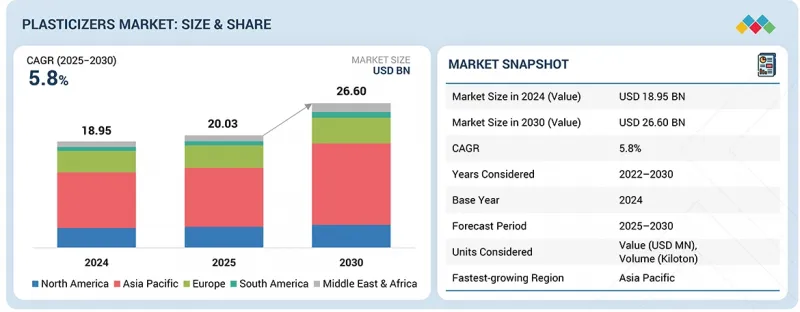
세계의 가소제 시장 규모는 2026년 211억 4,000만 달러에서 2031년까지 275억 1,000만 달러로 성장하고, 예측 기간 중 연평균 복합 성장률(CAGR)은 5.4%를 기록할 전망입니다.
| 조사 범위 | |
|---|---|
| 조사 대상 기간 | 2022-2031년 |
| 기준 연도 | 2025년 |
| 예측 기간 | 2026-2031년 |
| 산정 단위 | 금액(100만 달러) 및 킬로톤 |
| 부문 | 제품 등급별, 유래별, 용도별, 최종 이용 산업별, 지역별 |
| 대상 지역 | 북미, 아시아태평양, 유럽, 중동 및 아프리카, 남미 |
세계 가소제 시장의 성장은 주로 건설, 자동차, 전기 및 전자, 포장 및 헬스케어 분야에서 유연한 PVC에 대한 수요 증가에 힘입어 이루어지고 있습니다. 급속한 도시화와 인프라 개발로 인해, 특히 신흥국에서 PVC 파이프, 바닥재, 지붕용 시트, 벽재의 소비량이 증가하고 있습니다. 송전망, 재생에너지 프로젝트, 전기차 및 통신 인프라에 대한 투자 확대가 가소제를 함유한 전선 및 케이블 제품 수요를 더욱 끌어올리고 있습니다. 의료기기, 혈액백, 수액 튜브 및 연포장재의 성장 또한 시장 확대를 뒷받침하고 있습니다. 또한, 산업화의 진전, 소비재 생산 증가, 그리고 비프탈레이트계 및 바이오 가소제 분야의 기술 발전이 새로운 성장 기회를 창출하고 있습니다. 아시아태평양의 활발한 제조 활동과 지속가능성을 중시하는 제품 혁신의 지속이 세계 시장의 발전을 계속해서 가속화하고 있습니다.
“원료별로는 예측 기간 동안 석유화학 부문이 가장 큰 시장 점유율을 차지할 것으로 예측됩니다.”
석유화학제품은 무수 프탈산, 2-에틸헥사놀, 부탄올, 기타 옥소알코올을 비롯한 풍부한 원료에 기반을 둔, 확립되고 비용 효율이 뛰어난 고도로 통합된 공급망을 갖추고 있어, 가소제 시장 전체에서 가장 큰 공급원이 되고 있습니다. 지속적으로 성장하고 있는 전 세계 PVC 가공 업계에서 DINP, DOTP, DIDP 등 석유화학계 가소제의 사용은 이미 정착되어 있으며, 이로 인해 이러한 모든 제품에 대한 지속적인 수요가 창출되고 있습니다. 또한, 이러한 제품의 주요 제조업체들은 통합된 석유화학 사업, 규모의 경제, 그리고 확립된 유통 시스템의 혜택을 누리고 있어, 바이오 가소제에 대한 관심이 높아지고 있음에도 불구하고 석유화학계 가소제가 시장을 계속 독점하고 있습니다.
제품 등급별로는 예측 기간 동안 프탈산계 가소제 부문이 가장 큰 시장 점유율을 차지할 것으로 전망됩니다.
프탈산계 가소제는 오랜 기간에 걸친 상업적 활용 실적, 비용 경쟁력, 폭넓은 입수 가능성, 그리고 연질 PVC 용도에서의 뛰어난 성능 덕분에 가소제 시장 전체에서 가장 큰 비중을 차지하고 있습니다. DINP, DIDP, DEHP 등의 제품은 유연성, 내구성, 가공성 및 PVC와의 호환성 측면에서 효과적인 균형을 제공하며, 건축자재, 전선 및 케이블, 자동차 부품, 바닥재, 벽재, 공업 제품 등에서 널리 사용되고 있습니다. 대규모 생산 인프라, 성숙한 공급망, 업스트림 석유화학 원료와의 통합을 통해 제조업체는 상당한 규모의 경제를 실현하고 경쟁력 있는 가격을 유지할 수 있게 되었습니다. 또한, 프탈산계 가소제는 검증된 성능을 갖추고 있어, 규제상의 제한이 제한적인 많은 비민감 용도에서 여전히 우선적으로 선택되고 있습니다. 프탈산계 이외의 대체재 사용이 증가하고 있음에도 불구하고, 프탈산계 가소제는 뛰어난 가성비와 광범위한 기존 용도 기반 덕분에 전 세계 소비량을 여전히 주도하고 있습니다.
“아시아태평양은 예측 기간 동안 가장 큰 시장 점유율을 차지할 것으로 추정됩니다.
아시아태평양은 중국, 인도, 일본, 한국, 동남아시아 국가 등 주요 경제권의 급속한 산업화, 도시화, 인프라 개발에 힘입어 PVC의 생산, 가공, 소비 분야에서 지배적인 위치를 차지하고 있어, 가소제의 최대 시장이 되고 있습니다. 이 지역에서는 건설, 자동차, 전기 및 전자, 포장, 의료, 산업 제조 등 각 부문이 견조하고 빠르게 성장하고 있습니다. 주택 및 상업용 건축, 교통망, 송전 인프라, 재생에너지 프로젝트, 그리고 소비재 제조업에 대한 대규모 투자가 가소제 소비를 지속적으로 견인하고 있습니다. 또한, 통합형 석유화학 단지의 존재, 풍부한 생산 능력, 경쟁력 있는 생산 비용, 그리고 강력한 수출 지향형 산업이 수요를 더욱 뒷받침하고 있습니다. 인구 증가, 가처분 소득의 향상, 그리고 하류 PVC 가공 능력의 확대로 인해 아시아태평양은 앞으로도 세계 최대이자 가장 영향력 있는 가소제 시장으로 남을 것이 확실합니다.
가소제 시장은 BASF(독일), Eastman Chemical Company(미국), Evonik Industries AG(독일), Exxon Mobil Corporation(미국), UPC Technology Corporation(대만), AEKYUNG(한국), LG Chem(한국), NAN YA PLASTICS CORPORATION(대만), KLJ Group(인도), Bluesail Chemical Group(중국)과 같은 주요 기업들로 구성되어 있습니다. 본 조사에서는 가소제 시장의 주요 기업들에 대해 기업 프로파일, 최근 동향 및 주요 시장 전략을 포함한 상세한 경쟁 분석을 수행하고 있습니다.
조사 범위
본 보고서에서는 가소제 시장을 원산지, 제품 등급, 용도, 최종 이용 산업 및 지역별로 세분화하여, 각 지역의 전체 시장 규모에 대한 추정치를 제시하고 있습니다. 주요 업계 진출 기업에 대한 상세한 분석을 통해 가소제 시장과 관련된 사업 개요, 제품 및 서비스, 주요 전략, 그리고 사업 확장에 대한 인사이트를 제공합니다.
본 보고서를 구매할 때의 주요 이점
본 조사 보고서는 업계 분석(업계 동향), 주요 기업의 시장 순위 분석, 기업 프로파일 등 다양한 수준의 분석에 초점을 맞추고 있으며, 이를 종합하여 가소제 시장 경쟁 구도, 신흥 및 고성장 부문, 고성장 지역, 그리고 시장 성장 촉진요인 및 과제에 대한 전반적인 현황을 제공합니다.
본 보고서에서는 다음 사항에 대한 인사이트를 제공합니다.
- 성장 요인 분석 :(인프라 및 건설 분야에서의 유연성 PVC 소비 확대), 제약 요인(석유화학 원료 가격 변동 및 이익률 압박 위험), 기회(바이오 및 저탄소 가소제 기술의 상업적 확대), 과제(범용 부문의 생산 과잉 및 가격 압박) 등, 가소제 시장의 성장에 영향을 미치는 요인
- 시장 침투도 : 전 세계 가소제 시장에서 주요 기업들이 제공하는 가소제에 관한 종합적인 정보
- 제품 개발 및 혁신 : 가소제 시장의 향후 기술 동향, 신제품 출시, 사업 확장 및 인수에 관한 상세한 분석
- 시장 개발: 수익성이 높은 신흥 시장에 대한 종합적인 정보 - 본 보고서에서는 지역별 가소제 시장을 분석했습니다.
- 시장 생산 능력: 입수 가능한 범위 내에서 각 기업의 생산 능력을 제시함과 동시에, 가소제 시장의 향후 생산 능력 전망에 대해서도 기술하고 있습니다.
- 경쟁사 평가: 가소제 시장에서 주요 기업의 시장 점유율, 전략, 제품 및 생산 능력에 대한 상세한 평가
자주 묻는 질문
목차
제1장 서론
제2장 주요 요약
제3장 프리미엄 인사이트
제4장 시장 개요
제5장 업계 동향
제6장 기술 진보, AI의 영향, 특허, 혁신, 그리고 향후 응용
제7장 규제 상황과 지속가능성 이니셔티브
제8장 고객 현황과 구매 행동
제9장 가소제 시장(제품 등급별)
제10장 가소제 시장(유래별)
제11장 가소제 시장(용도별)
제12장 가소제 시장(최종 이용 산업별)
제13장 가소제 시장(지역별)
제14장 경쟁 구도
제15장 기업 개요
제16장 조사 방법
제17장 부록
LSH 26.07.03The global plasticizers market is projected to grow from USD 21.14 billion in 2026 to USD 27.51 billion by 2031, registering a CAGR of 5.4% during the forecast period.
| Scope of the Report | |
|---|---|
| Years Considered for the Study | 2022-2031 |
| Base Year | 2025 |
| Forecast Period | 2026-2031 |
| Units Considered | Value (USD Million) and Volume (Kiloton) |
| Segments | Type, Application, End-use Industry, and Region |
| Regions covered | North America, Asia Pacific, Europe, Middle East & Africa, and South America |
The growth of the global plasticizers market is primarily driven by rising demand for flexible PVC across construction, automotive, electrical & electronics, packaging, and healthcare applications. Rapid urbanization and infrastructure development are increasing the consumption of PVC pipes, flooring, roofing membranes, and wall coverings, particularly in emerging economies. Expanding investments in power transmission networks, renewable energy projects, electric vehicles, and telecommunications infrastructure are further boosting demand for plasticizer-containing wire and cable products. Growth in medical devices, blood bags, IV tubing, and flexible packaging is also supporting market expansion. Additionally, increasing industrialization, rising consumer goods production, and technological advancements in non-phthalate and bio-based plasticizers are creating new growth opportunities. Strong manufacturing activity in Asia Pacific and ongoing sustainability-driven product innovation continue to accelerate market development globally.
"By origin, the petrochemicals-based segment is anticipated to account for the largest market share during the forecast period."
Petrochemicals are the largest source for the overall plasticizers market due to their well-established, cost-effective and highly integrated supply chain, supported by an abundance of feedstocks, including phthalic anhydride, 2-ethylhexanol, butanol and other oxo-alcohols. In the growing global PVC processing industry, the use of petrochemical-based plasticizers such as DINP, DOTP and DIDP has been well established, creating a continuous demand for all of these products. Furthermore, the major manufacturers of these products benefit from integrated petrochemical operations, economies of scale and well-established distribution systems, allowing petrochemical-based plasticizers to dominate the market, despite the growing interest in bio-based plasticizers.
By product grade, the phthalate plasticizers segment is anticipated to account for the largest market share during the forecast period.
Phthalate plasticizers represent the largest segment in the overall plasticizers market due to their long-established commercial use, cost competitiveness, broad availability, and excellent performance in flexible PVC applications. Products such as DINP, DIDP, and DEHP offer an effective balance of flexibility, durability, processability, and compatibility with PVC, making them widely used in construction materials, wire and cables, automotive components, flooring, wall coverings, and industrial products. Their large-scale production infrastructure, mature supply chains, and integration with upstream petrochemical feedstocks enable manufacturers to achieve significant economies of scale and maintain competitive pricing. Additionally, phthalate plasticizers have a proven performance history and remain the preferred choice in many non-sensitive applications where regulatory restrictions are limited. Despite the growing adoption of non-phthalate alternatives, phthalates continue to dominate global consumption due to their cost-performance advantage and extensive installed application base.
"Asia Pacific is estimated to account for the largest market share during the forecast period.
Asia Pacific is the largest market for plasticizers due to its dominant position in PVC production, processing, and consumption, supported by rapid industrialization, urbanization, and infrastructure development across major economies such as China, India, Japan, South Korea, and Southeast Asian countries. The region has a strong and rapidly expanding construction, automotive, electrical & electronics, packaging, healthcare, and industrial manufacturing sectors. Large-scale investments in residential and commercial construction, transportation networks, power transmission infrastructure, renewable energy projects, and consumer goods manufacturing continue to drive plasticizer consumption. Additionally, the presence of integrated petrochemical complexes, abundant manufacturing capacity, competitive production costs, and strong export-oriented industries further strengthens demand. Rising population levels, increasing disposable incomes, and expanding downstream PVC processing capabilities ensure that Asia Pacific remains the largest and most influential market for plasticizers globally.
In-depth interviews were conducted with Chief Executive Officers (CEOs), marketing directors, other innovation and technology directors, and executives from various key organizations operating in the plasticizers market, and information was gathered from secondary research to determine and verify the market size of the segments.
- By Company Type: Tier 1 - 50%, Tier 2 - 30%, and Tier 3 - 20%
- By Designation: Managers - 15%, Directors - 20%, and Others - 65%
- By Region: North America - 25%, Europe - 25%, Asia Pacific - 35%, Middle East & Africa - 10%, South America- 5%
The plasticizers market comprises of major companies, such as BASF (Germany), Eastman Chemical Company (US), Evonik Industries AG (Germany), Exxon Mobil Corporation (US), UPC Technology Corporation (Taiwan), AEKYUNG (South Korea), LG Chem (South Korea), NAN YA PLASTICS CORPORATION (Taiwan), KLJ Group (India), and Bluesail Chemical Group (China). The study includes an in-depth competitive analysis of these key players in the plasticizers market, with their company profiles, recent developments, and key market strategies.
Research Coverage
This report segments the market for plasticizers market based on origin, product grade, application, end-use industry, and region and provides estimations for the overall value of the market across various regions. A detailed analysis of key industry players has been conducted to provide insights into their business overviews, products & services, key strategies, and expansions associated with the plasticizers market.
Key benefits of buying this report
This research report is focused on various levels of analysis-industry analysis (industry trends), market ranking analysis of top players, and company profiles, which together provide an overall view of the competitive landscape, emerging and high-growth segments of the plasticizers market, high-growth regions, and market drivers, restraints, opportunities, and challenges.
The report provides insights into the following points:
- Analysis of Drivers: (Expanding flexible PVC consumption across infrastructure and construction applications), restraints (Volatility in petrochemical feedstocks and margin compression risks), opportunities (Commercial expansion of bio-based and low-carbon plasticizer technologies), and challenges (Overcapacity and pricing pressure in commodity segments) influencing the growth of the plasticizers market
- Market Penetration: Comprehensive information on the plasticizers offered by top players in the global plasticizers market
- Product Development/Innovation: Detailed insights on upcoming technologies, product launches, expansions, and acquisitions in the plasticizers market
- Market Development: Comprehensive information about lucrative emerging markets - the report analyzes the markets for plasticizers across regions.
- Market Capacity: Production capacity of the companies is provided wherever available with upcoming capacities for the plasticizers market.
- Competitive Assessment: In-depth assessment of market shares, strategies, products, and manufacturing capabilities of leading players in the plasticizers market
TABLE OF CONTENTS
1 INTRODUCTION
- 1.1 STUDY OBJECTIVES
- 1.2 MARKET DEFINITION
- 1.3 STUDY SCOPE
- 1.3.1 MARKETS COVERED AND REGIONAL SCOPE
- 1.3.2 INCLUSIONS AND EXCLUSIONS
- 1.3.3 YEARS CONSIDERED
- 1.3.4 CURRENCY CONSIDERED
- 1.3.5 UNIT CONSIDERED
- 1.4 STAKEHOLDERS
- 1.5 SUMMARY OF CHANGES
2 EXECUTIVE SUMMARY
- 2.1 KEY INSIGHTS AND MARKET HIGHLIGHTS
- 2.2 KEY MARKET PARTICIPANTS: SHARE INSIGHTS AND STRATEGIC DEVELOPMENTS
- 2.3 DISRUPTIVE TRENDS SHAPING MARKET
- 2.4 HIGH-GROWTH SEGMENTS & EMERGING FRONTIERS
- 2.5 SNAPSHOT: MARKET SIZE, GROWTH RATE, AND FORECAST
3 PREMIUM INSIGHTS
- 3.1 ATTRACTIVE OPPORTUNITIES FOR PLAYERS IN PLASTICIZERS MARKET
- 3.2 PLASTICIZERS MARKET, BY ORIGIN AND REGION
- 3.3 PLASTICIZERS MARKET, BY PRODUCT GRADE
- 3.4 PLASTICIZERS MARKET, BY APPLICATION
- 3.5 PLASTICIZERS MARKET, BY END-USE INDUSTRY
- 3.6 PLASTICIZERS MARKET, BY COUNTRY
4 MARKET OVERVIEW
- 4.1 INTRODUCTION
- 4.2 MARKET DYNAMICS
- 4.2.1 DRIVERS
- 4.2.1.1 Expanding flexible PVC consumption across infrastructure and construction applications
- 4.2.1.2 Accelerating shift toward non-phthalate and sustainable plasticizer formulations
- 4.2.1.3 Rising automotive electrification and advanced cable manufacturing demand
- 4.2.1.4 Manufacturing expansion and downstream industrialization in emerging economies
- 4.2.2 RESTRAINTS
- 4.2.2.1 Intensifying regulatory restrictions on conventional phthalate plasticizers
- 4.2.2.2 Volatility in petrochemical feedstocks and margin compression risks
- 4.2.3 OPPORTUNITIES
- 4.2.3.1 Commercial expansion of bio-based and low-carbon plasticizer technologies
- 4.2.3.2 Rising demand for high-performance specialty plasticizers in medical and electrical applications
- 4.2.4 CHALLENGES
- 4.2.4.1 Overcapacity and pricing pressure in commodity segments
- 4.2.4.2 Technological and performance limitations of alternative plasticizers
- 4.2.1 DRIVERS
- 4.3 UNMET NEEDS AND WHITE SPACES
- 4.3.1 UNMET NEEDS IN PLASTICIZERS MARKET
- 4.3.2 WHITE SPACE OPPORTUNITIES
- 4.4 INTERCONNECTED MARKETS AND CROSS-SECTOR OPPORTUNITIES
- 4.4.1 INTERCONNECTED MARKETS
- 4.4.2 CROSS-SECTOR OPPORTUNITIES
- 4.5 STRATEGIC MOVES BY TIER-1/2/3 PLAYERS
- 4.5.1 KEY MOVES AND STRATEGIC FOCUS
5 INDUSTRY TRENDS
- 5.1 PORTER'S FIVE FORCES ANALYSIS
- 5.1.1 THREAT OF NEW ENTRANTS
- 5.1.2 THREAT OF SUBSTITUTES
- 5.1.3 BARGAINING POWER OF SUPPLIERS
- 5.1.4 BARGAINING POWER OF BUYERS
- 5.1.5 INTENSITY OF COMPETITIVE RIVALRY
- 5.2 MACROECONOMICS INDICATORS
- 5.2.1 INTRODUCTION
- 5.2.2 GDP TRENDS AND FORECAST
- 5.2.3 TRENDS IN GLOBAL SPECIALTY CHEMICALS INDUSTRY
- 5.3 SUPPLY CHAIN ANALYSIS
- 5.4 PRICING ANALYSIS
- 5.4.1 AVERAGE SELLING PRICE, BY REGION (2022-2025)
- 5.4.2 AVERAGE SELLING PRICE, BY PRODUCT GRADE (2022-2025)
- 5.4.3 AVERAGE SELLING PRICE, BY ORIGIN (2022-2025)
- 5.4.4 AVERAGE SELLING PRICE, BY APPLICATION (2022-2025)
- 5.4.5 AVERAGE SELLING PRICE, BY END-USE INDUSTRY (2022-2025)
- 5.4.6 AVERAGE SELLING PRICE OF KEY PLAYERS, BY PRODUCT GRADE, 2025
- 5.5 ECOSYSTEM ANALYSIS
- 5.6 TRADE ANALYSIS
- 5.6.1 IMPORT SCENARIO (HS CODE 381220)
- 5.6.2 EXPORT SCENARIO (HS CODE 381220)
- 5.7 KEY CONFERENCES & EVENTS, 2026-2027
- 5.8 TRENDS/DISRUPTIONS IMPACTING CUSTOMER BUSINESS
- 5.9 INVESTMENT AND FUNDING SCENARIO
- 5.10 CASE STUDY ANALYSIS
- 5.10.1 BASF & AUTOMOTIVE OEMS COLLABORATION FOR LOW-VOC INTERIOR MATERIALS
- 5.10.2 EASTMAN CHEMICAL COMPANY & MEDICAL DEVICE MANUFACTURERS PARTNERSHIP FOR NON-PHTHALATE MEDICAL APPLICATIONS
- 5.10.3 KLJ GROUP AND WIRE & CABLE MANUFACTURERS COLLABORATION FOR EV INFRASTRUCTURE APPLICATIONS
- 5.11 IMPACT OF 2025 US TARIFF ON PLASTICIZERS MARKET
- 5.11.1 INTRODUCTION
- 5.11.2 KEY TARIFF RATES
- 5.11.3 PRICE IMPACT ANALYSIS
- 5.11.4 IMPACT ON COUNTRIES/REGIONS
- 5.11.4.1 North America
- 5.11.4.2 Europe
- 5.11.4.3 Asia Pacific
- 5.11.5 IMPACT ON END-USE INDUSTRIES
6 TECHNOLOGICAL ADVANCEMENTS, AI-DRIVEN IMPACT, PATENTS, INNOVATIONS, AND FUTURE APPLICATIONS
- 6.1 KEY TECHNOLOGIES
- 6.1.1 PHTHALATE PLASTICIZER TECHNOLOGY
- 6.1.2 NON-PHTHALATE PLASTICIZER TECHNOLOGY
- 6.1.3 BIO-BASED PLASTICIZER TECHNOLOGY
- 6.1.4 HIGH-PERFORMANCE SPECIALTY ESTER TECHNOLOGY
- 6.2 COMPLEMENTARY TECHNOLOGIES
- 6.2.1 PVC COMPOUNDING TECHNOLOGY
- 6.2.2 POLYMER RECYCLING TECHNOLOGY
- 6.2.3 FLEXIBLE PACKAGING TECHNOLOGY
- 6.3 ADJACENT TECHNOLOGIES
- 6.3.1 THERMOPLASTIC ELASTOMER (TPE) TECHNOLOGY
- 6.3.2 POLYURETHANE FLEXIBLE MATERIALS TECHNOLOGY
- 6.4 TECHNOLOGY/PRODUCT ROADMAP
- 6.4.1 TRANSITION FROM COMMODITY PHTHALATES TO SPECIALTY NON-PHTHALATE PLASTICIZERS
- 6.4.2 EXPANSION OF BIO-BASED AND RENEWABLE FEEDSTOCK TECHNOLOGIES
- 6.4.3 DEVELOPMENT OF HIGH-PERFORMANCE PLASTICIZERS FOR ELECTRIFICATION APPLICATIONS
- 6.4.4 INTEGRATION OF CIRCULAR ECONOMY AND RECYCLABILITY TECHNOLOGIES
- 6.4.5 DIGITAL MANUFACTURING AND AI-DRIVEN FORMULATION OPTIMIZATION
- 6.5 PATENT ANALYSIS
- 6.5.1 METHODOLOGY
- 6.5.2 GRANTED PATENTS, 2016-2025
- 6.5.2.1 Publication trends for last ten years
- 6.5.3 INSIGHTS
- 6.5.4 LEGAL STATUS
- 6.5.5 JURISDICTION ANALYSIS
- 6.5.6 TOP APPLICANTS
- 6.5.7 LIST OF MAJOR PATENTS
- 6.6 FUTURE APPLICATIONS
- 6.6.1 PLASTICIZERS FOR ELECTRIC VEHICLE BATTERY & CHARGING CABLE SYSTEMS
- 6.6.2 PLASTICIZERS FOR MEDICAL WEARABLES & FLEXIBLE HEALTHCARE DEVICES
- 6.6.3 PLASTICIZERS FOR RECYCLABLE FLEXIBLE PACKAGING SYSTEMS
- 6.6.4 PLASTICIZERS FOR SMART CONSTRUCTION & ENERGY-EFFICIENT BUILDINGS
- 6.7 IMPACT OF AI/GEN AI ON PLASTICIZERS MARKET
- 6.7.1 TOP USE CASES AND MARKET POTENTIAL
- 6.7.2 BEST PRACTICES IN PLASTICIZERS PROCESSING
- 6.7.3 CASE STUDIES OF AI IMPLEMENTATION IN PLASTICIZERS MARKET
- 6.7.4 INTERCONNECTED ADJACENT ECOSYSTEM AND IMPACT ON MARKET PLAYERS
- 6.7.5 CLIENTS' READINESS TO ADOPT GENERATIVE AI IN PLASTICIZERS MARKET
- 6.8 SUCCESS STORIES AND REAL-WORLD APPLICATIONS
- 6.8.1 BASF: SUSTAINABLE NON-PHTHALATE PLASTICIZER SOLUTIONS FOR FLEXIBLE PVC APPLICATIONS
- 6.8.2 EASTMAN CHEMICAL COMPANY: SPECIALTY PLASTICIZER INNOVATION FOR AUTOMOTIVE AND MEDICAL APPLICATIONS
- 6.8.3 EVONIK INDUSTRIES AG: BIO-BASED AND HIGH-PERFORMANCE PLASTICIZER DEVELOPMENT FOR INDUSTRIAL APPLICATIONS
7 REGULATORY LANDSCAPE AND SUSTAINABILITY INITIATIVES
- 7.1 REGIONAL REGULATIONS AND COMPLIANCE
- 7.1.1 REGULATORY BODIES, GOVERNMENT AGENCIES, AND OTHER ORGANIZATIONS
- 7.1.2 INDUSTRY STANDARDS
- 7.2 SUSTAINABILITY INITIATIVES
- 7.2.1 TRANSITION TOWARD NON-PHTHALATE PLASTICIZERS
- 7.2.2 DEVELOPMENT OF BIO-BASED PLASTICIZER TECHNOLOGIES
- 7.2.3 INTEGRATION OF CIRCULAR ECONOMY AND RECYCLABILITY PROGRAMS
- 7.2.4 ADOPTION OF LOW-CARBON MANUFACTURING TECHNOLOGIES
- 7.3 SUSTAINABILITY IMPACT AND REGULATORY POLICY INITIATIVES
- 7.4 CERTIFICATIONS, LABELING, & ECO-STANDARDS
8 CUSTOMER LANDSCAPE & BUYER BEHAVIOR
- 8.1 DECISION-MAKING PROCESS
- 8.2 KEY STAKEHOLDERS AND BUYING CRITERIA
- 8.2.1 KEY STAKEHOLDERS IN BUYING PROCESS
- 8.2.2 BUYING CRITERIA
- 8.3 ADOPTION BARRIERS & INTERNAL CHALLENGES
- 8.4 UNMET NEEDS FROM VARIOUS END-USE INDUSTRIES
- 8.5 MARKET PROFITABILITY
- 8.5.1 PROFITABILITY DRIVEN BY SPECIALTY NON-PHTHALATE PLASTICIZERS
- 8.5.2 BACKWARD INTEGRATION IMPROVES MARGIN STABILITY
- 8.5.3 HIGH-MARGIN GROWTH FROM ELECTRIFICATION AND EV INFRASTRUCTURE
- 8.5.4 PROFITABILITY PRESSURE FROM COMMODITY MARKET COMPETITION
9 PLASTICIZERS MARKET, BY PRODUCT GRADE
- 9.1 KEY INTRODUCTION
- 9.2 PHTHALATE PLASTICIZERS
- 9.2.1 GROWING DEMAND FOR FLEXIBLE PVC MATERIALS IN CONSTRUCTION, ELECTRICAL, AND AUTOMOTIVE APPLICATIONS
- 9.3 NON-PHTHALATE PLASTICIZERS
- 9.3.1 INCREASING REGULATORY FOCUS AND DEMAND FOR SUSTAINABLE FLEXIBLE PVC SOLUTIONS
10 PLASTICIZERS MARKET, BY ORIGIN
- 10.1 KEY INTRODUCTION
- 10.2 PETROCHEMICAL-BASED PLASTICIZERS
- 10.2.1 ESTABLISHED PETROCHEMICAL FEEDSTOCK NETWORKS SUPPORTING MARKET LEADERSHIP
- 10.3 BIO-BASED PLASTICIZERS
- 10.3.1 GROWING FOCUS ON SUSTAINABLE MATERIALS SUPPORTING BIO-BASED PLASTICIZER ADOPTION
11 PLASTICIZERS MARKET, BY APPLICATION
- 11.1 KEY INTRODUCTION
- 11.2 FLOORING & WALL COVERINGS
- 11.2.1 GROWING CONSTRUCTION AND INTERIOR RENOVATION ACTIVITIES TO DRIVE DEMAND
- 11.3 WIRES & CABLES
- 11.3.1 EXPANDING ELECTRIFICATION AND POWER NETWORK DEVELOPMENT
- 11.4 FILMS & SHEETS
- 11.4.1 INCREASING DEMAND FOR FLEXIBLE PACKAGING AND PROTECTIVE MATERIALS
- 11.5 COATED FABRICS
- 11.5.1 GROWING DEMAND FOR DURABLE AND FLEXIBLE MATERIALS TO DRIVE CONSUMPTION
- 11.6 PIPES & TUBINGS
- 11.6.1 EXPANDING INFRASTRUCTURE AND FLUID TRANSPORT SYSTEMS TO DRIVE DEMAND
- 11.7 OTHER APPLICATIONS
12 PLASTICIZERS MARKET, BY END-USE INDUSTRY
- 12.1 KEY INTRODUCTION
- 12.2 BUILDING & CONSTRUCTION
- 12.2.1 GROWING CONSTRUCTION ACTIVITIES DRIVING DEMAND FOR FLEXIBLE PVC MATERIALS
- 12.3 AUTOMOTIVE
- 12.3.1 INCREASING VEHICLE PRODUCTION AND ELECTRIFICATION DRIVING PLASTICIZER DEMAND
- 12.4 ELECTRICAL & ELECTRONICS
- 12.4.1 EXPANDING ELECTRIFICATION AND POWER INFRASTRUCTURE
- 12.5 PACKAGING
- 12.5.1 RISING DEMAND FOR FLEXIBLE PACKAGING MATERIALS TO DRIVE PLASTICIZER USAGE
- 12.6 HEALTHCARE & MEDICAL
- 12.6.1 GROWING MEDICAL DEVICE AND HEALTHCARE DEMAND
- 12.7 OTHER END-USE INDUSTRIES
13 PLASTICIZERS MARKET, BY REGION
- 13.1 INTRODUCTION
- 13.2 ASIA PACIFIC
- 13.2.1 CHINA
- 13.2.1.1 Massive electrification and infrastructure modernization
- 13.2.2 JAPAN
- 13.2.2.1 Advanced healthcare and high-performance manufacturing drive specialty plasticizer adoption
- 13.2.3 INDIA
- 13.2.3.1 National infrastructure expansion and urbanization create new wave of plasticizer demand
- 13.2.4 SOUTH KOREA
- 13.2.4.1 Electronics leadership and EV manufacturing strengthen high-value plasticizer demand
- 13.2.5 TAIWAN
- 13.2.5.1 Export-oriented electronics manufacturing expands demand for high-purity plasticizer formulations
- 13.2.6 REST OF ASIA PACIFIC
- 13.2.1 CHINA
- 13.3 NORTH AMERICA
- 13.3.1 US
- 13.3.1.1 Infrastructure modernization and electrification investments expand high-value plasticizer demand
- 13.3.2 CANADA
- 13.3.2.1 Sustainable infrastructure development and industrial upgrading strengthen specialty plasticizer consumption
- 13.3.3 MEXICO
- 13.3.3.1 Nearshoring and automotive supply chain expansion transform Mexico into North America's fastest-growing plasticizer market
- 13.3.1 US
- 13.4 EUROPE
- 13.4.1 GERMANY
- 13.4.1.1 Industrial decarbonization and automotive electrification accelerate demand for advanced plasticizer technologies
- 13.4.2 ITALY
- 13.4.2.1 Flexible PVC processing excellence strengthens specialty plasticizer consumption across industrial value chains
- 13.4.3 FRANCE
- 13.4.3.1 Healthcare innovation and sustainable materials adoption drive premium plasticizer demand growth
- 13.4.4 UK
- 13.4.4.1 Healthcare manufacturing expansion and sustainability commitments to drive specialty plasticizer adoption
- 13.4.5 SPAIN
- 13.4.5.1 Infrastructure renewal and renewable energy expansion reinforce plasticizer demand across key industries
- 13.4.6 REST OF EUROPE
- 13.4.1 GERMANY
- 13.5 MIDDLE EAST & AFRICA
- 13.5.1 GCC COUNTRIES
- 13.5.1.1 Saudi Arabia
- 13.5.1.1.1 Vision 2030 industrial diversification and megaproject development drive plasticizer demand
- 13.5.1.2 UAE
- 13.5.1.2.1 Advanced manufacturing zones and export-oriented processing strengthen plasticizer consumption
- 13.5.1.3 Rest of GCC countries
- 13.5.1.1 Saudi Arabia
- 13.5.2 SOUTH AFRICA
- 13.5.2.1 Industrial manufacturing expansion and infrastructure renewal sustain plasticizer demand growth
- 13.5.3 REST OF MIDDLE EAST & AFRICA
- 13.5.1 GCC COUNTRIES
- 13.6 SOUTH AMERICA
- 13.6.1 ARGENTINA
- 13.6.1.1 Manufacturing recovery and agricultural supply chain investments reinforce plasticizer demand
- 13.6.2 BRAZIL
- 13.6.2.1 Construction modernization and industrial diversification expand plasticizer consumption
- 13.6.3 REST OF SOUTH AMERICA
- 13.6.1 ARGENTINA
14 COMPETITIVE LANDSCAPE
- 14.1 INTRODUCTION
- 14.2 KEY PLAYER STRATEGIES/RIGHT TO WIN
- 14.3 MARKET SHARE ANALYSIS, 2025
- 14.3.1 UPC TECHNOLOGY CORPORATION
- 14.3.2 BASF
- 14.3.3 BLUESAIL CHEMICAL GROUP
- 14.3.4 AEKYUNG
- 14.3.5 EXXON MOBIL CORPORATION
- 14.4 REVENUE ANALYSIS
- 14.5 COMPANY EVALUATION MATRIX: KEY PLAYERS, 2025
- 14.5.1 STARS
- 14.5.2 EMERGING LEADERS
- 14.5.3 PERVASIVE PLAYERS
- 14.5.4 PARTICIPANTS
- 14.5.5 COMPANY FOOTPRINT: KEY PLAYERS, 2025
- 14.5.5.1 Company footprint
- 14.5.5.2 Region footprint
- 14.5.5.3 Product grade footprint
- 14.5.5.4 End-use industry footprint
- 14.5.5.5 Application footprint
- 14.6 COMPANY EVALUATION MATRIX: STARTUPS/SMES, 2025
- 14.6.1 PROGRESSIVE COMPANIES
- 14.6.2 RESPONSIVE COMPANIES
- 14.6.3 DYNAMIC COMPANIES
- 14.6.4 STARTING BLOCKS
- 14.6.5 COMPETITIVE BENCHMARKING
- 14.6.5.1 Detailed list of key startups/SMEs
- 14.6.5.2 Competitive benchmarking of key startups/SMEs
- 14.7 BRAND COMPARISON
- 14.8 COMPANY VALUATION AND FINANCIAL METRICS
- 14.9 COMPETITIVE SCENARIO
- 14.9.1 PRODUCT LAUNCH
- 14.9.2 DEALS
- 14.9.3 EXPANSIONS
15 COMPANY PROFILES
- 15.1 KEY PLAYERS
- 15.1.1 BASF
- 15.1.1.1 Business overview
- 15.1.1.2 Products/Solutions/Services offered
- 15.1.1.3 Recent developments
- 15.1.1.3.1 Product launches
- 15.1.1.3.2 Deals
- 15.1.1.3.3 Expansions
- 15.1.1.4 MnM view
- 15.1.1.4.1 Right to win
- 15.1.1.4.2 Strategic choices
- 15.1.1.4.3 Weaknesses and competitive threats
- 15.1.2 EASTMAN CHEMICAL COMPANY
- 15.1.2.1 Business overview
- 15.1.2.2 Products/Solutions/Services offered
- 15.1.2.3 Recent developments
- 15.1.2.3.1 Product launches
- 15.1.2.4 MnM view
- 15.1.2.4.1 Right to win
- 15.1.2.4.2 Strategic choices
- 15.1.2.4.3 Weaknesses and competitive threats
- 15.1.3 EVONIK INDUSTRIES AG
- 15.1.3.1 Business overview
- 15.1.3.2 Products/Solutions/Services offered
- 15.1.3.3 Recent developments
- 15.1.3.3.1 Product launches
- 15.1.3.3.2 Expansions
- 15.1.3.4 MnM view
- 15.1.3.4.1 Right to win
- 15.1.3.4.2 Strategic choices
- 15.1.3.4.3 Weaknesses and competitive threats
- 15.1.4 EXXON MOBIL CORPORATION
- 15.1.4.1 Business overview
- 15.1.4.2 Products/Solutions/Services offered
- 15.1.4.3 MnM view
- 15.1.4.3.1 Right to win
- 15.1.4.3.2 Strategic choices
- 15.1.4.3.3 Weaknesses and competitive threats
- 15.1.5 UPC TECHNOLOGY CORPORATION
- 15.1.5.1 Business overview
- 15.1.5.2 Products/Solutions/Services offered
- 15.1.5.3 Recent developments
- 15.1.5.3.1 Deals
- 15.1.5.4 MnM view
- 15.1.5.4.1 Right to win
- 15.1.5.4.2 Strategic choices
- 15.1.5.4.3 Weaknesses and competitive threats
- 15.1.6 AEKYUNG
- 15.1.6.1 Business overview
- 15.1.6.2 Products/Solutions/Services offered
- 15.1.6.3 Recent developments
- 15.1.6.3.1 Deals
- 15.1.6.4 MnM view
- 15.1.6.4.1 Right to win
- 15.1.6.4.2 Strategic choices
- 15.1.6.4.3 Weaknesses and competitive threats
- 15.1.7 LG CHEM
- 15.1.7.1 Business overview
- 15.1.7.2 Products/Solutions/Services offered
- 15.1.7.3 MnM view
- 15.1.7.3.1 Right to win
- 15.1.7.3.2 Strategic choices
- 15.1.7.3.3 Weaknesses and competitive threats
- 15.1.8 NAN YA PLASTICS CORPORATION
- 15.1.8.1 Business overview
- 15.1.8.2 Products/Solutions/Services offered
- 15.1.8.3 Recent developments
- 15.1.8.3.1 Product launches
- 15.1.8.4 MnM view
- 15.1.8.4.1 Right to win
- 15.1.8.4.2 Strategic choices
- 15.1.8.4.3 Weaknesses and competitive threats
- 15.1.9 KLJ GROUP
- 15.1.9.1 Business overview
- 15.1.9.2 Products/Solutions/Services offered
- 15.1.9.3 Recent developments
- 15.1.9.3.1 Expansions
- 15.1.9.4 MnM view
- 15.1.9.4.1 Right to win
- 15.1.9.4.2 Strategic choices
- 15.1.9.4.3 Weaknesses and competitive threats
- 15.1.10 BLUESAIL CHEMICAL GROUP
- 15.1.10.1 Business overview
- 15.1.10.2 Products/Solutions/Services offered
- 15.1.10.3 MnM view
- 15.1.10.3.1 Right to win
- 15.1.10.3.2 Strategic choices
- 15.1.10.3.3 Weaknesses and competitive threats
- 15.1.1 BASF
- 15.2 OTHER PLAYERS
- 15.2.1 DEZA, A.S.
- 15.2.2 LANXESS
- 15.2.3 PERSTORP
- 15.2.4 POLYNT S.P.A
- 15.2.5 PROVIRON HOLDINGS NV
- 15.2.6 VALTRIS SPECIALTY CHEMICALS
- 15.2.7 HANWHA SOLUTIONS CORPORATION
- 15.2.8 DIC CORPORATION
- 15.2.9 KAO CORPORATION
- 15.2.10 MITSUBISHI CHEMICAL GROUP CORPORATION
- 15.2.11 ADEKA CORPORATION
- 15.2.12 CARGILL INCORPORATED
- 15.2.13 GALATA CHEMICALS
- 15.2.14 JIANGSU ZHENGDAN CHEMICAL INDUSTRY CO., LTD.
- 15.2.15 SABIC
16 RESEARCH METHODOLOGY
- 16.1 RESEARCH DATA
- 16.1.1 SECONDARY DATA
- 16.1.1.1 Key data from secondary sources
- 16.1.2 PRIMARY DATA
- 16.1.2.1 Key data from primary sources
- 16.1.2.2 Key primary interview participants
- 16.1.2.3 Breakdown of primary interviews
- 16.1.2.4 Key industry insights
- 16.1.1 SECONDARY DATA
- 16.2 MARKET SIZE ESTIMATION
- 16.2.1 BOTTOM-UP APPROACH
- 16.2.2 TOP-DOWN APPROACH
- 16.3 BASE NUMBER CALCULATION
- 16.3.1 APPROACH 1: SUPPLY-SIDE ANALYSIS
- 16.3.2 APPROACH 2: DEMAND-SIDE ANALYSIS
- 16.4 MARKET FORECAST APPROACH
- 16.4.1 SUPPLY SIDE
- 16.4.2 DEMAND SIDE
- 16.5 DATA TRIANGULATION
- 16.6 FACTOR ANALYSIS
- 16.7 RESEARCH ASSUMPTIONS
- 16.8 RESEARCH LIMITATIONS AND RISK ASSESSMENT
17 APPENDIX
- 17.1 DISCUSSION GUIDE
- 17.2 KNOWLEDGESTORE: MARKETSANDMARKETS' SUBSCRIPTION PORTAL
- 17.3 CUSTOMIZATION OPTIONS
- 17.4 RELATED REPORTS
- 17.5 AUTHOR DETAILS