

|
시장보고서
상품코드
2072266
크레인 임대 시장 : 유형별, 리프팅 능력별, 최종 이용 산업별, 지역별 - 예측(-2031년)Crane Rental Market by Type (Fixed Cranes, Mobile Cranes), Weightlifting Capacity (Low, Low to Medium, Heavy, Extreme Heavy), End-use Industry (Building & Construction, Infrastructure, Other End-use Industries), and Region - Global Forecast To 2031 |
||||||

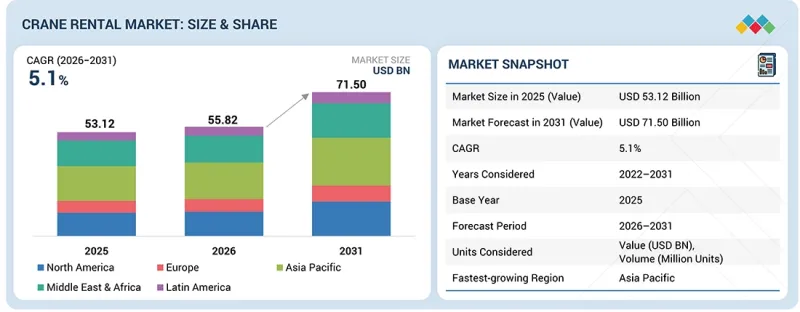
크레인 임대 시장 규모는 2026년 558억 2,000만 달러에서 2031년까지 715억 달러로 확대되어 예측 기간 중 연평균 복합 성장률(CAGR) 5.1%를 기록할 전망입니다.
| 조사 범위 | |
|---|---|
| 조사 대상 기간 | 2022-2031년 |
| 기준 연도 | 2025년 |
| 예측 기간 | 2026-2031년 |
| 산정 대상대 | 금액(100만 달러) 수량( 100만 대) |
| 부문 | 유형별, 리프팅 능력별, 최종 이용 산업별, 지역별 |
| 대상 지역 | 북미, 아시아태평양, 유럽, 중동 및 아프리카, 남미 |
세계 건설 및 인프라 개발이 확대됨에 따라 크레인 임대 시장도 성장할 것으로 전망됩니다. 초기 비용과 유지 관리 비용이 많이 들기 때문에 크레인을 구매하는 것보다 대여하는 것을 선호합니다. 또한, 재생에너지, 석유 및 가스 및 산업 프로젝트 분야 수요 증가에 따라 크레인 대여 이용도 늘어나고 있습니다.
“2026년부터 2031년에 걸쳐 이동식 크레인 부문이 가장 높은 연평균 성장률(CAGR)을 보일 것으로 예측됩니다.”
이동식 크레인 부문은 뛰어난 유연성과 현장 내 고속 이동 능력 덕분에, 예측 기간 동안 크레인 임대 시장에서 가장 높은 연평균 성장률(CAGR)을 보일 것으로 전망됩니다. 건설 및 산업용 유지보수 등 폭넓은 용도로 사용할 수 있습니다. 설치가 간편하고 활용도가 높아 렌탈 업체나 도급업체에서 선호하고 있습니다.
“저하중 부문은 예측 기간 동안 가장 높은 연평균 성장률(CAGR)을 보일 것으로 전망됩니다.”
저적재량 부문은 예측 기간 동안 크레인 임대 시장에서 가장 높은 연평균 성장률(CAGR)을 보일 것으로 예측됩니다. 이 크레인들은 운반, 사용, 유지보수가 간편합니다. 따라서 단기적으로 이용할 경우 비용 대비 효과가 뛰어납니다. 또한 크기가 작기 때문에 공간이 제한된 도심 지역의 건설 현장에서도 사용할 수 있습니다.
“2031년에는 건축 및 건설 부문이 가장 큰 시장 점유율을 차지할 것으로 예측됩니다.”
건축 및 건설 부문은 크레인 임대 시장에서 가장 큰 최종 사용자입니다. 주택, 상업시설, 공공 인프라의 건설이 급속히 확대되면서 크레인 수요가 증가하고 있습니다. 렌탈 서비스는 건설 회사에 있어 비용 관리에 도움이 되며, 막대한 투자를 하지 않고도 최신 장비를 이용할 수 있는 기회를 제공합니다.
“아시아태평양의 크레인 임대 시장은 예측 기간 동안 가장 높은 연평균 성장률(CAGR)을 보일 것으로 전망됩니다.”
아시아태평양에서는 도시화와 산업화의 진전, 그리고 대규모 인프라 투자에 힘입어 크레인 임대 시장이 눈부신 성장을 이루고 있습니다. 중국, 인도, 인도네시아 등의 국가들은 건설 및 교통 인프라 사업에 막대한 투자를 하고 있습니다. 또한, 정부의 스마트시티 및 재생에너지 관련 정책도 크레인 임대 수요를 끌어올리고 있습니다.
대상 기업: 본 보고서에서는 Liebherr(독일), United Rentals Inc(미국), PALFINGER AG(오스트리아), Sarens NV(벨기에), Mammoet(네덜란드), Manitowoc Company, Inc.(미국) 등을 비롯한 기업들을 대상으로 하고 있습니다.
본 조사에서는 크레인 임대 시장의 주요 기업들에 대해 기업 프로파일, 최근 동향 및 주요 시장 전략을 포함한 상세한 경쟁 분석을 수행하고 있습니다.
조사 범위
본 조사 보고서에서는 크레인 임대 시장을 유형(이동식 크레인 및 고정식 크레인), 적재 능력(경량, 경량-중량, 중량, 초중량), 최종 이용 산업(건축 및 건설, 인프라, 석유 및 가스, 에너지 및 전력, 해양·오프쇼어, 광업·시추, 운송, 기타 최종 이용 산업), 지역(아시아태평양, 북미, 유럽, 남미, 중동 및 아프리카)에 따라 분류하고 있습니다. 본 보고서의 범위에는 크레인 임대 시장의 성장에 영향을 미치는 촉진요인, 제약 요인, 과제 및 기회에 대한 상세한 정보가 포함되어 있습니다. 주요 업계 진출 기업에 대한 상세한 분석을 통해 사업 개요, 제공 제품, 그리고 크레인 임대 시장과 관련된 제휴, 제품 출시, 사업 확장, 인수합병 등 주요 전략에 대한 인사이트를 제공합니다. 또한, 본 보고서에서는 크레인 임대 시장 생태계에서 두각을 나타내고 있는 스타트업 기업들에 대한 경쟁 분석도 다루고 있습니다.
이 보고서를 구매해야 하는 이유
본 보고서는 시장 선도 기업 및 신규 진출기업을 대상으로, 크레인 임대 시장 전체 및 각 하위 부문의 매출액에 관한 가장 정확한 추정치를 제공합니다. 본 보고서는 이해관계자들이 경쟁 구도를 이해하고, 자사의 비즈니스를 보다 적절하게 포지셔닝하기 위한 인사이트를 높이며, 적절한 시장 진출 전략을 수립하는 데 도움이 됩니다. 또한, 본 보고서는 이해관계자들이 시장을 이해하는 데 도움이 되며, 주요 시장 성장 촉진요인, 시장 성장 억제요인, 과제 및 기회에 대한 정보를 제공합니다.
본 보고서에서는 다음 사항에 대한 인사이트를 제공합니다.
주요 촉진요인(건설 및 인프라 프로젝트의 급증), 제약 요인(임대 사업자의 유지관리비 및 운영비 급등), 기회(신흥 시장의 인프라 급속한 성장), 과제(시장 경쟁 심화 및 가격 압박)에 대한 분석
- 제품 개발/혁신 : 크레인 임대 시장의 향후 기술 동향, 연구 개발 활동 및 신규 제품 및 서비스 출시와 관련된 상세한 인사이트
- 시장 개발: 수익성이 높은 시장에 대한 종합적인 정보 -- 본 보고서에서는 다양한 지역의 크레인 임대 시장을 분석했습니다.
시장의 다양화: 크레인 임대 시장의 신제품 및 서비스, 미개척 지역, 최근 동향 및 투자에 관한 종합적인 정보
- 경쟁사 분석 : Liebherr(독일), United Rentals Inc.(미국), PALFINGER AG(오스트리아), Sarens NV(벨기에), Mammoet(네덜란드), The Manitowoc Company, Inc.(미국) 등 주요 기업의 시장 점유율, 성장 전략 및 서비스 제공 내용에 대한 상세한 평가
자주 묻는 질문
목차
제1장 서론
제2장 주요 요약
제3장 프리미엄 인사이트
제4장 시장 개요
제5장 업계 동향
제6장 기술 진보, AI의 영향, 특허, 혁신, 그리고 향후 응용
제7장 규제 상황과 지속가능성 이니셔티브
제8장 고객 현황과 구매 행동
제9장 크레인 임대 시장(유형별)
제10장 크레인 임대 시장(리프팅 능력별)
제11장 크레인 임대 시장(용도별)
제12장 크레인 임대 시장(지역별)
제13장 경쟁 구도
제14장 기업 개요
제15장 조사 방법
제16장 부록
LSH 26.07.03The crane rental market is projected to grow from USD 55.82 billion in 2026 to USD 71.50 billion by 2031, at a CAGR of 5.1% during the forecast period.
| Scope of the Report | |
|---|---|
| Years Considered for the Study | 2022-2031 |
| Base Year | 2025 |
| Forecast Period | 2026-2031 |
| Units Considered | Value (USD Million) Volume (Million Units) |
| Segments | Type, Weightlifting Capacity, End-use Industry, and Region |
| Regions covered | North America, Asia Pacific, Europe, the Middle East & Africa, and South America |
The crane rental sector will expand owing to the increased construction and infrastructural development globally. The cost of renting cranes is preferred over purchasing them due to high initial expenses and maintenance costs. Also, crane rentals are increasing due to the increasing demand in renewable energy, oil & gas, and industrial projects.
"The mobile cranes segment is projected to exhibit the highest CAGR from 2026 to 2031."
The mobile cranes segment is expected to record the highest CAGR in the crane rental market during the forecast period, owing to their high flexibility and ability to move around the job sites at high speed. They can be used in a large variety of applications, including construction and industrial maintenance. They are easy to set up, versatile, and hence preferred by rental companies and contractors.
"The low segment is projected to exhibit the highest CAGR during the forecast period."
The low weightlifting capacity segment is expected to record the highest CAGR in the crane rental market during the forecast period. These cranes are simple to carry, use, and maintain. Hence, they are affordable when used on a short-term basis. They are also small in size and can be used in urban construction sites where space is limited.
"The building & construction segment is projected to capture the largest market share in 2031."
The building & construction segment is the largest end user in the crane rental market. The rapid expansion of residential, commercial, and public infrastructure construction is boosting the demand for cranes. The services of renting assist construction companies in cost management and the possibility of using modern equipment without significant investments.
"Asia Pacific crane rental market is projected to grow at the highest CAGR during the forecast period."
Asia Pacific is experiencing high growth in the crane rental market due to the high rate of urbanization, industrialization, and extensive infrastructure spending. Countries such as China, India, and Indonesia are immensely investing in construction and transportation works. Smart city and renewable energy programs by the government are also increasing the demand for crane rental.
Breakdown of Primary Interviews:
By Company Type: Tier 1 - 25%, Tier 2 - 42%, and Tier 3 - 33%
By Designation: C-level Executives - 20%, Directors - 30%, and Others - 50%
By Region: North America - 20%, Europe - 10%, Asia Pacific - 40%, South America - 10%, and Middle East & Africa - 20%
Notes: Other designations include sales, marketing, and product managers.
Tier 1: >USD 1 Billion; Tier 2: USD 500 million-1 Billion; and Tier 3: <USD 500 million
Companies Covered: Liebherr (Germany), United Rentals Inc. (US), PALFINGER AG (Austria), Sarens NV (Belgium), Mammoet (Netherlands), and The Manitowoc Company, Inc. (US), among other companies, are covered in the report.
The study includes an in-depth competitive analysis of these key players in the crane rental market, with their company profiles, recent developments, and key market strategies.
Research Coverage
This research report categorizes the crane rental market based on type (mobile cranes and fixed cranes), weightlifting capacity (low, low to medium, heavy, and extreme heavy), end-use industry (building & construction, infrastructure, oil & gas, energy & power, marine & offshore, mining & excavation, transportation, and other end-use industries), and region (Asia Pacific, North America, Europe, South America, and the Middle East & Africa). The report's scope covers detailed information regarding the drivers, restraints, challenges, and opportunities influencing the growth of the crane rental market. A detailed analysis of the key industry players has been done to provide insights into their business overview, products offered, and key strategies, such as partnerships, product launches, expansions, and acquisitions, associated with the crane rental market. This report covers a competitive analysis of upcoming startups in the crane rental market ecosystem.
Reasons to Buy the Report
The report will offer the market leaders/new entrants with information on the closest approximations of the revenue numbers for the overall crane rental market and the subsegments. This report will help stakeholders understand the competitive landscape, gain more insights into positioning their businesses better, and plan suitable go-to-market strategies. The report will help stakeholders understand the market and provide them with information on key market drivers, restraints, challenges, and opportunities.
The report provides insights into the following points:
Analysis of key drivers (surge in construction and infrastructure projects), restraints (elevated maintenance and operational expenses for rental providers), opportunities (rapid infrastructure growth across emerging markets), and challenges (heightened market competition and pricing pressures)
- Product Development/Innovation: Detailed insights into upcoming technologies, research & development activities, and product & service launches in the crane rental market
- Market Development: Comprehensive information about profitable markets-the report analyzes the crane rental market across varied regions
Market Diversification: Exhaustive information about new products & services, untapped geographies, recent developments, and investments in the crane rental market
- Competitive Assessment: In-depth assessment of market shares, growth strategies, and service offerings of leading players, such as Liebherr (Germany), United Rentals Inc. (US), PALFINGER AG (Austria), Sarens NV (Belgium), Mammoet (Netherlands), and The Manitowoc Company, Inc. (US)
TABLE OF CONTENTS
1 INTRODUCTION
- 1.1 STUDY OBJECTIVES
- 1.2 MARKET DEFINITION
- 1.3 STUDY SCOPE
- 1.3.1 MARKET SEGMENTATION
- 1.3.2 INCLUSIONS & EXCLUSIONS
- 1.3.3 YEARS CONSIDERED
- 1.3.4 CURRENCY CONSIDERED
- 1.3.5 UNIT CONSIDERED
- 1.3.6 STAKEHOLDERS
- 1.4 SUMMARY OF STRATEGIC CHANGES
2 EXECUTIVE SUMMARY
- 2.1 KEY INSIGHTS AND MARKET HIGHLIGHTS
- 2.2 KEY MARKET PARTICIPANTS: SHARE INSIGHTS AND STRATEGIC DEVELOPMENTS
- 2.3 DISRUPTIVE TRENDS SHAPING MARKET
- 2.4 HIGH-GROWTH SEGMENTS
- 2.5 SNAPSHOT: ASIA PACIFIC MARKET SIZE, GROWTH RATE, AND FORECAST
3 PREMIUM INSIGHTS
- 3.1 ATTRACTIVE OPPORTUNITIES FOR PLAYERS IN CRANE RENTAL MARKET
- 3.2 CRANE RENTAL MARKET, BY TYPE AND REGION
- 3.3 CRANE RENTAL MARKET, BY WEIGHTLIFTING CAPACITY
- 3.4 CRANE RENTAL MARKET, BY END-USE INDUSTRY
- 3.5 CRANE RENTAL MARKET, BY COUNTRY
4 MARKET OVERVIEW
- 4.1 INTRODUCTION
- 4.2 MARKET DYNAMICS
- 4.2.1 DRIVERS
- 4.2.1.1 Rising offshore oil & gas development activities
- 4.2.1.2 Growing emphasis on smart city developments
- 4.2.1.3 Surge in construction and infrastructure projects
- 4.2.2 RESTRAINTS
- 4.2.2.1 Intense price wars and reduced profit margins creating barriers for new entrants
- 4.2.2.2 Fluctuating demand due to economic cycles
- 4.2.2.3 High maintenance and operational costs for rental companies
- 4.2.3 OPPORTUNITIES
- 4.2.3.1 Expansion in emerging economies
- 4.2.3.2 Technological advancements and digitalization
- 4.2.3.3 Expanding wind energy sector
- 4.2.4 CHALLENGES
- 4.2.4.1 Volatility in raw material and fuel prices
- 4.2.4.2 Shortage of skilled workforce
- 4.2.1 DRIVERS
- 4.3 UNMET NEEDS AND WHITE SPACES
- 4.3.1 UNMET NEEDS IN CRANE RENTAL MARKET
- 4.3.1.1 Greater availability of specialized and high-capacity cranes
- 4.3.1.2 Digitalization and fleet management systems
- 4.3.1.3 Improved service, maintenance, and technical support
- 4.3.1.4 Flexible and transparent pricing models
- 4.3.1.5 Skilled operators and safety assurance
- 4.3.2 WHITE SPACE OPPORTUNITIES
- 4.3.2.1 Expansion into emerging and underserved markets
- 4.3.2.2 Green and sustainable crane fleets
- 4.3.2.3 Digital platforms and smart fleet management
- 4.3.2.4 Enhanced value-added services
- 4.3.2.5 Integrated lifting and project solutions
- 4.3.1 UNMET NEEDS IN CRANE RENTAL MARKET
- 4.4 INTERCONNECTED MARKETS AND CROSS-SECTOR OPPORTUNITIES
- 4.4.1 INTERCONNECTED MARKETS
- 4.4.2 CROSS-SECTOR OPPORTUNITIES
- 4.4.3 STRATEGIC MOVES BY TIER-1/2/3 PLAYERS
5 INDUSTRY TRENDS
- 5.1 PORTER'S FIVE FORCES' ANALYSIS
- 5.1.1 THREAT OF NEW ENTRANTS
- 5.1.2 THREAT OF SUBSTITUTES
- 5.1.3 BARGAINING POWER OF SUPPLIERS
- 5.1.4 BARGAINING POWER OF BUYERS
- 5.1.5 INTENSITY OF COMPETITIVE RIVALRY
- 5.2 MACROECONOMIC ANALYSIS
- 5.2.1 GDP TRENDS AND FORECASTS
- 5.3 URBANIZATION AND DEMOGRAPHIC SHIFTS
- 5.4 VALUE CHAIN ANALYSIS
- 5.5 ECOSYSTEM ANALYSIS
- 5.6 PRICING ANALYSIS
- 5.6.1 AVERAGE SELLING PRICE OF KEY PLAYERS, BY END-USE INDUSTRY
- 5.6.2 AVERAGE SELLING PRICE TREND, BY REGION
- 5.7 TRADE ANALYSIS
- 5.7.1 IMPORT SCENARIO (HS CODE 8426)
- 5.7.2 EXPORT SCENARIO (HS CODE 8426)
- 5.8 KEY CONFERENCES AND EVENTS, 2026
- 5.9 TRENDS/DISRUPTIONS IMPACTING CUSTOMER BUSINESS
- 5.10 INVESTMENT AND FUNDING SCENARIO
- 5.11 CASE STUDY ANALYSIS
- 5.11.1 OPTIMIZING 7MW WIND TURBINE INSTALLATION VIA SINGLE-LIFT STRATEGY
- 5.11.2 DELIVERING COMPLEX HSRG LIFTING SOLUTIONS UNDER TIGHT SITE CONSTRAINTS
- 5.11.3 STRATEGIC REPLACEMENT OF CRITICAL COMPONENTS IN GAS-FIRED POWER PLANTS
- 5.12 IMPACT OF 2025 US TARIFF
- 5.12.1 KEY TARIFF RATES
- 5.12.2 PRICE IMPACT ANALYSIS
- 5.12.3 IMPACT ON COUNTRIES/REGIONS
- 5.12.4 IMPACT ON END-USE INDUSTRIES
6 TECHNOLOGICAL ADVANCEMENTS, AI-DRIVEN IMPACT, PATENTS, INNOVATIONS, AND FUTURE APPLICATIONS
- 6.1 KEY TECHNOLOGIES
- 6.1.1 TELEMATICS SYSTEMS
- 6.1.2 IOT SENSORS
- 6.1.3 DIGITAL PLATFORMS AND SOFTWARE SOLUTIONS
- 6.2 COMPLEMENTARY TECHNOLOGIES
- 6.2.1 ELECTRIC AND HYBRID CRANES
- 6.2.2 SIMULATOR-BASED TRAINING SYSTEMS
- 6.2.3 DIGITAL SAFETY TOOLS
- 6.2.4 GREEN CRANES
- 6.3 ADJACENT TECHNOLOGIES
- 6.3.1 REMOTE MONITORING SYSTEMS
- 6.3.2 AUTOMATED LIFTING SYSTEMS
- 6.4 TECHNOLOGY/PRODUCT ROADMAP
- 6.4.1 SHORT-TERM (2025-2027): DIGITAL TRANSITION AND FLEET OPTIMIZATION PHASE
- 6.4.2 MID-TERM (2027-2030): SUSTAINABLE FLEETS AND SMART CONSTRUCTION INTEGRATION
- 6.4.3 LONG-TERM (2030-2035+): FULLY AUTOMATED, INTELLIGENT, AND SUSTAINABLE LIFTING ECOSYSTEMS
- 6.5 PATENT ANALYSIS
- 6.6 FUTURE APPLICATIONS
- 6.7 IMPACT OF AI/GEN AI
- 6.7.1 TOP USE CASES AND MARKET POTENTIAL
- 6.7.2 BEST PRACTICES
- 6.7.3 CASE STUDIES OF AI IMPLEMENTATION
- 6.7.4 INTERCONNECTED ECOSYSTEM AND IMPACT ON MARKET PLAYERS
- 6.7.5 CLIENTS' READINESS TO ADOPT GEN AI
7 REGULATORY LANDSCAPE AND SUSTAINABILITY INITIATIVES
- 7.1 REGIONAL REGULATIONS AND COMPLIANCE
- 7.1.1 REGULATORY BODIES, GOVERNMENT AGENCIES, AND OTHER ORGANIZATIONS
- 7.1.2 INDUSTRY STANDARDS
- 7.2 SUSTAINABILITY INITIATIVES
- 7.2.1 CARBON IMPACT REDUCTION
- 7.2.2 ECO-APPLICATIONS
- 7.3 SUSTAINABILITY IMPACT AND REGULATORY POLICY INITIATIVES
- 7.4 CERTIFICATIONS, LABELING, AND ECO-STANDARDS
8 CUSTOMER LANDSCAPE AND BUYER BEHAVIOR
- 8.1 DECISION-MAKING PROCESS
- 8.2 KEY STAKEHOLDERS IN BUYING PROCESS AND THEIR EVALUATION CRITERIA
- 8.2.1 KEY STAKEHOLDERS IN BUYING PROCESS
- 8.2.2 BUYING CRITERIA
- 8.3 ADOPTION BARRIERS AND INTERNAL CHALLENGES
- 8.4 UNMET NEEDS FROM VARIOUS END-USE INDUSTRIES
- 8.5 MARKET PROFITIBILITY
- 8.5.1 REVENUE POTENTIAL
- 8.5.2 COST DYNAMICS
- 8.5.3 MARGIN OPPORTUNITIES BY END-USE INDUSTRY
9 CRANE RENTAL MARKET, BY TYPE
- 9.1 INTRODUCTION
- 9.2 FIXED CRANES
- 9.2.1 UNMATCHED STABILITY, HEIGHT, AND LIFTING POWER OF FIXED CRANES TO DRIVE DEMAND
- 9.3 MOBILE CRANES
- 9.3.1 UNMATCHED MOBILITY, VERSATILITY, AND ADAPTABILITY OF M MOBILE CRANES ACROSS JOB SITES TO DRIVE DEMAND
10 CRANE RENTAL MARKET, BY WEIGHTLIFTING CAPACITY
- 10.1 INTRODUCTION
- 10.2 LOW
- 10.2.1 SUITABILITY OF LOW-CAPACITY CRANES FOR WIDE ARRAY OF TASKS IN VARIOUS INDUSTRIES TO DRIVE DEMAND
- 10.3 LOW TO MEDIUM
- 10.3.1 DEMAND FOR CRANES WITH LOW TO MEDIUM CAPACITY FOR RESIDENTIAL DEVELOPMENTS TO DRIVE MARKET
- 10.4 HEAVY
- 10.4.1 DEMAND FOR CRANES IN EXTENSIVE PROJECTS SPANNING MULTIPLE INDUSTRIES TO DRIVE MARKET
- 10.5 EXTREME HEAVY
- 10.5.1 DEMAND FOR HEAVY CRANES FOR PRECISE, EFFICIENT, AND SAFE HANDLING OF SPECIALIZED PROJECTS INVOLVING MASSIVE LOADS TO DRIVE MARKET
11 CRANE RENTAL MARKET, BY END-USE INDUSTRY
- 11.1 INTRODUCTION
- 11.2 BUILDING & CONSTRUCTION
- 11.2.1 RESIDENTIAL CONSTRUCTION
- 11.2.1.1 Growing preference for rental over ownership of cranes to drive market
- 11.2.2 COMMERCIAL CONSTRUCTION
- 11.2.2.1 Need to reduce downtime and improve project efficiency to drive market
- 11.2.1 RESIDENTIAL CONSTRUCTION
- 11.3 INFRASTRUCTURE
- 11.3.1 VARIED INFRASTRUCTURE PROJECTS GLOBALLY TO GENERATE SUBSTANTIAL DEMAND
- 11.4 OIL & GAS
- 11.4.1 EXTENSIVE LIFTING REQUIREMENTS AND LARGE-SCALE PROJECT OPERATIONS IN THE OIL & GAS SECTOR TO FUEL DEMAND
- 11.5 ENERGY & POWER
- 11.5.1 ONGOING RENEWABLE EXPANSION TO DRIVE MARKET
- 11.6 MARINE & OFFSHORE
- 11.6.1 GROWING EMPHASIS ON OFFSHORE WIND FARMS AND RENEWABLE ENERGY PROJECTS TO DRIVE MARKET
- 11.7 MINING & EXCAVATION
- 11.7.1 REQUIREMENT FOR SPECIALIZED LIFTING SOLUTIONS IN REMOTE AND CHALLENGING TERRAINS TO FUEL DEMAND
- 11.8 TRANSPORTATION
- 11.8.1 VARIED TRANSPORT INFRASTRUCTURE PROJECTS AND OPERATIONAL REQUIREMENTS TO DRIVE MARKET
- 11.9 OTHER END-USE INDUSTRIES
12 CRANE RENTAL MARKET, BY REGION
- 12.1 INTRODUCTION
- 12.2 NORTH AMERICA
- 12.2.1 US
- 12.2.1.1 Increasing implementation of infrastructure, energy, and urban development projects to propel market
- 12.2.2 CANADA
- 12.2.2.1 Rising infrastructure investments and construction intensity to drive demand
- 12.2.3 MEXICO
- 12.2.3.1 Large-scale infrastructure rollout and industrial investments to sustain demand
- 12.2.1 US
- 12.3 ASIA PACIFIC
- 12.3.1 CHINA
- 12.3.1.1 Massive infrastructure execution and industrial-scale projects to drive demand
- 12.3.2 INDIA
- 12.3.2.1 Rapid infrastructure expansion and industrial project execution to drive growth
- 12.3.3 JAPAN
- 12.3.3.1 Infrastructure modernization and energy transition to strengthen demand
- 12.3.4 SOUTH KOREA
- 12.3.4.1 Large-scale infrastructure upgrades and industrial investments to drive market demand
- 12.3.5 AUSTRALIA
- 12.3.5.1 Strong infrastructure pipeline and mining investments to boost market
- 12.3.6 REST OF ASIA PACIFIC
- 12.3.1 CHINA
- 12.4 SOUTH AMERICA
- 12.4.1 BRAZIL
- 12.4.1.1 Focus on infrastructure investments and industrial expansion to drive demand
- 12.4.2 ARGENTINA
- 12.4.2.1 Infrastructure modernization and energy sector investments to boost growth
- 12.4.3 REST OF SOUTH AMERICA
- 12.4.1 BRAZIL
- 12.5 EUROPE
- 12.5.1 GERMANY
- 12.5.1.1 Expanding construction and infrastructure investments to drive market
- 12.5.2 FRANCE
- 12.5.2.1 Expanding construction and infrastructure modernization initiatives to fuel demand
- 12.5.3 UK
- 12.5.3.1 Expanding infrastructure and urban development projects to support market growth
- 12.5.4 ITALY
- 12.5.4.1 Expanding infrastructure and offshore energy projects to augment market growth
- 12.5.5 SPAIN
- 12.5.5.1 Expanding urban renewal and tourism-led construction growth to drive demand
- 12.5.6 SWEDEN
- 12.5.6.1 Strong infrastructure investments and sustainable construction initiatives to drive market
- 12.5.7 AUSTRIA
- 12.5.7.1 Expansion of urban infrastructure and regulatory framework to support growth
- 12.5.8 SWITZERLAND
- 12.5.8.1 Steady industrial growth and technological advancements to drive market
- 12.5.9 REST OF EUROPE
- 12.5.1 GERMANY
- 12.6 MIDDLE EAST & AFRICA
- 12.6.1 GCC COUNTRIES
- 12.6.1.1 Saudi Arabia
- 12.6.1.1.1 Expansion of mega infrastructure and offshore energy projects to drive market
- 12.6.1.2 UAE
- 12.6.1.2.1 Economic diversification and expansion of large-scale energy and infrastructure projects to drive market
- 12.6.1.3 Rest of GCC countries
- 12.6.1.1 Saudi Arabia
- 12.6.2 SOUTH AFRICA
- 12.6.2.1 Large-scale infrastructure development and expanding industrial projects to strengthen demand
- 12.6.3 REST OF MIDDLE EAST & AFRICA
- 12.6.1 GCC COUNTRIES
13 COMPETITIVE LANDSCAPE
- 13.1 OVERVIEW
- 13.2 KEY PLAYER STRATEGIES/RIGHT TO WIN, 2021-2026
- 13.3 REVENUE ANALYSIS, 2021-2025
- 13.4 MARKET SHARE ANALYSIS, 2025
- 13.5 COMPANY VALUATION AND FINANCIAL METRICS
- 13.6 BRAND/PRODUCT COMPARISON
- 13.7 COMPANY EVALUATION MATRIX: KEY PLAYERS, 2025
- 13.7.1 STARS
- 13.7.2 EMERGING LEADERS
- 13.7.3 PERVASIVE PLAYERS
- 13.7.4 PARTICIPANTS
- 13.7.5 COMPANY FOOTPRINT: KEY PLAYERS, 2025
- 13.7.5.1 Company footprint
- 13.7.5.2 Region footprint
- 13.7.5.3 Type footprint
- 13.7.5.4 Weightlifting capacity footprint
- 13.7.5.5 End-use industry footprint
- 13.8 COMPANY EVALUATION MATRIX: STARTUPS/SMES, 2025
- 13.8.1 PROGRESSIVE COMPANIES
- 13.8.2 RESPONSIVE COMPANIES
- 13.8.3 DYNAMIC COMPANIES
- 13.8.4 STARTING BLOCKS
- 13.8.5 COMPETITIVE BENCHMARKING: STARTUPS/SMES, 2025
- 13.8.5.1 List of startups/SMEs
- 13.8.6 COMPETITIVE BENCHMARKING OF STARTUPS/SMES
- 13.9 COMPETITIVE SCENARIO
- 13.9.1 PRODUCT LAUNCHES/DEVELOPMENTS
- 13.9.2 DEALS
- 13.9.3 EXPANSIONS
- 13.9.4 OTHER DEVELOPMENTS
14 COMPANY PROFILES
- 14.1 KEY PLAYERS
- 14.1.1 LIEBHERR
- 14.1.1.1 Business overview
- 14.1.1.2 Products offered
- 14.1.1.3 Recent developments
- 14.1.1.3.1 Product launches/developments
- 14.1.1.3.2 Deals
- 14.1.1.3.3 Other developments
- 14.1.1.4 MnM view
- 14.1.1.4.1 Key strengths
- 14.1.1.4.2 Strategic choices
- 14.1.1.4.3 Weaknesses and competitive threats
- 14.1.2 UNITED RENTALS, INC.
- 14.1.2.1 Business overview
- 14.1.2.2 Products offered
- 14.1.2.3 Recent developments
- 14.1.2.3.1 Deals
- 14.1.2.3.2 Other developments
- 14.1.2.4 MnM view
- 14.1.2.4.1 Key strengths
- 14.1.2.4.2 Strategic choices
- 14.1.2.4.3 Weaknesses and competitive threats
- 14.1.3 MAMMOET
- 14.1.3.1 Business overview
- 14.1.3.2 Products offered
- 14.1.3.3 Recent developments
- 14.1.3.3.1 Product launches/developments
- 14.1.3.3.2 Deals
- 14.1.3.4 MnM view
- 14.1.3.4.1 Key strengths
- 14.1.3.4.2 Strategic choices
- 14.1.3.4.3 Weaknesses and competitive threats
- 14.1.4 PALFINGER AG
- 14.1.4.1 Business overview
- 14.1.4.2 Products offered
- 14.1.4.3 Recent developments
- 14.1.4.3.1 Product launches/developments
- 14.1.4.4 MnM view
- 14.1.4.4.1 Key strengths
- 14.1.4.4.2 Strategic choices
- 14.1.4.4.3 Weaknesses and competitive threats
- 14.1.5 THE MANITOWOC COMPANY, INC.
- 14.1.5.1 Business overview
- 14.1.5.2 Products offered
- 14.1.5.3 Recent developments
- 14.1.5.3.1 Deals
- 14.1.5.3.2 Expansions
- 14.1.5.4 MnM view
- 14.1.5.4.1 Key strengths
- 14.1.5.4.2 Strategic choices
- 14.1.5.4.3 Weaknesses and competitive threats
- 14.1.6 SARENS NV
- 14.1.6.1 Business overview
- 14.1.6.2 Products offered
- 14.1.6.3 Recent developments
- 14.1.6.3.1 Product launches/developments
- 14.1.6.3.2 Deals
- 14.1.6.3.3 Expansions
- 14.1.7 MAXIM CRANE WORKS
- 14.1.7.1 Business overview
- 14.1.7.2 Products offered
- 14.1.7.3 Recent developments
- 14.1.7.3.1 Deals
- 14.1.8 ACTION CONSTRUCTION EQUIPMENT LTD.
- 14.1.8.1 Business overview
- 14.1.8.2 Products offered
- 14.1.9 LEAVITT CRANES
- 14.1.9.1 Business overview
- 14.1.9.2 Products offered
- 14.1.10 WASEL GMBH
- 14.1.10.1 Business overview
- 14.1.10.2 Products offered
- 14.1.10.3 Recent developments
- 14.1.10.3.1 Deals
- 14.1.1 LIEBHERR
- 14.2 OTHER PLAYERS
- 14.2.1 WELDEX (INTERNATIONAL) OFFSHORE LTD.
- 14.2.2 MEDIACO GROUP
- 14.2.3 BUCKNER HEAVYLIFT CRANES, LLC
- 14.2.4 VMS EQUIPMENT
- 14.2.5 DAIKYO KENKI CO., LTD.
- 14.2.6 EUROGRUAS
- 14.2.7 SHINSEI MACHINERY CO., LTD.
- 14.2.8 AMERICAN CRANE RENTAL, INC.
- 14.2.9 SANGHVI MOVERS LIMITED
- 14.2.10 DEEP SOUTH CRANE & RIGGING LLC
- 14.2.11 STARLOG ENTERPRISES LIMITED
- 14.2.12 MYCRANE
- 14.2.13 LAMPSON INTERNATIONAL LLC
- 14.2.14 IMPERIAL CRANES
- 14.2.15 BKL BAUKRAN LOGISTIK GMBH
15 RESEARCH METHODOLOGY
- 15.1 RESEARCH DATA
- 15.1.1 SECONDARY DATA
- 15.1.1.1 Key data from secondary sources
- 15.1.2 PRIMARY DATA
- 15.1.2.1 Key data from primary sources
- 15.1.1 SECONDARY DATA
- 15.2 MARKET SIZE ESTIMATION
- 15.3 DATA TRIANGULATION
- 15.4 RESEARCH ASSUMPTIONS
- 15.5 RISK ASSESSMENT
- 15.6 GROWTH RATE ASSUMPTIONS
16 APPENDIX
- 16.1 DISCUSSION GUIDE
- 16.2 CUSTOMIZATION OPTIONS
- 16.3 RELATED REPORTS
- 16.4 KNOWLEDGESTORE: MARKETSANDMARKETS' SUBSCRIPTION PORTAL
- 16.5 AUTHOR DETAILS


