
|
시장보고서
상품코드
2074457
세포배양 시장(-2031년) : 소모품, 배양 용기(플레이트, 플라스크, 롤러 보틀), 기기(바이오리액터, 여과 장비, 인큐베이터, 원심분리기), 용도(단일클론항체, 백신, 세포 유전자 치료, 기업별Cell Culture Market by Consumables, Vessels (Plates, Flask, Roller Bottle), Equipment (Bioreactor, Filtration, Incubators, Centrifuge), Application (mAbs, Vaccines, CGT), Competition - Global Forecast to 2031 |
||||||

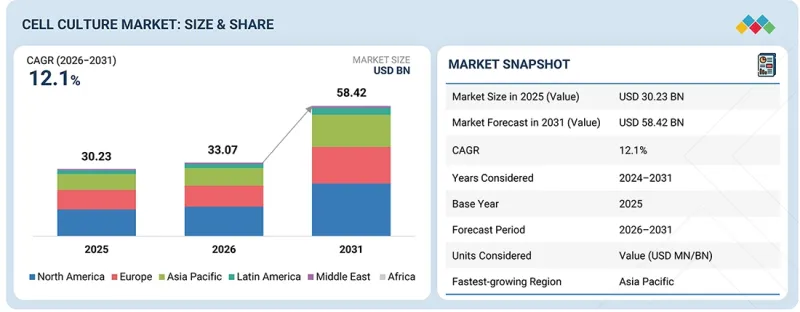
세포배양 시장 규모는 2026년 추정 330억 7,000만 달러에서 2031년에는 584억 2,000만 달러에 이를 것으로 예측되며, 2026년부터 2031년까지 예측 기간에 CAGR은 12.1`%를 기록할 전망입니다.
| 조사 범위 | |
|---|---|
| 조사 대상 기간 | 2026-2031년 |
| 기준연도 | 2025년 |
| 예측 기간 | 2026-2031년 |
| 단위 | 금액(달러) |
| 부문 | 제품, 용도, 최종사용자 |
| 대상 지역 | 북미, 유럽, 아시아태평양, 라틴아메리카, 중동 및 아프리카 |
이 시장의 성장은 세포 생물학 연구에 대한 투자 및 자금 조달 증가에 기인한 것으로 보입니다. 암 등 만성 질환의 발병률이 증가함에 따라, 조직 공학이나 재생 의학과 같은 첨단 치료법에 대한 수요가 높아지고 있습니다. 이러한 추세는 향후 몇 년 동안 세포 배양 시장의 성장을 견인할 것으로 예측됩니다.
용도별로는 바이오의약품 제조 부문이 2025년 시장에서 가장 큰 점유율을 차지했습니다.
2025년, 용도별 부문 중 바이오의약품 제조 부문이 가장 큰 점유율을 차지했습니다. 바이오의약품 제조 부문은 다시 백신 제조, 단일클론 항체 제조, 기타 치료용 단백질 제조로 분류됩니다. 감염병의 확산이 확대됨에 따라 백신, 단일클론 항체, 치료용 단백질 등의 바이오의약품에 대한 수요가 증가하고 있으며, 이에 따라 세포 배양 시장 내 바이오의약품 제조의 성장이 촉진되고 있습니다.
2025년에는 혈청·배지·시약 부문이 소모품 시장에서 주요 점유율을 차지했습니다.
이 부문의 점유율이 높은 이유는 생명공학 및 제약 업계에서 소모품에 대한 반복적이고 대규모의 구매와 수요에 기인합니다. 연구 기관이나 생산 시설에서는 지속적인 세포 배양 활동을 유지하기 위해 혈청, 배지, 시약, 배양 용기, 부속품을 대량으로 필요로 하는 경우가 많습니다. 이에 따라 실험, 시험 및 제조 공정을 위한 빈번하고 대규모의 조달이 이루어지고 있습니다.
아시아태평양은 2026년부터 2031년에 걸쳐 가장 높은 연평균 성장률(CAGR)을 보일 것으로 예측됩니다.
아시아태평양은 바이오의약품 및 바이오시밀러 생산 확대, 백신 생산 증가, 세포 및 유전자 치료 활동의 활성화, 국내 바이오 제조에 대한 정부 지원 강화에 힘입어 예측 기간 동안 가장 빠른 성장세를 보일 것으로 전망됩니다. 중국, 인도, 일본, 한국, 호주 등의 국가들은 바이오의약품 생산, 재생의료, 줄기세포 연구, 첨단 바이오프로세스 인프라에 대한 투자를 통해 세포 배양 역량을 강화하고 있습니다. 또한, 해당 지역에서는 CDMO 활동의 확대, 비용 효율적인 제조, 임상 연구 증가, 무혈청 배지, 일회용 시스템, 배양 용기, 시약 및 기타 세포 배양용 소모품의 보급 확대도 긍정적인 요인으로 작용하고 있습니다.
본 보고서에서는 전 세계 세포 배양 시장을 조사했으며, 시장 개요, 시장 성장에 영향을 미치는 다양한 요인에 대한 분석, 기술 및 특허 동향, 법규제 환경, 사례 연구, 시장 규모 추이 및 전망, 각종 분류·지역/주요 국가별 상세 분석, 경쟁 현황, 주요 기업 프로파일 등을 정리했습니다.
자주 묻는 질문
목차
제1장 서론
제2장 주요 요약
제3장 프리미엄 인사이트
제4장 시장 개요
제5장 업계 동향
제6장 기술 진보, AI의 영향, 특허, 혁신
제7장 지속가능성과 규제 상황
제8장 고객 현황과 구매 행동
제9장 세포배양 시장 : 제품별
제10장 세포배양 시장 : 용도별
제11장 세포배양 시장 : 최종사용자별
제12장 세포배양 시장 : 지역별
제13장 경쟁 구도
제14장 기업 개요
제15장 조사 방법
제16장 부록
LSH 26.07.06The cell culture market is projected to reach USD 58.42 billion by 2031 from an estimated USD 33.07 billion in 2026, at a CAGR of 12.1% during the forecast period of 2026 to 2031.
| Scope of the Report | |
|---|---|
| Years Considered for the Study | 2026-2031 |
| Base Year | 2025 |
| Forecast Period | 2026-2031 |
| Units Considered | Value (USD billion) |
| Segments | Product, Application, and End User |
| Regions covered | North America, Europe, Asia Pacific, Latin America, Middle East, and Africa |
The growth of this market can be attributed to increasing investment and funding for research in cell biology. The rising incidence of chronic diseases such as cancer is boosting the demand for advanced therapies such as tissue engineering and regenerative medicine. This trend is expected to drive the growth of the cell culture market in the coming years.
By application, the biopharmaceutical production segment accounted for the largest share of the market in 2025.
In 2025, the biopharmaceutical production segment accounted for the largest share of the application segment in the global cell culture market. The biopharmaceutical production segment is further categorized into vaccine production, monoclonal antibody production, and other therapeutic protein production. The growing prevalence of infectious diseases is boosting demand for biopharmaceuticals such as vaccines, monoclonal antibodies, and therapeutic proteins, thereby promoting the growth of biopharmaceutical production in the cell culture market.
The sera, media, and reagents segment accounted for a major share of the consumables market in 2025.
The cell culture consumables market is categorized by type into sera, media, and reagents; vessels; and accessories. The sera, media, and reagents segment accounted for the largest share of the cell culture consumables market in 2025. The large share of this segment is attributed to repeated bulk purchases and the need for consumables in the biotechnology and pharmaceutical industries. Research labs and production facilities often require large quantities of sera, media, reagents, vessels, and accessories to sustain continuous cell culture activities. This leads to frequent and substantial procurement for experimentation, testing, and manufacturing processes.
The Asia Pacific region is expected to experience the highest CAGR in the cell culture market from 2026 to 2031.
The cell culture market is divided into North America, Europe, Asia Pacific, Latin America, the Middle East, and Africa. Asia Pacific is expected to register the fastest growth during the forecast period, driven by expanding biologics and biosimilar manufacturing, rising vaccine production, increasing cell & gene therapy activity, and growing government support for domestic biomanufacturing. Countries such as China, India, Japan, South Korea, and Australia are strengthening their cell culture capabilities through investments in biopharmaceutical production, regenerative medicine, stem cell research, and advanced bioprocessing infrastructure. The region is also benefiting from growing CDMO activity, cost-efficient manufacturing, rising clinical research, and wider adoption of serum-free media, single-use systems, culture vessels, reagents, and other cell culture consumables.
The primary interviews conducted for this report can be categorized as follows:
- By Respondent: Supply Side (70%) and Demand Side (30%)
- By Designation: Managers (45%), CXOs & Directors (30%), and Executives (25%)
- By Region: North America (40%), Europe (25%), Asia Pacific (25%), Latin America (5%), and the Middle East & Africa (5%)
Thermo Fisher Scientific Inc. (US), Danaher Corporation (US), Sartorius AG (Germany), Merck KGaA (Germany), Corning Incorporated (US), FUJIFILM Holdings Corporation (Japan), BD (US), Eppendorf SE (Germany), Lonza (Switzerland), Getinge AB (Sweden), Agilent Technologies, Inc. (US), HiMedia Laboratories (India), Miltenyi Biotec (Germany), STEMCELL Technologies (Canada), Solida Biotech GmbH (Germany), Plant Cell Technology Inc. (US), PromoCell GmbH (Germany), InvivoGen (France), PAN-Biotech (Germany), Cellexus (Scotland), Meissner Filtration Products Inc. (US), Adolf Kuhner AG (Switzerland), Bio-Techne (US), Advancion Corporation (US), and BioSpherix, Ltd. (US) are some of the key companies offering cell culture solutions.
Research Coverage
This research report categorizes the cell culture market by product [consumables (sera, media, reagents; vessels, and other consumables & accessories), equipment (supporting equipment, bioreactors, and storage equipment)], application [biopharmaceutical production (monoclonal antibody production, vaccine production, and other therapeutic protein production), diagnostics, tissue engineering & regenerative medicine (cell & gene therapy and other tissue engineering & regenerative medicine applications), drug screening & development, and other applications], end user (pharmaceutical & biotechnology companies, hospitals & diagnostic laboratories, academic & research institutes, and other end users), and region (North America, Europe, Asia Pacific, Latin America, Middle East, and Africa).
The scope of the report provides detailed information on major factors such as drivers, challenges, opportunities, and restraints that influence the growth of the cell culture market. A comprehensive analysis of key industry players has been conducted to provide insights into their business overviews, product portfolios, and key strategies, including collaborations, partnerships, expansions, agreements, acquisitions, and recent developments in the cell culture market.
Key Benefits of Buying the Report
This report offers a comprehensive overview of the cell culture market. It aims to assess the market size and future growth opportunities across various segments. The report also features an in-depth competitive analysis of the major market players, including their company profiles, recent developments, and key market strategies
The report provides insights on the following pointers:
- Analysis of key drivers (increasing support and funding for cell-based research, rising demand for serum-free and animal component-free media, growing popularity of monoclonal antibodies and biosimilars, increasing adoption of single-use technologies, and growth in advanced therapy medicinal products), restraints (high cost of cell biology research and limitations in producing high-density cell cultures), opportunities (growing opportunities in emerging economies, rising demand for 3D cell culture, and Increasing focus on next-generation therapeutics), and challenges (ethical concern regarding cell usage, and disposal of plastic consumables) influencing the growth of the market.
- Product Development/Innovation: Detailed insights on newly launched products of the cell culture market
- Market Development: Comprehensive information about lucrative markets - the report analyses the market across varied regions.
- Market Diversification: Exhaustive information about new products, untapped geographies, recent developments, and investments in the cell culture market
- Competitive Assessment: In-depth assessment of market shares, growth strategies, and product offerings of leading players such as Thermo Fisher Scientific Inc. (US), Danaher Corporation (US), Sartorius AG (Germany), Merck KGaA (Germany), Corning Incorporated (US), FUJIFILM Holdings Corporation (Japan), BD (US), Eppendorf SE (Germany), Lonza (Switzerland), Getinge AB (Sweden), Agilent Technologies, Inc. (US), HiMedia Laboratories (India), Miltenyi Biotec (Germany), STEMCELL Technologies (Canada), Solida Biotech GmbH (Germany), Caisson Labs (US), PromoCell GmbH (Germany), InvivoGen (France), PAN-Biotech (Germany), Cellexus (Scotland), Meissner Filtration Products Inc. (US), Adolf Kuhner AG (Switzerland), Bio-Techne (US), Advancion Corporation (US), and BioSpherix, Ltd. (US).
The report also helps stakeholders understand trends in the cell culture market and provides information on key drivers, restraints, challenges, and opportunities. A detailed analysis of the key industry players has been conducted to offer insights into their strategies, product launches, acquisitions, partnerships, collaborations, recent activities, investments, funding, brand and product comparisons, vendor evaluations, and financial metrics of the cell culture sector.
TABLE OF CONTENTS
1 INTRODUCTION
- 1.1 STUDY OBJECTIVES
- 1.2 MARKET DEFINITION
- 1.2.1 INCLUSIONS & EXCLUSIONS
- 1.3 STUDY SCOPE
- 1.3.1 MARKET SEGMENTATION AND REGIONS COVERED
- 1.3.2 YEARS CONSIDERED
- 1.3.3 CURRENCY CONSIDERED
- 1.3.4 UNIT CONSIDERED
- 1.4 STAKEHOLDERS
- 1.5 SUMMARY OF CHANGES
2 EXECUTIVE SUMMARY
- 2.1 MARKET HIGHLIGHTS & KEY INSIGHTS
- 2.2 KEY MARKET PARTICIPANTS: MAPPING OF STRATEGIC DEVELOPMENTS
- 2.3 DISRUPTIVE TRENDS IN CELL CULTURE MARKET
- 2.4 HIGH-GROWTH SEGMENTS
- 2.5 REGIONAL SNAPSHOT: MARKET SIZE, GROWTH RATE, AND FORECAST
3 PREMIUM INSIGHTS
- 3.1 CELL CULTURE MARKET OVERVIEW
- 3.2 NORTH AMERICA: CELL CULTURE MARKET, BY CONSUMABLE AND COUNTRY
- 3.3 CELL CULTURE MARKET: GEOGRAPHIC GROWTH OPPORTUNITIES
- 3.4 CELL CULTURE MARKET SHARE, BY END USER
4 MARKET OVERVIEW
- 4.1 INTRODUCTION
- 4.2 MARKET DYNAMICS
- 4.2.1 DRIVERS
- 4.2.1.1 Increasing support and funding for cell-based research
- 4.2.1.2 Rising demand for serum-free and animal component-free media
- 4.2.1.3 Growing popularity of monoclonal antibodies and biosimilars
- 4.2.1.4 Increasing adoption of single-use technologies
- 4.2.1.5 Growth in advanced therapy medicinal products
- 4.2.2 RESTRAINTS
- 4.2.2.1 High cost of cell biology research
- 4.2.2.2 Limitations in producing high-density cell cultures
- 4.2.3 OPPORTUNITIES
- 4.2.3.1 Rising demand for 3D cell culture
- 4.2.3.2 Growth opportunities in emerging economies
- 4.2.3.3 Increasing focus on next-generation therapeutics
- 4.2.4 CHALLENGES
- 4.2.4.1 Disposal of plastic consumables
- 4.2.4.2 Ethical concerns related to cell usage
- 4.2.1 DRIVERS
- 4.3 UNMET NEEDS & WHITE SPACES
- 4.4 INTERCONNECTED MARKETS & CROSS-SECTOR OPPORTUNITIES
- 4.5 STRATEGIC MOVES BY TIER-1/2/3 PLAYERS
5 INDUSTRY TRENDS
- 5.1 PORTER'S FIVE FORCES ANALYSIS
- 5.1.1 BARGAINING POWER OF SUPPLIERS
- 5.1.2 BARGAINING POWER OF BUYERS
- 5.1.3 THREAT OF NEW ENTRANTS
- 5.1.4 THREAT OF SUBSTITUTES
- 5.1.5 INTENSITY OF COMPETITIVE RIVALRY
- 5.2 MACROECONOMIC OUTLOOK
- 5.2.1 INTRODUCTION
- 5.2.2 GDP TRENDS & FORECAST
- 5.2.3 TRENDS IN GLOBAL CELL CULTURE INDUSTRY
- 5.3 VALUE CHAIN ANALYSIS
- 5.4 ECOSYSTEM ANALYSIS
- 5.5 PRICING ANALYSIS
- 5.5.1 AVERAGE SELLING PRICE TREND OF KEY PLAYERS, BY PRODUCT
- 5.5.2 AVERAGE SELLING PRICE TREND OF CELL CULTURE PRODUCTS, BY REGION
- 5.6 TRADE ANALYSIS
- 5.6.1 IMPORT SCENARIO (HS CODE 382100)
- 5.6.2 EXPORT SCENARIO (HS CODE 382100)
- 5.7 KEY CONFERENCES AND EVENTS, 2026-2027
- 5.8 TRENDS/DISRUPTIONS IMPACTING CUSTOMERS' BUSINESS
- 5.9 INVESTMENT AND FUNDING SCENARIO
- 5.9.1 VC/PRIVATE EQUITY INVESTMENT TRENDS & STARTUP LANDSCAPE
- 5.10 IMPACT OF 2025 US TARIFFS ON CELL CULTURE MARKET
- 5.10.1 INTRODUCTION
- 5.10.2 KEY TARIFF RATES
- 5.10.3 PRICE IMPACT ANALYSIS
- 5.10.4 IMPACT ON COUNTRY/REGION
- 5.10.4.1 US
- 5.10.4.2 Europe
- 5.10.4.3 Asia Pacific
- 5.10.5 IMPACT ON END-USE INDUSTRIES
- 5.10.5.1 Pharmaceutical & biotech companies
- 5.10.5.2 Hospitals & diagnostic laboratories
- 5.10.5.3 Academic & research institutes
- 5.10.5.4 Contract research organizations & contract development and manufacturing organizations
6 TECHNOLOGICAL ADVANCEMENTS, AI-DRIVEN IMPACT, PATENTS, AND INNOVATIONS
- 6.1 TECHNOLOGY ANALYSIS
- 6.1.1 KEY EMERGING TECHNOLOGIES
- 6.1.1.1 Single-use technology
- 6.1.1.2 Flow cytometry
- 6.1.1.3 Microscopy
- 6.1.2 COMPLEMENTARY TECHNOLOGIES
- 6.1.2.1 High-throughput screening
- 6.1.2.2 Mass spectrometry
- 6.1.3 ADJACENT TECHNOLOGIES
- 6.1.3.1 Microfluidics and organ-on-a-chip
- 6.1.3.2 3D bioprinting
- 6.1.1 KEY EMERGING TECHNOLOGIES
- 6.2 TECHNOLOGY/PRODUCT ROADMAP
- 6.3 PATENT ANALYSIS
- 6.3.1 TOP APPLICANTS/OWNERS (COMPANIES) FOR CELL CULTURE PATENTS
- 6.4 FUTURE APPLICATIONS
- 6.5 IMPACT OF AI/GEN AI ON CELL CULTURE MARKET
- 6.5.1 BEST PRACTICES IN CELL CULTURE WORKFLOW
- 6.5.2 CASE STUDIES OF AI IMPLEMENTATION IN CELL CULTURE MARKET
- 6.5.3 INTERCONNECTED ADJACENT ECOSYSTEMS & IMPACT ON MARKET PLAYERS
- 6.5.4 CLIENTS' READINESS TO ADOPT GENERATIVE AI IN CELL CULTURE MARKET
7 SUSTAINABILITY & REGULATORY LANDSCAPE
- 7.1 REGIONAL REGULATIONS & COMPLIANCE
- 7.1.1 REGULATORY BODIES, GOVERNMENT AGENCIES, AND OTHER ORGANIZATIONS
- 7.1.2 REGULATORY FRAMEWORK
- 7.1.2.1 North America
- 7.1.2.2 Europe
- 7.1.2.3 Asia Pacific
- 7.1.2.4 Latin America
- 7.1.2.5 Middle East & Africa
- 7.1.3 INDUSTRY STANDARDS
- 7.2 SUSTAINABILITY INITIATIVES
- 7.3 SUSTAINABILITY IMPACT & REGULATORY POLICY INITIATIVES
- 7.4 CERTIFICATIONS, LABELING, AND ECO-STANDARDS
8 CUSTOMER LANDSCAPE & BUYER BEHAVIOR
- 8.1 DECISION-MAKING PROCESS
- 8.2 BUYER STAKEHOLDERS & BUYING EVALUATION CRITERIA
- 8.2.1 KEY STAKEHOLDERS IN BUYING PROCESS
- 8.2.2 KEY BUYING CRITERIA, BY END USER
- 8.3 ADOPTION BARRIERS & INTERNAL CHALLENGES
- 8.4 UNMET NEEDS FROM VARIOUS END-USE INDUSTRIES
- 8.5 MARKET PROFITABILITY
9 CELL CULTURE MARKET, BY PRODUCT
- 9.1 INTRODUCTION
- 9.2 CONSUMABLES
- 9.2.1 SERA, MEDIA, AND REAGENTS
- 9.2.1.1 Media
- 9.2.1.1.1 Serum-free media
- 9.2.1.1.1.1 CHO media
- 9.2.1.1.1.1.1 High-yield biologics manufacturing to sustain demand for optimized CHO serum-free media
- 9.2.1.1.1.2 HEK 293 media
- 9.2.1.1.1.2.1 Viral vector manufacturing and transient expression workflows to accelerate HEK 293 media adoption
- 9.2.1.1.1.3 Serum-free stem cell media
- 9.2.1.1.1.3.1 Regenerative medicine, iPSC models, and cell therapy translation to drive specialized stem cell media demand
- 9.2.1.1.1.4 Vero Cell media
- 9.2.1.1.1.4.1 Increasing vaccine manufacturing to support demand for serum-free Vero cell media
- 9.2.1.1.1.5 BHK media
- 9.2.1.1.1.5.1 Vaccine production and viral vector workflows to support demand for BHK serum-free media
- 9.2.1.1.1.6 Other serum-free media
- 9.2.1.1.1.1 CHO media
- 9.2.1.1.2 Classical media & salts
- 9.2.1.1.2.1 Standardized basal media and salt solutions to support routine culture, assay reproducibility, and vaccine production
- 9.2.1.1.3 Stem cell culture media
- 9.2.1.1.3.1 Rising use of stem cell models and regenerative medicine workflows to drive demand for specialized culture media
- 9.2.1.1.4 Chemically-defined media
- 9.2.1.1.4.1 Increasing need for reproducible, animal component-free workflows to support biologics and advanced therapy development
- 9.2.1.1.5 Specialty media
- 9.2.1.1.5.1 Suitability for use in selective cell types in bioprocessing and biomanufacturing industries to boost market
- 9.2.1.1.6 Other media
- 9.2.1.1.1 Serum-free media
- 9.2.1.2 Reagents
- 9.2.1.2.1 Growth factors
- 9.2.1.2.1.1 Need to regulate cell proliferation, differentiation, and migration to sustain growth
- 9.2.1.2.2 Supplements
- 9.2.1.2.2.1 Need to improve cell growth, nutrient availability, and bioproduction performance to support segment growth
- 9.2.1.2.3 Buffers & chemicals
- 9.2.1.2.3.1 Ability to maintain stable pH levels to facilitate growth
- 9.2.1.2.4 Cell dissociation reagents
- 9.2.1.2.4.1 Ability to minimize cell stress and reduce cell damage to foster growth
- 9.2.1.2.5 Balanced salt solutions
- 9.2.1.2.5.1 Ability to maintain optimal physiological conditions for cell growth and experimentation to assist growth
- 9.2.1.2.6 Attachment & matrix factors
- 9.2.1.2.6.1 Rising adoption of 3D cell culture models to support growth
- 9.2.1.2.7 Antibiotics/Antimycotics
- 9.2.1.2.7.1 Ability to mitigate growth of contaminating bacteria, fungi, and mycoplasma to drive market
- 9.2.1.2.8 Cryoprotective reagents
- 9.2.1.2.8.1 Ability to preserve cell viability during freezing and thawing to aid growth
- 9.2.1.2.9 Contamination detection kits
- 9.2.1.2.9.1 Need for rapid identification of microbial contaminants to promote growth
- 9.2.1.2.10 Other reagents
- 9.2.1.2.1 Growth factors
- 9.2.1.3 Sera
- 9.2.1.3.1 Fetal bovine sera
- 9.2.1.3.1.1 Increasing role of fetal bovine sera in cell proliferation to favor growth
- 9.2.1.3.2 Adult bovine sera
- 9.2.1.3.2.1 Cost-effectiveness to contribute to growth
- 9.2.1.3.3 Other animal sera
- 9.2.1.3.1 Fetal bovine sera
- 9.2.1.1 Media
- 9.2.2 VESSELS
- 9.2.2.1 Cell factory systems/cell stacks
- 9.2.2.1.1 Efficient and scalable solutions for large-scale expansion to drive adoption
- 9.2.2.2 Roller/roux bottles
- 9.2.2.2.1 Scalability, cost-effectiveness, and ease of handling to support growth
- 9.2.2.3 Flasks
- 9.2.2.3.1 Growing advancements in cell culture flasks to boost market
- 9.2.2.4 Multiwell plates
- 9.2.2.4.1 Increasing adoption of multiwell plates in high-throughput or high-content screening to aid growth
- 9.2.2.5 Petri dishes
- 9.2.2.5.1 Rising use of petri dishes as sterile containers to sustain growth
- 9.2.2.1 Cell factory systems/cell stacks
- 9.2.3 OTHER CONSUMABLES & ACCESSORIES
- 9.2.3.1 Reduced preparation time and equipment performance improvements to augment growth
- 9.2.1 SERA, MEDIA, AND REAGENTS
- 9.3 EQUIPMENT
- 9.3.1 SUPPORTING EQUIPMENT
- 9.3.1.1 Filtration systems
- 9.3.1.1.1 Sterile filtration for contamination-controlled workflows to boost market
- 9.3.1.2 Cell counters
- 9.3.1.2.1 Growing adoption of automated cell counters to propel market
- 9.3.1.3 Carbon dioxide incubators
- 9.3.1.3.1 Increasing focus of research institutes on developing lab-scale incubators to drive market
- 9.3.1.4 Centrifuges
- 9.3.1.4.1 Increasing demand for bioproduction applications to drive adoption of centrifuges
- 9.3.1.5 Autoclaves
- 9.3.1.5.1 Reliance on single-use labware and equipment to affect demand for autoclaves
- 9.3.1.6 Microscopes
- 9.3.1.6.1 Rising adoption of live-cell imaging in 3D culture and stem cell models to support segment growth
- 9.3.1.7 Biosafety cabinets
- 9.3.1.7.1 Rising focus on contamination control and operator safety to support segment growth
- 9.3.1.8 Other supporting equipment
- 9.3.1.1 Filtration systems
- 9.3.2 BIOREACTORS
- 9.3.2.1 Rising biologics and advanced therapy production to accelerate adoption of scalable bioreactor systems
- 9.3.3 STORAGE EQUIPMENT
- 9.3.3.1 Refrigerators & freezers
- 9.3.3.1.1 Increasing need for storage solutions to propel market
- 9.3.3.2 Cryostorage systems
- 9.3.3.2.1 Benefits of long-term preservation of cell cultures to support growth
- 9.3.3.1 Refrigerators & freezers
- 9.3.1 SUPPORTING EQUIPMENT
10 CELL CULTURE MARKET, BY APPLICATION
- 10.1 INTRODUCTION
- 10.2 BIOPHARMACEUTICAL PRODUCTION
- 10.2.1 MONOCLONAL ANTIBODY PRODUCTION
- 10.2.1.1 Increasing approval and launch of monoclonal antibodies to amplify growth
- 10.2.2 VACCINE PRODUCTION
- 10.2.2.1 Rising incidence of infectious diseases to support growth
- 10.2.3 OTHER THERAPEUTIC PROTEIN PRODUCTION
- 10.2.1 MONOCLONAL ANTIBODY PRODUCTION
- 10.3 DIAGNOSTICS
- 10.3.1 USE OF CULTURED CELLS IN CYTOGENETICS AND ASSAY VALIDATION TO SUPPORT SEGMENT GROWTH
- 10.4 TISSUE ENGINEERING & REGENERATIVE MEDICINE
- 10.4.1 CELL & GENE THERAPY
- 10.4.1.1 Rising approvals and manufacturing investments in advanced therapies to propel segment growth
- 10.4.2 OTHER TISSUE ENGINEERING & REGENERATIVE MEDICINE APPLICATIONS
- 10.4.1 CELL & GENE THERAPY
- 10.5 DRUG SCREENING & DEVELOPMENT
- 10.5.1 ADOPTION OF HUMAN-RELEVANT 3D MODELS AND AUTOMATED SCREENING PLATFORMS TO PROPEL SEGMENT GROWTH
- 10.6 OTHER APPLICATIONS
11 CELL CULTURE MARKET, BY END USER
- 11.1 INTRODUCTION
- 11.2 PHARMACEUTICAL & BIOTECHNOLOGY COMPANIES
- 11.2.1 INCREASING DEMAND FOR CULTURE CELL LINES FOR DRUG SCREENING AND R&D TO AID GROWTH
- 11.3 HOSPITALS & DIAGNOSTIC LABORATORIES
- 11.3.1 GROWING USE OF CELL CULTURE FOR CELLULAR PHYSIOLOGY, DISEASE MECHANISMS, AND DRUG RESPONSES TO BOOST MARKET
- 11.4 ACADEMIC & RESEARCH INSTITUTES
- 11.4.1 RISING FUNDING ACTIVITIES TO CONTRIBUTE TO GROWTH
- 11.5 OTHER END USERS
12 CELL CULTURE MARKET, BY REGION
- 12.1 INTRODUCTION
- 12.2 NORTH AMERICA
- 12.2.1 US
- 12.2.1.1 Strong biologics pipeline and domestic cell therapy manufacturing investments to bolster growth
- 12.2.2 CANADA
- 12.2.2.1 Increasing funding and investments for cell-based therapies to boost market
- 12.2.1 US
- 12.3 EUROPE
- 12.3.1 GERMANY
- 12.3.1.1 Biologics manufacturing strength and mRNA oncology investments to drive demand
- 12.3.2 UK
- 12.3.2.1 ATMP clinical infrastructure and government life sciences strategy to boost growth
- 12.3.3 FRANCE
- 12.3.3.1 Rising number of cell-based research projects to enhance growth
- 12.3.4 ITALY
- 12.3.4.1 Strong government support for R&D activities to spur growth
- 12.3.5 SPAIN
- 12.3.5.1 Rising biotechnology R&D investment to support cell-based research applications
- 12.3.6 REST OF EUROPE
- 12.3.1 GERMANY
- 12.4 ASIA PACIFIC
- 12.4.1 CHINA
- 12.4.1.1 Large-scale CRDMO activity and multinational cell therapy investments to accelerate growth
- 12.4.2 JAPAN
- 12.4.2.1 Rising government initiatives and increasing investments in biotech to intensify growth
- 12.4.3 INDIA
- 12.4.3.1 Favorable government support and expansion by key cell culture players to augment growth
- 12.4.4 SOUTH KOREA
- 12.4.4.1 Growing pharmaceutical sector to drive market
- 12.4.5 AUSTRALIA
- 12.4.5.1 Regenerative medicine funding and hospital-linked CAR-T manufacturing to support growth
- 12.4.6 REST OF ASIA PACIFIC
- 12.4.1 CHINA
- 12.5 LATIN AMERICA
- 12.5.1 BRAZIL
- 12.5.1.1 Cell therapy partnerships and vaccine manufacturing capacity to strengthen regional leadership
- 12.5.2 MEXICO
- 12.5.2.1 Pharmaceutical manufacturing investments and clinical research capacity to support steady growth
- 12.5.3 REST OF LATIN AMERICA
- 12.5.1 BRAZIL
- 12.6 MIDDLE EAST
- 12.6.1 GCC COUNTRIES
- 12.6.1.1 Saudi Arabia
- 12.6.1.1.1 Increasing focus on expansion to drive market
- 12.6.1.2 UAE
- 12.6.1.2.1 Increasing shift from importing to manufacturing pharmaceuticals to boost market
- 12.6.1.3 Rest of GCC Countries
- 12.6.1.1 Saudi Arabia
- 12.6.2 REST OF MIDDLE EAST
- 12.6.1 GCC COUNTRIES
- 12.7 AFRICA
- 12.7.1 RISING GRANTS AND FUNDING FOR CELL AND GENE THERAPY PRODUCTS TO FOSTER GROWTH
13 COMPETITIVE LANDSCAPE
- 13.1 OVERVIEW
- 13.2 KEY PLAYER STRATEGIES/RIGHT TO WIN
- 13.2.1 OVERVIEW OF STRATEGIES ADOPTED BY PLAYERS IN CELL CULTURE MARKET
- 13.3 REVENUE ANALYSIS, 2021-2025
- 13.4 MARKET SHARE ANALYSIS, 2025
- 13.5 COMPANY EVALUATION MATRIX: KEY PLAYERS, 2025
- 13.5.1 STARS
- 13.5.2 EMERGING LEADERS
- 13.5.3 PERVASIVE PLAYERS
- 13.5.4 PARTICIPANTS
- 13.5.5 COMPANY FOOTPRINT: KEY PLAYERS, 2025
- 13.5.5.1 Company footprint
- 13.5.5.2 Regional footprint
- 13.5.5.3 Product footprint
- 13.5.5.4 Application footprint
- 13.5.5.5 End-user footprint
- 13.6 COMPANY EVALUATION MATRIX: STARTUPS/SMES, 2025
- 13.6.1 PROGRESSIVE COMPANIES
- 13.6.2 RESPONSIVE COMPANIES
- 13.6.3 DYNAMIC COMPANIES
- 13.6.4 STARTING BLOCKS
- 13.6.5 COMPETITIVE BENCHMARKING: STARTUPS/SMES, 2025
- 13.6.5.1 Detailed list of key startups/SMEs
- 13.6.5.2 Competitive benchmarking of key startups/SMEs
- 13.7 COMPANY VALUATION AND FINANCIAL METRICS
- 13.7.1 FINANCIAL METRICS
- 13.7.2 COMPANY VALUATION
- 13.8 BRAND/PRODUCT COMPARISON
- 13.9 COMPETITIVE SCENARIO
- 13.9.1 PRODUCT LAUNCHES
- 13.9.2 DEALS
- 13.9.3 EXPANSIONS
14 COMPANY PROFILES
- 14.1 INTRODUCTION
- 14.2 KEY PLAYERS
- 14.2.1 THERMO FISHER SCIENTIFIC INC.
- 14.2.1.1 Business overview
- 14.2.1.2 Products offered
- 14.2.1.3 Recent developments
- 14.2.1.3.1 Product launches
- 14.2.1.3.2 Deals
- 14.2.1.3.3 Expansions
- 14.2.1.4 MnM view
- 14.2.1.4.1 Right to win
- 14.2.1.4.2 Strategic choices
- 14.2.1.4.3 Weaknesses and competitive threats
- 14.2.2 DANAHER CORPORATION
- 14.2.2.1 Business overview
- 14.2.2.2 Products offered
- 14.2.2.3 Recent developments
- 14.2.2.3.1 Product launches
- 14.2.2.3.2 Deals
- 14.2.2.3.3 Expansions
- 14.2.2.3.4 Other developments
- 14.2.2.4 MnM view
- 14.2.2.4.1 Right to win
- 14.2.2.4.2 Strategic choices
- 14.2.2.4.3 Weaknesses and competitive threats
- 14.2.3 MERCK KGAA
- 14.2.3.1 Business overview
- 14.2.3.2 Products offered
- 14.2.3.3 Recent developments
- 14.2.3.3.1 Product launches
- 14.2.3.3.2 Deals
- 14.2.3.3.3 Expansions
- 14.2.3.4 MnM view
- 14.2.3.4.1 Right to win
- 14.2.3.4.2 Strategic choices
- 14.2.3.4.3 Weaknesses and competitive threats
- 14.2.4 SARTORIUS AG
- 14.2.4.1 Business overview
- 14.2.4.2 Products offered
- 14.2.4.3 Recent developments
- 14.2.4.3.1 Product launches
- 14.2.4.3.2 Deals
- 14.2.4.3.3 Expansions
- 14.2.4.4 MnM view
- 14.2.4.4.1 Right to win
- 14.2.4.4.2 Strategic choices
- 14.2.4.4.3 Weaknesses and competitive threats
- 14.2.5 CORNING INCORPORATED
- 14.2.5.1 Business overview
- 14.2.5.2 Products offered
- 14.2.5.3 Recent developments
- 14.2.5.3.1 Deals
- 14.2.6 FUJIFILM HOLDINGS CORPORATION
- 14.2.6.1 Business overview
- 14.2.6.2 Products offered
- 14.2.6.3 Recent developments
- 14.2.6.3.1 Product launches
- 14.2.6.3.2 Deals
- 14.2.6.3.3 Other developments
- 14.2.7 BD
- 14.2.7.1 Business overview
- 14.2.7.2 Product offered
- 14.2.7.3 Recent developments
- 14.2.7.3.1 Product Launches
- 14.2.7.3.2 Deals
- 14.2.7.3.3 Other developments
- 14.2.8 EPPENDORF SE
- 14.2.8.1 Business overview
- 14.2.8.2 Products offered
- 14.2.8.3 Recent developments
- 14.2.8.3.1 Product launches
- 14.2.8.3.2 Expansions
- 14.2.9 LONZA
- 14.2.9.1 Business overview
- 14.2.9.2 Products offered
- 14.2.9.3 Recent developments
- 14.2.9.3.1 Product launches
- 14.2.9.3.2 Deals
- 14.2.10 GETINGE
- 14.2.10.1 Business overview
- 14.2.10.2 Products offered
- 14.2.10.3 Recent developments
- 14.2.10.3.1 Product launches
- 14.2.10.3.2 Deals
- 14.2.11 AGILENT TECHNOLOGIES, INC.
- 14.2.11.1 Business overview
- 14.2.11.2 Products offered
- 14.2.11.3 Recent developments
- 14.2.11.3.1 Product launches
- 14.2.11.3.2 Deals
- 14.2.11.3.3 Expansions
- 14.2.12 HIMEDIA LABORATORIES
- 14.2.12.1 Business overview
- 14.2.12.2 Products offered
- 14.2.13 BIO-TECHNE
- 14.2.13.1 Business overview
- 14.2.13.2 Products offered
- 14.2.13.3 Recent developments
- 14.2.13.3.1 Product launches
- 14.2.13.3.2 Deals
- 14.2.13.3.3 Expansions
- 14.2.1 THERMO FISHER SCIENTIFIC INC.
- 14.3 OTHER PLAYERS
- 14.3.1 MILTENYI BIOTEC
- 14.3.2 STEMCELL TECHNOLOGIES
- 14.3.3 SOLIDA BIOTECH GMBH
- 14.3.4 CAISSON LABS
- 14.3.5 PROMOCELL GMBH
- 14.3.6 INVIVOGEN
- 14.3.7 PAN-BIOTECH
- 14.3.8 CELLEXUS
- 14.3.9 MEISSNER FILTRATION PRODUCTS, INC.
- 14.3.10 ADOLF KUHNER AG
- 14.3.11 ADVANCION CORPORATION
- 14.3.12 BIOSPHERIX LLC
15 RESEARCH METHODOLOGY
- 15.1 RESEARCH DATA
- 15.1.1 SECONDARY DATA
- 15.1.1.1 Key secondary sources
- 15.1.1.2 Key data from secondary research
- 15.1.2 PRIMARY DATA
- 15.1.2.1 Key primary participants
- 15.1.2.2 Breakdown of primary interviews
- 15.1.2.3 Key data from primary sources
- 15.1.1 SECONDARY DATA
- 15.2 MARKET SIZE ESTIMATION
- 15.2.1 GLOBAL CELL CULTURE MARKET ESTIMATION, 2025
- 15.2.1.1 Approach 1: Company revenue analysis-based estimation (bottom-up)
- 15.2.1.2 Approach 2: Primary research
- 15.2.1.2.1 Key industry insights
- 15.2.1.3 Approach 3: MnM repository analysis
- 15.2.2 SEGMENTAL MARKET SIZE ESTIMATION, 2025
- 15.2.1 GLOBAL CELL CULTURE MARKET ESTIMATION, 2025
- 15.3 MARKET GROWTH RATE PROJECTIONS
- 15.4 DATA TRIANGULATION
- 15.5 RESEARCH ASSUMPTIONS
- 15.6 RESEARCH LIMITATIONS AND RISK ASSESSMENT
16 APPENDIX
- 16.1 DISCUSSION GUIDE
- 16.2 KNOWLEDGESTORE: MARKETSANDMARKETS' SUBSCRIPTION PORTAL
- 16.3 CUSTOMIZATION OPTIONS
- 16.4 RELATED REPORTS
- 16.5 AUTHOR DETAILS


