
|
시장보고서
상품코드
2076873
데이터센터용 발전기 시장 : 유형별(디젤 발전기, 천연가스 발전기, 바이퓨얼 발전기, 기타), 정격 출력별(1 MW 이하, 1-3 MW, 3 MW 이상), 최종사용자별, 지역별 - 세계 예측(-2031년)Data Center Generators Market by Type (Diesel Generator, Natural Gas Generator, Bi-fuel Generator, Others), Power Rating (Up to 1 MW, 1 MW to 3 MW, above 3 MW), End User, and Region - Global Forecast to 2031 |
||||||

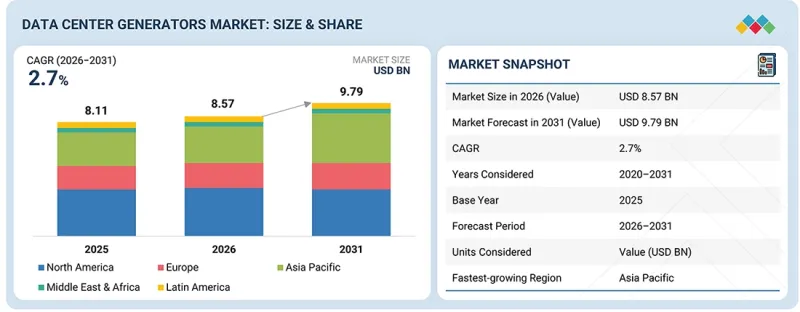
데이터센터용 발전기 시장 규모는 빠르게 확대하고 있으며, 2026년 85억 7,000만 달러에서 2031년에는 97억 9,000만 달러로, CAGR 2.7%로 확대될 것으로 예측됩니다.
비즈니스 연속성과 재해 복구의 중요성이 커짐에 따라, 데이터센터 시설 전반에 걸쳐 첨단 비상 전원 인프라에 대한 투자가 촉진되고 있습니다.
| 조사 범위 | |
|---|---|
| 조사 대상 기간 | 2020-2031년 |
| 기준 연도 | 2025년 |
| 예측 기간 | 2026-2031년 |
| 단위 | 금액(달러) |
| 부문 | 유형별, 정격 출력별, 최종사용자별, 지역별 |
| 대상 지역 | 북미, 유럽, 아시아태평양, 중동 및 아프리카, 라틴아메리카 |
기업과 하이퍼스케일 사업자들은 전력망 고장, 기상 이변, 전력 수요 변동의 확대로 인해 발생하는 가동 중단 위험을 최소화하기 위해 중복화된 발전 시스템 도입을 점점 더 확대하고 있습니다. 또한, 엣지 컴퓨팅 및 분산형 데이터센터 네트워크의 확대에 따라, 여러 거점에 걸친 미션 크리티컬한 운영을 지원할 수 있는 확장성과 신뢰성을 겸비한 발전 솔루션에 대한 수요도 증가하고 있습니다.
데이터센터용 발전기 시장은 엔진, 발전기, 제어 시스템, 주요 전기 부품의 공급에 영향을 미치는 공급망 혼란으로 인해 어려움에 직면해 있습니다. 대용량 발전기의 긴 리드타임이나 인프라 개발 지연은 하이퍼스케일 사업자나 코로케이션 사업자의 프로젝트 실행을 늦출 가능성이 있습니다. 게다가 원자재 비용 상승과 설치·유지보수 작업을 담당하는 숙련된 인력의 부족으로 인해, 데이터센터 사업자에게는 운영상의 복잡성과 전반적인 도입 비용이 증가하고 있습니다.
"유형별로는 바이퓨얼 발전기가 예측 기간 동안 가장 높은 연평균 성장률(CAGR)을 기록할 것으로 전망됩니다."
바이퓨얼 발전기는 연료의 유연성, 지속가능성, 운영 효율성에 대한 중요성이 커지고 있는 만큼, 가장 높은 성장이 예상됩니다. 이러한 시스템은 디젤과 천연가스를 병용하여 가동할 수 있으므로, 데이터센터 사업자는 연료비 절감, 이산화탄소 배출량 감소, 장기간 정전 시 에너지 복원력 향상을 실현할 수 있습니다. 하이퍼스케일 및 AI 기반 데이터센터에 대한 투자 확대 또한 고밀도 워크로드를 지원할 수 있고, 확장성이 뛰어나며, 더욱 친환경적인 백업 전원 솔루션에 대한 수요를 더욱 가속화하고 있습니다. 또한, 환경 규제의 강화와 기업의 탄소 배출 감축 노력에 따라 사업자들은 기존의 디젤 전용 발전기를 대체할 저배출형 대안을 도입하도록 장려받고 있습니다. 바이퓨얼 발전기는 특히 디젤 공급 제약이나 연료 가격 변동이 심한 지역에서 연료의 확보 가능성과 공급 안정성을 높여줍니다. 신뢰성과 지속가능성의 균형을 동시에 달성하는 능력 덕분에, 효율적이고 미래를 내다보는 백업 전원 인프라를 필요로 하는 하이퍼스케일, 코로케이션, 엔터프라이즈 데이터센터 시설에 있어 점점 더 매력적인 선택지가 되고 있습니다.
"출력별로는 3MW를 초과하는 발전기가 예측 기간 동안 가장 큰 시장 점유율을 차지할 것으로 예상됩니다."
3MW를 초과하는 발전기는 대규모 백업 전력 용량이 필요한 하이퍼스케일 및 AI 기반 데이터센터의 도입이 증가함에 따라 가장 큰 시장 규모를 차지할 것으로 예상됩니다. AI 훈련 클러스터, 클라우드 컴퓨팅, 고성능 컴퓨팅(HPC) 워크로드로 인한 전력 소비량 증가가, 송전망 정전 시에도 지속적인 운영을 뒷받침할 수 있는 대용량 발전기 시스템에 대한 수요를 이끌고 있습니다. 하이퍼스케일 사업자들은 가동 시간의 신뢰성을 확보하고, 광대한 캠퍼스 전체에서 서비스를 중단 없이 유지하기 위해 수 메가와트 규모의 백업 인프라에 대한 투자를 확대하고 있습니다. 또한, 코로케이션 시설의 확대와 랙당 전력 밀도의 향상으로 인해, 미션 크리티컬 용도에서 3MW 이상의 발전기 도입이 가속화되고 있습니다. 이러한 시스템은 막대한 전력 부하를 관리하는 대규모 시설에 대해 더욱 뛰어난 확장성과 운영 효율성도 제공합니다. 북미, 유럽, 아시아태평양에서의 하이퍼스케일 개발에 대한 적극적인 투자 또한, 시장 총액 측면에서 3MW를 초과하는 부문이 우위를 차지하는 데 더욱 힘을 실어주고 있습니다.
"북미가 시장을 주도하는 한편, 아시아태평양은 하이퍼스케일의 급속한 확대와 AI 인프라에 대한 투자에 힘입어 가장 빠르게 성장하고 있는 지역입니다."
북미는 하이퍼스케일 클라우드 제공업체의 강력한 입지, AI 인프라에 대한 투자 확대, 미국 및 캐나다 전역에 걸친 대규모 데이터센터 캠퍼스의 지속적인 확장으로 인해 시장에서 가장 큰 시장 점유율을 차지할 것으로 예상됩니다. 이 지역에는 운영 중단을 방지하기 위해 신뢰성이 높은 대용량 백업 전원 시스템이 필요한 티어 III 및 티어 IV 시설이 집중되어 있습니다. 또한, AI, 클라우드 컴퓨팅, 고성능 컴퓨팅(HPC) 워크로드로 인한 전력 소비량 증가가 첨단 발전기 인프라에 대한 막대한 수요를 이끌고 있습니다. 대형 기술 기업들의 적극적인 투자와 기존 시설의 백업 전원 시스템 현대화 역시 이 지역의 시장 우위를 더욱 공고히 하고 있습니다. 성숙한 전력 인프라, 첨단 서비스 네트워크, 엄격한 가동 시간 기준이 마련되어 있는 점도 해당 지역 전체에서 대규모 발전기 시스템의 도입 확대에 기여하고 있습니다.
아시아태평양은 중국, 인도, 동남아시아, 일본, 호주에서 진행되고 있는 급속한 디지털 전환, 클라우드 도입 확대, 하이퍼스케일 및 코로케이션 데이터센터에 대한 투자 증가에 힘입어 가장 빠르게 성장하는 시장이 될 것으로 전망됩니다. 정부 주도의 디지털 인프라 구축, 인터넷 보급률 향상, AI 대응 시설에 대한 수요 증가 등도 해당 지역 전체에서 발전기 도입을 더욱 가속화하고 있습니다. 또한, 전 세계 클라우드 서비스 제공업체들의 진출 확대, 엣지 데이터센터 확충, 기업의 디지털화 진전이 신뢰성이 높은 백업 전원 인프라에 대한 막대한 투자를 촉진하고 있습니다. 전력망의 신뢰성에 대한 우려가 커지고 전력 수요가 증가함에 따라, 아시아 신흥 시장에서 사업자들이 첨단 기술과 연료 유연성이 높은 발전 시스템을 도입하는 데 박차를 가하고 있습니다.
본 보고서에서는 전 세계 데이터센터용 발전기 시장을 조사하여, 시장 개요, 시장 성장에 영향을 미치는 다양한 요인에 대한 분석, 기술 및 특허 동향, 법규제 환경, 사례 연구, 시장 규모 추정 및 전망, 각종 분류·지역/주요 국가별 상세 분석, 경쟁 현황, 주요 기업 개요 등을 정리하고 있습니다.
자주 묻는 질문
목차
제1장 소개
제2장 주요 요약
제3장 주요 인사이트
제4장 시장 개요
제5장 업계 동향
제6장 기술의 진보, AI의 영향, 특허, 혁신, 향후 응용
제7장 규제 상황
제8장 고객 상황과 구매 행동
제9장 데이터센터용 발전기 시장 : 연료 유형별
제10장 데이터센터용 발전기 시장 : 출력 정격별
제11장 데이터센터용 발전기 시장 : 용도별
제12장 데이터센터용 발전기 시장 : 중복 구성별
제13장 데이터센터용 발전기 시장 : 최종사용자별
제14장 데이터센터용 발전기 시장 : 지역별
제15장 경쟁 구도
제16장 기업 개요
제17장 조사 방법
제18장 부록
KSM 26.07.10The data center generators market is expanding rapidly, with the market projected to grow from USD 8.57 billion in 2026 to USD 9.79 billion by 2031 at a CAGR of 2.7%. The growing importance of business continuity and disaster recovery is driving investments in advanced backup power infrastructure across data center facilities.
| Scope of the Report | |
|---|---|
| Years Considered for the Study | 2020-2031 |
| Base Year | 2025 |
| Forecast Period | 2026-2031 |
| Units Considered | Value (USD Billion) |
| Segments | By Type, Power Rating, End User, Region |
| Regions covered | North America, Europe, Asia Pacific, Middle East & Africa, Latin America |
Enterprises and hyperscale operators are increasingly deploying redundant generator systems to minimize downtime risks caused by grid failures, extreme weather events, and rising power demand fluctuations. The expansion of edge computing and distributed data center networks is also increasing the requirement for scalable and reliable generator solutions capable of supporting mission-critical operations across multiple locations.
The data center generators market is facing challenges due to supply chain disruptions impacting the availability of engines, alternators, control systems, and critical electrical components. Long lead times for high-capacity generators and delays in infrastructure development can slow project execution for hyperscale and colocation operators. In addition, rising raw material costs and shortages of skilled labor for installation and maintenance activities are increasing operational complexity and overall deployment costs for data center operators.
"By type, the bi-fuel generators are expected to grow at the highest CAGR during the forecast period."
Bi-fuel generators are expected to witness the highest growth in the data center generators market due to increasing emphasis on fuel flexibility, sustainability, and operational efficiency. These systems can operate using a combination of diesel and natural gas, enabling data center operators to reduce fuel costs, lower carbon emissions, and improve energy resilience during prolonged power outages. Growing investments in hyperscale and AI-driven data centers are further accelerating demand for scalable and cleaner backup power solutions capable of supporting high-density workloads. In addition, tightening environmental regulations and corporate carbon reduction commitments are encouraging operators to adopt lower-emission alternatives to conventional diesel-only generators. Bi-fuel generators also provide improved fuel availability and supply security, particularly in regions facing diesel supply constraints or rising fuel price volatility. Their ability to balance reliability with sustainability makes them increasingly attractive for hyperscale, colocation, and enterprise data center facilities seeking efficient and future-ready backup power infrastructure.
"By power, the above 3 MW generators are expected to hold the largest market share during the forecast period."
Generators above 3 MW are expected to hold the largest market value in the data center generators market due to rising deployments of hyperscale and AI-driven data centers requiring large-scale backup power capacity. Increasing power consumption from AI training clusters, cloud computing, and high-performance computing (HPC) workloads is driving demand for high-capacity generator systems capable of supporting continuous operations during grid failures. Hyperscale operators are increasingly investing in multi-megawatt backup infrastructure to ensure uptime reliability and maintain uninterrupted services across large campuses. In addition, the expansion of colocation facilities and growing rack power densities are accelerating the adoption of generators above 3 MW for mission-critical applications. These systems also offer better scalability and operational efficiency for large facilities managing substantial power loads. Strong investments in hyperscale developments across North America, Europe, and the Asia Pacific are further supporting the dominance of the above 3 MW segment in overall market value.
"North America leads the data center generators market, while Asia Pacific is the fastest-growing region driven by rapid hyperscale expansion and AI infrastructure investments."
North America is expected to hold the largest market share in the data center generators market due to the strong presence of hyperscale cloud providers, increasing AI infrastructure investments, and the continuous expansion of large-scale data center campuses across the US and Canada. The region has a high concentration of Tier III and Tier IV facilities that require reliable high-capacity backup power systems to ensure uninterrupted operations. In addition, growing power consumption from AI, cloud computing, and high-performance computing (HPC) workloads is driving significant demand for advanced generator infrastructure. Strong investments from major technology companies and the modernization of backup power systems across existing facilities are further supporting regional market dominance. The availability of mature power infrastructure, advanced service networks, and stringent uptime standards also contributes to increased adoption of large-scale generator systems across the region.
The Asia Pacific is projected to be the fastest-growing market, supported by rapid digital transformation, expanding cloud adoption, and rising investments in hyperscale and colocation data centers across China, India, Southeast Asia, Japan, and Australia. Government-led digital infrastructure initiatives, increasing internet penetration, and growing demand for AI-ready facilities are further accelerating generator deployments across the region. Additionally, the rising presence of global cloud providers, the expansion of edge data centers, and increasing enterprise digitization are driving substantial investments in reliable backup power infrastructure. Growing concerns regarding grid reliability and increasing electricity demand are also encouraging operators to deploy advanced and fuel-flexible generator systems across emerging Asian markets.
Breakdown of Primaries
In-depth interviews were conducted with Chief Executive Officers (CEOs), innovation and technology directors, system integrators, and executives from various key organizations operating in the data center generators market.
- By Company: Tier I - 30%, Tier II - 45%, and Tier III - 25%
- By Designation: C-Level Executives - 50%, D-Level Executives -35%, and Others - 15%
- By Region: North America - 50%, Europe - 30%, Asia Pacific - 15%, and RoW - 5%
The report includes a detailed study of key players operating in the data center generators market. Major companies covered in the study include Cummins (US), Caterpillar (US), Rolls-Royce (UK), Rehlko (US), Mitsubishi (Japan), GE Vernova (US), ABB (Switzerland), Vertiv (US), Eaton (Ireland), Siemens Energy (Germany), Atlas Copco (Sweden), Himoinsa (Spain), Generac (US), Yanmar (Japan), Schneider Electric (France), Fuji Electric (Japan), Baudouin (France), Pramac (Italy), FG Wilson (UK), and Genesal Energy (Spain).
Research Coverage
This research report categorizes the data center generators market based on type (diesel generator, natural gas generator, bi-fuel generator), by power rating (upto 1 MW, 1 MW to 3 MW, Above 3 MW), end user (hyperscale data centers, colocation data centers, enterprise data centers), and region (North America, Europe, Asia Pacific, Middle East & Africa, and Latin America).
The report's scope encompasses detailed information regarding the major factors influencing market growth, including drivers, restraints, challenges, and opportunities shaping the data center networking landscape. A comprehensive analysis of key industry players has been conducted to provide insights into their business overview, product portfolios, technology offerings, strategic initiatives, partnerships, agreements, product launches, mergers & acquisitions, and recent developments within the data center generators market.
Reason to Buy this Report
The report would provide market leaders and new entrants with information on the closest approximations of the revenue numbers for the overall data center generators market and its subsegments. It would help stakeholders understand the competitive landscape and gain more insights to better position their businesses and plan suitable go-to-market strategies. It also helps stakeholders understand the market's pulse and provides information on key drivers, restraints, challenges, and opportunities.
The report provides insights into the following points:
- The report provides insights into key drivers, restraints, opportunities, and challenges shaping the data center generators market. Major drivers include (expansion of ai and hyperscale data centers accelerating demand for high-capacity backup generators, rising grid constraints and ai-driven power demand accelerating generator adoption, stringent uptime and resilience regulations driving adoption of redundant generator systems, expansion of edge and modular data centers fueling demand for scalable generator systems) restraints include (supply chain bottlenecks and extended equipment lead times restraining market growth, stringent emission regulations limiting deployment of conventional diesel generators), opportunities (transition toward low-emission and alternative fuel systems creating new growth opportunities, prefabricated modular generator systems creating opportunities for faster data center deployment, growing adoption of natural gas microgrids creating new opportunities in data center power infrastructure). Key challenges include (fuel supply security and storage management, creating operational challenges for data centers, shortage of skilled electrical and maintenance professionals, and slowing infrastructure deployment)
- Product Development/Innovation: Detailed insights into upcoming technologies, research & development activities, and product & service launches in the data center generators market
- Market Development: Comprehensive information about lucrative markets (the report analyzes the data center generators market across varied regions)
- Market Diversification: Exhaustive information about new products & services, untapped geographies, recent developments, and investments in the data center generators market
- Competitive Assessment: In-depth assessment of market shares, growth strategies and network infrastructure offerings of leading players such as Cummins (US), Caterpillar (US), Rolls-Royce (UK), Rehlko (US), Mitsubishi (Japan), GE Vernova (US), ABB (Switzerland), Vertiv (US), Eaton (Ireland), Siemens Energy (Germany), Atlas Copco (Sweden), Himoinsa (Spain), Generac (US), Yanmar (Japan), Schneider Electric (France), Fuji Electric (Japan), Baudouin (France), Pramac (Italy), FG Wilson (UK), and Genesal Energy (Spain)
TABLE OF CONTENTS
1 INTRODUCTION
- 1.1 STUDY OBJECTIVES
- 1.2 MARKET DEFINITION
- 1.3 MARKET SCOPE
- 1.3.1 MARKET SEGMENTATION AND REGIONAL SCOPE
- 1.3.2 INCLUSIONS AND EXCLUSIONS
- 1.3.3 YEARS CONSIDERED
- 1.4 CURRENCY CONSIDERED
- 1.5 LIMITATIONS
- 1.6 STAKEHOLDERS
2 EXECUTIVE SUMMARY
- 2.1 MARKET HIGHLIGHTS AND KEY INSIGHTS
- 2.2 KEY MARKET PARTICIPANTS: MAPPING OF STRATEGIC DEVELOPMENTS
- 2.3 DISRUPTIVE TRENDS IN DATA CENTER GENERATOR MARKET
- 2.4 HIGH GROWTH SEGMENTS
- 2.5 REGIONAL SNAPSHOT: MARKET SIZE, GROWTH RATE, AND FORECAST
3 PREMIUM INSIGHTS
- 3.1 ATTRACTIVE OPPORTUNITIES FOR PLAYERS IN DATA CENTER GENERATOR MARKET
- 3.2 DATA CENTER GENERATOR MARKET, BY FUEL TYPE
- 3.3 DATA CENTER GENERATOR MARKET, BY POWER RATING
- 3.4 DATA CENTER GENERATOR MARKET, BY APPLICATION
- 3.5 DATA CENTER GENERATOR MARKET, BY END USER
- 3.6 DATA CENTER GENERATOR MARKET, BY REGION
4 MARKET OVERVIEW
- 4.1 INTRODUCTION
- 4.2 MARKET DYNAMICS
- 4.2.1 DRIVERS
- 4.2.1.1 Expansion of AI and hyperscale data centers
- 4.2.1.2 Rising grid constraints and AI-driven power demand
- 4.2.1.3 Stringent uptime and resilience regulations
- 4.2.1.4 Expansion of edge and modular data centers
- 4.2.2 RESTRAINTS
- 4.2.2.1 Supply chain bottlenecks and extended equipment lead times
- 4.2.2.2 Stringent emission regulations
- 4.2.3 OPPORTUNITIES
- 4.2.3.1 Transition toward low-emission and alternative fuel systems
- 4.2.3.2 Rising implementation of prefabricated modular generator systems
- 4.2.3.3 Growing adoption of natural gas microgrids
- 4.2.4 CHALLENGES
- 4.2.4.1 Fuel supply security and storage management
- 4.2.4.2 Shortage of skilled electrical and maintenance professionals
- 4.2.1 DRIVERS
- 4.3 UNMET NEEDS AND WHITE SPACES
- 4.3.1 UNMET NEEDS IN DATA CENTER GENERATOR MARKET
- 4.3.2 WHITE SPACE OPPORTUNITIES
- 4.4 INTERCONNECTED MARKETS AND CROSS-SECTOR OPPORTUNITIES
- 4.4.1 INTERCONNECTED MARKETS
- 4.4.2 CROSS-SECTOR OPPORTUNITIES
- 4.5 EMERGING BUSINESS MODELS AND ECOSYSTEM SHIFTS
- 4.5.1 EMERGING BUSINESS MODELS
- 4.5.1.1 Data center generator business models
- 4.5.2 ECOSYSTEM SHIFTS
- 4.5.1 EMERGING BUSINESS MODELS
- 4.6 STRATEGIC MOVES BY TIER-1/2/3 PLAYERS
- 4.6.1 KEY MOVES AND STRATEGIC FOCUS
5 INDUSTRY TRENDS
- 5.1 PORTER'S FIVE FORCES ANALYSIS
- 5.1.1 THREAT OF NEW ENTRANTS
- 5.1.2 THREAT OF SUBSTITUTES
- 5.1.3 BARGAINING POWER OF BUYERS
- 5.1.4 BARGAINING POWER OF SUPPLIERS
- 5.1.5 INTENSITY OF COMPETITIVE RIVALRY
- 5.2 MACROECONOMIC INDICATORS
- 5.2.1 INTRODUCTION
- 5.2.2 GDP TRENDS & FORECASTS
- 5.2.3 TRENDS IN GLOBAL DATA CENTER POWER INDUSTRY
- 5.2.4 TRENDS IN GLOBAL DATA CENTER UPS INDUSTRY
- 5.3 SUPPLY CHAIN ANALYSIS
- 5.3.1 RAW MATERIAL & COMPONENT SUPPLIERS
- 5.3.2 ELECTRICAL & POWER COMPONENT SUPPLIERS
- 5.3.3 DATA CENTER GENERATOR OEMS & POWER SYSTEM PROVIDERS
- 5.3.4 SYSTEM INTEGRATORS & EPC CONTRACTORS
- 5.3.5 DISTRIBUTORS & RESELLERS
- 5.3.6 END USERS
- 5.4 ECOSYSTEM ANALYSIS
- 5.5 PRICING ANALYSIS
- 5.5.1 AVERAGE SELLING PRICE, BY REGION, 2021-2025 (USD THOUSAND/GENERATOR)
- 5.5.2 INDICATIVE PRICING ANALYSIS OF DATA CENTER GENERATORS, BY VENDOR, 2025
- 5.6 TRADE ANALYSIS
- 5.6.1 HS CODE: ELECTRIC GENERATING SETS AND ROTARY CONVERTERS (8502)
- 5.6.1.1 Export scenario
- 5.6.1.2 Import scenario
- 5.6.1 HS CODE: ELECTRIC GENERATING SETS AND ROTARY CONVERTERS (8502)
- 5.7 KEY CONFERENCES AND EVENTS, 2026-2027
- 5.8 TRENDS/DISRUPTIONS IMPACTING CUSTOMER BUSINESS
- 5.9 INVESTMENT AND FUNDING SCENARIO
- 5.10 CASE STUDY ANALYSIS
- 5.10.1 GENERAC ENABLES SCALABLE BACKUP POWER INFRASTRUCTURE FOR C7 DATA CENTERS
- 5.10.2 CUMMINS DELIVERS 27 MW BACKUP POWER INFRASTRUCTURE FOR LG CNS BUSAN GLOBAL DATA CENTER
- 5.10.3 CATERPILLAR ENABLES RELIABLE BACKUP POWER FOR FARNAM'S SPACE-CONSTRAINED DATA CENTER
- 5.10.4 ABB SUPPORTS SUSTAINABLE POWER INFRASTRUCTURE FOR LEFDAL MINE DATA CENTER
- 5.10.5 MODERNIZING MUNICIPAL INFRASTRUCTURE WITH EXTREME FABRIC CONNECT
- 5.11 IMPACT OF 2025 US TARIFF - DATA CENTER GENERATOR MARKET
- 5.11.1 INTRODUCTION
- 5.11.2 KEY TARIFF RATES
- 5.11.3 PRICE IMPACT ANALYSIS
- 5.11.4 IMPACT ON COUNTRIES/REGIONS
- 5.11.4.1 US
- 5.11.4.2 Europe
- 5.11.4.3 Asia Pacific
- 5.11.5 IMPACT ON VERTICALS
- 5.11.5.1 Hyperscale data centers
- 5.11.5.2 Colocation data centers
- 5.11.5.3 Enterprise data centers
6 TECHNOLOGICAL ADVANCEMENTS, AI-DRIVEN IMPACT, PATENTS, INNOVATIONS, AND FUTURE APPLICATIONS
- 6.1 TECHNOLOGY ANALYSIS
- 6.1.1 KEY EMERGING TECHNOLOGIES
- 6.1.1.1 Hydrogen-ready generator technologies
- 6.1.1.2 Alternator and excitation systems
- 6.1.1.3 Digital generator control systems
- 6.1.1.4 Generator paralleling and synchronization systems
- 6.1.2 COMPLEMENTARY TECHNOLOGIES
- 6.1.2.1 Uninterruptible power supply (UPS) systems
- 6.1.2.2 Battery energy storage systems (BESS)
- 6.1.2.3 DCIM (data center infrastructure management) software
- 6.1.2.4 Smart sensors and IoT-enabled monitoring
- 6.1.3 ADJACENT TECHNOLOGIES
- 6.1.3.1 Small modular reactors (SMRs)
- 6.1.3.2 Smart grid technologies
- 6.1.3.3 Virtual power plants (VPPs)
- 6.1.1 KEY EMERGING TECHNOLOGIES
- 6.2 TECHNOLOGY/PRODUCT ROADMAP
- 6.2.1 SHORT-TERM (2026-2028) | GRID-RESILIENT & LOW-EMISSION BACKUP POWER TRANSITION
- 6.2.2 MID-TERM (2028-2031) | INTELLIGENT ENERGY ORCHESTRATION & HYBRID POWER INTEGRATION
- 6.2.3 LONG-TERM (2031-2036+) | AUTONOMOUS & CARBON-NEUTRAL POWER ECOSYSTEMS
- 6.3 PATENT ANALYSIS
- 6.4 FUTURE APPLICATIONS
- 6.4.1 AUTONOMOUS AI-DRIVEN GENERATOR OPERATIONS & PREDICTIVE MAINTENANCE
- 6.4.2 HYDROGEN-POWERED & CARBON-NEUTRAL BACKUP POWER SYSTEMS
- 6.4.3 HYBRID GENERATOR-BATTERY ENERGY STORAGE (BESS) MICROGRIDS
- 6.4.4 GRID-INTERACTIVE & VIRTUAL POWER PLANT (VPP)-ENABLED BACKUP INFRASTRUCTURE
- 6.4.5 SMR-SUPPORTED CONTINUOUS POWER FOR HYPERSCALE AI DATA CENTERS
- 6.5 IMPACT OF AI/GENERATIVE AI ON DATA CENTER GENERATOR MARKET
- 6.5.1 TOP USE CASES AND MARKET POTENTIAL
- 6.5.2 BEST PRACTICES IN DATA CENTER GENERATORS
- 6.5.3 CASE STUDY OF AI IMPLEMENTATION IN DATA CENTER GENERATOR MARKET
- 6.5.3.1 Naver gak sejong enables ai-driven hyperscale data center resiliency with digital backup power
- 6.5.3.2 GE Vernova & crusoe advance ai data center power infrastructure with aeroderivative gas turbines
- 6.5.4 INTERCONNECTED ADJACENT ECOSYSTEM AND IMPACT ON MARKET PLAYERS
- 6.5.5 CLIENT READINESS TO ADOPT GENERATIVE AI IN DATA CENTER GENERATOR MARKET
- 6.6 SUCCESS STORIES AND REAL-WORLD APPLICATIONS
- 6.6.1 CUMMINS: AI-READY HYPERSCALE BACKUP POWER SOLUTIONS
- 6.6.2 CATERPILLAR: AI-OPTIMIZED ONSITE POWER INFRASTRUCTURE
7 REGULATORY LANDSCAPE
- 7.1 REGULATORY LANDSCAPE
- 7.1.1 REGULATORY BODIES, GOVERNMENT AGENCIES, AND OTHER ORGANIZATIONS
- 7.1.2 INDUSTRY STANDARDS, BY REGION
- 7.1.2.1 North America
- 7.1.2.2 Europe
- 7.1.2.3 Asia Pacific
- 7.1.2.4 Middle East & Africa
- 7.1.2.5 Latin America
8 CUSTOMER LANDSCAPE AND BUYER BEHAVIOR
- 8.1 DECISION-MAKING PROCESS
- 8.2 KEY STAKEHOLDERS INVOLVED IN BUYING PROCESS AND THEIR EVALUATION CRITERIA
- 8.2.1 KEY STAKEHOLDERS IN BUYING PROCESS
- 8.2.2 BUYING CRITERIA
- 8.3 ADOPTION BARRIERS AND INTERNAL CHALLENGES
- 8.4 UNMET NEEDS IN VARIOUS END-USER INDUSTRIES
- 8.5 MARKET PROFITABILITY
- 8.5.1 REVENUE POTENTIAL
- 8.5.2 COST DYNAMICS
- 8.5.3 MARGIN OPPORTUNITIES IN KEY APPLICATIONS
9 DATA CENTER GENERATOR MARKET, BY FUEL TYPE
- 9.1 INTRODUCTION
- 9.1.1 FUEL TYPE: DATA CENTER GENERATOR MARKET DRIVERS
- 9.2 DIESEL GENERATORS
- 9.2.1 RAPID EXPANSION OF AI AND HYPERSCALE INFRASTRUCTURE DRIVING ADOPTION OF HIGH-CAPACITY DIESEL GENERATORS
- 9.3 NATURAL GAS GENERATORS
- 9.3.1 ADVANCING SUSTAINABLE AND LOW-EMISSION POWER SOLUTIONS FOR MODERN DATA CENTERS
- 9.4 BI-FUEL GENERATORS
- 9.4.1 ENHANCING OPERATIONAL FLEXIBILITY THROUGH DUAL-FUEL BACKUP POWER CAPABILITIES
- 9.5 OTHER FUEL TYPES (HYBRID, HYDROGEN-READY, RENEWABLE, HVO)
10 DATA CENTER GENERATOR MARKET, BY POWER RATING
- 10.1 INTRODUCTION
- 10.1.1 POWER RATING: DATA CENTER GENERATOR MARKET DRIVERS
- 10.2 UP TO 1 MW
- 10.2.1 SUPPORTING EDGE AND SMALL-SCALE DATA CENTERS WITH COMPACT BACKUP POWER SOLUTIONS
- 10.3 1 MW TO 2 MW
- 10.3.1 SUPPORTING LOW-LATENCY DIGITAL INFRASTRUCTURE WITH RELIABLE AND DISTRIBUTED BACKUP POWER SOLUTIONS
- 10.4 2 MW TO 3 MW
- 10.4.1 SUPPORTING HIGH-DENSITY ENTERPRISE AND COLOCATION GROWTH WITH SCALABLE MID-TO-HIGH CAPACITY GENERATOR SOLUTIONS
- 10.5 ABOVE 3 MW
- 10.5.1 POWERING HYPERSCALE AND AI-DRIVEN DATA CENTERS WITH HIGH-CAPACITY BACKUP SYSTEMS
11 DATA CENTER GENERATOR MARKET, BY APPLICATION
- 11.1 INTRODUCTION
- 11.1.1 APPLICATION: DATA CENTER GENERATOR MARKET DRIVERS
- 11.2 STANDBY POWER
- 11.2.1 ENSURING UNINTERRUPTED OPERATIONS THROUGH RELIABLE EMERGENCY BACKUP POWER INFRASTRUCTURE
- 11.3 PRIME POWER
- 11.3.1 SUPPORTING LOW-LATENCY DIGITAL INFRASTRUCTURE WITH RELIABLE AND DISTRIBUTED BACKUP POWER SOLUTIONS
- 11.4 CONTINUOUS POWER
- 11.4.1 SUPPORTING AROUND-THE-CLOCK DATA CENTER OPERATIONS WITH DEDICATED CONTINUOUS POWER GENERATION
12 DATA CENTER GENERATOR MARKET, BY REDUNDANCY CONFIGURATION
- 12.1 INTRODUCTION
- 12.1.1 REDUNDANCY CONFIGURATION: DATA CENTER GENERATOR MARKET DRIVERS
- 12.2 N
- 12.2.1 OPTIMIZING BACKUP POWER COSTS WITH ESSENTIAL CAPACITY-BASED GENERATOR DEPLOYMENT
- 12.3 N+1
- 12.3.1 ENHANCING RELIABILITY THROUGH SINGLE-FAILURE PROTECTION AND MAINTENANCE FLEXIBILITY
- 12.4 2N
- 12.4.1 DELIVERING MAXIMUM OPERATIONAL RESILIENCE THROUGH FULLY REDUNDANT BACKUP POWER INFRASTRUCTURE
- 12.5 2N+1
- 12.5.1 ACHIEVING HIGHEST LEVEL OF POWER AVAILABILITY WITH MULTI-LAYERED REDUNDANCY PROTECTION
13 DATA CENTER GENERATOR MARKET, BY END USER
- 13.1 INTRODUCTION
- 13.1.1 END USER: DATA CENTER GENERATOR MARKET DRIVERS
- 13.2 HYPERSCALE DATA CENTERS
- 13.2.1 POWERING AI-DRIVEN HYPERSCALE EXPANSION WITH HIGH-CAPACITY AND RESILIENT GENERATOR INFRASTRUCTURE
- 13.3 COLOCATION DATA CENTERS
- 13.3.1 ENSURING MULTI-TENANT UPTIME WITH SCALABLE AND RELIABLE GENERATOR INFRASTRUCTURE FOR COLOCATION DATA CENTERS
- 13.4 ENTERPRISE DATA CENTERS
- 13.4.1 SUPPORTING MISSION-CRITICAL ENTERPRISE OPERATIONS WITH RELIABLE AND INDUSTRY-SPECIFIC BACKUP POWER INFRASTRUCTURE
- 13.5 EDGE DATA CENTERS
- 13.5.1 SUPPORTING LOW-LATENCY DIGITAL INFRASTRUCTURE WITH RELIABLE AND DISTRIBUTED BACKUP POWER SOLUTIONS
14 DATA CENTER GENERATOR MARKET, BY REGION
- 14.1 INTRODUCTION
- 14.2 NORTH AMERICA
- 14.2.1 US
- 14.2.1.1 Large-scale AI infrastructure investments to support market growth
- 14.2.2 CANADA
- 14.2.2.1 Government investments in hyperscale, colocation, and AI-focused digital infrastructure to drive market
- 14.2.1 US
- 14.3 EUROPE
- 14.3.1 UK
- 14.3.1.1 Grid constraints and AI workloads to drive demand for advanced power resilience solutions
- 14.3.2 GERMANY
- 14.3.2.1 Frankfurt's expanding AI and colocation ecosystem to fuel backup power demand
- 14.3.3 FRANCE
- 14.3.3.1 Rising investments in hyperscale facilities and increasing enterprise cloud adoption to drive market
- 14.3.4 ITALY
- 14.3.4.1 AI and Mediterranean connectivity investments to strengthen demand for backup power infrastructure
- 14.3.5 REST OF EUROPE
- 14.3.1 UK
- 14.4 ASIA PACIFIC
- 14.4.1 CHINA
- 14.4.1.1 Massive AI and cloud investments to accelerate high-capacity power systems deployment
- 14.4.2 JAPAN
- 14.4.2.1 Disaster resilience and AI workloads strengthen demand for reliable standby power solutions
- 14.4.3 INDIA
- 14.4.3.1 Hyperscale expansion and grid reliability concerns to fuel generator adoption across data centers
- 14.4.4 REST OF ASIA PACIFIC
- 14.4.1 CHINA
- 14.5 MIDDLE EAST & AFRICA
- 14.5.1 GCC COUNTRIES
- 14.5.1.1 Saudi Arabia
- 14.5.1.1.1 Vision 2030 AI and hyperscale expansion to strengthen demand for high-capacity backup power infrastructure
- 14.5.1.2 UAE
- 14.5.1.2.1 Sovereign AI and cloud infrastructure expansion to strengthen demand for advanced backup power systems
- 14.5.1.3 Other GCC countries
- 14.5.1.1 Saudi Arabia
- 14.5.2 SOUTH AFRICA
- 14.5.2.1 Persistent grid instability to intensify dependence on standby power infrastructure
- 14.5.3 REST OF MIDDLE EAST & AFRICA
- 14.5.1 GCC COUNTRIES
- 14.6 LATIN AMERICA
- 14.6.1 BRAZIL
- 14.6.1.1 Hyperscale expansion and rising cloud adoption to strengthen demand for energy-resilient data centers
- 14.6.2 MEXICO
- 14.6.2.1 Cloud region expansion and nearshoring trends to accelerate demand for resilient power infrastructure
- 14.6.3 REST OF LATIN AMERICA
- 14.6.1 BRAZIL
15 COMPETITIVE LANDSCAPE
- 15.1 INTRODUCTION
- 15.2 KEY PLAYER STRATEGIES/RIGHT TO WIN, 2023-2026
- 15.3 REVENUE ANALYSIS, 2021-2025
- 15.4 MARKET SHARE ANALYSIS, 2025
- 15.5 PRODUCT COMPARISON
- 15.6 COMPANY EVALUATION MATRIX: KEY PLAYERS, 2025
- 15.6.1 STARS
- 15.6.2 EMERGING LEADERS
- 15.6.3 PERVASIVE PLAYERS
- 15.6.4 PARTICIPANTS
- 15.6.5 COMPANY FOOTPRINT: KEY PLAYERS, 2025
- 15.6.5.1 Company footprint
- 15.6.5.2 Region footprint
- 15.6.5.3 Fuel type footprint
- 15.6.5.4 Power rating footprint
- 15.6.5.5 End user footprint
- 15.7 COMPANY VALUATION AND FINANCIAL METRICS
- 15.7.1 COMPANY VALUATION OF KEY VENDORS
- 15.7.2 FINANCIAL METRICS OF KEY VENDORS
- 15.8 COMPETITIVE SCENARIO
- 15.8.1 PRODUCT LAUNCHES AND ENHANCEMENTS
- 15.8.2 DEALS
16 COMPANY PROFILES
- 16.1 INTRODUCTION
- 16.2 KEY PLAYERS
- 16.2.1 CATERPILLAR
- 16.2.1.1 Business overview
- 16.2.1.2 Products/Solutions/Services offered
- 16.2.1.3 Recent developments
- 16.2.1.3.1 Product launches and enhancements
- 16.2.1.3.2 Deals
- 16.2.1.4 MnM view
- 16.2.1.4.1 Right to win
- 16.2.1.4.2 Strategic choices
- 16.2.1.4.3 Weaknesses and competitive threats
- 16.2.2 CUMMINS
- 16.2.2.1 Business overview
- 16.2.2.2 Products/Solutions/Services offered
- 16.2.2.3 Recent developments
- 16.2.2.3.1 Product launches and enhancements
- 16.2.2.3.2 Deals
- 16.2.2.4 MnM view
- 16.2.2.4.1 Right to win
- 16.2.2.4.2 Strategic choices
- 16.2.2.4.3 Weaknesses and competitive threats
- 16.2.3 ROLLS-ROYCE
- 16.2.3.1 Business overview
- 16.2.3.2 Products/Solutions/Services offered
- 16.2.3.2.1 Product launches and enhancements
- 16.2.3.2.2 Deals
- 16.2.3.3 MnM view
- 16.2.3.3.1 Right to win
- 16.2.3.3.2 Strategic choices
- 16.2.3.3.3 Weaknesses and competitive threats
- 16.2.4 GE VERNOVA
- 16.2.4.1 Business overview
- 16.2.4.2 Products/Solutions/Services offered
- 16.2.4.3 Recent developments
- 16.2.4.3.1 Deals
- 16.2.4.4 MnM view
- 16.2.4.4.1 Right to win
- 16.2.4.4.2 Strategic choices
- 16.2.4.4.3 Weaknesses and competitive threats
- 16.2.5 GENERAC
- 16.2.5.1 Business overview
- 16.2.5.2 Products/Solutions/Services offered
- 16.2.5.3 Recent developments
- 16.2.5.3.1 Product launches and enhancements
- 16.2.5.3.2 Deals
- 16.2.5.4 MnM view
- 16.2.5.4.1 Right to win
- 16.2.5.4.2 Strategic choices
- 16.2.5.4.3 Weaknesses and competitive threats
- 16.2.6 REHLKO (KOHLER ENERGY)
- 16.2.6.1 Business overview
- 16.2.6.2 Products/Solutions/Services offered
- 16.2.6.2.1 Product launches and enhancements
- 16.2.6.2.2 Deals
- 16.2.7 MITSUBISHI HEAVY INDUSTRIES
- 16.2.7.1 Business overview
- 16.2.7.2 Products/Solutions/Services offered
- 16.2.7.3 Recent developments
- 16.2.7.3.1 Product launches and enhancements
- 16.2.7.3.2 Deals
- 16.2.8 ABB
- 16.2.8.1 Business overview
- 16.2.8.2 Products/Solutions/Services offered
- 16.2.8.3 Recent developments
- 16.2.8.3.1 Deals
- 16.2.9 SIEMENS ENERGY
- 16.2.9.1 Business overview
- 16.2.9.2 Products/Solutions/Services offered
- 16.2.9.3 Recent developments
- 16.2.9.3.1 Deals
- 16.2.10 ATLAS COPCO
- 16.2.10.1 Business overview
- 16.2.10.2 Products/Solutions/Services offered
- 16.2.10.3 Recent developments
- 16.2.10.3.1 Deals
- 16.2.1 CATERPILLAR
- 16.3 OTHER PLAYERS
- 16.3.1 HIMOINSA
- 16.3.2 BAUDOUIN
- 16.3.3 PRAMAC
- 16.3.4 FG WILSON
- 16.3.5 GENESAL ENERGY
- 16.3.6 AKSA POWER GENERATION
- 16.3.7 AGGREKO
- 16.3.8 JENBACHER
- 16.3.9 KIRLOSKAR OIL ENGINES LIMITED
- 16.3.10 POWERICA
- 16.3.11 DOOSAN ENERBILITY
- 16.3.12 MAHINDRA POWEROL
17 RESEARCH METHODOLOGY
- 17.1 RESEARCH DATA
- 17.1.1 SECONDARY DATA
- 17.1.1.1 Data & list of key secondary sources
- 17.1.2 PRIMARY DATA
- 17.1.2.1 Breakdown of primary interviews
- 17.1.3 MARKET SIZE ESTIMATION
- 17.1.4 DATA TRIANGULATION
- 17.1.5 FACTOR ANALYSIS
- 17.1.6 RESEARCH ASSUMPTIONS
- 17.1.1 SECONDARY DATA
18 APPENDIX
- 18.1 DISCUSSION GUIDE
- 18.2 KNOWLEDGESTORE: MARKETSANDMARKETS' SUBSCRIPTION PORTAL
- 18.3 CUSTOMIZATION OPTIONS
- 18.4 RELATED REPORTS
- 18.5 AUTHOR DETAILS


