

|
시장보고서
상품코드
2081117
환자 모니터링 기기 시장 예측(-2031년) : 제품(멀티파라미터, 혈당 CGM, 웨어러블, EEG, EMG, ECG, ILR, MCT, 펄스 옥시미터, 태아용, 신생아용, 혈압, 혈행동태, 스파이로미터, 카프노그래프), 최종사용자(병원, ICU, ASC), 지역별Patient Monitoring Devices Market By Product (Multiparameter, Glucose CGM, Wearables, EEG, EMG, ECG, ILR, MCT, Pulse Oximeter, Fetal, Neonatal, BP, Hemodynamic, Spirometer, Capnograph), End User (Hospital, ICU, ASC), & Region - Global Forecast to 2031 |
||||||

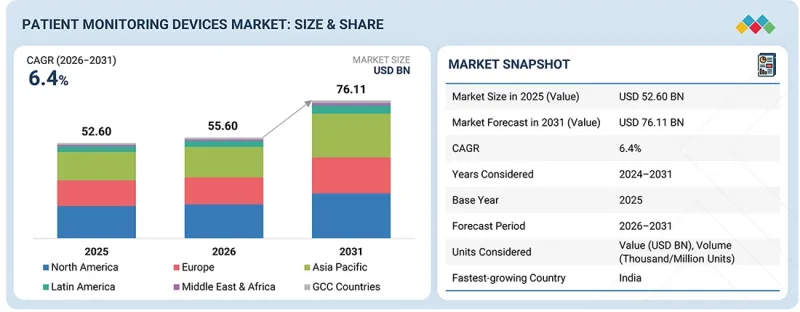
환자 모니터링 기기 시장 규모는 2026년 556억 달러에서 CAGR 6.4%로 확대하며, 2031년에는 761억 1,000만 달러에 달할 것으로 예측됩니다.
| 조사 범위 | |
|---|---|
| 조사 대상 기간 | 2026-2031년 |
| 기준연도 | 2025년 |
| 예측 기간 | 2026-2031년 |
| 단위 | 금액(달러) |
| 부문 | 제품, 최종사용자, 지역 |
| 대상 지역 | 북미, 유럽, 아시아태평양, 라틴아메리카, 중동 및 아프리카, GCC 국가 |
끊임없는 기술 혁신과 커넥티드 헬스케어 기술의 보급 확대가 환자 모니터링 기기 시장의 성장을 크게 견인하고 있습니다. 웨어러블 기기, 연속 혈당 모니터링(CGM), 원격 환자 모니터링 플랫폼, AI를 활용한 분석 기능 등 환자 모니터링 시스템의 발전으로 인해 실시간 건강 상태 추적, 임상적 의사결정 개선, 환자 예후 향상이 실현되고 있습니다. 이러한 기술은 지속적인 모니터링을 지원하고, 병원에 대한 의존도를 낮추며, 건강 상태의 악화를 조기에 감지할 수 있게 해줍니다. 또한 기기 설계의 혁신을 통해 콤팩트하고 무선이며 사용자 친화적인 시스템이 구현되어, 병원이나 재택 간호 현장에서 사용하기에 적합해졌습니다. 제조사들은 클라우드 연결, 모바일 앱, 예측 분석, 원격의료와의 호환성 등 스마트 기능을 점점 더 적극적으로 통합하고 있습니다. 이러한 지속적인 혁신의 순환은 기존 모니터링 시스템의 교체를 가속화하며, 첨단 환자 모니터링 기기에 대한 전 세계적 수요를 지속적으로 견인하고 있습니다.
제품별로는 혈당 모니터링 기기, 특히 연속 혈당 모니터링(CGM) 시스템이 성장을 주도하는 주요 하위 부문으로 자리 잡고 있습니다. 이 부문이 주도적인 위치를 차지하고 있는 주요 요인은 전 세계 당뇨병 유병률의 증가와 지속적인 질환 관리에 대한 수요의 증가입니다. CGM 및 웨어러블 혈당 모니터링 기기는 실시간 혈당 정보를 제공함으로써, 적시에 치료 결정을 내릴 수 있도록 지원하며, 환자의 예후를 개선합니다. 병원, 진료소, 재택 간호 등 각 현장에서의 도입이 활발한 데다, 예방 의료, 재택 모니터링, 스마트폰 연동, 커넥티드 헬스케어 플랫폼에 대한 수요가 증가함에 따라 혈당 모니터링 기기의 시장 입지는 계속해서 강화되고 있습니다.
최종사용자별로 살펴보면, 병원 및 진료소는 지속적인 환자 모니터링이 필요한 급성 및 만성질환 관리에서 핵심적인 역할을 수행하고 있으므로 환자 모니터링 기기 시장에서 가장 큰 점유율을 차지하고 있습니다. 이러한 의료 시설에서는 일반 병동, 중환자실(ICU), 응급·외상 센터에서 심박수, 혈압, 산소 포화도, 혈당치 등 중요한 생체 신호를 모니터링하기 위해 환자 모니터링 시스템이 일상적으로 활용되고 있습니다. 심혈관 질환, 당뇨병, 호흡기 질환의 유병률이 증가함에 따라 실시간 모니터링 및 조기 임상적 개입에 대한 수요가 크게 높아지고 있습니다. 또한 병원과 진료소는 첨단 의료 인프라, 숙련된 전문가, 연결형 모니터링 기술의 통합과 같은 이점을 누리고 있습니다. 응급의료 역량 및 디지털 헬스케어 솔루션에 대한 지속적인 투자가 환자 모니터링 장비의 도입을 더욱 촉진하고 있으며, 이를 통해 시장내 병원 및 진료소의 경쟁력을 강화하고 있습니다.
북미의 잘 갖춰진 의료 인프라는 환자 모니터링 기기의 광범위한 도입을 지원하는 데 있으며, 매우 중요한 역할을 하고 있습니다. 이 지역에는 급성 및 만성질환을 효율적으로 관리하기 위한 최신 모니터링 기술을 갖춘 병원, 전문 클리닉, 첨단 의료 시설로 구성된 광범위한 네트워크가 있습니다. 미국과 캐나다의 의료 시스템은 엄격한 임상 프로토콜, 높은 의료비 지출, 고도로 훈련된 전문가들을 특징으로 하며, 이를 통해 환자 모니터링 솔루션을 일상적인 진료에 원활하게 통합할 수 있습니다. 또한 연속 혈당 모니터링 시스템, 심장 모니터링 기기, 웨어러블 기술, 원격 환자 모니터링 플랫폼의 도입 확대가 조기 진단과 적시 개입을 지원하고 있습니다. 디지털 헬스 기술에 대한 정기적인 투자와 모니터링 시스템의 지속적인 업그레이드 또한 수요의 지속에 더욱 기여하고 있습니다. 견고한 의료 생태계 덕분에 여러 의료 현장에서 환자 모니터링 기기의 일관된 활용과 도입이 보장되고 있습니다.
이 보고서에서는 전 세계 환자 모니터링 기기 시장을 조사하여, 시장 개요, 시장 성장에 영향을 미치는 다양한 요인에 대한 분석, 기술 및 특허 동향, 법규제 환경, 사례 연구, 시장 규모 추이 및 전망, 각종 분류·지역/주요 국가별 상세 분석, 경쟁 현황, 주요 기업 개요 등을 정리하여 전해드립니다.
자주 묻는 질문
목차
제1장 서론
제2장 개요
제3장 주요 인사이트
제4장 시장 개요
제5장 업계 동향
제6장 기술의 진보, AI의 영향, 특허, 혁신, 향후 응용
제7장 규제 상황
제8장 고객 상황과 구매 행동
제9장 환자 모니터링 기기 시장 : 제품별
제10장 환자 모니터링 기기 시장 : 최종사용자별
제11장 환자 모니터링 기기 시장 : 지역별
제12장 경쟁 구도
제13장 기업 개요
제14장 조사 방법
제15장 부록
KSA 26.07.14The patient monitoring devices market is projected to reach USD 76.11 billion by 2031, up from USD 55.60 billion in 2026, at a CAGR of 6.4%.
| Scope of the Report | |
|---|---|
| Years Considered for the Study | 2026-2031 |
| Base Year | 2025 |
| Forecast Period | 2026-2031 |
| Units Considered | Value (USD billion) |
| Segments | Product, End user, and Region |
| Regions covered | North America, Europe, Asia Pacific, Latin America, Middle East & Africa, and GCC Countries |
Continuous technological innovation and increasing adoption of connected healthcare technologies are significantly driving growth in the patient monitoring devices market. Advancements in patient monitoring systems, including wearable devices, continuous glucose monitoring (CGM), remote patient monitoring platforms, and AI-enabled analytics, offer real-time health tracking, improved clinical decision-making, and enhanced patient outcomes. These technologies support continuous monitoring, reduce dependence on hospitals, and enable early detection of health deterioration. Additionally, innovations in device design have led to compact, wireless, and user-friendly systems, making them more suitable for hospital and home-care settings. Manufacturers are increasingly integrating smart features such as cloud connectivity, mobile applications, predictive analytics, and telehealth compatibility. This ongoing innovation cycle is accelerating the replacement of traditional monitoring systems and driving sustained global demand for advanced patient monitoring devices.
Based on product: The patient monitoring devices market includes multiparameter monitors, blood glucose monitoring devices (CGM and SMBG), wearable monitoring devices, EEG, EMG, ICP, ECG, ILR, MCT, pulse oximeters, fetal & neonatal monitors, blood pressure monitoring devices, hemodynamic monitoring systems, spirometers, and capnography devices. Among these, blood glucose monitoring devices, particularly continuous glucose monitoring (CGM) systems, represent a major growth-driving subsegment. The dominance of this segment is driven primarily by the rising global prevalence of diabetes and the growing need for continuous disease management. CGM and wearable glucose monitoring devices provide real-time glucose insights that support timely treatment decisions and improve patient outcomes. Strong adoption across hospitals, clinics, and home care settings, coupled with rising demand for preventive healthcare, home-based monitoring, smartphone connectivity, and connected healthcare platforms, continues to strengthen the market position of blood glucose monitoring devices.
Based on end user: Hospitals and clinics account for the largest share of the patient monitoring devices market due to their central role in managing acute and chronic conditions requiring continuous patient surveillance. These facilities routinely utilize patient monitoring systems across general wards, intensive care units (ICUs), and emergency & trauma centers to track critical parameters such as heart rate, blood pressure, oxygen saturation, and glucose levels. The growing prevalence of cardiovascular diseases, diabetes, and respiratory disorders has significantly increased demand for real-time monitoring and early clinical intervention. Additionally, hospitals and clinics benefit from advanced healthcare infrastructure, skilled professionals, and integration of connected monitoring technologies. Ongoing investments in critical care capabilities and digital healthcare solutions further drive the adoption of patient monitoring devices, reinforcing the dominance of hospitals and clinics in the market.
North America's well-developed healthcare infrastructure plays a crucial role in supporting the widespread adoption of patient monitoring devices. The region has an extensive network of hospitals, specialty clinics, and advanced care facilities equipped with modern monitoring technologies to efficiently manage acute and chronic conditions. Healthcare systems across the US and Canada are characterized by strong clinical protocols, high healthcare spending, and highly trained professionals, enabling seamless integration of patient monitoring solutions into routine care. Additionally, the growing adoption of continuous glucose monitoring systems, cardiac monitoring devices, wearable technologies, and remote patient monitoring platforms supports early diagnosis and timely intervention. Regular investments in digital health technologies and continuous upgrades of monitoring systems further contribute to sustained demand. The presence of a robust healthcare ecosystem ensures consistent utilization and adoption of patient monitoring devices across multiple care settings.
A breakdown of the primary respondents (supply-side) for the patient monitoring devices market referred to in this report is provided below:
- By Company Type: Tier 1: 40%, Tier 2: 30%, and Tier 3: 30%
- By Designation: C-level: 55%, Director Level: 27%, and Others: 18%
- By Region: North America: 34%, Europe: 27%, Asia Pacific: 30%, Latin America: 6%, Middle East & Africa: 2% and GCC Countries: 2%
Prominent players in the patient monitoring devices market include Medtronic Plc (Ireland), Abbott Laboratories (US), Dexcom, Inc. (US), GE HealthCare (US), Philips Healthcare (Netherlands), Nihon Kohden Corporation (Japan), Mindray Medical International Ltd. (China), Edwards Lifesciences Corporation (US), Getinge AB (Sweden), Baxter International Inc. (US), Dragerwerk AG & Co. KGaA (Germany), Boston Scientific Corporation (US), Masimo Corporation (US), Omron Corporation (Japan), ARCHIMED SAS (Natus Medical) (France), Compumedics Limited (Australia), and Nonin Medical, Inc. (US), among others.
Research Coverage
The report evaluates the patient monitoring devices market and estimates the market size and future growth potential of this market based on various segments, including product, end user, and region. The report also includes a competitive analysis of the major players in this market, along with company profiles, product offerings, recent developments, and key market strategies.
Reasons to Buy the Report
The report will assist market leaders and new entrants in the patient monitoring devices market with data on the nearest approximations of revenue figures for the overall market and its subsegments. The report will help stakeholders understand the competitive landscape and gain insights to better position their businesses and develop effective go-to-market strategies. It also enables stakeholders to understand market dynamics and provides insights into key drivers, restraints, challenges, and growth opportunities influencing the patient monitoring devices market.
This report provides insights into the following points:
- Analysis of key drivers (rising prevalence of chronic diseases such as diabetes and cardiovascular disorders, growing aging population requiring continuous monitoring and long-term healthcare management, increasing demand for remote patient monitoring and home healthcare solutions, rapid adoption of wearable and connected healthcare technologies, technological advancements in AI-enabled and cloud-integrated monitoring systems), restraints (high cost of advanced monitoring systems, data privacy and cybersecurity concerns, stringent regulatory approval requirements for medical devices), opportunities (expansion of remote patient monitoring platforms, development of low-cost and portable monitoring devices, growing adoption of home-based and preventive healthcare solutions), and challenges (limited healthcare infrastructure in developing regions, interoperability issues across connected monitoring platforms, reimbursement and adoption barriers in emerging markets)
- Product Enhancement/Innovation: Comprehensive details about product launches and anticipated trends in the global patient monitoring devices market.
- Market Development: Thorough knowledge and analysis of the profitable rising markets by product, end user, and region.
- Market Diversification: Comprehensive information about newly launched products, expanding markets, current advancements, and investments in the global patient monitoring devices market
- Competitive Assessment: Thorough evaluation of the market shares, growth plans, offerings, and capacities of the major competitors in the global patient monitoring devices market
TABLE OF CONTENTS
1 INTRODUCTION
- 1.1 STUDY OBJECTIVES
- 1.2 MARKET DEFINITION
- 1.3 STUDY SCOPE
- 1.3.1 MARKETS COVERED
- 1.3.2 INCLUSIONS AND EXCLUSIONS
- 1.3.3 YEARS CONSIDERED
- 1.3.4 CURRENCY CONSIDERED
- 1.4 STAKEHOLDERS
- 1.5 SUMMARY OF CHANGES
2 EXECUTIVE SUMMARY
- 2.1 KEY INSIGHTS AND MARKET HIGHLIGHTS
- 2.2 KEY MARKET PARTICIPANTS: SHARE INSIGHTS AND START DEVELOPMENTS
- 2.3 DISRUPTIVE TRENDS SHAPING MARKET
- 2.4 HIGH-GROWTH SEGMENTS & EMERGING FRONTIERS
- 2.5 SNAPSHOT: GLOBAL MARKET SIZE, GROWTH RATE, AND FORECAST
3 PREMIUM INSIGHTS
- 3.1 PATIENT MONITORING DEVICES MARKET OVERVIEW
- 3.2 NORTH AMERICA: PATIENT MONITORING DEVICES MARKET, BY PRODUCT AND COUNTRY (2025)
- 3.3 PATIENT MONITORING DEVICES MARKET: GEOGRAPHIC GROWTH OPPORTUNITIES
- 3.4 PATIENT MONITORING DEVICES MARKET, BY REGION (2024-2031)
- 3.5 PATIENT MONITORING DEVICES MARKET: DEVELOPED MARKETS VS. EMERGING ECONOMIES
4 MARKET OVERVIEW
- 4.1 INTRODUCTION
- 4.2 MARKET DYNAMICS
- 4.2.1 DRIVERS
- 4.2.1.1 Emergence of predictive analytics in vital sign monitors
- 4.2.1.2 Growing preference for wearable patient monitoring devices, biosensors, and smart implants
- 4.2.1.3 Availability of wireless monitoring devices
- 4.2.1.4 Expansion of telehealth services and remote monitoring capabilities
- 4.2.1.5 Growing incidence of chronic diseases
- 4.2.2 RESTRAINTS
- 4.2.2.1 Risks associated with invasive monitoring devices
- 4.2.2.2 High cost of patient monitoring products and inadequate reimbursement
- 4.2.3 OPPORTUNITIES
- 4.2.3.1 Integration with electronic health records (EHRs)
- 4.2.3.2 Expansion of remote patient monitoring in home healthcare settings
- 4.2.4 CHALLENGES
- 4.2.4.1 Lack of personnel and limited awareness & education for patient monitoring devices
- 4.2.4.2 Increased pricing pressure on market players
- 4.2.1 DRIVERS
- 4.3 UNMET NEEDS AND WHITE SPACES
- 4.3.1 UNMET NEEDS IN PATIENT MONITORING DEVICES MARKET
- 4.3.2 WHITE SPACE OPPORTUNITIES
- 4.4 INTERCONNECTED MARKETS AND CROSS-SECTOR OPPORTUNITIES
- 4.4.1 INTERCONNECTED MARKETS
- 4.4.2 CROSS-SECTOR OPPORTUNITIES
- 4.5 STRATEGIC MOVES BY TIER-1/2/3 PLAYERS
5 INDUSTRY TRENDS
- 5.1 PORTER'S FIVE FORCES ANALYSIS
- 5.1.1 THREAT OF NEW ENTRANTS
- 5.1.2 THREAT OF SUBSTITUTES
- 5.1.3 BARGAINING POWER OF SUPPLIERS
- 5.1.4 BARGAINING POWER OF BUYERS
- 5.1.5 INTENSITY OF COMPETITIVE RIVALRY
- 5.2 MACROECONOMIC OUTLOOK
- 5.2.1 INTRODUCTION
- 5.2.2 GDP TRENDS AND FORECAST
- 5.2.3 TRENDS IN GLOBAL PATIENT MONITORING DEVICES INDUSTRY
- 5.2.4 TRENDS IN GLOBAL HEALTHCARE & MEDICAL DEVICES INDUSTRY
- 5.3 SUPPLY CHAIN ANALYSIS
- 5.3.1 PROMINENT COMPANIES
- 5.3.2 SMALL & MEDIUM-SIZED COMPANIES
- 5.3.3 END USERS
- 5.4 VALUE CHAIN ANALYSIS
- 5.4.1 RESEARCH & DEVELOPMENT
- 5.4.2 PROCUREMENT AND PRODUCT DEVELOPMENT
- 5.4.3 MARKETING, SALES, DISTRIBUTION, AND POST-SALES SERVICES
- 5.5 ECOSYSTEM ANALYSIS
- 5.6 PRICING ANALYSIS
- 5.6.1 AVERAGE SELLING PRICE, BY PRODUCT (2025)
- 5.6.2 AVERAGE SELLING PRICE, BY REGION (2025)
- 5.7 TRADE ANALYSIS
- 5.7.1 IMPORT SCENARIO (HS CODE 9018)
- 5.7.2 EXPORT DATA (HS CODE 9018)
- 5.8 KEY CONFERENCES AND EVENTS, 2026-2027
- 5.9 TRENDS/DISRUPTIONS IMPACTING CUSTOMERS' BUSINESSES
- 5.10 INVESTMENT AND FUNDING SCENARIO
- 5.11 CASE STUDY ANALYSIS
- 5.11.1 CASE STUDY 1: SCALING REMOTE CARDIAC MONITORING
- 5.11.2 CASE STUDY 2: IMPROVING CHRONIC DISEASE MANAGEMENT THROUGH RPM
- 5.11.3 CASE STUDY 3: ENHANCING PATIENT SURVEILLANCE IN ACUTE CARE SETTINGS
- 5.12 IMPACT OF US TARIFFS-PATIENT MONITORING DEVICES MARKET
- 5.12.1 INTRODUCTION
- 5.12.2 KEY TARIFF RATES
- 5.12.3 PRICE IMPACT ANALYSIS
- 5.12.4 IMPACT ON COUNTRIES/REGIONS
- 5.12.4.1 North America
- 5.12.4.2 Europe
- 5.12.4.3 Asia Pacific
- 5.12.5 IMPACT ON END-USE INDUSTRIES
6 TECHNOLOGICAL ADVANCEMENTS, AI-DRIVEN IMPACT, PATENTS, INNOVATIONS, AND FUTURE APPLICATIONS
- 6.1 KEY EMERGING TECHNOLOGIES
- 6.1.1 SMART WEARABLE MONITORING DEVICES
- 6.1.2 VITAL SIGN MONITORS
- 6.2 COMPLEMENTARY TECHNOLOGIES
- 6.2.1 REMOTE PATIENT MONITORS
- 6.2.2 AI & IOT
- 6.3 TECHNOLOGY/PRODUCT ROADMAP
- 6.3.1 SHORT-TERM (2025-2027) | FOUNDATION & EARLY COMMERCIALIZATION
- 6.3.2 MID-TERM (2027-2030) | EXPANSION & STANDARDIZATION
- 6.3.3 LONG-TERM (2030-2035+) | MASS COMMERCIALIZATION & DISRUPTION
- 6.4 PATENT ANALYSIS
- 6.4.1 INSIGHTS: JURISDICTION AND TOP APPLICANT ANALYSIS
- 6.5 FUTURE APPLICATIONS
- 6.5.1 AI-ENABLED REMOTE PATIENT MONITORING & PREDICTIVE HEALTH ANALYTICS
- 6.5.2 HOME-BASED CHRONIC DISEASE MANAGEMENT & TELEHEALTH INTEGRATION
- 6.5.3 SMART HOSPITALS & INTEGRATED CLINICAL MONITORING NETWORKS
- 6.6 IMPACT OF AI/GEN AI ON PATIENT MONITORING DEVICES MARKET
- 6.6.1 TOP USE CASES AND MARKET POTENTIAL
- 6.6.2 CASE STUDIES OF AI IMPLEMENTATION IN PATIENT MONITORING DEVICES MARKET
- 6.6.3 INTERCONNECTED/ADJACENT ECOSYSTEMS AND IMPACT ON MARKET PLAYERS
- 6.6.4 CLIENTS' READINESS TO ADOPT GENERATIVE AI IN PATIENT MONITORING DEVICES MARKET
7 REGULATORY LANDSCAPE
- 7.1 REGIONAL REGULATIONS AND COMPLIANCE
- 7.1.1 REGULATORY BODIES, GOVERNMENT AGENCIES, AND OTHER ORGANIZATIONS
- 7.1.2 INDUSTRY STANDARDS
8 CUSTOMER LANDSCAPE & BUYER BEHAVIOR
- 8.1 DECISION-MAKING PROCESS
- 8.2 BUYER STAKEHOLDERS AND BUYING EVALUATION CRITERIA
- 8.2.1 KEY STAKEHOLDERS IN BUYING PROCESS
- 8.2.2 KEY BUYING CRITERIA
- 8.3 ADOPTION BARRIERS & INTERNAL CHALLENGES
- 8.4 UNMET NEEDS FROM VARIOUS END-USE INDUSTRIES
- 8.5 MARKET PROFITABILITY
- 8.5.1 REVENUE POTENTIAL
- 8.5.2 COST DYNAMICS
- 8.5.3 MARGIN OPPORTUNITIES IN KEY APPLICATIONS
9 PATIENT MONITORING DEVICES MARKET, BY PRODUCT
- 9.1 INTRODUCTION
- 9.2 BLOOD GLUCOSE MONITORING DEVICES
- 9.2.1 SELF-MONITORING BLOOD GLUCOSE DEVICES
- 9.2.1.1 Rising adoption of integrated glucose monitoring devices to drive growth
- 9.2.2 CONTINUOUS GLUCOSE MONITORING DEVICES
- 9.2.2.1 Product launches and evolving reimbursement scenarios for continuous monitoring devices to drive market growth
- 9.2.3 WEARABLE GLUCOSE MONITORING DEVICES
- 9.2.3.1 Growing patient inclination towards wearable monitors to boost the market
- 9.2.1 SELF-MONITORING BLOOD GLUCOSE DEVICES
- 9.3 CARDIAC MONITORING DEVICES
- 9.3.1 ECG DEVICES
- 9.3.1.1 Low cost and wide applications of ECG devices to drive market growth
- 9.3.2 IMPLANTABLE LOOP RECORDERS
- 9.3.2.1 High cost and limited applications to limit growth
- 9.3.3 EVENT MONITORS
- 9.3.3.1 Emergence of portable and wireless event monitors to drive market growth
- 9.3.4 MCT MONITORS
- 9.3.4.1 Availability of alternate technologies to hinder market growth
- 9.3.5 SMART/WEARABLE ECG MONITORS
- 9.3.5.1 Need to minimize treatment costs for CVD patients to increase adoption of smart/wearable ECG monitors
- 9.3.1 ECG DEVICES
- 9.4 MULTIPARAMETER MONITORING DEVICES
- 9.4.1 LOW-ACUITY MONITORS
- 9.4.1.1 Increasing adoption of low-acuity monitors in general wards to drive market growth
- 9.4.2 MID-ACUITY MONITORS
- 9.4.2.1 Rising geriatric population to increase market growth
- 9.4.3 HIGH-ACUITY MONITORS
- 9.4.3.1 Increasing partnerships between manufacturers and hospitals & clinics to drive device sales
- 9.4.1 LOW-ACUITY MONITORS
- 9.5 RESPIRATORY MONITORING DEVICES
- 9.5.1 PULSE OXIMETERS
- 9.5.1.1 Rising adoption of pulse oximeters in home care settings to drive market growth
- 9.5.2 SPIROMETERS
- 9.5.2.1 Technological advancements to increase adoption of spirometers
- 9.5.3 CAPNOGRAPHS
- 9.5.3.1 Product development and growing commercial acceptance to drive market growth
- 9.5.4 PEAK FLOW METERS
- 9.5.4.1 Low preference for peak flow meters due to high variability in measurements from different devices, to hinder market growth
- 9.5.1 PULSE OXIMETERS
- 9.6 TEMPERATURE MONITORING DEVICES
- 9.6.1 HANDHELD TEMPERATURE MONITORING DEVICES
- 9.6.1.1 Advantages associated with handheld temperature monitoring devices to drive market growth
- 9.6.2 TABLE-TOP TEMPERATURE MONITORING DEVICES
- 9.6.2.1 Increasing risks associated with hypothermia during surgeries to drive demand for table-top devices
- 9.6.3 WEARABLE CONTINUOUS MONITORING DEVICES
- 9.6.3.1 Versatile functionalities offered by wearable continuous monitoring devices to drive demand
- 9.6.4 INVASIVE TEMPERATURE MONITORING DEVICES
- 9.6.4.1 Risk of bloodstream infections associated with catheter usage to hinder market for invasive devices
- 9.6.5 SMART TEMPERATURE MONITORING PATCHES
- 9.6.5.1 Long-term monitoring capabilities of smart patches to drive market growth
- 9.6.1 HANDHELD TEMPERATURE MONITORING DEVICES
- 9.7 HEMODYNAMIC/PRESSURE MONITORING DEVICES
- 9.7.1 HEMODYNAMIC MONITORS
- 9.7.1.1 Influx of VC funding to drive market growth
- 9.7.2 BLOOD PRESSURE MONITORS
- 9.7.2.1 Development of wearable blood pressure monitors to drive market growth
- 9.7.3 DISPOSABLES
- 9.7.3.1 Growing number of surgical procedures to drive growth in disposables market
- 9.7.1 HEMODYNAMIC MONITORS
- 9.8 FETAL & NEONATAL MONITORING DEVICES
- 9.8.1 FETAL MONITORING DEVICES
- 9.8.1.1 Rising prevalence of obstetric complications to drive market growth
- 9.8.2 NEONATAL MONITORING DEVICES
- 9.8.2.1 Rising number of neonatal care facilities worldwide to drive market
- 9.8.1 FETAL MONITORING DEVICES
- 9.9 NEUROMONITORING DEVICES
- 9.9.1 EEG MACHINES
- 9.9.1.1 Growing applications and technological advancements to favor market growth
- 9.9.2 EMG MACHINES
- 9.9.2.1 Availability of reimbursements for EMG-assisted surgeries to boost product demand
- 9.9.3 CEREBRAL OXIMETERS
- 9.9.3.1 Growing cases of hypoxia during surgical procedures to drive market growth
- 9.9.4 ICP MONITORS
- 9.9.4.1 Growing incidence of post-surgical cerebrovascular complications and TBIs to support adoption of ICP monitors
- 9.9.5 MEG MACHINES
- 9.9.5.1 High implementation and maintenance costs of MEG devices hinder market growth
- 9.9.6 TCD MACHINES
- 9.9.6.1 Rising prevalence of strokes and cerebrovascular disorders to contribute to market growth
- 9.9.1 EEG MACHINES
- 9.10 WEIGHT MONITORING DEVICES
- 9.10.1 DIGITAL WEIGHT MONITORING DEVICES
- 9.10.1.1 Consumer preference for digital scales-a key market driver
- 9.10.2 ANALOG WEIGHT MONITORING DEVICES
- 9.10.2.1 Rising prevalence of obesity and low cost of analog scales to support market growth
- 9.10.1 DIGITAL WEIGHT MONITORING DEVICES
- 9.11 OTHER PATIENT MONITORING DEVICES
10 PATIENT MONITORING DEVICES MARKET, BY END USER
- 10.1 INTRODUCTION
- 10.2 HOSPITALS & CLINICS
- 10.2.1 ABILITY TO AFFORD HIGH INSTALLATION & MAINTENANCE COSTS OF PATIENT MONITORING TECHNOLOGIES TO BOOST MARKET
- 10.3 AMBULATORY SURGICAL CENTERS
- 10.3.1 COST-EFFECTIVENESS AND CONVENIENCE TO DRIVE DEMAND FOR AMBULATORY CARE
- 10.4 HOME CARE SETTINGS
- 10.4.1 REDUCED COST AND CONTINUOUS MONITORING OF VITAL INFORMATION IN HOME SETTINGS TO BOOST GROWTH
- 10.5 OTHER END USERS
11 PATIENT MONITORING DEVICES MARKET, BY REGION
- 11.1 INTRODUCTION
- 11.2 NORTH AMERICA
- 11.2.1 US
- 11.2.1.1 Growing number of FDA approvals for patient monitoring devices to support market growth
- 11.2.2 CANADA
- 11.2.2.1 Growing public-private funding for research to drive market growth
- 11.2.1 US
- 11.3 EUROPE
- 11.3.1 GERMANY
- 11.3.1.1 Rising healthcare expenditure and manufacturer expansion to boost market growth
- 11.3.2 UK
- 11.3.2.1 Increasing public & private investments to contribute to market growth
- 11.3.3 FRANCE
- 11.3.3.1 Statutory health insurance system to support market growth
- 11.3.4 ITALY
- 11.3.4.1 Rising incidence of lifestyle diseases to drive adoption of patient monitoring devices
- 11.3.5 SPAIN
- 11.3.5.1 Growing number of surgical procedures to drive market growth in Spain
- 11.3.6 REST OF EUROPE
- 11.3.1 GERMANY
- 11.4 ASIA PACIFIC
- 11.4.1 JAPAN
- 11.4.1.1 Large geriatric population and favorable reimbursement scenario to support market growth
- 11.4.2 CHINA
- 11.4.2.1 Growing focus of local and international market players to favor market growth
- 11.4.3 INDIA
- 11.4.3.1 Increasing government-implemented healthcare initiatives to support market growth
- 11.4.4 AUSTRALIA
- 11.4.4.1 R&D tax incentive program to support market growth
- 11.4.5 SOUTH KOREA
- 11.4.5.1 Supportive government initiatives to drive market growth
- 11.4.6 REST OF ASIA PACIFIC
- 11.4.1 JAPAN
- 11.5 LATIN AMERICA
- 11.5.1 BRAZIL
- 11.5.1.1 Brazil to dominate LATAM market
- 11.5.2 MEXICO
- 11.5.2.1 Favorable investment scenario for medical device manufacturers to drive market growth
- 11.5.3 REST OF LATIN AMERICA
- 11.5.1 BRAZIL
- 11.6 MIDDLE EAST & AFRICA
- 11.6.1 AWARENESS INITIATIVES TO DRIVE ADOPTION OF PATIENT MONITORING DEVICES
- 11.7 GCC COUNTRIES
- 11.7.1 HEALTHCARE DIGITALIZATION INITIATIVES TO ACCELERATE PATIENT MONITORING DEVICE ADOPTION IN GCC
12 COMPETITIVE LANDSCAPE
- 12.1 OVERVIEW
- 12.2 KEY PLAYER STRATEGIES/RIGHT TO WIN
- 12.3 REVENUE ANALYSIS
- 12.4 MARKET SHARE ANALYSIS
- 12.4.1 GLOBAL BLOOD GLUCOSE MONITORING DEVICES MARKET SHARE, BY KEY PLAYER, 2025
- 12.4.2 GLOBAL CARDIAC MONITORING DEVICES MARKET SHARE, BY KEY PLAYER, 2025
- 12.4.3 GLOBAL MULTIPARAMETER MONITORING DEVICES MARKET SHARE, BY KEY PLAYER, 2025
- 12.4.4 GLOBAL HEMODYNAMIC/PRESSURE MONITORING DEVICES MARKET SHARE, BY KEY PLAYER, 2025
- 12.4.5 GLOBAL FETAL & NEONATAL MONITORING DEVICES MARKET SHARE, BY KEY PLAYER, 2025
- 12.5 COMPANY EVALUATION MATRIX: KEY PLAYERS, 2025
- 12.5.1 STARS
- 12.5.2 EMERGING LEADERS
- 12.5.3 PERVASIVE PLAYERS
- 12.5.4 PARTICIPANTS
- 12.5.5 COMPANY FOOTPRINT: KEY PLAYERS, 2025
- 12.5.5.1 Company footprint
- 12.5.5.2 Region footprint
- 12.5.5.3 Product footprint
- 12.5.5.4 End-user footprint
- 12.6 COMPETITIVE EVALUATION MATRIX: STARTUPS/SMES, 2025
- 12.6.1 PROGRESSIVE COMPANIES
- 12.6.2 RESPONSIVE COMPANIES
- 12.6.3 DYNAMIC COMPANIES
- 12.6.4 STARTING BLOCKS
- 12.6.5 COMPETITIVE BENCHMARKING: STARTUPS/SMES, 2025
- 12.6.5.1 Detailed list of key startups/SMEs
- 12.6.5.2 Competitive benchmarking of key startups/SMEs, 2025
- 12.7 COMPANY VALUATION & FINANCIAL METRICS
- 12.8 BRAND/PRODUCT COMPARISON
- 12.9 COMPETITIVE SCENARIO
- 12.9.1 PRODUCT LAUNCHES & APPROVALS
- 12.9.2 DEALS
- 12.9.3 EXPANSIONS
13 COMPANY PROFILES
- 13.1 KEY PLAYERS
- 13.1.1 MEDTRONIC
- 13.1.1.1 Business overview
- 13.1.1.2 Products offered
- 13.1.1.3 Recent developments
- 13.1.1.3.1 Product launches & approvals
- 13.1.1.3.2 Deals
- 13.1.1.4 MnM view
- 13.1.1.4.1 Right to win
- 13.1.1.4.2 Strategic choices
- 13.1.1.4.3 Weaknesses and competitive threats
- 13.1.2 ABBOTT LABORATORIES
- 13.1.2.1 Business overview
- 13.1.2.2 Products offered
- 13.1.2.3 Recent developments
- 13.1.2.3.1 Product launches & approvals
- 13.1.2.3.2 Deals
- 13.1.2.4 MnM view
- 13.1.2.4.1 Right to win
- 13.1.2.4.2 Strategic choices
- 13.1.2.4.3 Weaknesses & competitive threats
- 13.1.3 DEXCOM, INC.
- 13.1.3.1 Business overview
- 13.1.3.2 Products offered
- 13.1.3.3 Recent developments
- 13.1.3.3.1 Product launches & approvals
- 13.1.3.3.2 Deals
- 13.1.3.4 MnM view
- 13.1.3.4.1 Right to win
- 13.1.3.4.2 Strategic choices
- 13.1.3.4.3 Weaknesses & competitive threats
- 13.1.4 GE HEALTHCARE
- 13.1.4.1 Business overview
- 13.1.4.2 Products offered
- 13.1.4.3 Recent developments
- 13.1.4.3.1 Product launches & approvals
- 13.1.4.3.2 Deals
- 13.1.4.4 MnM view
- 13.1.4.4.1 Right to win
- 13.1.4.4.2 Strategic choices
- 13.1.4.4.3 Weaknesses & competitive threats
- 13.1.5 PHILIPS HEALTHCARE
- 13.1.5.1 Business overview
- 13.1.5.2 Products offered
- 13.1.5.3 Recent developments
- 13.1.5.3.1 Product launches & approvals
- 13.1.5.3.2 Deals
- 13.1.5.4 MnM view
- 13.1.5.4.1 Right to win
- 13.1.5.4.2 Strategic choices
- 13.1.5.4.3 Weaknesses & competitive threats
- 13.1.6 NIHON KOHDEN CORPORATION
- 13.1.6.1 Business overview
- 13.1.6.2 Products offered
- 13.1.6.3 Recent developments
- 13.1.6.3.1 Product launches & approvals
- 13.1.6.3.2 Deals
- 13.1.7 MINDRAY MEDICAL INTERNATIONAL LTD.
- 13.1.7.1 Business overview
- 13.1.7.2 Products offered
- 13.1.7.3 Recent developments
- 13.1.7.3.1 Product launches & approvals
- 13.1.7.3.2 Deals
- 13.1.8 BD
- 13.1.8.1 Business overview
- 13.1.8.2 Products offered
- 13.1.9 GETINGE AB
- 13.1.9.1 Business overview
- 13.1.9.2 Products offered
- 13.1.9.3 Recent developments
- 13.1.9.3.1 Product launches, enhancements, and approvals
- 13.1.9.3.2 Deals
- 13.1.10 BAXTER INTERNATIONAL (HILL-ROM HOLDINGS, INC.)
- 13.1.10.1 Business overview
- 13.1.10.2 Products offered
- 13.1.11 DRAGERWERK AG & CO. KGAA
- 13.1.11.1 Business overview
- 13.1.11.2 Products offered
- 13.1.12 BOSTON SCIENTIFIC CORPORATION
- 13.1.12.1 Business overview
- 13.1.12.2 Products offered
- 13.1.12.3 Recent developments
- 13.1.12.3.1 Deals
- 13.1.13 MASIMO CORPORATION
- 13.1.13.1 Business overview
- 13.1.13.2 Products offered
- 13.1.14 OMRON CORPORATION
- 13.1.14.1 Business overview
- 13.1.14.2 Products offered
- 13.1.15 ARCHIMED SAS (NATUS MEDICAL)
- 13.1.15.1 Business overview
- 13.1.15.2 Products offered
- 13.1.15.3 Recent developments
- 13.1.15.3.1 Deals
- 13.1.16 COMPUMEDICS LIMITED
- 13.1.16.1 Business overview
- 13.1.16.2 Products offered
- 13.1.16.3 Recent developments
- 13.1.16.3.1 Deals
- 13.1.17 NONIN MEDICAL, INC.
- 13.1.17.1 Business overview
- 13.1.17.2 Products offered
- 13.1.17.3 Recent developments
- 13.1.17.3.1 Product launches & approvals
- 13.1.1 MEDTRONIC
- 13.2 OTHER PLAYERS
- 13.2.1 BIOTRONIK
- 13.2.2 SCHILLER AG
- 13.2.3 SENSEONICS
- 13.2.4 CARDIOMO
- 13.2.5 VITLS
- 13.2.6 NETEERA
- 13.2.7 QARDIO
- 13.2.8 VIVIFY HEALTH
- 13.2.9 IRHYTHM TECHNOLOGIES, INC.
- 13.2.10 OSYPKA MEDICAL
- 13.2.11 CARDINAL HEALTH
- 13.2.12 MERIT MEDICAL SYSTEMS
14 RESEARCH METHODOLOGY
- 14.1 RESEARCH DATA
- 14.1.1 SECONDARY DATA
- 14.1.1.1 Key data from secondary sources
- 14.1.2 PRIMARY DATA
- 14.1.2.1 Key data from primary sources
- 14.1.2.2 Key industry insights
- 14.1.1 SECONDARY DATA
- 14.2 MARKET SIZE ESTIMATION
- 14.3 MARKET BREAKDOWN AND DATA TRIANGULATION
- 14.4 MARKET SHARE ESTIMATION
- 14.5 STUDY ASSUMPTIONS
- 14.6 METHODOLOGY-RELATED LIMITATIONS
- 14.7 RESEARCH LIMITATIONS
- 14.8 RISK ASSESSMENT
15 APPENDIX
- 15.1 DISCUSSION GUIDE
- 15.2 KNOWLEDGESTORE: MARKETSANDMARKETS' SUBSCRIPTION PORTAL
- 15.3 CUSTOMIZATION OPTIONS
- 15.4 RELATED REPORTS
- 15.5 AUTHOR DETAILS


