
|
시장보고서
상품코드
2082815
바이오시뮬레이션 시장 예측(-2031년) : 단계, 모달리티, 용도, 적응증, 최종사용자별Biosimulation Market by Phase, Modality, Application, Indication, End User - Global Forecast to 2031 |
||||||

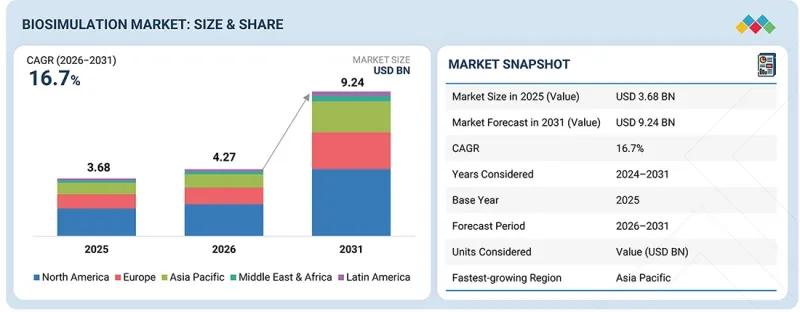
바이오시뮬레이션 시장 규모는 2026년 42억 7,000만 달러에서 2031년에는 92억 4,000만 달러에 달할 것으로 예측되고 있으며, 2026-2031년까지 CAGR은 16.7%에 달할 전망입니다.
바이오시뮬레이션 시장의 성장은 신약 및 의약품 개발의 복잡화, 연구개발(R&D) 생산성 향상에 대한 압박 증가, 예측 모델링 기법을 통해 후기 임상시험에서의 실패를 줄여야 할 필요성이 커짐에 따라 주도되고 있습니다. 제약 회사와 생명공학 기업은 비용이 많이 드는 실험실 연구나 임상 시험 단계로 화합물을 진행하기 전에, 의약품 후보 물질 평가, 투여 전략 최적화, 안전성 및 유효성 결과 예측, 규제 당국에 대한 신청 및 심사 지원을 목적으로 바이오시뮬레이션 기술을 점점 더 많이 활용하고 있습니다.
| 조사 범위 | |
|---|---|
| 조사 대상 기간 | 2026-2031년 |
| 기준연도 | 2025년 |
| 예측 기간 | 2026-2031년 |
| 단위 | 금액(달러) |
| 부문 | 제공, 단계, 모달리티, 용도, 치료 영역, 도입 형태, 최종사용자 |
| 대상 지역 | 북미, 유럽, 아시아태평양, 라틴아메리카, 중동 및 아프리카 |
또한 규제 당국은 모델 기반 의약품 개발(MIDD) 접근법을 점점 더 인정하고 있습니다. 2025년 1월, ICH(국제조화협의회)는 ‘모델을 활용한 의약품 개발에 관한 M15 지침’의 4단계 채택에 합의함으로써, 규제 당국에 대한 신청 및 의약품 개발 프로그램에서 모델링과 시뮬레이션을 적용하기 위한 조화로운 틀을 마련했습니다. 또한 제약 업계의 연구개발비 지속적 증가와 AI, 기계학습, 디지털 의약품 개발 기술의 도입 확대에 따라 첨단 바이오시뮬레이션 플랫폼에 대한 수요가 가속화되고 있습니다. 한편, 소프트웨어 도입 및 모델 개발에 따른 높은 비용, 데이터 품질 및 모델 검증과 관련된 과제, 숙련된 약리통계학자 및 계산과학자 인력 부족, 다양한 연구 환경 간의 통합이 복잡하다는 점 등이 시장 성장을 저해할 가능성이 있습니다.
'최종사용자별로는 제약·바이오기술 기업 부문이 2025년에 가장 큰 시장 점유율을 차지했습니다.'
이 부문이 주도적인 위치를 차지하게된 배경에는 신약 개발 효율 향상, 임상 성공 확률 제고, 그리고 점점 더 복잡해지는 치료 파이프라인 관리에 대한 수요 증가가 있습니다. 이러한 기관들은 화합물 스크리닝, 중개 연구, 노출-반응 분석, 임상시험 최적화, 규제 당국과의 협력을 지원하기 위해 바이오시뮬레이션 툴을 폭넓게 활용하고 있습니다. 바이오의약품, 유전자 치료, mRNA 기반 치료제, 정밀 의료와 같은 혁신적인 치료법에 대한 관심이 높아짐에 따라 첨단 모델링 및 시뮬레이션 기술에 대한 의존도는 더욱 커지고 있습니다. 또한 개발 중단률 감소, 시장 출시 기간 단축, 연구개발 투자 매출 극대화에 대한 수요가 높아짐에 따라 제약 및 생명공학 기업은 의약품 개발 과정의 여러 단계에 바이오시뮬레이션을 도입하도록 권장받고 있으며, 이는 시장내 최대 최종사용자 부문으로서의 입지를 공고히 하고 있습니다.
'도입 형태별로는 클라우드 기반 모델이 예측 기간 중 가장 빠른 성장세를 보일 것으로 전망됩니다.'
이러한 성장은 확장 가능한 컴퓨팅 자원, 공동 연구 환경, 첨단 모델링 및 시뮬레이션 기능에 대한 비용 효율적인 접근에 대한 수요가 증가함에 따라 주도되고 있습니다. 클라우드 기반 플랫폼을 통해 제약 회사 및 생명공학 기업은 온프레미스 인프라에 막대한 투자를 하지 않고도 PBPK 모델링, QSP, 분자 역학, AI를 활용한 신약 개발, 가상 환자 시뮬레이션과 같은 계산 부하가 높은 작업을 수행할 수 있게 됩니다. 또한 이러한 솔루션은 지역적으로 분산된 연구팀 간의 원활한 데이터 공유, 전 세계적인 공동 연구, 모델의 신속한 배포를 촉진합니다. 또한 AI, 기계학습, 고성능 컴퓨팅과 클라우드 환경 간의 통합이 진행됨에 따라 특히 유연성 향상과 운영 비용 절감을 추구하는 중소규모 조직을 중심으로 클라우드 기반 생물학적 시뮬레이션 플랫폼의 도입이 가속화되고 있습니다.
'아시아태평양은 예측 기간 중 가장 높은 성장률을 보일 것으로 예상됩니다.'
이러한 성장을 이끄는 주요 요인으로는 제약 및 생명공학 분야의 연구개발 활동 확대, AI를 활용한 신약 개발 기술의 도입 확대, 비용 대비 효과가 높은 신약 개발 전략에 대한 수요 증가, 계산생물학 및 정밀의학에 대한 투자 확대 등을 들 수 있습니다. 중국, 인도, 일본, 한국, 싱가포르 등의 국가들은 정부 주도의 혁신 프로그램, 바이오의약품 생산 능력 확대, 연구 워크플로우 전반에 걸친 첨단 모델링 및 시뮬레이션 툴의 활용 확대를 통해 생명과학 생태계를 강화하고 있습니다. 또한 전 세계 제약 기업, 수탁 연구 기관(CRO), 학술연구 기관의 입지가 강화되고 있는 점도 해당 지역내 바이오시뮬레이션 플랫폼 도입을 가속화하고 있습니다. 최근 동향 또한 이 지역의 활기를 여실히 보여주고 있습니다. 2025년 5월, Insilico Medicine은 AI를 활용한 신약 발굴 및 의약품 개발을 더욱 추진하기 위해 연구개발 사업의 글로벌 확장을 발표했으며, 아시아태평양은 계산 생명과학 및 바이오시뮬레이션 분야의 혁신을 주도하는 주요 거점으로서의 입지를 공고히 했습니다.
이 보고서에서는 전 세계 바이오시뮬레이션 시장을 조사하여, 시장 개요, 시장 성장에 영향을 미치는 다양한 요인에 대한 분석, 기술 및 특허 동향, 법규제 환경, 사례 연구, 시장 규모 추이 및 전망, 각종 분류·지역/주요 국가별 상세 분석, 경쟁 현황, 주요 기업 개요 등을 정리하여 전해드립니다.
자주 묻는 질문
목차
제1장 서론
제2장 개요
제3장 주요 인사이트
제4장 시장 개요
제5장 업계 동향
제6장 기술, 특허, 디지털 기술, AI의 도입에 의한 전략적 디스럽션
제7장 규제 상황
제8장 고객 상황과 구매 행동
제9장 바이오시뮬레이션 시장 : 제공별
제10장 바이오시뮬레이션 시장 : 단계별
제11장 바이오시뮬레이션 시장 : 모달리티별
제12장 바이오시뮬레이션 시장 : 용도별
제13장 바이오시뮬레이션 시장 : 치료 영역별
제14장 바이오시뮬레이션 시장 : 배포 모드별
제15장 바이오시뮬레이션 시장 : 최종사용자별
제16장 바이오시뮬레이션 시장 : 지역별
제17장 경쟁 구도
제18장 기업 개요
제19장 조사 방법
제20장 부록
KSA 26.07.14The biosimulation market is projected to reach USD 9.24 billion by 2031 from USD 4.27 billion in 2026, at a CAGR of 16.7% from 2026 to 2031. The growth of the biosimulation market is being driven by the increasing complexity of drug discovery and development, rising pressure to improve R&D productivity, and the growing need to reduce late-stage clinical failures through predictive modeling approaches. Pharmaceutical and biotechnology companies are increasingly utilizing biosimulation technologies to evaluate drug candidates, optimize dosing strategies, predict safety and efficacy outcomes, and support regulatory decision-making before advancing compounds into costly laboratory and clinical studies.
| Scope of the Report | |
|---|---|
| Years Considered for the Study | 2026-2031 |
| Base Year | 2025 |
| Forecast Period | 2026-2031 |
| Units Considered | Value (USD billion) |
| Segments | Offering, Phase of Development, Modality, Application, Therapeutic Area, Deployment Mode, End User |
| Regions covered | North America, Europe, Asia Pacific, Latin America, Middle East and Africa |
Furthermore, regulatory agencies are increasingly recognizing model-informed drug development (MIDD) approaches. In January '25, the International Council for Harmonisation (ICH) reached Step 4 adoption of the M15 Guideline on Model-Informed Drug Development, providing a harmonized framework for the application of modeling and simulation in regulatory submissions and drug development programs. In addition, continued growth in pharmaceutical R&D spending and the increasing adoption of artificial intelligence, machine learning, and digital drug development technologies are accelerating demand for advanced biosimulation platforms. However, market growth may be constrained by the high costs associated with software implementation and model development, challenges related to data quality and model validation, limited availability of skilled pharmacometricians and computational scientists, and integration complexities across diverse research environments.
"In 2025, the pharmaceutical & biotechnology companies segment accounted for the largest market share, by end user."
By end user, pharmaceutical and biotechnology companies represented the largest share of the biosimulation market in 2025. Their leadership stems from the growing need to improve drug development efficiency, increase the probability of clinical success, and manage increasingly complex therapeutic pipelines. These organizations extensively utilize biosimulation tools to support compound screening, translational research, exposure-response analysis, clinical trial optimization, and regulatory interactions. The rising focus on innovative modalities such as biologics, gene therapies, mRNA-based therapeutics, and precision medicine has further increased reliance on advanced modeling and simulation technologies. Moreover, the need to reduce attrition rates, accelerate time-to-market, and maximize returns on R&D investments has encouraged pharmaceutical and biotechnology companies to incorporate biosimulation across multiple stages of the drug development process, strengthening their position as the largest end-user segment in the market.
"The cloud-based models segment by deployment mode is expected to register the fastest growth during the forecast period."
By deployment mode, cloud-based solutions are expected to be the fastest-growing segment in the biosimulation market during the forecast period. This growth is driven by the increasing need for scalable computing resources, collaborative research environments, and cost-effective access to advanced modeling and simulation capabilities. Cloud-based platforms enable pharmaceutical and biotechnology companies to perform computationally intensive tasks such as PBPK modeling, QSP, molecular dynamics, AI-driven drug discovery, and virtual patient simulations without significant investments in on-premises infrastructure. These solutions also facilitate seamless data sharing, global collaboration, and faster model deployment across geographically distributed research teams. Furthermore, the growing integration of artificial intelligence, machine learning, and high-performance computing with cloud environments is accelerating the adoption of cloud-based biosimulation platforms, particularly among small and mid-sized organizations seeking greater flexibility and reduced operational costs.
"Asia Pacific is expected to witness the highest growth rate during the forecast period."
The Asia Pacific region is projected to experience the highest growth rate in the biosimulation market over the forecast period. Key factors driving this growth include expanding pharmaceutical and biotechnology R&D activities, increasing adoption of AI-driven drug discovery technologies, rising demand for cost-effective drug development strategies, and growing investments in computational biology and precision medicine. Countries such as China, India, Japan, South Korea, and Singapore are strengthening their life sciences ecosystems through government-backed innovation programs, expanding biopharmaceutical manufacturing capabilities, and the growing use of advanced modeling and simulation tools across research workflows. Furthermore, the increasing presence of global pharmaceutical companies, contract research organizations, and academic research institutes is accelerating the adoption of biosimulation platforms in the region. Recent developments also highlight the region's momentum; in May 2025, Insilico Medicine announced the global expansion of its research and development operations to further advance AI-powered drug discovery and development, reinforcing Asia Pacific's position as a key hub for innovation in computational life sciences and biosimulation.
The breakdown of primary participants is as mentioned below:
- By Company Type - Tier 1: 34%, Tier 2: 46%, and Tier 3: 20%
- By Designation - C-level: 35%, Director-level: 25%, and Others: 40%
- By Region - North America: 30%, Europe: 45%, Asia Pacific: 20%, Middle East & Africa: 3%, Latin America: 2%
Key Market Players
The key players in the biosimulation market include Certara (US), Dassault Systemes (France), Schrodinger, Inc. (US), Simulations Plus (US), and Advanced Chemistry Development, Inc. (Revvity) (Canada).
Research Coverage:
This research report categorizes the biosimulation market based on offering (software, services), phase of development (drug discovery, preclinical development, early clinical development, late clinical development, regulatory, commercial & market access), modality (antibody design, peptide discovery, enzyme engineering, bifunctional degraders, TCR modeling, others), application (molecular design & optimization, PK/PD modeling, PBPK modeling, quantitative systems pharmacology (QSP), ADME/toxicity prediction, clinical trial simulation, disease modeling, other applications), therapeutic area (oncology, cardiovascular diseases, neurological disorders, infectious diseases, metabolic & endocrine disorders, other therapeutic areas), deployment mode (on-premises models, cloud-based models, hybrid models), end user (pharmaceutical & biotechnology companies, contract research organizations, academic & research institutes, regulatory bodies, other end users), and region (North America, Europe, Asia Pacific, Latin America, Middle East and Africa). The scope of the report covers detailed information regarding the major factors, such as drivers, restraints, challenges, and opportunities, influencing the growth of the biosimulation market. A detailed analysis of the key industry players has been done to provide insights into their business overview, solutions, and services; key strategies; contracts, partnerships, agreements, new product & service launches, mergers & acquisitions; and recent developments associated with the biosimulation market. Competitive analysis of upcoming startups in the biosimulation market ecosystem is covered in this report.
Reasons to Buy the Report
This report will help established firms and new entrants/smaller firms to gauge the market's pulse, which, in turn, would help them gain a greater share of the market. Firms purchasing the report could use one or a combination of the following strategies to strengthen their positions in the market.
This report provides insights on:
- Analysis of key drivers (Increasing R&D investments in pharmaceutical and biotechnology industries, Growing adoption of biosimulation software by regulatory bodies, Integration of technologically advanced quantitative systems pharmacology (QSP), Need to curtail drug discovery and development costs), restraints (Lack of standardization, Data availability and quality), opportunities (Expansion into novel therapeutic modalities, Use of biosimulation solutions for pediatric drug development), and challenges (Difficulties in matching complexity of biological systems and processes, Shortage of biosimulation and modeling experts) influencing the growth of the biosimulation market.
- Product Development/Innovation: Detailed insights on upcoming technologies, research & development activities, and new product launches in the biosimulation market.
- Market Development: Comprehensive information on the lucrative emerging markets, offerings, phases of development, modalities, applications, therapeutic areas, deployment modes, end users, and regions.
- Market Diversification: Exhaustive information about the product portfolios, growing geographies, recent developments, and investments in the biosimulation market.
- Competitive Assessment: In-depth assessment of market shares, growth strategies, product offerings, and capabilities of the leading players, such as Certara (US), Dassault Systemes (France), Schrodinger, Inc. (US), Simulations Plus (US), Advanced Chemistry Development, Inc. (Revvity) (Canada), in the biosimulation market.
TABLE OF CONTENTS
1 INTRODUCTION
- 1.1 STUDY OBJECTIVES
- 1.2 MARKET DEFINITION
- 1.3 MARKET SCOPE
- 1.3.1 MARKET SEGMENTATION & REGIONAL SCOPE
- 1.3.2 INCLUSIONS & EXCLUSIONS
- 1.3.3 YEARS CONSIDERED
- 1.4 CURRENCY CONSIDERED
- 1.5 LIMITATIONS
- 1.6 STAKEHOLDERS
- 1.7 SUMMARY OF CHANGES
2 EXECUTIVE SUMMARY
- 2.1 KEY INSIGHTS AND MARKET HIGHLIGHTS
- 2.2 KEY MARKET PARTICIPANTS: SHARE INSIGHTS AND STRATEGIC DEVELOPMENTS
- 2.3 DISRUPTIVE TRENDS SHAPING THE MARKET
- 2.4 HIGH-GROWTH SEGMENTS & EMERGING FRONTIERS
- 2.5 SNAPSHOT: GLOBAL MARKET SIZE, GROWTH RATE, AND FORECAST
3 PREMIUM INSIGHTS
- 3.1 BIOSIMULATION MARKET OVERVIEW
- 3.2 BIOSIMULATION MARKET, BY OFFERING & REGION
- 3.3 BIOSIMULATION MARKET: GEOGRAPHIC SNAPSHOT
4 MARKET OVERVIEW
- 4.1 INTRODUCTION
- 4.2 MARKET DYNAMICS
- 4.2.1 DRIVERS
- 4.2.1.1 Increasing R&D investments in pharmaceutical and biotechnology industries
- 4.2.1.2 Growing adoption of biosimulation software by regulatory bodies
- 4.2.1.3 Integration of technologically advanced quantitative systems pharmacology
- 4.2.1.4 Need to curtail drug discovery and development costs
- 4.2.2 RESTRAINTS
- 4.2.2.1 Lack of standardization
- 4.2.2.2 Data availability and quality
- 4.2.3 OPPORTUNITIES
- 4.2.3.1 Expansion into novel therapeutic modalities
- 4.2.3.2 Use of biosimulation solutions for pediatric drug development
- 4.2.4 CHALLENGES
- 4.2.4.1 Difficulties in matching complexity of biological systems and processes
- 4.2.4.2 Shortage of biosimulation and modeling experts
- 4.2.1 DRIVERS
- 4.3 UNMET NEEDS AND WHITE SPACES
- 4.4 INTERCONNECTED MARKETS AND CROSS-SECTOR OPPORTUNITIES
- 4.5 STRATEGIC MOVES BY TIER-1/2/3 PLAYERS
5 INDUSTRY TRENDS
- 5.1 PORTER'S FIVE FORCES ANALYSIS
- 5.1.1 BARGAINING POWER OF SUPPLIERS
- 5.1.2 BARGAINING POWER OF BUYERS
- 5.1.3 THREAT OF SUBSTITUTES
- 5.1.4 THREAT OF NEW ENTRANTS
- 5.1.5 INTENSITY OF COMPETITIVE RIVALRY
- 5.2 MACROECONOMIC INDICATORS
- 5.2.1 INTRODUCTION
- 5.2.2 GDP TRENDS AND FORECAST
- 5.2.3 TRENDS IN GLOBAL HEALTHCARE IT INDUSTRY
- 5.3 VALUE CHAIN ANALYSIS
- 5.3.1 RESEARCH & PRODUCT DEVELOPMENT
- 5.3.2 DATA INPUTS & COMPUTATIONAL INFRASTRUCTURE
- 5.3.3 PLATFORM DEVELOPMENT AND INTEGRATION
- 5.3.4 DISTRIBUTION
- 5.3.5 MARKETING AND SALES
- 5.3.6 POST-SALES SERVICES
- 5.4 ECOSYSTEM ANALYSIS
- 5.5 PRICING ANALYSIS
- 5.5.1 INDICATIVE PRICE FOR BIOSIMULATION MARKET, BY OFFERING (2025)
- 5.5.2 INDICATIVE PRICE FOR BIOSIMULATION MARKET, BY REGION (2025)
- 5.6 KEY CONFERENCES AND EVENTS, 2026-2027
- 5.7 TRENDS/DISRUPTIONS IMPACTING CUSTOMER BUSINESS
- 5.8 INVESTMENT AND FUNDING SCENARIO
- 5.9 CASE STUDY ANALYSIS
- 5.10 IMPACT OF 2025 US TARIFF - BIOSIMULATION MARKET
- 5.10.1 INTRODUCTION
- 5.10.2 KEY TARIFF RATES
- 5.10.3 PRICE IMPACT ANALYSIS
- 5.10.4 IMPACT ON COUNTRY/REGION
- 5.10.4.1 US
- 5.10.4.2 Europe
- 5.10.4.3 Asia Pacific
- 5.10.5 IMPACT ON END-USE INDUSTRIES
- 5.10.5.1 Pharmaceutical and Biotechnology Companies
- 5.10.5.2 Contract Research Organizations
- 5.10.5.3 Academic & Research Institutes
- 5.10.5.4 Regulatory Bodies
- 5.10.5.5 Other End Users
6 STRATEGIC DISRUPTION THROUGH TECHNOLOGY, PATENTS, DIGITAL, AND AI ADOPTION
- 6.1 KEY EMERGING TECHNOLOGIES
- 6.1.1 MATHEMATICAL MODELING
- 6.1.2 POPULATION PK MODELING
- 6.1.3 MOLECULAR MODELING & SIMULATION
- 6.2 COMPLEMENTARY TECHNOLOGIES
- 6.2.1 DATA ANALYTICS
- 6.2.2 ARTIFICIAL INTELLIGENCE
- 6.3 ADJACENT TECHNOLOGIES
- 6.3.1 COMPUTATIONAL CHEMISTRY
- 6.3.2 AI-DRIVEN DRUG DISCOVERY
- 6.4 TECHNOLOGY/PRODUCT ROADMAP
- 6.5 PATENT ANALYSIS
- 6.5.1 PATENT PUBLICATION TRENDS FOR BIOSIMULATION MARKET
- 6.5.2 INSIGHTS: JURISDICTION AND TOP APPLICANT ANALYSIS
- 6.6 FUTURE APPLICATIONS
- 6.6.1 AI-ENABLED INTELLIGENT MODELING AND PREDICTION
- 6.6.2 VIRTUAL CLINICAL TRIALS AND DIGITAL PATIENT COHORTS
- 6.6.3 MULTI-SCALE BIOLOGICAL SYSTEMS SIMULATION
- 6.7 IMPACT OF AI/GEN AI ON BIOSIMULATION MARKET
- 6.7.1 INTRODUCTION
- 6.7.2 MARKET POTENTIAL OF AI/GEN AI IN BIOSIMULATION MARKET
- 6.7.3 CASE STUDIES RELATED TO AI/GEN AI IMPLEMENTATION
- 6.7.3.1 Artificial intelligence in drug discovery and development
- 6.7.4 IMPACT OF AI/GEN AI ON INTERCONNECTED AND ADJACENT ECOSYSTEMS
- 6.7.4.1 AI-Driven Drug Discovery Market
- 6.7.4.2 Digital Twin Healthcare Market
- 6.7.4.3 Real-World Evidence (RWE) Market
- 6.7.5 USER READINESS AND IMPACT ASSESSMENT
- 6.7.5.1 User readiness
- 6.7.5.1.1 User A: Pharmaceutical & biotechnology companies
- 6.7.5.1.2 User B: Contract research organizations (CROs)
- 6.7.5.2 Impact assessment
- 6.7.5.2.1 User A: Pharmaceutical & biotechnology companies
- 6.7.5.2.1.1 Implementation
- 6.7.5.2.1.2 Impact
- 6.7.5.2.2 User B: Contract research organizations
- 6.7.5.2.2.1 Implementation
- 6.7.5.2.2.2 Impact
- 6.7.5.2.1 User A: Pharmaceutical & biotechnology companies
- 6.7.5.1 User readiness
7 REGULATORY LANDSCAPE
- 7.1 REGIONAL REGULATIONS AND COMPLIANCE
- 7.1.1 REGULATORY BODIES, GOVERNMENT AGENCIES, & OTHER ORGANIZATIONS
- 7.1.2 REGULATORY FRAMEWORK
- 7.1.2.1 North America
- 7.1.2.2 Europe
- 7.1.2.3 Asia Pacific
- 7.1.2.4 Latin America
- 7.1.2.5 Middle East & Africa
- 7.1.3 INDUSTRY STANDARDS
8 CUSTOMER LANDSCAPE & BUYER BEHAVIOR
- 8.1 INTRODUCTION
- 8.2 DECISION-MAKING PROCESS
- 8.3 BUYER STAKEHOLDERS AND BUYING EVALUATION CRITERIA
- 8.3.1 KEY STAKEHOLDERS IN BUYING PROCESS
- 8.3.2 BUYING CRITERIA
- 8.4 ADOPTION BARRIERS & INTERNAL CHALLENGES
- 8.5 UNMET NEEDS FROM VARIOUS END-USE INDUSTRIES
- 8.5.1 UNMET NEEDS
- 8.5.2 END-USER EXPECTATIONS
- 8.6 MARKET PROFITABILITY
9 BIOSIMULATION MARKET, BY OFFERING
- 9.1 INTRODUCTION
- 9.2 SOFTWARE
- 9.2.1 AI-ENABLED PLATFORMS AND MODEL-INFORMED DRUG DEVELOPMENT DRIVE MARKET EXPANSION
- 9.3 SERVICES
- 9.3.1 CONSULTING & ADVISORY
- 9.3.1.1 Strategic R&D decision-making and biosimulation integration drive growth in consulting services
- 9.3.2 IMPLEMENTATION, TRAINING, AND SUPPORT
- 9.3.2.1 Growing enterprise-wide adoption of biosimulation platforms fuels demand
- 9.3.3 DATA ANALYSIS & INTERPRETATION
- 9.3.3.1 Expanding scientific data volumes and demand for actionable insights drive growth
- 9.3.1 CONSULTING & ADVISORY
10 BIOSIMULATION MARKET, BY PHASE OF DEVELOPMENT
- 10.1 INTRODUCTION
- 10.2 DRUG DISCOVERY
- 10.2.1 AI-DRIVEN MOLECULAR DESIGN AND VIRTUAL SCREENING STRENGTHEN BIOSIMULATION USE IN EARLY RESEARCH
- 10.3 PRECLINICAL DEVELOPMENT
- 10.3.1 GROWING EMPHASIS ON REDUCING ANIMAL TESTING AND IMPROVING TRANSLATIONAL PREDICTABILITY DRIVES BIOSIMULATION ADOPTION
- 10.4 EARLY CLINICAL DEVELOPMENT
- 10.4.1 RISING DEMAND FOR FIRST-IN-HUMAN DOSE OPTIMIZATION AND TRIAL DESIGN EFFICIENCY DRIVES BIOSIMULATION ADOPTION
- 10.5 LATE CLINICAL DEVELOPMENT
- 10.5.1 GROWING NEED FOR TRIAL OPTIMIZATION AND EVIDENCE GENERATION IN LARGE-SCALE STUDIES DRIVES BIOSIMULATION ADOPTION
- 10.6 REGULATORY
- 10.6.1 INCREASING USE OF QUANTITATIVE EVIDENCE IN REGULATORY SUBMISSIONS DRIVES BIOSIMULATION ADOPTION
- 10.7 COMMERCIAL & MARKET ACCESS
- 10.7.1 EXPANDING USE OF HEALTH ECONOMIC MODELING AND REAL-WORLD EVIDENCE ENHANCES MARKET ACCESS STRATEGIES
11 BIOSIMULATION MARKET, BY MODALITY
- 11.1 INTRODUCTION
- 11.2 ANTIBODY DESIGN
- 11.2.1 AI-BASED PROTEIN ENGINEERING AND RISING BIOLOGICS PIPELINES ACCELERATE BIOSIMULATION USE IN ANTIBODY DESIGN
- 11.3 PEPTIDE DISCOVERY
- 11.3.1 ADVANCEMENTS IN THERAPEUTIC PEPTIDE ENGINEERING AND AI-DRIVEN SEQUENCE OPTIMIZATION FUEL BIOSIMULATION ADOPTION
- 11.4 ENZYME ENGINEERING
- 11.4.1 INCREASING ADOPTION OF COMPUTATIONAL PROTEIN DESIGN ACCELERATES BIOSIMULATION USE IN ENZYME DEVELOPMENT
- 11.5 BIFUNCTIONAL DEGRADERS
- 11.5.1 RISING INTEREST IN TARGETED PROTEIN DEGRADATION DRIVES BIOSIMULATION ADOPTION
- 11.6 TCR MODELING
- 11.6.1 EXPANDING CELL THERAPY RESEARCH AND PRECISION IMMUNOTHERAPY DEVELOPMENT DRIVE ADOPTION
- 11.7 OTHER MODALITIES
- 11.7.1 ADVANCES IN COMPUTATIONAL DRUG DESIGN AND NEXT-GENERATION NUCLEIC ACID THERAPIES EXPAND APPLICATIONS
12 BIOSIMULATION MARKET, BY APPLICATION
- 12.1 INTRODUCTION
- 12.2 MOLECULAR DESIGN & OPTIMIZATION
- 12.2.1 AI-ENABLED MOLECULAR GENERATION AND CLOUD-BASED DESIGN PLATFORMS ACCELERATE LEAD OPTIMIZATION
- 12.3 PK/PD MODELING
- 12.3.1 INCREASING FOCUS ON EXPOSURE-RESPONSE UNDERSTANDING AND PRECISION DOSING EXPANDS PK/PD MODELING ADOPTION
- 12.4 PBPK MODELING
- 12.4.1 GROWING NEED FOR PREDICTIVE HUMAN PHARMACOKINETIC ASSESSMENTS DRIVES ADOPTION OF PBPK MODELING
- 12.5 QUANTITATIVE SYSTEMS PHARMACOLOGY
- 12.5.1 INCREASING FOCUS ON MECHANISTIC DISEASE UNDERSTANDING AND PRECISION THERAPEUTICS DRIVES ADOPTION
- 12.6 ADME/TOXICITY PREDICTION
- 12.6.1 GROWING EMPHASIS ON EARLY SAFETY ASSESSMENT AND CANDIDATE QUALITY IMPROVEMENT DRIVES ADME/TOXICITY MODELING ADOPTION
- 12.7 CLINICAL TRIAL SIMULATION
- 12.7.1 INCREASING CLINICAL TRIAL VOLUMES AND STUDY COMPLEXITY DRIVE ADOPTION OF SIMULATION-BASED DEVELOPMENT STRATEGIES
- 12.8 DISEASE MODELING
- 12.8.1 GROWING FOCUS ON PRECISION MEDICINE AND MECHANISTIC UNDERSTANDING OF COMPLEX DISEASES DRIVES ADOPTION
- 12.9 OTHER APPLICATIONS
- 12.9.1 ADVANCEMENTS IN SYSTEMS-LEVEL BIOLOGICAL ANALYSIS AND FORMULATION OPTIMIZATION EXPAND BIOSIMULATION APPLICATIONS
13 BIOSIMULATION MARKET, BY THERAPEUTIC AREA
- 13.1 INTRODUCTION
- 13.2 ONCOLOGY
- 13.2.1 EXPANDING PRECISION ONCOLOGY RESEARCH AND RISING CANCER TRIAL ACTIVITY ACCELERATE BIOSIMULATION ADOPTION
- 13.3 CARDIOVASCULAR DISEASES
- 13.3.1 RISING BURDEN OF CARDIOVASCULAR DISORDERS AND EXPANSION OF LARGE-SCALE OUTCOME TRIALS DRIVE BIOSIMULATION ADOPTION
- 13.4 NEUROLOGICAL DISORDERS
- 13.4.1 HIGH CNS TRIAL FAILURE AND ACCESS BARRIERS STRENGTHEN NEED FOR BIOSIMULATION IN NEUROLOGY DEVELOPMENT
- 13.5 INFECTIOUS DISEASES
- 13.5.1 PERSISTENT GLOBAL DISEASE BURDEN AND OUTBREAK PREPAREDNESS NEEDS DRIVE BIOSIMULATION ADOPTION
- 13.6 METABOLIC & ENDOCRINE DISORDERS
- 13.6.1 RISING DIABETES AND OBESITY BURDEN EXPANDS NEED FOR SIMULATION-DRIVEN METABOLIC DRUG DEVELOPMENT
- 13.7 OTHER THERAPEUTIC AREAS
- 13.7.1 EXPANSION OF RARE DISEASE, IMMUNOLOGY, RESPIRATORY, GASTROINTESTINAL, AND RENAL DRUG DEVELOPMENT BROADENS BIOSIMULATION APPLICATIONS
14 BIOSIMULATION MARKET, BY DEPLOYMENT MODE
- 14.1 INTRODUCTION
- 14.2 ON-PREMISES
- 14.2.1 ESTABLISHED INFRASTRUCTURE AND DATA GOVERNANCE REQUIREMENTS SUSTAIN ADOPTION
- 14.3 CLOUD-BASED MODELS
- 14.3.1 SCALABLE COMPUTING INFRASTRUCTURE AND AI-DRIVEN RESEARCH WORKFLOWS ACCELERATE CLOUD ADOPTION
- 14.4 HYBRID MODELS
- 14.4.1 BALANCING SECURITY AND SCALABILITY ENCOURAGES ADOPTION OF HYBRID DEPLOYMENT STRATEGIES
15 BIOSIMULATION MARKET, BY END USER
- 15.1 INTRODUCTION
- 15.2 PHARMACEUTICAL & BIOTECHNOLOGY COMPANIES
- 15.2.1 HIGH R&D SPENDING AND EXPANDING DRUG PIPELINES DRIVE BIOSIMULATION ADOPTION AMONG PHARMA & BIOTECH COMPANIES
- 15.3 CONTRACT RESEARCH ORGANIZATIONS
- 15.3.1 GROWING OUTSOURCING OF DRUG DEVELOPMENT ACTIVITIES EXPANDS BIOSIMULATION ADOPTION AMONG CROS
- 15.4 CONSULTING SERVICE COMPANIES
- 15.4.1 EXPANDING COMPUTATIONAL RESEARCH AND PUBLIC FUNDING INITIATIVES SUPPORT BIOSIMULATION ADOPTION IN ACADEMIA
- 15.5 REGULATORY BODIES
- 15.5.1 GROWING ACCEPTANCE OF MODEL-INFORMED EVIDENCE STRENGTHENS BIOSIMULATION ADOPTION AMONG REGULATORY AGENCIES
- 15.6 OTHER END USERS
- 15.6.1 EXPANDING USE OF COMPUTATIONAL MODELING BEYOND TRADITIONAL DRUG DEVELOPMENT BROADENS BIOSIMULATION ADOPTION
16 BIOSIMULATION MARKET, BY REGION
- 16.1 INTRODUCTION
- 16.2 NORTH AMERICA
- 16.2.1 MACROECONOMIC OUTLOOK FOR NORTH AMERICA
- 16.2.2 US
- 16.2.2.1 Regulatory science and AI-driven innovation accelerate biosimulation adoption
- 16.2.3 CANADA
- 16.2.3.1 Expanding computational drug research strengthens biosimulation adoption
- 16.3 EUROPE
- 16.3.1 MACROECONOMIC OUTLOOK FOR EUROPE
- 16.3.2 GERMANY
- 16.3.2.1 Strong pharmaceutical research base drives advanced modeling adoption
- 16.3.3 FRANCE
- 16.3.3.1 Biopharma innovation and research commercialization support market expansion
- 16.3.4 UK
- 16.3.4.1 Regulatory innovation and AI drug discovery accelerate adoption
- 16.3.5 ITALY
- 16.3.5.1 Research modernization efforts create opportunities for computational development
- 16.3.6 SPAIN
- 16.3.6.1 Expanding clinical trial leadership creates need for development efficiency
- 16.3.7 REST OF EUROPE
- 16.4 ASIA PACIFIC
- 16.4.1 CLINICAL TRIAL INITIATIONS IN ASIA PACIFIC (2014 AND 2024)
- 16.4.2 MACROECONOMIC OUTLOOK FOR ASIA PACIFIC
- 16.4.3 CHINA
- 16.4.3.1 AI-driven drug discovery reshapes pharmaceutical development strategies
- 16.4.4 JAPAN
- 16.4.4.1 Demographic pressures and innovation efficiency drive biosimulation adoption
- 16.4.5 INDIA
- 16.4.5.1 Cost-efficient innovation and clinical research expansion support growth
- 16.4.6 AUSTRALIA
- 16.4.6.1 Translational research ecosystem supports advanced development approaches
- 16.4.7 SOUTH KOREA
- 16.4.7.1 Government-led biotechnology ambitions accelerate digital drug development
- 16.4.8 REST OF ASIA PACIFIC
- 16.5 LATIN AMERICA
- 16.5.1 MACROECONOMIC OUTLOOK FOR LATIN AMERICA
- 16.5.2 BRAZIL
- 16.5.2.1 Leading Regional Clinical Research Activity Drives Modeling Adoption
- 16.5.3 MEXICO
- 16.5.3.1 Nearshoring Trends Strengthen Pharmaceutical Development Capabilities
- 16.5.4 REST OF LATIN AMERICA
- 16.6 MIDDLE EAST & AFRICA
- 16.6.1 MACROECONOMIC OUTLOOK FOR MIDDLE EAST & AFRICA
- 16.6.2 GCC COUNTRIES
- 16.6.2.1 National biotechnology strategies accelerate computational drug development
- 16.6.3 SAUDI ARABIA
- 16.6.3.1 Vision 2030 investments accelerate biotechnology and research capabilities
- 16.6.4 UAE
- 16.6.4.1 Innovation ecosystems and cross-border collaboration support growth
- 16.6.5 OTHER GCC COUNTRIES
- 16.6.6 SOUTH AFRICA
- 16.6.6.1 Growing clinical research activities and pharmaceutical innovation support biosimulation adoption
- 16.6.7 REST OF MIDDLE EAST & AFRICA
17 COMPETITIVE LANDSCAPE
- 17.1 OVERVIEW
- 17.2 KEY PLAYER STRATEGIES/RIGHT TO WIN
- 17.2.1 OVERVIEW OF STRATEGIES ADOPTED BY KEY PLAYERS IN BIOSIMULATION MARKET
- 17.3 REVENUE SHARE ANALYSIS OF TOP MARKET PLAYERS
- 17.4 MARKET SHARE ANALYSIS, 2025
- 17.5 BRAND COMPARISON
- 17.6 VALUATION & FINANCIAL METRICS
- 17.6.1 FINANCIAL METRICS
- 17.6.2 COMPANY VALUATION
- 17.7 COMPANY EVALUATION MATRIX, KEY PLAYERS (2025)
- 17.7.1 STARS
- 17.7.2 EMERGING LEADERS
- 17.7.3 PERVASIVE PLAYERS
- 17.7.4 PARTICIPANTS
- 17.8 COMPANY FOOTPRINT: KEY PLAYERS, 2025
- 17.8.1 COMPANY FOOTPRINT
- 17.8.1.1 Region footprint
- 17.8.1 COMPANY FOOTPRINT
- 17.9 COMPANY EVALUATION MATRIX: STARTUPS/SMES, 2025
- 17.9.1 PROGRESSIVE COMPANIES
- 17.9.2 RESPONSIVE COMPANIES
- 17.9.3 DYNAMIC COMPANIES
- 17.9.4 STARTING BLOCKS
- 17.9.5 COMPETITIVE BENCHMARKING: STARTUPS/SMES, 2025
- 17.9.5.1 Detailed list of key startups/SMEs
- 17.9.5.2 Competitive benchmarking of startups/SMEs
- 17.10 COMPETITIVE SCENARIO
- 17.10.1 PRODUCT/SERVICE LAUNCHES & APPROVALS
- 17.10.2 DEALS
- 17.10.3 OTHER DEVELOPMENTS
18 COMPANY PROFILES
- 18.1 KEY PLAYERS
- 18.1.1 CERTARA
- 18.1.1.1 Business overview
- 18.1.1.2 Products & services offered
- 18.1.1.3 Recent developments
- 18.1.1.3.1 Product launches & enhancements
- 18.1.1.3.2 Deals
- 18.1.1.3.3 Other developments
- 18.1.1.4 MnM view
- 18.1.1.4.1 Right to win
- 18.1.1.4.2 Strategic choices
- 18.1.1.4.3 Weaknesses & competitive threats
- 18.1.2 DASSAULT SYSTEMES
- 18.1.2.1 Business overview
- 18.1.2.2 Products & services offered
- 18.1.2.3 Recent developments
- 18.1.2.3.1 Product launches & enhancements
- 18.1.2.3.2 Deals
- 18.1.2.3.3 Other developments
- 18.1.2.4 MnM view
- 18.1.2.4.1 Right to win
- 18.1.2.4.2 Strategic choices
- 18.1.2.4.3 Weaknesses & competitive threats
- 18.1.3 SCHRODINGER, INC.
- 18.1.3.1 Business overview
- 18.1.3.2 Products & services offered
- 18.1.3.3 Recent developments
- 18.1.3.3.1 Product launches & enhancements
- 18.1.3.3.2 Deals
- 18.1.3.3.3 Other developments
- 18.1.3.4 MnM view
- 18.1.3.4.1 Right to win
- 18.1.3.4.2 Strategic choices
- 18.1.3.4.3 Weaknesses & competitive threats
- 18.1.4 SIMULATIONS PLUS
- 18.1.4.1 Business overview
- 18.1.4.2 Products & services offered
- 18.1.4.3 Recent Developments
- 18.1.4.3.1 Product launches & enhancements
- 18.1.4.3.2 Deals
- 18.1.4.3.3 Other developments
- 18.1.4.4 MnM view
- 18.1.4.4.1 Right to win
- 18.1.4.4.2 Strategic choices
- 18.1.4.4.3 Weaknesses & competitive threats
- 18.1.5 GENEDATA AG (A DANAHER COMPANY)
- 18.1.5.1 Business overview
- 18.1.5.2 Products & services offered
- 18.1.5.3 Recent developments
- 18.1.5.3.1 Product launches & enhancements
- 18.1.5.3.2 Deals
- 18.1.5.4 MnM view
- 18.1.5.4.1 Right to win
- 18.1.5.4.2 Strategic choices
- 18.1.5.4.3 Weaknesses & competitive threats
- 18.1.6 ADVANCED CHEMISTRY DEVELOPMENT, INC.
- 18.1.6.1 Business overview
- 18.1.6.2 Products & Services Offered
- 18.1.6.3 Recent developments
- 18.1.6.3.1 Product launches & enhancements
- 18.1.6.3.2 Deals
- 18.1.7 CHEMICAL COMPUTING GROUP ULC
- 18.1.7.1 Business overview
- 18.1.7.2 Products & services offered
- 18.1.7.3 Recent developments
- 18.1.7.3.1 Product launches & enhancements
- 18.1.7.3.2 Other developments
- 18.1.8 PHYSIOMICS PLC
- 18.1.8.1 Business overview
- 18.1.8.2 Products & services offered
- 18.1.8.3 Recent developments
- 18.1.8.3.1 Product launches & enhancements
- 18.1.8.3.2 Other developments
- 18.1.9 INSILICO MEDICINE
- 18.1.9.1 Business overview
- 18.1.9.2 Products & services offered
- 18.1.9.3 Recent developments
- 18.1.9.3.1 Product launches & enhancements
- 18.1.9.3.2 Deals
- 18.1.10 ROSA & CO. LLC
- 18.1.10.1 Business overview
- 18.1.10.2 Products & services offered
- 18.1.10.3 Recent developments
- 18.1.10.3.1 Deals
- 18.1.11 AITIA
- 18.1.11.1 Business overview
- 18.1.11.2 Products & services offered
- 18.1.11.3 Recent developments
- 18.1.11.3.1 Deals
- 18.1.12 INSTEM PLC
- 18.1.12.1 Business overview
- 18.1.12.2 Products & services offered
- 18.1.12.3 Recent developments
- 18.1.12.3.1 Product enhancements
- 18.1.12.3.2 Deals
- 18.1.13 ALLUCENT
- 18.1.13.1 Business overview
- 18.1.13.2 Products & services offered
- 18.1.13.3 Recent developments
- 18.1.13.3.1 Deals
- 18.1.13.3.2 Other developments
- 18.1.14 OPENEYE, CADENCE MOLECULAR SCIENCES
- 18.1.14.1 Business overview
- 18.1.14.2 Products & services offered
- 18.1.14.3 Recent developments
- 18.1.14.3.1 Product enhancements
- 18.1.14.3.2 Deals
- 18.1.14.3.3 Expansions
- 18.1.15 THE MATHWORKS, INC.
- 18.1.15.1 Business overview
- 18.1.15.2 Products & services offered
- 18.1.15.3 Recent developments
- 18.1.15.3.1 Product enhancements
- 18.1.16 VERISIM LIFE
- 18.1.16.1 Business overview
- 18.1.16.2 Products & services offered
- 18.1.16.3 Recent developments
- 18.1.16.3.1 Product launches & enhancements
- 18.1.16.3.2 Deals
- 18.1.16.3.3 Other developments
- 18.1.17 NETABOLICS
- 18.1.17.1 Business overview
- 18.1.17.2 Products & services offered
- 18.1.18 CHARNWOOD DISCOVERY
- 18.1.18.1 Business overview
- 18.1.18.2 Products & services offered
- 18.1.18.3 Recent developments
- 18.1.18.3.1 Deals
- 18.1.19 CELLWORKS GROUP, INC.
- 18.1.19.1 Business overview
- 18.1.19.2 Products & services offered
- 18.1.19.3 Recent developments
- 18.1.19.3.1 Product launches & enhancements
- 18.1.19.3.2 Other developments
- 18.1.20 IN SILICO BIOSCIENCES
- 18.1.20.1 Business overview
- 18.1.20.2 Products & services offered
- 18.1.1 CERTARA
- 18.2 OTHER PLAYERS
- 18.2.1 NOVA
- 18.2.2 INSITRO
- 18.2.3 SCM - SOFTWARE CHEMISTRY & MATERIALS
- 18.2.4 BIOSYMETRICS, INC.
- 18.2.5 METRUM RESEARCH GROUP
19 RESEARCH METHODOLOGY
- 19.1 RESEARCH APPROACH
- 19.1.1 SECONDARY RESEARCH
- 19.1.1.1 Key data from secondary sources
- 19.1.2 PRIMARY RESEARCH
- 19.1.2.1 Primary sources
- 19.1.2.2 Key data from primary sources
- 19.1.2.3 Breakdown of primaries
- 19.1.2.4 Insights from primary experts
- 19.1.1 SECONDARY RESEARCH
- 19.2 RESEARCH METHODOLOGY
- 19.3 MARKET SIZE ESTIMATION
- 19.4 MARKET BREAKDOWN DATA TRIANGULATION
- 19.5 MARKET SHARE ESTIMATION
- 19.6 STUDY ASSUMPTIONS
- 19.7 RESEARCH LIMITATIONS
- 19.7.1 METHODOLOGY-RELATED LIMITATIONS
- 19.8 RISK ASSESSMENT
20 APPENDIX
- 20.1 DISCUSSION GUIDE
- 20.2 KNOWLEDGESTORE: MARKETSANDMARKETS' SUBSCRIPTION PORTAL
- 20.3 CUSTOMIZATION OPTIONS
- 20.4 RELATED REPORTS
- 20.5 AUTHOR DETAILS


