

|
시장보고서
상품코드
2082820
자율주행 지게차 시장(-2033년) : 적재량(3톤 미만, 3-5톤, 5톤 이상), 내비게이션 방식(레이저, 비전, 광학 테이프, 자기, SLAM, 인유도형 가이던스), 판매채널, 용도, 최종사용자 산업, 지게차 유형, 추진, 컴포넌트, 지역별Autonomous Forklift Market by Tonnage (<3, 3-5, >5), Navigation (Laser, Vision, Optical Tape, Magnetic, SLAM, Inductive Guidance), Sales Channel, Application, End-use Industry, Forklift Type, Propulsion, Component, and Region - Global Forecast to 2033 |
||||||

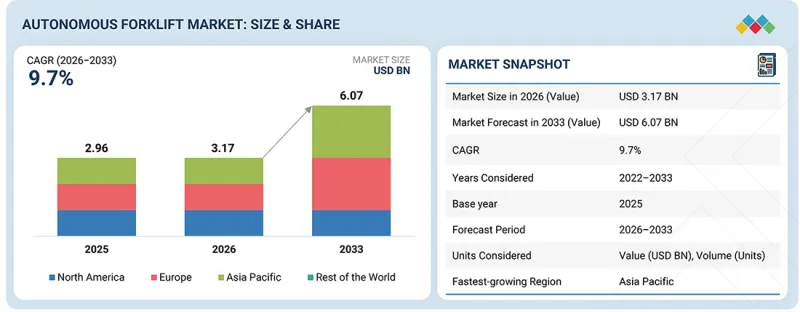
자율주행 지게차 시장 규모는 2026년 31억 7,000만 달러에서 2033년에는 60억 7,000만 달러로 성장할 것으로 예측되고 있어 2026년부터 2033년까지 연평균 복합 성장률(CAGR)은 9.7%를 기록할 전망입니다.
창고에서 고층 랙 보관 시스템, AS/RS 인프라, 협폭 통로 레이아웃이 도입되는 가운데, 자율 주행 지게차는 공간 활용도를 극대화하는 데 있어 매우 중요한 역할을 하고 있습니다. 정확하고 일관된 자재 운반 작업을 수행할 수 있는 능력 덕분에 실수를 최소화하고 업무 효율을 높일 수 있으므로, 자율 주행 지게차는 현대의 자동화 창고 환경에서 최적의 솔루션으로 자리 잡고 있습니다.
| 조사 범위 | |
|---|---|
| 조사 대상 기간 | 2026-2033년 |
| 기준연도 | 2025년 |
| 예측 기간 | 2026-2033년 |
| 단위 | 달러 |
| 부문 | 적재량, 내비게이션 방식, 판매채널, 용도, 최종사용자 산업, 지게차 유형, 추진, 컴포넌트, 지역 |
| 대상 지역 | 아시아태평양, 유럽, 북미, 기타 지역 |
AI를 활용한 내비게이션, 센서 기술, 배터리 시스템 등의 기술 덕분에 내부 물류 업무의 운영 효율이 향상되고 있습니다. 전자상거래 및 물류 업무가 대규모로 확대되는 가운데, 기업들은 처리 능력 향상, 공간 활용도 개선, 창고 업무의 지속적인 운영을 지원하기 위해 이러한 솔루션을 도입하고 있습니다.
'전자상거래 및 물류 부문의 성장이 자율주행 지게차의 도입을 주도할 것입니다.'
전자상거래 및 물류 부문은 자율주행 지게차가 가장 많이 도입되는 분야 중 하나입니다. 이는 주문 피킹, 크로스 도킹, 재고 관리, 계절적 수요 관리 등 창고 업무 전반에 걸쳐 폭넓게 활용될 수 있기 때문입니다. 전자상거래 풀필먼트 센터나 대규모 물류 허브에서 자율 주행 지게차는 자재의 이동, 보관, 출고 과정의 효율을 높여줍니다. 재고 보충 및 이송 작업을 자동화함으로써, 이러한 시스템은 주문 처리 속도 향상, 재고 정확도 제고, 업무상 실수 감소, 혼잡한 창고 환경에서의 동선 개선에 기여합니다. 반품 물량이 증가함에 따라 효율적인 역물류 업무의 필요성이 높아지고 있는 가운데, 자율주행 지게차는 반품 상품의 이동, 분류, 재입고를 신속하게 처리하는 동시에 인력 의존도와 업무상의 병목 현상을 완화합니다.
또한, 이러한 자율 주행 지게차에는 첨단 센서, 카메라, 지능형 소프트웨어가 탑재되어 있어 이동 경로, 사이클 타임, 자재 이동 패턴 등의 운영 데이터를 지속적으로 수집합니다. 이러한 실시간 가시성을 통해 전자상거래 및 물류 센터의 창고 관리자는 정보에 기반한 의사결정을 내리고, 업무 흐름을 최적화하며, 자원 활용 효율을 높일 수 있습니다. 데이터에 기반한 인사이트를 활용함으로써, 창고는 업무를 합리화하고, 생산성을 높이며, 재고 정확도를 향상시키고, 변화하는 고객 수요에 보다 효과적으로 대응할 수 있게 됩니다. 이처럼 자율 주행 지게차는 더욱 스마트하고 효율적이며 반응성이 뛰어난 창고 운영을 구축하기 위한 전략적 도구로 기능하고 있으며, 예측 기간 동안 전자상거래 및 물류 센터에서 도입 규모가 더욱 확대될 것으로 전망됩니다.
'실내용 자율 주행 지게차가 가장 큰 시장 점유율을 차지할 것으로 예측됩니다.'
실내용 자율 주행 지게차는 효율적인 팔레트 이동, 재고 추적성, 공간의 효율적 활용이 극히 중요한 전자상거래 물류 센터, 소매 유통 허브, 식음료 창고, 제약 시설, 제3자 물류(3PL) 사업 분야에서 급속히 보급되고 있습니다. 도입의 대부분은 3톤 미만 부문, 특히 팔레트 잭과 팔레트 스태커에 집중되어 있습니다. 이러한 차량은 고밀도 창고 환경에서 빈번하게 이루어지는 자재 이동, 보충, 입고, 출고 작업에 가장 적합하기 때문입니다. LiDAR, 레이저 유도, 비전 기반 내비게이션, SLAM과 같은 기술은 창고 운영자가 실시간으로 의사결정을 내릴 수 있도록 지원합니다. 이러한 내비게이션 시스템을 통해 정확한 위치 파악, 실시간 장애물 감지, 좁은 통로나 복잡한 창고 구조 내에서의 효율적인 이동이 가능해집니다. 또한, 창고 관리 시스템, 자동 창고 시스템, 차량 관리 플랫폼과의 원활한 통합을 통해 재고 정확도 향상, 자재 흐름의 최적화, 창고 업무 전반에 걸친 운영상의 병목 현상 해소에도 기여하고 있습니다.
아시아태평양은 중국, 일본, 인도의 전자상거래 및 물류 인프라의 급속한 확장에 힘입어 계속해서 주요 성장 지역으로 자리매김하고 있습니다. 실내용 자율 주행 지게차를 도입하는 기업들은 안전성과 효율성을 저해하지 않으면서 창고의 처리 능력 향상, 보관 용량 극대화, 24시간 운영 지원에 점점 더 주력하고 있습니다. 창고 자동화가 지속적으로 발전함에 따라, 실내용 자율 주행 지게차는 현대 창고 환경에서 생산성 향상, 운영의 일관성 제고, 확장 가능한 자재 이송을 실현하기 위한 핵심 요소로 부상하고 있습니다.
'아시아태평양이 2033년에는 자율주행 지게차 시장을 주도할 전망입니다.'
아시아태평양은 2033년까지 자율주행 지게차 시장을 주도하며, 전 세계 수요의 35-40% 이상을 차지할 것으로 예측됩니다. 이 지역의 선도적 지위는 중국, 일본, 한국, 인도에서 전자상거래 물류 센터의 급속한 확대, 창고 자동화에 대한 투자 증가, 스마트 제조 기법의 보급 확대에 힘입어 유지되고 있습니다. 창고 내 주문 처리량이 증가하고 자재 흐름이 더욱 복잡해지는 가운데, 기업들은 처리 능력 향상, 재고 이동 최적화, 24시간 운영 지원을 목적으로 자율 주행 지게차를 도입하고 있습니다.
또한, 이 지역에는 Toyota Material Handling, Mitsubishi Logisnext, Hangcha Group, Anhui Heli, Multiway Robotics 등 자율 주행 지게차 제조업체와 기술 제공업체가 다수 위치해 있습니다. 이 기업들은 AI 기반 내비게이션, 차량 관리 플랫폼, 창고 자동화 솔루션에 대한 투자를 지속하고 있습니다. 이러한 점들을 고려할 때, 예측 기간 동안 아시아태평양은 자율 주행 지게차 시장의 주요 성장 지역으로 자리매김할 것으로 예측됩니다.
본 보고서에서는 전 세계 자율 주행 지게차 시장을 조사했으며, 시장 개요, 시장 성장에 영향을 미치는 다양한 요인에 대한 분석, 기술 및 특허 동향, 법규제 환경, 사례 연구, 시장 규모 추이 및 전망, 각종 분류·지역/주요 국가별 상세 분석, 경쟁 현황, 주요 기업 프로파일 등을 정리했습니다.
자주 묻는 질문
목차
제1장 서론
제2장 주요 요약
제3장 프리미엄 인사이트
제4장 시장 개요
제5장 업계 동향
제6장 기술 진보, AI의 영향, 특허, 혁신, 향후 전략적 응용
제7장 규제 상황
제8장 고객 현황과 구매 행동
제9장 자율주행 지게차 시장 : 적재량별
제10장 자율주행 지게차 시장 : 용도별
제11장 자율주행 지게차 시장 : 최종사용자 산업별
제12장 자율주행 지게차 시장 : 지게차 유형별
제13장 자율주행 지게차 시장 : 동력별
제14장 자율주행 지게차 시장 : 내비게이션 기술별
제15장 자율주행 지게차 시장 : 판매채널별
제16장 자율주행 지게차 시장 : 유형별
제17장 자율주행 지게차 시장 : 컴포넌트별
제18장 자율주행 지게차 시장 : 지역별
제19장 경쟁 구도
제20장 기업 개요
제21장 조사 방법
제22장 부록
LSH 26.07.14The autonomous forklift market is projected to grow from USD 3.17 billion in 2026 to USD 6.07 billion by 2033, at a CAGR of 9.7% from 2026 to 2033. As warehouses adopt high-rack storage systems, AS/RS infrastructure, and narrow-aisle configurations, autonomous forklifts play a critical role in maximizing space utilization. Their ability to perform precise, consistent material-handling tasks helps minimize errors and improve operational efficiency, making them a preferred solution for modern automated warehouse environments.
| Scope of the Report | |
|---|---|
| Years Considered for the Study | 2026-2033 |
| Base Year | 2025 |
| Forecast Period | 2026-2033 |
| Units Considered | USD Billion |
| Segments | Tonnage, Navigation, Sales Channel, Application, End-use Industry, Forklift Type, Propulsion, Component, and Region |
| Regions covered | Asia Pacific, Europe, North America, Rest of the World |
Technologies such as AI-based navigation, sensor technologies, and battery systems are improving operational efficiency for intralogistics operations. As e-commerce and logistics operations are expanding on a large scale, businesses are adopting these solutions to support higher throughput, better space utilization, and continuous warehouse operations.
"Rising E-commerce and logistics sector to drive the adoption of autonomous forklifts."
The e-commerce and logistics sector is one of the largest adopters of autonomous forklifts, owing to their extensive applications across warehouse operations such as order picking, cross-docking, inventory handling, and seasonal demand management. In e-commerce, fulfillment centers and large distribution hubs, autonomous forklifts improve the efficiency of material movement, storage, and retrieval processes. By automating stock replenishment and transportation tasks, these systems help accelerate order fulfillment, enhance inventory accuracy, reduce operational errors, and improve traffic flow in busy warehouse environments. The growing volume of product returns is increasing the need for efficient reverse logistics operations, where autonomous forklifts help accelerate the movement, sorting, and restocking of returned goods while reducing labor dependency and operational bottlenecks. Furthermore, these autonomous forklifts are installed with advanced sensors, cameras, and intelligent software that continuously collect operational data, including travel routes, cycle times, and material movement patterns. This real-time visibility enables warehouse managers in e-commerce & distribution centers to make informed decisions, optimize workflows, and improve resource utilization. By leveraging data-driven insights, warehouses can streamline operations, enhance productivity, increase inventory accuracy, and respond more effectively to changing customer demands. Thus, autonomous forklifts serve as a strategic tool for building smarter, more efficient, and highly responsive warehouse operations and would continue to find a larger installation base in the e-commerce & logistics centers during the forecast period.
"Indoor autonomous forklifts are expected to account for the largest market share."
Indoor autonomous forklifts are witnessing strong adoption across e-commerce fulfillment centers, retail distribution hubs, food & beverage warehouses, pharmaceutical facilities, and third-party logistics operations, where efficient pallet movement, inventory traceability, and space utilization are critical. The majority of deployments are concentrated in the below 3-ton segment, particularly pallet jacks and pallet stackers, as these vehicles are ideally suited for high-frequency material movement, replenishment, put-away, and retrieval operations within high-density warehouse environments. Technologies such as LiDAR, laser guidance, vision-based navigation, and SLAM support warehouse operators in making real-time decisions. These navigation systems enable precise positioning, real-time obstacle detection, and efficient movement through narrow aisles and complex warehouse layouts. Their seamless integration with warehouse management systems, automated storage and retrieval systems, and fleet management platforms helps improve inventory accuracy, optimize material flow, and reduce operational bottlenecks across warehouse operations.
Asia Pacific remains the key growth region, driven by rapid expansion of e-commerce and logistics infrastructure across China, Japan, and India. Companies deploying indoor autonomous forklifts are increasingly focused on improving warehouse throughput, maximizing storage capacity, and supporting round-the-clock operations without compromising safety or efficiency. As warehouse automation continues to evolve, indoor autonomous forklifts are emerging as a critical enabler of higher productivity, improved operational consistency, and scalable material handling across modern warehouse environments.
"The Asia Pacific will dominate the autonomous forklift market in 2033."
Asia Pacific is expected to lead the autonomous forklift market by 2033, accounting for over 35-40% of global demand. The region's leadership is driven by the rapid expansion of e-commerce fulfillment centers, rising investments in warehouse automation, and growing adoption of smart manufacturing practices across China, Japan, South Korea, and India. As warehouses handle higher order volumes and more complex material flows, businesses are deploying autonomous forklifts to improve throughput, optimize inventory movement, and support round-the-clock operations. The region also benefits from the strong presence of autonomous forklift manufacturers and technology providers, including Toyota Material Handling, Mitsubishi Logisnext, Hangcha Group, Anhui Heli, and Multiway Robotics, which continue to invest in AI-enabled navigation, fleet management platforms, and warehouse automation solutions. In addition, the growing adoption of warehouse management systems, automated storage and retrieval systems, and connected logistics infrastructure is accelerating the deployment of autonomous forklifts across warehousing, manufacturing, food & beverage, and logistics applications. As a result, Asia Pacific is expected to remain the primary growth region for the autonomous forklift market during the forecast period.
The breakup of primary respondents
- By Company: OEM - 70%, Tier-1 - 30%
- By Designation: CXOs - 20%, Directors - 30%, and Others - 50%
- By Region: Asia Pacific - 40%, Europe - 30%, and North America - 30%
The autonomous forklift market comprises prominent players such as Toyota Industries Corporation (Japan), KION GROUP AG (Germany), Mitsubishi Logisnext Co., Ltd (France), Jungheinrich AG (Germany), and Hyster-Yale Materials Handling (US).
Research Coverage:
The study segments the autonomous forklift market and forecasts the market size based on tonnage capacity (<3, 3-5, >5), navigation technology (laser, vision, optical tape, magnetic, inductive guidance, SLAM), sales channel (in-house purchase, lease), application, end-use industry, type (indoor, outdoor), forklift type (pallet jacks, pallet stackers), propulsion, component, and region (North America, Europe, Asia Pacific, and Rest of the World).
The study also includes an in-depth competitive analysis of the key players in the market, their company profiles, key observations related to product and business offerings, recent developments, and key market strategies.
The report provides insights on the following pointers:
- Analysis of key drivers (warehouse labor shortages and shift toward autonomous material handling, expansion of e-commerce and logistics fulfillment centers driving 24/7 automation and higher asset utilization, and advancements in AI-based navigation and infrastructure-free deployment), restraints (high initial capital investment and integration costs), opportunities (AI-enabled fleet management and smart warehouse ecosystems and expansion of smart factories and data-driven intralogistics operations), challenges (scalability and operational flexibility in dynamic environments and high integration complexity and facility digitalization requirements).
- Product Development/Innovation: Detailed insights on upcoming technologies, research & development activities, and new product & service launches in the Autonomous Forklift market.
- Market Development: Comprehensive information about lucrative markets - the report analyses the autonomous forklift market across different regions.
- Market Diversification: Exhaustive information about new products & services, untapped geographies, recent developments, and investments in the autonomous forklift market.
- Competitive Assessment: In-depth assessment of market shares, growth strategies, and service offerings of leading players like Toyota Industries Corporation (Japan), KION Group AG (Germany), Mitsubishi Logisnext Co Ltd (France), Jungheinrich AG (Germany), and Hyster-Yale Materials Handling (US) in the autonomous forklift market.
TABLE OF CONTENTS
1 INTRODUCTION
- 1.1 STUDY OBJECTIVES
- 1.2 MARKET DEFINITION
- 1.2.1 INCLUSIONS AND EXCLUSIONS
- 1.3 STUDY SCOPE
- 1.3.1 MARKETS COVERED AND REGIONAL SCOPE
- 1.3.2 YEARS CONSIDERED
- 1.4 CURRENCY CONSIDERED
- 1.5 UNITS CONSIDERED
- 1.6 STAKEHOLDERS
- 1.7 SUMMARY OF CHANGES
2 EXECUTIVE SUMMARY
- 2.1 MARKET HIGHLIGHTS AND KEY INSIGHTS
- 2.2 KEY MARKET PARTICIPANTS: MAPPING OF STRATEGIC DEVELOPMENTS
- 2.3 DISRUPTIVE TRENDS FOR AUTONOMOUS FORKLIFT MARKETS
- 2.4 HIGH-GROWTH SEGMENTS IN AUTONOMOUS FORKLIFT MARKETS
- 2.5 REGIONAL SNAPSHOT: MARKET SIZE, GROWTH RATE, AND FORECAST
3 PREMIUM INSIGHTS
- 3.1 ATTRACTIVE OPPORTUNITIES FOR PLAYERS IN AUTONOMOUS FORKLIFT MARKET
- 3.2 AUTONOMOUS FORKLIFT MARKET, BY TONNAGE CAPACITY
- 3.3 AUTONOMOUS FORKLIFT MARKET, BY SALES CHANNEL
- 3.4 AUTONOMOUS FORKLIFT MARKET, BY APPLICATION
- 3.5 AUTONOMOUS FORKLIFT MARKET, BY TYPE
- 3.6 AUTONOMOUS FORKLIFT MARKET, BY FUEL SOURCE
- 3.7 AUTONOMOUS FORKLIFT MARKET, BY NAVIGATION TECHNOLOGY
- 3.8 AUTONOMOUS FORKLIFT MARKET, BY END-USE INDUSTRY
- 3.9 AUTONOMOUS FORKLIFT MARKET, BY FORKLIFT TYPE
- 3.10 AUTONOMOUS FORKLIFT MARKET, BY REGION
4 MARKET OVERVIEW
- 4.1 INTRODUCTION
- 4.2 MARKET DYNAMICS
- 4.2.1 DRIVERS
- 4.2.1.1 Warehouse Labor Shortages and Shift Toward Autonomous Material Handling
- 4.2.1.2 Expansion of E-commerce and Logistics Fulfillment Centers Driving 24/7 Automation and Higher Asset Utilization
- 4.2.1.3 Advancements in AI-based Navigation and Infrastructure-free Deployment
- 4.2.2 RESTRAINTS
- 4.2.2.1 High Initial Capital Investment and Integration Costs
- 4.2.3 OPPORTUNITIES
- 4.2.3.1 AI-enabled Fleet Management and Smart Warehouse Ecosystems
- 4.2.3.2 Expansion of Smart Factories and Data-driven Intralogistics Operations
- 4.2.4 CHALLENGES
- 4.2.4.1 Scalability and Operational Flexibility in Dynamic Environments
- 4.2.4.2 High Integration Complexity and Facility Digitalization Requirement
- 4.2.1 DRIVERS
- 4.3 UNMET NEEDS AND WHITE SPACES
- 4.4 INTERCONNECTED MARKETS AND CROSS-SECTOR OPPORTUNITIES
- 4.5 STRATEGIC MOVES BY TIER-1/2/3 PLAYERS
5 INDUSTRY TRENDS
- 5.1 MACROECONOMIC OUTLOOK
- 5.1.1 INTRODUCTION
- 5.1.2 GDP TRENDS AND FORECAST
- 5.1.3 TRENDS IN GLOBAL AUTONOMOUS FORKLIFT INDUSTRY
- 5.1.3.1 AI-powered Perception and Adaptive Navigation
- 5.1.3.2 Integration into Connected Warehouse Ecosystems
- 5.1.3.3 Expansion of High-throughput Fulfillment Centers
- 5.1.3.4 Electrification and Sustainable Material Handling
- 5.1.3.5 Expansion Beyond Traditional Warehousing
- 5.2 SUPPLY CHAIN ANALYSIS
- 5.2.1 COMPONENT & TECHNOLOGY SUPPLIERS
- 5.2.2 SOFTWARE & NAVIGATION PLATFORM PROVIDERS
- 5.2.3 AUTONOMOUS FORKLIFT OEMS & SYSTEM INTEGRATORS
- 5.2.4 END USERS & SERVICE PROVIDERS
- 5.3 PRICING ANALYSIS
- 5.3.1 BY AUTONOMOUS FORKLIFT TYPE
- 5.3.2 BY REGION
- 5.3.3 ASIA PACIFIC AVERAGE SELLING PRICE
- 5.3.4 EUROPE AVERAGE SELLING PRICE
- 5.3.5 NORTH AMERICA AVERAGE SELLING PRICE
- 5.4 TRADE ANALYSIS
- 5.4.1 IMPORT SCENARIO OF AUTONOMOUS FORKLIFT (HS CODE 842710)
- 5.4.2 EXPORT SCENARIO OF AUTONOMOUS FORKLIFT (HS CODE 842710)
- 5.5 KEY CONFERENCES AND EVENTS, 2026-2027
- 5.6 TRENDS AND DISRUPTIONS IMPACTING CUSTOMER BUSINESS
- 5.7 INVESTMENT AND FUNDING SCENARIO
- 5.8 TOTAL COST OF OWNERSHIP
- 5.9 CASE STUDY ANALYSIS
- 5.9.1 ENHANCING GLASS TRANSPORT EFFICIENCY WITH SCOTT AUTOMATION'S LASER-GUIDED TUGGER
- 5.9.2 STREAMLINING OPERATIONS IN AUTO PARTS MANUFACTURING WITH WELLWIT'S AUTOMATED GUIDED VEHICLE SOLUTION
- 5.9.3 OPTIMIZING MATERIAL HANDLING IN CHEMICAL INDUSTRY WITH WELLWIT'S AUTOMATED GUIDED VEHICLE SOLUTION
- 5.9.4 REPLACING AGING AUTONOMOUS FLOOR-TO-FLOOR MATERIAL HANDLING SYSTEMS WITH COMPACT AUTONOMOUS TUGGERS LINE
- 5.9.5 L'OREAL IMPLEMENTING AUTONOMOUS FORKLIFTS BY DEMATIC TO REDUCE DELIVERY TIME
- 5.9.6 PANASONIC ENERGY IMPLEMENTING AUTOMATED STACKERS, TRUCKS, AND RACKING SYSTEMS BY TOYOTA
- 5.9.7 WALMART DEPLOYS FOX ROBOTICS AUTONOMOUS FORKLIFTS TO AUTOMATE LOADING DOCK OPERATIONS
- 5.9.8 DHL IMPLEMENTS FOXBOT AUTONOMOUS FORKLIFTS TO AUTOMATE TRAILER UNLOADING
- 5.9.9 HOLMAN LOGISTICS DEPLOYS THIRD WAVE AUTOMATION AUTONOMOUS HIGH-REACH FORKLIFTS
- 5.10 ECOSYSTEM ANALYSIS
- 5.11 OEM ANALYSIS
- 5.11.1 OEM VS. TONNAGE CAPACITY
- 5.11.2 DISTRIBUTION OF AUTONOMOUS FORKLIFTS BASED ON TONNAGE CAPACITY
- 5.11.3 OEM VS NAVIGATION TECHNOLOGY
- 5.12 FLEET OWNERSHIP MODELS
- 5.12.1 DIRECT OWNERSHIP
- 5.12.2 LEASING
- 5.12.3 ROBOTICS-AS-A-SERVICE
- 5.12.4 MANAGED FLEET SERVICES
- 5.13 AI & SOFTWARE ECOSYSTEM ANALYSIS OF AUTONOMOUS FORKLIFT
- 5.13.1 FLEET MANAGEMENT PLATFORMS
- 5.13.2 WAREHOUSE MANAGEMENT SYSTEM (WMS) INTEGRATION
- 5.13.3 AI-BASED TRAFFIC OPTIMIZATION
- 5.13.4 PREDICTIVE MAINTENANCE PLATFORMS
6 TECHNOLOGICAL ADVANCEMENTS, AI-DRIVEN IMPACT, PATENTS, INNOVATIONS, AND FUTURE STRATEGIC APPLICATIONS
- 6.1 TECHNOLOGY ANALYSIS
- 6.1.1 KEY TECHNOLOGIES
- 6.1.1.1 AI in autonomous forklifts
- 6.1.1.2 Intelligent Fleet Coordination and Warehouse Optimization
- 6.1.1.3 Intelligent Material Flow and Warehouse Decision-making
- 6.1.2 ADJACENT TECHNOLOGIES
- 6.1.2.1 ADVANCED ENERGY AND POWER TECHNOLOGIES FOR AUTONOMOUS FORKLIFTS
- 6.1.1 KEY TECHNOLOGIES
- 6.2 FUTURE TECHNOLOGY ROADMAP
- 6.2.1 AI-POWERED DECISION MAKING
- 6.2.2 COLLABORATIVE FLEET COORDINATION & SWARM AUTOMATION
- 6.2.3 END-TO-END AUTONOMOUS MATERIAL FLOW ECOSYSTEMS
- 6.3 PATENT ANALYSIS
- 6.4 IMPACT ANALYSIS ON AUTONOMOUS FORKLIFT
- 6.4.1 IMPACT OF AI/GENERATIVE AI
- 6.4.2 IMPACT OF EU-FTA TRADE DEAL
- 6.4.3 IMPACT OF ISRAEL-IRAN WAR
- 6.4.4 IMPACT OF WAREHOUSE AUTOMATION AND SMART WAREHOUSE INVESTMENTS
- 6.4.5 IMPACT OF INDUSTRY 4.0 AND SMART FACTORY EXPANSION
- 6.4.6 IMPACT OF AI, ROBOTICS, AND AUTONOMOUS MATERIAL FLOW ECOSYSTEMS
7 REGULATORY LANDSCAPE
- 7.1 REGIONAL REGULATIONS AND COMPLIANCE
- 7.1.1 REGULATORY BODIES, GOVERNMENT AGENCIES, AND OTHER ORGANIZATIONS
- 7.2 INDUSTRY STANDARDS
- 7.3 SUSTAINABILITY INITIATIVES
- 7.3.1 ELECTRIFICATION AND ENERGY-EFFICIENT AUTONOMOUS FORKLIFTS
- 7.3.2 SMART ENERGY MANAGEMENT AND FLEET OPTIMIZATION
- 7.3.3 CIRCULAR ECONOMY AND BATTERY RECYCLING
- 7.3.4 LOW-CARBON WAREHOUSE AUTOMATION AND DECARBONIZATION
8 CUSTOMER LANDSCAPE & BUYER BEHAVIOR
- 8.1 DECISION-MAKING PROCESS
- 8.2 BUYER STAKEHOLDER AND BUYING EVALUATION CRITERIA
- 8.2.1 KEY STAKEHOLDERS IN BUYING PROCESS
- 8.2.2 KEY BUYING CRITERIA
- 8.3 ADOPTION BARRIERS & INTERNAL CHALLENGES
- 8.4 UNMET NEEDS FROM VARIOUS END-USE INDUSTRIES
- 8.5 MARKET PROFITABILITY
9 AUTONOMOUS FORKLIFT MARKET, BY TONNAGE CAPACITY
- 9.1 INTRODUCTION
- 9.2 <3 TONS
- 9.2.1 EXPANSION OF AUTOMATED WAREHOUSES AND FULFILLMENT CENTERS TO DRIVE MARKET
- 9.3 3-5 TONS
- 9.3.1 INDUSTRIAL AUTOMATION TO DRIVE MARKET
- 9.4 >5 TONS
- 9.4.1 GROWING DEMAND FOR HEAVY-DUTY MATERIAL HANDLING TO DRIVE MARKET
- 9.5 INDUSTRY INSIGHTS
10 AUTONOMOUS FORKLIFT MARKET, BY APPLICATION
- 10.1 INTRODUCTION
- 10.2 MANUFACTURING
- 10.2.1 SMART MANUFACTURING AND CONTINUOUS PRODUCTION TO DRIVE MARKET
- 10.3 WAREHOUSING
- 10.3.1 EXPANSION OF HIGH-THROUGHPUT WAREHOUSE AUTOMATION TO DRIVE MARKET
- 10.4 MATERIAL HANDLING
- 10.4.1 AUTOMATION OF END-TO-END INTRALOGISTICS TO DRIVE MARKET
- 10.5 LOGISTICS & FREIGHT
- 10.5.1 CROSS-DOCKING AND HIGH-SPEED FREIGHT MOVEMENT TO DRIVE MARKET
- 10.6 OTHER APPLICATIONS
- 10.7 INDUSTRY INSIGHTS
11 AUTONOMOUS FORKLIFT MARKET, BY END-USE INDUSTRY
- 11.1 INTRODUCTION
- 11.2 THIRD-PARTY LOGISTICS
- 11.2.1 EXPANSION OF MULTI-CLIENT DISTRIBUTION CENTERS TO DRIVE MARKET
- 11.3 FOOD & BEVERAGE
- 11.3.1 EXPANSION OF COLD CHAIN & TEMPERATURE-CONTROLLED LOGISTICS
- 11.4 AUTOMOTIVE
- 11.4.1 EXPANSION OF JUST-IN-TIME AND JUST-IN-SEQUENCE MANUFACTURING TO DRIVE MARKET
- 11.5 PAPER & PULP
- 11.5.1 GROWING INVESTMENTS IN SUSTAINABLE PACKAGING PRODUCTION AND AUTOMATED MILL LOGISTICS TO DRIVE MARKET
- 11.6 METALS & HEAVY MACHINERY
- 11.6.1 AUTOMATION OF HEAVY-LOAD MATERIAL HANDLING TO DRIVE MARKET
- 11.7 E-COMMERCE
- 11.7.1 EXPANSION OF HIGH-THROUGHPUT FULFILLMENT CENTERS TO DRIVE MARKET
- 11.8 AVIATION
- 11.8.1 INCREASING AUTOMATION OF AIRPORT CARGO OPERATIONS TO DRIVE MARKET
- 11.9 SEMICONDUCTOR & ELECTRONICS
- 11.9.1 EXPANSION OF SEMICONDUCTOR FABRICATION FACILITIES TO DRIVE MARKET
- 11.10 CHEMICAL
- 11.10.1 SAFE HANDLING OF HAZARDOUS MATERIALS TO DRIVE MARKET
- 11.11 HEALTHCARE
- 11.11.1 EXPANSION OF PHARMACEUTICAL MANUFACTURING AND COLD-CHAIN LOGISTICS TO DRIVE MARKET
- 11.12 OTHER END-USE INDUSTRIES
- 11.13 INDUSTRY INSIGHTS
12 AUTONOMOUS FORKLIFT MARKET, BY FORKLIFT TYPE
- 12.1 INTRODUCTION
- 12.2 PALLET JACK
- 12.2.1 INCREASING ADOPTION OF AUTONOMOUS HORIZONTAL MATERIAL TRANSPORT TO DRIVE MARKET
- 12.3 PALLET STACKER
- 12.3.1 HIGH-DENSITY WAREHOUSE AUTOMATION AND E-COMMERCE EXPANSION DRIVE MARKET GROWTH
- 12.4 INDUSTRY INSIGHTS
13 AUTONOMOUS FORKLIFT MARKET, BY FUEL SOURCE
- 13.1 INTRODUCTION
- 13.2 ELECTRIC
- 13.2.1 GROWING WAREHOUSE ELECTRIFICATION AND INDOOR AUTOMATION DRIVE MARKET
- 13.3 ICE & ALTERNATE FUEL
- 13.3.1 EXPANSION OF HEAVY-DUTY OUTDOOR MATERIAL HANDLING AND HYDROGEN ADOPTION TO DRIVE MARKET
- 13.4 INDUSTRY INSIGHTS
14 AUTONOMOUS FORKLIFT MARKET, BY NAVIGATION TECHNOLOGY
- 14.1 INTRODUCTION
- 14.2 LASER GUIDANCE
- 14.2.1 HIGH NAVIGATION ACCURACY TO DRIVE MARKET
- 14.3 MAGNETIC GUIDANCE
- 14.3.1 COST-EFFECTIVE NAVIGATION FOR REPETITIVE MATERIAL HANDLING TO DRIVE MARKET
- 14.4 INDUCTIVE GUIDANCE
- 14.4.1 RELIABLE NAVIGATION IN HARSH INDUSTRIAL ENVIRONMENTS TO DRIVE MARKET
- 14.5 OPTICAL TAPE GUIDANCE
- 14.5.1 RAPID DEPLOYMENT AND FLEXIBLE ROUTE MODIFICATION TO DRIVE MARKET
- 14.6 VISION GUIDANCE
- 14.6.1 AI-POWERED PERCEPTION AND DYNAMIC OBSTACLE DETECTION TO DRIVE MARKET
- 14.7 SLAM
- 14.7.1 INFRASTRUCTURE-FREE NAVIGATION TO DRIVE MARKET
- 14.8 OTHER NAVIGATION TECHNOLOGIES
- 14.9 INDUSTRY INSIGHTS
15 AUTONOMOUS FORKLIFT MARKET, BY SALES CHANNEL
- 15.1 INTRODUCTION
- 15.2 IN-HOUSE PURCHASE
- 15.2.1 LONG-TERM RETURN ON INVESTMENT AND FLEET CONTROL DRIVE MARKET
- 15.3 LEASING
- 15.3.1 LOWER UPFRONT INVESTMENT AND FLEET FLEXIBILITY DRIVE MARKET
- 15.4 INDUSTRY INSIGHTS
16 AUTONOMOUS FORKLIFT MARKET, BY TYPE
- 16.1 INTRODUCTION
- 16.2 INDOOR
- 16.2.1 RISE OF GOODS-TO-PERSON AND AS/RS FACILITIES TO SUPPORT INDOOR AUTONOMOUS FORKLIFT ADOPTION
- 16.3 OUTDOOR
- 16.3.1 EXPANSION OF AUTOMATED YARD LOGISTICS AND INTER-FACILITY MATERIAL TRANSPORT TO DRIVE OUTDOOR AUTONOMOUS FORKLIFT ADOPTION
- 16.4 PRIMARY INSIGHTS
17 AUTONOMOUS FORKLIFT MARKET, BY COMPONENT
- 17.1 INTRODUCTION
- 17.2 SENSOR SYSTEM
- 17.3 NAVIGATION SYSTEM
- 17.4 CONTROL SYSTEM
- 17.5 SAFETY SYSTEM
- 17.6 COMMUNICATIONS SYSTEM
18 AUTONOMOUS FORKLIFT MARKET, BY REGION
- 18.1 INTRODUCTION
- 18.2 EUROPE
- 18.2.1 GERMANY
- 18.2.1.1 Industry 4.0 and Advanced Manufacturing to Drive Market
- 18.2.2 UK
- 18.2.2.1 Expansion of Automated Logistics and Distribution Networks to Drive Market
- 18.2.3 FRANCE
- 18.2.3.1 France 2030 and Advanced Manufacturing Investments to Drive Market
- 18.2.4 RUSSIA
- 18.2.4.1 Industrial Localization and Supply Chain Resilience to Drive Market
- 18.2.5 ITALY
- 18.2.5.1 Transition 5.0 and Industrial Modernization to Drive Market
- 18.2.6 SPAIN
- 18.2.6.1 Strategic location for logistics and warehousing to drive market
- 18.2.7 POLAND
- 18.2.7.1 Nearshoring and Industrial Expansion to Drive Market
- 18.2.8 REST OF EUROPE
- 18.2.1 GERMANY
- 18.3 NORTH AMERICA
- 18.3.1 US
- 18.3.1.1 Expansion of Intelligent Warehouse Networks to Drive Market
- 18.3.2 MEXICO
- 18.3.2.1 Nearshoring and Cross-border Manufacturing Expansion to Drive Market
- 18.3.3 CANADA
- 18.3.3.1 Growth in Export-oriented Warehousing to Drive Market
- 18.3.1 US
- 18.4 ASIA PACIFIC
- 18.4.1 CHINA
- 18.4.1.1 Government-led Smart Manufacturing Initiatives to Drive Market
- 18.4.2 INDIA
- 18.4.2.1 Expansion of Logistics Infrastructure and Manufacturing Investments to Drive Market
- 18.4.3 JAPAN
- 18.4.3.1 Industrial Automation and Smart Factory Investments to Drive Market
- 18.4.4 SOUTH KOREA
- 18.4.4.1 Expansion of Smart Manufacturing and Semiconductor Production to Drive Market
- 18.4.5 THAILAND
- 18.4.5.1 Expansion of Eastern Economic Corridor (EEC) and Regional Manufacturing to Drive Market
- 18.4.6 MALAYSIA
- 18.4.6.1 Expansion of Electronics Manufacturing and Regional Logistics to Drive Market
- 18.4.7 SINGAPORE
- 18.4.7.1 Development of Smart Logistics Infrastructure to Drive Market
- 18.4.1 CHINA
- 18.5 REST OF THE WORLD
- 18.5.1 AFRICA
- 18.5.1.1 Regional Trade Integration and Logistics Infrastructure Development to Drive Market
- 18.5.2 AUSTRALIA & OCEANIA
- 18.5.2.1 Industrial Automation Across Export-oriented Industries to Drive Market
- 18.5.1 AFRICA
- 18.6 PRIMARY INSIGHTS
19 COMPETITIVE LANDSCAPE
- 19.1 INTRODUCTION
- 19.2 KEY PLAYER STRATEGIES/RIGHT TO WIN, 2022-2026
- 19.3 MARKET SHARE ANALYSIS, 2025
- 19.4 REVENUE ANALYSIS, 2022-2025
- 19.5 COMPANY EVALUATION MATRIX: KEY PLAYERS, 2025
- 19.5.1 STARS
- 19.5.2 EMERGING LEADERS
- 19.5.3 PERVASIVE PLAYERS
- 19.5.4 PARTICIPANTS
- 19.5.5 COMPANY FOOTPRINT
- 19.5.5.1 Company footprint
- 19.5.5.2 Tonnage capacity footprint
- 19.5.5.3 Forklift type footprint
- 19.5.5.4 Region footprint
- 19.6 COMPANY EVALUATION MATRIX, STARTUPS/SMES, 2025
- 19.6.1 PROGRESSIVE COMPANIES
- 19.6.2 RESPONSIVE COMPANIES
- 19.6.3 DYNAMIC COMPANIES
- 19.6.4 STARTING BLOCKS
- 19.6.5 COMPETITIVE BENCHMARKING
- 19.6.5.1 List of startups/SMEs
- 19.6.5.2 Competitive benchmarking of startups/SMEs
- 19.7 COMPANY VALUATION AND FINANCIAL METRICS
- 19.8 BRAND/PRODUCT COMPARISON
- 19.9 COMPETITIVE SCENARIO
- 19.9.1 PRODUCT LAUNCHES
- 19.9.2 DEALS
- 19.9.3 EXPANSIONS
- 19.9.4 OTHERS
20 COMPANY PROFILES
- 20.1 KEY PLAYERS
- 20.1.1 TOYOTA INDUSTRIES CORPORATION
- 20.1.1.1 Business overview
- 20.1.1.2 Products/Solutions/Services offered
- 20.1.1.3 Recent developments
- 20.1.1.3.1 Product launches
- 20.1.1.3.2 Deals
- 20.1.1.3.3 Expansions
- 20.1.1.4 MnM view
- 20.1.1.4.1 Key strengths
- 20.1.1.4.2 Strategic choices
- 20.1.1.4.3 Weaknesses and competitive threats
- 20.1.2 KION GROUP AG
- 20.1.2.1 Business overview
- 20.1.2.2 Products/Solutions/Services offered
- 20.1.2.3 Recent developments
- 20.1.2.3.1 Product launches
- 20.1.2.3.2 Deals
- 20.1.2.3.3 Expansions
- 20.1.2.3.4 Other Developments
- 20.1.2.4 MnM view
- 20.1.2.4.1 Key strengths
- 20.1.2.4.2 Strategic choices
- 20.1.2.4.3 Weaknesses and competitive threats
- 20.1.3 LOGISNEXT CO., LTD.
- 20.1.3.1 Business overview
- 20.1.3.2 Products/Solutions/Services offered
- 20.1.3.3 Recent developments
- 20.1.3.3.1 Product launches
- 20.1.3.3.2 Others
- 20.1.3.4 MnM view
- 20.1.3.4.1 Key strengths
- 20.1.3.4.2 Strategic choices
- 20.1.3.4.3 Weaknesses and competitive threats
- 20.1.4 JUNGHEINRICH AG
- 20.1.4.1 Business overview
- 20.1.4.2 Products/Solutions/Services offered
- 20.1.4.3 Recent developments
- 20.1.4.3.1 Product/Service launches/developments
- 20.1.4.3.2 Deals
- 20.1.4.3.3 Expansions
- 20.1.4.3.4 Others
- 20.1.4.4 MnM view
- 20.1.4.4.1 Key strengths
- 20.1.4.4.2 Strategic choices
- 20.1.4.4.3 Weaknesses and competitive threats
- 20.1.5 HYSTER-YALE, INC.
- 20.1.5.1 Business overview
- 20.1.5.2 Products offered
- 20.1.5.3 Recent developments
- 20.1.5.3.1 Product launches
- 20.1.5.3.2 Deals
- 20.1.5.3.3 Others
- 20.1.5.4 MnM view
- 20.1.5.4.1 Key strengths
- 20.1.5.4.2 Strategic choices
- 20.1.5.4.3 Weaknesses and competitive threats
- 20.1.6 AGILOX SERVICES GMBH
- 20.1.6.1 Business overview
- 20.1.6.2 Products offered
- 20.1.6.3 Recent developments
- 20.1.6.3.1 Product launches
- 20.1.6.3.2 Deals
- 20.1.6.3.3 Expansions
- 20.1.7 SWISSLOG HOLDING AG
- 20.1.7.1 Business overview
- 20.1.7.2 Products offered
- 20.1.7.3 Recent developments
- 20.1.7.3.1 Product launches
- 20.1.7.3.2 Deals
- 20.1.7.3.3 Expansions
- 20.1.7.3.4 Others
- 20.1.8 OCEANEERING INTERNATIONAL, INC.
- 20.1.8.1 Business overview
- 20.1.8.2 Products/Solutions/Services offered
- 20.1.8.3 Recent developments
- 20.1.8.3.1 Product/Service launches/developments
- 20.1.8.3.2 Deals
- 20.1.8.3.3 Expansions
- 20.1.9 HD HYUNDAI CONSTRUCTION EQUIPMENT CO., LTD.
- 20.1.9.1 Business overview
- 20.1.9.2 Products/Solutions/Services offered
- 20.1.9.3 Recent developments
- 20.1.9.3.1 Product/Service launches/developments
- 20.1.9.3.2 Deals
- 20.1.9.3.3 Expansions
- 20.1.9.3.4 Others
- 20.1.10 BALYO
- 20.1.10.1 Business overview
- 20.1.10.2 Products offered
- 20.1.10.3 Recent developments
- 20.1.10.3.1 Deals
- 20.1.1 TOYOTA INDUSTRIES CORPORATION
- 20.2 OTHER PLAYERS
- 20.2.1 MOBILE INDUSTRIAL ROBOTS
- 20.2.2 VISIONNAV ROBOTICS
- 20.2.3 ANHUI HELI CO., LTD.
- 20.2.4 AGVE
- 20.2.5 MOVIGO ROBOTICS BV
- 20.2.6 OTTO MOTORS
- 20.2.7 VECNA ROBOTICS
- 20.2.8 SEEGRID
- 20.2.9 E80 GROUP SPA
- 20.2.10 MULTIWAY ROBOTICS (SHENZHEN) CO., LTD.
- 20.2.11 SCOTT AUTOMATION
- 20.2.12 SHENZHEN WELLWIT ROBOTICS CO., LTD.
- 20.2.13 CROWN EQUIPMENT CORPORATION
- 20.2.14 CLARK MATERIAL HANDLING COMPANY
- 20.2.15 BASTIAN SOLUTIONS, LLC
- 20.2.16 MANITOU GROUP
- 20.2.17 ALTA MATERIAL HANDLING
21 RESEARCH METHODOLOGY
- 21.1 RESEARCH DATA
- 21.1.1 SECONDARY DATA
- 21.1.1.1 List of key secondary sources to estimate base numbers
- 21.1.1.2 Key data from secondary sources
- 21.1.2 PRIMARY DATA
- 21.1.2.1 Primary participants
- 21.1.1 SECONDARY DATA
- 21.2 MARKET SIZE ESTIMATION
- 21.2.1 BOTTOM-UP APPROACH
- 21.2.2 TOP-DOWN APPROACH
- 21.2.3 FACTOR ANALYSIS FOR MARKET SIZING: DEMAND- AND SUPPLY- SIDES
- 21.3 MARKET BREAKDOWN & DATA TRIANGULATION
- 21.4 RESEARCH ASSUMPTIONS
- 21.4.1 RISK ASSESSMENT
- 21.5 RESEARCH LIMITATIONS
22 APPENDIX
- 22.1 INSIGHTS FROM INDUSTRY EXPERTS
- 22.2 DISCUSSION GUIDE
- 22.3 KNOWLEDGESTORE: MARKETSANDMARKETS' SUBSCRIPTION PORTAL
- 22.4 CUSTOMIZATION OPTIONS
- 22.4.1 AUTONOMOUS FORKLIFT MARKET, BY TYPE, AT COUNTRY LEVEL
- 22.4.1.1 Indoor
- 22.4.1.2 Outdoor
- 22.4.2 AUTONOMOUS FORKLIFT MARKET, BY END-USE INDUSTRY, AT COUNTRY LEVEL
- 22.4.2.1 3PL
- 22.4.2.2 Food & Beverage
- 22.4.2.3 Paper & Pulp
- 22.4.2.4 Automotive
- 22.4.2.5 Metals and Heavy Machinery
- 22.4.2.6 E-commerce
- 22.4.2.7 Aviation
- 22.4.2.8 Semiconductors and Electronics
- 22.4.2.9 Healthcare
- 22.4.2.10 Semiconductors and Electronics
- 22.4.1 AUTONOMOUS FORKLIFT MARKET, BY TYPE, AT COUNTRY LEVEL
- 22.5 RELATED REPORTS
- 22.6 AUTHOR DETAILS


