
|
시장보고서
상품코드
2084069
토목합성재료 시장 예측(-2031년) : 제품 유형별, 최종 용도별, 지역별Geosynthetics Market, By Type (Geotextile, Geomembranes, Geogrids, Geofoams, Geonets), Application (Waste Management, Water Management, Transportation Infrastructure, Civil Construction), and Region - Global Forecast to 2031 |
||||||

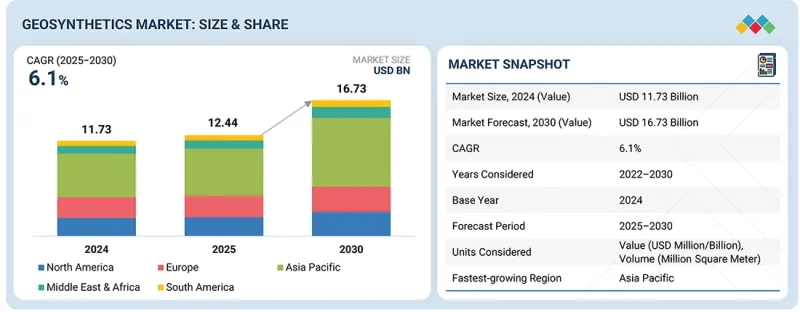
토목합성재료 시장 규모는 2026년 134억 6,000만 달러에서 2031년까지 181억 5,000만 달러로 성장하며, 예측 기간 중 CAGR은 6.2%에 달할 것으로 전망되고 있습니다.
| 조사 범위 | |
|---|---|
| 조사 대상 기간 | 2023-2031년 |
| 기준연도 | 2025년 |
| 예측 기간 | 2026-2031년 |
| 산정 단위 | 금액(100만/10억 달러) 및 수량(100만 평방미터) |
| 부문 | 제품 유형별, 최종 용도별, 지역별 |
| 대상 지역 | 북미, 아시아태평양, 유럽, 중동 및 아프리카, 남미 |
지오신세틱 자재에 대한 수요가 증가하고 있는 배경에는 친환경적인 특성을 유지하면서도 저비용으로 장기적인 성능을 발휘하는 건설 자재에 대한 수요가 있기 때문입니다. 토양 안정화 및 보강, 배수 시스템에서 지오신세틱 재료의 사용이 증가하고 있는 것은 도시 지역의 확대와 도로, 철도, 공항 등의 교통 인프라 정비에 정부가 막대한 투자를 하고 있기 때문입니다. 엄격한 환경 규제로 인해 조직들은 매립지 봉쇄, 광산 폐석 관리, 수자원 보전 시스템 등에서 지오멤브레인이나 지오신세틱 클레이 라이너 등의 재료를 사용하고 있습니다. 이는 오염을 방지하고 규제 준수에 기여하기 때문입니다. 홍수나 침식, 연안 지역 열화 등 기후 변화의 영향에 대한 일반 시민들의 우려가 커짐에 따라 탄력적인 인프라 솔루션에 대한 수요가 증가하고 있습니다. 지오신세틱스 시장이 성장하고 있는 이유는 폴리머 기술의 발전과 재활용 소재 사용 확대가 모두 제품의 성능과 지속가능성을 향상시키는 동시에 새로운 용도의 기회를 창출하고 있기 때문입니다.
'예측 기간 중, 지오그리드는 지오신세틱스 시장에서 가장 빠르게 성장할 제품 유형이 될 것으로 전망됩니다. '
지오신세틱스 시장에서 지오그리드가 가장 빠른 성장세를 보이고 있는 이유는 이러한 제품들이 인프라 프로젝트에 뛰어난 하중 지지 및 지반 보강 솔루션을 제공하기 때문입니다. 폴리머로 만들어진 격자 구조는 도로 건설, 철도, 옹벽, 성토 등에 활용되어 구조적 안정성 향상, 변형 감소 및 수명 연장을 실현하고 있습니다. 신흥 국가들이 교통 인프라에 대한 투자를 확대하는 한편, 지오그리드는 건설사에 고품질 골재 사용량을 줄일 수 있는 비용 대비 효과가 높은 솔루션을 제공함으로써 이 부문은 급속한 성장을 달성하고 있습니다. 이 기술은 포장 성능을 향상시키고 유지 관리의 필요성을 줄여주기 때문에 신규 프로젝트나 노후화된 인프라의 개보수시 지오그리드의 도입이 가속화되고 있습니다. 고강도 폴리머의 개발과 그리드 설계의 개선, 그리고 그 이후의 기술적 진보가 맞물리면서, 현재 지오그리드는 전 세계에서 가장 빠르게 발전하고 있는 지오신세틱스 제품군으로 자리매김하고 있습니다.
'예측 기간 중, 토목 건설 분야는 지오신세틱스 시장에서 성장률이 두 번째로 높은 용도가 될 것으로 전망됩니다. '
도시화가 가속화되고 교통 인프라 프로젝트에 대한 자금 투자가 증가함에 따라 토목 건설 부문은 지오신세틱스 시장에서 가장 빠르게 성장하고 있는 부문이 되었습니다. 지오신세틱스는 도로, 철도, 성토, 옹벽, 기초 시스템 등 다양한 분야에서 활용되며, 지반의 안정화 및 보강, 분리, 배수 등의 기능을 수행하고 있습니다. 이 기술은 하중 분산을 개선하는 동시에 건설 비용을 절감하고 인프라의 수명을 연장하므로 대규모 인프라 프로젝트를 추진 중인 개발도상국들에게 더욱 매력적인 선택지가 되고 있습니다. 지속가능한 건설 방식에 대한 수요와 선진 지역의 노후화된 인프라 복구 수요가 시장 성장을 주도하고 있습니다. 현재 각국의 정부 기관들은 내구성이 뛰어나고 회복력이 높은 인프라를 구축하기 위한 필수 소재로 지오신세틱스를 인식하고 있으며, 이에 따라 이 제품군은 시장에서 가장 빠르게 성장하고 있는 분야가 되었습니다.
'중동 및 아프리카은 예측 기간 중 지오신세틱스 시장에서 두 번째로 높은 성장률을 보일 것으로 전망됩니다. '
중동 및 아프리카의 지오신세틱스 산업은 대규모 인프라 프로젝트와 수자원 관리 시스템, 광업에 대한 투자 증가로 인해 두 번째로 빠르게 성장하고 있는 시장이 되었습니다. 도로 및 철도 시스템, 지반 안정화를 위한 지오신세틱스의 도입은 주로 사우디아라비아와 아랍에미리트에서 나타나는 도시 지역의 급속한 확장과 대규모 건설 프로젝트를 통해 그 기세를 더해가고 있습니다. 이 지역에서는 해수 담수화 플랜트, 관개 시스템, 저수 시설에 영향을 미치는 심각한 물 부족으로 인해 지오멤브레인과 지오텍스타일에 대한 수요가 증가하고 있습니다. 아프리카 광업 부문의 확대와 폐기물 관리 솔루션에 대한 수요 증가는 봉쇄 시스템을 포함한 환경 보호 조치의 필요성을 부추기고 있습니다. 중동 및 아프리카 시장은 침식 방지 솔루션 및 해안 보호 시스템에 대한 수요 증가와 기후 변화에 대응한 인프라 개발로 인해 확대되고 있으며, 이 지역은 전 세계 지오신세틱스 산업 전반에서 급속한 성장을 달성하고 있는 높은 잠재력을 지닌 시장으로서의 입지를 확고히 하고 있습니다.
대상 기업: Solmax(캐나다), Officine Maccaferri Spa(이탈리아), Tensar International Corporation(미국), HUESKER, Inc.(독일), Naue GmbH & Co. KG(독일), AGRU America, Inc.(미국), Fibertex Nonwovens A/S(덴마크), Thrace Group(그리스), Freudenberg Performance Materials(독일), Strata Geosystems(인도)가 이 보고서의 대상입니다.
본 조사에서는 지오신세틱스 시장의 주요 기업에 대해 기업 개요, 최근 동향 및 주요 시장 전략을 포함한 상세한 경쟁 분석을 수행하고 있습니다.
조사 범위
본 조사 보고서에서는 지오신세틱스 시장을 유형(지오텍스타일, 지오멤브레인, 지오그리드, 지오폼, 지오넷), 용도(폐기물 관리, 수자원 관리, 교통 인프라, 토목 건설) 및 지역(북미, 유럽, 아시아태평양, 중동 및 아프리카, 남미)에 따라 분류하고 있습니다. 이 보고서의 범위에는 지오신세틱스 시장의 성장에 영향을 미치는 촉진요인, 제약 요인, 과제 및 기회에 대한 상세한 정보가 포함되어 있습니다. 주요 업계 기업에 대한 상세한 분석을 통해 사업 개요, 제공 제품, 그리고 지오신세틱스 시장에서의 합병, 인수, 사업 확장 등 주요 전략에 대한 인사이트를 제공합니다. 또한 이 보고서에서는 지오신세틱스 시장에 진출할 예정인 신생 기업에 대한 경쟁 분석도 수록하고 있습니다.
이 보고서를 구매해야 하는 이유
이 보고서는 시장 선도 기업 및 신규 진입 기업을 대상으로, 지오신세틱스 시장 전체 및 그 하위 부문의 매출에 관한 가장 정확한 추정치를 제공합니다. 이 보고서는 이해관계자들이 경쟁 구도를 이해하고, 자사의 포지셔닝에 대한 더 심층 인사이트를 얻어, 효과적인 시장 진입 전략을 수립하는 데 도움이 됩니다. 또한 시장 동향을 파악하고 주요 시장 촉진요인, 억제요인, 과제 및 기회에 관한 정보를 제공합니다.
이 보고서에서는 다음 사항에 대한 인사이트를 제공합니다. 주요 촉진요인 분석(전 세계 인프라 확충 및 교통망 현대화의 추세, 폐기물 격리에 관한 전 세계 환경 규제의 강화, 전 세계적인 물 부족 현상의 가속화 및 광업 분야의 광미 관리 확대), 제약 요인(석유화학 원료 가격의 급격한 변동, 사용 중 발생하는 물리적 막힘, 생물학적 분해, 설치시 손상에 대한 취약성), 기회(친환경적, 바이오 기반 및 완전 생분해성 지오신세틱의 등장, 스마트 센서 기술 및 IoT를 활용한 구조 건전성 모니터링의 통합, 부유식 증발 커버를 통한 건조 지역에서의 산업적 용도 확대) 및 과제(전 세계에서 표준화된 조사 기법 및 조화된 규제 승인 기준의 부재, 광범위한 기술적 지식의 부족, 그리고 보수적인 엔지니어링 문화로 인한 저항)에 대해 인사이트를 제공합니다.
- 제품 개발/혁신: 지오신세틱스 시장의 향후 기술 및 연구개발 활동에 대한 상세 인사이트.
- 시장 개발: 수익성이 높은 시장에 대한 포괄적인 정보 - 이 보고서에서는 다양한 지역에 걸친 지오신세틱스 시장을 분석하고 있습니다.
- 시장의 다각화: 지오신세틱스 시장의 신제품 및 서비스, 미개발 지역, 최근 동향, 그리고 투자에 관한 포괄적인 정보.
- 경쟁사 평가: Solmax(캐나다), Officine Maccaferri Spa(이탈리아), Tensar International Corporation(미국), HUESKER, Inc.(독일), Naue GmbH & Co. KG(독일), AGRU America, Inc.(미국), Fibertex Nonwovens A/S(덴마크), Thrace Group(그리스), Freudenberg Performance Materials(독일), Strata Geosystems(인도) 등 주요 기업의 시장 점유율, 성장 전략, 서비스 제공에 대한 상세한 평가.
자주 묻는 질문
목차
제1장 서론
제2장 개요
제3장 주요 인사이트
제4장 시장 개요
제5장 기술 진보, AI에 의한 영향, 특허, 혁신, 향후 응용
제6장 규제 상황과 지속가능성 구상
제7장 고객 상황과 구매 행동
제8장 토목합성재료 시장(제품 유형별)
제9장 토목합성재료 시장(용도별)
제10장 토목합성재료 시장(지역별)
제11장 경쟁 구도
제12장 기업 개요
제13장 조사 방법
제14장 부록
KSA 26.07.14The geosynthetics market is projected to grow from USD 13.46 billion in 2026 to USD 18.15 billion by 2031, at a CAGR of 6.2% during the forecast period.
| Scope of the Report | |
|---|---|
| Years Considered for the Study | 2023-2031 |
| Base Year | 2025 |
| Forecast Period | 2026-2031 |
| Units Considered | Value (USD Million/Billion) and Volume (Million Square Meter) |
| Segments | Type, Application, and Region |
| Regions covered | North America, Asia Pacific, Europe, the Middle East & Africa, and South America |
The increasing demand for geosynthetics stems from the need for construction materials that deliver long-lasting performance at low costs while maintaining environmentally friendly properties. The rising use of geosynthetics for soil stabilization and reinforcement and drainage systems results from urban areas expanding and governments investing heavily in building transportation infrastructure which includes roads and railways and airports. The strict environmental regulations drive organizations to use materials such as geomembranes and geosynthetic clay liners for their landfill containment and mining tailings management and water conservation systems because these materials stop contamination and help with compliance. The demand for resilient infrastructure solutions has increased due to rising public worries about climate change impacts which include flooding and erosion and coastal degradation. The geosynthetics market is experiencing growth because both polymer technology improvements and increasing recyclable material usage are boosting product performance and sustainability while creating new application opportunities.
"Geogrids is projected to be the fastest-growing type in the geosynthetics market during the forecast period."
The geosynthetics market displays its fastest expansion through geogrids because these products provide superior load-bearing and soil reinforcement solutions for infrastructure projects. The polymer grid structures find application in road construction and railways and retaining walls and embankments to achieve better structural stability and lower deformation and longer service life. The segment experiences rapid expansion because emerging economies increase their transportation infrastructure investments while geogrids provide construction companies with a cost-effective solution that requires fewer high-quality aggregates. The new projects and aging infrastructure rehabilitation efforts experience faster adoption because the technology improves pavement performance and decreases maintenance needs. The development of high-strength polymers and better grid designs together with technological progress, which has occurred since that time, has created a situation where geogrids now represent the most rapidly advancing category of geosynthetics that exists worldwide.
"Civil Construction is projected to be the second-fastest-growing application in the geosynthetics market during the forecast period."
The civil construction sector represents the fastest-expanding segment of the geosynthetics market because urbanization accelerates and transportation infrastructure projects receive increasing funding. Geosynthetics find common usage across roadways and railways and embankments and retaining structures and foundation systems to perform functions that include soil stabilization and reinforcement and separation and drainage. The technology improves load distribution while lowering construction expenses and extending the life of infrastructure which makes it more appealing to developing countries that are building major infrastructure projects. The demand for sustainable construction methods and the requirement to restore old infrastructure in developed areas drive the market forward. The government agencies of various countries now consider geosynthetics as essential materials for constructing durable and resilient infrastructure which enables this product category to become the fastest-growing sector of the market.
"Middle East & Africa is projected to be the second-fastest-growing region in the geosynthetics market during the forecast period."
The geosynthetics industry in Middle East and Africa has become the second most rapidly developing market because of increased funding for major infrastructure projects and water management systems and mining operations. The implementation of geosynthetics in roadways and rail systems and foundation stabilization has gained momentum through the rapid growth of urban areas and massive construction projects which dominantly exist in Saudi Arabia and the United Arab Emirates. The region requires geomembranes and geotextiles because of its severe water shortage which affects desalination plants irrigation systems and water storage facilities. The African mining sector expansion and the increasing demand for waste management solutions drive the need for environmental protection measures which include containment systems. The Middle East and Africa market expands because of increasing demand for erosion control solutions and coastal protection systems and climate-adaptive infrastructure development which establishes this region as a high-potential market that experiences rapid growth throughout the worldwide geosynthetics industry.
By Company Type: Tier 1: 40%, Tier 2: 30%, and Tier 3: 30%
By Designation: Directors: 30%, Managers: 20%, and Others: 50%
By Region: North America: 20%, Europe: 10%, Asia Pacific: 40%, South America: 10%, and Middle East & Africa 20%
Notes: Others include sales, marketing, and product managers.
Tier 1: >USD 1 Billion; Tier 2: USD 500 million-1 Billion; and Tier 3: <USD 500 million
Companies Covered: Solmax (Canada), Officine Maccaferri Spa (Italy), Tensar International Corporation (US), HUESKER, Inc. (Germany), Naue GmbH & Co. KG (Germany), AGRU America, Inc. (US), Fibertex Nonwovens A/S (Denmark), Thrace Group (Greece), Freudenberg Performance Materials (Germany) and Strata Geosystems (India) are covered in the report.
The study includes an in-depth competitive analysis of these key players in the geosynthetics market, with their company profiles, recent developments, and key market strategies.
Research Coverage
This research report categorizes the geosynthetics market based on by type (geotextile, geomembranes, geogrids, geofoams, geonets), application (waste management, water management, transportation infrastructure, civil construction), and region (North America, Europe, Asia Pacific, Middle East & Africa, South America). The report's scope covers detailed information regarding the drivers, restraints, challenges, and opportunities influencing the growth of the geosynthetics market. A detailed analysis of key industry players has been conducted to provide insights into their business overview, products offered, and key strategies, including mergers, acquisitions, and expansions, in the geosynthetics market. This report provides a competitive analysis of upcoming startups in the geosynthetics market.
Reasons to Buy the Report
The report will provide market leaders/new entrants with information on the closest approximations of revenue for the overall geosynthetics market and its subsegments. This report will help stakeholders understand the competitive landscape, gain deeper insights into positioning their businesses, and plan effective go-to-market strategies. The report will help stakeholders understand the pulse of the market and provide them with information on key market drivers, restraints, challenges, and opportunities.
The report provides insights into the following points: Analysis of key drivers (The momentum of global infrastructure expansion and transportation network modernization, Escalating global stringency in environmental regulations for waste containment, Accelerating global water scarcity and the expansion of tailings management in mining), restraints (High volatility in petrochemical raw material feedstock prices, Susceptibility to in-service physical clogging, biological degradation, and installation damage), opportunities (The emergence of eco-friendly, bio-based, and fully biodegradable geosynthetics, Integration of smart sensor technologies and IOT-enabled structural health monitoring, Expanding industrial applications in arid regions via floating evaporation covers), and challenges (Absence of globally standardized testing methodologies and harmonized regulatory approval codes, Pervasive technical knowledge deficits and resistance from conservative engineering cultures).
- Product Development/Innovation: Detailed insights into upcoming technologies, research & development activities, in the geosynthetics market.
- Market Development: Comprehensive information about profitable markets - the report analyzes the geosynthetics market across varied regions.
- Market Diversification: Exhaustive information about new products & services, untapped geographies, recent developments, and investments in the geosynthetics market.
- Competitive Assessment: In-depth assessment of market shares, growth strategies, and service offerings of leading players such as Solmax (Canada), Officine Maccaferri Spa (Italy), Tensar International Corporation (US), HUESKER, Inc. (Germany), Naue GmbH & Co. KG (Germany), AGRU America, Inc. (US), Fibertex Nonwovens A/S (Denmark), Thrace Group (Greece), Freudenberg Performance Materials (Germany) and Strata Geosystems (India).
TABLE OF CONTENTS
1 INTRODUCTION
- 1.1 STUDY OBJECTIVES
- 1.2 MARKET DEFINITION
- 1.3 STUDY SCOPE
- 1.3.1 MARKETS COVERED AND REGIONAL SCOPE
- 1.3.2 INCLUSIONS AND EXCLUSIONS
- 1.3.3 YEARS CONSIDERED
- 1.3.4 CURRENCY CONSIDERED
- 1.3.5 UNITS CONSIDERED
- 1.4 STAKEHOLDERS
- 1.5 SUMMARY OF CHANGES
2 EXECUTIVE SUMMARY
- 2.1 KEY INSIGHTS AND MARKET HIGHLIGHTS
- 2.2 KEY MARKET PARTICIPANTS: SHARE INSIGHTS AND STRATEGIC DEVELOPMENTS
- 2.3 DISRUPTIVE TRENDS SHAPING MARKET
- 2.4 HIGH-GROWTH SEGMENTS & EMERGING FRONTIERS
- 2.5 SNAPSHOT: GLOBAL MARKET SIZE, GROWTH RATE, AND FORECAST
3 PREMIUM INSIGHTS
- 3.1 ATTRACTIVE OPPORTUNITIES FOR PLAYERS IN GEOSYNTHETICS MARKET
- 3.2 ASIA PACIFIC: GEOSYNTHETICS MARKET, BY PRODUCT TYPE AND COUNTRY
- 3.3 GEOSYNTHETICS MARKET, BY PRODUCT TYPE
- 3.4 GEOSYNTHETICS MARKET, BY APPLICATION
- 3.5 GEOSYNTHETICS MARKET, BY COUNTRY
4 MARKET OVERVIEW
- 4.1 INTRODUCTION
- 4.2 MARKET DYNAMICS
- 4.2.1 DRIVERS
- 4.2.1.1 The momentum of global infrastructure expansion and transportation network modernization
- 4.2.1.2 Rising global stringency in environmental regulations for waste containment
- 4.2.1.3 Accelerating global water scarcity and the expansion of tailings management in mining
- 4.2.2 RESTRAINTS
- 4.2.2.1 High volatility in petrochemical raw material feedstock prices
- 4.2.2.2 Susceptibility to in-service physical clogging, biological degradation, and installation damage
- 4.2.3 OPPORTUNITIES
- 4.2.3.1 The emergence of eco-friendly, bio-based, and fully biodegradable geosynthetics
- 4.2.3.2 Integration of smart sensor technologies and IoT-enabled structural health monitoring
- 4.2.4 CHALLENGES
- 4.2.4.1 Absence of globally standardized testing methodologies and harmonized regulatory approval codes
- 4.2.4.2 Pervasive technical knowledge deficits and resistance from conservative engineering cultures
- 4.2.1 DRIVERS
- 4.3 UNMET NEEDS AND WHITE SPACES
- 4.3.1 UNMET NEEDS IN GEOSYNTHETICS MARKET
- 4.3.2 WHITE SPACE OPPORTUNITIES
- 4.4 INTERCONNECTED MARKETS AND CROSS-SECTOR OPPORTUNITIES
- 4.4.1 INTERCONNECTED MARKETS
- 4.4.2 CROSS-SECTOR OPPORTUNITIES
- 4.5 EMERGING BUSINESS MODELS AND ECOSYSTEM SHIFTS
- 4.5.1 EMERGING BUSINESS MODELS
- 4.5.2 ECOSYSTEM SHIFTS
- 4.6 STRATEGIC MOVES BY TIER 1/2/3 PLAYERS
- 4.6.1 KEY MOVES AND STRATEGIC FOCUS
- 4.7 PORTER'S FIVE FORCES ANALYSIS
- 4.7.1 THREAT OF NEW ENTRANTS
- 4.7.2 THREAT OF SUBSTITUTES
- 4.7.3 BARGAINING POWER OF SUPPLIERS
- 4.7.4 BARGAINING POWER OF BUYERS
- 4.7.5 INTENSITY OF COMPETITIVE RIVALRY
- 4.8 VALUE CHAIN ANALYSIS
- 4.8.1 RAW MATERIAL SUPPLIERS
- 4.8.2 MANUFACTURERS
- 4.8.3 DISTRIBUTORS
- 4.8.4 END USERS
- 4.9 ECOSYSTEM ANALYSIS
- 4.10 PRICING ANALYSIS
- 4.10.1 AVERAGE SELLING PRICE, BY REGION
- 4.10.2 AVERAGE SELLING PRICE, BY KEY PLAYERS
- 4.10.3 AVERAGE SELLING PRICE, BY PRODUCT TYPE
- 4.11 MACROECONOMIC INDICATORS
- 4.11.1 GLOBAL GDP TRENDS
- 4.12 IMPACT OF 2025 US TARIFFS ON GEOSYNTHETICS MARKET
- 4.12.1 KEY TARIFF RATES
- 4.12.2 PRICE IMPACT ANALYSIS
- 4.12.3 IMPACT ON COUNTRIES/REGIONS
- 4.12.3.1 North America
- 4.12.3.2 Europe
- 4.12.3.3 Asia Pacific
- 4.12.4 IMPACT ON END-USE INDUSTRIES
- 4.13 TRADE ANALYSIS
- 4.13.1 IMPORT SCENARIO (HS CODE 392690)
- 4.13.2 EXPORT SCENARIO (HS CODE 392690)
- 4.13.3 IMPORT SCENARIO (HS CODE 392010)
- 4.13.4 EXPORT SCENARIO (HS CODE 392010)
- 4.14 TRENDS/DISRUPTIONS IMPACTING CUSTOMER BUSINESS
- 4.15 INVESTMENT AND FUNDING SCENARIO
- 4.16 CASE STUDY ANALYSIS
- 4.16.1 TENSAR INTERNATIONAL CORPORATION: NO EXCAVATION REQUIRED A SMARTER WAY TO REHABILITATE TRACKBEDS
- 4.16.2 STRATA GEOSYSTEMS: MECHANICALLY STABILIZED EARTH EMBANKMENTS FOR URBAN ROAD EXPANSIONS
- 4.16.3 OFFICINE MACCAFERRI SPA: STRUCTURAL LANDSCAPING AND SLOPE INTEGRATION AT EXPO HOUSE
- 4.16.4 NAUE GMBH & CO. KG: HIGH-PERFORMANCE ENVIRONMENTAL CONTAINMENT LINING FOR CO-DISPOSAL LANDFILLS
- 4.17 KEY CONFERENCES & EVENTS
5 TECHNOLOGICAL ADVANCEMENTS, AI-DRIVEN IMPACTS, PATENTS, INNOVATIONS, AND FUTURE APPLICATIONS
- 5.1 TECHNOLOGY ANALYSIS
- 5.1.1 KEY TECHNOLOGIES
- 5.1.1.1 Polymeric geomembrane and barrier technology
- 5.1.1.2 Liquid-applied polymeric and sprayable barrier technology
- 5.1.2 COMPLEMENTARY TECHNOLOGIES
- 5.1.2.1 Protective geotextiles and geosynthetic protection systems
- 5.1.2.2 Subsurface drainage and venting integration systems
- 5.1.3 ADJACENT TECHNOLOGIES
- 5.1.3.1 Bio-engineered soil stabilization and phytoremediation systems
- 5.1.3.2 Electro-geotechnical soil stabilization and ground improvement systems
- 5.1.1 KEY TECHNOLOGIES
- 5.2 TECHNOLOGY/PRODUCT ROADMAP
- 5.2.1 SHORT-TERM (2026-2027) | PERFORMANCE ENHANCEMENT
- 5.2.2 MID-TERM (2027-2030) | INTELLIGENT SYSTEMS INTEGRATION
- 5.2.3 LONG-TERM (2030-2035+) | SCALED ADVANCED ADOPTION
- 5.3 PATENT ANALYSIS
- 5.3.1 LEGAL STATUS OF PATENTS
- 5.3.2 JURISDICTION ANALYSIS
- 5.4 FUTURE APPLICATIONS
- 5.4.1 SUSTAINABLE URBAN DRAINAGE & STORMWATER MANAGEMENT (SUDS)
- 5.4.2 RENEWABLE ENERGY INFRASTRUCTURE & ENERGY STORAGE
- 5.4.3 CLIMATE-RESILIENT CIVIL INFRASTRUCTURE
- 5.4.4 SMART & SENSOR-INTEGRATED CONTAINMENT SYSTEMS
- 5.4.5 MODULAR CONSTRUCTION & PREFABRICATED GEOCOMPOSITES
- 5.5 IMPACT OF AI/GENERATIVE AI ON GEOSYNTHETICS MARKET
- 5.5.1 TOP USE CASES AND MARKET POTENTIAL
- 5.5.2 BEST PRACTICES IN GEOSYNTHETICS
- 5.5.3 CASE STUDIES OF AI IMPLEMENTATION IN GEOSYNTHETICS MARKET
- 5.5.4 INTERCONNECTED ADJACENT ECOSYSTEM AND IMPACT ON MARKET PLAYERS
- 5.5.5 CLIENTS' READINESS TO ADOPT GENERATIVE AI IN GEOSYNTHETICS MARKET
6 REGULATORY LANDSCAPE AND SUSTAINABILITY INITIATIVES
- 6.1 REGIONAL REGULATIONS AND COMPLIANCE
- 6.1.1 REGULATORY BODIES, GOVERNMENT AGENCIES, AND OTHER ORGANIZATIONS
- 6.1.2 INDUSTRY STANDARDS
- 6.2 SUSTAINABILITY INITIATIVES
- 6.3 IMPACT OF REGULATORY POLICIES AND SUSTAINABILITY INITIATIVES
- 6.4 CERTIFICATIONS, LABELING, AND ECO-STANDARDS
7 CUSTOMER LANDSCAPE & BUYER BEHAVIOR
- 7.1 INTRODUCTION
- 7.2 DECISION-MAKING PROCESS
- 7.3 KEY STAKEHOLDERS AND BUYING CRITERIA
- 7.3.1 KEY STAKEHOLDERS IN BUYING PROCESS
- 7.3.2 BUYING CRITERIA
- 7.4 ADOPTION BARRIERS & INTERNAL CHALLENGES
- 7.5 UNMET NEEDS IN VARIOUS END USES
- 7.6 MARKET PROFITABILITY
- 7.6.1 REVENUE POTENTIAL
- 7.6.2 COST DYNAMICS
- 7.6.3 MARGIN OPPORTUNITIES IN KEY END USES
8 GEOSYNTHETICS MARKET, BY PRODUCT TYPE
- 8.1 INTRODUCTION
- 8.2 GEOTEXTILES
- 8.2.1 USE OF GEOTEXTILES TO STRENGTHEN TRANSPORTATION AND CIVIL INFRASTRUCTURE
- 8.3 GEOMEMBRANES
- 8.3.1 GROWING NEED FOR SUSTAINABLE INFRASTRUCTURE AND ENVIRONMENTAL COMPLIANCE
- 8.4 GEOGRIDS
- 8.4.1 INCREASING DEMAND FOR SOIL REINFORCEMENT AND STRUCTURAL STABILITY
- 8.5 GEONETS
- 8.5.1 GEONETS FACILITATE EFFICIENT DRAINAGE AND LEACHATE COLLECTION SYSTEMS
- 8.6 GEOCOMPOSITES
- 8.6.1 RISING DEMAND FOR MULTI-FUNCTIONAL GEOTECHNICAL PERFORMANCE
- 8.7 GEOCELLS
- 8.7.1 RISING DEMAND FOR SUSTAINABLE GROUND STABILIZATION AND LOAD-BEARING EFFICIENCY DRIVING ADOPTION OF GEOCELLS IN THE MARKET
- 8.8 OTHER PRODUCT TYPES
9 GEOSYNTHETIC MARKET, BY END USE
- 9.1 INTRODUCTION
- 9.2 WASTE MANAGEMENT
- 9.2.1 STRINGENT ENVIRONMENTAL REGULATIONS POSITION WASTE MANAGEMENT AS LARGEST REVENUE OPPORTUNITY
- 9.3 WATER MANAGEMENT
- 9.3.1 WATER SECURITY INVESTMENTS CONTINUE TO ACCELERATE GEOSYNTHETICS ADOPTION
- 9.4 TRANSPORTATION
- 9.4.1 INFRASTRUCTURE MODERNIZATION SUSTAINS LONG-TERM DEMAND ACROSS TRANSPORTATION NETWORKS
- 9.5 CIVIL CONSTRUCTION
- 9.5.1 RAPID URBANIZATION AND GROUND REINFORCEMENT NEEDS PROPEL CIVIL INFRASTRUCTURE GROWTH
- 9.6 OTHERS
10 GEOSYNTHETICS MARKET, BY REGION
- 10.1 INTRODUCTION
- 10.2 NORTH AMERICA
- 10.2.1 US
- 10.2.1.1 Robust industrial base and regulatory push to drive demand
- 10.2.2 CANADA
- 10.2.2.1 Industrial diversification, environmental containment, and infrastructure investments to drive growth
- 10.2.3 MEXICO
- 10.2.3.1 Industrial diversification, hydraulic challenges, and transportation investments to drive growth
- 10.2.1 US
- 10.3 EUROPE
- 10.3.1 GERMANY
- 10.3.1.1 Demand from automotive manufacturing, construction, and industrial end uses to boost market
- 10.3.2 FRANCE
- 10.3.2.1 Institutional modernization, health sector asset protection, and infrastructure durability to drive market
- 10.3.3 SPAIN
- 10.3.3.1 Multi-sectoral growth and public capital outlays in civil infrastructure to propel market
- 10.3.4 UK
- 10.3.4.1 Robust developments across healthcare, hygiene, and industrial sectors to propel demand
- 10.3.5 ITALY
- 10.3.5.1 Major production line expansions and rising subgrade and containment infrastructure demand to drive market growth
- 10.3.6 REST OF EUROPE
- 10.3.1 GERMANY
- 10.4 ASIA PACIFIC
- 10.4.1 CHINA
- 10.4.1.1 Innovation, sustainability, and exports to drive market
- 10.4.2 JAPAN
- 10.4.2.1 Sustainable innovation and seismic-resilient infrastructure to drive market
- 10.4.3 INDIA
- 10.4.3.1 Rapid urbanization, policy support, and domestic innovation to drive growth
- 10.4.4 SOUTH KOREA
- 10.4.4.1 Megaproject clusters, high-speed transit investments, and industrial water mandates to drive growth
- 10.4.5 REST OF ASIA PACIFIC
- 10.4.1 CHINA
- 10.5 MIDDLE EAST & AFRICA
- 10.5.1 GCC COUNTRIES
- 10.5.1.1 Growing government investments and economic diversification to drive market
- 10.5.1.2 Saudi Arabia
- 10.5.1.2.1 Structural megaprojects, municipal water expansions, and environmental containment to drive growth
- 10.5.1.3 UAE
- 10.5.1.3.1 Regulatory and economic momentum to drive demand
- 10.5.1.4 Rest of GCC
- 10.5.2 SOUTH AFRICA
- 10.5.2.1 Rising water treatment challenges to drive market
- 10.5.3 REST OF MIDDLE EAST & AFRICA
- 10.5.1 GCC COUNTRIES
- 10.6 SOUTH AMERICA
- 10.6.1 BRAZIL
- 10.6.1.1 Large-scale investments, expanding industrial processing footprints, and institutional pushes toward supply chain autonomy to support market growth
- 10.6.2 ARGENTINA
- 10.6.2.1 Strong demand in agricultural containment, structural water conservation, and municipal protection frameworks to boost growth
- 10.6.3 REST OF SOUTH AMERICA
- 10.6.1 BRAZIL
11 COMPETITIVE LANDSCAPE
- 11.1 OVERVIEW
- 11.2 KEY PLAYERS' STRATEGIES/RIGHT TO WIN
- 11.3 MARKET SHARE ANALYSIS
- 11.4 REVENUE ANALYSIS OF KEY PLAYERS
- 11.5 COMPANY VALUATION AND FINANCIAL METRICS
- 11.6 PRODUCT COMPARISON
- 11.7 COMPANY EVALUATION MATRIX
- 11.7.1 STARS
- 11.7.2 EMERGING LEADERS
- 11.7.3 PERVASIVE PLAYERS
- 11.7.4 PARTICIPANTS
- 11.7.5 COMPANY FOOTPRINT: KEY PLAYERS, 2025
- 11.7.5.1 Company footprint
- 11.7.5.2 Region footprint
- 11.7.5.3 Product Type footprint
- 11.7.5.4 End use footprint
- 11.8 STARTUP/SME EVALUATION QUADRANT
- 11.8.1 PROGRESSIVE COMPANIES
- 11.8.2 RESPONSIVE COMPANIES
- 11.8.3 DYNAMIC COMPANIES
- 11.8.4 STARTING BLOCKS
- 11.8.5 COMPETITIVE BENCHMARKING: STARTUPS/SMES, 2025
- 11.8.5.1 Detailed list of key startups/SMEs
- 11.8.5.2 Competitive benchmarking of key startups/SMEs
- 11.9 COMPETITIVE SCENARIO
- 11.9.1 PRODUCT LAUNCHES
- 11.9.2 DEALS
- 11.9.3 EXPANSIONS
12 COMPANY PROFILES
- 12.1 KEY PLAYERS
- 12.1.1 SOLMAX
- 12.1.1.1 Business overview
- 12.1.1.2 Products/Solutions/Services offered
- 12.1.1.3 Recent developments
- 12.1.1.3.1 Deals
- 12.1.1.3.2 Expansions
- 12.1.1.4 MnM view
- 12.1.1.4.1 Right to win
- 12.1.1.4.2 Strategic choices
- 12.1.1.4.3 Weaknesses and competitive threats
- 12.1.2 OFFICINE MACCAFERRI SPA
- 12.1.2.1 Business overview
- 12.1.2.2 Products/Solutions/Services offered
- 12.1.2.3 Recent developments
- 12.1.2.3.1 Deals
- 12.1.2.3.2 Expansions
- 12.1.2.4 MnM view
- 12.1.2.4.1 Right to win
- 12.1.2.4.2 Strategic choices
- 12.1.2.4.3 Weaknesses and competitive threats
- 12.1.3 TENSAR INTERNATIONAL CORPORATION
- 12.1.3.1 Business overview
- 12.1.3.2 Products/Solutions/Services offered
- 12.1.3.3 Recent developments
- 12.1.3.3.1 Deals
- 12.1.3.4 MnM view
- 12.1.3.4.1 Right to win
- 12.1.3.4.2 Strategic choices
- 12.1.3.4.3 Weaknesses and competitive threats
- 12.1.4 HUESKER, INC.
- 12.1.4.1 Business overview
- 12.1.4.2 Products/Solutions/Services offered
- 12.1.4.3 Recent developments
- 12.1.4.3.1 Product launches
- 12.1.4.3.2 Expansions
- 12.1.4.4 MnM view
- 12.1.4.4.1 Right to win
- 12.1.4.4.2 Strategic choices
- 12.1.4.4.3 Weaknesses and competitive threats
- 12.1.5 NAUE GMBH & CO. KG
- 12.1.5.1 Business overview
- 12.1.5.2 Products/Solutions/Services offered
- 12.1.5.3 Recent developments
- 12.1.5.3.1 Product launches
- 12.1.5.3.2 Deals
- 12.1.5.4 MnM view
- 12.1.5.4.1 Right to win
- 12.1.5.4.2 Strategic choices
- 12.1.5.4.3 Weaknesses and competitive threats
- 12.1.6 AGRU AMERICA, INC.
- 12.1.6.1 Business overview
- 12.1.6.2 Products/Solutions/Services offered
- 12.1.6.3 MnM view
- 12.1.7 FIBERTEX NONWOVENS A/S
- 12.1.7.1 Business overview
- 12.1.7.2 Products/Solutions/Services offered
- 12.1.7.3 Recent developments
- 12.1.7.3.1 Expansions
- 12.1.7.4 MnM view
- 12.1.8 THRACE GROUP
- 12.1.8.1 Business overview
- 12.1.8.2 Products/Solutions/Services offered
- 12.1.8.3 MnM view
- 12.1.9 FREUDENBERG PERFORMANCE MATERIALS
- 12.1.9.1 Business overview
- 12.1.9.2 Products/Solutions/Services offered
- 12.1.9.3 Recent Developments
- 12.1.9.3.1 Expansions
- 12.1.9.4 MnM view
- 12.1.10 STRATA GEOSYSTEMS
- 12.1.10.1 Business overview
- 12.1.10.2 Products/Solutions/Services offered
- 12.1.10.2.1 Deals
- 12.1.10.3 MnM view
- 12.1.1 SOLMAX
- 12.2 OTHER PLAYERS
- 12.2.1 RENOLIT SE
- 12.2.2 CONCRETE CANVAS LTD
- 12.2.3 SOLENO
- 12.2.4 WINFAB
- 12.2.5 MAGNERA
- 12.2.6 TENAX CORPORATION
- 12.2.7 KAYTECH
- 12.2.8 SKAPS INDUSTRIES
- 12.2.9 CARTHAGE MILLS
- 12.2.10 BONTEXGEO NV
- 12.2.11 GEOFABRICS AUSTRALASIA PTY LTD.
- 12.2.12 ACE GEOSYNTHETICS
- 12.2.13 GLOBAL SYNTHETICS
- 12.2.14 ASAHI KASEI ADVANCE CORPORATION
- 12.2.15 TECHFABINDIA
13 RESEARCH METHODOLOGY
- 13.1 RESEARCH DATA
- 13.1.1 SECONDARY DATA
- 13.1.1.1 Key data from secondary sources
- 13.1.2 PRIMARY DATA
- 13.1.2.1 Key data from primary sources
- 13.1.2.2 Key industry insights
- 13.1.1 SECONDARY DATA
- 13.2 MARKET SIZE ESTIMATION
- 13.3 BASE NUMBER CALCULATION
- 13.3.1 DEMAND-SIDE APPROACH
- 13.3.2 SUPPLY-SIDE APPROACH
- 13.4 MARKET FORECAST APPROACH
- 13.4.1 SUPPLY SIDE
- 13.4.2 DEMAND SIDE
- 13.5 DATA TRIANGULATION
- 13.6 FACTOR ANALYSIS
- 13.7 RESEARCH ASSUMPTIONS
- 13.8 RESEARCH LIMITATIONS AND RISK ASSESSMENT
14 APPENDIX
- 14.1 DISCUSSION GUIDE
- 14.2 KNOWLEDGESTORE: MARKETSANDMARKETS' SUBSCRIPTION PORTAL
- 14.3 CUSTOMIZATION OPTIONS
- 14.4 RELATED REPORTS
- 14.5 AUTHOR DETAILS


