
|
시장보고서
상품코드
2092405
데이터센터용 수처리 및 폐수처리 설비 시장 : 데이터센터 유형별(하이퍼스케일, 코로케이션, 엔터프라이즈), 설비 유형별, 처리 단계별(전처리 및 정화, 냉각수 처리), 지역별 - 세계 예측(-2031년)Data Center Water & Wastewater Treatment Equipment Market by Data Center Type (Hyperscale, Colocation, Enterprise), By Equipment Type, By Treatment Stage (Pretreatment & Purification, Cooling Water Treatment), and Region - Global Forecast to 2031 |
||||||

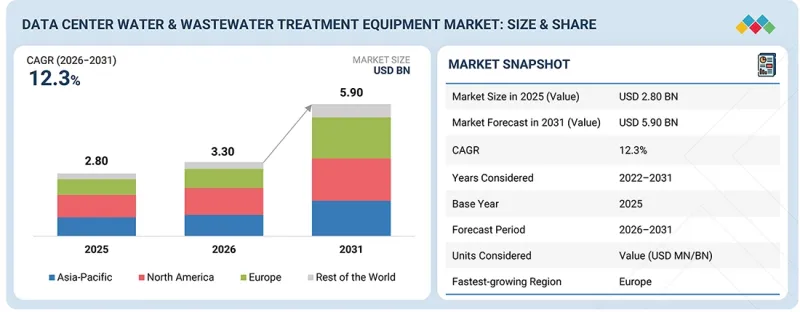
세계의 데이터센터용 수처리 및 폐수처리 설비 시장 규모는 2026년 33억 달러에서 2031년에는 59억 달러로 확대되어 예측 기간 동안 CAGR 12.3%를 기록할 것으로 전망됩니다.
| 조사 범위 | |
|---|---|
| 조사 대상 기간 | 2022-2031년 |
| 기준 연도 | 2025년 |
| 예측 기간 | 2026-2031년 |
| 단위 | 금액(달러) |
| 부문 | 설비 유형, 처리 단계, 데이터센터 유형 |
| 대상 지역 | 아시아태평양, 북미, 유럽, 기타 지역 |
데이터센터용 수처리 및 폐수처리 설비 시장은 데이터센터 건설 증가, 냉각수 사용량 증가, 지속가능성 추구로 인해 급속한 성장을 이루고 있습니다. 이 시장에서는 화학 처리 및 조정 시스템, 막 및 고순도 수처리 장치, 여과 장치, 소독 장치, 폐수처리 솔루션 등의 제품이 제공되고 있습니다. 이러한 기술은 냉각 효율 향상, 수질 확보, 물의 재사용을 가능하게 합니다. 기존에는 데이터센터가 주로 에너지 효율에 중점을 두어 왔으나, 규제상의 압박과 기업 및 소비자에게 영향을 미치는 지역적 물 부족 문제로 인해 물 효율도 마찬가지로 중요해지고 있습니다. 하이퍼스케일 및 AI에 특화된 데이터센터의 확대, 액체 냉각 도입 증가, 폐쇄형 수냉 시스템, 폐수 재활용, 디지털 물 관리 플랫폼에 대한 투자 확대를 배경으로 시장 성장은 더욱 가속화될 것으로 예상됩니다.
"설비 유형별로는, 예측 기간 동안 화학 처리·수질 조정 시스템 부문이 가장 큰 시장 점유율을 차지할 것으로 전망됩니다."
화학 처리·수질 조정 시스템은 냉각 시스템의 성능, 신뢰성, 운영 효율을 유지하는 데 있어 매우 중요한 역할을 하므로, 설비 유형별로는 최대 규모를 차지할 것으로 예상됩니다. 데이터센터는 냉각수 시스템에 크게 의존하고 있으며, 열전달 효율을 저하시키거나 장비에 손상을 줄 수 있는 부식, 스케일, 미생물 증식, 오염을 억제하기 위해 화학적 처리가 필수적입니다. 이러한 시스템은 기존 냉각 인프라와 통합이 가능하며, 지속적인 수질 관리를 제공할 수 있어 하이퍼스케일, 코로케이션, 엔터프라이즈 및 엣지 데이터센터에서 널리 채택되고 있습니다. 또한, 냉각탑, 냉수 시스템, 액체 냉각 기술의 도입이 확대됨에 따라, 첨단 화학 조정 솔루션에 대한 수요가 증가하고 있습니다. 유지보수 비용 최소화, 장비 수명 연장, 데이터센터 가동 중단 방지 필요성이 이 부문의 경쟁력을 더욱 강화하고 있습니다.
"처리 단계별로 보면 냉각수 처리 부문이 예측 기간 동안 가장 큰 시장 점유율을 차지할 것으로 전망됩니다."
이는 데이터센터의 신뢰성과 운영 효율성을 유지하는 데 있어 냉각 시스템이 매우 중요한 역할을 하기 때문입니다. 데이터센터는 특히 냉각탑, 냉수 시스템, 첨단 액체 냉각 인프라 등에서 냉각 용도로 대량의 물을 사용하고 있습니다. 냉각 성능을 저하시키거나 중요한 장비에 손상을 줄 가능성이 있는 스케일, 부식, 생물 증식, 오염을 방지하기 위해서는 효과적인 수처리가 필수적입니다. 더 높은 열 부하를 발생시키는 하이퍼스케일 및 AI 기반 데이터센터의 급속한 확대로 인해, 첨단 냉각수 처리 솔루션에 대한 수요가 증가하고 있습니다. 또한, 물 이용 효율, 규제 준수, 냉각 운영 최적화에 대한 중요성이 커짐에 따라 사업자들은 화학 처리, 여과, 모니터링, 수질 조정 기술에 대한 투자를 확대하고 있으며, 이에 따라 냉각수 처리 부문이 시장을 주도하는 부문으로 부상하고 있습니다.
"예측 기간 동안 북미가 가장 큰 시장 점유율을 차지할 것으로 전망됩니다."
북미는 고도로 발달한 데이터센터 생태계의 견인 덕분에 최대의 지역 시장으로서 선두를 달리고 있습니다. 전 세계의 주요 클라우드 서비스 제공업체들에 의해 ‘하이퍼스케일 시설’로 알려진 대규모 멀티테넌트형 데이터센터가 다수 건설되고 있습니다. AI, 클라우드 컴퓨팅, 디지털 서비스, 고성능 컴퓨팅으로 인해 생성되는 데이터의 급증으로 인해 북미, 특히 미국의 데이터센터 확장이 가속화되고 있습니다. 이러한 시설의 규모와 수가 늘어남에 따라, 그 물 소비량에 대한 우려도 커지고 있습니다. 이에 대응하여 많은 데이터센터 운영업체들은 첨단 폐수처리, 재활용 및 재사용 시스템을 도입하고 있습니다. 환경 규제의 강화와 지속가능성을 위한 기업의 노력도 새로운 물 관리 기술에 대한 투자를 촉진하고 있지만, 이에 따라 설비 투자 및 운영비 양면에서 막대한 비용이 발생할 가능성이 있습니다. 주요 수처리 기술 기업 대부분(통합형 처리 솔루션 제공업체 및 전문 장비 제조업체 등)은 앞으로도 시장 성장을 주도해 나갈 것으로 예상됩니다. 또한, AI를 위해 액체 냉각 방식을 도입하는 데이터센터가 늘어남에 따라 물 관리 시스템에 대한 수요도 높아질 것입니다.
본 보고서에서는 전 세계 데이터센터용 수처리 및 폐수처리 설비 시장을 조사하여, 시장 개요, 시장 성장에 영향을 미치는 다양한 요인에 대한 분석, 기술 및 특허 동향, 법규제 환경, 사례 연구, 시장 규모 추정 및 전망, 각종 분류·지역/주요 국가별 상세 분석, 경쟁 구도, 주요 기업 개요 등을 정리하고 있습니다.
자주 묻는 질문
목차
제1장 소개
제2장 주요 요약
제3장 주요 인사이트
제4장 시장 개요
제5장 업계 동향
제6장 기술의 진보, AI의 영향, 특허, 혁신, 향후 응용
제7장 규제 상황과 지속가능성에 대한 대처
제8장 고객 상황과 구매 행동
제9장 데이터센터용 수처리 및 폐수처리 설비 시장 : 데이터센터 유형별
제10장 데이터센터용 수처리 및 폐수처리 설비 시장 : 설비 유형별
제11장 데이터센터용 수처리 및 폐수처리 설비 시장 : 처리 단계별
제12장 데이터센터용 수처리 및 폐수처리 설비 시장 : 지역별
제13장 경쟁 구도
제14장 기업 개요
제15장 조사 방법
제16장 부록
KSM 26.07.24The global data center water & wastewater treatment equipment market is projected to grow from USD 3.30 billion in 2026 to USD 5.90 billion by 2031, registering a CAGR of 12.3% during the forecast period.
| Scope of the Report | |
|---|---|
| Years Considered for the Study | 2022-2031 |
| Base Year | 2025 |
| Forecast Period | 2026-2031 |
| Units Considered | Value (USD Million/Billion) |
| Segments | Equipment type, Treatment Stage, Data Center type |
| Regions covered | Asia Pacific, North America, Europe, Rest of the World |
The water and wastewater treatment equipment market for data centers is experiencing rapid growth due to rising data center construction, increased water use for cooling, and a shift towards sustainability. This market offers products such as chemical treatment and conditioning systems, membranes and high-purity water devices, filtration units, disinfection tools, and wastewater treatment solutions. These technologies enhance cooling efficiency, ensure water quality, and enable water reuse. While data centers traditionally focused mainly on energy efficiency, water efficiency has become equally vital due to regulatory pressures and regional water scarcity affecting businesses and consumers. The market's growth is expected to accelerate further, driven by the expansion of hyperscale and AI-focused data centers, increased adoption of liquid cooling, and greater investments in closed-loop water systems, wastewater recycling, and digital water management platforms.
"By equipment type, the chemical treatment & conditioning systems segment is anticipated to account for the largest market share during the forecast period."
Chemical treatment & conditioning systems are expected to be the largest equipment type segment due to their critical role in maintaining cooling system performance, reliability, and operational efficiency. Data centers rely heavily on cooling water systems, in which chemical treatment is essential to control corrosion, scaling, microbial growth, and contamination that can impair heat transfer efficiency and damage equipment. These systems are widely adopted across hyperscale, colocation, enterprise, and edge data centers because they can be integrated with existing cooling infrastructure and provide continuous water quality management. Additionally, the growing deployment of cooling towers, chilled water systems, and liquid cooling technologies is increasing demand for advanced chemical conditioning solutions. The need to minimize maintenance costs, extend equipment lifespan, and ensure uninterrupted data center operations further supports this segment's dominance.
By treatment stage, the cooling water treatment segment is anticipated to account for the largest market share during the forecast period.
Cooling water treatment is expected to be the largest segment by treatment stage in the data center water & wastewater treatment equipment market due to the critical role of cooling systems in maintaining data center reliability and operational efficiency. Data centers consume significant amounts of water for cooling applications, particularly in cooling towers, chilled water systems, and advanced liquid cooling infrastructure. Effective water treatment is essential to prevent scaling, corrosion, biological growth, and contamination that can reduce cooling performance and damage critical equipment. The rapid expansion of hyperscale and AI-driven data centers, which generate higher heat loads, is increasing demand for advanced cooling water treatment solutions. Additionally, the growing emphasis on water efficiency, regulatory compliance, and optimized cooling operations is encouraging operators to invest in chemical treatment, filtration, monitoring, and water-conditioning technologies, making cooling water treatment the dominant market segment.
"North America is anticipated to account for the largest market share during the forecast period.
North America leads as the largest regional market, driven by a highly advanced data center ecosystem. Numerous massive, multi-tenant data centers, known as hyperscale facilities, are being constructed by major cloud service providers worldwide. The surge in data generated by artificial intelligence (AI), cloud computing, digital services, and high-performance computing is fueling the expansion of data centers in North America, especially in the United States. As these facilities grow in size and number, concerns about their water consumption increase. In response, many data center operators are adopting advanced wastewater treatment, recycling, and reuse systems. Stricter environmental regulations and corporate commitments to sustainability are also prompting investments in new water management technologies, which can be costly both in capital and operating expenses. Most key water technology companies-either integrated treatment solution providers or specialized equipment manufacturers-are expected to continue driving market growth. Moreover, as more data centers adopt liquid cooling for AI applications, demand for water management systems will rise.
In-depth interviews were conducted with Chief Executive Officers (CEOs), marketing directors, other innovation and technology directors, and executives from key organizations operating in the data center water & wastewater treatment equipment market, and secondary research was used to determine and verify the market size of several segments.
- By Company Type: Tier 1 - 50%, Tier 2 - 30%, and Tier 3 - 20%
- By Designation: Managers - 15%, Directors - 20%, and Others - 65%
- By Region: North America - 40%, Europe - 25%, Asia Pacific - 28%, Rest of the World - 7%.
The data center water & wastewater treatment equipment market comprises major companies, such as Veolia (France), Ecolab Inc. (US), Xylem (US), Solenis (US), Saltworks Technologies Inc. (Canada), Aquatech International LLC (US), Kurita America Inc. (US), Gradiant (US), Lenntech B.V. (Netherlands), and IDE (Israel). The study includes in-depth competitive analysis of these key players in the data center water & wastewater treatment equipment market, with their company profiles, recent developments, and key market strategies.
Research Coverage
This report segments the market for data center water & wastewater treatment equipment market on the basis of equipment type, treatment stage, data center type, and region, and provides estimations for the overall value of the market across various regions. A detailed analysis of key industry players has been conducted to provide insights into their business overviews, products & services, key strategies, and expansions associated with the data center water & wastewater treatment equipment market.
Key Benefits of Buying this Report
This research report is focused on various levels of analysis-industry analysis (industry trends), market ranking analysis of top players, and company profiles, which together provide an overall view of the competitive landscape; emerging and high-growth segments of the data center water & wastewater treatment equipment market; high-growth regions; and market drivers, restraints, opportunities, and challenges.
The report provides insights into the following points:
- Analysis of drivers (hyperscale data center expansion accelerates demand for water treatment infrastructure, AI and high-density computing drive demand for advanced cooling water treatment solutions, growing cloud computing and digital transformation drive data center construction activity, etc.), restraints (high capital expenditure requirements restrain adoption of advanced treatment systems, complexity of retrofitting treatment systems into existing data centers, lengthy permitting and approval processes delay infrastructure projects), opportunities (water reuse & recovery investments create new growth opportunities, adoption of alternative water sources expands demand for advanced treatment equipment, expansion of colocation facilities expands addressable market for treatment equipment), and challenges (water scarcity and local resource constraints impact data center development, rising energy and operating costs affect total cost of water treatment operations) influencing the growth of the market
- Market Penetration: Comprehensive information on the data center water & wastewater treatment equipment offered by top players in the global data center water & wastewater treatment equipment market
- Product Development/Innovation: Detailed insights on upcoming technologies, product launches, expansions, and acquisitions in the market
- Market Development: Comprehensive information about lucrative emerging markets; the report analyzes the market across several regions.
- Market Capacity: Production capacity of the companies is provided wherever available, with upcoming capacities for the market
- Competitive Assessment: In-depth assessment of market shares, strategies, products, and manufacturing capabilities of leading players in the data center water & wastewater treatment equipment market
TABLE OF CONTENTS
1 INTRODUCTION
- 1.1 STUDY OBJECTIVES
- 1.2 MARKET DEFINITION
- 1.3 STUDY SCOPE
- 1.3.1 MARKETS COVERED AND REGIONAL SCOPE
- 1.3.2 INCLUSIONS AND EXCLUSIONS
- 1.3.3 YEARS CONSIDERED
- 1.3.4 CURRENCY CONSIDERED
- 1.3.5 UNIT CONSIDERED
- 1.4 STAKEHOLDERS
2 EXECUTIVE SUMMARY
- 2.1 KEY INSIGHTS AND MARKET HIGHLIGHTS
- 2.2 KEY MARKET PARTICIPANTS: SHARE INSIGHTS AND STRATEGIC DEVELOPMENTS
- 2.3 DISRUPTIVE TRENDS SHAPING MARKET
- 2.4 HIGH-GROWTH SEGMENTS & EMERGING FRONTIERS
- 2.5 SNAPSHOT: MARKET SIZE, GROWTH RATE, AND FORECAST
3 PREMIUM INSIGHTS
- 3.1 ATTRACTIVE OPPORTUNITIES FOR PLAYERS IN DATA CENTER WATER & WASTEWATER TREATMENT MARKET
- 3.2 DATA CENTER WATER & WASTEWATER TREATMENT MARKET, BY EQUIPMENT TYPE AND REGION
- 3.3 DATA CENTER WATER & WASTEWATER TREATMENT MARKET, BY DATA CENTER TYPE
- 3.4 DATA CENTER WATER & WASTEWATER TREATMENT MARKET, BY TREATMENT STAGE
- 3.5 DATA CENTER WATER & WASTEWATER TREATMENT MARKET, BY COUNTRY
4 MARKET OVERVIEW
- 4.1 INTRODUCTION
- 4.2 MARKET DYNAMICS
- 4.2.1 DRIVERS
- 4.2.1.1 Increasing AI and hyperscale data center expansion
- 4.2.1.2 Growing adoption of water-efficient cooling technologies
- 4.2.1.3 Increasing sustainability commitments and water neutrality targets
- 4.2.1.4 Stringent water consumption regulations and wastewater discharge standards
- 4.2.1.5 Expansion of water recycling and reuse systems
- 4.2.2 RESTRAINTS
- 4.2.2.1 High capital investment requirements
- 4.2.2.2 Limited water treatment expertise among data center operators
- 4.2.2.3 Regional variations in water availability and regulations
- 4.2.3 OPPORTUNITIES
- 4.2.3.1 Expansion of AI data centers to create significant demand for advanced cooling water treatment solutions
- 4.2.3.2 Increasing adoption of closed-loop water recycling systems
- 4.2.3.3 Integration of smart water monitoring and AI-based optimization
- 4.2.3.4 Expansion of emerging data center markets
- 4.2.4 CHALLENGES
- 4.2.4.1 Balancing water conservation with mission-critical data center reliability requirements
- 4.2.4.2 Managing wastewater streams containing chemicals and treatment by-products
- 4.2.1 DRIVERS
- 4.3 UNMET NEEDS AND WHITE SPACES
- 4.3.1 UNMET NEEDS IN DATA CENTER WATER & WASTEWATER TREATMENT MARKET
- 4.3.2 WHITE SPACE OPPORTUNITIES
- 4.4 INTERCONNECTED MARKETS AND CROSS-SECTOR OPPORTUNITIES
- 4.4.1 INTERCONNECTED MARKETS
- 4.4.2 CROSS-SECTOR OPPORTUNITIES
- 4.5 STRATEGIC MOVES BY TIER-1/2/3 PLAYERS
- 4.5.1 KEY MOVES AND STRATEGIC FOCUS
5 INDUSTRY TRENDS
- 5.1 PORTER'S FIVE FORCES ANALYSIS
- 5.1.1 THREAT OF NEW ENTRANTS
- 5.1.2 THREAT OF SUBSTITUTES
- 5.1.3 BARGAINING POWER OF SUPPLIERS
- 5.1.4 BARGAINING POWER OF BUYERS
- 5.1.5 INTENSITY OF COMPETITIVE RIVALRY
- 5.2 MACROECONOMICS INDICATORS
- 5.2.1 INTRODUCTION
- 5.2.2 GDP TRENDS AND FORECAST
- 5.2.3 TRENDS IN GLOBAL WATER & WASTEWATER TREATMENT INDUSTRY
- 5.3 SUPPLY CHAIN ANALYSIS
- 5.4 PRICING ANALYSIS
- 5.4.1 AVERAGE SELLING PRICE, BY REGION (2022-2025)
- 5.4.2 INDICATIVE PRICING ANALYSIS, BY PRODUCT TYPE
- 5.5 ECOSYSTEM ANALYSIS
- 5.6 TRADE ANALYSIS
- 5.6.1 IMPORT SCENARIO (HS CODE 842119)
- 5.6.2 EXPORT SCENARIO (HS CODE 842119)
- 5.7 KEY CONFERENCES & EVENTS, 2026-2027
- 5.8 TRENDS/DISRUPTIONS IMPACTING CUSTOMER BUSINESS
- 5.9 INVESTMENT AND FUNDING SCENARIO
- 5.10 CASE STUDY ANALYSIS
- 5.10.1 GOOGLE & SOUTHERN COMPANY COLLABORATION FOR WATER REUSE AND SUSTAINABLE DATA CENTER OPERATIONS IN US
- 5.10.2 MICROSOFT WATER REUSE SYSTEM IMPLEMENTATION FOR DATA CENTER CAMPUS IN ARIZONA, UNITED STATES
- 5.10.3 EQUINIX WATER CONSERVATION AND COOLING WATER MANAGEMENT PROGRAM ACROSS GLOBAL DATA CENTERS
- 5.11 IMPACT OF 2025 US TARIFF ON DATA CENTER WATER & WASTEWATER TREATMENT MARKET
- 5.11.1 INTRODUCTION
- 5.11.2 KEY TARIFF RATES
- 5.11.3 PRICE IMPACT ANALYSIS
- 5.11.4 IMPACT ON COUNTRIES/REGIONS
- 5.11.4.1 North America
- 5.11.4.2 Europe
- 5.11.4.3 Asia Pacific
- 5.11.5 IMPACT ON END USERS
6 TECHNOLOGICAL ADVANCEMENTS, AI-DRIVEN IMPACT, PATENTS, INNOVATIONS, AND FUTURE APPLICATIONS
- 6.1 KEY TECHNOLOGIES
- 6.1.1 AI-ENABLED SMART WATER MANAGEMENT AND PREDICTIVE TREATMENT SYSTEMS
- 6.1.2 ADVANCED MEMBRANE-BASED WATER PURIFICATION TECHNOLOGIES
- 6.1.3 CLOSED-LOOP COOLING WATER MANAGEMENT SYSTEMS
- 6.1.4 ADVANCED WATER REUSE AND RESOURCE RECOVERY TECHNOLOGIES
- 6.1.5 DIGITAL TWIN TECHNOLOGY FOR WATER TREATMENT OPTIMIZATION
- 6.2 COMPLEMENTARY TECHNOLOGIES
- 6.2.1 LIQUID COOLING TECHNOLOGIES FOR HIGH-DENSITY DATA CENTERS
- 6.2.2 IOT-BASED WATER QUALITY MONITORING SYSTEMS
- 6.2.3 ADVANCED CHEMICAL DOSING AND WATER CHEMISTRY CONTROL SYSTEMS
- 6.3 ADJACENT TECHNOLOGIES
- 6.3.1 RENEWABLE ENERGY INTEGRATION AND SUSTAINABLE DATA CENTER INFRASTRUCTURE
- 6.3.2 HEAT RECOVERY AND THERMAL ENERGY MANAGEMENT SYSTEMS
- 6.4 TECHNOLOGY/PRODUCT ROADMAP
- 6.4.1 DEVELOPMENT OF AI-DRIVEN AUTONOMOUS WATER MANAGEMENT PLATFORMS
- 6.4.2 ADVANCEMENT OF HIGH-EFFICIENCY MEMBRANE AND PURIFICATION TECHNOLOGIES
- 6.4.3 INTEGRATION OF CLOSED-LOOP COOLING AND ZERO LIQUID DISCHARGE SOLUTIONS
- 6.4.4 EXPANSION OF MODULAR AND PREFABRICATED WATER TREATMENT SYSTEMS
- 6.4.5 DEVELOPMENT OF ADVANCED DIGITAL TWIN AND PREDICTIVE MAINTENANCE SOLUTIONS
- 6.4.6 DEVELOPMENT OF SUSTAINABLE CHEMICAL TREATMENT ALTERNATIVES
- 6.4.7 INTEGRATION OF WATER TREATMENT SYSTEMS WITH LIQUID COOLING INFRASTRUCTURE
- 6.4.8 ADOPTION OF CIRCULAR WATER MANAGEMENT AND RESOURCE RECOVERY PLATFORMS
- 6.5 PATENT ANALYSIS
- 6.5.1 METHODOLOGY
- 6.5.2 GRANTED PATENTS, 2016-2025
- 6.5.2.1 Publication trends for last ten years
- 6.5.3 INSIGHTS
- 6.5.4 LEGAL STATUS
- 6.5.5 JURISDICTION ANALYSIS
- 6.5.6 TOP APPLICANTS
- 6.5.7 LIST OF MAJOR PATENTS
- 6.6 FUTURE APPLICATIONS
- 6.6.1 DATA CENTER WATER & WASTEWATER TREATMENT FOR CLOSED-LOOP WATER MANAGEMENT SYSTEMS
- 6.6.2 DATA CENTER WATER & WASTEWATER TREATMENT FOR AI DATA CENTERS AND HIGH-DENSITY COMPUTING INFRASTRUCTURE
- 6.6.3 DATA CENTER WATER & WASTEWATER TREATMENT FOR WATER-POSITIVE AND SUSTAINABLE DATA CENTER CAMPUSES
- 6.6.4 DATA CENTER WATER & WASTEWATER TREATMENT FOR EDGE DATA CENTERS AND DISTRIBUTED DIGITAL INFRASTRUCTURE
- 6.7 IMPACT OF AI/GEN AI ON DATA CENTER WATER & WASTEWATER TREATMENT MARKET
- 6.7.1 TOP USE CASES AND MARKET POTENTIAL
- 6.7.2 BEST PRACTICES IN DATA CENTER WATER & WASTEWATER TREATMENT PROCESSING
- 6.7.3 CASE STUDIES OF AI IMPLEMENTATION IN DATA CENTER WATER & WASTEWATER TREATMENT MARKET
- 6.7.4 INTERCONNECTED ADJACENT ECOSYSTEM AND IMPACT ON MARKET PLAYERS
- 6.7.5 CLIENTS' READINESS TO ADOPT GENERATIVE AI IN DATA CENTER WATER & WASTEWATER TREATMENT MARKET
- 6.8 SUCCESS STORIES AND REAL-WORLD APPLICATIONS
- 6.8.1 VEOLIA - INTEGRATED WATER MANAGEMENT SOLUTIONS FOR LARGE-SCALE DATA CENTER OPERATIONS
- 6.8.2 ECOLAB/NALCO WATER - INTELLIGENT COOLING WATER TREATMENT AND DIGITAL OPTIMIZATION FOR DATA CENTERS
- 6.8.3 XYLEM - DIGITAL WATER INTELLIGENCE AND ADVANCED MONITORING APPLICATIONS FOR DATA CENTER INFRASTRUCTURE
7 REGULATORY LANDSCAPE AND SUSTAINABILITY INITIATIVES
- 7.1 REGIONAL REGULATIONS AND COMPLIANCE
- 7.1.1 REGULATORY BODIES, GOVERNMENT AGENCIES, AND OTHER ORGANIZATIONS
- 7.1.2 INDUSTRY STANDARDS
- 7.2 SUSTAINABILITY INITIATIVES
- 7.2.1 ADOPTION OF WATER USAGE EFFECTIVENESS (WUE) OPTIMIZATION STRATEGIES
- 7.2.2 EXPANSION OF WATER REUSE AND RECYCLING PROGRAMS
- 7.2.3 DEVELOPMENT OF WATER-POSITIVE DATA CENTER STRATEGIES
- 7.2.4 IMPLEMENTATION OF ADVANCED COOLING TECHNOLOGIES TO REDUCE WATER CONSUMPTION
- 7.2.5 INTEGRATION OF DIGITAL WATER MANAGEMENT AND AI-BASED OPTIMIZATION
- 7.2.6 REDUCTION OF WASTEWATER DISCHARGE THROUGH CIRCULAR WATER MANAGEMENT
- 7.2.7 ADOPTION OF RENEWABLE ENERGY AND WATER-EFFICIENT INFRASTRUCTURE INTEGRATION
- 7.2.8 COMPLIANCE WITH GLOBAL ENVIRONMENTAL REPORTING AND SUSTAINABILITY FRAMEWORKS
- 7.3 SUSTAINABILITY IMPACT AND REGULATORY POLICY INITIATIVES
- 7.4 CERTIFICATIONS, LABELING, & ECO-STANDARDS
8 CUSTOMER LANDSCAPE & BUYER BEHAVIOR
- 8.1 DECISION-MAKING PROCESS
- 8.2 KEY STAKEHOLDERS AND BUYING CRITERIA
- 8.2.1 KEY STAKEHOLDERS IN BUYING PROCESS
- 8.2.2 BUYING CRITERIA
- 8.3 ADOPTION BARRIERS & INTERNAL CHALLENGES
- 8.4 UNMET NEEDS FROM VARIOUS END-USE INDUSTRIES
- 8.5 MARKET PROFITABILITY
- 8.5.1 INCREASING DEMAND FOR ADVANCED WATER TREATMENT TECHNOLOGIES DRIVING HIGHER MARGINS
- 8.5.2 RECURRING REVENUE OPPORTUNITIES THROUGH SERVICE AND MAINTENANCE CONTRACTS
- 8.5.3 GROWTH OF HYPERSCALE AND AI DATA CENTERS INCREASING PREMIUM SOLUTION ADOPTION
- 8.5.4 SUSTAINABILITY REGULATIONS AND WATER CONSERVATION TARGETS IMPROVING MARKET VALUE
- 8.5.5 INTEGRATION OF DIGITALIZATION AND AI-BASED WATER MANAGEMENT IMPROVING PROFITABILITY POTENTIAL
9 DATA CENTER WATER & WASTEWATER TREATMENT MARKET, BY DATA CENTER
- 9.1 INTRODUCTION
- 9.2 HYPERSCALE DATA CENTERS
- 9.2.1 HIGH-DENSITY COMPUTING GROWTH
- 9.3 COLOCATION DATA CENTERS
- 9.3.1 SUSTAINABLE MULTI-TENANT INFRASTRUCTURE DEVELOPMENT
- 9.4 ENTERPRISE DATA CENTERS
- 9.4.1 DEMAND FOR MODERNIZED AND COMPLIANCE-FOCUSED WATER TREATMENT SOLUTIONS
- 9.5 EDGE/TELECOM DATA CENTERS
- 9.5.1 ACCELERATING DEMAND FOR COMPACT AND MODULAR WATER TREATMENT SOLUTIONS
10 DATA CENTER WATER & WASTEWATER TREATMENT MARKET, BY EQUIPMENT TYPE
- 10.1 INTRODUCTION
- 10.2 CHEMICAL TREATMENT & CONDITIONING SYSTEMS
- 10.2.1 SUPPORTING COOLING RELIABILITY THROUGH ADVANCED WATER CHEMISTRY MANAGEMENT
- 10.3 MEMBRANE & HIGH-PURITY WATER SYSTEMS
- 10.3.1 ENABLING ADVANCED COOLING AND WATER REUSE APPLICATIONS
- 10.4 FILTRATION SYSTEMS
- 10.4.1 IMPROVING COOLING EFFICIENCY THROUGH CONTAMINANT REMOVAL AND WATER QUALITY CONTROL
- 10.5 DISINFECTION SYSTEMS
- 10.5.1 SUPPORTING SAFE WATER REUSE AND MICROBIAL CONTROL IN DATA CENTERS
- 10.6 OTHER EQUIPMENT TYPES
11 DATA CENTER WATER & WASTEWATER TREATMENT MARKET, BY TREATMENT STAGE
- 11.1 INTRODUCTION
- 11.2 PRETREATMENT & PURIFICATION
- 11.2.1 ESTABLISHING HIGH-QUALITY WATER FOUNDATIONS FOR RELIABLE DATA CENTER OPERATIONS
- 11.3 COOLING WATER TREATMENT
- 11.3.1 ENSURING THERMAL EFFICIENCY AND OPERATIONAL RELIABILITY IN DATA CENTERS
- 11.4 WASTEWATER TREATMENT
- 11.4.1 ADDRESSING ENVIRONMENTAL COMPLIANCE AND DISCHARGE MANAGEMENT REQUIREMENTS
- 11.5 WATER REUSE & RECOVERY
- 11.5.1 ENABLING CIRCULAR WATER MANAGEMENT AND SUSTAINABILITY GOALS
12 DATA CENTER WATER & WASTEWATER TREATMENT MARKET, BY REGION
- 12.1 INTRODUCTION
- 12.2 ASIA PACIFIC
- 12.2.1 CHINA
- 12.2.1.1 Hyperscale expansion and large-scale digital infrastructure development
- 12.2.2 JAPAN
- 12.2.2.1 Mature data center infrastructure and reliability-focused operations
- 12.2.3 SOUTH KOREA
- 12.2.3.1 AI infrastructure growth and high-performance computing expansion
- 12.2.4 SINGAPORE
- 12.2.4.1 Water efficiency regulations and sustainable data center development
- 12.2.5 AUSTRALIA
- 12.2.5.1 Water scarcity and renewable-powered data center growth
- 12.2.6 REST OF ASIA PACIFIC
- 12.2.1 CHINA
- 12.3 NORTH AMERICA
- 12.3.1 US
- 12.3.1.1 AI data center expansion and large-scale hyperscale infrastructure investments
- 12.3.2 CANADA
- 12.3.2.1 Renewable energy advantages and climate-efficient data center development
- 12.3.3 MEXICO
- 12.3.3.1 Cloud infrastructure expansion and sustainable cooling investments
- 12.3.1 US
- 12.4 EUROPE
- 12.4.1 SWEDEN
- 12.4.1.1 Renewable energy integration and water-efficient cooling infrastructure
- 12.4.2 FINLAND
- 12.4.2.1 Climate advantages and sustainable hyperscale data center development
- 12.4.3 DENMARK
- 12.4.3.1 Sustainable infrastructure and advanced data center operations
- 12.4.4 GERMANY
- 12.4.4.1 Industrial digitalization and expanding data center infrastructure
- 12.4.5 NORWAY
- 12.4.5.1 Leverages renewable energy and natural cooling advantages
- 12.4.6 SWITZERLAND
- 12.4.6.1 Precision infrastructure and sustainable data center development
- 12.4.7 NETHERLANDS
- 12.4.7.1 European data hub expansion and sustainable cooling strategies
- 12.4.8 IRELAND
- 12.4.8.1 Hyperscale growth and resource management challenges
- 12.4.9 FRANCE
- 12.4.9.1 Digital infrastructure growth and environmental compliance requirements
- 12.4.10 AUSTRIA
- 12.4.10.1 Regional data center expansion and environmental standards
- 12.4.11 UK
- 12.4.11.1 Cloud expansion and sustainability-focused data center infrastructure
- 12.4.12 REST OF EUROPE
- 12.4.1 SWEDEN
- 12.5 REST OF THE WORLD
- 12.5.1 UAE
- 12.5.1.1 Digital infrastructure investments and water sustainability initiatives
- 12.5.2 SAUDI ARABIA
- 12.5.2.1 Vision 2030 digital infrastructure development and resource optimization
- 12.5.3 BRAZIL
- 12.5.3.1 Regional digital infrastructure growth and sustainable data center development
- 12.5.4 ARGENTINA
- 12.5.4.1 Digitalization growth and emerging data center infrastructure investments
- 12.5.5 OTHERS IN REST OF THE WORLD
- 12.5.1 UAE
13 COMPETITIVE LANDSCAPE
- 13.1 INTRODUCTION
- 13.2 KEY PLAYERS STRATEGIES/RIGHT TO WIN
- 13.3 MARKET SHARE ANALYSIS, 2025
- 13.4 REVENUE ANALYSIS
- 13.5 COMPANY EVALUATION MATRIX: KEY PLAYERS, 2025
- 13.5.1 STARS
- 13.5.2 EMERGING LEADERS
- 13.5.3 PERVASIVE PLAYERS
- 13.5.4 PARTICIPANTS
- 13.5.5 COMPANY FOOTPRINT: KEY PLAYERS, 2026
- 13.5.5.1 Company footprint
- 13.5.5.2 By region footprint
- 13.5.5.3 By equipment type footprint
- 13.5.5.4 By treatment stage footprint
- 13.5.5.5 By data center type footprint
- 13.6 COMPANY EVALUATION MATRIX: STARTUPS/SMES, 2025
- 13.6.1 PROGRESSIVE COMPANIES
- 13.6.2 RESPONSIVE COMPANIES
- 13.6.3 DYNAMIC COMPANIES
- 13.6.4 STARTING BLOCKS
- 13.6.5 COMPETITIVE BENCHMARKING
- 13.6.5.1 Detailed list of key startups/SMEs
- 13.6.5.2 Competitive benchmarking of key startups/SMEs
- 13.7 BRAND/PRODUCT COMPARISON
- 13.8 COMPANY VALUATION AND FINANCIAL METRICS
- 13.9 COMPETITIVE SCENARIO
- 13.9.1 PRODUCT LAUNCH
- 13.9.2 DEALS
- 13.9.3 EXPANSION
14 COMPANY PROFILES
- 14.1 KEY PLAYERS
- 14.1.1 VEOLIA
- 14.1.1.1 Business overview
- 14.1.1.2 Products/Solutions/Services offered
- 14.1.1.3 Recent developments
- 14.1.1.3.1 Product Launch
- 14.1.1.3.2 Deals
- 14.1.1.4 MnM view
- 14.1.1.4.1 Right to win
- 14.1.1.4.2 Strategic choices
- 14.1.1.4.3 Weaknesses and competitive threats
- 14.1.2 ECOLAB INC.
- 14.1.2.1 Business overview
- 14.1.2.2 Products/Solutions/Services offered
- 14.1.2.3 Recent developments
- 14.1.2.3.1 Product Launch
- 14.1.2.3.2 Deals
- 14.1.2.4 MnM view
- 14.1.2.4.1 Right to win
- 14.1.2.4.2 Strategic choices
- 14.1.2.4.3 Weaknesses and competitive threats
- 14.1.3 XYLEM
- 14.1.3.1 Business overview
- 14.1.3.2 Products/Solutions/Services offered
- 14.1.3.3 MnM view
- 14.1.3.3.1 Right to win
- 14.1.3.3.2 Strategic choices
- 14.1.3.3.3 Weaknesses and competitive threats
- 14.1.4 KURITA WATER INDUSTRIES LTD.
- 14.1.4.1 Business overview
- 14.1.4.2 Products/Solutions/Services offered
- 14.1.4.3 MnM view
- 14.1.4.3.1 Right to win
- 14.1.4.3.2 Strategic choices
- 14.1.4.3.3 Weaknesses and competitive threats
- 14.1.5 CHEM AQUA, INC.
- 14.1.5.1 Business overview
- 14.1.5.2 Products/Solutions/Services offered
- 14.1.5.3 MnM view
- 14.1.5.3.1 Right to win
- 14.1.5.3.2 Strategic choices
- 14.1.5.3.3 Weaknesses and competitive threats
- 14.1.6 SALTWORKS TECHNOLOGIES INC.
- 14.1.6.1 Business overview
- 14.1.6.2 Products/Solutions/Services offered
- 14.1.6.3 Recent developments
- 14.1.6.3.1 Product launch
- 14.1.6.3.2 Expansions
- 14.1.6.4 MnM view
- 14.1.6.4.1 Right to Win
- 14.1.6.4.2 Strategic choices
- 14.1.6.4.3 Weaknesses and competitive threats
- 14.1.7 LENNTECH B.V.
- 14.1.7.1 Business overview
- 14.1.7.2 Products/Solutions/Services offered
- 14.1.7.3 MnM view
- 14.1.7.3.1 Right to Win
- 14.1.7.3.2 Strategic choices
- 14.1.7.3.3 Weaknesses and competitive threats
- 14.1.8 IDE
- 14.1.8.1 Business overview
- 14.1.8.2 Products/Solutions/Services offered
- 14.1.8.3 MnM view
- 14.1.8.3.1 Right to Win
- 14.1.8.3.2 Strategic choices
- 14.1.8.3.3 Weaknesses and competitive threats
- 14.1.9 GRADIANT
- 14.1.9.1 Business overview
- 14.1.9.2 Products/Solutions/Services offered
- 14.1.9.3 Recent developments
- 14.1.9.3.1 Product launch
- 14.1.9.4 MnM view
- 14.1.9.4.1 Right to Win
- 14.1.9.4.2 Strategic choices
- 14.1.9.4.3 Weaknesses and competitive threats
- 14.1.10 AQUATECH INTERNATIONAL LLC
- 14.1.10.1 Business overview
- 14.1.10.2 Products/Solutions/Services offered
- 14.1.10.3 Recent developments
- 14.1.10.3.1 Deals
- 14.1.10.4 MnM View
- 14.1.10.4.1 Right to Win
- 14.1.10.4.2 Strategic Choices
- 14.1.10.4.3 Weaknesses and competitive threats
- 14.1.1 VEOLIA
- 14.2 OTHER PLAYERS
- 14.2.1 EASYWATER
- 14.2.2 JETCOOL TECHNOLOGIES INC.
- 14.2.3 HITACHI ENERGY LTD.
- 14.2.4 EVERFILT, INC.
- 14.2.5 WESTTECH ENGINEERING, LLC
- 14.2.6 GRAVER TECHNOLOGIES
- 14.2.7 GARRATT-CALLAHAN
- 14.2.8 ULTRAAQUA A/S
- 14.2.9 HERCO WASSERTECHNIK GMBH
- 14.2.10 LUBRON UK LTD.
- 14.2.11 ADEKA CORPORATION
- 14.2.12 CHEMSTAR WATER
- 14.2.13 MARLOWE ENVIRONMENTAL SERVICES
- 14.2.14 MEMBRANE SOLUTIONS
- 14.2.15 ORIVAL, INC.
15 RESEARCH METHODOLOGY
- 15.1 RESEARCH DATA
- 15.1.1 SECONDARY DATA
- 15.1.1.1 Key data from secondary sources
- 15.1.2 PRIMARY DATA
- 15.1.2.1 Key data from primary sources
- 15.1.2.2 Key primary interview participants
- 15.1.2.3 Breakdown of primary interviews
- 15.1.2.4 Key industry insights
- 15.1.1 SECONDARY DATA
- 15.2 MARKET SIZE ESTIMATION
- 15.2.1 BOTTOM-UP APPROACH
- 15.2.2 TOP-DOWN APPROACH
- 15.3 BASE NUMBER CALCULATION
- 15.3.1 APPROACH 1: SUPPLY-SIDE ANALYSIS
- 15.4 MARKET FORECAST APPROACH
- 15.4.1 SUPPLY SIDE
- 15.4.2 DEMAND SIDE
- 15.5 DATA TRIANGULATION
- 15.6 FACTOR ANALYSIS
- 15.7 RESEARCH ASSUMPTIONS
- 15.8 RESEARCH LIMITATIONS AND RISK ASSESSMENT
16 APPENDIX
- 16.1 DISCUSSION GUIDE
- 16.2 KNOWLEDGESTORE: MARKETSANDMARKETS' SUBSCRIPTION PORTAL
- 16.3 CUSTOMIZATION OPTIONS
- 16.4 RELATED REPORTS
- 16.5 AUTHOR DETAILS


