
|
시장보고서
상품코드
2107172
연구용 재조합 단백질 시장 예측(-2031년) : 제품별, 제품 처방별, 유형별, 숙주세포별, 용도별, 최종사용자별, 지역별Research Use Recombinant Protein Market by Product (Cytokines, Growth Factors), Product Formulation (Lyophilized, Liquid), Species (Human, Mouse), Host Cell (Mammalian, Yeast), Application (Cell Culture), End User, Region - Global Forecast to 2031 |
||||||

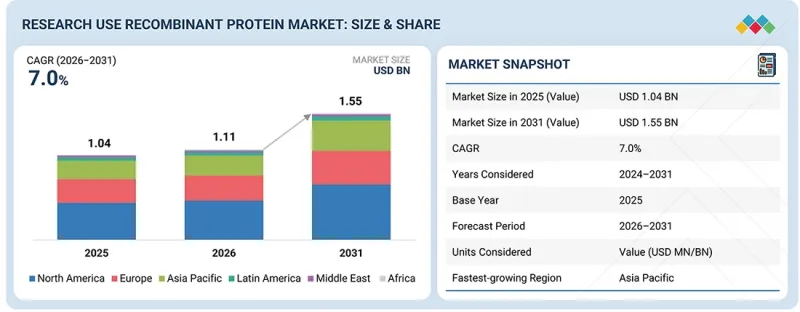
연구용 재조합 단백질 시장 규모는 2026년 11억 1,000만 달러에서 2031년에는 15억 5,000만 달러에 달할 것으로 예측되고 있으며, 예측 기간 중 CAGR 7.0%를 기록할 전망입니다.
이 시장의 주요 성장 요인으로는 재조합 치료제 파이프라인의 확대, 첨단 치료법 분야의 전임상 연구 증가, 그리고 종양 미세환경 연구에서 단백질의 활용 확대가 꼽힙니다. 사이토카인, 케모카인, 성장인자, 항원, 수용체, 리간드 및 효소는 신약 개발, 면역학, 종양학, 줄기세포 연구, 질환 모델링 및 세포 기반 분석법 개발 등 각 분야에서 널리 활용되고 있습니다.
| 조사 범위 | |
|---|---|
| 조사 대상 기간 | 2024-2031년 |
| 기준연도 | 2025년 |
| 예측 기간 | 2026-2031년 |
| 산정 단위 | 금액(10억 달러) |
| 부문 | 제품별, 제품 처방별, 유형별, 숙주세포별, 용도별, 최종사용자별, 지역별 |
| 대상 지역 | 북미, 유럽, 아시아태평양, 라틴아메리카, 중동 및 아프리카 |
인간 발현형 재조합 단백질로의 전환에 따라 복잡한 연구 모델에서의 생물학적 타당성이 더욱 향상되고 있습니다. 또한 즉시 사용 가능한 액상 제제 및 생명공학을 통해 제작된 내열성 단백질 변이체는 자동화, 고처리량 및 연속 세포배양 워크플로우의 기회를 제공하고 있습니다. 그러나 로트 간 편차, 시판 단백질의 품질 편차, 그리고 포유류 발현 제품의 높은 비용이 시장 성장을 제약하고 있습니다. 새롭게 등장하는 비단백질계 대체재와 공급망의 복잡화도 제조업체와 연구소에게 여전히 중요한 과제로 남아 있습니다.
"예측 기간 중 인간 유래 부문이 가장 높은 연평균 성장률(CAGR)을 기록할 전망"
유형별로는 신약 개발, 중개 연구, 질환 모델링 및 첨단 세포 기반 분석에서 인간 유래 단백질의 사용이 증가하고 있으며, 연구용 재조합 단백질 시장에서 인간 부문이 가장 높은 연평균 성장률(CAGR)을 보일 것으로 예측됩니다. 인간 유래 사이토카인, 성장인자, 케모카인, 수용체, 리간드, 항원 및 효소는 종양학, 면역학, 신경과학, 감염병 및 줄기세포 연구 분야에서 널리 활용되고 있습니다. 인간 세포주, 오르가노이드 및 생리학적으로 관련성이 높은 실험 모델의 채택이 확대됨에 따라 고순도이며 생물학적 활성을 가지고 특정 용도에 특화된 인간 재조합 단백질에 대한 수요가 증가하고 있습니다.
"2026년에는 사이토카인·케모카인 분야가 가장 큰 시장 점유율을 차지할 전망"
제품별로는 사이토카인 및 케모카인 부문이 연구용 재조합 단백질 시장에서 가장 큰 점유율을 차지할 것으로 추정됩니다. 이는 면역학, 종양학, 염증 연구, 줄기세포 연구 및 신약 개발 분야에서의 광범위한 활용에 힘입은 결과입니다. 이러한 단백질은 세포 기반 분석법 및 질환 모델에서 면역 세포의 활성화, 증식, 분화 및 이동을 조절하는 데 필수적입니다. 오르가노이드 개발, 종양 미세환경 연구, 바이오마커 연구 및 중개 의학 응용 분야에서 인터류킨, 인터페론, 콜로니 자극인자 및 화학유인 단백질에 대한 수요가 증가함에 따라 이 부문의 입지는 계속해서 더욱 공고해지고 있습니다.
"예측 기간 중 미국이 가장 높은 연평균 성장률(CAGR)을 기록할 전망"
미국에서는 주요 생명과학 기업의 강력한 입지, 첨단인 생의학 연구 인프라, 그리고 신약 개발 및 전임상 연구에서 재조합 단백질의 높은 채택률에 힘입어, 연구용 재조합 단백질 시장이 가장 높은 연평균 성장률(CAGR)을 기록할 것으로 예상됩니다. 재조합 치료제 파이프라인의 확대, 세포·유전자 치료, 면역종양학, 줄기세포 생물학 및 종양 미세환경 연구 분야의 활발한 연구 활동이 시장 성장을 이끄는 주요 요인으로 작용하고 있습니다. 인간 유래 사이토카인, 성장인자, 케모카인, 항원, 수용체, 효소는 제약 회사, 생명공학 기업, CRO 및 학술연구 기관에서 점점 더 널리 사용되고 있으며, 수요를 더욱 부추기고 있습니다.
Thermo Fisher Scientific Inc.(미국), Bio-Techne(미국), Merck KGaA(독일), Danaher Corporation(미국), Revvity(미국), BPS Bioscience, Inc.(미국), Bio-Rad Laboratories, Inc.(미국), Sartorius AG(독일), Sino Biological, Inc.(중국), GenScript(중국), Proteintech Group, Inc.(미국), Miltenyi Biotec(독일), Enzo Biochem Inc.(미국), Abnova Corporation(대만), STEMCELL Technologies(캐나다), RayBiotech, Inc.(미국), ProSpec-Tany TechnoGene Ltd.(이스라엘), ProteoGenix(프랑스), Aviva Systems Biology Corporation(미국), Elabscience(미국), Qkine Ltd.(영국), Abbexa(영국), Bon Opus Biosciences, LLC(미국), Novoprotein Scientific Inc.(중국) 및 OriGene Technologies, Inc.(미국)는 연구용 재조합 단백질을 공급하는 주요 기업 중 일부입니다.
조사 범위
본 조사 보고서에서는 연구용 재조합 단백질 시장을 제품별(사이토카인 및 케모카인, 성장인자, 재조합 항원, 수용체 및 리간드, 효소, ECM 및 접착 단백질, 기타 재조합 단백질), 제품 형태별(동결건조 및 액상 재조합 단백질), 유형별(인간, 생쥐, 쥐, 비인간 영장류, 기타 종), 숙주세포(포유류 세포, 곤충 세포, 세균 세포, 효모·곰팡이 세포, 기타 숙주세포), 용도(세포배양·분화, 신약 개발, 암 연구, 줄기세포 연구, 감염증·백신 연구, 기타 용도), 최종사용자(제약·바이오기술 기업, 학술·연구 기관, 수탁 연구 기관, 기타 최종사용자) 및 지역(북미, 유럽, 아시아태평양, 라틴아메리카, 중동 및 아프리카)으로 분류되어 있습니다.
이 보고서의 범위에는 연구용 재조합 단백질 시장의 성장에 영향을 미치는 주요 요인(촉진요인, 제약 요인, 과제 및 기회 등)에 대한 상세한 정보가 포함되어 있습니다. 주요 업계 플레이어에 대한 포괄적인 분석을 통해 사업 개요, 제품 포트폴리오, 주요 전략, 신제품 출시, 인수합병 및 연구용 재조합 단백질 시장과 관련된 최근 동향에 대한 인사이트를 제공합니다. 또한 이 보고서에는 연구용 재조합 단백질 업계 생태계에서 두각을 보이고 있는 스타트업 기업에 대한 경쟁 분석도 포함되어 있습니다.
이 보고서 구매의 주요 이점
이 보고서는 시장 전체 및 그 하위 부문의 시장 수익 추정치를 제공함으로써 시장을 선도하는 기업과 신규 진입 기업을 지원합니다. 또한 이해관계자가 경쟁 구도를 더 깊이 이해하고, 자사의 비즈니스를 효과적으로 포지셔닝하며, 적절한 시장 진입 전략을 수립하기 위한 인사이트를 얻는 데 도움이 됩니다. 이 보고서를 통해 이해관계자는 시장 동향을 파악하고, 주요 시장 촉진요인, 시장 억제요인, 기회 및 과제에 대한 정보를 얻을 수 있습니다.
이 보고서는 다음 사항에 대한 인사이트를 제공합니다. :
- 주요 촉진요인 분석(재조합 치료용 단백질 파이프라인 확대, 첨단 치료법 분야의 전임상 연구 활동 증가, 연구 용도에서의 인간 유래 재조합 단백질로의 전환, 종양 미세환경 연구에서 연구용 재조합 단백질 수요 증가) , 제약 요인(연구용 기성 재조합 단백질의 로트 간 편차 및 불균일성, 포유류 세포에서 발현된 고품질 재조합 단백질에 따른 높은 비용), 기회(자동화된 고처리량 워크플로우에 통합 가능한 즉시 사용 가능한 액상 제제의 등장, 연속 배양 세포주 및 세포배양용 생명공학 기반 내열성 단백질 변이체의 개발), 그리고 과제(비단백질 모방 물질 및 대체요법의 등장, 공급망 복잡성의 심화)가 시장 성장에 영향을 미치고 있습니다
- 제품 개발/혁신: 연구용 재조합 단백질 시장의 신제품 출시 및 혁신에 대한 상세한 분석
- 시장 개발: 수익성이 높은 시장에 대한 포괄적인 정보 및 지역별 시장 분석
- 시장 다각화: 연구용 재조합 단백질 시장의 신제품, 미개발 지역, 최근 동향 및 투자에 관한 포괄적인 정보
- 경쟁 분석: Thermo Fisher Scientific Inc.(미국), Bio-Techne(미국), Merck KGaA(독일), Danaher Corporation(미국), Revvity(미국), BPS Bioscience, Inc.(미국), Bio-Rad Laboratories, Inc.(미국), Sartorius AG(독일) 등, 연구용 재조합 단백질 시장의 주요 기업의 시장 점유율, 성장 전략, 제품에 대한 상세한 평가
자주 묻는 질문
목차
제1장 서론
제2장 개요
제3장 주요 인사이트
제4장 시장 개요
제5장 업계 동향
제6장 기술 진보, AI에 의한 영향, 특허, 혁신, 향후 응용
제7장 규제 상황과 지속가능성 구상
제8장 고객 상황과 구매 행동
제9장 연구용(RUO) 재조합 단백질 시장(제품별)
제10장 연구용(RUO) 재조합 단백질 시장(제품 처방별)
제11장 연구용(RUO) 재조합 단백질 시장(유형별)
제12장 연구용(RUO) 재조합 단백질 시장(숙주세포별)
제13장 연구용(RUO) 재조합 단백질 시장(용도별)
제14장 연구용(RUO) 재조합 단백질 시장(최종사용자별)
제15장 연구용(RUO) 재조합 단백질 시장(지역별)
제16장 경쟁 구도
제17장 기업 개요
제18장 조사 방법
제19장 부록
KSA 26.08.12The research use recombinant protein market is expected to reach USD 1.55 billion in 2031 from USD 1.11 billion in 2026, registering a CAGR of 7.0% during the forecast period. The market is primarily driven by the growing pipeline of recombinant therapeutics, rising preclinical research in advanced therapies, and increasing use of proteins in tumor microenvironment studies. Cytokines, chemokines, growth factors, antigens, receptors, ligands, and enzymes are widely used across drug discovery, immunology, oncology, stem cell research, disease modeling, and cell-based assay development.
| Scope of the Report | |
|---|---|
| Years Considered for the Study | 2024-2031 |
| Base Year | 2025 |
| Forecast Period | 2026-2031 |
| Units Considered | Value (USD billion) |
| Segments | Product, Product Formulation, Species, Host Cell, Application, and End User |
| Regions covered | North America, Europe, Asia Pacific, Latin America, Middle East, and Africa |
The shift toward human-expressed recombinant proteins is further improving biological relevance in complex research models. In addition, ready-to-use liquid formulations and bioengineered heat-stable protein variants present opportunities for automated, high-throughput, and continuous cell culture workflows. However, market growth is constrained by lot-to-lot variability, inconsistencies in off-the-shelf proteins, and the high cost of mammalian-expressed products. Emerging non-protein alternatives and increasing supply chain complexity also remain key challenges for manufacturers and research laboratories.
"Human species segment to register highest CAGR during forecast period"
By species, the human segment is projected to exhibit the highest CAGR in the research use recombinant protein market due to the increasing use of human-derived proteins in drug discovery, translational research, disease modeling, and advanced cell-based assays. Human cytokines, growth factors, chemokines, receptors, ligands, antigens, and enzymes are widely used across oncology, immunology, neuroscience, infectious disease, and stem cell research. Growing adoption of human cell lines, organoids, and physiologically relevant experimental models is increasing demand for high-purity, biologically active, and application-specific human recombinant proteins.
"Cytokines & chemokines segment to hold largest market share in 2026"
By product, the cytokines & chemokines segment is estimated to account for the largest share of the research use recombinant protein market, driven by their extensive use in immunology, oncology, inflammation research, stem cell studies, and drug discovery. These proteins are essential for regulating immune-cell activation, proliferation, differentiation, and migration across cell-based assays and disease models. Growing demand for interleukins, interferons, colony-stimulating factors, and chemotactic proteins in organoid development, tumor microenvironment studies, biomarker research, and translational applications continues to strengthen the position of this segment.
"US to register highest CAGR during forecast period"
In the US, the research use recombinant protein market is expected to register the highest CAGR, driven by the strong presence of leading life science companies, an advanced biomedical research infrastructure, and a high adoption rate of recombinant proteins in drug discovery and preclinical research. Expanding pipelines of recombinant therapeutics, rising research in cell and gene therapies, immuno-oncology, stem cell biology, and tumor microenvironment studies are key factors driving market growth. Human-expressed cytokines, growth factors, chemokines, antigens, receptors, and enzymes are increasingly used across pharmaceutical companies, biotechnology firms, CROs, and academic research institutes, further supporting demand.
The primary interviews conducted for this report can be categorized as follows:
- By Respondent: Supply Side - 70% and Demand Side- 30%
- By Designation: Managers - 45%, CXOs and Directors - 30%, and Executives - 25%
- By Region: North America - 40%, Europe - 25%, Asia Pacific - 25%, Latin America - 5%, Middle East & Africa - 5%
Thermo Fisher Scientific Inc. (US), Bio-Techne (US), Merck KGaA (Germany), Danaher Corporation (US), Revvity (US), BPS Bioscience, Inc. (US), Bio-Rad Laboratories, Inc. (US), Sartorius AG (Germany), Sino Biological, Inc. (China), GenScript (China), Proteintech Group, Inc. (US), Miltenyi Biotec (Germany), Enzo Biochem Inc. (US), Abnova Corporation (Taiwan), STEMCELL Technologies (Canada), RayBiotech, Inc. (US), ProSpec-Tany TechnoGene Ltd. (Israel), ProteoGenix (France), Aviva Systems Biology Corporation (US), Elabscience (US), Qkine Ltd. (UK), Abbexa (UK), Bon Opus Biosciences, LLC (US), Novoprotein Scientific Inc. (China), and OriGene Technologies, Inc. (US) are some of the key companies offering research use recombinant proteins.
Research Coverage
This research report categorizes the research use recombinant protein market by product (cytokines & chemokines, growth factors, recombinant antigens, receptors & ligands, enzymes, ECM & adhesion proteins, and other recombinant proteins), product formulation (lyophilized and liquid recombinant proteins), species (human, mouse, rat, non-human primate, and other species), host cell (mammalian cells, insect cells, bacterial cells, yeast & fungi cells, and other host cells), application (cell culture & differentiation, drug discovery, cancer research, stem cell research, infectious disease & vaccine research, and other applications), end user (pharmaceutical & biotechnology companies, academic & research institutes, contract research organizations, and other end users), and region (North America, Europe, Asia Pacific, Latin America, and Middle East & Africa).
The report's scope encompasses detailed information about the primary factors, including drivers, restraints, challenges, and opportunities, that influence the growth of the research use recombinant protein market. A comprehensive analysis of key industry players has been performed to provide insights into their business overview, product portfolio, key strategies, new product launches, acquisitions, and recent developments related to the research use recombinant protein market. This report also includes a competitive analysis of emerging startups in the research use recombinant protein industry ecosystem.
Key Benefits of Buying the Report
The report will assist market leaders and new entrants by providing revenue estimates for the overall market and its subsegments. It will also help stakeholders better understand the competitive landscape and gain more insights to position their businesses effectively and develop suitable go-to-market strategies. This report will enable stakeholders to grasp the market's pulse and offer information on key market drivers, restraints, opportunities, and challenges.
The report provides insights into the following pointers:
- Analysis of key drivers (growing pipeline for recombinant therapeutic proteins, rising preclinical research activities in advanced therapies, shift towards human-expressed recombinant proteins for research use applications, increase in demand for research use recombinant proteins in tumor microenvironment studies), restraints (high lot-to-lot variability and inconsistency in off-the-shelf recombinant proteins for research use applications, high costs associated with premium recombinant proteins expressed in mammalian cells), opportunities (emergence of ready-to-use liquid formulations for integration into automated high-throughput workflows, development of bio-engineered, heat-stable protein variants for continuous cell lines & cell culture), and challenges (advent of non-protein mimics and alternative modalities, rising supply chain complexities) influencing the market growth
- Product Development/Innovation: Detailed insights into newly launched products and innovations in the research use recombinant protein market
- Market Development: Comprehensive information about lucrative markets and analysis of the market across varied regions
- Market Diversification: Exhaustive information about new products, untapped geographies, recent developments, and investments in the research use recombinant protein market
- Competitive Assessment: In-depth assessment of market shares, growth strategies, and products of leading players, such as Thermo Fisher Scientific Inc. (US), Bio-Techne (US), Merck KGaA (Germany), Danaher Corporation (US), Revvity (US), BPS Bioscience, Inc. (US), Bio-Rad Laboratories, Inc. (US), and Sartorius AG (Germany), among others, for the research use recombinant protein market
TABLE OF CONTENTS
1 INTRODUCTION
- 1.1 STUDY OBJECTIVES
- 1.2 MARKET DEFINITION
- 1.3 STUDY SCOPE
- 1.3.1 MARKET SEGMENTATION AND REGIONS COVERED
- 1.3.2 INCLUSIONS & EXCLUSIONS
- 1.3.3 YEARS CONSIDERED
- 1.3.4 CURRENCY CONSIDERED
- 1.4 STAKEHOLDERS
2 EXECUTIVE SUMMARY
- 2.1 MARKET HIGHLIGHTS AND KEY INSIGHTS
- 2.2 KEY MARKET PARTICIPANTS: MAPPING OF STRATEGIC DEVELOPMENTS
- 2.3 DISRUPTIVE TRENDS IN RUO RECOMBINANT PROTEIN MARKET
- 2.4 HIGH-GROWTH SEGMENTS
- 2.5 REGIONAL SNAPSHOT: MARKET SIZE, GROWTH RATE, AND FORECAST
3 PREMIUM INSIGHTS
- 3.1 RUO RECOMBINANT PROTEIN MARKET OVERVIEW
- 3.2 NORTH AMERICA: RUO RECOMBINANT PROTEIN MARKET, BY PRODUCT FORMULATION
- 3.3 RUO RECOMBINANT PROTEIN MARKET: GEOGRAPHIC GROWTH OPPORTUNITIES
- 3.4 RUO RECOMBINANT PROTEIN MARKET SHARE, BY END USER, 2026 VS 2031 (%)
4 MARKET OVERVIEW
- 4.1 INTRODUCTION
- 4.2 MARKET DYNAMICS
- 4.2.1 DRIVERS
- 4.2.1.1 Growing pipeline for recombinant therapeutic proteins
- 4.2.1.2 Rising preclinical research in advanced therapies (cell & gene therapies)
- 4.2.1.3 Shift toward human-expressed recombinant proteins for RUO applications
- 4.2.1.4 Rising demand for RUO recombinant proteins in tumor microenvironment studies
- 4.2.2 RESTRAINTS
- 4.2.2.1 High lot-to-lot variability and inconsistency in off-the-shelf recombinant proteins for research-use applications
- 4.2.2.2 High costs associated with premium recombinant proteins expressed in mammalian cells
- 4.2.3 OPPORTUNITIES
- 4.2.3.1 Emergence of ready-to-use liquid formulations for integration into automated high-throughput workflows
- 4.2.3.2 Development of bioengineered, heat-stable protein variants for continuous cell lines & cell culture
- 4.2.4 CHALLENGES
- 4.2.4.1 Advent of non-protein mimics and alternative modalities
- 4.2.4.2 Rising supply chain complexities
- 4.2.1 DRIVERS
- 4.3 UNMET NEEDS AND WHITE SPACES
- 4.4 INTERCONNECTED MARKETS & CROSS-SECTOR OPPORTUNITIES
- 4.5 STRATEGIC MOVES BY TIER-1/2/3 PLAYERS
5 INDUSTRY TRENDS
- 5.1 PORTER'S FIVE FORCES ANALYSIS
- 5.1.1 INTENSITY OF COMPETITIVE RIVALRY
- 5.1.2 BARGAINING POWER OF SUPPLIERS
- 5.1.3 BARGAINING POWER OF BUYERS
- 5.1.4 THREAT OF SUBSTITUTES
- 5.1.5 THREAT OF NEW ENTRANTS
- 5.2 MACROECONOMIC OUTLOOK
- 5.2.1 INTRODUCTION
- 5.2.2 GDP TRENDS AND FORECASTS
- 5.2.3 TRENDS IN GLOBAL HEALTHCARE INDUSTRY
- 5.2.4 TRENDS IN GLOBAL BIOTECH INDUSTRY
- 5.3 VALUE CHAIN ANALYSIS
- 5.4 ECOSYSTEM ANALYSIS
- 5.4.1 ROLE OF PLAYERS IN ECOSYSTEM
- 5.5 PRICING ANALYSIS
- 5.5.1 AVERAGE SELLING PRICE TREND, BY KEY PLAYER, 2023-2025
- 5.5.2 AVERAGE SELLING PRICE TREND, BY REGION, 2023-2025
- 5.6 TRADE ANALYSIS
- 5.6.1 IMPORT SCENARIO (HS CODE 3822.00)
- 5.6.2 EXPORT SCENARIO (HS CODE 3822.00)
- 5.7 KEY CONFERENCES & EVENTS, 2026-2027
- 5.8 TRENDS/DISRUPTIONS IMPACTING CUSTOMERS' BUSINESSES
- 5.9 INVESTMENT & FUNDING SCENARIO
- 5.10 CASE STUDY ANALYSIS
- 5.10.1 RECOMBINANT LIGAND SCREENING MAPS INFLAMED INTESTINAL ORGANOID RESPONSES
- 5.10.2 RECOMBINANT OSTEOGLYCIN SUPPORTS ALVEOLAR ORGANOID RESEARCH
- 5.10.3 RECOMBINANT ANTIGENS IMPROVE H. PYLORI ASSAY DEVELOPMENT
- 5.11 IMPACT OF US TARIFFS-RUO RECOMBINANT PROTEIN MARKET
- 5.11.1 INTRODUCTION
- 5.11.2 KEY TARIFF RATES
- 5.11.3 PRICE IMPACT ANALYSIS
- 5.11.4 IMPACT ON COUNTRIES/REGIONS
- 5.11.4.1 US
- 5.11.4.2 Europe
- 5.11.4.3 Asia Pacific
- 5.11.5 IMPACT ON END-USE INDUSTRIES
- 5.11.5.1 Pharmaceutical & biotechnology companies
- 5.11.5.2 Academic & research institutes
- 5.11.5.3 CROs
6 TECHNOLOGICAL ADVANCEMENTS, AI-DRIVEN IMPACT, PATENTS, INNOVATIONS, AND FUTURE APPLICATIONS
- 6.1 INTRODUCTION
- 6.2 KEY TECHNOLOGIES
- 6.2.1 CODON OPTIMIZATION
- 6.2.2 CRISPR/CAS9 ENGINEERING
- 6.2.3 TRANSIENT GENE EXPRESSION (TGE)
- 6.3 COMPLEMENTARY TECHNOLOGIES
- 6.3.1 AFFINITY CHROMATOGRAPHY
- 6.3.2 TANGENTIAL FLOW FILTRATION (TFF) AND ULTRAFILTRATION
- 6.4 ADJACENT TECHNOLOGIES
- 6.4.1 GENE EDITING
- 6.4.2 SPATIAL MULTI-OMICS
- 6.5 TECHNOLOGY ROADMAP
- 6.6 PATENT ANALYSIS
- 6.6.1 METHODOLOGY
- 6.6.2 NUMBER OF PATENTS FILED, BY DOCUMENT TYPE
- 6.6.3 LIST OF KEY PATENTS
- 6.7 FUTURE APPLICATIONS
- 6.8 IMPACT OF AI/GEN AI ON RUO RECOMBINANT PROTEIN MARKET
- 6.8.1 TOP USE CASES AND MARKET POTENTIAL
- 6.8.2 BEST PRACTICES IN AI-ENABLED RECOMBINANT PROTEIN DISCOVERY, DESIGN, AND WORKFLOWS
- 6.8.3 CASE STUDIES OF AI IMPLEMENTATION IN RUO RECOMBINANT PROTEIN MARKET
- 6.8.4 INTERCONNECTED ADJACENT ECOSYSTEMS AND IMPACT ON MARKET PLAYERS
- 6.8.5 CLIENTS' READINESS TO ADOPT AI-INTEGRATED RECOMBINANT PROTEIN SOLUTIONS
7 REGULATORY LANDSCAPE AND SUSTAINABILITY INITIATIVES
- 7.1 REGIONAL REGULATIONS AND COMPLIANCE
- 7.1.1 REGULATORY BODIES, GOVERNMENT AGENCIES, AND OTHER ORGANIZATIONS
- 7.1.2 INDUSTRY STANDARDS
- 7.1.2.1 North America
- 7.1.2.2 Europe
- 7.1.2.3 Asia Pacific
- 7.1.2.4 Rest of the world
- 7.2 SUSTAINABILITY INITIATIVES
- 7.3 IMPACT OF REGULATORY POLICIES ON SUSTAINABILITY INITIATIVES
- 7.4 CERTIFICATIONS, LABELING, AND ECO-STANDARDS
8 CUSTOMER LANDSCAPE & BUYER BEHAVIOR
- 8.1 DECISION-MAKING PROCESS
- 8.2 BUYER STAKEHOLDERS AND BUYING EVALUATION CRITERIA
- 8.2.1 KEY STAKEHOLDERS IN BUYING PROCESS
- 8.2.2 KEY BUYING CRITERIA, BY END USER
- 8.3 ADOPTION BARRIERS & INTERNAL CHALLENGES
- 8.4 UNMET NEEDS FROM VARIOUS END-USE INDUSTRIES
9 RESEARCH USE ONLY (RUO) RECOMBINANT PROTEIN MARKET, BY PRODUCT
- 9.1 INTRODUCTION
- 9.2 CYTOKINES & CHEMOKINES
- 9.2.1 EXPANDING IMMUNE-CELL RESEARCH TO BOOST MARKET GROWTH
- 9.3 GROWTH FACTORS
- 9.3.1 EXPANDING STEM CELL, ORGANOID, AND TISSUE-MODEL RESEARCH TO FUEL SEGMENT GROWTH
- 9.4 RECOMBINANT ANTIGENS
- 9.4.1 INFECTIOUS-DISEASE AND ANTIBODY RESEARCH TO DRIVE MARKET
- 9.5 RECEPTORS & LIGANDS
- 9.5.1 INCREASING USE OF RECOMBINANT RECEPTORS AND LIGANDS TO DRIVE MARKET
- 9.6 ENZYMES
- 9.6.1 EXPANDING MOLECULAR RESEARCH TO DRIVE MARKET
- 9.7 ECM & ADHESION PROTEINS
- 9.7.1 STEM CELL AND 3D CULTURE RESEARCH TO DRIVE MARKET
- 9.8 OTHER RECOMBINANT PROTEINS
10 RESEARCH USE ONLY (RUO) RECOMBINANT PROTEIN MARKET, BY PRODUCT FORMULATION
- 10.1 INTRODUCTION
- 10.2 LYOPHILIZED RECOMBINANT PROTEINS
- 10.2.1 IMPROVED STABILITY, SIMPLIFIED DISTRIBUTION, AND CONSISTENT RESEARCH PERFORMANCE TO DRIVE MARKET GROWTH
- 10.3 LIQUID RECOMBINANT PROTEINS
- 10.3.1 CONVENIENCE, PRECISE DOSING, AND AUTOMATION-COMPATIBLE WORKFLOWS TO SUPPORT GROWTH
11 RESEARCH USE ONLY (RUO) RECOMBINANT PROTEIN MARKET, BY SPECIES
- 11.1 INTRODUCTION
- 11.2 HUMAN
- 11.2.1 EXPANDING HUMAN-RELEVANT MODELS AND TRANSLATIONAL RESEARCH TO BOOST MARKET GROWTH
- 11.3 MOUSE
- 11.3.1 EXPANDING MURINE DISEASE MODELS AND SPECIES-MATCHED CELL CULTURE WORKFLOWS TO FUEL SEGMENT
- 11.4 RAT
- 11.4.1 EXPANDING RAT-BASED PRECLINICAL MODELS AND SPECIES-MATCHED RESEARCH WORKFLOWS TO DRIVE MARKET
- 11.5 NON-HUMAN PRIMATE
- 11.5.1 EXPANDING TRANSLATIONAL VALIDATION AND ADVANCED BIOLOGIC DEVELOPMENT TO DRIVE MARKET
- 11.6 OTHER SPECIES
12 RESEARCH USE ONLY (RUO) RECOMBINANT PROTEIN MARKET, BY HOST CELL
- 12.1 INTRODUCTION
- 12.2 MAMMALIAN CELLS
- 12.2.1 GROWING BIOLOGICS RESEARCH TO BOOST MARKET GROWTH
- 12.3 BACTERIAL CELLS
- 12.3.1 COST-EFFECTIVE AND RAPID PROTEIN PRODUCTION TO DRIVE MARKET
- 12.4 INSECT CELLS
- 12.4.1 GROWING RESEARCH ON COMPLEX PROTEINS AND VIRAL TARGETS TO FUEL GROWTH
- 12.5 YEAST & FUNGI CELLS
- 12.5.1 SCALABLE AND COST-EFFICIENT PROTEIN PRODUCTION TO DRIVE MARKET
- 12.6 OTHER HOST CELLS
13 RESEARCH USE ONLY (RUO) RECOMBINANT PROTEIN MARKET, BY APPLICATION
- 13.1 INTRODUCTION
- 13.2 CELL CULTURE & DIFFERENTIATION
- 13.2.1 GROWTH IN STEM-CELL, ORGANOID, AND ADVANCED CELL-CULTURE RESEARCH TO BOOST MARKET GROWTH
- 13.3 DRUG DISCOVERY
- 13.3.1 EXPANDING BIOLOGICS RESEARCH AND TARGET SCREENING TO FUEL SEGMENT
- 13.4 CANCER RESEARCH
- 13.4.1 EXPANDING IMMUNO-ONCOLOGY AND PRECISION CANCER RESEARCH TO DRIVE MARKET
- 13.5 STEM CELL RESEARCH
- 13.5.1 GROWTH IN STEM CELL, ORGANOID, AND REGENERATIVE MEDICINE RESEARCH TO DRIVE MARKET
- 13.6 INFECTIOUS DISEASE & VACCINE RESEARCH
- 13.6.1 EMERGING PATHOGENS AND EVOLVING VIRAL STRAINS TO DRIVE MARKET
- 13.7 OTHER APPLICATIONS
14 RESEARCH USE ONLY (RUO) RECOMBINANT PROTEIN MARKET, BY END USER
- 14.1 INTRODUCTION
- 14.2 PHARMACEUTICAL & BIOTECHNOLOGY COMPANIES
- 14.2.1 EXPANDING THERAPEUTIC PIPELINES, ADVANCED CELL MODELS, AND ENGINEERED PROTEINS TO BOOST MARKET GROWTH
- 14.3 ACADEMIC & RESEARCH INSTITUTES
- 14.3.1 PUBLIC RESEARCH FUNDING AND ADVANCED HUMAN DISEASE MODELS TO FUEL SEGMENT
- 14.4 CONTRACT RESEARCH ORGANIZATIONS
- 14.4.1 EXPANDING R&D OUTSOURCING TO DRIVE MARKET
- 14.5 OTHER END USERS
15 RESEARCH USE ONLY (RUO) RECOMBINANT PROTEIN MARKET, BY REGION
- 15.1 INTRODUCTION
- 15.2 NORTH AMERICA
- 15.2.1 US
- 15.2.1.1 Research funding, advanced cellular models, and engineered protein innovation to drive market
- 15.2.2 CANADA
- 15.2.2.1 Government funding and regenerative medicine leadership to propel market
- 15.2.1 US
- 15.3 EUROPE
- 15.3.1 GERMANY
- 15.3.1.1 Biotechnology clusters, translational research, and supplier expansion to aid market growth
- 15.3.2 UK
- 15.3.2.1 Advanced cellular models and animal-origin-free protein innovation to drive market
- 15.3.3 FRANCE
- 15.3.3.1 Immuno-oncology research to drive market
- 15.3.4 ITALY
- 15.3.4.1 Advanced research infrastructure and biotechnology collaboration to drive market
- 15.3.5 SPAIN
- 15.3.5.1 AI-enabled protein design and collaborative biomedical infrastructure to aid growth
- 15.3.6 REST OF EUROPE
- 15.3.1 GERMANY
- 15.4 ASIA PACIFIC
- 15.4.1 CHINA
- 15.4.1.1 AI-enabled protein engineering and localized reagent production to boost market
- 15.4.2 JAPAN
- 15.4.2.1 Regenerative medicine expertise and development of application-specific recombinant proteins to drive market growth
- 15.4.3 INDIA
- 15.4.3.1 Research outsourcing capabilities and expanding scientific infrastructure to propel market
- 15.4.4 AUSTRALIA
- 15.4.4.1 Integrated protein-research infrastructure and translational science to fuel market
- 15.4.5 SOUTH KOREA
- 15.4.5.1 Synthetic biology, organoid-based screening, and AI-enabled discovery to support market growth
- 15.4.6 REST OF ASIA PACIFIC
- 15.4.1 CHINA
- 15.5 LATIN AMERICA
- 15.5.1 BRAZIL
- 15.5.1.1 Infectious-disease research, shared protein-production infrastructure, and vaccine innovation to drive market
- 15.5.2 MEXICO
- 15.5.2.1 Expanding use of high-quality recombinant proteins in global translational workflows to support market
- 15.5.3 REST OF LATIN AMERICA
- 15.5.1 BRAZIL
- 15.6 MIDDLE EAST
- 15.6.1 GCC COUNTRIES
- 15.6.1.1 Saudi Arabia
- 15.6.1.1.1 Biotechnology policy and advanced-therapy infrastructure to boost market
- 15.6.1.2 UAE
- 15.6.1.2.1 AI-enabled human-relevant models and integrated biotechnology infrastructure to aid market growth
- 15.6.1.3 Rest of GCC Countries
- 15.6.1.1 Saudi Arabia
- 15.6.2 REST OF MIDDLE EAST
- 15.6.1 GCC COUNTRIES
- 15.7 AFRICA
- 15.7.1 INFECTIOUS-DISEASE RESEARCH AND LOCALIZED RECOMBINANT PROTEIN PRODUCTION TO PROPEL MARKET
16 COMPETITIVE LANDSCAPE
- 16.1 INTRODUCTION
- 16.2 KEY PLAYER STRATEGIES/RIGHT TO WIN, JANUARY 2023-JUNE 2026
- 16.3 REVENUE ANALYSIS
- 16.4 MARKET SHARE ANALYSIS, 2025
- 16.5 COMPANY EVALUATION MATRIX: KEY PLAYERS, 2025
- 16.5.1 STARS
- 16.5.2 EMERGING LEADERS
- 16.5.3 PERVASIVE PLAYERS
- 16.5.4 PARTICIPANTS
- 16.5.5 COMPANY FOOTPRINT: KEY PLAYERS, 2025
- 16.5.5.1 Company footprint
- 16.5.5.2 Region footprint
- 16.5.5.3 Product footprint
- 16.5.5.4 Application footprint
- 16.5.5.5 Species footprint
- 16.6 COMPANY EVALUATION MATRIX: STARTUPS/SMES, 2025
- 16.6.1 PROGRESSIVE COMPANIES
- 16.6.2 RESPONSIVE COMPANIES
- 16.6.3 DYNAMIC COMPANIES
- 16.6.4 STARTING BLOCKS
- 16.6.5 COMPETITIVE BENCHMARKING
- 16.6.5.1 Detailed list of key startups/SMEs
- 16.6.5.2 Competitive benchmarking of key startups/SMEs
- 16.7 COMPANY VALUATION AND FINANCIAL METRICS
- 16.7.1 COMPANY VALUATION
- 16.7.2 FINANCIAL METRICS
- 16.8 BRAND COMPARISON
- 16.9 COMPETITIVE SCENARIO
- 16.9.1 PRODUCT LAUNCHES
- 16.9.2 DEALS
- 16.9.3 EXPANSIONS
17 COMPANY PROFILES
- 17.1 KEY PLAYERS
- 17.1.1 THERMO FISHER SCIENTIFIC INC.
- 17.1.1.1 Business overview
- 17.1.1.2 Products offered
- 17.1.1.3 Recent developments
- 17.1.1.3.1 Product launches
- 17.1.1.3.2 Deals
- 17.1.1.4 MnM view
- 17.1.1.4.1 Key strengths
- 17.1.1.4.2 Strategic choices
- 17.1.1.4.3 Weaknesses and competitive threats
- 17.1.2 MERCK KGAA
- 17.1.2.1 Business overview
- 17.1.2.2 Products offered
- 17.1.2.3 Recent developments
- 17.1.2.3.1 Deals
- 17.1.2.3.2 Expansions
- 17.1.2.4 MnM view
- 17.1.2.4.1 Key strengths
- 17.1.2.4.2 Strategic choices
- 17.1.2.4.3 Weaknesses and competitive threats
- 17.1.3 BIO-TECHNE
- 17.1.3.1 Business overview
- 17.1.3.2 Products offered
- 17.1.3.3 Recent developments
- 17.1.3.3.1 Product launches
- 17.1.3.3.2 Deals
- 17.1.3.4 MnM view
- 17.1.3.4.1 Key strengths
- 17.1.3.4.2 Strategic choices
- 17.1.3.4.3 Weaknesses and competitive threats
- 17.1.4 DANAHER CORPORATION
- 17.1.4.1 Business overview
- 17.1.4.2 Products offered
- 17.1.4.3 Recent developments
- 17.1.4.3.1 Product launches
- 17.1.4.3.2 Deals
- 17.1.4.4 MnM view
- 17.1.4.4.1 Key strengths
- 17.1.4.4.2 Strategic choices
- 17.1.4.4.3 Weaknesses and competitive threats
- 17.1.5 REVVITY
- 17.1.5.1 Business overview
- 17.1.5.2 Products offered
- 17.1.5.3 Recent developments
- 17.1.5.3.1 Expansions
- 17.1.5.4 MnM view
- 17.1.5.4.1 Key strengths
- 17.1.5.4.2 Strategic choices
- 17.1.5.4.3 Weaknesses and competitive threats
- 17.1.6 BIO-RAD LABORATORIES, INC.
- 17.1.6.1 Business overview
- 17.1.6.2 Products offered
- 17.1.6.3 Recent developments
- 17.1.6.3.1 Product launches
- 17.1.7 BPS BIOSCIENCE, INC.
- 17.1.7.1 Business overview
- 17.1.7.2 Products offered
- 17.1.8 SARTORIUS AG
- 17.1.8.1 Business overview
- 17.1.8.2 Products offered
- 17.1.9 SINO BIOLOGICAL, INC.
- 17.1.9.1 Business overview
- 17.1.9.2 Products offered
- 17.1.10 GENSCRIPT
- 17.1.10.1 Business overview
- 17.1.10.2 Products offered
- 17.1.11 PROTEINTECH GROUP, INC.
- 17.1.11.1 Business overview
- 17.1.11.2 Products offered
- 17.1.11.3 Recent developments
- 17.1.11.3.1 Deals
- 17.1.12 MILTENYI BIOTEC
- 17.1.12.1 Business overview
- 17.1.12.2 Products offered
- 17.1.12.3 Recent developments
- 17.1.12.3.1 Product launches
- 17.1.13 ENZO BIOCHEM, INC.
- 17.1.13.1 Business overview
- 17.1.13.2 Products offered
- 17.1.13.3 Recent developments
- 17.1.13.3.1 Deals
- 17.1.14 ABNOVA CORPORATION
- 17.1.14.1 Business overview
- 17.1.14.2 Products offered
- 17.1.1 THERMO FISHER SCIENTIFIC INC.
- 17.2 OTHER PLAYERS
- 17.2.1 STEMCELL TECHNOLOGIES
- 17.2.2 RAYBIOTECH, INC.
- 17.2.3 PROSPEC-TANY TECHNOGENE LTD.
- 17.2.4 PROTEOGENIX
- 17.2.5 AVIVA SYSTEMS BIOLOGY CORPORATION
- 17.2.6 ELABSCIENCE
- 17.2.7 QKINE LTD.
- 17.2.8 ABBEXA
- 17.2.9 BON OPUS BIOSCIENCES, LLC
- 17.2.10 NOVOPROTEIN SCIENTIFIC INC.
- 17.2.11 ORIGENE TECHNOLOGIES, INC.
18 RESEARCH METHODOLOGY
- 18.1 RESEARCH DATA
- 18.1.1 SECONDARY DATA
- 18.1.1.1 Key data from secondary sources
- 18.1.2 PRIMARY DATA
- 18.1.2.1 Key data from primary sources
- 18.1.2.2 Key primary participants
- 18.1.2.3 Breakdown of primary interviews
- 18.1.2.4 Key industry insights
- 18.1.1 SECONDARY DATA
- 18.2 MARKET SIZE ESTIMATION
- 18.2.1 GLOBAL RUO RECOMBINANT PROTEIN MARKET ESTIMATION, 2025
- 18.2.2 SEGMENTAL MARKET SIZE ESTIMATION
- 18.3 MARKET GROWTH RATE PROJECTIONS
- 18.4 DATA TRIANGULATION
- 18.5 FACTOR ANALYSIS
- 18.6 RESEARCH ASSUMPTIONS
- 18.7 RESEARCH LIMITATIONS AND RISK ASSESSMENT
19 APPENDIX
- 19.1 DISCUSSION GUIDE
- 19.2 KNOWLEDGESTORE: MARKETSANDMARKETS' SUBSCRIPTION PORTAL
- 19.3 CUSTOMIZATION OPTIONS
- 19.4 RELATED REPORTS
- 19.5 AUTHOR DETAILS


