
|
시장보고서
상품코드
2107269
의료용 플라스틱 시장 : 유형별, 용도별, 지역별 - 세계 예측(-2031년)Medical Plastics Market by Type (Standard Plastics, Engineering Plastics, High-performance Plastics), Application (Medical Disposables, Medical Instruments & Devices, Prosthetics & Implants, Drug Delivery, Medical Packaging) - Global Forecast to 2031 |
||||||

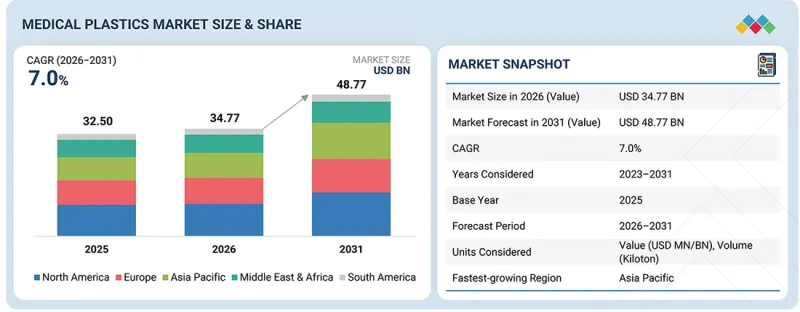
세계의 의료용 플라스틱 시장 규모는 2026년에는 347억 7,000만 달러, 2031년까지 487억 7,000만 달러에 달할 것으로 예측되며, 예측 기간 동안 CAGR 7.0%를 기록할 전망입니다.
첨단 의료기기 및 일회용 의료 제품에 대한 수요 증가가 시장 성장을 주도하고 있습니다. 의료 용도를 위한 안전하고 가벼우며 효율적인 폴리머에 대한 수요 증가와 고령화에 따른 만성 질환 유병률 증가가 성장 기회를 창출하고 있습니다.
| 조사 범위 | |
|---|---|
| 조사 대상 기간 | 2023-2031년 |
| 기준 연도 | 2025년 |
| 예측 기간 | 2026-2031년 |
| 산정 단위 | 금액(100만/10억 달러) 킬로톤 |
| 부문 | 유형별, 용도별, 지역별 |
| 대상 지역 | 북미, 아시아태평양, 유럽, 중동 및 아프리카, 남미 |
또한, 최소침습 수술의 보급에 더해, 감염률을 낮추기 위한 일회용 의료기기의 도입도 시장 성장을 뒷받침하고 있습니다.
"2026년부터 2031년까지 고성능 플라스틱 부문이 가장 높은 연평균 성장률(CAGR)을 기록할 전망"
유형별로는 예측 기간 동안 의료용 플라스틱 시장에서 고성능 플라스틱 부문이 가장 빠른 성장을 이룰 것으로 전망됩니다. 이 부문의 성장은 뛰어난 기계적 강도, 내화학성, 우수한 열안정성 및 생체적합성에 기인합니다. PEEK, PTFE, PPSU 등의 첨단 소재가 이 부문을 대표합니다. 이 부문은 가혹한 의료 환경에서도 높은 신뢰성과 성능이 요구되는 하이엔드 의료 용도에 채택되고 있습니다. 이러한 소재는 경량성, 치수 안정성, 내마모성, 그리고 반복적인 멸균이 가능하다는 특징 덕분에 정형외과 및 척추용 임플란트, 수술기구, 카테터 부품, 약물전달 시스템, 치과용 기기, 그리고 반복적으로 멸균되는 도구 등이 주요 용도로 사용되고 있습니다. 또한, X선 투과성을 갖추고 있으며 내식성과 설계 유연성을 겸비하고 있어 현장에서 금속의 대체재로 활용할 수 있습니다.
"2031년에는 의료용 일회용 제품 부문이 의료용 플라스틱 시장에서 가장 큰 점유율을 차지할 전망"
용도별로 보면 의료용 일회용 제품 부문은 병원, 외래 진료 시설, 진단 검사실, 재택 의료에서의 광범위한 사용으로 인해 2031년에는 최대 시장 점유율을 차지할 것으로 예측됩니다. 주사기, 장갑, 수액용 부품, 채혈 기구, 외과용 일회용 제품, 검체 용기, 일회용 호흡기 제품 등 다양한 제품은 비용 대비 효율이 높은 생산 수준에서 무균 상태를 유지하고 환자의 안전을 확보하기 위해 의료용 플라스틱에 크게 의존하고 있습니다. 외과 수술 건수의 증가, 감염 예방 대책 강화, 예방 접종 및 진단 프로그램의 확대, 그리고 일회용 플라스틱 제품의 인기가 높아짐에 따라 의료용 일회용 제품에 대한 수요가 증가하고 있습니다. 또한, 엄격한 규제 체계와 병원내 감염 예방에 대한 집중적인 노력이 이 부문 시장의 주도적 지위를 공고히 하고 있습니다.
"예측 기간 동안 유럽은 의료용 플라스틱 시장에서 2위 규모를 차지할 전망"
지역별로 보면 유럽은 선진적인 의료기기 제조 산업, 잘 갖춰진 의료 인프라, 그리고 의료용 플라스틱 및 환자 안전에 관한 엄격한 규제로 인해 2026년부터 2031년까지 의료용 플라스틱 시장에서 2위의 점유율을 차지할 것으로 예상됩니다. 이 지역에는 의료기기, 폴리머 및 기타 의료용 포장 제품의 주요 제조업체들이 다수 진출해 있어, 고성능 의료용 플라스틱의 혁신을 촉진하고 있습니다. 최소침습 수술에 대한 수요 증가, 인구 고령화, 만성 질환 유병률 증가, 그리고 제약 및 생명공학 산업의 확장이 이 지역의 시장을 견인하고 있습니다.
대상 기업 - 본 보고서에서는 BASF(독일), Celanese Corporation(미국), SABIC(사우디아라비아), Covestro AG(독일), Syensqo(벨기에), Evonik Industries(독일), Arkema(프랑스), Lubrizol(미국), Ensinger(독일), Dow(미국) 등을 대상으로 하고 있습니다.
본 조사에서는 의료용 플라스틱 시장의 이러한 주요 기업들에 대해 기업 개요, 최근 동향 및 주요 시장 전략을 포함한 상세한 경쟁 분석을 수행하고 있습니다.
조사 범위
본 조사 보고서에서는 의료용 플라스틱 시장을 종류(표준 플라스틱, 엔지니어링 플라스틱, 고성능 플라스틱, 실리콘, 기타) 및 용도(의료용 일회용 제품, 의료 기구·기기, 보철물·임플란트, 약물전달, 의료용 포장, 기타 용도)에 따라 분류하고 있습니다. 본 보고서의 범위에는 시장 성장에 영향을 미치는 촉진요인, 제약요인, 과제 및 기회에 대한 상세한 정보가 포함되어 있습니다. 주요 업계 플레이어에 대한 상세한 분석을 통해 각 기업의 사업 개요, 제공 제품, 그리고 의료용 플라스틱 시장과 관련된 합병·인수, 제품 출시, 사업 확장 등의 주요 전략에 대한 인사이트를 제공합니다. 또한, 본 보고서에서는 의료용 플라스틱 시장의 생태계에서 두각을 나타내고 있는 신생 기업에 대한 경쟁 분석도 포괄하고 있습니다.
본 보고서를 구매해야 하는 이유
본 보고서는 시장 선도 기업 및 신규 진입 기업에게 의료용 플라스틱 시장 전체 및 각 하위 부문의 매출에 대한 가장 정확한 추정치를 제공합니다. 본 보고서는 이해관계자가 경쟁 구도를 이해하고, 자사의 비즈니스를 보다 적절하게 포지셔닝하기 위한 인사이트를 심화하며, 적절한 시장 진입 전략을 수립하는 데 도움이 됩니다. 또한, 본 보고서는 이해관계자가 시장 동향을 파악하고, 주요 시장 촉진요인, 제약요인, 과제 및 기회에 대한 정보를 얻는 데에도 도움이 됩니다.
본 보고서는 다음 사항에 대한 인사이트를 제공합니다:
- 주요 촉진요인 분석(일회용 의료기기에 대한 수요 증가, 전 세계 고령화 진행 및 만성 질환 부담 증가, 첨단 의료기기 및 최소침습 수술의 채택 확대), 제약요인(엄격한 규제 및 소재 검증 요건, 플라스틱 폐기물 관련 환경 문제), 기회(바이오 기반 및 지속가능한 의료용 플라스틱의 채택 확대, 신흥 경제국에서의 의료 인프라 확충), 그리고 과제(지속가능성 요건과 엄격한 의료 성능 기준 간의 균형을 맞추는 데 따른 문제, 고성능 의료용 폴리머 공급망의 복잡성)
- 제품 개발/혁신 : 의료용 플라스틱 시장의 향후 기술, 연구개발 활동 및 제품·서비스 출시에 대한 상세한 인사이트
- 시장 개발 : 수익성이 높은 시장에 대한 종합적인 정보(본 보고서에서는 다양한 지역에 걸친 의료용 플라스틱 시장을 분석하고 있습니다)
- 시장 다각화 : 의료용 플라스틱 시장의 신제품·서비스, 미개척 지역, 최근 동향 및 투자에 관한 종합적인 정보
- 경쟁 분석 : BASF(독일), Celanese Corporation(미국), SABIC(사우디아라비아), Covestro AG(독일), Syensqo(벨기에), Evonik Industries(독일), Arkema(프랑스), Lubrizol(미국), Ensinger(독일), Dow(미국) 등 주요 기업의 시장 점유율, 성장 전략, 서비스 제공 내용에 대한 상세한 평가
자주 묻는 질문
목차
제1장 소개
제2장 주요 요약
제3장 주요 인사이트
제4장 시장 개요
제5장 기술 진보, AI에 의한 영향, 특허, 혁신, 향후 응용
제6장 규제 상황과 지속가능성에 대한 대처
제7장 고객 상황과 구매 행동
제8장 의료용 플라스틱 시장(유형별)
제9장 의료용 플라스틱 시장(용도별)
제10장 의료용 플라스틱 시장(지역별)
제11장 경쟁 구도
제12장 기업 개요
제13장 조사 방법
제14장 부록
KSM 26.08.14The global medical plastics market is expected to be valued at USD 34.77 billion in 2026 and USD 48.77 billion by 2031, registering a CAGR of 7.0% during the forecast period. Rising demand for advanced medical devices and single-use healthcare products is driving the market. The mounting demand for safe, lightweight, and efficient polymers for healthcare applications and the growing incidence of chronic diseases among an aging population create market growth opportunities.
| Scope of the Report | |
|---|---|
| Years Considered for the Study | 2023-2031 |
| Base Year | 2025 |
| Forecast Period | 2026-2031 |
| Units Considered | Value (USD Million/Billion) Volume (Kiloton) |
| Segments | Type and Application |
| Regions covered | North America, Asia Pacific, Europe, the Middle East & Africa, and South America |
Furthermore, the increasing use of minimally invasive procedures, combined with the use of disposable medical devices to decrease infection rates, also adds to the momentum of the market.
"High-performance plastics segment to record the highest CAGR from 2026 to 2031"
In terms of type, the high-performance plastics segment is anticipated to be the fastest-growing in the medical plastics market during the forecast period. The segmental growth is attributed to its remarkable mechanical strength, chemical resistance, excellent thermal stability, and biocompatibility. High-tech materials, including PEEK, PTFE, and PPSU, represent this segment. It is embraced in high-end medical applications looking for high reliability and performance under demanding medical conditions. Orthopedic and spinal implants, surgical instruments, catheter parts, drug delivery systems, dental devices, and tools used in repeated sterilization are among the key applications of these materials due to their low weight, dimensional stability, resistance to wear, and repeated sterilization ability. In addition, they can replace metals in the field while being radiolucent and offering corrosion resistance and design flexibility.
"Medical disposables segment to hold the largest share of the medical plastics market in 2031"
In terms of application, the medical disposables segment is projected to capture the largest market share in 2031, owing to the extensive usage in hospitals, ambulatory care facilities, diagnostic laboratories, and home healthcare. Various products, including syringes, gloves, IV components, blood collection devices, surgical disposables, specimen containers, and disposable respiratory products, heavily depend on medical-grade plastics to maintain sterility and ensure patient safety at a cost-effective production level. Increasing volumes of surgical procedures, rising measures taken for infection prevention, growing vaccination and diagnostic programs, and increasing popularity of disposable plastic products drive the demand for medical disposables. Moreover, the stringent regulatory framework and the emphasis on the prevention of hospital-acquired infections solidify the market leadership of the segment.
"Europe to be the second-largest region in the medical plastics market during the forecast period"
In terms of region, Europe is anticipated to hold the second-largest share of the medical plastic market between 2026 and 2031 due to the advanced medical device manufacturing industry, better healthcare infrastructure, and strict regulations governing medical plastic and patient safety. The region houses many prominent manufacturers of medical devices, polymers, and other packaging products for healthcare, hence stimulating innovations in high-performance medical plastics. Increased need for minimally invasive procedures, aging populations, growing prevalence of chronic diseases, and expansion of the pharmaceutical and biotech industry are driving the regional market.
Breakdown of Primary Interviews:
By Company Type: Tier 1: 40%, Tier 2: 30%, and Tier 3: 30%
By Designation: Directors: 30%, Managers: 20%, and Others: 50%
By Region: North America: 20%, Europe: 10%, Asia Pacific: 40%, South America: 10%, and Middle East & Africa: 20%
Notes: Others include sales, marketing, and product managers.
Tier 1: >USD 1 Billion; Tier 2: USD 500 million-1 Billion; and Tier 3: <USD 500 million
Companies Covered: BASF (Germany), Celanese Corporation (US), SABIC (Saudi Arabia), Covestro AG (Germany), Syensqo (Belgium), Evonik Industries (Germany), Arkema (France), Lubrizol (US), Ensinger (Germany), and Dow (US), among others, are covered in the report.
The study includes an in-depth competitive analysis of these key players in the medical plastics market, with their company profiles, recent developments, and key market strategies.
Research Coverage
This research report categorizes the medical plastics market based on type (standard plastics, engineering plastics, high-performance plastics, silicone, and other types) and application (medical disposables, medical instruments & devices, prosthetics & implants, drug delivery, medical packaging, and other applications). The report's scope covers detailed information regarding drivers, restraints, challenges, and opportunities influencing the market growth. A detailed analysis of the key industry players has been done to provide insights into their business overviews, products offered, and key strategies, such as mergers, acquisitions, product launches, and expansions, associated with the medical plastics market. This report covers a competitive analysis of upcoming startups in the medical plastics market ecosystem.
Reasons to Buy the Report
The report will offer the market leaders/new entrants with information on the closest approximations of the revenue numbers for the overall medical plastics market and the subsegments. This report will help stakeholders understand the competitive landscape, gain more insights into positioning their businesses better, and plan suitable go-to-market strategies. The report will also help stakeholders understand the pulse of the market and provide them with information on key market drivers, restraints, challenges, and opportunities.
The report provides insights into the following points:
- Analysis of key drivers (Rising demand for single-use and disposable medical devices, Growing global aging population and chronic disease burden, Increasing adoption of advanced medical devices and minimally invasive procedures), restraints (Stringent regulatory and material validation requirements, Environmental concerns related to plastic waste), opportunities (Growing adoption of bio-based and sustainable medical plastics, Expanding healthcare infrastructure in emerging economies), and challenges (Issues in balancing sustainability requirements with stringent medical performance standards, Supply chain complexity for high-performance medical-grade polymers)
- Product Development/Innovation: Detailed insights into upcoming technologies, research & development activities, and product & service launches in the medical plastics market
- Market Development: Comprehensive information about profitable markets (the report analyzes the medical plastics market across varied regions)
- Market Diversification: Exhaustive information about new products & services, untapped geographies, recent developments, and investments in the medical plastics market
- Competitive Assessment: In-depth assessment of market shares, growth strategies, and service offerings of leading players such as BASF (Germany), Celanese Corporation (US), SABIC (Saudi Arabia), Covestro AG (Germany), Syensqo (Belgium), Evonik Industries (Germany), Arkema (France), Lubrizol (US), Ensinger (Germany), and Dow (US), among others
TABLE OF CONTENTS
1 INTRODUCTION
- 1.1 STUDY OBJECTIVES
- 1.2 MARKET DEFINITION
- 1.3 STUDY SCOPE
- 1.3.1 MARKETS COVERED AND REGIONAL SCOPE
- 1.3.2 INCLUSIONS AND EXCLUSIONS
- 1.3.3 YEARS CONSIDERED
- 1.3.4 CURRENCY CONSIDERED
- 1.3.5 UNITS CONSIDERED
- 1.4 STAKEHOLDERS
- 1.5 SUMMARY OF CHANGES
2 EXECUTIVE SUMMARY
- 2.1 KEY INSIGHTS AND MARKET HIGHLIGHTS
- 2.2 KEY MARKET PARTICIPANTS: SHARE INSIGHTS AND STRATEGIC DEVELOPMENTS
- 2.3 DISRUPTIVE TRENDS SHAPING THE MARKET
- 2.4 HIGH-GROWTH SEGMENTS & EMERGING FRONTIERS
- 2.5 SNAPSHOT: GLOBAL MARKET SIZE, GROWTH RATE, AND FORECAST
3 PREMIUM INSIGHTS
- 3.1 ATTRACTIVE OPPORTUNITIES FOR PLAYERS IN MEDICAL PLASTICS MARKET
- 3.2 ASIA PACIFIC: MEDICAL PLASTICS MARKET, BY APPLICATION AND COUNTRY
- 3.3 MEDICAL PLASTICS MARKET, BY TYPE
- 3.4 MEDICAL PLASTICS MARKET, BY COUNTRY
4 MARKET OVERVIEW
- 4.1 INTRODUCTION
- 4.2 MARKET DYNAMICS
- 4.2.1 DRIVERS
- 4.2.1.1 Rising demand for single-use and disposable medical devices
- 4.2.1.2 Growing global aging population and rising chronic disease burden
- 4.2.1.3 Increasing adoption of advanced medical devices and minimally invasive procedures
- 4.2.2 RESTRAINTS
- 4.2.2.1 Stringent regulatory and material validation requirements
- 4.2.2.2 Environmental concerns related to plastic waste
- 4.2.3 OPPORTUNITIES
- 4.2.3.1 Growing adoption of bio-based and sustainable medical plastics
- 4.2.3.2 Expanding healthcare infrastructure in emerging economies
- 4.2.4 CHALLENGES
- 4.2.4.1 Balancing sustainability requirements with stringent medical performance standards
- 4.2.4.2 Supply chain complexity for high-performance medical-grade polymers
- 4.2.1 DRIVERS
- 4.3 UNMET NEEDS AND WHITE SPACES
- 4.3.1 UNMET NEEDS IN MEDICAL PLASTICS MARKET
- 4.3.2 WHITE SPACE OPPORTUNITIES
- 4.4 INTERCONNECTED MARKETS AND CROSS-SECTOR OPPORTUNITIES
- 4.5 STRATEGIC MOVES BY TIER-1/2/3 PLAYERS
- 4.5.1 KEY MOVES AND STRATEGIC FOCUS
- 4.6 PORTER'S FIVE FORCES ANALYSIS
- 4.6.1 BARGAINING POWER OF SUPPLIERS
- 4.6.2 BARGAINING POWER OF BUYERS
- 4.6.3 THREAT OF SUBSTITUTES
- 4.6.4 THREAT OF NEW ENTRANTS
- 4.6.5 INTENSITY OF COMPETITIVE RIVALRY
- 4.7 VALUE CHAIN ANALYSIS
- 4.7.1 RAW MATERIAL SUPPLIERS
- 4.7.2 DISTRIBUTORS
- 4.7.3 MANUFACTURERS
- 4.7.4 END CONSUMERS
- 4.8 ECOSYSTEM
- 4.9 PRICING ANALYSIS
- 4.9.1 AVERAGE SELLING PRICE TREND, BY REGION
- 4.10 MACROECONOMIC INDICATORS
- 4.10.1 GLOBAL GDP TRENDS
- 4.10.2 HEALTHCARE INDUSTRY TRENDS
- 4.11 IMPACT OF 2025 US TARIFFS ON MEDICAL PLASTICS MARKET
- 4.11.1 INTRODUCTION
- 4.11.2 KEY TARIFF RATES
- 4.11.3 PRICE IMPACT ANALYSIS
- 4.11.4 IMPACT ON COUNTRIES/REGIONS
- 4.11.4.1 US
- 4.11.4.2 Europe
- 4.11.4.3 Asia Pacific
- 4.11.5 IMPACT ON END-USE INDUSTRIES
- 4.12 TRADE ANALYSIS
- 4.12.1 IMPORT SCENARIO (HS CODE 3926)
- 4.12.2 EXPORT SCENARIO (HS CODE 3926)
- 4.13 TRENDS/DISRUPTIONS IMPACTING CUSTOMER BUSINESS
- 4.14 INVESTMENT AND FUNDING SCENARIO
- 4.15 CASE STUDY ANALYSIS
- 4.15.1 COVESTRO AG INTRODUCES CIRCULAR MEDICAL-GRADE POLYCARBONATE FOR HEALTHCARE APPLICATIONS
- 4.15.2 CELANESE CORPORATION EXPANDS GUR UHMW-PE PORTFOLIO FOR MEDICAL APPLICATIONS
- 4.15.3 EVONIK INDUSTRIES ADVANCES IMPLANTABLE BIOMATERIALS FOR MEDICAL DEVICES
- 4.16 KEY CONFERENCES & EVENTS
5 TECHNOLOGICAL ADVANCEMENTS, AI-DRIVEN IMPACT, PATENTS, INNOVATIONS, AND FUTURE APPLICATIONS
- 5.1 TECHNOLOGY ANALYSIS
- 5.1.1 KEY TECHNOLOGIES
- 5.1.1.1 Bio-based and bio-attributed medical-grade polymers
- 5.1.1.2 High-performance polymers for implantable and minimally invasive devices
- 5.1.1.3 Medical-grade additive manufacturing (3D printing) of polymers
- 5.1.2 COMPLEMENTARY TECHNOLOGIES
- 5.1.2.1 AI-powered quality inspection and smart manufacturing systems
- 5.1.2.2 Digital twin technology for manufacturing process optimization
- 5.1.1 KEY TECHNOLOGIES
- 5.2 TECHNOLOGY/PRODUCT ROADMAP
- 5.2.1 SHORT TERM (2025-2027) | MATERIAL INNOVATION & REGULATORY FOUNDATION
- 5.2.2 MID-TERM (2027-2030) | SMART MATERIALS & DIGITAL MANUFACTURING
- 5.2.3 LONG TERM (2030-2030+) | SUSTAINABLE HIGH-PERFORMANCE MATERIALS & AUTONOMOUS MANUFACTURING
- 5.3 PATENT ANALYSIS
- 5.3.1 LEGAL STATUS OF PATENTS
- 5.3.2 JURISDICTION ANALYSIS
- 5.4 FUTURE APPLICATIONS
- 5.4.1 ADVANCED SINGLE-USE MEDICAL DEVICES & INFECTION PREVENTION
- 5.4.2 ADVANCED DRUG DELIVERY & COMBINATION MEDICAL DEVICES
- 5.4.3 BIOPHARMACEUTICAL MANUFACTURING & ADVANCED THERAPIES
- 5.4.4 SMART DIAGNOSTICS, WEARABLE HEALTHCARE & HOME MEDICAL DEVICES
- 5.4.5 ROBOTIC SURGERY, MINIMALLY INVASIVE DEVICES & HIGH-PERFORMANCE MEDICAL COMPONENTS
- 5.5 IMPACT OF AI/GEN AI ON MEDICAL PLASTICS MARKET
- 5.5.1 TOP USE CASES AND MARKET POTENTIAL OF MEDICAL PLASTICS
- 5.5.2 BEST PRACTICES IN MEDICAL PLASTICS PROCESSING
- 5.5.3 CASE STUDIES OF AI IMPLEMENTATION IN MEDICAL PLASTICS MARKET
- 5.5.4 INTERCONNECTED ADJACENT ECOSYSTEM AND IMPACT ON MARKET PLAYERS
- 5.5.5 CLIENTS' READINESS TO ADOPT GENERATIVE AI IN MEDICAL PLASTICS MARKET
6 REGULATORY LANDSCAPE AND SUSTAINABILITY INITIATIVES
- 6.1 REGIONAL REGULATIONS AND COMPLIANCE
- 6.1.1 REGULATORY BODIES, GOVERNMENT AGENCIES, AND OTHER ORGANIZATIONS
- 6.1.2 INDUSTRY STANDARDS
- 6.2 IMPACT OF REGULATORY POLICIES AND SUSTAINABILITY INITIATIVES
- 6.3 CERTIFICATIONS, LABELING, AND ECO-STANDARDS
7 CUSTOMER LANDSCAPE & BUYER BEHAVIOR
- 7.1 INTRODUCTION
- 7.2 DECISION-MAKING PROCESS
- 7.3 KEY STAKEHOLDERS AND BUYING CRITERIA
- 7.3.1 KEY STAKEHOLDERS IN BUYING PROCESS
- 7.3.2 BUYING CRITERIA
- 7.4 ADOPTION BARRIERS & INTERNAL CHALLENGES
- 7.5 UNMET NEEDS IN VARIOUS END-USE INDUSTRIES
- 7.6 MARKET PROFITABILITY
- 7.6.1 REVENUE POTENTIAL
- 7.6.2 COST DYNAMICS
- 7.6.3 MARGIN OPPORTUNITIES IN KEY END-USE INDUSTRIES
8 MEDICAL PLASTICS MARKET, BY TYPE
- 8.1 INTRODUCTION
- 8.2 POLYPROPYLENE (PP)
- 8.2.1 HIGH FATIGUE RESISTANCE AND STERILIZATION STABILITY SUPPORTING REUSABLE AND DISPOSABLE DEVICES
- 8.3 POLYVINYL CHLORIDE (PVC)
- 8.3.1 EXCELLENT FLEXIBILITY, STERILIZATION COMPATIBILITY, AND COST EFFICIENCY TO SUPPORT HIGH-VOLUME MEDICAL APPLICATIONS
- 8.4 POLYETHYLENE (PE)
- 8.4.1 OUTSTANDING CHEMICAL RESISTANCE AND BIOCOMPATIBILITY DRIVING DISPOSABLE HEALTHCARE PRODUCTS
- 8.5 POLYSTYRENE (PS)
- 8.5.1 SUPERIOR CLARITY AND DIMENSIONAL PRECISION ENABLING DIAGNOSTIC AND LABORATORY APPLICATIONS
- 8.6 POLYMETHYL METHACRYLATE (PMMA)
- 8.6.1 HIGH OPTICAL TRANSPARENCY AND WEATHER RESISTANCE ADVANCING SPECIALIZED MEDICAL DEVICES
- 8.7 ENGINEERING AND HIGH PERFORMANCE PLASTICS
- 8.7.1 POLYETHER ETHER KETONE (PEEK)
- 8.7.1.1 Superior mechanical performance and biocompatibility accelerating implant innovation
- 8.7.2 POLYAMIDE (PA)
- 8.7.2.1 Excellent mechanical strength and wear resistance supporting precision medical components
- 8.7.3 POLYPHENYLSULFONE (PPSU)
- 8.7.3.1 Excellent sterilization durability and impact resistance supporting reusable medical devices
- 8.7.4 POLYSULFONE (PSU)
- 8.7.4.1 High thermal stability and hydrolytic resistance driving adoption in reusable medical devices
- 8.7.5 POLYCARBONATE (PC)
- 8.7.5.1 Exceptional transparency and impact resistance supporting advanced healthcare devices
- 8.7.6 ACRYLONITRILE BUTADIENE STYRENE (ABS)
- 8.7.6.1 High impact strength and dimensional stability enabling durable medical equipment
- 8.7.7 OTHER ENGINEERING AND HIGH-PERFORMANCE PLASTICS
- 8.7.1 POLYETHER ETHER KETONE (PEEK)
- 8.8 OTHER TYPES
9 MEDICAL PLASTICS MARKET, BY APPLICATION
- 9.1 INTRODUCTION
- 9.2 MEDICAL DISPOSABLES
- 9.2.1 MEDICAL BAGS
- 9.2.1.1 Reliable fluid containment and sterility driving demand in healthcare
- 9.2.2 CATHETERS
- 9.2.2.1 Precision polymer technologies enabling minimally invasive therapies
- 9.2.3 SYRINGES
- 9.2.3.1 High-volume disposable devices supporting safe drug administration
- 9.2.4 OTHER DISPOSABLES
- 9.2.1 MEDICAL BAGS
- 9.3 MEDICAL INSTRUMENTS & DEVICES
- 9.3.1 SURGICAL INSTRUMENTS
- 9.3.1.1 Lightweight engineering polymers improving surgical precision
- 9.3.2 DIAGNOSTIC DEVICES
- 9.3.2.1 Precision plastics enabling accurate diagnostic performance
- 9.3.3 DENTAL INSTRUMENTS
- 9.3.3.1 Durable biocompatible polymers advancing dental treatments
- 9.3.1 SURGICAL INSTRUMENTS
- 9.4 PROSTHETICS & IMPLANTS
- 9.4.1 LIMB PROSTHETICS
- 9.4.1.1 Lightweight high-strength polymers enhancing patient mobility
- 9.4.2 IMPLANTS
- 9.4.2.1 Advanced biomaterials improving long-term clinical performance
- 9.4.1 LIMB PROSTHETICS
- 9.5 DRUG DELIVERY
- 9.6 MEDICAL PACKAGING
- 9.7 OTHER APPLICATIONS
10 MEDICAL PLASTICS MARKET, BY REGION
- 10.1 INTRODUCTION
- 10.2 NORTH AMERICA
- 10.2.1 US
- 10.2.1.1 FDA regulatory excellence, robust healthcare spending, and advanced medical device manufacturing to drive market
- 10.2.2 CANADA
- 10.2.2.1 Universal healthcare investments, regulatory modernization, and expanding home healthcare services to accelerate growth
- 10.2.3 MEXICO
- 10.2.3.1 Nearshoring investments, export-oriented medical device manufacturing, and regulatory reforms propelling demand
- 10.2.1 US
- 10.3 EUROPE
- 10.3.1 GERMANY
- 10.3.1.1 Advanced medical device manufacturing, healthcare reforms, and aging population to fuel demand
- 10.3.2 FRANCE
- 10.3.2.1 Biopharmaceutical innovation, government healthcare investments, and France 2030 Strategy to strengthen market
- 10.3.3 SPAIN
- 10.3.3.1 Strong economic growth, healthcare digitalization, and medical device investments accelerating market growth
- 10.3.4 UK
- 10.3.4.1 NHS investment, regulatory modernization, and life sciences innovation driving growth
- 10.3.5 ITALY
- 10.3.5.1 Mirandola biomedical cluster, healthcare modernization, and medical device manufacturing strength supporting market
- 10.3.6 REST OF EUROPE
- 10.3.1 GERMANY
- 10.4 ASIA PACIFIC
- 10.4.1 CHINA
- 10.4.1.1 Manufacturing scale, regulatory modernization, and healthcare investments driving market
- 10.4.2 JAPAN
- 10.4.2.1 Aging demographics, rising healthcare expenditure, and stringent regulatory standards to support market growth
- 10.4.3 INDIA
- 10.4.3.1 Production-linked incentives, healthcare infrastructure expansion, and rising domestic manufacturing to propel market
- 10.4.4 SOUTH KOREA
- 10.4.4.1 Government MedTech investments, advanced manufacturing, and digital healthcare expansion driving market
- 10.4.5 REST OF ASIA PACIFIC
- 10.4.1 CHINA
- 10.5 MIDDLE EAST & AFRICA
- 10.5.1 GCC COUNTRIES
- 10.5.1.1 Healthcare infrastructure expansion, rising chronic disease burden, and medical technology investments to fuel demand
- 10.5.1.2 Saudi Arabia
- 10.5.1.2.1 Vision 2030 healthcare transformation, medical infrastructure investments, and regulatory modernization to support market growth
- 10.5.1.3 UAE
- 10.5.1.3.1 Healthcare hub development, regulatory transformation, and medical tourism drive market
- 10.5.1.4 Rest of GCC
- 10.5.2 SOUTH AFRICA
- 10.5.2.1 National health insurance reform, expanding healthcare access, and rising chronic disease burden to support market
- 10.5.3 REST OF MIDDLE EAST & AFRICA
- 10.5.1 GCC COUNTRIES
- 10.6 SOUTH AMERICA
- 10.6.1 BRAZIL
- 10.6.1.1 Universal healthcare expansion, healthcare infrastructure investments, and regulatory modernization to drive market
- 10.6.2 ARGENTINA
- 10.6.2.1 Macroeconomic stabilization, regulatory modernization, and rising healthcare demand to accelerate market
- 10.6.3 REST OF SOUTH AMERICA
- 10.6.1 BRAZIL
11 COMPETITIVE LANDSCAPE
- 11.1 OVERVIEW
- 11.2 KEY PLAYERS' STRATEGIES/RIGHT TO WIN
- 11.3 REVENUE ANALYSIS, 2021-2025
- 11.4 MARKET SHARE ANALYSIS, 2025
- 11.5 PRODUCT COMPARISON
- 11.6 COMPANY EVALUATION MATRIX: KEY PLAYERS, 2025
- 11.6.1 STARS
- 11.6.2 EMERGING LEADERS
- 11.6.3 PERVASIVE PLAYERS
- 11.6.4 PARTICIPANTS
- 11.6.5 COMPANY FOOTPRINT: KEY PLAYERS, 2025
- 11.6.5.1 Company footprint
- 11.6.5.2 Region footprint
- 11.6.5.3 Type footprint
- 11.6.5.4 Application footprint
- 11.7 COMPANY EVALUATION MATRIX: STARTUPS/SMES, 2025
- 11.7.1 PROGRESSIVE COMPANIES
- 11.7.2 RESPONSIVE COMPANIES
- 11.7.3 DYNAMIC COMPANIES
- 11.7.4 STARTING BLOCKS
- 11.7.5 COMPETITIVE BENCHMARKING: STARTUPS/SMES, 2025
- 11.7.5.1 Detailed list of key startups/SMEs
- 11.7.5.2 Competitive benchmarking of key startups/SMEs
- 11.8 COMPANY VALUATION & FINANCIAL METRICS
- 11.8.1 FINANCIAL METRICS
- 11.8.2 COMPANY VALUATION
- 11.8.3 ENTERPRISE VALUATION
- 11.9 COMPETITIVE SCENARIO
- 11.9.1 PRODUCT LAUNCHES
- 11.9.2 DEALS
- 11.9.3 EXPANSIONS
12 COMPANY PROFILES
- 12.1 KEY PLAYERS
- 12.1.1 BASF
- 12.1.1.1 Business overview
- 12.1.1.2 Products/Solutions/Services offered
- 12.1.1.2.1 Recent developments
- 12.1.1.2.2 Expansions
- 12.1.1.3 MnM view
- 12.1.1.3.1 Right to win
- 12.1.1.3.2 Strategic choices
- 12.1.1.3.3 Weaknesses and competitive threats
- 12.1.2 CELANESE CORPORATION
- 12.1.2.1 Business overview
- 12.1.2.2 Products/Solutions/Services offered
- 12.1.2.3 Recent developments
- 12.1.2.3.1 Deals
- 12.1.2.4 MnM view
- 12.1.2.4.1 Right to win
- 12.1.2.4.2 Strategic choices
- 12.1.2.4.3 Weaknesses and competitive threats
- 12.1.3 SABIC
- 12.1.3.1 Business overview
- 12.1.3.2 Products/Solutions/Services offered
- 12.1.3.3 Recent developments
- 12.1.3.3.1 Product launches
- 12.1.3.3.2 Deals
- 12.1.3.4 MnM view
- 12.1.3.4.1 Right to win
- 12.1.3.4.2 Strategic choices
- 12.1.3.4.3 Weaknesses and competitive threats
- 12.1.4 COVESTRO AG
- 12.1.4.1 Business overview
- 12.1.4.2 Products/Solutions/Services offered
- 12.1.4.3 Recent developments
- 12.1.4.3.1 Product launches
- 12.1.4.4 MnM view
- 12.1.4.4.1 Right to win
- 12.1.4.4.2 Strategic choices
- 12.1.4.4.3 Weaknesses and competitive threats
- 12.1.5 SYENSQO
- 12.1.5.1 Business overview
- 12.1.5.2 Products/Solutions/Services offered
- 12.1.5.3 Recent developments
- 12.1.5.3.1 Product launches
- 12.1.5.3.2 Deals
- 12.1.5.4 MnM view
- 12.1.5.4.1 Right to win
- 12.1.5.4.2 Strategic choices
- 12.1.5.4.3 Weaknesses and competitive threats
- 12.1.6 EVONIK INDUSTRIES
- 12.1.6.1 Business overview
- 12.1.6.2 Products/Solutions/Services offered
- 12.1.6.3 Recent developments
- 12.1.6.3.1 Product launches
- 12.1.6.3.2 Expansions
- 12.1.6.4 MnM view
- 12.1.7 ARKEMA
- 12.1.7.1 Business overview
- 12.1.7.2 Products/Solutions/Services offered
- 12.1.7.3 Recent developments
- 12.1.7.3.1 Product launches
- 12.1.7.3.2 Deals
- 12.1.7.4 MnM view
- 12.1.8 LUBRIZOL
- 12.1.8.1 Business overview
- 12.1.8.2 Products/Solutions/Services offered
- 12.1.8.3 Recent developments
- 12.1.8.3.1 Product launches
- 12.1.8.3.2 Deals
- 12.1.8.3.3 Expansions
- 12.1.8.4 MnM view
- 12.1.9 ENSINGER
- 12.1.9.1 Business overview
- 12.1.9.2 Products/Solutions/Services offered
- 12.1.9.3 MnM view
- 12.1.10 DOW
- 12.1.10.1 Business overview
- 12.1.10.2 Products/Solutions/Services offered
- 12.1.10.3 Recent developments
- 12.1.10.3.1 Deals
- 12.1.10.4 MnM view
- 12.1.1 BASF
- 12.2 OTHER PLAYERS
- 12.2.1 TRINSEO
- 12.2.2 BIOMERICS
- 12.2.3 ENVALIOR
- 12.2.4 EASTMAN CHEMICAL COMPANY
- 12.2.5 INVIBIO LTD.
- 12.2.6 LYONDELLBASELL INDUSTRIES HOLDINGS B.V.
- 12.2.7 MITSUBISHI CHEMICAL GROUP
- 12.2.8 AVIENT CORPORATION
- 12.2.9 ROCHLING SE & CO. KG
- 12.2.10 RTP COMPANY
- 12.2.11 SAINT-GOBAIN
- 12.2.12 TEKNI-PLEX, INC.
- 12.2.13 TEKNOR APEX COMPANY
- 12.2.14 WACKER CHEMIE AG
- 12.2.15 GEON PERFORMANCE SOLUTIONS LLC
13 RESEARCH METHODOLOGY
- 13.1 RESEARCH DATA
- 13.1.1 SECONDARY DATA
- 13.1.1.1 Key data from secondary sources
- 13.1.2 PRIMARY DATA
- 13.1.2.1 Key data from primary sources
- 13.1.2.2 Key industry insights
- 13.1.1 SECONDARY DATA
- 13.2 MARKET SIZE ESTIMATION
- 13.3 BASE NUMBER CALCULATION
- 13.4 MARKET FORECAST APPROACH
- 13.5 DATA TRIANGULATION
- 13.6 FACTOR ANALYSIS
- 13.7 RESEARCH ASSUMPTIONS
- 13.8 RESEARCH LIMITATIONS AND RISK ASSESSMENT
14 APPENDIX
- 14.1 DISCUSSION GUIDE
- 14.2 KNOWLEDGESTORE: MARKETSANDMARKETS' SUBSCRIPTION PORTAL
- 14.3 CUSTOMIZATION OPTIONS
- 14.4 RELATED REPORTS
- 14.5 AUTHOR DETAILS


