
|
시장보고서
상품코드
2107272
의료장비 냉각 시장 : 유형별, 컴프레서별, 구성별, 용도별, 최종사용자별, 지역별 - 세계 예측(-2031년)Medical Equipment Cooling Market by Type (Ultra-low Temperature Freezers, Plasma Freezers, Temperature Monitoring Devices, Plasma Contact Shock Freezers, Blood Transport Boxes, Ice-lined Refrigerators), End User - Global Forecast to 2031 |
||||||

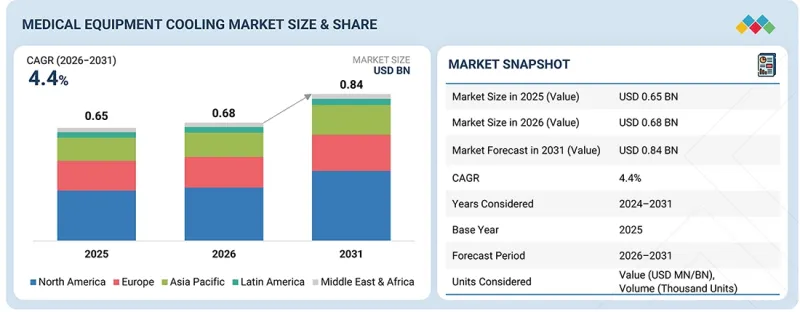
세계의 의료장비 냉각 시장 규모는 2026년 6억 8,000만 달러에서 2031년까지 8억 4,000만 달러로 확대되어 예측 기간 동안 CAGR은 4.4%에 달할 것으로 전망됩니다.
이 시장은 안전하고 신뢰할 수 있는 가동을 위해 정밀한 열 관리가 필요한 첨단 영상 진단 장비, 검사 장비, 방사선 치료 장비 및 생명과학 장비의 도입 확대에 힘입어 성장하고 있습니다. 의료비 증가, 만성 질환 유병률 상승, 그리고 제약 및 생명공학 분야의 연구 확대가 수요를 더욱 부추기고 있습니다.
| 조사 범위 | |
|---|---|
| 조사 대상 기간 | 2026-2031년 |
| 기준 연도 | 2025년 |
| 예측 기간 | 2026-2031년 |
| 산정 단위 | 금액(10억 달러) |
| 부문 | 유형별, 컴프레서별, 구성별, 용도별, 최종사용자별, 지역별 |
| 대상 지역 | 북미, 유럽, 아시아태평양, 라틴아메리카, 중동 및 아프리카 |
의료 인프라 확충, 병원 현대화, 바이오 뱅킹 활동 증가, 그리고 스마트한 온도 모니터링 기능을 갖춘 에너지 절약형 냉각 시스템의 도입으로 인해 큰 성장 기회가 창출되고 있습니다. 그러나 높은 설치 및 유지 관리 비용, 엄격한 환경 및 의료 규제, 그리고 끊김 없는 냉각 성능과 숙련된 기술 지원의 필요성은 여전히 시장 성장에 영향을 미치는 주요 과제로 남아 있습니다.
"2025년에는 초저온 냉동고 부문이 가장 큰 시장 점유율을 차지했습니다."
제품별로 보면 2025년에는 초저온 냉동고 부문이 의료장비 냉각 시장에서 가장 큰 점유율을 차지했습니다. 이는 혈장, 혈장 유래 의약품, 혈액 성분, 백신, 세포·유전자 치료용 시료, 기타 생체 재료 등 온도에 극히 민감한 생물학적 물질의 보존에 있어 해당 부문이 필수적인 역할을 수행하고 있기 때문입니다. 이러한 냉동고는 -86°C라는 극저온을 유지함으로써 장기 보관 중 발생하는 생물학적 열화를 방지하고 제품의 유효성을 유지합니다. 혈액은행, 혈장 분획 시설, 병원, 제약·바이오기술 기업, 연구소 등에서의 광범위한 활용이 견조한 수요를 견인하고 있습니다. 또한, 생물학적 검체 보존에 관한 엄격한 규제 요건, 혈장 채취량 증가, 바이오 뱅킹 및 생명과학 연구에 대한 투자 확대가 해당 부문의 시장 내 주도적 지위를 더욱 공고히 하고 있습니다.
"2026년부터 2031년까지 병원·수혈 센터 부문은 현저한 성장률을 보일 전망"
최종사용자별로 보면 병원 및 수혈 센터 부문은 예측 기간 동안 상당한 연평균 성장률(CAGR)을 기록할 것으로 전망됩니다. 이는 주로 이러한 시설에서 이루어지는 수혈, 응급 의료, 외과 수술, 외상 관리 및 만성 질환 치료 건수가 많기 때문입니다. 병원 및 수혈 센터에서는 전혈, 혈장, 혈소판, 크리오프레시피테이트 및 기타 혈액 성분을 품질과 치료 효과를 유지하면서 안전하게 보관하기 위해 신뢰성 높은 냉장·냉동 시스템이 필요합니다. 입원율 상승, 수술 건수 증가, 암 치료 및 이식 수술에 대한 수요 증가, 그리고 수혈 서비스의 확대로 인해 첨단 의료용 냉각 장비의 도입이 더욱 가속화되고 있습니다. 또한, 혈액 보존, 지속적인 온도 모니터링 및 제품 추적성에 관한 엄격한 규제 요건이 이 최종사용자 부문의 지속적인 수요를 뒷받침하고 있습니다.
"예측 기간 동안 북미 의료장비 냉각 시장에서 미국이 가장 높은 연평균 성장률(CAGR)을 기록할 전망"
미국은 높은 신뢰성의 온도 제어 장비가 필요한 제약 제조, 생물학적 제제 생산 및 혈장 분획 시설이 집중되어 있어, 2026년부터 2031년까지 북미 시장에서 가장 높은 연평균 성장률(CAGR)을 기록할 전망입니다. 미국은 바이오 뱅킹, 재생의료, 세포 및 유전자 치료 연구에 대한 대규모 투자에 힘입어 가장 큰 시장 점유율을 차지하고 있습니다. 이 모든 분야는 초저온 보존 시스템에 의존하고 있습니다. 또한, 이 지역에서는 IoT를 활용한 온도 모니터링, 원격 진단, 예측 유지보수를 특징으로 하는 스마트 냉동 기술이 조기에 도입되어 운영 효율과 규정 준수 향상에 기여하고 있습니다. 아울러, 확립된 콜드체인 물류 네트워크의 존재, 노후화된 냉동 인프라의 교체 수요가 높다는 점, 그리고 의료기관 및 연구소의 고품질 실험실용 냉각 장비에 대한 지속적인 조달도 시장 성장을 뒷받침하고 있습니다.
의료장비 냉각 시장의 주요 기업으로는 Thermo Fisher Scientific, Inc.(미국), Haier Biomedical(Haier Group)(중국), Avantor, Inc.(미국), Eppendorf SE(독일), Blue Star Limited(인도), B Medical Systems(Azenta)(미국), Godrej and Boyce Manufacturing(인도), BioLife Solutions(미국), Berlinger & Co. AG(독일), Vestfrost Solutions A/S(덴마크) 등이 있습니다.
조사 범위
본 보고서에서는 의료장비 냉각 시장을 분석하고, 제품, 최종사용자, 지역 등의 부문별로 시장 규모 및 추정을 제시하며, 향후 성장 가능성을 예측하고 있습니다. 또한, 해당 시장의 주요 기업에 대한 경쟁 분석과 더불어 각 기업 개요, 제공 서비스, 최근 동향 및 주요 시장 전략에 대해서도 다루고 있습니다.
본 보고서를 구매해야 하는 이유
본 보고서는 의료장비 냉각 시장 전체의 매출액에 관한 가장 정확한 추정치를 제공함으로써, 이 시장의 시장 리더 및 신규 진입 기업을 지원합니다. 또한, 이해관계자가 경쟁 구도를 이해하고 더 깊은 인사이트를 얻어 자사의 비즈니스를 최적의 위치에 자리매김하며, 적절한 시장 진입 전략을 수립하는 데 도움이 됩니다. 더불어, 본 보고서는 이해관계자가 시장 동향을 파악할 수 있도록 지원하며, 주요 촉진요인, 제약, 과제 및 기회에 대한 정보를 제공합니다.
본 보고서는 다음 사항에 대한 인사이트를 제공합니다:
- 시장 역학 : 의료장비 냉각 시장에 영향을 미치는 주요 촉진요인(면역글로불린 및 기타 혈장 제제의 사용 증가, 만성 질환 치료를 목적으로 한 혈장 유래 의약품의 수요 증가) , 제약요인(막대한 설비 투자 필요), 기회(혈장 분획 센터의 급속한 확대, 콜드체인 인프라 구축에 대한 정부의 지원), 및 과제(훈련된 인력 부족 및 장비 유지보수에 필요한 자원 제약, 엄격한 정부 규제)에 대한 분석
- 시장 침투도 : 전 세계 의료장비 냉각 시장의 주요 기업이 제공하는 제품에 대한 광범위한 정보를 수록하고 있습니다. 본 보고서에는 제품, 최종사용자, 지역별 다양한 부문이 포함되어 있습니다.
- 제품 기능 강화 및 혁신 : 전 세계 의료장비 냉각 시장의 신제품 출시 및 예상되는 동향에 대한 종합적인 세부 정보
- 시장 개발 : 유형, 최종사용자, 지역별로 수익성이 높은 성장 시장에 대한 상세한 인사이트 및 분석
- 시장 다각화 : 전 세계 의료장비 냉각 시장에서 신제품 출시, 시장 확대, 현재 진행 상황 및 투자에 관한 종합적인 정보
- 경쟁 평가 : 전 세계 의료장비 냉각 시장에서 주요 경쟁사의 시장 점유율, 성장 계획, 제품 라인업 및 생산능력에 대한 철저한 평가
자주 묻는 질문
목차
제1장 소개
제2장 주요 요약
제3장 주요 인사이트
제4장 시장 개요
제5장 업계 동향
제6장 기술 진보, AI에 의한 영향, 특허, 혁신, 향후 응용
제7장 규제 상황과 지속가능성에 대한 대처
제8장 고객 상황과 구매 행동
제9장 의료장비 냉각 시장(유형별)
제10장 의료장비 냉각 시장(컴프레서별)
제11장 의료장비 냉각 시장(구성별)
제12장 의료장비 냉각 시장(용도별)
제13장 의료장비 냉각 시장(최종사용자별)
제14장 의료장비 냉각 시장(지역별)
제15장 경쟁 구도
제16장 기업 개요
제17장 조사 방법
제18장 부록
KSM 26.08.14The global medical equipment cooling market is expected to grow from USD 0.68 billion in 2026 to USD 0.84 billion by 2031, at a CAGR of 4.4% during the forecast period. The market is driven by the increasing adoption of advanced diagnostic imaging, laboratory, radiotherapy, and life science equipment that require precise thermal management for safe and reliable operation. Rising healthcare expenditure, growing prevalence of chronic diseases, and expanding pharmaceutical and biotechnology research further stimulate demand.
| Scope of the Report | |
|---|---|
| Years Considered for the Study | 2026-2031 |
| Base Year | 2025 |
| Forecast Period | 2026-2031 |
| Units Considered | Value (USD billion) |
| Segments | Product, End User, and Region |
| Regions covered | North America, Europe, Asia Pacific, Latin America, and the Middle East & Africa |
Significant opportunities emerge from healthcare infrastructure expansion, hospital modernization, increasing biobanking activities, and the adoption of energy-efficient cooling systems with smart temperature monitoring. However, high installation and maintenance costs, stringent environmental and healthcare regulations, and the need for uninterrupted cooling performance and skilled technical support remain key challenges affecting market growth.
"Ultra-low temperature freezers segment accounted for the largest market share in 2025"
Based on product, the ultra-low temperature freezers segment captured the largest share of the medical equipment cooling market in 2025 due to its indispensable role in preserving highly temperature-sensitive biological materials, including plasma, plasma-derived medicinal products, blood components, vaccines, cell and gene therapy samples, and other biomaterials. These freezers maintain temperatures as low as -86°C, preventing biological degradation and preserving product potency during long-term storage. Their widespread use across blood banks, plasma fractionation facilities, hospitals, pharmaceutical and biotechnology companies, and research laboratories drives strong demand. Additionally, stringent regulatory requirements for biological sample storage, increasing plasma collection, and growing investments in biobanking and life sciences research continue to reinforce the segment's market leadership.
"Hospitals & transfusion centers segment to grow at a significant rate between 2026 and 2031"
Based on end user, the hospitals & transfusion centers segment is projected to record a significant CAGR during the forecast period. This is mainly because of the high volume of blood transfusions, emergency care, surgical procedures, trauma management, and chronic disease treatments performed in these facilities. Hospitals and transfusion centers require reliable refrigeration and freezing systems to safely store whole blood, plasma, platelets, cryoprecipitate, and other blood components while maintaining their quality and therapeutic efficacy. Rising hospitalization rates, increasing surgical volumes, growing demand for oncology and transplant procedures, and expanding transfusion services have further accelerated the adoption of advanced medical cooling equipment. Additionally, stringent regulatory requirements for blood storage, continuous temperature monitoring, and product traceability continue to support sustained demand from this end-user segment.
"US to grow at the highest CAGR in the North American medical equipment cooling market during the forecast period"
The US is likely to record the highest CAGR in the North American market between 2026 and 2031 due to its strong concentration of pharmaceutical manufacturing, biologics production, and plasma fractionation facilities that require highly reliable temperature-controlled equipment. The US contributes the largest share, supported by extensive investments in biobanking, regenerative medicine, and cell and gene therapy research, all of which depend on ultra-low-temperature storage systems. The region also benefits from the early adoption of smart refrigeration technologies featuring IoT-enabled temperature monitoring, remote diagnostics, and predictive maintenance, improving operational efficiency and compliance. Furthermore, the presence of established cold chain logistics networks, high replacement demand for aging refrigeration infrastructure, and continuous procurement of premium laboratory cooling equipment by healthcare and research organizations sustain market growth.
A breakdown of the primary participants (supply side) for the medical equipment cooling market referred to in this report is provided below:
- By Company Type: Tier 1 (35%), Tier 2 (40%), and Tier 3 (25%)
- By Designation: C-level Executives (45%), Directors (35%), and Others (20%)
- By Region: North America (27%), Europe (25%), Asia Pacific (30%), Latin America (8%), and the Middle East & Africa (10%)
Prominent players in the medical equipment cooling market include Thermo Fisher Scientific, Inc. (US), Haier Biomedical (Haier Group) (China), Avantor, Inc. (US), Eppendorf SE (Germany), Blue Star Limited (India), B Medical Systems (Azenta) (US), Godrej and Boyce Manufacturing Co. Ltd. (India), BioLife Solutions (US), Berlinger & Co. AG (Germany), and Vestfrost Solutions A/S (Denmark).
Research Coverage
The report analyzes the medical equipment cooling market and estimates its size and future growth potential across segments such as product, end user, and region. The report also includes a competitive analysis of the key players in this market along with their company profiles, service offerings, recent developments, and key market strategies.
Reasons to Buy the Report
The report will help market leaders/new entrants in this market by providing information on the closest approximations of revenue for the overall medical equipment cooling market. This report will help stakeholders understand the competitive landscape and gain deeper insights to better position their businesses and plan suitable go-to-market strategies. The report also helps stakeholders understand the market pulse and provides information on key drivers, restraints, challenges, and opportunities.
This report provides insights into the following pointers:
- Market Dynamics: Analysis of key drivers (Rising use of immunoglobulins and other plasma products, Increasing demand for plasma-derived medicinal products to treat chronic diseases), restraints (Requirement for high capital investment), opportunities (Rapid expansion of plasma fractionation centers, Government support for cold chain infrastructure development), and challenges (Shortage of trained manpower and limited resources to maintain equipment, Stringent government regulations) influencing the medical equipment cooling market
- Market Penetration: Includes extensive information on products offered by the major players in the global medical equipment cooling market. The report includes various segments in products, end users, and regions
- Product Enhancement/Innovation: Comprehensive details about new product launches and anticipated trends in the global medical equipment cooling market
- Market Development: Thorough knowledge and analysis of the profitable rising markets by type, end users, and regions
- Market Diversification: Comprehensive information about newly launched products, expanding markets, current advancements, and investments in the global medical equipment cooling market
- Competitive Assessment: Thorough evaluation of the market shares, growth plans, offerings of products, and capacities of the major competitors in the global medical equipment cooling market
TABLE OF CONTENTS
1 INTRODUCTION
- 1.1 STUDY OBJECTIVES
- 1.2 MARKET DEFINITION
- 1.3 STUDY SCOPE
- 1.3.1 MARKET SEGMENTATION AND REGIONS CONSIDERED
- 1.3.2 INCLUSIONS & EXCLUSIONS
- 1.3.3 YEARS CONSIDERED
- 1.3.4 CURRENCY CONSIDERED
- 1.4 STAKEHOLDERS
- 1.5 SUMMARY OF CHANGES
2 EXECUTIVE SUMMARY
- 2.1 KEY INSIGHTS AND MARKET HIGHLIGHTS
- 2.2 KEY MARKET PARTICIPANTS: SHARE INSIGHTS AND DEVELOPMENTS
- 2.3 DISRUPTIVE TRENDS SHAPING THE MARKET
- 2.4 HIGH-GROWTH SEGMENTS & EMERGING FRONTIERS
- 2.5 SNAPSHOT: GLOBAL MARKET SIZE, GROWTH RATE, AND FORECAST
3 PREMIUM INSIGHTS
- 3.1 MEDICAL EQUIPMENT COOLING MARKET OVERVIEW
- 3.2 ASIA PACIFIC: MEDICAL EQUIPMENT COOLING MARKET, BY END USER AND COUNTRY (2025)
- 3.3 MEDICAL EQUIPMENT COOLING MARKET: GEOGRAPHIC GROWTH OPPORTUNITIES
- 3.4 MEDICAL EQUIPMENT COOLING MARKET, BY REGIONAL (2024-2031)
- 3.5 MEDICAL EQUIPMENT COOLING MARKET: DEVELOPED MARKETS VS. EMERGING ECONOMIES
4 MARKET OVERVIEW
- 4.1 INTRODUCTION
- 4.2 MARKET DYNAMICS
- 4.2.1 DRIVERS
- 4.2.1.1 Rising installation and utilization of advanced diagnostic and therapeutic equipment
- 4.2.1.2 Rising Burden of Chronic Diseases and Expanding Use of Advanced Medical Equipment
- 4.2.1.3 Requirement for reliable equipment cooling
- 4.2.2 RESTRAINTS
- 4.2.2.1 High installation, customization, and lifecycle costs of medical cooling systems
- 4.2.2.2 Inadequate electricity, water, and technical infrastructure in developing markets
- 4.2.3 OPPORTUNITIES
- 4.2.3.1 Transition toward energy-efficient, low-GWP, and intelligent equipment-cooling systems
- 4.2.3.2 Regulatory transition creating a replacement and retrofit opportunity
- 4.2.3.3 Innovation in MRI cooling technologies
- 4.2.4 CHALLENGES
- 4.2.4.1 Shortage of specialized cooling-system and biomedical maintenance professionals
- 4.2.1 DRIVERS
- 4.3 UNMET NEEDS AND WHITE SPACES
- 4.3.1 UNMET NEEDS
- 4.3.2 WHITE SPACE OPPORTUNITIES
- 4.4 INTERCONNECTED MARKETS AND CROSS-SECTOR OPPORTUNITIES
- 4.4.1 INTERCONNECTED MARKETS
- 4.4.2 CROSS-SECTOR OPPORTUNITIES
- 4.5 STRATEGIC MOVES BY TIER- 1/2/3 PLAYERS
5 INDUSTRY TRENDS
- 5.1 PORTER'S FIVE FORCES ANALYSIS
- 5.1.1 THREAT FROM NEW ENTRANTS
- 5.1.2 THREAT FROM SUBSTITUTES
- 5.1.3 BARGAINING POWER OF SUPPLIERS
- 5.1.4 BARGAINING POWER OF BUYERS
- 5.1.5 INTENSITY OF COMPETITIVE RIVALRY
- 5.2 MACROECONOMIC OUTLOOK
- 5.2.1 INTRODUCTION
- 5.2.2 GDP TRENDS AND FORECAST
- 5.2.3 TRENDS IN MEDICAL EQUIPMENT COOLING MARKET
- 5.3 VALUE CHAIN ANALYSIS
- 5.4 ECOSYSTEM ANALYSIS
- 5.5 SUPPLY CHAIN ANALYSIS
- 5.6 PRICING ANALYSIS
- 5.6.1 AVERAGE SELLING PRICE, BY PRODUCT
- 5.6.2 INDICATIVE PRICING, BY REGION
- 5.7 TRADE ANALYSIS
- 5.8 KEY CONFERENCES & EVENTS DURING 2026
- 5.9 TRENDS/DISRUPTIONS IMPACTING CUSTOMERS' BUSINESSES
- 5.10 INVESTMENT & FUNDING SCENARIO
- 5.11 CASE STUDY ANALYSIS
- 5.12 IMPACT OF US TARIFFS-MEDICAL EQUIPMENT COOLING MARKET
- 5.12.1 INTRODUCTION
- 5.12.2 KEY TARIFF RATES
- 5.12.3 PRICE IMPACT ANALYSIS
- 5.12.3.1 US
- 5.12.3.2 Europe
- 5.12.3.3 Asia Pacific
- 5.12.4 IMPACT ON END-USER INDUSTRIES
6 TECHNOLOGICAL ADVANCEMENTS, AI-DRIVEN IMPACT, PATENTS, INNOVATIONS, AND FUTURE APPLICATIONS
- 6.1 KEY EMERGING TECHNOLOGIES
- 6.1.1 AI-ENABLED PREDICTIVE COOLING MANAGEMENT & INTELLIGENT THERMAL MONITORING
- 6.1.2 HIGH-EFFICIENCY LIQUID COOLING & SUSTAINABLE REFRIGERATION TECHNOLOGIES
- 6.2 COMPLEMENTARY TECHNOLOGIES
- 6.2.1 ARTIFICIAL INTELLIGENCE (AI) IN INTELLIGENT THERMAL MANAGEMENT
- 6.3 ADJACENT TECHNOLOGIES
- 6.3.1 IOT-BASED REMOTE MONITORING & CLOUD-CONNECTED COOLING PLATFORMS
- 6.3.2 ADVANCED LIQUID COOLING & VARIABLE-SPEED THERMAL MANAGEMENT TECHNOLOGIES
- 6.4 TECHNOLOGY/PRODUCT ROADMAP
- 6.4.1 SHORT-TERM |RECENT TECHNOLOGIES| FOUNDATION & EARLY COMMERCIALIZATION
- 6.4.2 MID-TERM (2027-2030) | EXPANSION & STANDARDIZATION
- 6.4.3 LONG-TERM (2030-2035+) | MASS COMMERCIALIZATION & DISRUPTION
- 6.5 PATENT ANALYSIS
- 6.5.1 PATENT PUBLICATION TRENDS FOR DENTAL EQUIPMENT
- 6.5.2 INSIGHTS: JURISDICTION AND TOP APPLICANT ANALYSIS
- 6.6 IMPACT OF AI/GEN AI ON MEDICAL EQUIPMENT COOLING MARKET
- 6.6.1 TOP USE CASES AND MARKET POTENTIAL
- 6.6.2 INTERCONNECTED ADJACENT ECOSYSTEMS AND IMPACT ON MARKET PLAYERS
- 6.6.3 CLIENTS' READINESS TO ADOPT GENERATIVE AI IN MEDICAL EQUIPMENT COOLING MARKET
- 6.7 SUCCESS STORIES AND REAL-WORLD APPLICATIONS
- 6.7.1 CARRIER: HIGH-EFFICIENCY COOLING FOR MRI INFRASTRUCTURE
- 6.7.2 MOTIVAIR: CUSTOM PRECISION COOLING FOR MRI SYSTEM MODERNIZATION
- 6.7.3 ICS COOL ENERGY: TEMPORARY COOLING SOLUTION ENSURES CONTINUOUS MRI OPERATIONS
7 REGULATORY LANDSCAPE AND SUSTAINABILITY INITIATIVES
- 7.1 US
- 7.2 EUROPEAN UNION
- 7.3 CHINA
- 7.3.1 LATIN AMERICA
- 7.3.2 MIDDLE EAST & AFRICA
- 7.3.3 REGULATORY BODIES, GOVERNMENT AGENCIES, AND OTHER ORGANIZATIONS
- 7.4 SUSTAINABILITY INITIATIVES
- 7.4.1 ENVIRONMENTAL SUSTAINABILITY IN MEDICAL EQUIPMENT COOLING SYSTEMS
- 7.4.2 ENERGY-EFFICIENT MRI COOLING INFRASTRUCTURE - CARRIER
- 7.4.3 SUSTAINABLE PRECISION COOLING FOR MEDICAL IMAGING - MOTIVAIR
- 7.4.4 CERTIFICATIONS, LABELING, AND ECO-STANDARDS
8 CUSTOMER LANDSCAPE & BUYER BEHAVIOR
- 8.1 DECISION-MAKING PROCESS
- 8.2 BUYER STAKEHOLDERS AND BUYING EVALUATION CRITERIA
- 8.2.1 INFLUENCE OF KEY STAKEHOLDERS
- 8.2.2 BUYING CRITERIA
- 8.3 ADOPTION BARRIERS & INTERNAL CHALLENGES
- 8.4 UNMET NEEDS FROM VARIOUS END-USE INDUSTRIES
9 MEDICAL EQUIPMENT COOLING MARKET, BY TYPE
- 9.1 INTRODUCTION
- 9.2 LIQUID-BASED COOLING
- 9.2.1 LIQUID-LIQUID CONFIGURATION
- 9.2.1.1 High cooling capacity and investments in advanced infrastructure drive market
- 9.2.2 LIQUID-AIR HEAT TRANSFER CONFIGURATION
- 9.2.2.1 Introduction of modular and space-efficient technologies drives growth
- 9.2.3 COMPRESSOR-BASED RECIRCULATING CONFIGURATION
- 9.2.3.1 Increasing adoption of advanced diagnostic imaging and radiation therapy equipment propels demand growth
- 9.2.1 LIQUID-LIQUID CONFIGURATION
- 9.3 AIR-BASED COOLING
- 9.3.1 DIRECT-TO-AIR CONFIGURATION
- 9.3.1.1 Dependable, compact thermal management supports market growth
- 9.3.2 AIR-TO-AIR CONFIGURATION
- 9.3.2.1 Wide usage in patient monitoring technologies to sustain demand
- 9.3.1 DIRECT-TO-AIR CONFIGURATION
10 MEDICAL EQUIPMENT COOLING MARKET, BY COMPRESSOR
- 10.1 INTRODUCTION
- 10.2 SCROLL COMPRESSORS
- 10.2.1 REDUCED PRICES OF SCROLL COMPRESSORS TO DRIVE DEMAND AMONG END USERS
- 10.3 SCREW COMPRESSORS
- 10.3.1 REDUCED RISK OF REFRIGERANT LEAKAGE SUPPORTS ADOPTION
- 10.4 CENTRIFUGAL COMPRESSORS
- 10.4.1 HIGH ENERGY EFFICIENCY OF CENTRIFUGAL COMPRESSORS PROPELS DEMAND
- 10.5 RECIPROCATING COMPRESSORS
- 10.5.1 COMPLEXITY OF INSTALLATION LIMITS END-USER ADOPTION
11 MEDICAL EQUIPMENT COOLING MARKET, BY CONFIGURATION
- 11.1 INTRODUCTION
- 11.2 PACKAGED SYSTEMS
- 11.2.1 WIDESPREAD DEMAND AND EASY INSTALLATION & MAINTENANCE DRIVE MARKET GROWTH
- 11.3 MODULAR SYSTEMS
- 11.3.1 MODULAR, RACK-BASED DESIGNS OFFER HIGH EFFICIENCY AND EASE OF USE
- 11.4 SPLIT SYSTEMS
- 11.4.1 ADDED COST OF ASSEMBLING AND ENGINEERING SPLIT UNITS RESTRAINTS MARKET GROWTH
12 MEDICAL EQUIPMENT COOLING MARKET, BY APPLICATION
- 12.1 INTRODUCTION
- 12.2 MEDICAL DEVICES
- 12.2.1 MEDICAL IMAGING SYSTEMS
- 12.2.1.1 MRI systems
- 12.2.1.1.1 Rising use of MRI systems in diagnostic imaging is driving market growth
- 12.2.1.2 CT scanners
- 12.2.1.2.1 Technological advancements in the field of CT are driving the demand for optimal cooling
- 12.2.1.3 PET scanners
- 12.2.1.3.1 Increasing use of PET scanners has boosted the demand for cooling systems
- 12.2.1.1 MRI systems
- 12.2.2 MEDICAL LASERS
- 12.2.2.1 Optimal cooling is required to improve the shelf-life of lasers
- 12.2.3 LINEAR ACCELERATORS
- 12.2.3.1 Increasing prevalence of cancer is driving the demand for LINAC cooling
- 12.2.1 MEDICAL IMAGING SYSTEMS
- 12.3 ANALYTICAL & LABORATORY EQUIPMENT
- 12.3.1 NEED FOR HIGH HEAT DISSIPATION IN ANALYTICAL AND LABORATORY EQUIPMENT DRIVING THE GROWTH
13 MEDICAL EQUIPMENT COOLING MARKET, BY END USER
- 13.1 INTRODUCTION
- 13.2 ORIGINAL EQUIPMENT MANUFACTURERS
- 13.2.1 OEMS DEPEND ON EFFICIENT COOLING SYSTEMS TO REMOVE HIGH-WATT DENSITY HEAT LOADS FROM MEDICAL IMAGING EQUIPMENT
- 13.3 HOSPITALS & CLINICS
- 13.3.1 RISING NUMBER OF DIAGNOSTIC IMAGING PROCEDURES TO DRIVE MARKET
- 13.4 INDEPENDENT DIAGNOSTIC & TREATMENT CENTERS & LABORATORIES
- 13.4.1 INCREASING NUMBER OF PRIVATE AND PUBLIC IMAGING CENTERS TO SUPPORT MARKET GROWTH
- 13.5 OTHER END USERS
14 MEDICAL EQUIPMENT COOLING MARKET, BY REGION
- 14.1 INTRODUCTION
- 14.2 NORTH AMERICA
- 14.2.1 MACROECONOMIC OUTLOOK FOR NORTH AMERICA
- 14.2.2 US
- 14.2.2.1 Large installed base of advanced diagnostic imaging and radiotherapy systems drives the market
- 14.2.3 CANADA
- 14.2.3.1 Rising obesity level to expedite growth
- 14.3 EUROPE
- 14.3.1 MACROECONOMIC OUTLOOK FOR EUROPE
- 14.3.2 GERMANY
- 14.3.2.1 Extensive installed base of diagnostic imaging equipment and strong medical device manufacturing drive market growth
- 14.3.3 UK
- 14.3.3.1 National investments in diagnostic imaging and cancer care drive adoption of medical equipment cooling systems
- 14.3.4 FRANCE
- 14.3.4.1 Expansion of cancer care infrastructure and advanced diagnostic imaging fuels demand
- 14.3.5 ITALY
- 14.3.5.1 Growing diagnostic imaging capacity and an aging population drive demand for medical equipment cooling
- 14.3.6 SPAIN
- 14.3.6.1 Healthcare modernization and expanding diagnostic imaging infrastructure drive market growth
- 14.3.7 REST OF EUROPE
- 14.4 ASIA PACIFIC
- 14.4.1 MACROECONOMIC OUTLOOK FOR ASIA PACIFIC
- 14.4.2 JAPAN
- 14.4.2.1 Extensive diagnostic imaging infrastructure and aging population drive demand for medical equipment cooling
- 14.4.3 CHINA
- 14.4.3.1 Rapid healthcare infrastructure expansion and increasing deployment of advanced diagnostic imaging systems drive market
- 14.4.4 INDIA
- 14.4.4.1 Expanding healthcare infrastructure to stimulate growth
- 14.4.5 AUSTRALIA
- 14.4.5.1 Advanced diagnostic imaging infrastructure and increasing investments in cancer care propel market growth
- 14.4.6 SOUTH KOREA
- 14.4.6.1 Advanced healthcare infrastructure and rapid adoption of AI-enabled diagnostic technologies drive market
- 14.4.7 REST OF ASIA PACIFIC
- 14.5 LATIN AMERICA
- 14.5.1 MACROECONOMIC OUTLOOK FOR LATIN AMERICA
- 14.5.2 BRAZIL
- 14.5.2.1 Expanding healthcare infrastructure and increasing investments in diagnostic imaging and cancer care
- 14.5.3 MEXICO
- 14.5.3.1 Healthcare modernization and growing adoption of advanced diagnostic imaging technologies
- 14.5.4 REST OF LATIN AMERICA
- 14.6 MIDDLE EAST & AFRICA
- 14.6.1 LARGE OBESE POPULATION AND RISING AWARENESS OF PATIENT SAFETY TO FAVOR MARKET GROWTH
- 14.6.2 MACROECONOMIC OUTLOOK FOR MIDDLE EAST & AFRICA
- 14.7 GCC COUNTRIES
- 14.7.1 GROWING MODERNIZATION EFFORTS ACROSS HEALTHCARE INDUSTRY TO DRIVE MARKET
15 COMPETITIVE LANDSCAPE
- 15.1 INTRODUCTION
- 15.2 KEY PLAYER STRATEGIES/RIGHT TO WIN
- 15.2.1 OVERVIEW OF STRATEGIES ADOPTED BY KEY PLAYERS IN MEDICAL EQUIPMENT COOLING MARKET
- 15.3 REVENUE ANALYSIS, 2021-2025
- 15.4 MARKET SHARE ANALYSIS, 2025
- 15.5 BRAND/PRODUCT COMPARISON
- 15.6 COMPANY EVALUATION MATRIX: KEY PLAYERS, 2025
- 15.6.1 STARS
- 15.6.2 EMERGING LEADERS
- 15.6.3 PERVASIVE PLAYERS
- 15.6.4 EMERGING COMPANIES
- 15.6.5 COMPANY FOOTPRINT: KEY PLAYERS, 2025
- 15.6.5.1 Company footprint
- 15.6.5.2 Region footprint
- 15.6.5.3 Type footprint
- 15.6.5.4 Compressor footprint
- 15.6.5.5 Configuration footprint
- 15.6.5.6 Application footprint
- 15.6.5.7 End-user footprint
- 15.7 COMPANY EVALUATION MATRIX: STARTUPS/SMES, 2025
- 15.7.1 PROGRESSIVE COMPANIES
- 15.7.2 RESPONSIVE COMPANIES
- 15.7.3 DYNAMIC COMPANIES
- 15.7.4 STARTING BLOCKS
- 15.7.5 COMPETITIVE BENCHMARKING: STARTUPS/SMES, 2025
- 15.7.5.1 Detailed list of key startups/SMEs
- 15.7.5.2 Competitive benchmarking of key startups/SMEs
- 15.8 COMPANY VALUATION AND FINANCIAL METRICS
- 15.8.1 COMPANY VALUATION
- 15.8.2 FINANCIAL METRICS
- 15.9 COMPETITIVE SCENARIO
- 15.9.1 PRODUCT LAUNCHES
- 15.9.2 DEALS
- 15.9.3 EXPANSIONS
16 COMPANY PROFILES
- 16.1 KEY PLAYERS
- 16.1.1 GLEN DIMPLEX GROUP
- 16.1.1.1 Business overview
- 16.1.1.2 Products offered
- 16.1.1.3 Recent developments
- 16.1.1.3.1 Expansions
- 16.1.1.4 MnM View
- 16.1.1.4.1 Right to win
- 16.1.1.4.2 Strategic choices made
- 16.1.1.4.3 Weaknesses and competitive threats
- 16.1.2 PARKER HANNIFIN CORP
- 16.1.2.1 Business overview
- 16.1.2.2 Products offered
- 16.1.2.3 MnM View
- 16.1.2.3.1 Right to win
- 16.1.2.3.2 Strategic choices made
- 16.1.2.3.3 Weaknesses and competitive threats
- 16.1.3 THERMO FISHER SCIENTIFIC
- 16.1.3.1 Business overview
- 16.1.3.2 Products offered
- 16.1.3.3 Recent developments
- 16.1.3.3.1 Product launches
- 16.1.3.4 MnM View
- 16.1.3.4.1 Right to win
- 16.1.3.4.2 Strategic choices made
- 16.1.3.4.3 Weaknesses and competitive threats
- 16.1.4 DAIKIN INDUSTRIES LTD.
- 16.1.4.1 Business overview
- 16.1.4.2 Products offered
- 16.1.4.3 Recent developments
- 16.1.4.3.1 Product launches
- 16.1.4.3.2 Expansions
- 16.1.4.4 MnM View
- 16.1.4.4.1 Right to win
- 16.1.4.4.2 Strategic choices made
- 16.1.4.4.3 Weaknesses and competitive threats
- 16.1.5 SMC CORPORATION
- 16.1.5.1 Business overview
- 16.1.5.2 Products offered
- 16.1.5.3 Recent developments
- 16.1.5.3.1 Product launches
- 16.1.5.4 MnM View
- 16.1.5.4.1 Right to win
- 16.1.5.4.2 Strategic choices made
- 16.1.5.4.3 Weaknesses and competitive threats
- 16.1.6 SCHNEIDER ELECTRIC
- 16.1.6.1 Business overview
- 16.1.6.2 Products offered
- 16.1.6.3 Recent developments
- 16.1.6.3.1 Deals
- 16.1.6.3.2 Expansions
- 16.1.7 FILTRINE
- 16.1.7.1 Business overview
- 16.1.7.2 Products offered
- 16.1.8 BOYD THERMAL
- 16.1.8.1 Business overview
- 16.1.8.2 Products offered
- 16.1.8.3 Recent developments
- 16.1.8.3.1 Deals
- 16.1.8.3.2 Expansions
- 16.1.9 GENERAL AIR PRODUCTS
- 16.1.9.1 Business overview
- 16.1.9.2 Products offered
- 16.1.10 ECOCHILLERS
- 16.1.10.1 Business overview
- 16.1.10.2 Products offered
- 16.1.1 GLEN DIMPLEX GROUP
- 16.2 OTHER PLAYERS
- 16.2.1 KKT CHILLERS
- 16.2.2 LEGACY CHILLERS, INC.
- 16.2.3 TARK THERMAL SOLUTIONS
- 16.2.4 DRAKE REFRIGERATION
- 16.2.5 POLYSCIENCE
- 16.2.6 HASKRIS
- 16.2.7 AMERICAN CHILLERS
- 16.2.8 THERMAL CARE
- 16.2.9 ASPEN SYSTEMS
- 16.2.10 WHALEY PRODUCTS, INC
- 16.2.11 JULABO GMBH
- 16.2.12 LAUDA SCIENTIFIC GMBH
- 16.2.13 PETER HUBER KALTEMASCHINENBAU SE
- 16.2.14 PFANNENBERG GROUP HOLDING
- 16.2.15 COLD SHOT CHILLERS
17 RESEARCH METHODOLOGY
- 17.1 RESEARCH APPROACH
- 17.1.1 SECONDARY DATA
- 17.1.1.1 Key data from secondary sources
- 17.1.2 PRIMARY DATA
- 17.1.2.1 Key data from primary sources
- 17.1.2.2 Key industry insights
- 17.1.1 SECONDARY DATA
- 17.2 MARKET SIZE ESTIMATION
- 17.3 MARKET BREAKDOWN AND DATA TRIANGULATION
- 17.4 MARKET SHARE ESTIMATION
- 17.5 ASSUMPTIONS
- 17.6 LIMITATIONS
- 17.6.1 METHODOLOGY-RELATED LIMITATIONS
- 17.6.2 SCOPE-RELATED LIMITATIONS
- 17.7 RISK ASSESSMENT
18 APPENDIX
- 18.1 DISCUSSION GUIDE
- 18.2 KNOWLEDGESTORE: MARKETSANDMARKETS' SUBSCRIPTION PORTAL
- 18.3 CUSTOMIZATION OPTIONS
- 18.4 RELATED REPORTS
- 18.5 AUTHOR DETAILS


