

|
시장보고서
상품코드
2109031
배터리 프리 센서 시장 : 에너지 수확기술 능력별, 에너지원별, 센서 유형별, 용도별, 업계별, 지역별 예측(-2032년)Battery-free Sensors Market by Sensor Type (Temperature, Humidity/Moisture, Pressure, Motion & Position, Gas, Biosensors, Light Sensors), Energy Harvesting Capacity, Energy Source, Application, End User, and Region - Global Forecast to 2032 |
||||||

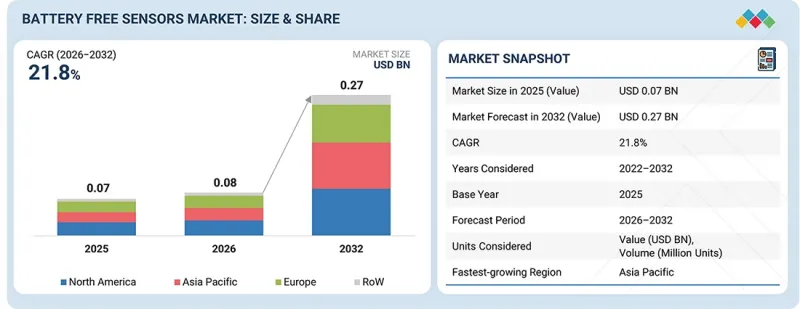
배터리 프리 센서 시장 규모는 2026년 8,000만 달러에서 2032년까지 2억 7,000만 달러에 이를 것으로 예측되며, CAGR은 21.8%를 나타낼 전망입니다.
| 조사 범위 | |
|---|---|
| 조사 대상 기간 | 2022-2032년 |
| 기준 연도 | 2025년 |
| 예측 기간 | 2026-2032년 |
| 산정 단위 | 금액(10억 달러), 수량(100만호) |
| 부문 | 에너지 수확기술 능력별, 에너지원별, 센서 유형별, 용도별, 업계별, 지역별 |
| 대상 지역 | 북미, 유럽, 아시아태평양, 중동 및 아프리카 및 라틴아메리카 |
'최종 사용자별로는 예측 기간 동안 제조 부문이 배터리 프리 센서 시장에서 가장 큰 점유율을 차지할 것으로 예측됩니다.'
제조 부문은 설비 모니터링, 공정 최적화, 생산 효율 향상을 목적으로 한 무선 센싱 기술의 채택 확대에 힘입어 배터리 프리 센서 시장에서 가장 큰 점유율을 차지할 것으로 예측됩니다. 배터리 프리 센서는 온도, 진동, 압력, 습도, 기계 상태와 같은 중요한 매개변수를 배터리 교체 없이 지속적으로 모니터링할 수 있어 유지보수 비용 절감과 생산 중단 시간 최소화로 이어집니다. 또한, 손이 닿기 어려운 장소나 가혹한 산업 환경에서도 작동할 수 있어 현대 제조 시설에 최적입니다. 각 제조업체는 자산의 신뢰성 향상, 품질 관리 강화, 그리고 생산 라인 전반에 걸친 예측 유지보수 전략 지원을 목적으로 이러한 센서의 도입을 확대되고 있습니다. 또한, 스마트 팩토리, 커넥티드 생산 시스템, 그리고 자동화된 제조 공정의 도입 확대가 유지보수가 필요 없는 센싱 솔루션에 대한 수요를 견인하고 있습니다. 에너지 수확 기술과 초저전력 전자 기기의 발전으로 센서의 성능과 도입 유연성이 더욱 향상되어, 전 세계 배터리 프리 센서 시장에서 제조 부문의 우위를 공고히 하고 있습니다.
'용도별로 보면, 예측 기간 동안 바이오센서 분야가 배터리 프리 센서 시장에서 가장 높은 연평균 성장률(CAGR)을 보일 것으로 예상됩니다'
바이오센서 분야는 지속적이고 비침습적이며, 유지보수가 필요 없는 건강 모니터링 솔루션에 대한 수요가 증가함에 따라 배터리 프리 센서 시장에서 가장 높은 연평균 성장률(CAGR)을 보일 것으로 예측됩니다. 배터리가 필요 없는 바이오센서는 잦은 배터리 교체가 필요 없이 생리학적 매개변수를 실시간으로 측정할 수 있으므로, 웨어러블 의료기기, 이식형 센서, 스마트 패치 및 현장 진단(Point-of-Care) 시스템에 이상적입니다. 컴팩트한 크기, 경량 설계, 그리고 주변 에너지원에서 에너지를 회수하는 능력 덕분에 환자의 편의성이 향상되고 장기 모니터링 용도가 지원됩니다. 예방 의료, 원격 환자 모니터링, 맞춤형 의료 및 질병 조기 발견에 대한 관심이 높아짐에 따라 배터리 불필요 바이오센싱 기술의 채택이 더욱 가속화되고 있습니다. 플렉서블 전자기기, 생체 적합성 소재, 초저전력 집적 회로 및 무선 통신 기술의 지속적인 발전으로 센서의 정확도, 신뢰성 및 작동 효율이 향상되고 있습니다. 또한, 디지털 헬스케어 인프라 및 차세대 의료기기에 대한 투자 확대가 급속한 상용화를 뒷받침할 것으로 예상되며, 예측 기간 동안 바이오센서는 전 세계 배터리 프리 센서 시장에서 가장 빠르게 성장하는 응용 분야가 될 전망입니다.
'예측 기간 동안 아시아태평양은 전 세계 배터리 프리 센서 시장에서 가장 높은 연평균 성장률(CAGR)을 보일 것으로 예상됩니다'
아시아태평양은 중국, 일본, 한국, 인도 등 주요 경제권의 급속한 산업화, 전자제품 제조 확대, 그리고 스마트 인프라에 대한 투자 증가로 인해 전 세계 배터리 프리 센서 시장에서 가장 높은 연평균 성장률(CAGR)을 보일 것으로 예측됩니다. 이 지역은 반도체 제조, 센서 생산 및 에너지 수확 기술 개발의 세계적 거점으로 부상하고 있으며, 첨단 배터리 프리 센싱 솔루션의 상용화를 뒷받침하고 있습니다. 제조, 물류, 의료, 농업, 운송, 스마트 빌딩 분야에서 무선 센서의 채택 확대가 시장 성장을 더욱 가속화하고 있습니다. 또한, 디지털 제조, 지속 가능한 기술, 커넥티드 인프라를 추진하는 정부의 이니셔티브가 유지보수가 필요 없는 센싱 솔루션의 도입을 뒷받침하고 있습니다. 인더스트리 4.0, 스마트 시티, 환경 모니터링 프로젝트에 대한 투자 증가와 더불어, 유지보수가 적고 에너지 효율이 높은 센서 네트워크에 대한 수요 증가가 큰 성장 기회를 창출하고 있습니다. 초저전력 전자기기, MEMS 및 에너지 수확 기술 분야의 지속적인 기술 발전으로 인해 이 지역의 입지는 더욱 강화될 것으로 예상되며, 아시아태평양은 예측 기간 동안 배터리 프리 센서 시장에서 가장 빠르게 성장하는 시장이 될 전망입니다.
배터리 프리 센서 시장의 주요 업계 전문가들을 대상으로 광범위한 1차 인터뷰를 실시하고, 2차 조사를 통해 수집한 각종 부문 및 하위 부문 시장 규모를 파악하고 검증했습니다. 본 보고서의 1차 인터뷰 대상자 구성은 다음과 같습니다.
배터리 프리 센서 시장은 에너지 수확, 패시브 무선 센싱, RFID/NFC 기술, 그리고 초저전력 센서 솔루션을 전문으로 하는 몇몇 확고한 기술 제공업체가 존재한다는 점이 특징입니다. 주요 시장 진출기업으로는 Semiconductor Components Industries, LLC(미국), EnOcean GmbH(독일), Inductosense Ltd.(영국), Wiliot Ltd.(이스라엘), Axzon Inc.(미국) 등이 있습니다. 이 기업들은 지속적인 제품 혁신, 전략적 제휴, 연구 개발 투자, 그리고 첨단 배터리 없는 센싱 기술의 상용화를 통해 경쟁을 펼치며 시장 지위를 강화하고, 산업, 의료, 물류, 스마트 인프라 각 분야에서 높아지는 무정비 무선 센싱 솔루션에 대한 수요에 대응하고 있습니다.
본 조사에서는 배터리 프리 센서 시장의 주요 기업들에 대해 기업 프로파일, 최근 동향, 제품 혁신, 에너지 저장 기술의 발전, 그리고 주요 시장 전략을 포괄하는 상세한 경쟁 분석을 수행하고 있습니다.
조사 범위 :
본 보고서에서는 배터리 프리 센서 시장을 세분화하여 센서 유형별, 에너지원별, 용도별, 에너지 수확 능력별 및 최종 사용자별로 시장 규모를 예측했습니다. 또한, 본 보고서에서는 업계 성장에 영향을 미치는 주요 시장 성장 촉진요인, 억제요인, 기회 및 과제에 대해서도 분석했습니다. 아시아태평양, 북미, 유럽 및 기타 지역에 걸친 상세한 지역별 평가와 더불어, 주요 시장에 대한 국가별 인사이트도 제공합니다. 또한, 본 조사에는 전 세계 배터리 프리 센서 생태계에서 사업을 전개하는 주요 기업의 밸류체인 분석 및 경쟁 구도 평가도 포함되어 있습니다.
본 보고서를 구매할 때의 주요 이점 :
- 주요 성장 촉진요인(유지보수가 필요 없는 센싱에 대한 구조적 수요를 창출하는 IoT 기기 생태계의 기하급수적 성장, 가혹한 환경 하에서 자가 발전형 센서 노드가 필요한 인더스트리 4.0 및 IIoT 도입 가속화), 제약 요인(높은 초기 시스템 비용과 투자 회수율의 불확실성, 자원이 제한된 노드에서의 사이버 보안 및 데이터 무결성 취약성), 기회(앰비언트 IoT 및 5G 지원 연결 인프라의 확대, 지속 가능한 스마트 빌딩 및 에너지 효율이 높은 인프라 도입 확대), 과제(첨단 트랜스듀서 소재 제조에서의 확장성 및 비용 장벽, 통신 표준의 분열 및 레거시 시스템과의 통합)에 대한 분석이 포함되어 있습니다.
- 제품 개발/혁신 : 신흥 배터리 프리 센싱 기술, 에너지 수확 기술(RF, 태양광 발전, 압전, 열전, NFC)의 발전, 초저파워 반도체 및 MEMS 기술, 무선 통신 프로토콜, 진행 중인 연구 개발 활동, 그리고 배터리 프리 센서 시장의 신제품 출시와 관련된 상세한 인사이트를 제공합니다.
- 시장 동향 : 고성장 시장에 대한 종합적인 정보. 본 보고서는 북미, 유럽, 아시아태평양 및 기타 지역(RoW)의 배터리 프리 센서 시장을 분석합니다.
- 시장 다각화 : 차세대 배터리 없는 센싱 기술, 신흥 응용 분야, 전략적 투자, 기술 제휴 및 사업 확장에 대한 종합적인 정보.
- 경쟁 평가 : Semiconductor Components Industries, LLC(미국), EnOcean GmbH(독일), Inductosense(영국), Wiliot Ltd.(이스라엘), Axzon(미국)과 같은 주요 기업의 시장 점유율 및 성장 전략에 대한 상세한 평가와 더불어, 각사의 제품 포트폴리오, 전략적 제휴, 연구 개발 활동, 제품 출시, 사업 확장 노력에 대한 분석을 수록했습니다.
자주 묻는 질문
목차
제1장 서론
제2장 주요 요약
제3장 프리미엄 인사이트
제4장 시장 개요
제5장 업계 동향
제6장 기술 진보, AI의 영향, 특허, 혁신, 향후 응용
제7장 규제 상황과 지속가능성 이니셔티브
제8장 고객 현황과 구매 행동
제9장 배터리 프리 센서를 위한 통신기술
제10장 배터리 프리 센서 시장(에너지 수확기술 능력별)
제11장 배터리 프리 센서 시장(에너지원별)
제12장 배터리 프리 센서 시장(센서 유형별)
제13장 배터리 프리 센서 시장(용도별)
제14장 배터리 프리 센서 시장(업계별)
제15장 배터리 프리 센서 시장(지역별)
제16장 경쟁 구도
제17장 기업 개요
제18장 조사 방법
제19장 부록
KTH 26.08.20The battery-free sensors market is projected to reach USD 0.27 billion by 2032 from USD 0.08 billion in 2026, growing at a CAGR of 21.8%.
| Scope of the Report | |
|---|---|
| Years Considered for the Study | 2022-2032 |
| Base Year | 2025 |
| Forecast Period | 2026-2032 |
| Units Considered | Value (USD BN), Volume (Million Units) |
| Segments | by Sensor Type, Energy Harvesting Capacity, Energy Source, Application, End User, and Region |
| Regions covered | North America, Europe, Asia Pacific, Middle East & Africa, and Latin America |
"Based on end user, the manufacturing segment is expected to account for the largest share of the battery-free sensors market during the forecast period."
The manufacturing segment is expected to hold the largest share of the battery-free sensors market due to the increasing adoption of wireless sensing technologies for equipment monitoring, process optimization, and production efficiency. Battery-free sensors enable continuous monitoring of critical parameters such as temperature, vibration, pressure, humidity, and machine health without requiring battery replacement, thereby reducing maintenance costs and minimizing production downtime. Their ability to operate in hard-to-reach and harsh industrial environments makes them well suited for modern manufacturing facilities. Manufacturers are increasingly deploying these sensors to improve asset reliability, enhance quality control, and support predictive maintenance strategies across production lines. In addition, the growing implementation of smart factories, connected production systems, and automated manufacturing processes is driving demand for maintenance-free sensing solutions. Advancements in energy harvesting technologies and ultra-low-power electronics are further improving sensor performance and deployment flexibility, reinforcing the dominance of the manufacturing segment in the global battery-free sensors market.
"Based on application, the biosensors segment is expected to register the highest CAGR in the battery-free sensors market during the forecast period"
The biosensors segment is expected to witness the highest CAGR in the battery-free sensors market owing to the increasing demand for continuous, non-invasive, and maintenance-free health monitoring solutions. Battery-free biosensors enable real-time measurement of physiological parameters without frequent battery replacement, making them well suited for wearable medical devices, implantable sensors, smart patches, and point-of-care diagnostic systems. Their compact size, lightweight design, and ability to harvest energy from ambient sources improve patient comfort and support long-term monitoring applications. Growing emphasis on preventive healthcare, remote patient monitoring, personalized medicine, and early disease detection is further accelerating the adoption of battery-free biosensing technologies. Continuous advancements in flexible electronics, biocompatible materials, ultra-low-power integrated circuits, and wireless communication technologies are enhancing sensor accuracy, reliability, and operational efficiency. In addition, increasing investments in digital healthcare infrastructure and next-generation medical devices are expected to drive rapid commercialization, making biosensors the fastest-growing application segment in the global battery-free sensors market during the forecast period.
"Asia Pacific is expected to register the highest CAGR in the global battery-free sensors market during the forecast period"
The Asia Pacific region is expected to witness the highest CAGR in the global battery-free sensors market due to rapid industrialization, expanding electronics manufacturing, and increasing investments in smart infrastructure across major economies such as China, Japan, South Korea, and India. The region has emerged as a global hub for semiconductor manufacturing, sensor production, and energy harvesting technology development, supporting the commercialization of advanced battery-free sensing solutions. Growing adoption of wireless sensors across manufacturing, logistics, healthcare, agriculture, transportation, and smart buildings is further accelerating market growth. In addition, government initiatives promoting digital manufacturing, sustainable technologies, and connected infrastructure are encouraging the deployment of maintenance-free sensing solutions. Rising investments in Industry 4.0, smart cities, and environmental monitoring projects, coupled with increasing demand for low-maintenance and energy-efficient sensor networks, are creating significant growth opportunities. Continuous technological advancements in ultra-low-power electronics, MEMS, and energy harvesting technologies are expected to further strengthen the region's position, making Asia Pacific the fastest-growing market for battery-free sensors during the forecast period.
Extensive primary interviews were conducted with key industry experts in the battery-free sensors market to determine and verify the market size for various segments and subsegments gathered through secondary research. The breakdown of primary participants for the report is shown below.
The study contains insights from various industry experts, from component suppliers to Tier 1 companies and OEMs. The break-up of the primaries is as follows:
- By Company Type - Tier 1 - 40%, Tier 2 - 35%, and Tier 3 - 25%
- By Designation - C-level Executives - 33%, Directors - 38%, and Others - 29%
- By Region - North America - 30%, Europe - 40%, Asia Pacific - 20%, and RoW - 10%
The battery-free sensors market is characterized by the presence of several established technology providers specializing in energy harvesting, passive wireless sensing, RFID/NFC technologies, and ultra-low-power sensor solutions. Key market participants include Semiconductor Components Industries, LLC (US), EnOcean GmbH (Germany), Inductosense Ltd. (UK), Wiliot Ltd. (Israel), and Axzon Inc. (US). These companies compete through continuous product innovation, strategic partnerships, research and development investments, and the commercialization of advanced battery-free sensing technologies to strengthen their market position and address the growing demand for maintenance-free wireless sensing solutions across industrial, healthcare, logistics, and smart infrastructure applications.
The study includes an in-depth competitive analysis of these key players in the battery-free sensors market, covering their company profiles, recent developments, product innovations, storage technology advancements, and key market strategies.
Study Coverage:
The report segments the battery-free sensors market and forecasts its size by sensor type (temperature sensors, humidity/moisture sensors, pressure sensors, motion and position sensors, light sensors, biosensors, gas sensors, other sensors), by energy source (light energy, vibration energy, radio frequency (RF) energy, thermal energy), application (food quality monitoring, supply chain management, condition monitoring, building automation, environmental monitoring, healthcare monitoring, agriculture monitoring, other applications), energy harvesting capacity (low energy harvesting capacity, medium energy harvesting capacity, high energy harvesting capacity), and end user (manufacturing, aerospace & defense, logistics & transportation, energy, healthcare, oil & gas, food & beverages, smart building, other end Users). The report also analyses key market drivers, restraints, opportunities, and challenges influencing industry growth. It provides a detailed regional assessment across Asia Pacific, North America, Europe, and RoW, along with country-level insights for major markets. In addition, the study includes value chain analysis and competitive landscape assessment of leading players operating in the global battery-free sensor ecosystem.
Key Benefits of Buying the Report:
- Analysis of key drivers (Exponential growth of IoT device ecosystems creating structural demand for maintenance-free sensing, Accelerating industry 4.0 and IIoT adoption demanding self-powered sensor nodes in harsh environments ), restraints (Elevated upfront system cost and return-on-investment uncertainty, Cybersecurity and data integrity vulnerabilities in resource-constrained nodes), opportunities (Expansion of ambient IoT and 5G-enabled connected infrastructure, Increasing adoption of sustainable smart buildings and energy-efficient infrastructure), challenges (Manufacturing scalability and cost barriers for advanced transducer materials, Fragmented communication standards and legacy system integration).
- Product Development/Innovation: Detailed insights into emerging battery-free sensing technologies, advancements in energy harvesting techniques (RF, photovoltaic, piezoelectric, thermoelectric, and NFC), ultra-low-power semiconductor and MEMS technologies, wireless communication protocols, ongoing research and development activities, and new product launches in the battery-free sensors market.
- Market Development: Comprehensive information about high-growth markets-the report analyzes the battery-free sensors market across North America, Europe, Asia Pacific, and RoW.
- Market Diversification: Exhaustive information on next-generation battery-free sensing technologies, emerging application areas, strategic investments, technology partnerships, and expansion.
- Competitive Assessment: In-depth assessment of market shares and growth strategies of leading players, such as Semiconductor Components Industries, LLC (US), EnOcean GmbH (Germany), Inductosense (UK), Wiliot Ltd. (Israel), and Axzon (US), along with analysis of their product portfolios, strategic partnerships, research and development activities, product launches, and business expansion initiatives.
TABLE OF CONTENTS
1 INTRODUCTION
- 1.1 STUDY OBJECTIVES
- 1.2 MARKET DEFINITION
- 1.3 STUDY SCOPE
- 1.3.1 MARKET SEGMENTATION AND REGIONAL SCOPE
- 1.3.2 YEARS CONSIDERED
- 1.3.3 INCLUSIONS AND EXCLUSIONS
- 1.4 CURRENCY CONSIDERED
- 1.5 UNITS CONSIDERED
- 1.6 STAKEHOLDERS
- 1.7 SUMMARY OF CHANGES
2 EXECUTIVE SUMMARY
- 2.1 MARKET HIGHLIGHTS AND KEY INSIGHTS
- 2.2 KEY MARKET PARTICIPANTS: MAPPING OF STRATEGIC DEVELOPMENTS
- 2.3 DISRUPTIVE TRENDS IN BATTERY-FREE SENSORS MARKET
- 2.4 HIGH-GROWTH SEGMENTS
- 2.5 REGIONAL SNAPSHOT: MARKET SIZE, GROWTH RATE, AND FORECAST
3 PREMIUM INSIGHTS
- 3.1 ATTRACTIVE OPPORTUNITIES FOR PLAYERS IN BATTERY-FREE SENSORS MARKET
- 3.2 BATTERY-FREE SENSORS MARKET, BY INDUSTRY
- 3.3 BATTERY-FREE SENSORS MARKET, BY APPLICATION
- 3.4 BATTERY-FREE SENSORS MARKET, BY ENERGY HARVESTING CAPACITY
- 3.5 BATTERY-FREE SENSORS MARKET, BY SENSOR TYPE
- 3.6 BATTERY-FREE SENSORS MARKET, BY ENERGY SOURCE
- 3.7 BATTERY-FREE SENSORS MARKET, BY REGION
- 3.8 BATTERY-FREE SENSORS MARKET, BY GEOGRAPHY
4 MARKET OVERVIEW
- 4.1 INTRODUCTION
- 4.2 MARKET DYNAMICS
- 4.2.1 DRIVERS
- 4.2.1.1 Exponential growth of industrial IoT device ecosystems
- 4.2.1.2 Rapid transition toward Industry 4.0 technologies
- 4.2.1.3 Regulatory pressure on battery waste and E-sustainability
- 4.2.2 RESTRAINTS
- 4.2.2.1 Limited and intermittent ambient energy harvesting output
- 4.2.2.2 Absence of universally accepted standards for energy harvesting technologies
- 4.2.2.3 Elevated upfront cost and return-on-investment uncertainty
- 4.2.2.4 Cybersecurity and data integrity vulnerabilities in resource-constrained devices
- 4.2.3 OPPORTUNITIES
- 4.2.3.1 Expansion of ambient IoT and 5G networks
- 4.2.3.2 Increasing development of smart and energy-efficient buildings
- 4.2.3.3 Rising deployment of connected asset monitoring systems
- 4.2.4 CHALLENGES
- 4.2.4.1 Intermittent and unpredictable ambient energy supply
- 4.2.4.2 Issues in scaling production while maintaining consistent performance and competitive costs
- 4.2.4.3 Fragmented communication standards and legacy system integration
- 4.2.1 DRIVERS
- 4.3 INTERCONNECTED MARKETS AND CROSS-SECTOR OPPORTUNITIES
- 4.4 STRATEGIC MOVES BY TIER-1/2/3 PLAYERS
5 INDUSTRY TRENDS
- 5.1 INTRODUCTION
- 5.2 PORTER'S FIVE FORCES ANALYSIS
- 5.2.1 THREAT OF NEW ENTRANTS
- 5.2.2 THREAT OF SUBSTITUTES
- 5.2.3 BARGAINING POWER OF SUPPLIERS
- 5.2.4 BARGAINING POWER OF BUYERS
- 5.2.5 INTENSITY OF COMPETITIVE RIVALRY
- 5.3 MACROECONOMIC OUTLOOK
- 5.3.1 INTRODUCTION
- 5.3.2 GDP TRENDS AND FORECAST
- 5.3.3 TRENDS IN GLOBAL MANUFACTURING INDUSTRY
- 5.3.4 TRENDS IN GLOBAL HEALTHCARE INDUSTRY
- 5.4 VALUE CHAIN ANALYSIS
- 5.5 ECOSYSTEM ANALYSIS
- 5.6 PRICING ANALYSIS
- 5.6.1 AVERAGE SELLING PRICE TREND OF BATTERY-FREE SENSORS, BY KEY PLAYER, 2022-2025
- 5.6.2 AVERAGE SELLING PRICE TREND OF BATTERY-FREE SENSORS, BY REGION, 2022-2025
- 5.7 TRADE ANALYSIS
- 5.7.1 IMPORT SCENARIO (HS CODE 9026)
- 5.7.2 EXPORT SCENARIO (HS CODE 9026)
- 5.8 KEY CONFERENCES AND EVENTS, 2026-2027
- 5.9 TRENDS/DISRUPTIONS IMPACTING CUSTOMER BUSINESS
- 5.10 INVESTMENT AND FUNDING SCENARIO, 2022-2026
- 5.11 CASE STUDY ANALYSIS
- 5.11.1 WILIOT ENABLES ROYAL MAIL TO DIGITALIZE LOGISTICS THROUGH BATTERY-FREE IOT PIXELS
- 5.11.2 ENOCEAN HELPS SUMITOMO HEAVY INDUSTRIES SUPPORT BATTERY-FREE INDUSTRIAL IOT MONITORING USING WIRELESS SENSORS
- 5.11.3 WILIOT IMPROVES COLD CHAIN VISIBILITY FOR GLOBAL GROCERY RETAILER THROUGH BATTERY-FREE IOT PIXELS
- 5.11.4 MURATA MANUFACTURING ALLOWS ELECTRONICS MANUFACTURING FACILITY TO ENHANCE ENERGY MANAGEMENT THROUGH WIRELESS SENSING
- 5.11.5 INDUCTOSENSE ENABLES PETROINEOS REFINING TO SUPPORT CONTINUOUS CORROSION MONITORING USING BATTERY-FREE WAND WIRELESS ULTRASONIC SENSORS
- 5.12 IMPACT OF US TARIFFS - BATTERY-FREE SENSORS MARKET
- 5.12.1 INTRODUCTION
- 5.12.2 KEY TARIFF RATES
- 5.12.3 PRICE IMPACT ANALYSIS
- 5.12.4 IMPACT ON COUNTRIES/REGIONS
- 5.12.4.1 US
- 5.12.4.2 Europe
- 5.12.4.3 Asia Pacific
- 5.12.5 IMPACT ON INDUSTRIES
6 TECHNOLOGICAL ADVANCEMENTS, AI-DRIVEN IMPACT, PATENTS, INNOVATIONS, AND FUTURE APPLICATIONS
- 6.1 KEY EMERGING TECHNOLOGIES
- 6.1.1 PIEZOELECTRIC MICROELECTROMECHANICAL SYSTEMS
- 6.1.2 TRIBOELECTRIC NANOGENERATORS
- 6.1.3 NEAR-FIELD COMMUNICATION AND RADIO FREQUENCY ENERGY HARVESTING
- 6.2 COMPLEMENTARY TECHNOLOGIES
- 6.2.1 BACKSCATTER COMMUNICATION
- 6.2.2 DIGITAL TWIN
- 6.2.3 ULTRA-LOW-POWER EDGE AI INFERENCE
- 6.3 TECHNOLOGY ROADMAP
- 6.3.1 SHORT-TERM (2025-2027): COMMERCIAL EXPANSION OF BATTERY-FREE SENSING
- 6.3.2 MID-TERM (2027-2030): INTELLIGENT AND SCALABLE BATTERY-FREE SENSOR NETWORKS
- 6.3.3 LONG-TERM (2030-2035): AUTONOMOUS SELF-POWERED SENSOR ECOSYSTEMS
- 6.4 PATENT ANALYSIS
- 6.5 IMPACT OF AI/GEN ON BATTERY-FREE SENSORS MARKET
- 6.5.1 TOP USE CASES AND MARKET POTENTIAL
- 6.5.2 BEST PRACTICES FOLLOWED BY OEMS IN BATTERY-FREE SENSORS MARKET
- 6.5.3 CASE STUDIES RELATED TO AI/GEN AI IMPLEMENTATION IN BATTERY-FREE SENSORS MARKET
- 6.5.4 INTERCONNECTED ECOSYSTEM AND IMPACT ON MARKET PLAYERS
- 6.5.5 CLIENTS' READINESS TO ADOPT AI/GEN AI-INTEGRATED BATTERY-FREE SENSORS
7 REGULATORY LANDSCAPE AND SUSTAINABILITY INITIATIVES
- 7.1 INTRODUCTION
- 7.2 REGIONAL REGULATIONS AND COMPLIANCE
- 7.2.1 REGULATORY BODIES, GOVERNMENT AGENCIES, AND OTHER ORGANIZATIONS
- 7.2.2 INDUSTRY STANDARDS
- 7.2.2.1 RFID Air Interface Standards (ISO/IEC 18000 Series, EPCglobal Gen2/ISO 18000-63)
- 7.2.2.2 Near Field Communication (NFC) Standards (ISO/IEC 14443, ISO/IEC 15693, NFC Forum Specifications)
- 7.2.2.3 Low-Power Wireless Communication Standards (IEEE 802.15.4, Zigbee, Thread)
- 7.2.2.4 Bluetooth Low Energy (BLE) Standards (Bluetooth Core Specification)
- 7.2.2.5 Radio Equipment, Electromagnetic Compatibility, and Safety Standards (IEC 62368-1, IEC 61000 Series, ETSI EN 300 220)
- 7.2.3 INDUSTRY FRAMEWORKS AND RATING ORGANIZATIONS
- 7.3 SUSTAINABILITY INITIATIVES
- 7.3.1 ENERGY HARVESTING AND BATTERY ELIMINATION
- 7.3.2 E-WASTE REDUCTION AND CIRCULAR ECONOMY
- 7.3.3 LOW-POWER SEMICONDUCTOR DESIGN AND ENERGY-EFFICIENT ELECTRONICS
- 7.3.4 SUSTAINABLE MANUFACTURING AND RESPONSIBLE MATERIAL SOURCING
- 7.3.5 SMART RESOURCE MONITORING AND ENVIRONMENTAL OPTIMIZATION
- 7.4 IMPACT OF REGULATORY POLICIES ON SUSTAINABILITY INITIATIVES
- 7.4.1 ENERGY EFFICIENCY AND ELECTRONIC WASTE REDUCTION POLICIES
- 7.4.2 HAZARDOUS SUBSTANCE AND CIRCULAR ECONOMY POLICIES
- 7.4.3 WIRELESS CONNECTIVITY, CYBERSECURITY, AND SUSTAINABLE IOT POLICIES
8 CUSTOMER LANDSCAPE AND BUYER BEHAVIOR
- 8.1 INTRODUCTION
- 8.2 DECISION-MAKING PROCESS
- 8.3 KEY STAKEHOLDERS INVOLVED IN BUYING PROCESS AND THEIR EVALUATION CRITERIA
- 8.3.1 KEY STAKEHOLDERS IN BUYING PROCESS
- 8.3.2 BUYING CRITERIA
- 8.4 ADOPTION BARRIERS AND INTERNAL CHALLENGES
- 8.5 UNMET NEEDS OF VARIOUS INDUSTRIES
9 COMMUNICATION TECHNOLOGIES FOR BATTERY-FREE SENSORS
- 9.1 INTRODUCTION
- 9.2 RFID
- 9.3 NFC
- 9.4 BLE
- 9.5 ZIGBEE
- 9.6 LORAWAN
- 9.7 OTHER COMMUNICATION TECHNOLOGIES
10 BATTERY-FREE SENSORS MARKET, BY ENERGY HARVESTING CAPACITY
- 10.1 INTRODUCTION
- 10.2 HIGH
- 10.2.1 RELIABILITY, CONTINUOUS MONITORING, AND REDUCED MAINTENANCE ATTRIBUTES TO BOLSTER SEGMENTAL GROWTH
- 10.3 MEDIUM
- 10.3.1 ABILITY TO BALANCE ENERGY AVAILABILITY AND OPERATIONAL EFFICIENCY IN COMMERCIAL IOT APPLICATIONS TO FUEL SEGMENTAL GROWTH
- 10.4 LOW
- 10.4.1 USE TO REDUCE BATTERY WASTE, SIMPLIFY INSTALLATION, AND SUPPORT LONG-TERM SUSTAINABILITY INITIATIVES TO SPUR DEMAND
11 BATTERY-FREE SENSORS MARKET, BY ENERGY SOURCE
- 11.1 INTRODUCTION
- 11.2 LIGHT ENERGY
- 11.2.1 CONTINUOUS IMPROVEMENTS IN PV CELL EFFICIENCY AND ADOPTION OF SMART BUILDINGS TO AUGMENT SEGMENTAL GROWTH
- 11.3 VIBRATION ENERGY
- 11.3.1 HIGH EMPHASIS ON AUTOMATION, PREDICTIVE MAINTENANCE, AND INDUSTRY 4.0 INITIATIVES TO FOSTER SEGMENTAL GROWTH
- 11.4 RADIO FREQUENCY (RF) ENERGY
- 11.4.1 RISING ADOPTION OF REAL-TIME VISIBILITY SOLUTIONS THROUGHOUT SUPPLY CHAINS TO ACCELERATE SEGMENTAL GROWTH
- 11.5 THERMAL ENERGY
- 11.5.1 INCREASING INVESTMENT IN PREDICTIVE MAINTENANCE AND INFRASTRUCTURE MONITORING TO EXPEDITE SEGMENTAL GROWTH
12 BATTERY-FREE SENSORS MARKET, BY SENSOR TYPE
- 12.1 INTRODUCTION
- 12.2 TEMPERATURE SENSORS
- 12.2.1 MAINTENANCE-FREE OPERATION, COMPACT DESIGN, AND LONG SERVICE LIFE TO FACILITATE SEGMENTAL GROWTH
- 12.3 HUMIDITY/MOISTURE SENSORS
- 12.3.1 SUITABILITY FOR LARGE-SCALE IIOT DEPLOYMENTS AND DIFFICULT-TO-ACCESS LOCATIONS TO FUEL SEGMENTAL GROWTH
- 12.4 PRESSURE SENSORS
- 12.4.1 ADVANCES IN ULTRA-LOW-POWER MEMS SENSING AND ENERGY-HARVESTING TECHNOLOGIES TO BOOST SEGMENTAL GROWTH
- 12.5 MOTION & POSITION SENSORS
- 12.5.1 FOCUS ON IMPROVING ENERGY EFFICIENCY, SECURITY, AND SPACE UTILIZATION TO CONTRIBUTE TO SEGMENTAL GROWTH
- 12.6 LIGHT SENSORS
- 12.6.1 ADVANCES IN ULTRA-LOW-POWER OPTICAL SENSING, ENERGY HARVESTING, AND WIRELESS COMMUNICATION PROTOCOLS TO DRIVE MARKET
- 12.7 GAS SENSORS
- 12.7.1 EMPHASIS ON WORKER SAFETY, REGULATORY COMPLIANCE, AND OPERATIONAL EFFICIENCY TO BOLSTER SEGMENTAL GROWTH
- 12.8 BIOSENSORS
- 12.8.1 COMPACT DESIGN, MAINTENANCE-FREE OPERATION, AND ABILITY TO ENABLE CONTINUOUS HEALTH MONITORING TO SPUR DEMAND
- 12.9 OTHER SENSORS
13 BATTERY-FREE SENSORS MARKET, BY APPLICATION
- 13.1 INTRODUCTION
- 13.2 FOOD QUALITY MONITORING
- 13.2.1 STRONG FOCUS ON MONITORING CRITICAL ENVIRONMENTAL PARAMETERS AND COMPLYING WITH STANDARDS TO FUEL SEGMENTAL GROWTH
- 13.3 SUPPLY CHAIN MANAGEMENT
- 13.3.1 RISING EMPHASIS ON IMPROVING ASSET VISIBILITY AND ENHANCING INVENTORY MANAGEMENT TO FOSTER SEGMENTAL GROWTH
- 13.4 CONDITION MONITORING
- 13.4.1 INCREASING NEED TO REDUCE MAINTENANCE COSTS AND MINIMIZE UNPLANNED DOWNTIME TO AUGMENT SEGMENTAL GROWTH
- 13.5 BUILDING AUTOMATION
- 13.5.1 GROWING ADOPTION OF NET-ZERO ENERGY INITIATIVES AND IOT-ENABLED BUILDING MANAGEMENT SYSTEMS TO DRIVE MARKET
- 13.6 ENVIRONMENTAL MONITORING
- 13.6.1 STRONG FOCUS ON SUPPORTING RESOURCE MANAGEMENT, CLIMATE MONITORING, AND REGULATORY COMPLIANCE TO FUEL SEGMENTAL GROWTH
- 13.7 HEALTHCARE MONITORING
- 13.7.1 GROWING POPULARITY OF CONNECTED HEALTHCARE SYSTEMS TO ACCELERATE SEGMENTAL GROWTH
- 13.8 AGRICULTURE MONITORING
- 13.8.1 RISING NEED TO OPTIMIZE RESOURCE UTILIZATION AND SUPPORT SUSTAINABLE FARMING PRACTICES TO BOLSTER SEGMENTAL GROWTH
- 13.9 OTHER APPLICATIONS
14 BATTERY-FREE SENSORS MARKET, BY INDUSTRY
- 14.1 INTRODUCTION
- 14.2 MANUFACTURING
- 14.2.1 RAPID TRANSITION TOWARD INTELLIGENT, DATA-DRIVEN PRODUCTION ENVIRONMENTS TO ACCELERATE SEGMENTAL GROWTH
- 14.3 LOGISTICS & TRANSPORTATION
- 14.3.1 HIGH EMPHASIS ON MANAGING WAREHOUSE INVENTORY AND TRACKING SHIPMENTS TO FUEL SEGMENTAL GROWTH
- 14.4 HEALTHCARE
- 14.4.1 GROWING FOCUS ON IMPROVING PATIENT OUTCOMES AND OPERATIONAL EFFICIENCY TO EXPEDITE SEGMENTAL GROWTH
- 14.5 OIL & GAS
- 14.5.1 HIGH INVESTMENT IN DIGITAL TECHNOLOGIES, ASSET INTEGRITY MANAGEMENT, AND PREDICTIVE MAINTENANCE SOLUTIONS TO DRIVE MARKET
- 14.6 FOOD & BEVERAGES
- 14.6.1 STRONG FOCUS ON IMPROVING SUPPLY CHAIN EFFICIENCY AND REDUCING LOSSES TO CONTRIBUTE TO SEGMENTAL GROWTH
- 14.7 AEROSPACE & DEFENSE
- 14.7.1 INCREASING INVESTMENT IN ADVANCED PLATFORMS AND INTELLIGENT SURVEILLANCE SYSTEMS TO AUGMENT SEGMENTAL GROWTH
- 14.8 ENERGY
- 14.8.1 RAPID INDUSTRIALIZATION, ELECTRIC VEHICLE ADOPTION, AND DIGITAL INFRASTRUCTURE EXPANSION TO FUEL SEGMENTAL GROWTH
- 14.9 SMART BUILDING
- 14.9.1 RISING EMPHASIS ON ACHIEVING GLOBAL DECARBONIZATION GOALS TO ACCELERATE SEGMENTAL GROWTH
- 14.10 OTHER INDUSTRIES
15 BATTERY FREE SENSORS MARKET, BY REGION
- 15.1 INTRODUCTION
- 15.2 NORTH AMERICA
- 15.2.1 US
- 15.2.1.1 Growing adoption of IIoT and industrial automation to contribute to market growth
- 15.2.2 CANADA
- 15.2.2.1 Rising emphasis on strengthening advanced manufacturing ecosystem to bolster market growth
- 15.2.3 MEXICO
- 15.2.3.1 Rapid industrialization, increasing FDI, and expanding manufacturing activities to fuel market growth
- 15.2.1 US
- 15.3 EUROPE
- 15.3.1 GERMANY
- 15.3.1.1 Rising deployment of Industry 4.0 technologies to strengthen industrial digitalization to drive market
- 15.3.2 UK
- 15.3.2.1 Increasing investment in smart buildings, industrial digitalization, and sustainable infrastructure to foster market growth
- 15.3.3 FRANCE
- 15.3.3.1 Government investments in semiconductor technologies, industrial digitalization, and sustainable manufacturing to expedite market growth
- 15.3.4 ITALY
- 15.3.4.1 Rapid industrial digitalization, automation, and energy efficiency to accelerate market growth
- 15.3.5 SPAIN
- 15.3.5.1 Mounting adoption of IIoT, connected infrastructure, and intelligent building management systems to boost market growth
- 15.3.6 REST OF EUROPE
- 15.3.1 GERMANY
- 15.4 ASIA PACIFIC
- 15.4.1 CHINA
- 15.4.1.1 Large-scale smart factory deployments and investments in semiconductor technologies to foster market growth
- 15.4.2 JAPAN
- 15.4.2.1 Rapid advancements in Society 5.0 and smart manufacturing to expedite market growth
- 15.4.3 INDIA
- 15.4.3.1 Expanding smart manufacturing initiatives and government investments in electronics manufacturing to fuel market growth
- 15.4.4 SOUTH KOREA
- 15.4.4.1 Rising support for smart manufacturing and semiconductor innovation to augment market growth
- 15.4.5 REST OF ASIA PACIFIC
- 15.4.1 CHINA
- 15.5 ROW
- 15.5.1 MIDDLE EAST
- 15.5.1.1 Increasing investment in smart cities, renewable energy, and intelligent infrastructure to bolster market growth
- 15.5.1.2 GCC countries
- 15.5.1.3 Rest of Middle East
- 15.5.2 AFRICA
- 15.5.2.1 Increasing investment in digitalization, smart infrastructure, renewable energy, and connected IoT technologies to drive market
- 15.5.3 SOUTH AMERICA
- 15.5.3.1 Rising industrial automation, digital transformation, and smart infrastructure development to fuel market growth
- 15.5.1 MIDDLE EAST
16 COMPETITIVE LANDSCAPE
- 16.1 OVERVIEW
- 16.2 KEY PLAYER COMPETITIVE STRATEGIES/RIGHT TO WIN, 2024-2026
- 16.3 MARKET SHARE ANALYSIS, 2025
- 16.4 COMPANY VALUATION AND FINANCIAL METRICS
- 16.5 BRAND COMPARISON
- 16.5.1 SEMICONDUCTOR COMPONENTS INDUSTRIES, LLC (US)
- 16.5.2 WILIOT LTD. (ISRAEL)
- 16.5.3 ENOCEAN GMBH (GERMANY)
- 16.5.4 INDUCTOSENSE LTD. (UK)
- 16.5.5 AXZON INC. (US)
- 16.6 COMPANY EVALUATION MATRIX: KEY PLAYERS, 2025
- 16.6.1 STARS
- 16.6.2 EMERGING LEADERS
- 16.6.3 PERVASIVE PLAYERS
- 16.6.4 PARTICIPANTS
- 16.6.5 COMPANY FOOTPRINT: KEY PLAYERS, 2025
- 16.6.5.1 Company footprint
- 16.6.5.2 Region footprint
- 16.6.5.3 Sensor type footprint
- 16.6.5.4 Application footprint
- 16.6.5.5 Industry footprint
- 16.7 COMPANY EVALUATION MATRIX: STARTUPS/SMES, 2025
- 16.7.1 PROGRESSIVE COMPANIES
- 16.7.2 RESPONSIVE COMPANIES
- 16.7.3 DYNAMIC COMPANIES
- 16.7.4 STARTING BLOCKS
- 16.7.5 COMPETITIVE BENCHMARKING: STARTUPS/SMES, 2025
- 16.7.5.1 Detailed list of key startups/SMEs
- 16.7.5.2 Competitive benchmarking of key startups/SMEs
- 16.8 COMPETITIVE SCENARIO
- 16.8.1 PRODUCT LAUNCHES
- 16.8.2 DEALS
17 COMPANY PROFILES
- 17.1 KEY PLAYERS
- 17.1.1 SEMICONDUCTOR COMPONENTS INDUSTRIES, LLC
- 17.1.1.1 Business overview
- 17.1.1.2 Products/Solutions/Services offered
- 17.1.1.3 MnM view
- 17.1.1.3.1 Key strengths/Right to win
- 17.1.1.3.2 Strategic choices
- 17.1.1.3.3 Weaknesses/Competitive threats
- 17.1.2 WILIOT LTD.
- 17.1.2.1 Business overview
- 17.1.2.2 Products/Solutions/Services offered
- 17.1.2.3 Recent developments
- 17.1.2.3.1 Product launches
- 17.1.2.3.2 Deals
- 17.1.2.4 MnM view
- 17.1.2.4.1 Key strengths/Right to win
- 17.1.2.4.2 Strategic choices
- 17.1.2.4.3 Weaknesses/Competitive threats
- 17.1.3 ENOCEAN GMBH
- 17.1.3.1 Business overview
- 17.1.3.2 Products/Solutions/Services offered
- 17.1.3.3 Recent developments
- 17.1.3.3.1 Product launches
- 17.1.3.3.2 Deals
- 17.1.3.4 MnM view
- 17.1.3.4.1 Key strengths/Right to win
- 17.1.3.4.2 Strategic choices
- 17.1.3.4.3 Weaknesses/Competitive threats
- 17.1.4 INDUCTOSENSE
- 17.1.4.1 Business overview
- 17.1.4.2 Products/Solutions/Services offered
- 17.1.4.3 Recent developments
- 17.1.4.3.1 Product launches
- 17.1.4.4 MnM view
- 17.1.4.4.1 Key strengths/Right to win
- 17.1.4.4.2 Strategic choices
- 17.1.4.4.3 Weaknesses/Competitive threats
- 17.1.5 AXZON
- 17.1.5.1 Business overview
- 17.1.5.2 Products/Solutions/Services offered
- 17.1.5.3 Recent developments
- 17.1.5.3.1 Product launches
- 17.1.5.4 MnM view
- 17.1.5.4.1 Key strengths/Right to win
- 17.1.5.4.2 Strategic choices
- 17.1.5.4.3 Weaknesses/Competitive threats
- 17.1.6 MURATA MANUFACTURING CO., LTD.
- 17.1.6.1 Business overview
- 17.1.6.2 Products/Solutions/Services offered
- 17.1.6.3 Recent developments
- 17.1.6.3.1 Deals
- 17.1.7 POWERCAST CORPORATION
- 17.1.7.1 Business overview
- 17.1.7.2 Products/Solutions/Services offered
- 17.1.7.3 Recent developments
- 17.1.7.3.1 Product launches
- 17.1.7.3.2 Deals
- 17.1.8 ENERGOUS CORPORATION
- 17.1.8.1 Business overview
- 17.1.8.2 Products/Solutions/Services offered
- 17.1.8.3 Recent developments
- 17.1.8.3.1 Product launches
- 17.1.8.3.2 Deals
- 17.1.9 EVERACTIVE
- 17.1.9.1 Business overview
- 17.1.9.2 Products/Solutions/Services offered
- 17.1.10 THERMOKON SENSORTECHNIK GMBH
- 17.1.10.1 Business overview
- 17.1.10.2 Products/Solutions/Services offered
- 17.1.1 SEMICONDUCTOR COMPONENTS INDUSTRIES, LLC
- 17.2 OTHER PLAYERS
- 17.2.1 ESCOM ENHANCED SOLUTIONS
- 17.2.2 SHENZHEN RICHRFID TECHNOLOGY CO., LTD.
- 17.2.3 PHASE IV ENGINEERING INC.
- 17.2.4 E-PEAS SA
- 17.2.5 INSTA GMBH
- 17.2.6 BALLUFF GMBH
- 17.2.7 GREENTEG AG
- 17.2.8 KLISKATEK S.L.
- 17.2.9 GAO TEK & GAO GROUP INC.
- 17.2.10 DRACULA TECHNOLOGIES
- 17.2.11 STMICROELECTRONICS
- 17.2.12 METALCRAFT, INC.
- 17.2.13 NXP SEMICONDUCTORS
- 17.2.14 INFINEON TECHNOLOGIES AG
- 17.2.15 TEXAS INSTRUMENTS INCORPORATED
18 RESEARCH METHODOLOGY
- 18.1 RESEARCH DATA
- 18.1.1 SECONDARY AND PRIMARY RESEARCH
- 18.1.2 SECONDARY DATA
- 18.1.2.1 List of key secondary sources
- 18.1.2.2 Key data from secondary sources
- 18.1.3 PRIMARY DATA
- 18.1.3.1 List of primary interview participants
- 18.1.3.2 Breakdown of primary interviews
- 18.1.3.3 Key data from primary sources
- 18.1.3.4 Key industry insights
- 18.2 MARKET SIZE ESTIMATION
- 18.2.1 BOTTOM-UP APPROACH
- 18.2.1.1 Approach to arrive at market size using bottom-up analysis (demand side)
- 18.2.2 TOP-DOWN APPROACH
- 18.2.2.1 Approach to arrive at market size using top-down analysis (supply side)
- 18.2.1 BOTTOM-UP APPROACH
- 18.3 DATA TRIANGULATION
- 18.4 RESEARCH ASSUMPTIONS
- 18.5 RESEARCH LIMITATIONS
- 18.6 RISK ANALYSIS
19 APPENDIX
- 19.1 INSIGHTS FROM INDUSTRY EXPERTS
- 19.2 DISCUSSION GUIDE
- 19.3 KNOWLEDGESTORE: MARKETSANDMARKETS' SUBSCRIPTION PORTAL
- 19.4 CUSTOMIZATION OPTIONS
- 19.5 RELATED REPORTS
- 19.6 AUTHOR DETAILS


