

|
시장보고서
상품코드
2120872
PTFE 시장 예측(-2031년) : 형상, 용도, 최종사용자 산업(화학 및 산업 프로세스, 자동차 및 항공우주, 전기 및 전자, 건축 및 건설, 소비재), 지역별PTFE Market by Form, Application, End-use Industry (Chemical & Industrial Processing, Automotive & Aerospace, Electrical & Electronics, Building & Construction, Consumer Goods), and Region - Global Forecast to 2031 |
||||||

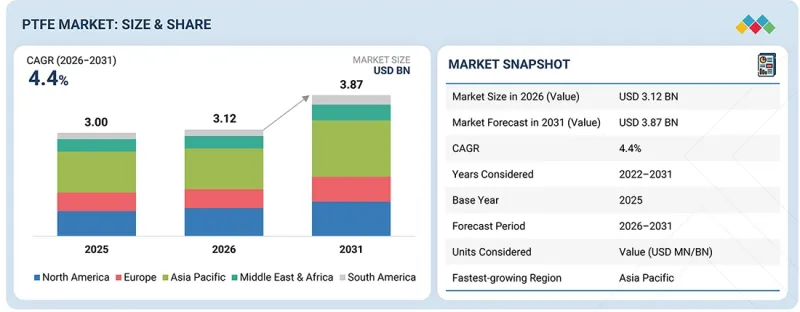
PTFE 시장 규모는 2026년 31억 2,000만 달러에서 2031년에는 38억 7,000만 달러로 성장하며, 예측 기간 중 CAGR은 4.4%에 달할 것으로 전망되고 있습니다.
| 조사 범위 | |
|---|---|
| 조사 대상 기간 | 2022-2031년 |
| 기준연도 | 2025년 |
| 예측 기간 | 2026-2031년 |
| 단위 | 금액(달러)·킬로톤 |
| 부문 | 형상, 용도, 최종사용자 산업, 지역별 |
| 대상 지역 | 유럽, 북미, 아시아태평양, 중동 및 아프리카, 남미 |
과립형/성형 분말 유형의 PTFE가 금액 기준 2위 형태 카테고리가 될 것으로 예측됩니다. 이는 다양한 산업 용도로 사용되는 고성능 성형 부품 및 기계 가공 부품의 제조에 PTFE가 널리 사용되고 있기 때문입니다. 과립상 PTFE의 가공에는 일반적으로 압축 성형이나 램 압출이 사용되며, 실, 개스킷, 밸브 시트, 베어링, 부싱, 로드, 시트, 튜브 등이 제조됩니다. 이러한 제품은 가혹한 환경에서도 높은 신뢰성을 요구하는 화학 처리, 석유 및 가스, 자동차, 항공우주, 전기·전자, 산업 기계 업계에서 사용되고 있습니다. 산업 인프라, 공정 자동화 및 내식성 기계에 대한 투자 확대가 과립상 PTFE의 수요를 끌어올리고 있습니다. 또한 PTFE는 기존의 엔지니어링 소재에 비해 뛰어난 기계적 강도와 치수 안정성을 갖추고 있으며, 고성능 부품에 대한 채택이 확대되고 있습니다.
"용도별로는 코팅이 예측 기간 중 금액 기준으로 두 번째로 높은 성장률을 기록할 것으로 보입니다."
다양한 산업 분야에서 내구성, 비점착성, 내식성, 내열성을 갖춘 표면에 대한 수요가 높아짐에 따라 PTFE 코팅 부문은 예측 기간 중 매출 기준으로 두 번째로 높은 성장률을 보일 것으로 예상됩니다. PTFE 코팅은 뛰어난 내화학성, 극히 낮은 마찰 특성, 높은 열 안정성으로 인해 기계, 화학 제조 플랜트, 자동차, 조리 기구, 항공우주 공학용 부품, 의료기기, 전기·전자 부품 등에서 널리 사용되고 있습니다. 또한 반도체 제조 산업, 전기자동차(EV) 제조, 재생 가능 에너지 인프라의 급속한 확장에 따라 가혹한 화학적 환경이나 작동 환경에서 작동하는 부품에 대한 PTFE 코팅 수요가 증가하고 있으며, 이것이 PTFE 코팅 부문의 성장을 지원하고 있습니다. 또한 산업용 유지보수에 대한 투자 증가, 기계 및 설비의 수명 연장, 에너지 효율이 높은 제조를 위한 노력도 PTFE 코팅 제품의 채택을 촉진하고 있습니다.
"최종사용자 산업별로는 전기·전자 산업이 예측 기간 중 금액 기준으로 두 번째로 높은 성장률을 보일 전망입니다."
반도체 제조 산업, 5G 인프라, 소비자용 전자기기, 전기자동차의 급속한 성장에 힘입어 전기·전자 부문은 예측 기간 중 금액 기준으로 두 번째로 높은 성장률을 보일 것으로 전망됩니다. PTFE는 뛰어난 절연 내력, 낮은 유전율, 높은 내열 안정성, 탁월한 내화학성을 갖추고 있으며, 전선·케이블 절연, 커넥터, 인쇄회로기판, 반도체용 유체 관리 시스템, 고주파 통신 기기 등에 사용되고 있습니다. 특히 아시아태평양 및 북미 지역에서는 반도체 제조 공장 및 첨단 전자기기 제조 공장에 대한 투자 확대에 따라 고순도 PTFE 소재에 대한 수요가 더욱 증가하고 있습니다. 또한 첨단 데이터 전송 기술, AI 데이터센터, 소형 전자기기의 채택 확대에 따라 가혹한 작동 조건에서도 신뢰성 높은 성능을 발휘할 수 있는 소재가 요구되고 있습니다.
"지역별로는 예측 기간 중 중동 및 아프리카이 두 번째로 높은 성장률을 보일 것으로 전망됩니다."
중동 및 아프리카는 화학 처리, 석유 및 가스, 발전, 인프라 산업에 대한 투자 증가를 배경으로, 예측 기간 중 두 번째로 높은 성장률을 보일 것으로 전망됩니다. 배관, 밸브, 실, 개스킷, 처리 장치 분야의 내식성 소재에 대한 수요 증가에 힘입어 PTFE 수요가 대폭 증가하고 있습니다. 사우디아라비아, 아랍에미리트(UAE), 남아프리카공화국 등의 국가들은 ‘Saudi Vision 2030’과 같은 프로그램을 통해 산업 다각화, 석유화학 산업 확대, 재생 가능 에너지 프로젝트, 첨단 제조 분야에 막대한 투자를 하고 있습니다. 또한 전기 인프라, 수처리 시설, 산업용 가공 플랜트에 대한 투자가 증가함에 따라 뛰어난 내화학성, 내열성, 전기 절연성을 갖춘 PTFE에 대한 수요가 높아지고 있습니다.
이 보고서에서는 전 세계 PTFE 시장을 조사하여 시장 개요, 시장 성장에 영향을 미치는 각종 요인에 대한 분석, 기술 및 특허 동향, 법규제 환경, 사례 연구, 시장 규모 추이 및 전망, 각종 분류·지역/주요 국가별 상세 분석, 경쟁 구도, 주요 기업 개요 등을 정리하여 전해드립니다.
자주 묻는 질문
목차
제1장 서론
제2장 개요
제3장 주요 인사이트
제4장 시장 개요
제5장 업계 동향
제6장 기술의 진보, AI에 의한 영향, 특허, 혁신, 향후 응용
제7장 규제 상황과 지속가능성 구상
제8장 고객 상황과 구매 행동
제9장 PTFE 시장 : 형상별
제10장 PTFE 시장 : 용도별
제11장 PTFE 시장 : 최종사용자 산업별
제12장 PTFE 시장 : 지역별
제13장 경쟁 구도
제14장 기업 개요
제15장 조사 방법
제16장 부록
KSA 26.09.08The PTFE market is projected to grow from USD 3.12 billion in 2026 to USD 3.87 billion by 2031, at a CAGR of 4.4% during the forecast period.
| Scope of the Report | |
|---|---|
| Years Considered for the Study | 2022-2031 |
| Base Year | 2025 |
| Forecast Period | 2026-2031 |
| Units Considered | Value (USD Million/Billion), Volume (Kiloton) |
| Segments | By form, application, end-use industry, and region |
| Regions covered | Europe, North America, Asia Pacific, Middle East & Africa, and South America |
It is anticipated that granular/molded powder form PTFE will be the second-largest format category in the PTFE market in terms of value, driven by the widespread use of PTFE in making high-performance molded and machined parts used in various industrial applications. The processing techniques commonly used to manufacture granular PTFE are compression molding and RAM extrusion to make seals, gaskets, valve seats, bearings, bushings, rods, sheets, and tubes that need high chemical resistance, heat resistance, and a very low coefficient of friction. These products are used in chemical processing, oil & gas, automotive, aerospace, electrical & electronics, and industrial machinery industries where reliable operation in harsh environments is required. Investment in industrial infrastructure, process automation, and corrosion-resistant machinery drives the consumption of granular PTFE. In addition, the excellent mechanical strength and dimensional stability offered by PTFE as compared to traditional engineering materials drive its use in high-performance components.
''Based on application, coatings are the second fastest-growing application in the PTFE market, in terms of value, during the forecast period.''
The PTFE coatings segment is likely to grow at the second-fastest rate in terms of revenue during the forecast period due to increasing demand for durable, non-stick, corrosion-resistant, and heat-resistant surfaces for various industries. PTFE coatings are used extensively in machinery, chemical manufacturing plants, automobiles, cooking equipment, aerospace engineering components, medical equipment, and electrical & electronics components because of the superior chemical resistance, very low frictional characteristics, and high thermal stability of PTFE. In addition, rising demand for PTFE coatings in components that operate in harsh chemical and operating environments, due to the rapid expansion of the semiconductor manufacturing industry, electric vehicle manufacturing, and renewable energy infrastructure, is fueling growth in the PTFE coatings segment. Further, increasing investments in industrial maintenance, extending the life of machinery and equipment, and energy-efficient manufacturing are driving the adoption of PTFE coating products.
"Based on end-use industry, electrical & electronics is the second-fastest-growing end-use industry, in terms of value, during the forecast period."
The electrical & electronics segment is projected to witness the second-highest growth among the end-use industries of the PTFE market in terms of value during the forecast period, owing to the rapid growth in the semiconductor manufacturing industry, 5G infrastructure, consumer electronics, and electric vehicles. The use of PTFE in wire & cable insulation, connectors, printed circuit boards, semiconductor fluid management systems, and high-frequency communications equipment is attributable to its excellent dielectric strength, low dielectric constant, high heat stability, and outstanding chemical resistance. Growing investments in semiconductor fabrication plants and advanced electronics manufacturing plants, especially in the Asia Pacific and North American regions, are further increasing the demand for high-purity PTFE materials. Moreover, the growing adoption of advanced data transmission technology, artificial intelligence data centers, and miniature electronic devices demands materials that can offer reliable performance even in extreme operating conditions.
"Based on region, the Middle East & Africa is the second-fastest-growing market for PTFE, in terms of value, during the forecast period."
The Middle East & Africa is projected to witness the second-fastest growth in terms of market value of PTFE during the forecast period on account of rising investments in chemical processing, oil & gas, power generation, and infrastructure industries. Rising demand for PTFE, driven by increasing requirements for corrosion-resistant materials in pipes, valves, seals, gaskets, and processing equipment, has significantly increased PTFE demand. Nations like Saudi Arabia, the UAE, and South Africa are making huge investments in industrial diversification, petrochemical expansion, renewable energy projects, and advanced manufacturing through programs such as Saudi Vision 2030. In addition, rising investments in electrical infrastructure, water treatment plants, and industrial processing plants are increasing demand for PTFE owing to its superior chemical resistance, thermal resistance, and electrical insulation properties.
The PTFE market has been validated through primary interviews with industry experts globally. These primary sources have been divided into the following three categories:
- By Company Type: Tier 1 - 60%, Tier 2 - 20%, and Tier 3 - 20%
- By Designation: C-level - 33%, Director Level - 33%, and Managers - 34%
- By Region: North America - 30%, Europe - 20%, Asia Pacific - 35%, Middle East & Africa - 5%, and South America - 10%
The report provides a comprehensive analysis of company profiles:
Prominent companies include Daikin Industries, Ltd (Japan), Dongyue Group (China), Gujarat Fluorochemicals Limited (India), The Chemours Company (US), Syensqo (Belgium), AGC Inc. (Japan), 3M (US), Halopolymer (Russia), Shanghai Huayi 3F New Materials Co., Ltd (China), and Micropowders Inc. (US).
Research Coverage
This research report categorizes the PTFE market by form (Granular/Molded Powder, Fine Powder, Dispersion, and Micronized Powder), application (Sheets, Coatings, Pipes, Films, and Other Applications), end-use industry (Chemical & Industrial Processing, Automotive & Aerospace, Electrical & Electronics, Building & Construction, Consumer Goods, and Other End-use Industries), and region (North America, Europe, Asia Pacific, Middle East & Africa, and South America). The scope of the report includes detailed information on the major factors influencing the growth of the PTFE market, including drivers, restraints, challenges, and opportunities. A thorough examination of the key industry players has been conducted to provide insights into their business overview, solutions and services, key strategies, contracts, partnerships, and agreements. Product launches, mergers & acquisitions, and recent developments in the PTFE market are all covered. This report includes a competitive analysis of upcoming startups in the PTFE market ecosystem.
Reasons to buy this report:
The report will help market leaders/new entrants in this market by providing information on the closest approximations of revenue for the overall PTFE market and its subsegments. This report will help stakeholders understand the competitive landscape and gain deeper insights to better position their businesses and plan suitable go-to-market strategies. The report also helps stakeholders understand the pulse of the market and provides them with information on key market drivers, restraints, challenges, and opportunities.
The report provides insights on the following pointers:
- Analysis of key drivers (Accelerating Electric Vehicle Adoption and Energy Transition Driving Multi-Point PTFE Demand, Semiconductor Industry Boom and Escalating Demand for Ultra-High-Purity PTFE), restraints (Regulatory Overhang: PFAS Classification and Evolving Restriction Frameworks, Geographic Supply Concentration and Fluorspar Feedstock Vulnerability), opportunities (Growing Demand from Electric Vehicles and Semiconductor Manufacturing, Rising Adoption in Renewable Energy and Hydrogen Infrastructure), and challenges (Escalating PFAS Regulatory Scrutiny and Compliance Complexity, Fluorspar Supply Concentration and Raw Material Price Volatility)
- Product Development/Innovation: Detailed insights on upcoming technologies, research & development activities, and service launches in the PTFE market
- Market Development: Comprehensive information about lucrative markets - the report analyzes the PTFE market across varied regions
- Market Diversification: Exhaustive information about services, untapped geographies, recent developments, and investments in the PTFE market
- Competitive Assessment: In-depth assessment of market shares, growth strategies, and service offerings of leading players like Daikin Industries, Ltd (Japan), Dongyue Group (China), Gujarat Fluorochemicals Limited (India), The Chemours Company (US), Syensqo (Belgium), AGC Inc (Japan), 3M (US), Halopolymer (Russia), Shanghai Huayi 3F New Materials Co., Ltd (China), and Micropowders Inc (US), among others, in the PTFE market
TABLE OF CONTENTS
1 INTRODUCTION
- 1.1 STUDY OBJECTIVES
- 1.2 MARKET DEFINITION
- 1.3 MARKET SCOPE
- 1.3.1 MARKET SEGMENTATION AND REGIONAL SCOPE
- 1.3.2 INCLUSIONS & EXCLUSIONS
- 1.3.3 YEARS CONSIDERED
- 1.4 CURRENCY CONSIDERED
- 1.5 UNIT CONSIDERED
- 1.6 STAKEHOLDERS
2 EXECUTIVE SUMMARY
- 2.1 MARKET HIGHLIGHTS AND KEY INSIGHTS
- 2.2 KEY MARKET PARTICIPANTS: MAPPING OF STRATEGIC DEVELOPMENTS
- 2.3 DISRUPTIVE TRENDS IN PTFE MARKET
- 2.4 HIGH-GROWTH SEGMENTS
- 2.5 REGIONAL SNAPSHOT: MARKET SIZE, GROWTH RATE, AND FORECAST
3 PREMIUM INSIGHTS
- 3.1 ATTRACTIVE OPPORTUNITIES FOR PLAYERS IN PTFE MARKET
- 3.2 PTFE MARKET, BY FORM AND REGION
- 3.3 PTFE MARKET, BY APPLICATION
- 3.4 PTFE MARKET, BY END-USE INDUSTRY
- 3.5 PTFE MARKET, BY COUNTRY
4 MARKET OVERVIEW
- 4.1 INTRODUCTION
- 4.2 MARKET DYNAMICS
- 4.2.1 DRIVERS
- 4.2.1.1 Accelerating demand for electric vehicles
- 4.2.1.2 Booming semiconductor industry
- 4.2.2 RESTRAINTS
- 4.2.2.1 Rising compliance costs and substitution risk
- 4.2.2.2 Rising feedstock and energy costs
- 4.2.3 OPPORTUNITIES
- 4.2.3.1 Expanding use of PTFE in advanced healthcare applications
- 4.2.3.2 Transition toward renewable energy and emerging hydrogen economy
- 4.2.4 CHALLENGES
- 4.2.4.1 Adapting to evolving PFAS regulatory landscape
- 4.2.4.2 Securing diversified and reliable fluorspar supply
- 4.2.1 DRIVERS
- 4.3 UNMET NEEDS AND WHITE SPACES
- 4.3.1 UNMET NEEDS IN PTFE MARKET
- 4.3.2 WHITE SPACE OPPORTUNITIES
- 4.4 INTERCONNECTED MARKETS AND CROSS-SECTOR OPPORTUNITIES
- 4.4.1 INTERCONNECTED MARKETS AND APPLICATION OF PTFE
- 4.4.2 CROSS-SECTOR OPPORTUNITIES
- 4.5 STRATEGIC MOVES BY TIER 1/2/3 PLAYERS
5 INDUSTRY TRENDS
- 5.1 PORTER'S FIVE FORCES ANALYSIS
- 5.1.1 BARGAINING POWER OF BUYERS
- 5.1.2 BARGAINING POWER OF SUPPLIERS
- 5.1.3 THREAT OF NEW ENTRANTS
- 5.1.4 THREAT OF SUBSTITUTES
- 5.1.5 INTENSITY OF COMPETITIVE RIVALRY
- 5.2 MACROECONOMIC OUTLOOK
- 5.2.1 GLOBAL GDP TRENDS AND FORECAST
- 5.2.2 TRENDS IN GLOBAL AUTOMOTIVE AND AERSOPACE INDUSTRY
- 5.3 VALUE CHAIN ANALYSIS
- 5.3.1 RAW MATERIAL SUPPLIERS
- 5.3.2 PTFE MANUFACTURERS
- 5.3.3 DISTRIBUTORS
- 5.3.4 END USERS
- 5.4 ECOSYSTEM ANALYSIS
- 5.5 PRICING ANALYSIS
- 5.5.1 AVERAGE SELLING PRICE TREND OF PTFE, BY REGION, 2022-2025 (USD/KG)
- 5.5.2 AVERAGE SELLING PRICE TREND OF PTFE, BY FORM, 2022-2025 (USD/KG)
- 5.6 TRADE ANALYSIS
- 5.6.1 IMPORT SCENARIO (HS CODE 390461)
- 5.6.2 EXPORT SCENARIO (HS CODE 390461)
- 5.7 KEY CONFERENCES AND EVENTS, 2026-2027
- 5.8 TRENDS/DISRUPTIONS IMPACTING CUSTOMER BUSINESS
- 5.9 INVESTMENT AND FUNDING SCENARIO
- 5.10 CASE STUDY ANALYSIS
- 5.10.1 IMPROVING SEAL PERFORMANCE IN HIGH-PRESSURE AND TEMPERATURE APPLICATIONS WITH SPRING-ENERGIZED PTFE SEALS
- 5.10.2 ADDRESSING FRICTION AND THERMAL EXPANSION ISSUES IN FLAT SCREEN MOUNTING SYSTEMS WITH PTFE COATINGS
- 5.10.3 ENHANCING CONVEYOR RELIABILITY AND UPTIME IN FOOD MANUFACTURING WITH PTFE COMPONENTS
- 5.11 IMPACT OF US TARIFFS ON PTFE MARKET
- 5.11.1 INTRODUCTION
- 5.11.2 KEY TARIFF RATES
- 5.11.3 PRICE IMPACT ANALYSIS
- 5.11.4 IMPACT ON COUNTRIES/REGIONS
- 5.11.4.1 US
- 5.11.4.2 Europe
- 5.11.4.3 Asia Pacific
- 5.11.5 IMPACT ON END-USE INDUSTRIES
6 TECHNOLOGICAL ADVANCEMENTS, AI-DRIVEN IMPACT, PATENTS, INNOVATIONS, AND FUTURE APPLICATIONS
- 6.1 TECHNOLOGY ANALYSIS
- 6.1.1 KEY TECHNOLOGIES
- 6.1.1.1 PTFE nanocomposite engineering
- 6.1.1.2 Electrospinning-based PTFE nanofiber membrane technology
- 6.1.1.3 Plasma-assisted PTFE surface modification technology
- 6.1.2 COMPLEMENTARY TECHNOLOGIES
- 6.1.2.1 Digital twin and AI-driven manufacturing intelligence
- 6.1.2.2 Hydrogen energy and proton exchange membrane infrastructure
- 6.1.3 ADJACENT TECHNOLOGIES
- 6.1.3.1 PTFE fiber technology
- 6.1.1 KEY TECHNOLOGIES
- 6.2 TECHNOLOGY ROADMAP
- 6.2.1 SHORT TERM (2025-2027) | HIGH-PURITY PTFE & PROCESS OPTIMIZATION
- 6.2.2 MID-TERM (2027-2030) | ADVANCED MATERIALS & SUSTAINABLE MANUFACTURING
- 6.2.3 LONG TERM (2030-2035+) | NEXT-GENERATION FLUOROPOLYMERS & SMART MATERIALS
- 6.3 PATENT ANALYSIS
- 6.3.1 LEGAL STATUS OF PATENTS
- 6.3.2 JURISDICTION ANALYSIS
- 6.4 FUTURE APPLICATIONS
- 6.4.1 NEXT-GENERATION SEMICONDUCTOR FABRICATION & ADVANCED CHIP PACKAGING
- 6.4.2 HYDROGEN ECONOMY & FUEL CELL INFRASTRUCTURE
- 6.4.3 ELECTRIC VEHICLES & NEXT-GENERATION BATTERY SYSTEMS
- 6.4.4 ADVANCED MEDICAL DEVICES & BIOMEDICAL TECHNOLOGIES
- 6.4.5 SUSTAINABLE INDUSTRIAL PROCESSING & CARBON CAPTURE SYSTEMS
- 6.5 IMPACT OF AI/GEN AI ON PTFE MARKET
- 6.5.1 TOP USE CASES AND MARKET POTENTIAL OF PTFE
- 6.5.2 BEST PRACTICES FOLLOWED BY MANUFACTURERS/OEMS IN PTFE MARKET
- 6.5.3 CASE STUDIES RELATED TO AI IMPLEMENTATION IN PTFE MARKET
- 6.5.4 INTERCONNECTED/ADJACENT ECOSYSTEM AND IMPACT ON MARKET PLAYERS
- 6.5.5 CLIENTS' READINESS TO ADOPT GENERATIVE AI IN PTFE MARKET
7 REGULATORY LANDSCAPE AND SUSTAINABILITY INITIATIVES
- 7.1 REGIONAL REGULATIONS AND COMPLIANCE
- 7.1.1 REGULATORY BODIES, GOVERNMENT AGENCIES, AND OTHER ORGANIZATIONS
- 7.1.2 INDUSTRY STANDARDS
- 7.2 IMPACT OF REGULATORY POLICIES AND SUSTAINABILITY INITIATIVES
- 7.3 CERTIFICATIONS, LABELING, AND ECO-STANDARDS
8 CUSTOMER LANDSCAPE AND BUYER BEHAVIOR
- 8.1 INTRODUCTION
- 8.2 DECISION-MAKING PROCESS
- 8.3 KEY STAKEHOLDERS INVOLVED IN BUYING PROCESS AND THEIR EVALUATION CRITERIA
- 8.3.1 KEY STAKEHOLDERS IN BUYING PROCESS
- 8.3.2 BUYING CRITERIA
- 8.4 ADOPTION BARRIERS AND INTERNAL CHALLENGES
- 8.5 UNMET NEEDS OF VARIOUS END-USE INDUSTRIES
- 8.6 MARKET PROFITABILITY
- 8.6.1 REVENUE POTENTIAL
- 8.6.2 COST DYNAMICS
- 8.6.3 MARGIN OPPORTUNITIES IN KEY END-USE INDUSTRIES
9 PTFE MARKET, BY FORM
- 9.1 INTRODUCTION
- 9.2 GRANULAR/MOLDED POWDER
- 9.2.1 CHEMICAL INERTNESS, THERMAL STABILITY, AND LOW FRICTION TO ENABLE WIDESPREAD USE IN MOLDING AND RAM EXTRUSION
- 9.3 FINE POWDER
- 9.3.1 HIGH-TENSILE STRENGTH AND IMPROVED FLEX LIFE TO PROMOTE USE IN THREAD SEAL TAPES, HOSES, TUBING, AND LINERS
- 9.4 DISPERSION
- 9.4.1 HIGH MECHANICAL STRENGTH TO ENCOURAGE ADOPTION IN COATING, SPRAYING, AND IMPREGNATION APPLICATIONS
- 9.5 MICRONIZED POWDER
- 9.5.1 LOW MOLECULAR WEIGHT AND ULTRA-FINE PARTICLE SIZE TO AID DISPERSION IN GREASES, WAXES, PLASTICS, AND ELASTOMERS
10 PTFE MARKET, BY APPLICATION
- 10.1 INTRODUCTION
- 10.2 SHEETS
- 10.2.1 PERSISTENT USAGE OF PTFE SHEETS IN FOOD AND PACKAGING INDUSTRY TO DRIVE DEMAND
- 10.3 COATINGS
- 10.3.1 HIGH-TEMPERATURE ENDURANCE AND CHEMICAL RESISTANCE TO BOOST DEMAND
- 10.4 PIPES
- 10.4.1 RISING DEMAND FOR PTFE PIPES IN CHEMICAL AND INDUSTRIAL PROCESSING
- 10.5 FILMS
- 10.5.1 DURABILITY AND DIMENSIONAL STABILITY TO BOOST ADOPTION IN HIGH-PERFORMANCE ENGINEERING APPLICATIONS
- 10.6 OTHER APPLICATIONS
11 PTFE MARKET, BY END-USE INDUSTRY
- 11.1 INTRODUCTION
- 11.2 CHEMICAL & INDUSTRIAL PROCESSING
- 11.2.1 OUTSTANDING MECHANICAL DURABILITY AND CORROSION RESISTANCE TO SUPPORT ADOPTION IN GASKETS AND SEALS
- 11.2.2 CHEMICAL PROCESSING
- 11.2.3 OIL & GAS
- 11.2.4 PHARMACEUTICALS
- 11.2.5 OTHER INDUSTRIAL PROCESSING APPLICATIONS
- 11.3 AUTOMOTIVE & AEROSPACE
- 11.3.1 EXCELLENT CHEMICAL RESISTANCE AND ELECTRICAL INSULATION TO DRIVE ADOPTION IN FUEL AND BRAKE SYSTEMS AND HOSES
- 11.3.2 AUTOMOTIVE
- 11.3.3 AEROSPACE
- 11.4 ELECTRICAL & ELECTRONICS
- 11.4.1 LOW DIELECTRIC CONSTANT AND HIGH DIELECTRIC STRENGTH TO SPIKE PTFE USE IN COAXIAL CABLES, CONNECTORS, AND PCBS
- 11.4.2 TELECOMMUNICATIONS
- 11.4.3 SEMICONDUCTOR
- 11.4.4 ELECTRONIC COMPONENTS AND GADGETS
- 11.4.5 ELECTRICAL
- 11.5 BUILDING & CONSTRUCTION
- 11.5.1 HIGH WEATHER RESISTANCE AND UV STABILITY TO FACILITATE PTFE USE IN TENSILE MEMBRANE STRUCTURES AND ROOFING
- 11.6 CONSUMER GOODS
- 11.6.1 EXCEPTIONAL NON-STICK PROPERTIES AND THERMAL STABILITY TO DRIVE PTFE USE IN COOKWARE AND KITCHEN APPLIANCES
- 11.7 OTHER END-USE INDUSTRIES
- 11.7.1 HEALTHCARE
- 11.7.2 DEFENSE
- 11.7.3 AGROCHEMICALS
12 PTFE MARKET, BY REGION
- 12.1 INTRODUCTION
- 12.2 ASIA PACIFIC
- 12.2.1 CHINA
- 12.2.1.1 Thriving photovoltaic, hydrogen, and battery manufacturing industries to accelerate PTFE demand
- 12.2.2 JAPAN
- 12.2.2.1 Growing investments in robotics and industrial automation technologies to strengthen PTFE demand
- 12.2.3 SOUTH KOREA
- 12.2.3.1 Government initiatives supporting carbon neutrality and renewable energy development to propel PTFE growth
- 12.2.4 INDIA
- 12.2.4.1 Rapid industrialization and increasing foreign direct investment in advanced manufacturing to create growth opportunities
- 12.2.5 AUSTRALIA
- 12.2.5.1 Booming growing food processing, pharmaceuticals, and advanced manufacturing sectors to support market expansion
- 12.2.6 REST OF ASIA PACIFIC
- 12.2.1 CHINA
- 12.3 NORTH AMERICA
- 12.3.1 US
- 12.3.1.1 Rapid advancement in battery technologies due to escalating production of electric vehicles to strengthen market expansion
- 12.3.2 CANADA
- 12.3.2.1 Increasing investments in hydrogen production, carbon capture, and renewable energy projects to contribute to market growth
- 12.3.3 MEXICO
- 12.3.3.1 Expanding automotive manufacturing and nearshoring-driven industrial investments to fuel market growth
- 12.3.1 US
- 12.4 EUROPE
- 12.4.1 GERMANY
- 12.4.1.1 Advanced automotive engineering and chemical processing industries to foster market growth
- 12.4.2 FRANCE
- 12.4.2.1 Aerospace leadership and nuclear energy investments to boost PTFE demand
- 12.4.3 UK
- 12.4.3.1 Strong focus on aircraft modernization and high-value precision manufacturing to drive PTFE market
- 12.4.4 ITALY
- 12.4.4.1 Growing industrial machinery production and chemical processing activities to contribute to market growth
- 12.4.5 SPAIN
- 12.4.5.1 Rising renewable energy installations and automotive production to reinforce PTFE demand
- 12.4.6 REST OF EUROPE
- 12.4.1 GERMANY
- 12.5 MIDDLE EAST & AFRICA
- 12.5.1 GCC
- 12.5.1.1 Saudi Arabia
- 12.5.1.1.1 Industrial diversification and petrochemical expansion under Vision 2030 initiative to stimulate market growth
- 12.5.1.2 Rest of GCC
- 12.5.1.1 Saudi Arabia
- 12.5.2 SOUTH AFRICA
- 12.5.2.1 Mining and chemical processing industries to contribute to PTFE market growth
- 12.5.3 REST OF MIDDLE EAST & AFRICA
- 12.5.1 GCC
- 12.6 SOUTH AMERICA
- 12.6.1 BRAZIL
- 12.6.1.1 Growing chemical processing and automotive production to foster market expansion
- 12.6.2 ARGENTINA
- 12.6.2.1 Shale energy development and industrial modernization support PTFE market growth
- 12.6.3 REST OF SOUTH AMERICA
- 12.6.1 BRAZIL
13 COMPETITIVE LANDSCAPE
- 13.1 INTRODUCTION
- 13.2 KEY PLAYER COMPETITIVE STRATEGIES/RIGHT TO WIN, FEBRUARY 2022-MARCH 2026
- 13.3 REVENUE ANALYSIS, 2023-2025
- 13.4 MARKET SHARE ANALYSIS, 2025
- 13.4.1 DAIKIN INDUSTRIES, LTD. (JAPAN)
- 13.4.2 DONGYUE GROUP (CHINA)
- 13.4.3 GUJARAT FLUOROCHEMICALS LIMITED (INDIA)
- 13.4.4 THE CHEMOURS COMPANY (US)
- 13.4.5 SYENSQO (BELGIUM)
- 13.5 COMPANY VALUATION AND FINANCIAL METRICS
- 13.6 BRAND COMPARISON
- 13.6.1 GUJARAT FLUOROCHEMICALS LIMITED (INDIA)
- 13.6.2 AGC INC. (JAPAN)
- 13.6.3 DAIKIN INDUSTRIES, LTD. (JAPAN)
- 13.6.4 THE CHEMOURS COMPANY (US)
- 13.7 COMPANY EVALUATION MATRIX: KEY PLAYERS, 2025
- 13.7.1 STARS
- 13.7.2 EMERGING LEADERS
- 13.7.3 PERVASIVE PLAYERS
- 13.7.4 PARTICIPANTS
- 13.7.5 COMPANY FOOTPRINT: KEY PLAYERS, 2025
- 13.7.5.1 Company footprint
- 13.7.5.2 Region footprint
- 13.7.5.3 Form footprint
- 13.7.5.4 Application footprint
- 13.7.5.5 End-use industry footprint
- 13.8 COMPANY EVALUATION MATRIX: STARTUPS/SMES, 2025
- 13.8.1 PROGRESSIVE COMPANIES
- 13.8.2 RESPONSIVE COMPANIES
- 13.8.3 DYNAMIC COMPANIES
- 13.8.4 STARTING BLOCKS
- 13.8.5 COMPETITIVE BENCHMARKING: STARTUPS/SMES, 2025
- 13.8.5.1 Detailed list of key startups/SMEs
- 13.8.5.2 Competitive benchmarking of startups/SMEs
- 13.9 COMPETITIVE SCENARIO
- 13.9.1 DEALS
- 13.9.2 EXPANSIONS
- 13.9.3 OTHER DEVELOPMENTS
14 COMPANY PROFILES
- 14.1 KEY PLAYERS
- 14.1.1 DAIKIN INDUSTRIES, LTD.
- 14.1.1.1 Business overview
- 14.1.1.2 Products/Solutions/Services offered
- 14.1.1.3 Recent developments
- 14.1.1.3.1 Expansions
- 14.1.1.4 MnM view
- 14.1.1.4.1 Key strengths
- 14.1.1.4.2 Strategic choices
- 14.1.1.4.3 Weaknesses and competitive threats
- 14.1.2 DONGYUE GROUP
- 14.1.2.1 Business overview
- 14.1.2.2 Products/Solutions/Services offered
- 14.1.2.3 MnM view
- 14.1.2.3.1 Key strengths
- 14.1.2.3.2 Strategic choices
- 14.1.2.3.3 Weaknesses and competitive threats
- 14.1.3 GUJARAT FLUOROCHEMICALS LIMITED
- 14.1.3.1 Business overview
- 14.1.3.2 Products/Solutions/Services offered
- 14.1.3.3 Recent developments
- 14.1.3.3.1 Expansions
- 14.1.3.4 MnM view
- 14.1.3.4.1 Key strengths
- 14.1.3.4.2 Strategic choices
- 14.1.3.4.3 Weaknesses and competitive threats
- 14.1.4 THE CHEMOURS COMPANY
- 14.1.4.1 Business overview
- 14.1.4.2 Products/Solutions/Services offered
- 14.1.4.3 Recent developments
- 14.1.4.3.1 Deals
- 14.1.4.3.2 Other developments
- 14.1.4.4 MnM view
- 14.1.4.4.1 Key strengths
- 14.1.4.4.2 Strategic choices
- 14.1.4.4.3 Weaknesses and competitive threats
- 14.1.5 SYENSQO
- 14.1.5.1 Business overview
- 14.1.5.2 Products/Solutions/Services offered
- 14.1.5.3 MnM view
- 14.1.5.3.1 Key strengths
- 14.1.5.3.2 Strategic choices
- 14.1.5.3.3 Weaknesses and competitive threats
- 14.1.6 3M
- 14.1.6.1 Business overview
- 14.1.6.2 Products/Solutions/Services offered
- 14.1.6.3 Recent developments
- 14.1.6.3.1 Developments
- 14.1.6.4 MnM view
- 14.1.6.4.1 Key strengths
- 14.1.6.4.2 Strategic choices
- 14.1.6.4.3 Weaknesses and competitive threats
- 14.1.7 AGC INC.
- 14.1.7.1 Business overview
- 14.1.7.2 Products/Solutions/Services offered
- 14.1.7.3 MnM view
- 14.1.7.3.1 Key strengths
- 14.1.7.3.2 Strategic choices
- 14.1.7.3.3 Weaknesses and competitive threats
- 14.1.8 HALOPOLYMER, OJSC
- 14.1.8.1 Business overview
- 14.1.8.2 Products/Solutions/Services offered
- 14.1.8.3 MnM view
- 14.1.8.3.1 Key strengths
- 14.1.8.3.2 Strategic choices
- 14.1.8.3.3 Weaknesses and competitive threats
- 14.1.9 SHANGHAI HUAYI 3F NEW MATERIALS CO. LTD.
- 14.1.9.1 Business overview
- 14.1.9.2 Products/Solutions/Services offered
- 14.1.9.3 MnM view
- 14.1.9.3.1 Key strengths
- 14.1.9.3.2 Strategic choices
- 14.1.9.3.3 Weaknesses and competitive threats
- 14.1.10 MICROPOWDERS, INC.
- 14.1.10.1 Business overview
- 14.1.10.2 Products/Solutions/Services offered
- 14.1.10.3 MnM view
- 14.1.10.3.1 Key strengths
- 14.1.10.3.2 Strategic choices
- 14.1.10.3.3 Weaknesses and competitive threats
- 14.1.1 DAIKIN INDUSTRIES, LTD.
- 14.2 OTHER PLAYERS
- 14.2.1 DALAU LTD.
- 14.2.2 FREUDENBERG FST GMBH
- 14.2.3 EVERFLON FLUOROPOLYMERS
- 14.2.4 FLUOROCARBON GROUP
- 14.2.5 BERGHOF GMBH
- 14.2.6 IN2PLASTICS
- 14.2.7 PBY PLASTICS, INC
- 14.2.8 ROCHLING SE & CO. KG
- 14.2.9 SHANDONG HENGYI NEW MATERIAL TECHNOLOGY CO., LTD.
- 14.2.10 MAFLON S.P.A
- 14.2.11 AFT FLUROTEC
- 14.2.12 THE MITSUBISHI CHEMICAL GROUP CORPORATION
- 14.2.13 HANGZHOU FINE FLUOROTECH CO., LTD.
- 14.2.14 SRF LIMITED
15 RESEARCH METHODOLOGY
- 15.1 RESEARCH DATA
- 15.1.1 SECONDARY DATA
- 15.1.1.1 Key data from secondary sources
- 15.1.1.2 Key data from secondary sources
- 15.1.2 PRIMARY DATA
- 15.1.2.1 Key data from primary sources
- 15.1.2.2 Key industry insights
- 15.1.2.3 Breakdown of primary interviews
- 15.1.1 SECONDARY DATA
- 15.2 MARKET SIZE ESTIMATION
- 15.2.1 BOTTOM-UP APPROACH
- 15.2.2 TOP-DOWN APPROACH
- 15.3 DATA TRIANGULATION
- 15.4 STUDY ASSUMPTIONS
- 15.5 RESEARCH LIMITATIONS
16 APPENDIX
- 16.1 DISCUSSION GUIDE
- 16.2 KNOWLEDGESTORE: MARKETSANDMARKETS' SUBSCRIPTION PORTAL
- 16.3 CUSTOMIZATION OPTIONS
- 16.4 RELATED REPORTS
- 16.5 AUTHOR DETAILS


