

|
시장보고서
상품코드
2126319
인공호흡기 시장 : 휴대성별(집중 치료용, 이송용), 유형별(성인용, 소아용), 인터페이스별(침습형), 모드별(복합 모드), 의료 환경별(병원, 진료소) - 세계 예측(-2031년)Ventilators Market by Mobility (Intensive Care Ventilators, Transportable Ventilators), Type (Adult & Pediatric Ventilators), Interface (Invasive Ventilation), Mode (Combined Mode Ventilation), Care Setting (Hospitals & Clinics)- Global Forecast to 2031 |
||||||

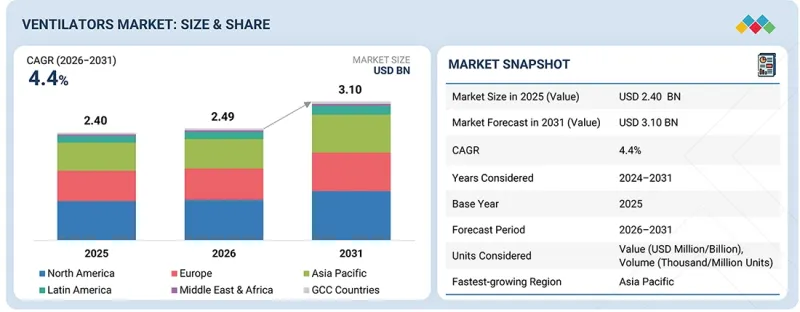
인공호흡기 시장은 예측 기간 동안 CAGR 4.4%로 확대되어, 2026년 24억 9,000만 달러에서 2031년에는 31억 달러에 달할 것으로 전망됩니다.
| 조사 범위 | |
|---|---|
| 조사 대상 기간 | 2026-2031년 |
| 기준 연도 | 2025년 |
| 예측 기간 | 2026-2031년 |
| 단위 | 금액(달러) |
| 부문 | 휴대성, 유형, 연령층, 인터페이스, 모드, 의료 환경, 지역별 |
| 대상 지역 | 북미, 유럽, 아시아태평양, 라틴아메리카, 중동 및 아프리카 |
COPD 및 천식 등 호흡기질환의 증가가 인공호흡기 시장의 주요 성장 촉진요인으로 작용하고 있습니다. 대기 오염의 심화, 생활 습관의 변화, 고령화에 따라 이러한 만성 질환 환자 수가 증가하고 있으며, 그 결과 호흡기 발작의 빈도와 중증도가 높아지고 있습니다. COPD 및 중증 천식 환자는 급성 악화기에 호흡 지원이 필요한 경우가 많으며, 이로 인해 병원 및 재택 간호 분야에서 침습형 및 비침습형 인공호흡기에 대한 수요가 증가하고 있습니다. 또한, 인공호흡기 기술의 지속적인 발전(안전성, 정확도 및 환자 예후 개선)에 힘입어 의료 종사자들은 최신형 호흡 지원 기기에 대한 투자를 확대하고 있습니다. 이처럼 호흡기질환으로 인한 부담의 증대가 시장 성장을 견인하고 있습니다.

이동성 유형별로는 하이엔드 ICU용 인공호흡기 부문이 가장 큰 점유율을 차지하고 있습니다.
고성능 ICU용 인공호흡기는 중환자실에서 생명을 위협하는 상태를 치료하는 데 필수적이기 때문에 시장을 독점하고 있습니다. 이러한 첨단 기기는 광범위한 환기 모드, 정교한 모니터링 시스템, 강화된 안전 기능을 갖추고 있으며, 이 모든 것은 중증 환자에게 필수적인 요소입니다. 전 세계 인구의 고령화와 복잡한 호흡기질환 발생률의 증가에 따라, 의료 기관들은 차세대 ICU 솔루션에 대한 투자를 점점 더 늘리고 있습니다. 또한, 끊임없는 기술 혁신과 규제 당국의 엄격한 규제도 이러한 첨단 장비의 도입을 촉진하고 있으며, 환자의 최적의 예후가 중요한 생명을 위협하는 상황에서 이 장비들이 최우선 선택지로 자리 잡고 있습니다.
모드별로는 복합 모드가 가장 큰 시장 점유율을 차지하고 있습니다.
복합 모드 인공호흡기는 용량 조절식 환기와 압력 조절식 환기 모두의 뛰어난 기능을 겸비하고 있어 가장 큰 시장 점유율을 차지하고 있습니다. 이를 통해 임상의는 각 환자의 개별적인 필요에 맞춰 호흡 지원을 조정할 수 있습니다. 이러한 인공호흡기는 1회 환기량을 정밀하게 제어하는 동시에 폐 손상을 방지하기 위해 기도 내 압력을 안전한 범위 내로 유지할 수 있으므로, 다양한 임상 상황에 대응할 수 있는 범용성이 높은 솔루션입니다.
또한, 이 장치에 탑재된 첨단 모니터링 시스템과 자동 조절 기능 덕분에 편의성이 향상되고 환자의 예후도 개선됩니다. 그 결과, 중증 환자에게 적응성이 높고 유연한 인공호흡 옵션이 요구되는 중환자실(ICU)에서 복합 모드 인공호흡기에 대한 수요가 높아지고 있습니다. 또한 지속적인 기술 혁신, 의료 시설에 대한 투자 확대, 호흡기질환의 증가와 같은 요인들로 인해 시장 내 복합 모드 인공호흡기에 대한 수요가 확대되고 있습니다.
유럽은 시장 점유율 2위를 차지하고 있습니다.
유럽은 확립된 의료 인프라, 막대한 정부 지출, 최고 품질의 제품을 보장하는 엄격한 규제를 바탕으로 세계 2위의 호흡기 시장이 되었습니다. 유럽 내 중환자실 및 병원의 광범위한 보급에 더해, 호흡기질환의 높은 유병률과 고령화가 진행됨에 따라, 침습형 및 비침습형 인공호흡기에 대한 수요는 확실히 증가하고 있습니다.
유럽은 주요 제조사들이 주도하는 활기찬 커뮤니티와 지속적인 혁신의 혜택을 받고 있으며, 그 결과 환자의 예후를 개선하는 첨단 기술이 개발되고 있습니다. 선진적인 의료 정책과 종합적인 보험 제도 또한 시장 성장을 뒷받침하고 있어, 유럽은 세계 인공호흡기 시장에서 2위의 점유율을 차지하고 있습니다.
본 보고서에서는 전 세계 인공호흡기 시장을 조사하여 시장 개요, 시장 성장에 영향을 미치는 다양한 요인에 대한 분석, 기술 및 특허 동향, 법규제 환경, 사례 연구, 시장 규모 추정 및 전망, 각종 분류·지역/주요 국가별 상세 분석, 경쟁 구도, 주요 기업 개요 등을 종합적으로 다루고 있습니다.
자주 묻는 질문
목차
제1장 소개
제2장 주요 요약
제3장 주요 인사이트
제4장 시장 개요
제5장 업계 동향
제6장 기술의 진보, AI에 의한 영향, 특허, 혁신, 향후 응용
제7장 규제 상황
제8장 고객 상황과 구매 행동
제9장 인공호흡기 시장 : 휴대성별
제10장 인공호흡기 시장 : 유형별
제11장 인공호흡기 시장 : 인터페이스별
제12장 인공호흡기 시장 : 모드별
제13장 인공호흡기 시장 : 의료 환경별
제14장 인공호흡기 시장 : 지역별
제15장 경쟁 구도
제16장 기업 개요
제17장 조사 방법
제18장 부록
KSM 26.09.10The ventilators market is projected to reach USD 3.10 billion by 2031 from USD 2.49 billion in 2026 at a CAGR of 4.4% during the forecast period.
| Scope of the Report | |
|---|---|
| Years Considered for the Study | 2026-2031 |
| Base Year | 2025 |
| Forecast Period | 2026-2031 |
| Units Considered | Value (USD billion) |
| Segments | By Mobility, Type, Age group, Interface, Mode, Care Setting, and Region |
| Regions covered | North America, Europe, the Asia Pacific, Latin America, and the Middle East & Africa |
Increasing respiratory illnesses like COPD and asthma are key drivers of the ventilators market. With growing air pollution levels, lifestyles, and aging populations, an increased number of these chronic ailments have resulted in more frequent and severe respiratory attacks. COPD and severe asthma patients frequently need respiratory support through acute exacerbation, increasing hospital and homecare demand for both invasive and non-invasive ventilators. Further, ongoing advancements in ventilator technology-safety, accuracy, and patient outcomes-prompt healthcare professionals to invest in newer respiratory support equipment. The increasing burden of respiratory illnesses is thus driving market growth.
The high-end ICU ventilators segment accounts for the largest share of the global ventilators market.
Premium ICU ventilators dominate the global ventilators market because they are crucial for treating life-threatening conditions in intensive care units. These advanced devices offer a wide range of ventilation modes, sophisticated monitoring systems, and enhanced safety features, all of which are essential for critically ill patients. As the global population ages and the incidence of complex respiratory diseases rises, healthcare facilities are increasingly investing in next-generation ICU solutions. Additionally, continuous innovations and stringent regulations from governing bodies support the adoption of these advanced devices, making them the preferred choice for life-critical situations where optimal patient outcomes are important.
Combined mode ventilation has the largest market share in the ventilators market.
Combined mode ventilators hold the largest market share in the ventilator segment because they offer the best features of both volume- and pressure-controlled ventilation. This allows clinicians to tailor respiratory support to meet the individual needs of each patient. These ventilators enable precise control over tidal volumes while ensuring that pressure remains within safe limits to prevent lung injury, making them a versatile solution suitable for a variety of clinical situations.
Additionally, the advanced monitoring systems and automated adjustments of these devices enhance convenience and improve patient outcomes. As a result, combined mode ventilators are highly sought after in intensive care units where critically ill patients require adaptable and flexible ventilation options. Moreover, ongoing technological innovations, increased investments in healthcare facilities, and a rise in respiratory illnesses have all contributed to the growing demand for combined mode ventilators in the market.
Europe holds the second-largest market share in the ventilators market.
Europe is the world's second-largest ventilators market, with its established healthcare infrastructure, heavy government spending, and stringent regulation that guarantees top-quality products. Extensive coverage of intensive care units and hospitals in Europe, combined with a high incidence of respiratory conditions and an aging population, ensures rising demand for invasive and non-invasive ventilators.
Europe benefits from a dynamic community of leading producers and continuous innovation, resulting in the development of advanced technologies that enhance patient outcomes. Coupled with progressive healthcare initiatives and comprehensive insurance coverage, Europe stands out as a significant market for ventilators globally, securing its position as the second-largest market shareholder.
A breakdown of the primary participants (supply-side) for the ventilators market referred to for this report is provided below:
- By Company Type: Tier 1-25%, Tier 2-40%, and Tier 3-35%
- By Designation: C-level-20%, Director Level-38%, and Others-40%
- By Region: North America-37%, Europe-28%, Asia Pacific-26%, Latin America- 6%, and Middle East and Africa- 1% and GCC Countries- 2%
Prominent players in this market include Shenzhen Mindray Bio-Medical Electronics Co., Ltd. (China), ResMed (US), Nihon Kohden Corporation (Japan), ZOLL Medical Corporation (US), Getinge AB (Sweden), Dragerwerk AG & Co. KGaA (Germany), ICU Medical, Inc. (US), Hamilton Medical (Switzerland), Lowenstein Medical SE & Co. KG (Germany), Fisher & Paykel Healthcare Limited (New Zealand), Skanray Technologies Ltd. (India), aXcent Medical GmbH (Germany), Metran Co., Ltd. (Japan), MAGNAMED (Brazil), Leistung Ingenieria SRL (Argentina), Breas Medical AB (Sweden), Airon Corporation (US), TRITON Electronic Systems Ltd. (Russia), Bio-Med Devices, Inc. (US), HEYER Medical AG (Germany), AgVa Healthcare (India), Biodesign Innovation Labs (India), NOCCARC Robotics Pvt. Ltd. (India), Umbulizer (India), Schiller Healthcare India Pvt. Ltd. (India), and AVI Healthcare (India).
Research Coverage:
The market study covers the ventilators market across various segments. It aims to estimate the market size and growth potential of this market across different segments by mobility, type, age group, interface, mode, care setting, and region. The study also includes an in-depth competitive analysis of the key players in the market, along with their company profiles, key observations related to their product and business offerings, recent developments, and key market strategies.
Reasons to Buy the Report
This report will enrich established firms as well as new entrants/smaller firms to gauge the pulse of the market, which, in turn, would help them garner a greater share of the market. Firms purchasing the report could use one or a combination of the below-mentioned strategies to strengthen their positions in the market.
This report provides insights on:
- Analysis of Market Dynamics: Drivers (Rise in respiratory diseases (Urbanization and rising pollution levels, Rising obesity due to sedentary lifestyles, Growing geriatric population worldwide, Increasing preference for home care settings, Rising number of preterm births, Outbreak of infectious respiratory diseases)), restraints (Shortage of skilled medical workers, Excessive purchase of ventilators during COVID-19, Reimbursement concerns), opportunities (Cost-efficiency of home care services, Growth opportunities in emerging economies), and challenges (Low awareness and inadequate resources in emerging economies, Harmful effects of respiratory devices on neonates, Supply chain disruptions, Global demand fluctuations).
- Services/Innovations: Detailed insights on upcoming technologies, research & development activities, and new product launches in the ventilators market.
- Market Development: Comprehensive information on the lucrative emerging markets, components, demographics, care settings, and regions.
- Market Diversification: Exhaustive information about the product portfolios, growing geographies, recent developments, and investments in the ventilators market.
- Competitive Assessment: In-depth assessment of market shares, growth strategies, product offerings, and capabilities of the leading players in the ventilators market like ResMed (US), Getinge AB (Sweden), Koninklijke Philips N.V. (Netherlands), Dragerwerk AG & CO. KGAA (Germany), and ICU Medical, Inc. (US).
TABLE OF CONTENTS
1 INTRODUCTION
- 1.1 STUDY OBJECTIVES
- 1.2 MARKET DEFINITION
- 1.3 STUDY SCOPE
- 1.3.1 MARKETS COVERED & REGIONS CONSIDERED
- 1.3.2 INCLUSIONS & EXCLUSIONS
- 1.4 YEARS CONSIDERED
- 1.5 CURRENCY USED
- 1.6 STAKEHOLDERS
- 1.7 LIMITATIONS
- 1.8 SUMMARY OF CHANGES
2 EXECUTIVE SUMMARY
- 2.1 KEY INSIGHTS & MARKET HIGHLIGHTS
- 2.2 KEY MARKET PARTICIPANTS: INSIGHTS & DEVELOPMENTS
- 2.3 DISRUPTIVE TRENDS SHAPING MARKET GROWTH
- 2.4 HIGH-GROWTH SEGMENTS & EMERGING FRONTIERS
- 2.5 SNAPSHOT: GLOBAL MARKET SIZE, GROWTH RATE, AND FORECAST
3 PREMIUM INSIGHTS
- 3.1 VENTILATORS MARKET OVERVIEW
- 3.2 ASIA PACIFIC: VENTILATORS MARKET, BY MOBILITY AND COUNTRY (2025)
- 3.3 VENTILATORS MARKET: GEOGRAPHIC GROWTH OPPORTUNITIES
- 3.4 VENTILATORS MARKET: REGIONAL MIX
- 3.5 VENTILATORS MARKET: DEVELOPED VS. EMERGING ECONOMIES
4 MARKET OVERVIEW
- 4.1 INTRODUCTION
- 4.2 MARKET DYNAMICS
- 4.2.1 DRIVERS
- 4.2.1.1 Rise in respiratory diseases
- 4.2.1.1.1 Increasing incidence of COPD and asthma
- 4.2.1.1.2 Growing tobacco consumption
- 4.2.1.2 Urbanization and rising pollution levels
- 4.2.1.3 Rising obesity due to sedentary lifestyles
- 4.2.1.4 Growing geriatric population worldwide
- 4.2.1.5 Increasing preference for home care settings
- 4.2.1.6 Rising number of preterm births
- 4.2.1.7 Outbreak of infectious respiratory diseases
- 4.2.1.1 Rise in respiratory diseases
- 4.2.2 RESTRAINTS
- 4.2.2.1 Shortage of skilled medical workers
- 4.2.2.2 Excessive purchase of ventilators during COVID-19
- 4.2.2.3 Reimbursement concerns
- 4.2.3 OPPORTUNITIES
- 4.2.3.1 Cost-efficiency of home care services
- 4.2.3.2 Growth opportunities in emerging economies
- 4.2.4 CHALLENGES
- 4.2.4.1 Low awareness and inadequate resources in emerging economies
- 4.2.4.2 Harmful effects of respiratory devices on neonates
- 4.2.4.3 Supply chain disruptions
- 4.2.4.4 Global demand fluctuations
- 4.2.1 DRIVERS
- 4.3 UNMET NEEDS & WHITE SPACES
- 4.3.1 UNMET NEEDS IN VENTILATORS MARKET
- 4.3.2 WHITE SPACE OPPORTUNITIES
- 4.4 INTERCONNECTED MARKETS & CROSS-SECTOR OPPORTUNITIES
- 4.4.1 INTERCONNECTED MARKETS
- 4.4.2 CROSS-SECTOR OPPORTUNITIES
- 4.5 STRATEGIC MOVES BY TIER-1/2/3 PLAYERS
5 INDUSTRY TRENDS
- 5.1 PORTER'S FIVE FORCES ANALYSIS
- 5.1.1 THREAT OF NEW ENTRANTS
- 5.1.2 THREAT OF SUBSTITUTES
- 5.1.3 BARGAINING POWER OF SUPPLIERS
- 5.1.4 BARGAINING POWER OF BUYERS
- 5.1.5 INTENSITY OF COMPETITIVE RIVALRY
- 5.2 MACROECONOMIC OUTLOOK
- 5.2.1 INTRODUCTION
- 5.2.2 GDP TRENDS & FORECAST
- 5.2.3 TRENDS IN GLOBAL VENTILATORS INDUSTRY
- 5.2.4 TRENDS IN GLOBAL HEALTHCARE & CRITICAL CARE INDUSTRY
- 5.3 SUPPLY CHAIN ANALYSIS
- 5.4 VALUE CHAIN ANALYSIS
- 5.5 ECOSYSTEM ANALYSIS
- 5.6 PRICING ANALYSIS
- 5.6.1 INDICATIVE PRICING OF VENTILATORS, BY KEY PLAYER, 2025
- 5.6.2 AVERAGE SELLING PRICE TREND OF VENTILATORS, BY REGION, 2023-2025
- 5.7 TRADE ANALYSIS
- 5.7.1 IMPORT SCENARIO (HS CODE 9018)
- 5.7.2 EXPORT DATA (HS CODE 9018)
- 5.8 KEY CONFERENCES & EVENTS, 2026-2027
- 5.9 TRENDS/DISRUPTIONS IMPACTING CUSTOMERS' BUSINESSES
- 5.10 INVESTMENT & FUNDING SCENARIO
- 5.11 CASE STUDY ANALYSIS
- 5.11.1 CASE STUDY 1: SCALING AI-ENABLED CRITICAL CARE VENTILATION
- 5.11.2 CASE STUDY2: EXPANDING HOME RESPIRATORY CARE THROUGH CONNECTED VENTILATION
- 5.11.3 CASE STUDY 3: ENHANCING ICU RESPIRATORY CARE WITH INTEGRATED VENTILATION
- 5.12 IMPACT OF 2025 US TARIFFS ON VENTILATORS MARKET
- 5.12.1 INTRODUCTION
- 5.12.2 KEY TARIFF RATES
- 5.12.3 PRICE IMPACT ANALYSIS
- 5.12.4 IMPACT ON COUNTRIES/REGIONS
- 5.12.4.1 North America
- 5.12.4.2 Europe
- 5.12.4.3 Asia Pacific
- 5.12.5 END-USE INDUSTRY IMPACT
6 TECHNOLOGICAL ADVANCEMENTS, AI-DRIVEN IMPACT, PATENTS, INNOVATIONS, AND FUTURE APPLICATIONS
- 6.1 KEY EMERGING TECHNOLOGIES
- 6.1.1 INTELLIGENT & CLOSED-LOOP VENTILATION SYSTEMS
- 6.2 COMPLEMENTARY TECHNOLOGIES
- 6.2.1 REMOTE MONITORING SYSTEMS
- 6.3 TECHNOLOGY/PRODUCT ROADMAP
- 6.3.1 SHORT-TERM (2025-2027) | FOUNDATION & EARLY COMMERCIALIZATION
- 6.3.2 1.16.2 MID-TERM (2027-2030) | EXPANSION & STANDARDIZATION
- 6.3.3 1.16.3 LONG-TERM (2030-2035+) | MASS COMMERCIALIZATION & DISRUPTION
- 6.4 PATENT ANALYSIS
- 6.4.1 INSIGHTS: JURISDICTION & TOP APPLICANT ANALYSIS
- 6.5 FUTURE APPLICATIONS
- 6.5.1 AI-ENABLED REMOTE VENTILATION MANAGEMENT & PREDICTIVE CARE
- 6.5.2 SMART RESPIRATORY CARE ECOSYSTEMS
- 6.5.3 ADVANCED VENTILATOR CONSUMABLES & LUNG-PROTECTIVE SOLUTIONS
- 6.6 IMPACT OF AI/GEN AI ON VENTILATORS MARKET
- 6.6.1 TOP USE CASES & MARKET POTENTIAL
- 6.6.2 CASE STUDIES OF AI IMPLEMENTATION IN VENTILATORS MARKET
- 6.6.3 INTERCONNECTED ADJACENT ECOSYSTEMS & IMPACT ON MARKET PLAYERS
- 6.6.4 CLIENTS' READINESS TO ADOPT GENERATIVE AI IN VENTILATORS MARKET
7 REGULATORY LANDSCAPE
- 7.1 REGIONAL REGULATIONS & COMPLIANCE
- 7.1.1 REGULATORY BODIES, GOVERNMENT AGENCIES, AND OTHER ORGANIZATIONS
- 7.1.2 INDUSTRY STANDARDS
8 CUSTOMER LANDSCAPE & BUYER BEHAVIOR
- 8.1 DECISION-MAKING PROCESS
- 8.2 BUYER STAKEHOLDERS & BUYING EVALUATION CRITERIA
- 8.2.1 KEY STAKEHOLDERS IN BUYING PROCESS
- 8.2.2 BUYING CRITERIA
- 8.3 ADOPTION BARRIERS & INTERNAL CHALLENGES
- 8.4 UNMET NEEDS FROM VARIOUS END-USE INDUSTRIES
- 8.5 MARKET PROFITABILITY
- 8.5.1 REVENUE POTENTIAL
- 8.5.2 COST DYNAMICS
- 8.5.3 MARGIN OPPORTUNITIES IN KEY APPLICATIONS
9 VENTILATORS MARKET, BY MOBILITY
- 9.1 INTRODUCTION
- 9.2 INTENSIVE CARE VENTILATORS
- 9.2.1 HIGH-END ICU VENTILATORS
- 9.2.1.1 Rising healthcare expenditure and improving infrastructure in emerging economies to drive market
- 9.2.2 MID-END ICU VENTILATORS
- 9.2.2.1 Higher affordability and accessibility to drive market
- 9.2.3 BASIC ICU VENTILATORS
- 9.2.3.1 Growing use in ambulatory care centers to drive market
- 9.2.1 HIGH-END ICU VENTILATORS
- 9.3 PORTABLE/TRANSPORTABLE VENTILATORS
- 9.3.1 INCREASING DEMAND FOR COMPACT DEVICES FOR MECHANICAL VENTILATION TO DRIVE MARKET
10 VENTILATORS MARKET, BY TYPE
- 10.1 INTRODUCTION
- 10.2 ADULT & PEDIATRIC VENTILATORS
- 10.2.1 GROWING GERIATRIC POPULATION TO DRIVE MARKET
- 10.3 NEONATAL & INFANT VENTILATORS
- 10.3.1 TECHNOLOGICAL ADVANCEMENTS IN NEONATAL MONITORS TO DRIVE MARKET
11 VENTILATORS MARKET, BY INTERFACE
- 11.1 INTRODUCTION
- 11.2 DUAL-CAPABILITY VENTILATION
- 11.2.1 RISING PREVALENCE OF COPD & ARDS TO DRIVE MARKET GROWTH
- 11.3 NON-INVASIVE VENTILATION
- 11.3.1 RELIABILITY OF MECHANICAL DESIGNS TO SUPPORT MARKET GROWTH
- 11.4 INVASIVE VENTILATION
- 11.4.1 RISING PREVALENCE OF RESPIRATORY DISEASES TO DRIVE MARKET
12 VENTILATORS MARKET, BY MODE
- 12.1 INTRODUCTION
- 12.2 COMBINED-MODE VENTILATORS
- 12.2.1 COMBINED BENEFITS OF VOLUME-TARGETED AND PRESSURE-TARGETED VENTILATORS TO DRIVE MARKET
- 12.3 VOLUME-MODE VENTILATORS
- 12.3.1 INCREASING DEMAND FOR ADVANCED RESPIRATORY SUPPORT SYSTEMS IN HEALTHCARE SETTINGS TO DRIVE MARKET
- 12.4 PRESSURE-MODE VENTILATORS
- 12.4.1 PRESET INSPIRATORY PRESSURE MAINTENANCE AND BETTER PATIENT COMFORT TO DRIVE MARKET
- 12.5 OTHER VENTILATOR MODES
13 VENTILATORS MARKET, BY CARE SETTING
- 13.1 INTRODUCTION
- 13.2 HOSPITALS & CLINICS
- 13.2.1 RISING DEMAND FOR VENTILATORS IN PRIVATE HOSPITALS TO DRIVE MARKET
- 13.3 AMBULATORY CARE CENTERS
- 13.3.1 INCREASING NUMBER OF OUTPATIENT VISITS TO DRIVE MARKET
- 13.4 EMERGENCY MEDICAL SERVICES
- 13.4.1 HIGH INCIDENCE OF TRAUMA INJURIES TO DRIVE MARKET
- 13.5 HOME CARE SETTINGS
- 13.5.1 EMERGENCE OF REMOTE PATIENT MONITORING DEVICES TO DRIVE MARKET
14 VENTILATORS MARKET, BY REGION
- 14.1 INTRODUCTION
- 14.2 NORTH AMERICA
- 14.2.1 US
- 14.2.1.1 High prevalence of COPD to drive the market
- 14.2.2 CANADA
- 14.2.2.1 Increasing incidence of asthma to drive market growth
- 14.2.1 US
- 14.3 EUROPE
- 14.3.1 GERMANY
- 14.3.1.1 Rising healthcare spending to increase demand for high-end ventilators
- 14.3.2 FRANCE
- 14.3.2.1 Highly advanced healthcare system to drive adoption of ventilators in hospitals
- 14.3.3 UK
- 14.3.3.1 Increasing healthcare expenditure to drive market growth
- 14.3.4 ITALY
- 14.3.4.1 High growth in geriatric population and subsequent rise in age-related respiratory diseases to drive market
- 14.3.5 SPAIN
- 14.3.5.1 High burden on state-run health insurance system and poor healthcare infrastructure to restrain market growth
- 14.3.6 NETHERLANDS
- 14.3.6.1 Rising prevalence of respiratory diseases to drive market
- 14.3.7 REST OF EUROPE
- 14.3.1 GERMANY
- 14.4 ASIA PACIFIC
- 14.4.1 JAPAN
- 14.4.1.1 Established healthcare system to increase adoption of respiratory care devices
- 14.4.2 CHINA
- 14.4.2.1 High prevalence of COPD and lung cancer to propel demand
- 14.4.3 INDIA
- 14.4.3.1 Rising focus of global players on Indian market to drive adoption of advanced ventilators
- 14.4.4 AUSTRALIA
- 14.4.4.1 High prevalence of chronic lung diseases to drive demand for ventilators
- 14.4.5 REST OF ASIA PACIFIC
- 14.4.1 JAPAN
- 14.5 LATIN AMERICA
- 14.5.1 BRAZIL
- 14.5.1.1 Healthcare infrastructure improvement to support market growth
- 14.5.2 MEXICO
- 14.5.2.1 Rising obesity rate to increase incidence of respiratory diseases
- 14.5.3 ARGENTINA
- 14.5.3.1 Incidence of severe acute respiratory infections to drive market
- 14.5.4 REST OF LATIN AMERICA
- 14.5.1 BRAZIL
- 14.6 MIDDLE EAST & AFRICA
- 14.6.1 RISING HEALTHCARE SPENDING AND PRESENCE OF MEDICAL DEVICE MANUFACTURING COMPANIES TO DRIVE MARKET
- 14.7 GCC COUNTRIES
- 14.7.1 HIGHER DISPOSABLE INCOME AND INCREASED GOVERNMENT HEALTHCARE EXPENDITURE TO PROPEL MARKET GROWTH
15 COMPETITIVE LANDSCAPE
- 15.1 OVERVIEW
- 15.1.1 OVERVIEW OF STRATEGIES ADOPTED BY PLAYERS IN VENTILATORS MARKET
- 15.2 REVENUE ANALYSIS, 2021-2025
- 15.3 MARKET SHARE ANALYSIS, 2025
- 15.4 COMPANY EVALUATION MATRIX: KEY PLAYERS, 2025
- 15.4.1 STARS
- 15.4.2 EMERGING LEADERS
- 15.4.3 PERVASIVE PLAYERS
- 15.4.4 PARTICIPANTS
- 15.4.5 COMPANY FOOTPRINT: KEY PLAYERS, 2025
- 15.4.5.1 Company footprint
- 15.4.5.2 Company footprint
- 15.4.5.3 Mobility footprint
- 15.4.5.4 Type footprint
- 15.4.5.5 Interface footprint
- 15.4.5.6 Mode footprint
- 15.5 COMPANY EVALUATION MATRIX: STARTUPS/SMES, 2025
- 15.5.1 PROGRESSIVE COMPANIES
- 15.5.2 RESPONSIVE COMPANIES
- 15.5.3 DYNAMIC COMPANIES
- 15.5.4 STARTING BLOCKS
- 15.5.5 COMPETITIVE BENCHMARKING: STARTUPS/SMES, 2025
- 15.5.5.1 Detailed list of key startups/SMEs
- 15.5.5.2 Competitive benchmarking of key startups/SMEs
- 15.6 R&D EXPENDITURE
- 15.7 COMPANY VALUATION & FINANCIAL METRICS
- 15.7.1 FINANCIAL METRICS
- 15.7.2 COMPANY VALUATION
- 15.8 BRAND/PRODUCT COMPARISON
- 15.9 COMPETITIVE SCENARIO
- 15.9.1 PRODUCT LAUNCHES
- 15.9.2 DEALS
- 15.9.3 OTHER DEVELOPMENTS
16 COMPANY PROFILES
- 16.1 KEY PLAYERS
- 16.1.1 DRAGERWERK AG & CO. KGAA
- 16.1.1.1 Business overview
- 16.1.1.2 Products offered
- 16.1.1.3 Recent developments
- 16.1.1.3.1 Product launches
- 16.1.1.3.2 Deals
- 16.1.1.3.3 Other developments
- 16.1.1.4 MnM view
- 16.1.1.4.1 Key strengths
- 16.1.1.4.2 Strategic choices
- 16.1.1.4.3 Weaknesses & competitive threats
- 16.1.2 GETINGE AB
- 16.1.2.1 Business overview
- 16.1.2.2 Products offered
- 16.1.2.3 Recent developments
- 16.1.2.3.1 Product launches
- 16.1.2.3.2 Deals
- 16.1.2.3.3 Other developments
- 16.1.2.4 MnM view
- 16.1.2.4.1 Key strengths
- 16.1.2.4.2 Strategic choices
- 16.1.2.4.3 Weaknesses & competitive threats
- 16.1.3 SHENZHEN MINDRAY BIO-MEDICAL ELECTRONICS CO., LTD.
- 16.1.3.1 Business overview
- 16.1.3.2 Products offered
- 16.1.3.3 Recent developments
- 16.1.3.3.1 Product launches
- 16.1.3.3.2 Other developments
- 16.1.3.4 MnM view
- 16.1.3.4.1 Key strengths
- 16.1.3.4.2 Strategic choices
- 16.1.3.4.3 Weaknesses & competitive threats
- 16.1.4 ASAHI KASEI CORPORATION
- 16.1.4.1 Business overview
- 16.1.4.2 Products offered
- 16.1.4.3 Recent developments
- 16.1.4.3.1 Deals
- 16.1.5 RESMED INC.
- 16.1.5.1 Business overview
- 16.1.5.2 Products offered
- 16.1.5.3 Recent developments
- 16.1.5.3.1 Product launches
- 16.1.5.3.2 Deals
- 16.1.5.3.3 Other developments
- 16.1.5.4 MnM view
- 16.1.5.4.1 Key strengths
- 16.1.5.4.2 Strategic choices
- 16.1.5.4.3 Weaknesses & competitive threats
- 16.1.6 KONINKLIJKE PHILIPS N.V.
- 16.1.6.1 Business overview
- 16.1.6.2 Products offered
- 16.1.6.3 Recent developments
- 16.1.6.3.1 Other developments
- 16.1.6.4 MnM view
- 16.1.6.4.1 Key strengths
- 16.1.6.4.2 Strategic choices
- 16.1.6.4.3 Weaknesses & competitive threats
- 16.1.7 ICU MEDICAL INC.
- 16.1.7.1 Business overview
- 16.1.7.2 Products offered
- 16.1.7.3 Recent developments
- 16.1.7.3.1 Deals
- 16.1.7.4 MnM view
- 16.1.7.4.1 Key strengths
- 16.1.7.4.2 Strategic choices
- 16.1.7.4.3 Weaknesses & competitive threats
- 16.1.8 AIR LIQUIDE
- 16.1.8.1 Business overview
- 16.1.8.2 Products offered
- 16.1.8.3 MnM view
- 16.1.8.3.1 Key strengths
- 16.1.8.3.2 Strategic choices
- 16.1.8.3.3 Weaknesses & competitive threats
- 16.1.9 FLEXICARE (GROUP) LIMITED
- 16.1.9.1 Business overview
- 16.1.9.2 Products offered
- 16.1.9.3 Recent developments
- 16.1.9.3.1 Deals
- 16.1.10 NIHON KOHDEN CORPORATION
- 16.1.10.1 Business overview
- 16.1.10.2 Products offered
- 16.1.10.3 Recent developments
- 16.1.10.3.1 Product launches
- 16.1.10.4 MnM view
- 16.1.10.4.1 Key strengths
- 16.1.10.4.2 Strategic choices
- 16.1.10.4.3 Weaknesses & competitive threats
- 16.1.11 GE HEALTHCARE
- 16.1.11.1 Business overview
- 16.1.11.2 Products offered
- 16.1.11.3 MnM view
- 16.1.11.3.1 Key strengths
- 16.1.11.3.2 Strategic choices
- 16.1.11.3.3 Weaknesses & competitive threats
- 16.1.12 HAMILTON MEDICAL
- 16.1.12.1 Business overview
- 16.1.12.2 Products offered
- 16.1.12.3 Recent developments
- 16.1.12.3.1 Product upgrades
- 16.1.12.3.2 Deals
- 16.1.12.3.3 Other developments
- 16.1.12.4 MnM view
- 16.1.12.4.1 Key strengths
- 16.1.12.4.2 Strategic choices
- 16.1.12.4.3 Weaknesses & competitive threats
- 16.1.13 LOWENSTEIN MEDICAL TECHNOLOGY GMBH & CO. KG
- 16.1.13.1 Business overview
- 16.1.13.2 Products offered
- 16.1.13.3 MnM view
- 16.1.13.3.1 Key strengths
- 16.1.13.3.2 Strategic choices
- 16.1.13.3.3 Weaknesses & competitive threats
- 16.1.1 DRAGERWERK AG & CO. KGAA
- 16.2 OTHER PLAYERS
- 16.2.1 SKANRAY TECHNOLOGIES, LTD.
- 16.2.2 METRAN CO., LTD.
- 16.2.3 MAGNAMED
- 16.2.4 LEISTUNG INGENIERIA SRL
- 16.2.5 AIRON CORPORATION
- 16.2.6 TRITON ELECTRONIC SYSTEMS LTD.
- 16.2.7 BIO-MED DEVICES, INC.
- 16.2.8 HEYER MEDICAL AG
- 16.2.9 AGVA HEALTHCARE
- 16.2.10 SCHILLER AG
- 16.2.11 AVI HEALTHCARE LIMITED
- 16.2.12 MAGNAMEDIA B.V.
- 16.2.13 BREAS MEDICAL AB
- 16.2.14 BEIJING AEONMED CO., LTD
- 16.2.15 SHENZHEN COMEN MEDICAL INSTRUMENTS CO., LTD
- 16.2.16 REACT HEALTH
- 16.2.17 MICOMME MEDICAL TECHNOLOGY DEVELOPMENT CO., LTD
- 16.2.18 CHIRANA MEDICAL, A.S.
17 RESEARCH METHODOLOGY
- 17.1 RESEARCH DATA
- 17.1.1 SECONDARY RESEARCH
- 17.1.2 PRIMARY RESEARCH
- 17.2 MARKET SIZE ESTIMATION
- 17.3 MARKET BREAKDOWN & DATA TRIANGULATION
- 17.4 RESEARCH ASSUMPTIONS
- 17.5 RESEARCH LIMITATIONS
- 17.5.1 SCOPE-RELATED LIMITATIONS
- 17.5.2 METHODOLOGY-RELATED LIMITATIONS
- 17.6 RISK ASSESSMENT
18 APPENDIX
- 18.1 DISCUSSION GUIDE
- 18.2 KNOWLEDGESTORE: MARKETSANDMARKETS' SUBSCRIPTION PORTAL
- 18.3 CUSTOMIZATION OPTIONS
- 18.4 RELATED REPORTS
- 18.5 AUTHOR DETAILS


