

|
시장보고서
상품코드
2131875
스위치기어 시장 : 절연 유형(가스 절연, 공기 절연), 설치 장소(실내, 야외), 전류(교류, 직류), 전압(저압, 중압, 고압), 최종사용자(전력회사, 산업, 재생에너지, 데이터센터), 지역별 - 세계 예측(-2031년)Switchgear Market by Insulation type (Gas-insulated, Air-insulated), Installation (Indoor, Outdoor), Current (AC, DC), Voltage (Low, Medium, High), End User (Power Utilities, Industries, Renewables, Datacenter), and Region - Global Forecast to 2031 |
||||||

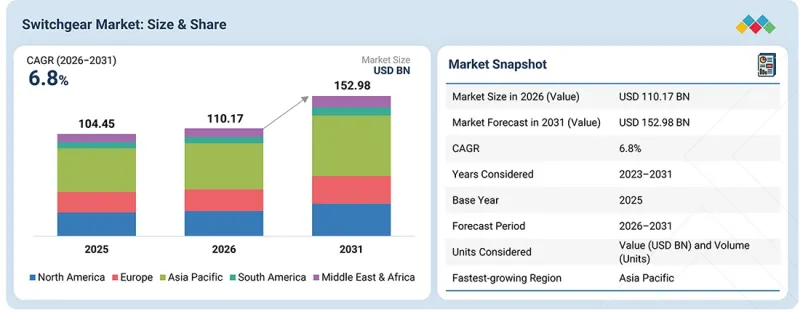
스위치기어 시장 규모는 2025년에 1,044억 5,000만 달러 규모에 달하고, 2026년에는 1,101억 7,000만 달러에 달할 것으로 추정됩니다.
그 후, 2031년까지 1,529억 8,000만 달러에 달할 것으로 예상되며, 2026년부터 2031년까지의 예측 기간 동안 연평균 성장률(CAGR) 6.8%를 기록할 것으로 전망됩니다. 이러한 성장은 전 세계 전력 생태계 전반에 걸친 구조적 및 순환적 수요 요인의 조합에 의해 뒷받침되고 있습니다.
| 조사 범위 | |
|---|---|
| 조사 대상 기간 | 2023-2031년 |
| 기준 연도 | 2025년 |
| 예측 기간 | 2026-2031년 |
| 단위 | 금액(달러)·수량(단위) |
| 부문 | 절연 유형, 전압, 최종사용자, 지역별 |
| 대상 지역 | 북미, 유럽, 아시아태평양, 중동 및 아프리카, 남미 |
세계 전력 회사들은 노후화된 설비의 교체, 송전망의 신뢰성 향상, 급속한 도시화와 산업화에 따른 전력 수요 증가에 대응하기 위해 대규모 송전망 현대화 및 송배전 인프라 업그레이드에 박차를 가하고 있습니다. 특히 아시아태평양, 중동, 남미의 신흥국에서 이러한 움직임이 두드러집니다.
동시에, 유틸리티 규모의 태양광 및 풍력발전 설비를 포함한 재생에너지 용량의 급속한 증가에 따라, 계통연계, 송전, 집전 시스템의 보호를 뒷받침하는 스위치기어에 대한 수요가 크게 증가하고 있습니다. 클라우드 컴퓨팅, AI 워크로드, 디지털화에 힘입어 전 세계 데이터센터 용량이 급속히 확대됨에 따라, 첨단 중저압 스위치기어를 포함한 고신뢰성 및 이중화된 배전 인프라에 대한 수요가 더욱 증가하고 있습니다. 또한, 교통수단의 전동화와 이에 따른 전기자동차(EV) 충전 인프라의 확대, 석유·가스, 금속, 화학, 제조업 분야의 지속적인 생산능력 확대 역시 모든 전압 등급 및 최종 용도 부문에 걸친 스위치기어에 대한 지속적인 투자를 뒷받침하고 있습니다.
이러한 핵심 수요 요인 외에도, 기술 도입, 제품 혁신, 경쟁적 포지셔닝에 영향을 미치는 몇 가지 새로운 동향이 시장을 형성하고 있습니다. 주요 동향 중 하나는 환경 규제 강화와 전력 부문의 온실가스 배출 감축에 초점을 맞춘 전력 사업자의 지속가능성 노력을 배경으로, SF6 가스 절연 개폐장치에서 SF6가 포함되지 않고 환경 효율이 뛰어난 대체 제품으로의 전환이 가속화되고 있다는 점입니다. IoT 지원 센서, 실시간 상태 모니터링, 예측 유지보수 분석, 디지털 트윈 기능 등의 디지털 기술 통합을 통해 기존의 스위치기어는 운영 효율을 높이고 예기치 못한 정전을 줄이는, 스마트하고 전력망을 고려한 자산으로 진화하고 있습니다.
또한, 도시 지역의 변전소, 해상 풍력발전 플랫폼, 공간이 제한된 산업 시설의 부지 제약에 대응하기 위해 특히 가스 절연형 및 하이브리드형을 중심으로 콤팩트하고 공간 절약형 스위치기어 설계의 채택이 확대되고 있습니다. 더욱이 HVDC 송전 회랑, 데이터센터의 전원 아키텍처, 재생에너지 시스템 등 직류 기반 용도의 보급이 진행됨에 따라 DC 스위치기어 솔루션에 대한 관심도 높아지고 있습니다. 마지막으로, 마이크로그리드 및 분산형 에너지 자원을 포함한 전력망의 복원력 강화와 분산형 에너지 시스템에 대한 관심이 높아짐에 따라, 양방향 전력 흐름과 점점 더 동적으로 변화하는 그리드 상황을 관리할 수 있는 모듈식 및 디지털 통합형 스위치기어 솔루션의 도입이 촉진되고 있습니다.
“절연 유형별로는 공기 절연 개폐장치가 2025년에 가장 큰 점유율을 차지했습니다.”
이는 주로 자본 비용이 낮고, 설치 및 유지보수가 용이하며, 기존 전력 회사 및 산업 인프라와의 호환성이 광범위하기 때문입니다. 특히 비용을 중시하는 아시아태평양, 남미, 중동 및 아프리카 시장에서 널리 보급된 기존 도입 실적이 계속해서 견조한 교체 수요와 브라운필드 수요를 뒷받침하고 있습니다. 또한, AIS는 SF6 기반 가스 절연 시스템에 수반되는 규제 심사를 피할 수 있을 뿐만 아니라, 단순한 설계로 인해 제조사의 공급 폭이 넓어지고 총 소유 비용의 절감도 실현되어 시장 내 지배적 지위를 강화하고 있습니다.
“설치 장소별로는 2025년에 실내형 부문이 가장 큰 시장 점유율을 차지했습니다.”
이는 공간 최적화 및 기상·환경 노출로부터의 보호가 최우선 과제가 되는 도시 지역의 변전소, 상업용 빌딩, 산업 시설, 데이터센터 등에서 널리 채택된 것이 요인입니다. 또한, 실내용 스위치기어는 인구 밀도가 높고 공간 제약이 있는 환경에서도 보다 안전한 운영과 손쉬운 유지보수를 가능하게 하므로, 도시 지역이나 대도시권에서 사업을 확장하는 전력 회사 및 기업에게 바람직한 선택지가 되고 있습니다. 게다가, 콤팩트하고 밀폐형 스위치기어 솔루션이 선호되는 데이터센터 및 상업 인프라에 대한 투자가 증가하고 있으며, 이는 시장 전체에서 해당 부문의 주도적인 입지를 더욱 공고히 하고 있습니다.
본 보고서에서는 전 세계 스위치기어 시장을 조사하여 시장 개요, 시장 성장에 영향을 미치는 각종 요인에 대한 분석, 기술 및 특허 동향, 법규제 환경, 사례 연구, 시장 규모 추정 및 전망, 각종 분류·지역/주요 국가별 상세 분석, 경쟁 구도, 주요 기업 개요 등을 정리하고 있습니다.
자주 묻는 질문
목차
제1장 소개
제2장 주요 요약
제3장 주요 인사이트
제4장 시장 개요
제5장 업계 동향
제6장 기술의 진보, AI의 영향, 특허, 혁신, 향후 응용
제7장 규제 상황과 지속가능성에 대한 대처
제8장 고객 상황과 구매 행동
제9장 스위치기어 시장 : 절연 유형별
제10장 스위치기어 시장 : 설치 장소별
제11장 스위치기어 시장 : 전압별
제12장 스위치기어 시장 : 전류별
제13장 스위치기어 시장 : 최종사용자별
제14장 스위치기어 시장 : 지역별
제15장 경쟁 구도
제16장 기업 개요
제17장 조사 방법
제18장 부록
KSM 26.09.28The switchgear market is valued at USD 104.45 billion in 2025 and is estimated to reach USD 110.17 billion in 2026, before reaching USD 152.98 billion by 2031, registering a CAGR of 6.8% during the forecast period of 2026-2031. This growth is supported by a combination of structural and cyclical demand drivers across the global power ecosystem.
| Scope of the Report | |
|---|---|
| Years Considered for the Study | 2023-2031 |
| Base Year | 2025 |
| Forecast Period | 2026-2031 |
| Units Considered | Value (USD Billion), Volume (Units) |
| Segments | by Insulation type , Voltage, End User, and Region |
| Regions covered | North America, Europe, Asia Pacific, Middle East & Africa, South America |
Utilities worldwide are undertaking large-scale grid modernization and transmission and distribution infrastructure upgrades to replace aging assets, enhance grid reliability, and accommodate increasing electricity demand driven by rapid urbanization and industrialization, particularly across emerging economies in Asia Pacific, the Middle East, and South America.
Concurrently, the accelerating addition of renewable energy capacity, including utility-scale solar and wind installations, is generating significant demand for switchgear to support grid interconnection, power evacuation, and collection-system protection. The rapid expansion of global data center capacity, driven by cloud computing, artificial intelligence workloads, and digitalization, is further increasing demand for high-reliability and redundant power distribution infrastructure, including advanced medium- and low-voltage switchgear. In addition, the electrification of transportation and the associated expansion of EV charging infrastructure, together with continued industrial capacity expansion across oil and gas, metals, chemicals, and manufacturing, is supporting sustained investment in switchgear equipment across voltage classes and end-use segments.
Beyond these core demand drivers, the market is being shaped by several emerging trends influencing technology adoption, product innovation, and competitive positioning. A key trend is the accelerating transition from SF6 gas-insulated switchgear toward SF6-free and eco-efficient alternatives, driven by tightening environmental regulations and utility sustainability commitments focused on reducing greenhouse gas emissions from the power sector. The integration of digital technologies, including IoT-enabled sensors, real-time condition monitoring, predictive maintenance analytics, and digital twin capabilities, is transforming conventional switchgear into intelligent, grid-aware assets that improve operational efficiency and reduce unplanned outages. The market is also witnessing increasing adoption of compact and space-optimized switchgear designs, particularly gas-insulated and hybrid configurations, to address land constraints in urban substations, offshore wind platforms, and space-constrained industrial facilities. Furthermore, the growing penetration of DC-based applications, including HVDC transmission corridors, data center power architectures, and renewable energy systems, is driving increased interest in DC switchgear solutions. Finally, the growing focus on grid resilience and decentralized energy systems, including microgrids and distributed energy resources, is supporting the adoption of modular and digitally integrated switchgear solutions capable of managing bidirectional power flows and increasingly dynamic grid conditions.
"Air-insulated switchgear held the largest share of the switchgear market, by insulation type, in 2025."
Air-insulated switchgear holds the largest market share in 2025, primarily due to its lower capital cost, ease of installation and maintenance, and broad compatibility with existing utility and industrial infrastructure. Its widespread legacy installed base, particularly across cost-sensitive markets in Asia Pacific, South America, and the Middle East & Africa, continues to support strong replacement and brownfield demand. Additionally, AIS avoids the regulatory scrutiny associated with SF6-based gas-insulated systems, while its simpler design ensures broader manufacturer availability and lower total cost of ownership, together reinforcing its dominant position in the market.
"By installation, the indoor segment accounted for the largest market share in 2025."
The indoor segment held the largest market share in 2025, driven by its widespread adoption across urban substations, commercial buildings, industrial facilities, and data centers, where space optimization and protection from weather and environmental exposure are key priorities. Indoor switchgear also supports safer operation and easier maintenance in densely populated and space-constrained settings, making it the preferred choice for utilities and businesses expanding within urban and metropolitan areas. Additionally, rising investments in data centers and commercial infrastructure, both of which favor compact, enclosed switchgear solutions, continue to reinforce the segment's leading position in the overall market.
Breakdown of Primaries:
In-depth interviews with key industry participants, subject-matter experts, C-level executives of key market players, and industry consultants, among other experts, were conducted to obtain and verify critical qualitative and quantitative information, as well as to assess future market prospects. The primary interviews were distributed as follows:
By Company Type: Tier 1 - 40%, Tier 2 - 35%, and Tier 3 - 25%
By Designation: C-Level Executives - 35%, Directors - 25%, and Managers - 40%
By Region: Asia Pacific - 55%, North America - 20%, Europe - 12%, Middle East & Africa - 8%, and South America - 5%,
Notes: Managers include sales managers, production managers, and regional managers.
Tier 1 company: revenue >USD 5 billion; tier 2 company: revenue between USD 1 and USD 5 billion; and tier 3 company: revenue <USD 1 billion in 2025
Well-established global leaders predominantly govern the switchgear market. Notable players in the switchgear market include ABB (Switzerland), GE Vernova (US), Siemens (Germany), Schneider Electric (France), Eaton (Ireland), Mitsubishi Electric Corporation (Japan), LS ELECTRIC Co., Ltd. (South Korea), Fuji Electric Co., Ltd. (Japan), HD Hyundai Electric Co., Ltd. (South Korea), TOSHIBA CORPORATION (Japan), and several others.
Research Coverage:
The report offers a detailed definition, description, and forecast of the switchgear market, focusing on insulation types (air-insulated switchgear, gas-insulated switchgears, other insulation types), installation (indoor, outdoor), voltage (low (up to 1 kV), medium (2-36 kV), high (above 36 kV)), current (AC, DC), end user (power utilities, industrial, renewables, commercial, EV charging infrastructure, datacenters, other end users), and region (North America, Europe, Asia Pacific, Middle East & Africa, South America). It provides a qualitative and quantitative analysis of market drivers, limitations, opportunities, and challenges. Key elements covered are competitive landscape assessment, market dynamics, value estimates, and future trends, along with investment information on major players in the switchgear market.
Key Benefits of Buying the Report
The report is thoughtfully designed to benefit both established industry leaders and newcomers in the switchgear market. It provides reliable revenue forecasts for the entire market as well as its individual sub-segments. This data is a valuable resource for stakeholders, enabling them to gain a comprehensive understanding of the competitive landscape and formulate effective market strategies for their businesses. Furthermore, the report serves as a channel for stakeholders to grasp the current state of the market, providing essential insights into market drivers, limitations, challenges, and growth opportunities. By incorporating these insights, stakeholders can make well-informed decisions and stay informed about the constantly evolving dynamics of the switchgear industry.
- Analysis of key drivers (Rising global T&D investment to support electrification, Data center power demand growth driving MV/HV switchgear needs, EV charging infrastructure expansion, Offshore wind and marine project development), restraints (High capital cost of digital and sf6-free switchgear, Volatility in raw material costs), opportunities (Large-scale retrofit demand from aging sf6 installed base, Digital/smart switchgear enabling recurring service revenue), and challenges (Cybersecurity risk from increased digital substation connectivity) influencing the growth of the switchgear market.
- Product Development/Innovation: Product development and innovation in the switchgear market are increasingly centered around sustainability, digitalization, and compactness. Leading manufacturers are investing heavily in SF6-free and eco-efficient switchgear technologies, utilizing alternative insulating mediums such as clean air, vacuum, and synthetic gas blends, in response to tightening environmental regulations and utility net-zero commitments. In parallel, the integration of digital technologies, including IoT-enabled sensors, real-time condition monitoring, predictive maintenance analytics, and digital twin capabilities, is transforming switchgear from passive protective equipment into intelligent, grid-aware assets capable of enhancing operational efficiency and reducing unplanned downtime. Manufacturers are also focused on developing compact, modular switchgear designs to address space constraints in urban substations, offshore wind platforms, and data centers, alongside growing efforts to develop DC-compatible switchgear solutions in support of HVDC transmission, EV charging, and renewable energy applications. Collectively, these innovation efforts are aimed at improving reliability, reducing environmental impact, and enabling greater automation and grid resilience across the evolving power ecosystem.
- Market Development: Market development in the switchgear space is being driven by a combination of strategic partnerships, capacity expansions, and geographic diversification as manufacturers seek to strengthen their positioning across high-growth regions and emerging application areas. Leading players are expanding local manufacturing and assembly facilities, particularly across Asia Pacific, the Middle East, and South America, to capitalize on rising grid infrastructure investment, renewable energy build-out, and industrialization, while also mitigating supply chain risks and import dependencies. Companies are increasingly forming collaborations and joint ventures with utilities, EPC contractors, and renewable energy developers to secure long-term supply agreements and gain early access to large-scale grid modernization and data center projects. At the same time, several manufacturers are pursuing mergers and acquisitions to strengthen their SF6-free and digital switchgear portfolios, acquire complementary technology capabilities, and accelerate entry into high-growth end-use segments such as EV charging infrastructure and hyperscale data centers. These developments collectively reflect a market that is actively repositioning itself to align with evolving regulatory requirements, decentralized energy trends, and the broader digitalization of power infrastructure.
- Market Diversification: Market diversification within the switchgear industry is being shaped by manufacturers' efforts to broaden their presence across insulation technologies, voltage classes, and end-use applications to reduce dependence on any single revenue stream and capture emerging demand pockets. Companies traditionally focused on air-insulated and medium voltage switchgear are increasingly expanding into gas-insulated, SF6-free, and high-voltage product lines to serve transmission-level and space-constrained applications, while also building dedicated DC switchgear portfolios to tap into HVDC transmission, data center, and EV charging opportunities. End-use diversification is equally prominent, with players moving beyond traditional utility and industrial customers to actively target fast-growing segments such as renewables, data centers, and EV charging infrastructure, which offer stronger long-term growth visibility than mature end markets. Geographically, manufacturers are diversifying their footprint beyond core developed markets into emerging economies across Asia Pacific, the Middle East, and South America, supported by local manufacturing, distribution partnerships, and region-specific product customization. This broad-based diversification strategy is enabling companies to balance growth opportunities with risk mitigation, while positioning themselves to capture value across the full spectrum of the evolving power infrastructure landscape.
Competitive Assessment: A comprehensive evaluation has been conducted to scrutinize the market presence, growth strategies, and service offerings of key players in the switchgear market. These prominent companies include ABB (Switzerland), GE Vernova (US), Siemens (Germany), Schneider Electric (France), Eaton (Ireland), Mitsubishi Electric Corporation (Japan), LS ELECTRIC Co., Ltd. (South Korea), Fuji Electric Co., Ltd. (Japan), HD Hyundai Electric Co., Ltd. (South Korea), TOSHIBA CORPORATION (Japan), and several others. This analysis provides in-depth insights into the competitive positions of these major players, their approaches to driving market growth, top companies' market shares within the switchgear market.
TABLE OF CONTENTS
1 INTRODUCTION
- 1.1 STUDY OBJECTIVES
- 1.2 MARKET DEFINITION
- 1.3 MARKET SCOPE
- 1.3.1 MARKET SEGMENTATION AND REGIONAL SCOPE
- 1.3.2 INCLUSIONS AND EXCLUSIONS
- 1.3.3 YEARS CONSIDERED
- 1.4 CURRENCY CONSIDERED
- 1.5 UNIT CONSIDERED
- 1.6 LIMITATIONS
- 1.7 STAKEHOLDERS
- 1.8 SUMMARY OF CHANGES
2 EXECUTIVE SUMMARY
- 2.1 MARKET HIGHLIGHTS AND KEY INSIGHTS
- 2.2 KEY MARKET PARTICIPANTS: MAPPING OF STRATEGIC DEVELOPMENTS
- 2.3 DISRUPTIVE TRENDS IN SWITCHGEAR MARKET
- 2.4 HIGH-GROWTH SEGMENTS
- 2.5 REGIONAL SNAPSHOT: MARKET SIZE, GROWTH RATE, AND FORECAST
3 PREMIUM INSIGHTS
- 3.1 ATTRACTIVE OPPORTUNITIES FOR PLAYERS IN SWITCHGEAR MARKET
- 3.2 SWITCHGEAR MARKET, BY REGION
- 3.3 ASIA PACIFIC: SWITCHGEAR MARKET, BY INSTALLATION AND COUNTRY
- 3.4 SWITCHGEAR MARKET SHARE, BY INSTALLATION
- 3.5 SWITCHGEAR MARKET SHARE, BY VOLTAGE
- 3.6 SWITCHGEAR MARKET SHARE, BY INSULATION TYPE
- 3.7 SWITCHGEAR MARKET SHARE, BY CURRENT
- 3.8 SWITCHGEAR MARKET SHARE, BY END USER
- 3.9 SWITCHGEAR MARKET, BY REGION
4 MARKET OVERVIEW
- 4.1 INTRODUCTION
- 4.2 MARKET DYNAMICS
- 4.2.1 DRIVERS
- 4.2.1.1 Sustained growth in global electricity generation and regional demand expansion
- 4.2.1.2 Rapid growth in data center power demand is accelerating high-density switchgear deployment
- 4.2.1.3 Increasing renewable capacity additions across wind, solar, and hydro are driving new substation and interconnection switchgear demand
- 4.2.1.4 Rising energy-efficiency investments across buildings, industry, and transportation are prompting replacement of aging low- and medium-voltage switchgear
- 4.2.2 RESTRAINTS
- 4.2.2.1 Volatile copper and aluminum prices are rising input costs and compressing manufacturer margins across value chain
- 4.2.3 OPPORTUNITIES
- 4.2.3.1 Accelerating electric vehicle sales and charging infrastructure expansion are increasing demand for specialized switchgear systems
- 4.2.3.2 Accelerating offshore wind installations globally are expanding demand for specialized, compact, high-value switchgear systems
- 4.2.3.3 Sustained growth in global power sector investment is translating into higher capital allocation toward transmission and distribution switching infrastructure
- 4.2.4 CHALLENGES
- 4.2.4.1 Shortage of skilled technical workforce for installation, operation, and maintenance of advanced switchgear systems
- 4.2.1 DRIVERS
- 4.3 UNMET NEEDS AND WHITE SPACES
- 4.4 INTERCONNECTED MARKETS AND CROSS-SECTOR OPPORTUNITIES
- 4.5 EMERGING BUSINESS MODELS AND ECOSYSTEM SHIFTS
- 4.6 STRATEGIC MOVES BY TIER-1/2/3 PLAYERS
5 INDUSTRY TRENDS
- 5.1 PORTER'S FIVE FORCES ANALYSIS
- 5.1.1 INTENSITY OF COMPETITIVE RIVALRY
- 5.1.2 THREAT OF NEW ENTRANTS
- 5.1.3 BARGAINING POWER OF SUPPLIERS
- 5.1.4 BARGAINING POWER OF BUYERS
- 5.1.5 THREAT OF SUBSTITUTES
- 5.2 MACROECONOMIC OUTLOOK
- 5.2.1 INTRODUCTION
- 5.2.2 GDP TRENDS AND FORECAST
- 5.2.3 TRENDS IN DATA CENTER INDUSTRY
- 5.2.4 TRENDS IN RENEWABLE ENERGY INDUSTRY
- 5.3 VALUE CHAIN ANALYSIS
- 5.4 ECOSYSTEM ANALYSIS
- 5.5 PRICING ANALYSIS
- 5.5.1 PRICING RANGE OF SWITCHGEAR, BY VOLTAGE, 2025
- 5.5.2 AVERAGE SELLING PRICE TREND OF SWITCHGEAR, BY REGION, 2022-2025
- 5.6 TRADE ANALYSIS
- 5.6.1 IMPORT SCENARIO (HS CODE 853720)
- 5.6.2 EXPORT SCENARIO (HS CODE 853720)
- 5.6.3 IMPORT SCENARIO (HS CODE 853521)
- 5.6.4 EXPORT SCENARIO (HS CODE 853521)
- 5.6.5 IMPORT SCENARIO (HS CODE 853529)
- 5.6.6 EXPORT SCENARIO (HS CODE 853529)
- 5.7 KEY CONFERENCES AND EVENTS, 2026-2027
- 5.8 TRENDS/DISRUPTIONS IMPACTING CUSTOMER BUSINESS
- 5.9 INVESTMENT AND FUNDING SCENARIO
- 5.10 CASE STUDY ANALYSIS
- 5.10.1 HORNSEA 3 OFFSHORE WIND FARM POWERED BY SIEMENS ENERGY'S SF6-FREE SWITCHGEAR
- 5.10.2 WESTERN DOWNS BATTERY ENERGY STORAGE SYSTEM ENABLED BY TGOOD'S PREFABRICATED MV SWITCHGEAR
- 5.10.3 KHAVDA RENEWABLE ENERGY ZONE'S HV TRANSMISSION INFRASTRUCTURE DELIVERED BY GE VERNOVA FOR ADANI
- 5.11 IMPACT OF US TARIFF - SWITCHGEAR MARKET
- 5.11.1 INTRODUCTION
- 5.11.2 KEY TARIFF RATES
- 5.11.3 PRICE IMPACT ANALYSIS
- 5.11.4 IMPACT ON COUNTRIES/REGIONS
- 5.11.4.1 US
- 5.11.4.2 Europe
- 5.11.4.3 Asia Pacific
- 5.11.5 IMPACT ON END USERS
6 TECHNOLOGICAL ADVANCEMENTS, AI-DRIVEN IMPACT, PATENTS, INNOVATIONS, AND FUTURE APPLICATIONS
- 6.1 KEY EMERGING TECHNOLOGIES
- 6.1.1 SOLID-STATE SWITCHGEAR AND CIRCUIT BREAKERS
- 6.1.2 SF6-FREE AND ECO-EFFICIENT GAS INSULATION TECHNOLOGY
- 6.2 COMPLEMENTARY TECHNOLOGIES
- 6.2.1 DIGITAL SUBSTATIONS AND IEC 61850-BASED COMMUNICATION PLATFORMS
- 6.2.2 AI AND IOT-ENABLED PREDICTIVE MAINTENANCE PLATFORMS
- 6.3 ADJACENT TECHNOLOGIES
- 6.3.1 BATTERY ENERGY STORAGE SYSTEMS
- 6.3.2 POWER ELECTRONICS AND WIDE-BANDGAP SEMICONDUCTORS
- 6.4 TECHNOLOGY/PRODUCT ROADMAP
- 6.4.1 SHORT-TERM (2026-2028) | FOUNDATION AND COMPLIANCE-DRIVEN ADOPTION
- 6.4.2 MID-TERM (2028-2031) | SCALE-UP AND DIGITAL-NATIVE INTEGRATION
- 6.4.3 LONG-TERM (2031-2035+) |AUTONOMOUS, FULLY ELECTRIFIED GRID ECOSYSTEM
- 6.5 PATENT ANALYSIS
- 6.6 FUTURE APPLICATIONS
- 6.7 IMPACT OF AI/GEN AI ON SWITCHGEAR MARKET
- 6.7.1 TOP USE CASES AND MARKET POTENTIAL
- 6.7.2 BEST PRACTICES FOLLOWED BY OEMS IN SWITCHGEAR PROCESSING
- 6.7.3 CASE STUDIES RELATED TO AI/GEN AI IMPLEMENTATION IN SWITCHGEAR MARKET
- 6.7.4 INTERCONNECTED ECOSYSTEM AND IMPACT ON MARKET PLAYERS
- 6.7.5 CLIENTS' READINESS TO ADOPT AI/GEN AI-INTEGRATED SWITCHGEAR
- 6.8 SUCCESS STORIES AND REAL-WORLD APPLICATIONS
7 REGULATORY LANDSCAPE AND SUSTAINABILITY INITIATIVES
- 7.1 REGIONAL REGULATIONS AND COMPLIANCE
- 7.1.1 REGULATORY BODIES, GOVERNMENT AGENCIES, AND OTHER ORGANIZATIONS
- 7.1.2 INDUSTRY STANDARDS
- 7.2 SUSTAINABILITY INITIATIVES
- 7.3 IMPACT OF REGULATORY POLICIES ON SUSTAINABILITY INITIATIVES
- 7.4 CERTIFICATIONS, LABELING, AND ECO-STANDARDS
8 CUSTOMER LANDSCAPE AND BUYER BEHAVIOR
- 8.1 DECISION-MAKING PROCESS
- 8.2 KEY STAKEHOLDERS INVOLVED IN BUYING PROCESS AND THEIR EVALUATION CRITERIA
- 8.2.1 KEY STAKEHOLDERS IN BUYING PROCESS
- 8.2.2 BUYING CRITERIA
- 8.3 ADOPTION BARRIERS AND INTERNAL CHALLENGES
- 8.4 UNMET NEEDS OF VARIOUS END USERS
- 8.5 MARKET PROFITABILITY
9 SWITCHGEAR MARKET, BY INSULATION TYPE
- 9.1 INTRODUCTION
- 9.2 AIR-INSULATED SWITCHGEAR
- 9.2.1 LOW COST AND SIMPLICITY TO DRIVE ADOPTION
- 9.3 GAS-INSULATED SWITCHGEAR
- 9.3.1 PREFERRED TECHNOLOGY FOR COMPACT AND HIGH RELIABILITY GRID EXPANSION
- 9.4 OTHER INSULATION TYPES
10 SWITCHGEAR MARKET, BY INSTALLATION
- 10.1 INTRODUCTION
- 10.2 INDOOR
- 10.2.1 PREFERRED CHOICE FOR SPACE OPTIMIZED URBAN AND INDUSTRIAL INFRASTRUCTURE
- 10.3 OUTDOOR
- 10.3.1 EXPANSION OF UTILITY-SCALE PROJECTS AND GROWTH OF RENEWABLE ENERGY INFRASTRUCTURE TO PROPEL MARKET
11 SWITCHGEAR MARKET, BY VOLTAGE
- 11.1 INTRODUCTION
- 11.2 LOW (UP TO 1 KV)
- 11.2.1 RISE OF BEHIND-THE-METER POWER SYSTEMS TO DRIVE MARKET
- 11.3 MEDIUM (2-36 KV)
- 11.3.1 DIVERSE HIGH-LOAD APPLICATIONS TO DRIVE ADOPTION
- 11.4 HIGH (ABOVE 36 KV)
- 11.4.1 TRANSMISSION EXPANSION AND LONG-DISTANCE POWER FLOWS TO DRIVE SWITCHGEAR DEMAND
12 SWITCHGEAR MARKET, BY CURRENT
- 12.1 INTRODUCTION
- 12.2 AC
- 12.2.1 CONTINUES TO ANCHOR GLOBAL SWITCHGEAR DEMAND
- 12.3 DC
- 12.3.1 EMERGES AS FASTEST-GROWING SWITCHGEAR SEGMENT AMID RISING ELECTRIFICATION
13 SWITCHGEAR MARKET, BY END USER
- 13.1 INTRODUCTION
- 13.2 POWER UTILITIES
- 13.2.1 INCREASING GRID INVESTMENTS TO DRIVE MARKET
- 13.3 INDUSTRIAL
- 13.3.1 INDUSTRIAL FACILITIES SUSTAIN STEADY DEMAND AS ELECTRIFICATION DEEPENS ACROSS HEAVY MANUFACTURING
- 13.4 COMMERCIAL
- 13.4.1 COMMERCIAL ESTABLISHMENTS EXPAND SWITCHGEAR DEMAND AS BUILDINGS BECOME MORE POWER-INTENSIVE
- 13.5 DATA CENTERS
- 13.5.1 SURGE IN DIGITAL INFRASTRUCTURE DEMAND TO PROPEL MARKET
- 13.6 RENEWABLES
- 13.6.1 DRIVE SUSTAINED SWITCHGEAR DEMAND AS WIND AND SOLAR CAPACITY EXPANDS AT RECORD PACE
- 13.7 EV CHARGING INFRASTRUCTURE
- 13.7.1 GAINS MOMENTUM AS TRANSPORT ELECTRIFICATION ACCELERATES GRID CONNECTION NEEDS
- 13.8 OTHER END USERS
14 SWITCHGEAR MARKET, BY REGION
- 14.1 INTRODUCTION
- 14.2 ASIA PACIFIC
- 14.2.1 CHINA
- 14.2.1.1 Mega-grid expansion, renewable integration, and next-generation SF6-free innovation to drive market
- 14.2.2 INDIA
- 14.2.2.1 Grid digitalization to support market growth
- 14.2.3 JAPAN
- 14.2.3.1 Advancing grid resilience through AI-driven substation expansion, offshore wind policy reform, and SF6-free switchgear leadership to propel market
- 14.2.4 AUSTRALIA
- 14.2.4.1 Building grid flexibility through battery storage scale-up and critical substation renewal to propel market
- 14.2.5 REST OF ASIA PACIFIC
- 14.2.1 CHINA
- 14.3 EUROPE
- 14.3.1 GERMANY
- 14.3.1.1 Grid congestion, offshore wind delays, and battery storage growth to drive switchgear demand
- 14.3.2 UK
- 14.3.2.1 Renewable energy contracts, battery storage growth, and doubling grid connections by 2050 to propel market
- 14.3.3 FRANCE
- 14.3.3.1 Nuclear fleet recovery, renewable acceleration, and new generation of EPR2 reactors to support market growth
- 14.3.4 ITALY
- 14.3.4.1 Renewable energy expansion and grid investments to strengthen switchgear demand
- 14.3.5 REST OF EUROPE
- 14.3.1 GERMANY
- 14.4 NORTH AMERICA
- 14.4.1 US
- 14.4.1.1 USD 2 billion manufacturing buildout to power AI data center boom
- 14.4.2 CANADA
- 14.4.2.1 Battery storage growth and grid infrastructure reinvestment to support market growth
- 14.4.3 MEXICO
- 14.4.3.1 Expanding switchgear manufacturing capacity to propel market
- 14.4.1 US
- 14.5 SOUTH AMERICA
- 14.5.1 BRAZIL
- 14.5.1.1 Renewable-led grid transition, AI data center boom, and multi-billion-real network modernization to drive market
- 14.5.2 ARGENTINA
- 14.5.2.1 Unlocking switchgear demand through Vaca Muerta USD 6.6 billion transmission buildout and landmark AI data center investment
- 14.5.3 REST OF SOUTH AMERICA
- 14.5.1 BRAZIL
- 14.6 MIDDLE EAST & AFRICA
- 14.6.1 GCC COUNTRIES
- 14.6.1.1 Saudi Arabia
- 14.6.1.1.1 Building multi-billion-dollar GIS substation pipeline to connect 130-GW renewable energy source and support AI data center expansion to drive market
- 14.6.1.2 UAE
- 14.6.1.2.1 Scaling substation capacity to power nuclear, 24/7 solar storage, and AI data center growth
- 14.6.1.3 Rest of GCC Countries
- 14.6.1.1 Saudi Arabia
- 14.6.2 EGYPT
- 14.6.2.1 Scale of grid investment and ambitious renewable integration targets to support market growth
- 14.6.3 SOUTH AFRICA
- 14.6.3.1 Landmark independent transmission program and World Bank-backed grid expansion position market for sustained high-voltage switchgear demand
- 14.6.4 REST OF MIDDLE EAST & AFRICA
- 14.6.1 GCC COUNTRIES
15 COMPETITIVE LANDSCAPE
- 15.1 OVERVIEW
- 15.2 KEY PLAYER COMPETITIVE STRATEGIES/RIGHT TO WIN, JANUARY 2023-AUGUST 2026
- 15.3 MARKET SHARE ANALYSIS, 2025
- 15.4 REVENUE ANALYSIS, 2021-2025
- 15.5 COMPANY EVALUATION MATRIX: KEY PLAYERS, 2025
- 15.5.1 STARS
- 15.5.2 EMERGING LEADERS
- 15.5.3 PERVASIVE PLAYERS
- 15.5.4 PARTICIPANTS
- 15.5.5 COMPANY FOOTPRINT: KEY PLAYERS, 2025
- 15.5.5.1 Region footprint
- 15.5.5.2 Insulation type footprint
- 15.5.5.3 Installation footprint
- 15.5.5.4 Voltage footprint
- 15.5.5.5 Current footprint
- 15.5.5.6 End-user footprint
- 15.6 COMPANY EVALUATION MATRIX: STARTUPS/SMES, 2025
- 15.6.1 PROGRESSIVE COMPANIES
- 15.6.2 RESPONSIVE COMPANIES
- 15.6.3 DYNAMIC COMPANIES
- 15.6.4 STARTING BLOCKS
- 15.6.5 COMPETITIVE BENCHMARKING: STARTUPS/SMES, 2025
- 15.6.5.1 Detailed list of key startups/SMEs
- 15.6.5.2 Competitive benchmarking of key startups/SMEs
- 15.7 COMPANY VALUATION AND FINANCIAL METRICS
- 15.8 BRAND COMPARISON
- 15.8.1 ABB (SWITZERLAND)
- 15.8.2 SIEMENS (GERMANY)
- 15.8.3 SCHNEIDER ELECTRIC (FRANCE)
- 15.8.4 EATON (IRELAND)
- 15.8.5 GE VERNOVA (US)
- 15.9 COMPETITIVE SCENARIO
- 15.9.1 PRODUCT LAUNCHES
- 15.9.2 DEALS
- 15.9.3 EXPANSIONS
- 15.9.4 OTHER DEVELOPMENTS
16 COMPANY PROFILES
- 16.1 KEY PLAYERS
- 16.1.1 SCHNEIDER ELECTRIC
- 16.1.1.1 Business overview
- 16.1.1.2 Products/Solutions/Services offered
- 16.1.1.3 Recent developments
- 16.1.1.3.1 Product launches
- 16.1.1.3.2 Deals
- 16.1.1.3.3 Expansions
- 16.1.1.3.4 Other developments
- 16.1.1.4 MnM view
- 16.1.1.4.1 Key strengths/Right to win
- 16.1.1.4.2 Strategic choices
- 16.1.1.4.3 Weaknesses/Competitive threats
- 16.1.2 ABB
- 16.1.2.1 Business overview
- 16.1.2.2 Products/Solutions/Services offered
- 16.1.2.3 Recent developments
- 16.1.2.3.1 Product launches
- 16.1.2.3.2 Deals
- 16.1.2.3.3 Expansions
- 16.1.2.3.4 Other developments
- 16.1.2.4 MnM view
- 16.1.2.4.1 Key strengths/Right to win
- 16.1.2.4.2 Strategic choices
- 16.1.2.4.3 Weaknesses/Competitive threats
- 16.1.3 SIEMENS
- 16.1.3.1 Business overview
- 16.1.3.2 Products/Solutions/Services offered
- 16.1.3.3 Recent developments
- 16.1.3.3.1 Product launches
- 16.1.3.3.2 Deals
- 16.1.3.3.3 Expansions
- 16.1.3.3.4 Other developments
- 16.1.3.4 MnM view
- 16.1.3.4.1 Key strengths/Right to win
- 16.1.3.4.2 Strategic choices
- 16.1.3.4.3 Weaknesses/Competitive threats
- 16.1.4 GE VERNOVA
- 16.1.4.1 Business overview
- 16.1.4.2 Products/Solutions/Services offered
- 16.1.4.3 Recent developments
- 16.1.4.3.1 Product launches
- 16.1.4.3.2 Deals
- 16.1.4.3.3 Expansions
- 16.1.4.3.4 Other developments
- 16.1.4.4 MnM view
- 16.1.4.4.1 Key strengths/Right to win
- 16.1.4.4.2 Strategic choices
- 16.1.4.4.3 Weaknesses/Competitive threats
- 16.1.5 EATON
- 16.1.5.1 Business overview
- 16.1.5.2 Products/Solutions/Services offered
- 16.1.5.3 Recent developments
- 16.1.5.3.1 Product launches
- 16.1.5.3.2 Deals
- 16.1.5.3.3 Expansions
- 16.1.5.3.4 Other developments
- 16.1.5.4 MnM view
- 16.1.5.4.1 Key strengths/Right to win
- 16.1.5.4.2 Strategic choices
- 16.1.5.4.3 Weaknesses/Competitive threats
- 16.1.6 HITACHI ENERGY LTD.
- 16.1.6.1 Business overview
- 16.1.6.2 Products/Solutions/Services offered
- 16.1.6.3 Recent developments
- 16.1.6.3.1 Other developments
- 16.1.7 SIEMENS ENERGY
- 16.1.7.1 Business overview
- 16.1.7.2 Products/Solutions/Services offered
- 16.1.7.3 Recent developments
- 16.1.7.3.1 Deals
- 16.1.7.3.2 Expansions
- 16.1.7.3.3 Other developments
- 16.1.8 MITSUBISHI ELECTRIC CORPORATION
- 16.1.8.1 Business overview
- 16.1.8.2 Products/Solutions/Services offered
- 16.1.8.3 Recent developments
- 16.1.8.3.1 Deals
- 16.1.8.3.2 Expansions
- 16.1.8.3.3 Other developments
- 16.1.9 FUJI ELECTRIC CO., LTD.
- 16.1.9.1 Business overview
- 16.1.9.2 Products/Solutions/Services offered
- 16.1.9.3 Recent developments
- 16.1.9.3.1 Expansions
- 16.1.9.3.2 Other developments
- 16.1.10 HYOSUNG HEAVY INDUSTRIES
- 16.1.10.1 Business overview
- 16.1.10.2 Products/Solutions/Services offered
- 16.1.10.3 Recent developments
- 16.1.10.3.1 Other developments
- 16.1.11 TOSHIBA CORPORATION
- 16.1.11.1 Business overview
- 16.1.11.2 Products/Solutions/Services offered
- 16.1.11.3 Recent developments
- 16.1.11.3.1 Expansions
- 16.1.11.3.2 Other developments
- 16.1.12 HD HYUNDAI ELECTRIC CO., LTD.
- 16.1.12.1 Business overview
- 16.1.12.2 Products/Solutions/Services offered
- 16.1.12.3 Recent developments
- 16.1.12.3.1 Other developments
- 16.1.13 MEIDENSHA CORPORATION
- 16.1.13.1 Business overview
- 16.1.13.2 Products/Solutions/Services offered
- 16.1.13.3 Recent developments
- 16.1.13.3.1 Expansions
- 16.1.14 CG POWER & INDUSTRIAL SOLUTIONS LTD.
- 16.1.14.1 Business overview
- 16.1.14.2 Products/Solutions/Services offered
- 16.1.14.3 Recent developments
- 16.1.14.3.1 Expansions
- 16.1.14.3.2 Other developments
- 16.1.15 LS ELECTRIC CO., LTD.
- 16.1.15.1 Business overview
- 16.1.15.2 Products/Solutions/Services offered
- 16.1.15.3 Recent developments
- 16.1.15.3.1 Deals
- 16.1.15.3.2 Expansions
- 16.1.15.3.3 Other developments
- 16.1.16 NVENT ELECTRIC PLC
- 16.1.16.1 Business overview
- 16.1.16.2 Products/Solutions/Services offered
- 16.1.16.3 Recent developments
- 16.1.16.3.1 Deals
- 16.1.17 CHINT GROUP
- 16.1.17.1 Business overview
- 16.1.17.2 Products/Solutions/Services offered
- 16.1.18 WEG
- 16.1.18.1 Business overview
- 16.1.18.2 Products/Solutions/Services offered
- 16.1.19 DOHO ELECTRIC
- 16.1.19.1 Business overview
- 16.1.19.2 Products/Solutions/Services offered
- 16.1.20 LUCY ELECTRIC
- 16.1.20.1 Business overview
- 16.1.20.2 Products/Solutions/Services offered
- 16.1.20.3 Recent developments
- 16.1.20.3.1 Deals
- 16.1.21 TBEA CO., LTD.
- 16.1.21.1 Business overview
- 16.1.21.2 Products/Solutions/Services offered
- 16.1.21.3 Recent developments
- 16.1.21.3.1 Deals
- 16.1.1 SCHNEIDER ELECTRIC
- 16.2 OTHER PLAYERS
- 16.2.1 BHARAT HEAVY ELECTRICALS LIMITED
- 16.2.2 CHINA XD ELECTRIC CO., LTD.
- 16.2.3 TGOOD GLOBAL
- 16.2.4 SIEYUAN ELECTRIC CO., LTD.
- 16.2.5 ORMAZABAL
- 16.2.6 S&C ELECTRIC COMPANY
- 16.2.7 SGC SWITCHGEAR COMPANY
17 RESEARCH METHODOLOGY
- 17.1 RESEARCH DATA
- 17.1.1 SECONDARY DATA
- 17.1.1.1 List of key secondary sources
- 17.1.1.2 Key data from secondary sources
- 17.1.2 PRIMARY DATA
- 17.1.2.1 Key data from primary sources
- 17.1.2.2 List of primary interview participants
- 17.1.2.3 Key industry insights
- 17.1.2.4 Breakdown of primary interviews
- 17.1.1 SECONDARY DATA
- 17.2 MARKET SIZE ESTIMATION
- 17.2.1 BOTTOM-UP APPROACH
- 17.2.2 TOP-DOWN APPROACH
- 17.2.3 DEMAND-SIDE ANALYSIS
- 17.2.3.1 Regional analysis
- 17.2.3.2 Country analysis
- 17.2.3.3 Demand-side assumptions
- 17.2.3.4 Demand-side calculations
- 17.2.4 SUPPLY-SIDE ANALYSIS
- 17.2.4.1 Supply-side assumptions
- 17.2.4.2 Supply-side calculations
- 17.3 MARKET FORECAST APPROACH
- 17.4 DATA TRIANGULATION
- 17.5 FACTOR ANALYSIS
- 17.6 RESEARCH ASSUMPTIONS AND LIMITATIONS
- 17.7 RISK ANALYSIS
18 APPENDIX
- 18.1 INSIGHTS FROM INDUSTRY EXPERTS
- 18.2 DISCUSSION GUIDE
- 18.3 KNOWLEDGESTORE: MARKETSANDMARKETS' SUBSCRIPTION PORTAL
- 18.4 CUSTOMIZATION OPTIONS
- 18.5 RELATED REPORTS
- 18.6 AUTHOR DETAILS


