
|
시장보고서
상품코드
2132651
경량 철골 구조(LGSF) 시장 예측(-2031년) : 유형(내력, 비내력), 최종사용자(주택, 상업, 기타), 유통 채널(프로젝트 직접 공급, 판매 대리점, 가공 및 프레이밍 공급업체, 기타), 지역별Light Gauge Steel Framing Market Type (Load-bearing, Non-load-bearing), End-use (Residential, Commercial, Others), Distribution Channel (Direct Project Supply, Distributors, Fabrication & Framing Supplier, Others), & Region - Global Forecast to 2031 |
||||||

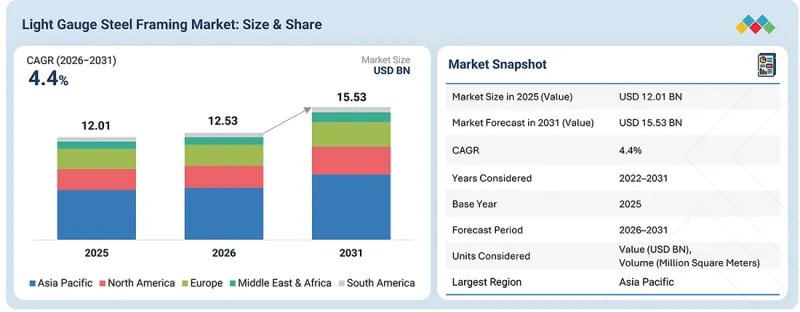
경량 철골 구조(LGSF) 시장 규모는 2026년 125억 3,000만 달러에서 2031년에는 155억 3,000만 달러에 달할 것으로 예측되고 있으며, 2026-2031년까지 CAGR은 4.4%에 달할 전망입니다.
| 조사 범위 | |
|---|---|
| 조사 대상 기간 | 2022-2031년 |
| 기준연도 | 2025년 |
| 예측 기간 | 2026-2031년 |
| 단위 | 금액(달러)·수량(평방미터) |
| 부문 | 유형, 최종사용자, 유통 채널, 지역 |
| 대상 지역 | 북미, 아시아태평양, 유럽, 중동 및 아프리카, 남미 |
수요는 고밀도 도시권에서 불연성 건축자재 사용을 의무화하는 지자체의 긴급 규제에 의해 견인되고 있으며, 지진 위험을 줄이기 위해 경량 구조 프레임을 의무화하는 엄격한 지역 구조 설계 기준에 의해 더욱 가속화되고 있습니다.
"비내력 부재 부문은 두 번째로 큰 점유율을 차지할 것으로 전망"
비내력 부문은 내부 칸막이, 벽, 천장, 파사드 지지 시스템 등 폭넓은 용도가 있으며, 예측 기간 중 LGSF 시장에서 두 번째로 큰 규모를 차지할 것으로 전망됩니다. 구조용 프레임과 달리, 이러한 시스템은 자중 및 기타 2차 하중만을 지탱하므로 콘크리트나 철강 등으로 구성된 구조 시스템을 갖춘 건물에 LGSF 부품을 통합하는 것이 가능합니다. 상업 시설, 주택, 공공 시설, 산업 시설 등 다양한 유형의 건축물에서 경량 칸막이 및 충진 시스템에 대한 수요가 증가함에 따라 비내력용 LGSF에 대한 수요는 급속히 확대되고 있습니다. 특히 실내 레이아웃의 유연성을 높이고 칸막이 위치를 쉽게 변경할 수 있다는 점이 중요합니다. 또한 비내력형 LGSF는 석고보드, 단열재, 외장재, 건축 설비와의 호환성이 있으며, 벽 및 천장 시스템에서의 활용이 확대되고 있습니다. 이 분야는 고밀도 건물, 호텔, 병원, 사무실, 주택 등 반복적인 평면 배치로 인해 많은 칸막이 벽이 필요한 장소에서 중요합니다.
"최종사용자별로는 예측 기간 중 상업 부문이 시장 규모 2위를 차지할 것으로 전망"
LGSF 시장은 사무실, 소매점, 호텔, 교육 기관, 의료 시설 등의 상업 공간에서의 사용이 증가하고 있으며, 예측 기간 중 2위 부문으로서 시장을 주도할 것으로 예상됩니다. LGSF는 반복적인 프레임 구조를 제공하고, 시공 과정을 신속하게 하며, 구조용 및 비구조용 벽 시스템의 통합을 가능하게 하므로 상업 분야에서 유용함이 입증되었습니다. 이처럼 경량 LGSF 부재는 특정 요구 사항에 맞춰 제조할 수 있으므로, 정해진 납기일에 따라 프레임 시공 공정 전체를 효율적으로 진행하는 데 도움이 됩니다. 또한 LGSF는 건물의 내부 마감에도 사용되며, 철근 콘크리트나 강재를 주요 내력 구조로 삼아 칸막이 벽이나 채움 벽으로 활용되고 있습니다. 현대식 사무실 건물에서는 다수의 칸막이, 매달린 천장, 각종 설비 관통부가 필요한 경우가 많아, 하나의 프로젝트 내에서 냉간 성형 강재 부재의 다양한 용도가 발생합니다.
"가공·프레임 공급업체 부문이 예측 기간 중 2위를 차지할 전망"
LGSF 시장의 가공·프레임 공급업체 부문은 특정 프로젝트를 위한 기성 프레임 패키지가 선호되는 경향이 강해지고 있는 것을 배경으로, 예측 기간 중 2위 유통 채널이 될 것으로 예상됩니다. 이러한 공급업체는 LGSF 제조사와 시공사 간의 중개자 역할을 수행하며, 프로젝트의 치수 및 요구 사항에 따라 철골 프레임 설계를 스터드, 트랙, 조이스트, 서까래, 트러스 등의 가공 제품으로 변환합니다. 특히 자체적으로 롤 성형, 상세 설계, 가공 설비를 보유하지 않은 시공업체에게 중요한 역할을 담당합니다.
그 밖의 장점으로는 자재 조달, 설계, 절단, 펀칭, 라벨링, 배송 조정이 있으며, 이를 통해 시공업체가 관리해야 하는 공정 수를 줄일 수 있습니다. 또한 모듈식 건축 및 조립식 건축의 확대도 이 채널을 지원하고 있습니다. 이러한 건축 방식에서는 조립 공정에 맞춰 정확하게 가공된 프레임 부재를 공급하는 것이 중요합니다. 이 분야의 공급업체는 다양한 프레임 요구 사항을 조합하여 특정 프로젝트를 위한 패키지로 납품할 수 있습니다. 또한 디지털 설계부터 가공에 이르는 워크플로우의 도입이 확대됨에 따라 프레임 공급업체가 건축 모델을 자동화된 생산 지시서로 변환할 수 있게 되었으며, 이로 인해 이 유통 채널의 중요성은 더욱 강화되고 있습니다.
"북미 지역은 예측 기간 중 금액 기준으로 2위 시장 규모가 될 전망"
북미는 확립된 냉간 성형 강재(CFS) 제조 체계, 건축 분야에서의 철골 프레임의 다양한 활용, 해당 지역내 조립식 건축 시스템에 대한 지속적인 수요로 인해 예측 기간 중 LGSF 시장에서 2위 규모의 지역이 될 것으로 전망됩니다. 이 지역에는 강판 코일 공급업체, 프레임 제조업체, 엔지니어링 회사, 제조업체, 벤더, 기술 도급업체로 구성된 성숙한 생태계가 구축되어 있으며, 경량 강철 프레임을 설계 및 제조 단계에서 건설 현장으로 원활하게 전환하는 것이 용이합니다.
주택 건설은 주요 용도이며, 특히 공동 주택의 경우 표준화된 부재를 쉽게 활용할 수 있습니다. 상업 시설 및 공공 시설에서의 용도 또한 내부 칸막이, 채움벽, 바닥 시스템, 지붕 구조에 CFS가 사용되므로 큰 수요가 예상됩니다. 확립된 건축 기준과 엔지니어링 관행 또한 CFS 프레임의 채택을 지원하고 있습니다. 기존 상업용 건물의 개보수, 용도 변경, 증축 역시 구조에 과도한 하중을 주지 않는 경량 강철 프레임 시스템에 대한 수요를 견인하고 있습니다. 오프사이트 생산 및 디지털 설계·제조 공정의 수용이 확대되고 있는 점도 긍정적인 요인으로 작용하고 있습니다.
이 보고서에서는 전 세계 경량 형강 프레임(LGSF) 시장을 조사하여, 시장 개요, 시장 성장에 영향을 미치는 각종 요인 분석, 기술 및 특허 동향, 법규제 환경, 사례 연구, 시장 규모 추이 및 전망,각 구분·지역/주요 국가별 상세 분석, 경쟁 구도, 주요 기업 개요 등을 정리하여 전해드립니다.
자주 묻는 질문
목차
제1장 서론
제2장 개요
제3장 주요 인사이트
제4장 시장 개요
제5장 업계 동향
제6장 기술의 진보, AI의 영향, 특허, 혁신, 향후 응용
제7장 규제 상황과 지속가능성 구상
제8장 고객 상황과 구매 행동
제9장 경량 철골 구조 시장 : 유형별
제10장 경량 철골 구조 시장 : 용도별
제11장 경량 철골 구조 시장 : 유통 채널별
제12장 경량 철골 구조 시장 : 지역별
제13장 경쟁 구도
제14장 기업 개요
제15장 조사 방법
제16장 부록
KSA 26.10.01The light gauge steel framing (LGSF) market is projected to reach USD 15.53 billion by 2031 from USD 12.53 billion in 2026, at a CAGR of 4.4% from 2026 to 2031.
| Scope of the Report | |
|---|---|
| Years Considered for the Study | 2022-2031 |
| Base Year | 2025 |
| Forecast Period | 2026-2031 |
| Units Considered | Value (USD Million) Volume (Million Square Meters) |
| Segments | Type, End-Use, Distribution Channel, and Region |
| Regions covered | North America, Asia Pacific, Europe, the Middle East & Africa, and South America |
Demand is driven by urgent municipal mandates for non-combustible building materials in high-density urban zones and accelerated by strict local structural engineering codes requiring lighter structural frames to lower seismic risk.
"Non-load-bearing segment projected to hold the second-largest share"
The non-load-bearing segment is projected to become the second-largest segment in the LGSF market during the forecast period, due to the wide range of uses as internal partitions and walls, ceilings, and facade support systems. Unlike structural framing, these systems carry only their own weight and other secondary loads, enabling the integration of LGSF components into buildings with structural systems made of concrete, steel, or others. Demand for non-load-bearing LGSF is rapidly growing because lightweight partition and infill systems are needed in various types of construction, such as commercial, residential, institutional, and industrial facilities. It is particularly important for providing flexibility in internal layouts, increasing the ability to change partition placement. The compatibility of non-load-bearing LGSF with gypsum boards, insulation, sheathing, and building-service installations contributes to its use in wall and ceiling systems. This section is important in high-density buildings, hotels, hospitals, offices, and dwellings, where repetitive floor plans require many partitions.
"Commercial segment to be the second-largest market, by end use, during the forecast period."
The LGSF market is expected to be dominated by the commercial segment as the second-largest end-use segment during the forecast period, since its use in commercial spaces such as offices, retail outlets, hotels, educational institutions, and healthcare facilities is rising. LGSF has proven beneficial in the commercial sector because it can provide repetitive framing patterns, speed up the construction process, and allow the integration of structural and non-structural wall systems. In this way, lightweight LGSF elements can be manufactured to meet specific requirements, helping organize the entire framing process in compliance with imposed deadlines. Additionally, LGSF is used for building interiors, where it can be employed for partition and infill walls, with reinforced concrete or steel as the primary load-bearing system. Modern office buildings usually require extensive partitioning, suspended ceilings, and various service penetration systems, indicating that a variety of applications for cold-formed steel components can appear in a single project.
"Fabrication & framing supplier segment projected to be the second-largest during the forecast period"
The fabrication and framing suppliers segment of the LGSF market is expected to become the second-largest distribution channel during the forecast period, driven by increasing preference for ready-made framing packages for specific projects. These suppliers act as intermediaries between LGSF manufacturers and contractors, converting steel-framing designs into fabricated products such as studs, tracks, joists, rafters, and trusses based on project dimensions and requirements. Fabrication and framing suppliers play a crucial role for contractors without in-house roll-forming, detailing, or fabrication capabilities. Other advantages include coordinating material procurement, engineering, cutting, punching, labeling, and delivery, which reduces the number of processes the contractor must manage. Another benefit of this channel is that modular and prefabricated construction is expanding, with special attention to delivering accurately fabricated framing components that must be received in accordance with assembly processes. Suppliers in this area can combine different framing requirements and deliver them as packages for a specific project. Increasing adoption of digital design-to-fabrication workflows is strengthening this channel by enabling framing suppliers to translate building models into automated production instructions.
"In terms of value, the North America region is projected to be the second-largest segment during the forecast period."
North America is projected to be the second-largest region in the LGSF market during the forecast period owing to its well-established cold-formed steel (CFS) manufacturing setup, varied utilization of steel framing in the building sector, and persistent demand for prefabricated building systems in the region. The region has a mature ecosystem of steel coil suppliers, framing makers, engineering firms, manufacturers, vendors, and technical contractors, making it easy to move light-gauge steel framing from design and manufacturing to the construction site. Residential construction is a major application, especially for multi-family housing where it is easy to utilize auto parts. Commercial and institutional applications also offer strong prospects because they use CFS for internal partitions, infill walls, floor systems, and roof structures. Established construction code regulations and engineering practices also stimulate the use of CFS framing. Renovation, adaptive reuse, and expansion of existing commercial buildings also drive demand for light-gauge framing systems that do not significantly overload the structure. Increasing acceptance of off-site production and digital design-to-manufacturing processes is also a positive factor.
By Company Type: Tier 1: 25%, Tier 2: 42%, and Tier 3: 33%
By Designation: C-level Executives: 20%, Directors: 30%, and Other Designations: 50%
By Region: North America: 20%, Europe: 10%, Asia Pacific: 40%, South America: 10%, and Middle East & Africa 20%
Notes: Other designations include sales, marketing, and product managers.
Tier 1: >USD 1 Billion; Tier 2: USD 500 million-1 Billion; and Tier 3: <USD 500 million
Companies Covered: ClarkDietrich Building Systems (US), Knauf (Germany), Saint-Gobain (France), Telling Industries, LLC (US), MiTek Industries, Inc. (US), BlueScope Steel Limited (Australia), Tata Steel Limited (India), Hadley Group (UK), voestalpine AG (Austria), Veitchi Frame (UK), among others are covered in the report.
The study includes an in-depth competitive analysis of these key players in the LGSF market, with their company profiles, recent developments, and key market strategies.
Research Coverage
This research report categorizes the LGSF market by type (load-bearing, non-load-bearing), by end-use (residential, commercial, other end-uses), by distribution channel (direct project supply, distributors, fabrication & framing suppliers, other distribution channels), by region (North America, Europe, Asia Pacific, Middle East & Africa, and South America). The report covers detailed information on the drivers, restraints, challenges, and opportunities influencing LGSF market growth. A detailed analysis of key industry players provides insights into their business overview, products offered, and key strategies, such as partnerships, collaborations, product launches, expansions, and acquisitions, associated with the LGSF market. This report covers a competitive analysis of upcoming startups in the LGSF market ecosystem.
Reasons to Buy the Report
The report will provide market leaders/new entrants with the closest available revenue estimates for the overall LGSF market and its subsegments. This report will help stakeholders understand the competitive landscape, gain insights into better positioning their businesses, and plan suitable go-to-market strategies. The report will help stakeholders understand the market pulse and provide information on key market drivers, restraints, challenges, and opportunities.
The report provides insights into the following points:
- Analysis of key drivers (increasing demand from the building & construction sector due to rapid urbanization, growing demand for lightweight construction systems due to increasing structural load constraints, rising labor constraints in conventional site-built framing), restraints (dependence on specialized roll-forming and fabrication equipment, exposure to fluctuations in galvanized steel prices), opportunities (growing demand for LGSF in disaster-reconstruction programs due to the need for rapid rebuilding, growing use of LGSF in renovation and retrofit projects due to ease of handling within occupied buildings, increasing demand for standardized construction systems in government-led housing programs), and challenges (maintaining tight dimensional tolerances during high-speed roll forming, preventing errors during design-to-machine data transfer)
- Product Development/Innovation: Detailed insights into upcoming technologies, research & development activities, and product & service launches in the LGSF market
- Market Development: Comprehensive information about profitable markets-the report analyzes the LGSF market across varied regions
- Market Diversification: Exhaustive information about new products & services, untapped geographies, recent developments, and investments in the LGSF market
- Competitive Assessment: In-depth assessment of market shares, growth strategies, and service offerings of leading players ClarkDietrich Building Systems (US), Knauf (Germany), Saint-Gobain (France), Telling Industries, LLC (US), MiTek Industries, Inc. (US), BlueScope Steel Limited (Australia), Tata Steel Limited (India), Hadley Group (UK), voestalpine AG (Austria), and Veitchi Frame (UK)
TABLE OF CONTENTS
1 INTRODUCTION
- 1.1 STUDY OBJECTIVES
- 1.2 MARKET DEFINITION
- 1.3 STUDY SCOPE
- 1.3.1 MARKETS COVERED AND REGIONAL SCOPE
- 1.3.2 INCLUSIONS AND EXCLUSIONS
- 1.3.3 YEARS CONSIDERED
- 1.4 CURRENCY CONSIDERED
- 1.5 UNIT CONSIDERED
- 1.6 STAKEHOLDERS
2 EXECUTIVE SUMMARY
- 2.1 MARKET HIGHLIGHTS AND KEY INSIGHTS
- 2.2 KEY MARKET PARTICIPANTS: MAPPING OF STRATEGIC DEVELOPMENTS
- 2.3 DISRUPTIVE TRENDS IN LIGHT GAUGE STEEL FRAMING MARKET
- 2.4 HIGH-GROWTH SEGMENTS
- 2.5 REGIONAL SNAPSHOT: MARKET SIZE, GROWTH RATE, AND FORECAST
3 PREMIUM INSIGHTS
- 3.1 ATTRACTIVE OPPORTUNITIES FOR PLAYERS IN LIGHT GAUGE STEEL FRAMING MARKET
- 3.2 LIGHT GAUGE STEEL FRAMING MARKET, BY TYPE, AND END USE
- 3.3 LIGHT GAUGE STEEL FRAMING MARKET, BY DISTRIBUTION CHANNEL
- 3.4 LIGHT GAUGE STEEL FRAMING MARKET, BY COUNTRY
4 MARKET OVERVIEW
- 4.1 INTRODUCTION
- 4.2 MARKET DYNAMICS
- 4.2.1 DRIVERS
- 4.2.1.1 Increasing housing demand amid rapid urbanization
- 4.2.1.2 Mounting demand for lightweight construction systems
- 4.2.1.3 Technical changes in construction and skilled labor shortage
- 4.2.2 RESTRAINTS
- 4.2.2.1 Dependence on specialized roll-forming and fabrication equipment
- 4.2.2.2 Fluctuations in galvanized steel prices
- 4.2.3 OPPORTUNITIES
- 4.2.3.1 Rising need for large-scale disaster reconstruction
- 4.2.3.2 Increasing renovation and retrofit projects
- 4.2.3.3 Growing demand for standardized construction systems in state-backed housing programs
- 4.2.4 CHALLENGES
- 4.2.4.1 Issues in maintaining dimensional accuracy during high-speed roll forming
- 4.2.4.2 Errors during design-to-machine data transfer
- 4.2.1 DRIVERS
- 4.3 UNMET NEEDS AND WHITE SPACES
- 4.3.1 UNMET NEEDS
- 4.3.1.1 High-performance thermal-break solutions for LGSF walls without compromising structural capacity
- 4.3.1.2 Ultra-efficient LGSF profiles that deliver high load capacity with less steel consumption
- 4.3.1.3 Integrated fire, acoustic, and structural systems for high-density multi-story LGSF buildings
- 4.3.2 WHITE SPACES
- 4.3.2.1 Digital-twin-enabled LGSF systems with direct BIM-to-roll-former production
- 4.3.2.2 Lightweight modular LGSF floor systems for longer spans and higher loads
- 4.3.2.3 Factory-integrated LGSF panels with pre-installed services and finishes
- 4.3.1 UNMET NEEDS
- 4.4 INTERCONNECTED MARKETS AND CROSS-SECTOR OPPORTUNITIES
- 4.4.1 CROSS-SECTOR OPPORTUNITIES
- 4.5 STRATEGIC MOVES BY TIER 1/2/3 PLAYERS
5 INDUSTRY TRENDS
- 5.1 PORTER'S FIVE FORCES ANALYSIS
- 5.1.1 THREAT OF NEW ENTRANTS
- 5.1.2 THREAT OF SUBSTITUTES
- 5.1.3 BARGAINING POWER OF SUPPLIERS
- 5.1.4 BARGAINING POWER OF BUYERS
- 5.1.5 INTENSITY OF COMPETITIVE RIVALRY
- 5.2 MACROECONOMIC OUTLOOK
- 5.2.1 INTRODUCTION
- 5.2.2 GDP TRENDS AND FORECAST
- 5.2.3 URBANIZATION AND DEMOGRAPHIC SHIFTS
- 5.2.4 TRENDS IN GLOBAL RESIDENTIAL CONSTRUCTION INDUSTRY
- 5.2.5 TRENDS IN GLOBAL COMMERCIAL CONSTRUCTION INDUSTRY
- 5.3 VALUE CHAIN ANALYSIS
- 5.4 ECOSYSTEM ANALYSIS
- 5.5 PRICING ANALYSIS
- 5.5.1 AVERAGE SELLING PRICE OF LIGHT GAUGE STEEL FRAMING SOLUTIONS OFFERED BY KEY PLAYERS, BY TYPE, 2025
- 5.5.2 AVERAGE SELLING PRICE TREND OF LIGHT GAUGE STEEL FRAMING SOLUTIONS, BY REGION, 2022-2025
- 5.6 TRADE ANALYSIS
- 5.6.1 EXPORT SCENARIO (HS CODE 730890)
- 5.6.2 IMPORT SCENARIO (HS CODE 730890)
- 5.7 KEY CONFERENCES AND EVENTS, 2026-2027
- 5.8 TRENDS/DISRUPTIONS IMPACTING CUSTOMER BUSINESS
- 5.9 INVESTMENT AND FUNDING SCENARIO
- 5.10 CASE STUDY ANALYSIS
- 5.10.1 HADLEY GROUP PROVIDES PREFABRICATED LGSF FOR NIGHTINGALE QUARTER DEVELOPMENT
- 5.10.2 METEK SUPPLIES LOAD-BEARING LGSF TO ACHIEVE DEMANDING SUSTAINABILITY OBJECTIVES
- 5.10.3 HADLEY GROUP MANUFACTURES LOAD-BEARING LGSF FOR PREMIER INN DEVELOPMENT
- 5.11 IMPACT OF US TARIFF - LIGHT GAUGE STEEL FRAMING MARKET
- 5.11.1 INTRODUCTION
- 5.11.2 KEY TARIFF RATES
- 5.11.3 PRICE IMPACT ANALYSIS
- 5.11.4 IMPACT ON COUNTRIES/REGIONS
- 5.11.4.1 US
- 5.11.4.2 Europe
- 5.11.4.3 Asia Pacific
- 5.11.5 IMPACT ON END USES
6 TECHNOLOGICAL ADVANCEMENTS, AI-DRIVEN IMPACT, PATENTS, INNOVATIONS, AND FUTURE APPLICATIONS
- 6.1 KEY EMERGING TECHNOLOGIES
- 6.1.1 AUTOMATED CNC ROLL FORMING
- 6.1.2 BIM-TO-CNC LGSF MANUFACTURING
- 6.1.3 PANELIZED LGSF PREFABRICATION
- 6.2 COMPLEMENTARY TECHNOLOGIES
- 6.2.1 COLD-FORMED STEEL STRUCTURAL ANALYSIS SOFTWARE
- 6.2.2 LGSF CONNECTION AND SELF-DRILLING FASTENING SYSTEMS
- 6.3 ADJACENT TECHNOLOGIES
- 6.3.1 VOLUMETRIC MODULAR CONSTRUCTION
- 6.3.2 HYBRID LGSF-STRUCTURAL STEEL SYSTEMS
- 6.4 TECHNOLOGY/PRODUCT ROADMAP
- 6.4.1 SHORT-TERM (2025-2027) | AUTOMATION & PANELIZATION ACCELERATION PHASE
- 6.4.2 MID-TERM (2027-2030): ADVANCED FABRICATION & INTEGRATED LGSF SYSTEMS PHASE
- 6.4.3 LONG-TERM (2030-2035+): DIGITALLY INTEGRATED & INDUSTRIALIZED BUILDING SYSTEMS PHASE
- 6.5 PATENT ANALYSIS
- 6.5.1 INTRODUCTION
- 6.5.2 APPROACH
- 6.5.3 TOP APPLICANTS
- 6.5.4 JURISDICTION ANALYSIS
- 6.6 FUTURE APPLICATIONS
- 6.7 IMPACT OF AI/GEN AI ON LIGHT GAUGE STEEL FRAMING MARKET
- 6.7.1 TOP USE CASES AND MARKET POTENTIAL
- 6.7.2 BEST PRACTICES FOLLOWED BY MANUFACTURERS/OEMS IN LIGHT GAUGE STEEL FRAMING
- 6.7.3 CASE STUDIES RELATED TO AI/GEN AI IMPLEMENTATION IN LIGHT GAUGE STEEL FRAMING MARKET
- 6.7.4 INTERCONNECTED ECOSYSTEM AND IMPACT ON MARKET PLAYERS
- 6.7.5 CLIENTS' READINESS TO ADOPT AI/GEN AI-INTEGRATED LIGHT GAUGE STEEL FRAMING SOLUTIONS
7 REGULATORY LANDSCAPE AND SUSTAINABILITY INITIATIVES
- 7.1 REGIONAL REGULATIONS AND COMPLIANCE
- 7.1.1 REGULATORY BODIES, GOVERNMENT AGENCIES, AND OTHER ORGANIZATIONS
- 7.1.2 INDUSTRY STANDARDS
- 7.2 SUSTAINABILITY INITIATIVES
- 7.2.1 CARBON IMPACT REDUCTION INITIATIVES
- 7.2.1.1 Increasing use of lower carbon and recycled steel feedstock
- 7.2.1.2 Optimizing steel consumption through precision structural design
- 7.2.1.3 Expanding factory prefabrication to reduce construction waste and rework
- 7.2.2 ECO APPLICATIONS
- 7.2.2.1 LGSF for low-carbon modular and prefabricated housing
- 7.2.2.2 LGSF for energy-efficient building envelope systems
- 7.2.2.3 LGSF for adaptive reuse and building extensions
- 7.2.1 CARBON IMPACT REDUCTION INITIATIVES
- 7.3 IMPACT OF REGULATORY POLICIES ON SUSTAINABILITY INITIATIVES
- 7.4 CERTIFICATIONS, LABELING, AND ECO-STANDARDS
8 CUSTOMER LANDSCAPE AND BUYER BEHAVIOR
- 8.1 DECISION-MAKING PROCESS
- 8.2 KEY STAKEHOLDERS INVOLVED IN BUYING PROCESS AND THEIR EVALUATION CRITERIA
- 8.2.1 KEY STAKEHOLDERS IN BUYING PROCESS
- 8.2.2 BUYING CRITERIA
- 8.3 ADOPTION BARRIERS AND INTERNAL CHALLENGES
- 8.4 UNMET NEEDS OF VARIOUS END USES
- 8.5 MARKET PROFITABILITY
- 8.5.1 REVENUE POTENTIAL
- 8.5.2 COST DYNAMICS
- 8.6 MARGIN OPPORTUNITIES, BY END USE
- 8.6.1 RESIDENTIAL
- 8.6.2 COMMERCIAL
- 8.6.3 OTHER END USES
9 LIGHT GAUGE STEEL FRAMING MARKET, BY TYPE
- 9.1 INTRODUCTION
- 9.2 LOAD-BEARING
- 9.2.1 STRUCTURAL OPTIMIZATION, PREFABRICATION AND REDUCED FOUNDATION LOADS TO BOOST SEGMENTAL GROWTH
- 9.3 NON-LOAD-BEARING
- 9.3.1 LIGHTWEIGHT AND HIGH-PERFORMANCE INTERIOR CONSTRUCTION CAPABILITIES TO EXPEDITE SEGMENTAL GROWTH
10 LIGHT GAUGE STEEL FRAMING MARKET, BY END USE
- 10.1 INTRODUCTION
- 10.2 RESIDENTIAL
- 10.2.1 AWARENESS ABOUT STRUCTURAL STRENGTH, DIMENSIONAL PRECISION, AND REDUCED SITE LABOR OF LGSF TO FUEL SEGMENTAL GROWTH
- 10.3 COMMERCIAL
- 10.3.1 ABILITY OF LGSF TO ENGINEER MEMBERS FOR VARIOUS DESIGN REQUIREMENTS TO CONTRIBUTE TO SEGMENTAL GROWTH
- 10.4 OTHER END USES
11 LIGHT GAUGE STEEL FRAMING MARKET, BY DISTRIBUTION CHANNEL
- 11.1 INTRODUCTION
- 11.2 DIRECT PROJECT SUPPLY
- 11.2.1 REQUIREMENT FOR ENGINEERED MEMBER SELECTION, PROJECT-SPECIFIC DETAILING, AND TECHNICAL SUPPORT TO BOOST SEGMENTAL GROWTH
- 11.3 DISTRIBUTORS
- 11.3.1 REDUCED DEPENDENCE ON PROJECT-SPECIFIC MANUFACTURING SCHEDULES TO FOSTER SEGMENTAL GROWTH
- 11.4 FABRICATION & FRAMING SUPPLIERS
- 11.4.1 FABRICATION AND FRAMING SUPPLIERS ENABLE PRECISION MANUFACTURED PROJECT READY LGSF SOLUTIONS
- 11.5 OTHER DISTRIBUTION CHANNELS
12 LIGHT GAUGE STEEL FRAMING MARKET, BY REGION
- 12.1 INTRODUCTION
- 12.2 ASIA PACIFIC
- 12.2.1 CHINA
- 12.2.1.1 Rapid urbanization and focus on sustainable construction to augment market growth
- 12.2.2 INDIA
- 12.2.2.1 Increasing housing incentives and demand for cost-efficient solutions to bolster market growth
- 12.2.3 JAPAN
- 12.2.3.1 Rising implementation of policies on infrastructure resilience and sustainability to fuel market growth
- 12.2.4 SOUTH KOREA
- 12.2.4.1 Growing emphasis on modular and prefabricated construction to accelerate market growth
- 12.2.5 AUSTRALIA
- 12.2.5.1 Increasing pressure to improve construction speed and reduce dependence on on-site labor to drive market
- 12.2.6 REST OF ASIA PACIFIC
- 12.2.1 CHINA
- 12.3 EUROPE
- 12.3.1 GERMANY
- 12.3.1.1 Increasing investment in civil engineering and labor shortage to contribute to market growth
- 12.3.2 UK
- 12.3.2.1 Growing adoption of modern methods of construction to expedite market growth
- 12.3.3 FRANCE
- 12.3.3.1 Large residential construction base, labor constraints, and support for off-site and industrialized construction to drive market
- 12.3.4 SPAIN
- 12.3.4.1 Government support for industrialized and off-site construction to foster market growth
- 12.3.5 ITALY
- 12.3.5.1 Ongoing investment in public infrastructure and housing requirements to boost market growth
- 12.3.6 REST OF EUROPE
- 12.3.1 GERMANY
- 12.4 NORTH AMERICA
- 12.4.1 US
- 12.4.1.1 Expanding commercial development, infrastructure investment, and demand for efficient construction to support market growth
- 12.4.2 CANADA
- 12.4.2.1 Increasing investment in non-residential sector and housing-enabling infrastructure to augment market growth
- 12.4.3 MEXICO
- 12.4.3.1 Rising housing development and industrial construction to contribute to market growth
- 12.4.1 US
- 12.5 MIDDLE EAST & AFRICA
- 12.5.1 GCC
- 12.5.2 SAUDI ARABIA
- 12.5.2.1 Expanding commercial construction, hospitality development, and sustained public infrastructure investment to drive market
- 12.5.3 UAE
- 12.5.3.1 Rapid construction growth, strong real estate activity, and continued public infrastructure spending to fuel market growth
- 12.5.4 REST OF GCC
- 12.5.5 SOUTH AFRICA
- 12.5.5.1 Rising construction approvals and substantial public infrastructure investment to foster market growth
- 12.5.6 REST OF MIDDLE EAST & AFRICA
- 12.6 SOUTH AMERICA
- 12.6.1 BRAZIL
- 12.6.1.1 Large-scale infrastructure investment and housing expansion to augment market growth
- 12.6.2 ARGENTINA
- 12.6.2.1 Continued investment in localized infrastructure and mining-related development to facilitate market growth
- 12.6.3 REST OF SOUTH AMERICA
- 12.6.1 BRAZIL
13 COMPETITIVE LANDSCAPE
- 13.1 OVERVIEW
- 13.2 KEY PLAYER COMPETITIVE STRATEGIES/RIGHT TO WIN, 2023-2026
- 13.3 MARKET SHARE ANALYSIS, 2025
- 13.4 BRAND COMPARISON
- 13.5 COMPANY EVALUATION MATRIX: KEY PLAYERS, 2025
- 13.5.1 STARS
- 13.5.2 EMERGING LEADERS
- 13.5.3 PERVASIVE PLAYERS
- 13.5.4 PARTICIPANTS
- 13.5.5 COMPANY FOOTPRINT: KEY PLAYERS, 2025
- 13.5.5.1 Company footprint
- 13.5.5.2 Region footprint
- 13.5.5.3 Type footprint
- 13.5.5.4 End use footprint
- 13.5.5.5 Distribution channel footprint
- 13.6 COMPANY EVALUATION MATRIX: STARTUPS/SMES, 2025
- 13.6.1 PROGRESSIVE COMPANIES
- 13.6.2 RESPONSIVE COMPANIES
- 13.6.3 DYNAMIC COMPANIES
- 13.6.4 STARTING BLOCKS
- 13.6.5 COMPETITIVE BENCHMARKING: STARTUPS/SMES, 2025
- 13.6.5.1 Detailed list of key startups/SMEs
- 13.6.5.2 Competitive benchmarking of key startups/SMEs
- 13.7 COMPANY VALUATION AND FINANCIAL METRICS
- 13.8 COMPETITIVE SCENARIO
- 13.8.1 DEALS
- 13.8.2 EXPANSIONS
- 13.8.3 OTHER DEVELOPMENT
14 COMPANY PROFILES
- 14.1 KEY PLAYERS
- 14.1.1 CLARKDIETRICH BUILDING SYSTEMS
- 14.1.1.1 Business overview
- 14.1.1.2 Products offered
- 14.1.1.3 Recent developments
- 14.1.1.3.1 Product launches
- 14.1.1.3.2 Deals
- 14.1.1.4 MnM view
- 14.1.1.4.1 Key strengths/Right to win
- 14.1.1.4.2 Strategic choices
- 14.1.1.4.3 Weaknesses/Competitive threats
- 14.1.2 KNAUF GROUP
- 14.1.2.1 Business overview
- 14.1.2.2 Products offered
- 14.1.2.3 Recent developments
- 14.1.2.3.1 Expansions
- 14.1.2.4 MnM view
- 14.1.2.4.1 Key strengths/Right to win
- 14.1.2.4.2 Strategic choices
- 14.1.2.4.3 Weaknesses & competitive threats
- 14.1.3 SAINT-GOBAIN
- 14.1.3.1 Business overview
- 14.1.3.2 Products offered
- 14.1.3.3 Recent developments
- 14.1.3.3.1 Product launches
- 14.1.3.3.2 Deals
- 14.1.3.3.3 Expansions
- 14.1.3.4 MnM view
- 14.1.3.4.1 Key strengths/Right to win
- 14.1.3.4.2 Strategic choices
- 14.1.3.4.3 Weaknesses/Competitive threats
- 14.1.4 TELLING INDUSTRIES
- 14.1.4.1 Business overview
- 14.1.4.2 Products/Solutions/Services offered
- 14.1.4.3 Recent developments
- 14.1.4.3.1 Product launches
- 14.1.4.4 MnM view
- 14.1.4.4.1 Key strengths/Right to win
- 14.1.4.4.2 Strategic choices
- 14.1.4.4.3 Weaknesses/Competitive threats
- 14.1.5 MITEK INC.
- 14.1.5.1 Business overview
- 14.1.5.2 Products offered
- 14.1.5.3 Recent developments
- 14.1.5.3.1 Deals
- 14.1.5.3.2 Expansions
- 14.1.5.4 MnM view
- 14.1.5.4.1 Key strengths/Right to win
- 14.1.5.4.2 Strategic choices
- 14.1.5.4.3 Weaknesses/Competitive threats
- 14.1.6 BLUESCOPE STEEL LIMITED
- 14.1.6.1 Business overview
- 14.1.6.2 Products offered
- 14.1.6.3 Recent developments
- 14.1.6.3.1 Developments
- 14.1.6.4 MnM view
- 14.1.7 TATA STEEL
- 14.1.7.1 Business overview
- 14.1.7.2 Products offered
- 14.1.7.3 Recent developments
- 14.1.7.3.1 Deals
- 14.1.7.3.2 Expansions
- 14.1.7.4 MnM view
- 14.1.8 HADLEY GROUP
- 14.1.8.1 Business overview
- 14.1.8.2 Products offered
- 14.1.8.3 MnM view
- 14.1.9 VOESTALPINE AG
- 14.1.9.1 Business overview
- 14.1.9.2 Products offered
- 14.1.9.3 Recent developments
- 14.1.9.3.1 Product launches
- 14.1.9.3.2 Deals
- 14.1.9.3.3 Expansions
- 14.1.9.4 MnM view
- 14.1.10 VEITCHIFRAME
- 14.1.10.1 Business overview
- 14.1.10.2 Products/Solutions/Services offered
- 14.1.10.3 MnM view
- 14.1.1 CLARKDIETRICH BUILDING SYSTEMS
- 14.2 OTHER PLAYERS
- 14.2.1 CEMCO
- 14.2.2 ETEX GROUP
- 14.2.3 EVEREST INDUSTRIES LIMITED
- 14.2.4 METEK
- 14.2.5 STEEL TEK FRAMING
- 14.2.6 HITEK STEEL FRAMING PTY LTD
- 14.2.7 THE STEEL NETWORK, INC.
- 14.2.8 CRACO MFG., INC.
- 14.2.9 MBA BUILDING SUPPLIES
- 14.2.10 MARINOWARE
- 14.2.11 GENESIS MANAZIL STEEL FRAMING
- 14.2.12 DCM METAL CORP.
- 14.2.13 SEAS HOMES
- 14.2.14 NP5
- 14.2.15 STEELTEC STEEL FRAMING
15 RESEARCH METHODOLOGY
- 15.1 RESEARCH DATA
- 15.1.1 SECONDARY DATA
- 15.1.1.1 List of key secondary sources
- 15.1.1.2 Key data from secondary sources
- 15.1.2 PRIMARY DATA
- 15.1.2.1 Key data from primary sources
- 15.1.2.2 Key industry insights
- 15.1.2.3 Breakdown of primary interviews
- 15.1.1 SECONDARY DATA
- 15.2 MARKET SIZE ESTIMATION
- 15.3 GROWTH FORECAST
- 15.4 DATA TRIANGULATION
- 15.5 RESEARCH ASSUMPTIONS
- 15.6 RISK ANALYSIS
- 15.7 FACTOR ANALYSIS
- 15.8 RESEARCH LIMITATIONS
16 APPENDIX
- 16.1 DISCUSSION GUIDE
- 16.2 KNOWLEDGESTORE: MARKETSANDMARKETS' SUBSCRIPTION PORTAL
- 16.3 CUSTOMIZATION OPTIONS
- 16.4 RELATED REPORTS
- 16.5 AUTHOR DETAILS


