

|
시장보고서
상품코드
2136423
SCADA 시장 : 제공별, 최종사용자별, 지역별 - 세계 예측(-2032년)SCADA Market by Component (Programmable Logic Controllers, Remote Terminal Units, Human-Machine Interfaces, Communication Systems, Input/Output Devices, Sensors, Actuators, Terminal Blocks, Connectors) - Global Forecast to 2032 |
||||||

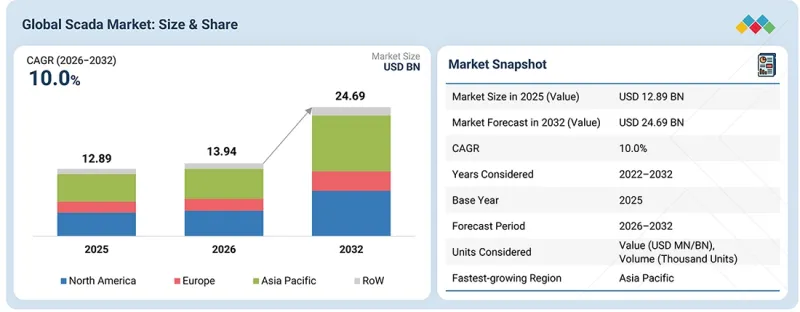
세계의 SCADA 시장 규모는 2026년 139억 4,000만 달러에서 CAGR 10.0%를 기록하며 2032년까지 246억 9,000만 달러로 성장할 것으로 예측됩니다.
이러한 성장은 공공사업, 이산형 제조업, 공정 산업 분야의 자동화 발전과 더불어 디지털 인프라에 대한 투자 확대에 힘입고 있습니다. 각 산업이 실시간 가시성, 운영 효율성, 시스템 복원력 향상을 추구하는 가운데, SCADA 솔루션은 중앙 집중식 모니터링 및 제어 분야에서 그 중요성이 점점 더 커지고 있습니다.
| 조사 범위 | |
|---|---|
| 조사 대상 기간 | 2021-2032년 |
| 기준 연도 | 2025년 |
| 예측 기간 | 2026-2032년 |
| 산정 단위 | 금액(10억 달러) |
| 부문 | 제공별, 최종사용자별, 지역별 |
| 대상 지역 | 북미, 유럽, 아시아태평양, 기타 지역 |
전력, 상하수도, 교통, 통신 등의 공공사업 분야에서는 인프라 현대화와 서비스 신뢰성 향상을 위해 SCADA 도입이 진행되고 있습니다. 자동차, 전자, 반도체 등의 이산형 산업에서는 자동화된 데이터 기반 운영을 지원하기 위해 SCADA가 활용되고 있으며, 한편 공정 산업에서는 공정 모니터링, 안전성 확보, 규정 준수를 위해 이러한 시스템에 의존하고 있습니다. SCADA를 산업용 IoT, AI 기반 분석, 클라우드 플랫폼, 엣지 컴퓨팅과 통합함으로써 시스템 기능이 더욱 확장되어 원격 모니터링 및 예측 유지보수가 가능해졌습니다. 각 업계가 디지털화와 스마트 운영을 지속적으로 추구하는 가운데, 주요 응용 분야에서 첨단 SCADA 솔루션에 대한 수요가 증가할 것으로 예상됩니다.
“운영 지원에 대한 수요 증가가 SCADA 시장의 서비스 부문 성장을 견인”
SCADA 시장에서 서비스 부문은 산업 및 공공사업 분야 전반에 걸친 시스템 통합, 원격 지원, 라이프사이클 유지보수에 대한 수요 증가에 힘입어 강력한 성장이 예상됩니다. SCADA 시스템의 복잡성이 심화됨에 따라 조직들은 시스템의 신뢰성, 사이버 보안 및 운영 성능을 향상시키는 서비스를 더욱 중요시하고 있습니다. 클라우드 기반 SCADA, 원격 모니터링, 예측 유지보수의 도입 확대에 따라 전문 서비스 및 관리형 서비스에 대한 수요는 더욱 증가하고 있습니다. 또한, 디지털 전환(DX) 노력은 기술 컨설팅, 시스템 업그레이드 및 교육 서비스의 기회를 창출하고 있습니다. 이러한 서비스는 조직이 가동 중단 시간을 줄이고, 시스템 성능을 유지하며, SCADA에 대한 투자 가치를 극대화하는 데 도움이 됩니다. 운영 효율성, 안전성 및 규정 준수에 대한 관심이 높아짐에 따라, SCADA 도입 전반에 걸쳐 서비스의 역할이 더욱 중요해질 것으로 예상됩니다.
“이산형 제조업이 SCADA 시장의 큰 비중을 차지할 전망”
이산 제조 부문은 스마트 제조 및 산업용 자동화 기술의 도입 확대에 힘입어, 예측 기간 동안 SCADA 시장의 큰 비중을 차지할 것으로 예상됩니다. 자동차, 반도체, 전자 등 업계에서는 운영 가시성 향상, 실시간 모니터링 구현, 데이터 기반 의사결정 지원을 목적으로 SCADA 솔루션 도입이 점점 더 확대되고 있습니다. SCADA와 연결된 장비 및 자동화 시스템의 통합을 통해 제조업체는 공정의 투명성을 높이고, 가동 중지 시간을 줄이며, 생산 효율을 향상시킬 수 있습니다. 이러한 산업 중에서도 반도체 및 전자기기 제조업체는 정밀한 공정 제어, 생산 유연성, 품질 관리를 지원하기 위해 SCADA 도입을 더욱 확대하고 있습니다. 개별 제조업체들이 디지털 전환 및 자동화된 생산 환경에 대한 투자를 지속함에 따라, SCADA는 운영 성과 향상과 복잡한 제조 공정 관리에 있어 계속해서 중요한 기술로 자리매김할 것으로 예상됩니다.
“산업 자동화 및 인프라 현대화가 유럽 SCADA 시장의 성장을 견인”
유럽은 성숙한 산업 기반, 높은 수준의 자동화 역량, 그리고 인프라 현대화를 위한 지속적인 투자에 힘입어 예측 기간 동안에도 SCADA의 주요 시장으로 남을 것으로 전망됩니다. 독일, 영국, 프랑스,이탈리아, 스페인 등의 국가에서는 산업의 디지털화가 확대되고 공공 인프라 업그레이드가 진행되면서 SCADA 시스템에 대한 지속적인 수요가 발생하고 있습니다. 스마트 그리드, 에너지 효율, 재생에너지 통합, 그리고 디지털 전환에 초점을 맞춘 정부의 노력도 시장 성장을 더욱 뒷받침하고 있습니다. 또한, 자동차, 화학, 제약, 식음료, 공정 산업 분야에서 이 지역이 차지하는 강력한 입지 역시 운영 가시성, 공정 제어, 자산 성능 향상을 목적으로 한 SCADA 도입을 뒷받침하고 있습니다. 게다가 노후화된 산업 및 공공 인프라의 현대화에 따라 각 조직은 레거시 제어 시스템의 업그레이드를 추진하고 있습니다. 유럽 산업계가 자동화, 복원력, 디지털 운영을 지속적으로 우선시함에 따라, 이 지역은 앞으로도 SCADA 솔루션의 주요 시장으로 남을 것으로 예상됩니다.
본 보고서에서 다루고 있는 주요 기업으로는 Automation(미국), ABB(스위스), Schneider Electric(프랑스), Emerson Electric Co.(미국), Siemens(독일), GE Vernova(미국),Honeywell International Inc.(미국), Mitsubishi Electric Corporation(일본), OMRON Corporation(일본), Yokogawa Electric Corporation(일본)이 포함됩니다.
조사 범위:
본 보고서에서는 제품군별(하드웨어, 소프트웨어, 서비스), 최종사용자별(공정 산업, 이산 제조업, 공공 사업), 및 지역별(북미, 유럽, 아시아태평양, 중동 및 아프리카, 라틴아메리카)을 기준으로 SCADA 시장을 정의, 설명 및 예측하고 있습니다. 하드웨어 부문은 프로그래머블 로직 컨트롤러(PLC), 원격 터미널 유닛(RTU), 인간-기계 인터페이스(HMI) 및 기타 구성요소별로 더 세분화하여 분석됩니다. 소프트웨어는 온프레미스 배포 및 클라우드 배포와 같은 도입 형태별로 분석되며, 서비스는 전문 서비스와 관리형 서비스로 분류됩니다. 공정 산업에는 화학, 제약, 식음료, 석유·가스 및 기타 공정 산업이 포함됩니다. 이산 제조에는 자동차, 반도체·전자, 및 기타 이산 제조가 포함됩니다. 공공 사업에는 전력, 상하수도, 교통, 및 통신이 포함됩니다. 본 보고서는 시장 성장에 영향을 미치는 촉진요인, 제약요인, 기회, 및 과제에 대한 상세한 정보를 제공합니다. 또한, 밸류체인, 생태계, 투자 및 자금 조달 동향, 가격 분석, 기술 동향, Porter's Five Forces, 주요 이해관계자 및 구매 기준, 사례 연구, 무역 분석, 특허 분석, 주요 회의 및 행사, 규제 현황, 표준 및 프레임워크, 그리고 AI가 SCADA 시장에 미치는 영향에 대해서도 분석하고 있습니다. 아울러 본 보고서에서는 주요 기업들이 시장 내 입지를 강화하기 위해 채택하고 있는 제품 출시, 인수, 제휴, 협업, 사업 확장, 전략 등의 경쟁 동향에 대해서도 분석하고 있습니다.
본 보고서를 구매해야 하는 이유:
본 보고서는 시장을 선도하는 기업이나 신규 진입 기업이 SCADA 시장 전체 및 제공 제품과 최종사용자를 포함한 주요 부문을 평가하는 데 도움이 됩니다. 또한 이해관계자가 경쟁 구도를 이해하고, 시장 내 입지를 강화하며, 적절한 시장 진입 전략을 수립하기 위한 인사이트를 얻는 데 도움이 됩니다. 아울러, 본 보고서는 시장의 주요 촉진요인 및 과제에 대한 종합적인 관점을 제공하여, 정보에 기반한 사업 및 투자 의사결정을 지원합니다.
본 보고서는 다음 사항에 대한 인사이트를 제공합니다:
- 주요 촉진요인(SCADA 시스템 도입에 대한 정부 지원 확대 및 재생에너지 도입의 전례 없는 성장), 제약요인(SCADA 시스템과 관련된 막대한 도입 및 유지보수 비용, 그리고 SCADA 시스템의 높은 복잡성과 광범위한 맞춤화 요구 사항), 기회(무선 센서 네트워크 기술의 급속한 발전, 그리고 운영 인텔리전스 강화를 위한 SCADA와 빅데이터 통합의 확산),그리고 과제(진화하는 사이버 보안 위협에 대한 SCADA 시스템의 취약성 증가 및 SCADA 시스템에서 사용되는 통신 프로토콜 간의 호환성 제한) 등, SCADA 시장 성장에 영향을 미치는 요인에 대한 분석.
- 제품 개발/혁신 : SCADA 시장의 향후 기술, 연구개발 활동 및 신제품 출시에 관한 상세한 분석
- 시장 개발 : 수익성 높은 시장에 대한 종합적인 정보(본 보고서에서는 다양한 지역에 걸친 SCADA 시장을 분석하고 있습니다. )
- 시장 다각화 : SCADA 시장의 신제품 출시, 미개척 지역, 최근 동향 및 투자에 관한 종합적인 정보
- 경쟁 분석 : SCADA 시장에서 록웰 오토메이션(미국), ABB(스위스), 슈나이더 일렉트릭(프랑스), 지멘스(독일), GE 버노바(미국) 등 주요 기업의 시장 점유율, 성장 전략 및 제공 제품에 대한 상세한 평가.
자주 묻는 질문
목차
제1장 소개
제2장 주요 요약
제3장 주요 인사이트
제4장 시장 개요
제5장 업계 동향
제6장 기술 진보, AI에 의한 영향, 특허, 혁신
제7장 규제 상황
제8장 고객 상황과 구매 행동
제9장 최신 SCADA 시스템의 중요한 특징
제10장 사이버 보안 관련 위협 종류와 대책
제11장 SCADA의 주요 이용 사례/애플리케이션
제12장 SCADA 시장(제공별)
제13장 SCADA 시장(최종사용자별)
제14장 SCADA 시장(지역별)
제15장 경쟁 구도
제16장 기업 개요
제17장 조사 방법
제18장 부록
KSM 26.10.07With a CAGR of 10.0%, the global SCADA market is projected to grow from USD 13.94 billion in 2026 to USD 24.69 billion by 2032. Growth is supported by increasing automation across utilities, discrete manufacturing, and process industries, along with rising investments in digital infrastructure. As industries seek better real-time visibility, operational efficiency, and system resilience, SCADA solutions are becoming increasingly important for centralized monitoring and control.
| Scope of the Report | |
|---|---|
| Years Considered for the Study | 2021-2032 |
| Base Year | 2025 |
| Forecast Period | 2026-2032 |
| Units Considered | Value (USD Billion) |
| Segments | By Component, Devices, Sensors and Region |
| Regions covered | North America, Europe, APAC, RoW |
Utilities such as power, water and wastewater treatment, transportation, and telecommunications are adopting SCADA to modernize infrastructure and improve service reliability. Discrete industries, including automotive, electronics, and semiconductors, use SCADA to support automated, data-driven operations, while process industries rely on these systems for process monitoring, safety, and compliance. Integrating SCADA with industrial IoT, AI-based analytics, cloud platforms, and edge computing is further expanding system capabilities and enabling remote monitoring and predictive maintenance. As industries continue to pursue digitalization and smarter operations, demand for advanced SCADA solutions is expected to increase across key application sectors.
"Rising demand for operational support to drive growth of services segment in the SCADA market"
The services segment is expected to grow strongly in the SCADA market, supported by rising demand for system integration, remote support, and lifecycle maintenance across industrial and utility operations. As SCADA systems become more complex, organizations are placing greater emphasis on services that improve system reliability, cybersecurity, and operational performance. The growing adoption of cloud-based SCADA, remote monitoring, and predictive maintenance is further increasing demand for professional and managed services. In addition, digital transformation initiatives are creating opportunities for technical consulting, system upgrades, and training services. These services help organizations reduce downtime, maintain system performance, and maximize the value of SCADA investments. The increasing focus on operational efficiency, safety, and compliance is expected to further support the role of services across SCADA deployments.
"Discrete manufacturing to capture a significant share of the SCADA market"
The discrete manufacturing segment is expected to capture a significant share of the SCADA market during the forecast period, supported by increasing adoption of smart manufacturing and industrial automation technologies. Industries such as automotive, semiconductor, and electronics are increasingly deploying SCADA solutions to improve operational visibility, enable real-time monitoring, and support data-driven decision-making. The integration of SCADA with connected equipment and automation systems helps manufacturers improve process transparency, reduce downtime, and enhance production efficiency. Among these industries, semiconductor and electronics manufacturers are increasingly adopting SCADA to support precise process control, production flexibility, and quality management. As discrete manufacturers continue to invest in digital transformation and automated production environments, SCADA is expected to remain an important technology for improving operational performance and managing complex manufacturing processes.
"Industrial automation and infrastructure modernization to strengthen SCADA market growth in Europe"
Europe is expected to remain a major market for SCADA during the forecast period, supported by its mature industrial base, advanced automation capabilities, and continued investments in infrastructure modernization. Countries such as Germany, the UK, France, Italy, and Spain are expanding industrial digitalization and upgrading utility infrastructure, creating sustained demand for SCADA systems. Government initiatives focused on smart grids, energy efficiency, renewable energy integration, and digital transformation are further supporting market growth. The region's strong presence in automotive, chemicals, pharmaceuticals, food & beverage, and process industries is also driving SCADA adoption to improve operational visibility, process control, and asset performance. Additionally, the modernization of aging industrial and utility infrastructure is encouraging organizations to upgrade legacy control systems. As European industries continue to prioritize automation, resilience, and digital operations, the region is expected to remain a key market for SCADA solutions.
- By Company Type: Tier 1 - 45%, Tier 2 - 35%, and Tier 3 - 20%
- By Designation: Directors - 45%, C-level Executives - 30%, and Others - 25%
- By Region: North America - 45%, Europe - 25%, Asia Pacific - 20%, and RoW - 10%
Prominent players profiled in this report include Rockwell Automation (US), ABB (Switzerland), Schneider Electric (France), Emerson Electric Co. (US), Siemens (Germany), GE Vernova (US), Honeywell International Inc. (US), Mitsubishi Electric Corporation (Japan), OMRON Corporation (Japan), and Yokogawa Electric Corporation (Japan).
Research Coverage:
The report defines, describes, and forecasts the SCADA market based on offering (Hardware, Software, Services), end user (Process Industries, Discrete Manufacturing, Utilities), and region (North America, Europe, Asia Pacific, Middle East & Africa, and Latin America). The hardware segment is further analyzed by component, including Programmable Logic Controllers (PLCs), Remote Terminal Units (RTUs), Human-Machine Interfaces (HMIs), and Other Components. Software is analyzed by deployment mode, including On-premises Deployment and Cloud Deployment, while services are segmented into Professional Services and Managed Services. Process industries include Chemicals, Pharmaceuticals, Food & Beverage, Oil & Gas, and Other Process Industries; discrete manufacturing includes Automotive, Semiconductor & Electronics, and Other Discrete Manufacturing; and utilities include Power, Water & Wastewater Treatment, Transportation, and Telecommunication. The report provides detailed information regarding drivers, restraints, opportunities, and challenges influencing the market's growth. It also analyzes the value chain, ecosystem, investment and funding landscape, pricing analysis, technology trends, Porter's Five Forces, key stakeholders and buying criteria, case studies, trade analysis, patent analysis, key conferences and events, regulatory landscape, standards and frameworks, and the impact of AI on the SCADA market. The report further analyzes competitive developments, including product launches, acquisitions, partnerships, collaborations, expansions, and strategies adopted by key players to strengthen their market positions.
Reasons to Buy This Report:
The report will help market leaders and new entrants assess the overall SCADA market and its key segments, including offering and end user. It will help stakeholders understand the competitive landscape and gain insights to strengthen their market positioning and develop suitable go-to-market strategies. The report also provides a comprehensive view of the market's key drivers, restraints, opportunities, and challenges, supporting informed business and investment decisions.
The report will provide insights into the following points:
- Analysis of Key Drivers (growing government support for the adoption of SCADA systems and unprecedented growth in renewable energy deployment), restraints (significant installation and maintenance costs associated with SCADA systems and high complexity and extensive customization requirements of SCADA systems), opportunities (rapid advancements in wireless sensor network technologies and growing adoption of SCADA-Big Data integration for enhanced operational intelligence), and challenges (increasing vulnerability of SCADA systems to evolving cybersecurity threats and limited compatibility among communication protocols used in SCADA systems) influencing the growth of the SCADA market.
- Product Development/Innovation: Detailed insights into upcoming technologies, research & development activities, and product launches in the SCADA market
- Market Development: Comprehensive information about lucrative markets (The report analyzes the SCADA market across various regions.)
- Market Diversification: Exhaustive information about new products launched, untapped geographies, recent developments, and investments in the SCADA market
- Competitive Assessment: In-depth assessment of market share, growth strategies, and offerings of leading players, including Rockwell Automation (US), ABB (Switzerland), Schneider Electric (France), Siemens (Germany), and GE Vernova (US), in the SCADA market.
TABLE OF CONTENTS
1 INTRODUCTION
- 1.1 STUDY OBJECTIVES
- 1.2 MARKET DEFINITION
- 1.3 MARKET SCOPE
- 1.3.1 MARKET SEGMENTATION AND REGIONAL SCOPE
- 1.3.2 YEARS CONSIDERED
- 1.3.3 INCLUSIONS AND EXCLUSIONS
- 1.4 CURRENCY CONSIDERED
- 1.5 UNIT CONSIDERED
- 1.6 LIMITATIONS
- 1.7 STAKEHOLDERS
- 1.8 SUMMARY OF CHANGES
2 EXECUTIVE SUMMARY
- 2.1 MARKET HIGHLIGHTS AND KEY INSIGHTS
- 2.2 KEY MARKET PARTICIPANTS: MAPPING OF STRATEGIC DEVELOPMENTS
- 2.3 DISRUPTIVE TRENDS IN SCADA MARKET
- 2.4 HIGH-GROWTH SEGMENTS
- 2.5 REGIONAL SNAPSHOT: MARKET SIZE, GROWTH RATE, AND FORECAST
3 PREMIUM INSIGHTS
- 3.1 ASIA PACIFIC TO CREATE LUCRATIVE OPPORTUNITIES FOR PLAYERS IN SCADA MARKET
- 3.2 SCADA MARKET, BY OFFERING
- 3.3 SCADA MARKET, BY END USER
- 3.4 SCADA MARKET, BY GEOGRAPHY
4 MARKET OVERVIEW
- 4.1 INTRODUCTION
- 4.2 MARKET DYNAMICS
- 4.2.1 DRIVERS
- 4.2.1.1 Growing Industry 4.0 adoption across manufacturing and process industries
- 4.2.1.2 Integration of AI and IoT with SCADA platforms
- 4.2.1.3 Growing demand for mobile and remote SCADA access
- 4.2.1.4 Increasing rollout of smart city developments
- 4.2.1.5 Government initiatives and funding for critical infrastructure
- 4.2.1.6 Growing focus on renewable energy capacity additions
- 4.2.2 RESTRAINTS
- 4.2.2.1 High installation, licensing, and maintenance costs
- 4.2.2.2 System complexity and extensive customization requirements
- 4.2.3 OPPORTUNITIES
- 4.2.3.1 Advances in wireless sensor networks for dispersed assets
- 4.2.3.2 Shift to hybrid cloud-based SCADA infrastructure
- 4.2.3.3 Convergence of SCADA with big data analytics and 5G
- 4.2.3.4 Expansion into transportation, smart buildings, and agriculture
- 4.2.3.5 Scale-up of floating solar PV projects
- 4.2.4 CHALLENGES
- 4.2.4.1 Growing cybersecurity exposure of connected SCADA systems
- 4.2.4.2 Communication protocol incompatibility and legacy integration
- 4.2.1 DRIVERS
- 4.3 INTERCONNECTED MARKETS AND CROSS-SECTOR OPPORTUNITIES
- 4.4 STRATEGIC MOVES BY TIER 1/2/3 PLAYERS
5 INDUSTRY TRENDS
- 5.1 INTRODUCTION
- 5.2 PORTER'S FIVE FORCES ANALYSIS
- 5.2.1 BARGAINING POWER OF SUPPLIERS
- 5.2.2 BARGAINING POWER OF BUYERS
- 5.2.3 THREAT OF NEW ENTRANTS
- 5.2.4 THREAT OF SUBSTITUTES
- 5.2.5 INTENSITY OF COMPETITIVE RIVALRY
- 5.3 MACROECONOMIC OUTLOOK
- 5.3.1 INTRODUCTION
- 5.3.2 GDP TRENDS AND FORECAST
- 5.3.3 TRENDS IN GLOBAL PROCESS INDUSTRIES
- 5.3.4 TRENDS IN GLOBAL DISCRETE INDUSTRIES
- 5.3.5 TRENDS IN GLOBAL UTILITIES
- 5.4 VALUE CHAIN ANALYSIS
- 5.5 ECOSYSTEM ANALYSIS
- 5.6 PRICING ANALYSIS
- 5.6.1 PRICING RANGE OF PLCS, BY KEY PLAYER, 2025
- 5.6.2 AVERAGE SELLING PRICE TREND OF RTUS, 2022-2025
- 5.6.3 AVERAGE SELLING PRICING OF SCADA SOFTWARE, BY KEY PLAYER, 2025
- 5.6.4 AVERAGE SELLING PRICE TREND OF RTUS, BY REGION, 2022-2025
- 5.7 TRADE ANALYSIS
- 5.7.1 IMPORT SCENARIO (903289)
- 5.7.2 EXPORT SCENARIO (903289)
- 5.8 TRENDS/DISRUPTIONS IMPACTING CUSTOMER BUSINESS
- 5.9 INVESTMENT AND FUNDING SCENARIO, 2021-2025
- 5.10 CASE STUDY ANALYSIS
- 5.10.1 SHOPPING MALLS IN ITALY DEPLOY EMERSON ELECTRIC CO.'S SCADA SYSTEM TO ENSURE SECURE MONITORING
- 5.10.2 MADTREE BREWING COMPANY IMPLEMENTS INDUCTIVE AUTOMATION'S IGNITION SOLUTION TO STREAMLINE OPERATIONS
- 5.10.3 EMS ADOPTS OVARRO'S SCADA SOLUTION TO IMPROVE DATA PRESENTATION TO CLIENTS
- 5.10.4 GUJARAT REFINERY OF INDIAN OIL AUTOMATES PLANT WITH HONEYWELL'S SCADA SOLUTION TO MINIMIZE DOWNTIME
- 5.11 KEY CONFERENCES AND EVENTS, 2026-2027
- 5.12 IMPACT OF 2025 US TARIFF - OVERVIEW
- 5.12.1 INTRODUCTION
- 5.12.2 KEY TARIFF RATES
- 5.12.3 PRICE IMPACT ANALYSIS
- 5.12.4 IMPACT ON COUNTRIES/REGIONS
- 5.12.4.1 US
- 5.12.4.2 Europe
- 5.12.4.3 Asia Pacific
- 5.12.5 IMPACT ON END USERS
6 TECHNOLOGICAL ADVANCEMENTS, AI-DRIVEN IMPACT, PATENTS, AND INNOVATIONS
- 6.1 KEY TECHNOLOGIES
- 6.1.1 IOT
- 6.2 COMPLEMENTARY TECHNOLOGIES
- 6.2.1 CLOUD COMPUTING
- 6.2.2 EDGE COMPUTING
- 6.2.3 AI
- 6.3 TECHNOLOGY ROADMAP
- 6.4 PATENT ANALYSIS
- 6.5 IMPACT OF AI ON SCADA MARKET
- 6.5.1 TOP USE CASES AND MARKET POTENTIAL
- 6.5.2 BEST PRACTICES FOLLOWED BY OEMS/MANUFACTURERS IN SCADA MARKET
- 6.5.3 CASE STUDIES RELATED TO AI IMPLEMENTATION IN SCADA MARKET
- 6.5.4 INTERCONNECTED/ADJACENT ECOSYSTEM AND IMPACT ON MARKET PLAYERS
- 6.5.5 CLIENTS' READINESS TO ADOPT AI IN SCADA MARKET
7 REGULATORY LANDSCAPE
- 7.1 REGIONAL REGULATIONS AND COMPLIANCE
- 7.1.1 REGULATORY BODIES, GOVERNMENT AGENCIES, AND OTHER ORGANIZATIONS
- 7.1.2 INDUSTRY STANDARDS
- 7.1.3 REGION-WISE SCADA STANDARDS/REGULATIONS/ REGULATORY AUTHORITIES
8 CUSTOMER LANDSCAPE AND BUYER BEHAVIOR
- 8.1 DECISION-MAKING PROCESS
- 8.2 KEY STAKEHOLDERS INVOLVED IN BUYING PROCESS AND THEIR BUYING CRITERIA
- 8.2.1 KEY STAKEHOLDERS IN BUYING PROCESS
- 8.2.2 BUYING CRITERIA
- 8.3 ADOPTION BARRIERS AND INTERNAL CHALLENGES
- 8.4 UNMET NEEDS OF VARIOUS END USERS
9 IMPORTANT FEATURES OF LATEST SCADA SYSTEMS
- 9.1 INTRODUCTION
- 9.2 HIGH PERFORMANCE AND RAPID DATA COLLECTION CAPACITY
- 9.3 LIVE AND SELF-SERVICE DASHBOARDS
- 9.4 PREDICTIVE ANALYTICS IN FAULT DETECTION
- 9.5 UNIVERSAL CONNECTIVITY AND IOT-READY OPERATIONS
- 9.6 2D AND 3D VISUALIZATION
- 9.7 UP-TO-DATE ALARMING
- 9.8 INDUSTRY-SPECIFIC CUSTOMIZATION AND BEST PRACTICES
- 9.9 MISSION-CRITICAL REDUNDANCY
- 9.10 INTEGRATED SMS/EMAIL ALERTS
- 9.11 CYBERSECURITY AND ZERO-TRUST ARCHITECTURE
10 TYPES AND CYBERSECURITY-RELATED THREATS AND COUNTERMEASURES
- 10.1 INTRODUCTION
- 10.2 TYPES OF SCADA SYSTEMS
- 10.2.1 FIRST GENERATION
- 10.2.2 SECOND GENERATION
- 10.2.3 THIRD GENERATION
- 10.2.4 FOURTH GENERATION
- 10.3 CYBERSECURITY RISKS ASSOCIATED WITH SCADA SYSTEMS AND COUNTERMEASURES
- 10.3.1 CYBER THREATS
- 10.3.1.1 Hacking
- 10.3.1.2 Malware
- 10.3.1.3 Inside errors
- 10.3.2 ROOT CAUSES OF CYBERATTACKS
- 10.3.2.1 Software development loopholes
- 10.3.2.2 Monitoring issues
- 10.3.2.3 Poor training and maintenance
- 10.3.3 PROTECTION SOLUTIONS
- 10.3.3.1 Software management
- 10.3.3.2 Network management
- 10.3.3.3 User access management
- 10.3.1 CYBER THREATS
11 TOP SCADA USE CASES/APPLICATIONS
- 11.1 INTRODUCTION
- 11.2 REAL-TIME MONITORING
- 11.3 REMOTE ACCESSIBILITY & CONTROL
- 11.4 GRID INTEGRATION
- 11.5 DATA ANALYSIS & OPTIMIZATION
- 11.6 FAULT DETECTION & PREDICTIVE MAINTENANCE
12 SCADA MARKET, BY OFFERING
- 12.1 INTRODUCTION
- 12.2 HARDWARE
- 12.2.1 PROGRAMMABLE LOGIC CONTROLLER
- 12.2.1.1 Growing industrial automation to accelerate demand for PLCs
- 12.2.2 REMOTE TERMINAL UNIT
- 12.2.2.1 Increasing need for reliable remote control to foster segmental growth
- 12.2.3 HUMAN-MACHINE INTERFACE
- 12.2.3.1 Rising demand for intuitive operator interfaces to increase HMI adoption
- 12.2.4 COMMUNICATION SYSTEMS
- 12.2.4.1 Escalating requirement for reliable and secure data transmission to facilitate communication system adoption
- 12.2.4.2 Wired communication systems
- 12.2.4.3 Wireless communication systems
- 12.2.5 OTHER HARDWARE COMPONENTS
- 12.2.1 PROGRAMMABLE LOGIC CONTROLLER
- 12.3 SOFTWARE
- 12.3.1 ON-PREMISES
- 12.3.1.1 Growing concerns over data privacy and cybersecurity to foster segmental growth
- 12.3.2 CLOUD-BASED
- 12.3.2.1 Easy data accessibility and low capital requirement to strengthen segmental growth
- 12.3.1 ON-PREMISES
- 12.4 SERVICES
- 12.4.1 PROFESSIONAL SERVICES
- 12.4.1.1 Growing complexity of industrial SCADA deployments to foster segmental growth
- 12.4.2 MANAGED SERVICES
- 12.4.2.1 Escalating cybersecurity threats and uptime requirements to facilitate managed services demand
- 12.4.1 PROFESSIONAL SERVICES
13 SCADA MARKET, BY END USER
- 13.1 INTRODUCTION
- 13.2 PROCESS INDUSTRIES
- 13.2.1 CHEMICALS
- 13.2.1.1 Inclination toward safe and reliable operations to drive SCADA adoption
- 13.2.2 PHARMACEUTICALS
- 13.2.2.1 Stringent hygiene and safety standards to unlock growth potential for SCADA solution providers
- 13.2.3 FOOD & BEVERAGES
- 13.2.3.1 Traceability demands and stringent food safety codes to accelerate SCADA uptake
- 13.2.4 OIL & GAS
- 13.2.4.1 Complex field operations and safety exposure to accelerate SCADA integration
- 13.2.5 OTHER PROCESS INDUSTRIES
- 13.2.1 CHEMICALS
- 13.3 DISCRETE INDUSTRIES
- 13.3.1 AUTOMOTIVE
- 13.3.1.1 Strong focus on achieving minimal wastage and higher throughput to strengthen SCADA demand
- 13.3.2 SEMICONDUCTOR & ELECTRONICS
- 13.3.2.1 Cleanroom precision and yield improvement need to promote SCADA adoption
- 13.3.3 OTHER DISCRETE INDUSTRIES
- 13.3.1 AUTOMOTIVE
- 13.4 UTILITIES
- 13.4.1 POWER
- 13.4.1.1 Renewable integration and grid-wide oversight requirements to reinforce SCADA demand
- 13.4.2 WATER & WASTEWATER TREATMENT
- 13.4.2.1 Cloud-based monitoring and tighter discharge norms to spur SCADA installations
- 13.4.3 TRANSPORTATION
- 13.4.3.1 Electrified metro and traction networks to create fresh SCADA opportunities
- 13.4.3.2 Traffic signal systems
- 13.4.3.3 Mass transit systems and railway traction systems
- 13.4.4 TELECOMMUNICATIONS
- 13.4.4.1 5G rollouts and remote oversight of network infrastructure to propel demand
- 13.4.1 POWER
14 SCADA MARKET, BY REGION
- 14.1 INTRODUCTION
- 14.2 NORTH AMERICA
- 14.2.1 US
- 14.2.1.1 Increasing cybersecurity investments to support market growth
- 14.2.2 CANADA
- 14.2.2.1 Increasing complexity of oil & gas operations and water utility networks to widen SCADA system deployment
- 14.2.3 MEXICO
- 14.2.3.1 Accelerating distribution grid automation and new factory build- outs to contribute to market growth
- 14.2.1 US
- 14.3 EUROPE
- 14.3.1 UK
- 14.3.1.1 Stringent infrastructure security mandates and wind asset monitoring to reinforce market growth
- 14.3.2 GERMANY
- 14.3.2.1 Widespread Industry 4.0 manufacturing upgrades to anchor SCADA demand growth
- 14.3.3 FRANCE
- 14.3.3.1 Ongoing transportation and power network modernization to broaden SCADA installations
- 14.3.4 ITALY
- 14.3.4.1 Large-scale grid investment and PNRR funding toward Industry
- 14.3.1 UK
- 4.0 initiatives to accelerate SCADA demand
- 14.3.5 SPAIN
- 14.3.5.1 Surging renewable capacity additions and grid stability needs to expand SCADA adoption
- 14.3.6 REST OF EUROPE
- 14.3.5 SPAIN
- 14.4 ASIA PACIFIC
- 14.4.1 CHINA
- 14.4.1.1 Strong power system reliability needs and electronics manufacturing scale to fuel market growth
- 14.4.2 JAPAN
- 14.4.2.1 Steady water utility automation and wind power expansion projects to foster market expansion
- 14.4.3 SOUTH KOREA
- 14.4.3.1 Robust manufacturing capacity and renewable integration targets to bolster market growth
- 14.4.4 INDIA
- 14.4.4.1 Rollout of smart city mission and urban utility expansion programs to augment market growth
- 14.4.5 AUSTRALIA
- 14.4.5.1 Growing adoption of remote asset monitoring in utilities and industrial sectors to increase SCADA usage
- 14.4.6 REST OF ASIA PACIFIC
- 14.4.1 CHINA
- 14.5 ROW
- 14.5.1 MIDDLE EAST
- 14.5.1.1 GCC
- 14.5.1.1.1 Deepening automation of oil & gas and water utility assets to strengthen SCADA adoption
- 14.5.1.2 Rest of Middle East
- 14.5.1.1 GCC
- 14.5.2 AFRICA
- 14.5.2.1 South Africa
- 14.5.2.1.1 Mining modernization and infrastructure investments to sustain market growth
- 14.5.2.2 Rest of Africa
- 14.5.2.1 South Africa
- 14.5.3 SOUTH AMERICA
- 14.5.3.1 Brazil
- 14.5.3.1.1 Industrial digitalization and infrastructure investments to facilitate market expansion
- 14.5.3.2 Argentina
- 14.5.3.2.1 Energy sector modernization and industrial automation to fuel market growth
- 14.5.3.3 Rest of South America
- 14.5.3.1 Brazil
- 14.5.1 MIDDLE EAST
15 COMPETITIVE LANDSCAPE
- 15.1 OVERVIEW
- 15.2 KEY COMPETITIVE STRATEGIES/RIGHT TO WIN, 2023-2026
- 15.3 MARKET SHARE ANALYSIS, 2025
- 15.4 REVENUE ANALYSIS, 2021-2025
- 15.5 COMPANY VALUATION AND FINANCIAL METRICS
- 15.6 BRAND COMPARISON
- 15.6.1 SCHNEIDER ELECTRIC (FRANCE)
- 15.6.2 ABB (SWITZERLAND)
- 15.6.3 EMERSON ELECTRIC CO. (US)
- 15.6.4 ROCKWELL AUTOMATION (US)
- 15.6.5 SIEMENS (GERMANY)
- 15.7 COMPANY EVALUATION MATRIX: KEY PLAYERS, 2025
- 15.7.1 STARS
- 15.7.2 EMERGING LEADERS
- 15.7.3 PERVASIVE PLAYERS
- 15.7.4 PARTICIPANTS
- 15.7.5 COMPANY FOOTPRINT: KEY PLAYERS, 2025
- 15.7.5.1 Company footprint (key players)
- 15.7.5.2 Region footprint (key players)
- 15.7.5.3 Offering footprint (key players)
- 15.7.5.4 End user footprint (key players)
- 15.7.6 COMPANY FOOTPRINT: SME/STARTUP PLAYERS, 2025
- 15.7.6.1 Company footprint (startups/SMES)
- 15.7.6.2 Region footprint (startups/SMEs)
- 15.7.6.3 Offering footprint (startups/SMEs)
- 15.7.6.4 End user footprint (startups/SMEs)
- 15.8 COMPANY EVALUATION MATRIX: STARTUPS/SMES, 2025
- 15.8.1 PROGRESSIVE COMPANIES
- 15.8.2 RESPONSIVE COMPANIES
- 15.8.3 DYNAMIC COMPANIES
- 15.8.4 STARTING BLOCKS
- 15.8.5 COMPETITIVE BENCHMARKING: STARTUPS/SMES IN SCADA MARKET, 2025
- 15.8.5.1 Detailed list of key startups/SMEs in SCADA Market
- 15.8.5.2 Competitive benchmarking of key startups/SMEs
- 15.9 COMPETITIVE SCENARIO
- 15.9.1 PRODUCT LAUNCHES
- 15.9.2 DEALS
- 15.9.3 EXPANSIONS
16 COMPANY PROFILES
- 16.1 KEY PLAYERS
- 16.1.1 SCHNEIDER ELECTRIC
- 16.1.1.1 Business overview
- 16.1.1.2 Products/Solutions/Services offered
- 16.1.1.3 Recent developments
- 16.1.1.3.1 Product launches
- 16.1.1.3.2 Deals
- 16.1.1.3.3 Other developments
- 16.1.1.4 MnM view
- 16.1.1.4.1 Key strengths
- 16.1.1.4.2 Strategic choices
- 16.1.1.4.3 Weaknesses and competitive threats
- 16.1.2 SIEMENS
- 16.1.2.1 Business overview
- 16.1.2.2 Products/Solutions/Services offered
- 16.1.2.3 Recent developments
- 16.1.2.3.1 Product launches
- 16.1.2.3.2 Deals
- 16.1.2.4 MnM view
- 16.1.2.4.1 Key strengths
- 16.1.2.4.2 Strategic choices
- 16.1.2.4.3 Weaknesses and competitive threats
- 16.1.3 ABB
- 16.1.3.1 Business overview
- 16.1.3.2 Products/Solutions/Services offered
- 16.1.3.3 Recent developments
- 16.1.3.3.1 Product launches
- 16.1.3.3.2 Deals
- 16.1.3.3.3 Expansions
- 16.1.3.3.4 Other developments
- 16.1.3.4 MnM view
- 16.1.3.4.1 Key strengths
- 16.1.3.4.2 Strategic choices
- 16.1.3.4.3 Weaknesses and competitive threats
- 16.1.4 ROCKWELL AUTOMATION
- 16.1.4.1 Business overview
- 16.1.4.2 Products/Solutions/Services offered
- 16.1.4.3 Recent developments
- 16.1.4.3.1 Product launches
- 16.1.4.3.2 Deals
- 16.1.4.4 MnM view
- 16.1.4.4.1 Key strengths
- 16.1.4.4.2 Strategic choices
- 16.1.4.4.3 Weaknesses and competitive threats
- 16.1.5 EMERSON ELECTRIC CO.
- 16.1.5.1 Business overview
- 16.1.5.2 Products/Solutions/Services offered
- 16.1.5.3 Recent developments
- 16.1.5.3.1 Product launches
- 16.1.5.3.2 Deals
- 16.1.5.4 MnM view
- 16.1.5.4.1 Key strengths
- 16.1.5.4.2 Strategic choices
- 16.1.5.4.3 Weaknesses and competitive threats
- 16.1.6 COPA-DATA
- 16.1.6.1 Business overview
- 16.1.6.2 Products/Solutions/Services offered
- 16.1.6.3 Recent developments
- 16.1.6.3.1 Product launches
- 16.1.6.3.2 Deals
- 16.1.6.3.3 Expansions
- 16.1.7 HONEYWELL INTERNATIONAL INC.
- 16.1.7.1 Business overview
- 16.1.7.2 Products/Solutions/Services offered
- 16.1.7.3 Recent developments
- 16.1.7.3.1 Product launches
- 16.1.7.3.2 Deals
- 16.1.8 MITSUBISHI ELECTRIC CORPORATION
- 16.1.8.1 Business overview
- 16.1.8.2 Products/Solutions/Services offered
- 16.1.8.3 Recent developments
- 16.1.8.3.1 Deals
- 16.1.9 OMRON CORPORATION
- 16.1.9.1 Business overview
- 16.1.9.2 Products/Solutions/Services offered
- 16.1.9.3 Recent developments
- 16.1.9.3.1 Product launches
- 16.1.10 YOKOGAWA ELECTRIC CORPORATION
- 16.1.10.1 Business overview
- 16.1.10.2 Products/Solutions/Services offered
- 16.1.10.3 Recent developments
- 16.1.10.3.1 Product launches
- 16.1.10.3.2 Deals
- 16.1.11 HITACHI ENERGY LTD
- 16.1.11.1 Business overview
- 16.1.11.2 Products/Solutions/Services offered
- 16.1.1 SCHNEIDER ELECTRIC
- 16.2 OTHER PLAYERS
- 16.2.1 CAPULA LTD
- 16.2.2 DATA FLOW SYSTEMS
- 16.2.3 FLOWCHIEF GMBH
- 16.2.4 OPOURA
- 16.2.5 POWER FACTORS
- 16.2.6 ELYNX TECHNOLOGIES, LLC.
- 16.2.7 EMR INTEGRATED SOLUTIONS
- 16.2.8 INDUCTIVE AUTOMATION, LLC
- 16.2.9 ISOTROL
- 16.2.10 PILZ GMBH & CO. KG
- 16.2.11 SPRECHER AUTOMATION GMBH
- 16.2.12 SURVALENT TECHNOLOGY CORPORATION
- 16.2.13 WILLOWGLEN SYSTEMS
- 16.2.14 TRIHEDRAL ENGINEERING LIMITED
17 RESEARCH METHODOLOGY
- 17.1 RESEARCH DATA
- 17.1.1 SECONDARY AND PRIMARY RESEARCH
- 17.1.2 SECONDARY DATA
- 17.1.2.1 List of major secondary sources
- 17.1.2.2 Key data from secondary sources
- 17.1.3 PRIMARY DATA
- 17.1.3.1 Breakdown of primaries
- 17.1.3.2 Key data from primary sources
- 17.1.3.3 Key primary participants
- 17.1.3.4 Key industry insights
- 17.2 MARKET SIZE ESTIMATION
- 17.2.1 BOTTOM-UP APPROACH
- 17.2.2 TOP-DOWN APPROACH
- 17.2.3 MARKET SIZE CALCULATION FOR BASE YEAR
- 17.3 MARKET FORECAST APPROACH
- 17.3.1 SUPPLY SIDE
- 17.3.2 DEMAND SIDE
- 17.4 DATA TRIANGULATION
- 17.5 RESEARCH ASSUMPTIONS
- 17.6 RESEARCH LIMITATIONS
- 17.7 RISK ASSESSMENT
18 APPENDIX
- 18.1 DISCUSSION GUIDE
- 18.2 KNOWLEDGESTORE: MARKETSANDMARKETS' SUBSCRIPTION PORTAL
- 18.3 CUSTOMIZATION OPTIONS
- 18.4 RELATED REPORTS
- 18.5 AUTHOR DETAILS


