

|
시장보고서
상품코드
2138093
환자 이송 장비 시장 : 유형별(환자 이송 기기(환자용 리프트(이동식, 계단용), 슬링), 의료용 침대(스마트), 이동 지원 기기(휠체어, 보행기, 목발)), 용도별(비만 환자용), 최종사용자별, 지역별 - 세계 예측(-2031년)Patient Handling Equipment Market by Type (Patient Transfer Device (Patient Lift {Mobile, Stair}, Slings), Medical Bed (Smart), Mobility Equipment (Wheelchair, Walkers, Crutches)), Application (Bariatric), End User, Region - Global Forecast to 2031 |
||||||

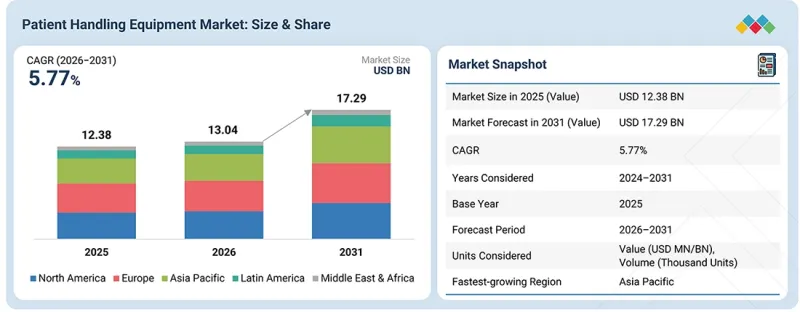
세계의 환자 이송 장비 시장 규모는 2026년 130억 4,000만 달러에서 2031년에는 172억 9,000만 달러에 달할 것으로 예측되며, 예측 기간 동안 CAGR은 5.77%가 될 전망입니다.
| 조사 범위 | |
|---|---|
| 조사 대상 기간 | 2026-2031년 |
| 기준 연도 | 2025년 |
| 예측 기간 | 2026-2031년 |
| 단위 | 금액(달러) |
| 부문 | 유형, 용도, 최종사용자, 지역 |
| 대상 지역 | 북미, 유럽, 아시아태평양, 중동 및 아프리카, 라틴아메리카 |
환자 이송 장비 시장은 고령화, 이동 능력이 제한된 사람의 증가, 간병인의 부상 증가, 안전한 환자 이송 및 이동 지원을 중시하는 경향이 높아짐에 따라 성장하고 있습니다. 재택의료, 재활, 장기 요양의 확대 또한 기기 도입을 뒷받침하고 있습니다. 또한, AI를 활용한 모니터링, 커넥티드 기기, 로봇 공학, 스마트 모빌리티 기기에서 새로운 기회가 창출되고 있습니다.
그러나 기기의 높은 비용, 일부 시장에서 보험 급여의 제한, 예산 제약 등이 도입을 저해할 가능성이 있습니다. 주요 과제로는 간병인의 교육 부족, 유지보수의 필요성, 상호운용성 문제, 커넥티드 기기의 사이버 보안 위험, 개발도상 지역에서의 보조 기술 접근 제한 등이 있습니다. WHO는 전 세계적으로 25억 명 이상이 보조 기기를 필요로 하고 있다고 추산하고 있습니다.
유형별로는 의료용 침대 부문이 2025년에 두 번째로 큰 점유율을 차지했습니다.
의료용 침대 부문은 다시 전동 침대, 수동 침대, 반전동 침대, 스마트 침대로 분류됩니다. 의료용 침대는 병원, 재활 시설, 장기 요양 시설, 재택의료 현장에서 필수적이기 때문에 큰 점유율을 차지하고 있습니다. 이러한 침대는 환자의 체위 조정, 이동, 쾌적성, 체압 관리, 안전한 간병을 지원하며, 환자 이송 및 이동 업무 흐름에서 없어서는 안 될 존재가 되었습니다. 또한 고령화의 진행과 장기적인 간병이 필요한 만성 질환의 유병률 증가도 수요를 더욱 부추기고 있습니다.
최종사용자별로는 예측 기간 동안 재활 시설 부문이 가장 높은 연평균 성장률(CAGR)을 기록할 것으로 예상됩니다.
고령화, 부상, 신경 질환, 근골격계 질환, 만성 질환으로 고통받는 환자들 사이에서 재활에 대한 수요가 높아지고 있기 때문에 재활 시설 부문은 가장 높은 연평균 성장률(CAGR)을 기록하며 성장할 것으로 예상됩니다. 세계보건기구(WHO)는 전 세계적으로 24억 명이 재활을 통해 상태가 개선될 것으로 기대되는 상태에 있다고 추산하고 있습니다. 재활 시설에서는 안전한 이송, 치료, 체위 조정, 기능 회복을 지원하기 위해 환자용 리프트, 이송 보조 기구, 의료용 침대, 휠체어, 이동 보조기구가 필요합니다. 자립 회복과 재활 서비스 강화가 점점 더 중요시되는 가운데, 예측 기간 동안 이러한 시설에서 환자 이송 장비의 도입이 확대될 것으로 예상됩니다.
“북미 시장에서는 미국이 가장 높은 연평균 성장률(CAGR)을 기록할 것으로 전망됩니다.”
2025년, 북미는 환자 이송·이동 지원 기기 시장에서 두 번째로 큰 점유율을 차지했습니다. 북미의 환자 이송·이동 지원 기기 시장은 미국과 캐나다로 나뉩니다. 2025년, 북미 시장에서 미국이 가장 큰 점유율을 차지했습니다. 이는 미국의 대규모 의료 시스템, 막대한 의료비 지출, 고령화, 확립된 보험 환급 체계에 기인한 것입니다. 2024년, 미국의 65세 이상 인구는 6,120만 명에 달해 전체 인구의 18.0%를 차지하며, 이동 지원 기기 및 환자 간호 기기에 대한 큰 수요를 창출하고 있습니다. 2024년 미국의 의료비는 5조 3,000억 달러에 달해 GDP의 18.0%를 차지하며, 의료 투자 규모가 얼마나 큰지를 여실히 보여주고 있습니다. 메디케어(Medicare)는 환자용 리프트, 병원용 침대, 휠체어,보행기, 휴대용 화장실 등 관련 내구 의료기기의 여러 범주도 지원 대상에 포함하고 있으며, 수급 자격이 있는 분들의 이용을 지원하고 있습니다. 또한, FDA의 지침 및 안전한 환자 이송·이동 지원에 관한 노력에 힘입어, 환자와 간병인의 부상 위험을 줄이기 위한 적절한 리프트 기술의 도입이 촉진되고 있습니다.
본 보고서에서는 전 세계 환자 이송 장비 시장을 조사하여, 시장 개요, 시장 성장에 영향을 미치는 각종 요인 분석, 기술 및 특허 동향, 법규제 환경, 사례 연구, 시장 규모 추정 및 전망, 각종 분류·지역/주요 국가별 상세 분석, 경쟁 현황, 주요 기업 개요 등을 정리하고 있습니다.
자주 묻는 질문
목차
제1장 소개
제2장 주요 요약
제3장 주요 인사이트
제4장 시장 개요
제5장 업계 동향
제6장 고객 상황과 구매 행동
제7장 지속가능성과 규제 상황
제8장 기술의 진보, AI의 영향, 특허, 혁신, 향후 응용
제9장 환자 이송 장비 시장 : 유형별
제10장 환자 이송 장비 시장 : 용도별
제11장 환자 이송 장비 시장 : 최종사용자별
제12장 환자 이송 장비 시장 : 지역별
제13장 경쟁 구도
제14장 기업 개요
제15장 조사 방법
제16장 부록
KSM 26.10.08The global patient handling equipment market is projected to reach USD 17.29 billion by 2031 from USD 13.04 billion in 2026, at a CAGR of 5.77% during the forecast period.
| Scope of the Report | |
|---|---|
| Years Considered for the Study | 2026-2031 |
| Base Year | 2025 |
| Forecast Period | 2026-2031 |
| Units Considered | Value (USD billion) |
| Segments | Type, Application, End User, and Region |
| Regions covered | North America, Europe, Asia Pacific, Middle East & Africa, Latin America |
The patient handling equipment market is driven by an aging population, rising mobility limitations, increasing caregiver injuries, and a growing emphasis on safe patient handling. Expansion of home healthcare, rehabilitation, and long-term care further supports equipment adoption. Opportunities arise from AI-enabled monitoring, connected devices, robotics, and smart mobility equipment. However, high equipment costs, limited reimbursement in some markets, and budget constraints can restrict adoption. Key challenges include inadequate caregiver training, maintenance requirements, interoperability issues, cybersecurity risks for connected devices, and limited access to assistive technologies in developing regions. WHO estimates that more than 2.5 billion people need assistive products globally.
By type, the medical beds segment held the second-largest share in the patient handling equipment market in 2025.
By type, the patient handling equipment market is segmented into patient transfer devices, medical beds, mobility equipment, bathroom & toilet assist equipment, and stretchers & transport chairs. In 2025, the medical beds segment held the second-largest market share. The medical beds segment is further categorized into Electric Beds, Manual Beds, Semi-electric Beds, and Smart Beds. The medical beds segment holds a major share because these beds are essential across hospitals, rehabilitation facilities, long-term care centers, and home healthcare settings. These beds support patient positioning, mobility, comfort, pressure management, and safe caregiving, making them fundamental to patient handling workflows. Demand is further supported by the aging population and increasing prevalence of chronic conditions requiring prolonged care.
By end user, the rehabilitation facilities segment is expected to grow at the highest CAGR during the forecast period.
The market is segmented by application into hospitals, home healthcare, elder care facilities, rehabilitation facilities, and others. The rehabilitation facilities segment is expected to grow at the highest CAGR as demand for rehabilitation increases among patients affected by aging, injuries, neurological conditions, musculoskeletal disorders, and chronic diseases. WHO estimates that 2.4 billion people globally live with conditions that could benefit from rehabilitation. Rehabilitation facilities require patient lifts, transfer equipment, medical beds, wheelchairs, and mobility aids to support safe transfers, therapy, positioning, and functional recovery. A growing emphasis on restoring independence and strengthening rehabilitation services is expected to increase adoption of patient handling equipment in these facilities during the forecast period.
"US to grow at the highest CAGR for North America patient handling equipment market."
The patient handling equipment market is divided into five major regions: North America, Europe, Asia Pacific, Latin America, and the Middle East & Africa. North America held the second largest share in the patient handling equipment market in 2025. The North American patient handling equipment market is divided into the US and Canada. In 2025, the US held the major share in the North America patient handling equipment market. This is due to its large healthcare system, substantial healthcare expenditure, aging population, and established reimbursement infrastructure. The US population aged 65 and older reached 61.2 million in 2024, representing 18.0% of the population and creating significant demand for mobility and patient-care equipment. US healthcare spending reached USD 5.3 trillion in 2024, or 18.0% of GDP, underscoring the scale of healthcare investment. Medicare also covers several relevant durable medical equipment categories, including patient lifts, hospital beds, wheelchairs, walkers, and commode chairs, supporting access for eligible beneficiaries. Additionally, FDA guidance and safe-patient-handling initiatives support adoption of appropriate lifting technologies to reduce patient and caregiver injury risks.
MARKET BREAKDOWN:
A breakdown of the primary participants referred to for this report is provided below:
- By Company Type: Tier 1 - 28%, Tier 2 - 34%, and Tier 3 - 38%
- By Designation: C-level - 40%, Director level - 26%, and Others - 34%
- By Region: North America - 25%, Europe - 41%, the Asia Pacific - 30%, Latin America - 3%, and the Middle East & Africa - 1%.
Note 1: Companies are classified into tiers based on their total revenue. As of 2024, Tier 1 = >USD 10.0 billion, Tier 2 = USD 1.0 billion to USD 10.0 billion, and Tier 3 = <USD 1.0 billion.
Note 2: C-level primaries include CEOs, CFOs, COOs, and VPs.
Note 3: Others include sales managers, marketing managers, business development managers, product managers, distributors, and suppliers.
The key players operating in the patient handling equipment market include Arjo (Sweden), Baxter International Inc. (US), Savaria (Canada), Stryker Corporation (US), Drive DeVilbiss Healthcare (US), Etac AB (Sweden), GF Health Products, Inc. (US), V. Guldmann A/S (Denmark), Joerns Healthcare (US), Medline Industries, LP (US), Prism Healthcare Group (UK), LINET Group (Netherland), Stiegelmeyer GmbH & Co. KG (Germany), DHCare (Switzerland), Malvetio Spa (Italy), and EZ Way, Inc. (US), among others.
Research Coverage
This report studies the patient handling equipment market based on type, application, end user, and region. The report also studies factors (such as drivers, restraints, opportunities, and challenges) affecting market growth and provides details of the competitive landscape for market leaders. Furthermore, the report analyzes micro markets concerning their growth trends. It forecasts revenue for market segments across five regions (and the respective countries in these regions).
Reasons to Buy the Report
The report will enable established and entrants/smaller firms to gauge the market's pulse, which, in turn, would help them gain a larger market share. Firms purchasing the report could use one or a combination of the strategies mentioned below to strengthen their market presence.
This report provides insights on the following pointers:
- Analysis of key drivers (Rising prevalence of aging & obese population, increasing hospital admissions, increasing injuries to healthcare professionals), restraints (Lack of trained caregivers for efficient operation of patient handling equipment), opportunities (Rising demand for home healthcare services), challenges (Persistent difficulties in handling bariatric patients, Improper architectural designs in healthcare facilities)
- Market Penetration: Complete knowledge of the spectrum of products presented by the major companies in the patient handling equipment market
- Product Development/Innovation: Comprehensive understanding of the forthcoming trends, research and development initiatives, and product launches within the patient handling equipment market
- Market Development: Complete knowledge about profitable developing regions
- Market Diversification: Exhaustive knowledge of new goods, expanding geographies, and current changes in the patient handling equipment industry helps to diversify the market
- Competitive Assessment: In-depth assessment of market shares, growth strategies, and product offerings of leading players like Arjo (Sweden), Baxter International, Inc. (US), Stryker Corporation (US), Etac AB (Sweden), Drive Devilbiss Healthcare (US), and GF Health Products, Inc. (US).
TABLE OF CONTENTS
1 INTRODUCTION
- 1.1 STUDY OBJECTIVES
- 1.2 MARKET DEFINITION
- 1.3 STUDY SCOPE
- 1.3.1 MARKETS COVERED & REGIONAL SEGMENTATION
- 1.3.2 INCLUSIONS & EXCLUSIONS
- 1.3.3 YEARS CONSIDERED
- 1.3.4 CURRENCY CONSIDERED
- 1.4 STAKEHOLDERS
- 1.5 SUMMARY OF CHANGES
2 EXECUTIVE SUMMARY
- 2.1 KEY INSIGHTS & MARKET HIGHLIGHTS
- 2.2 KEY MARKET PARTICIPANTS: INSIGHTS & DEVELOPMENTS
- 2.3 DISRUPTIVE TRENDS SHAPING MARKET GROWTH
- 2.4 HIGH-GROWTH SEGMENTS & EMERGING FRONTIERS
- 2.5 SNAPSHOT: GLOBAL MARKET SIZE, GROWTH RATE, AND FORECAST
3 PREMIUM INSIGHTS
- 3.1 PATIENT HANDLING EQUIPMENT MARKET OVERVIEW
- 3.2 EUROPE: PATIENT HANDLING EQUIPMENT MARKET, BY END USER
- 3.3 PATIENT HANDLING EQUIPMENT MARKET: GEOGRAPHIC GROWTH OPPORTUNITIES
- 3.4 PATIENT HANDLING EQUIPMENT MARKET: REGIONAL MIX
- 3.5 PATIENT HANDLING EQUIPMENT MARKET: DEVELOPED COUNTRIES VS. EMERGING ECONOMIES
4 MARKET OVERVIEW
- 4.1 INTRODUCTION
- 4.2 MARKET DYNAMICS
- 4.2.1 DRIVERS
- 4.2.1.1 Expanding geriatric population and increasing cases of obesity
- 4.2.1.2 High risk of caregiver injuries during manual patient handling
- 4.2.1.3 Rising number of hospital admissions
- 4.2.2 RESTRAINTS
- 4.2.2.1 Shortage of trained personnel in emerging economies
- 4.2.3 OPPORTUNITIES
- 4.2.3.1 Rising demand for home healthcare services
- 4.2.4 CHALLENGES
- 4.2.4.1 Challenges associated with bariatric patient handling
- 4.2.4.2 Improper architectural designs in healthcare facilities
- 4.2.1 DRIVERS
- 4.3 UNMET NEEDS & WHITE SPACES
- 4.3.1 UNMET NEEDS
- 4.3.2 WHITE SPACE OPPORTUNITIES
- 4.4 INTERCONNECTED MARKETS & CROSS-SECTOR OPPORTUNITIES
- 4.4.1 INTERCONNECTED MARKETS
- 4.4.2 CROSS-SECTOR OPPORTUNITIES
- 4.5 STRATEGIC MOVES BY TIER-1/2/3 PLAYERS
5 INDUSTRY TRENDS
- 5.1 PORTER'S FIVE FORCES ANALYSIS
- 5.1.1 THREAT OF NEW ENTRANTS
- 5.1.2 BARGAINING POWER OF SUPPLIERS
- 5.1.3 BARGAINING POWER OF BUYERS
- 5.1.4 THREAT OF SUBSTITUTES
- 5.1.5 INTENSITY OF COMPETITIVE RIVALRY
- 5.2 MACROECONOMIC OUTLOOK
- 5.2.1 INTRODUCTION
- 5.2.2 GDP TRENDS & FORECAST
- 5.2.3 TRENDS IN REHABILITATION EQUIPMENT INDUSTRY
- 5.3 SUPPLY CHAIN ANALYSIS
- 5.4 VALUE CHAIN ANALYSIS
- 5.5 ECOSYSTEM ANALYSIS
- 5.6 PRICING ANALYSIS
- 5.6.1 AVERAGE SELLING PRICE TREND OF KEY PATIENT HANDLING PRODUCTS, BY KEY PLAYER (2023-2025)
- 5.6.2 AVERAGE SELLING PRICE TREND OF KEY PATIENT HANDLING PRODUCTS, BY REGION (2023-2025)
- 5.7 TRADE ANALYSIS
- 5.7.1 IMPORT SCENARIO FOR HS CODE 9402
- 5.7.2 EXPORT SCENARIO FOR HS CODE 9402
- 5.8 KEY CONFERENCES AND EVENTS, 2026-2027
- 5.9 TRENDS/DISRUPTIONS IMPACTING CUSTOMERS' BUSINESSES
- 5.10 INVESTMENT & FUNDING SCENARIO
- 5.11 IMPACT OF 2025 US TARIFFS ON PATIENT HANDLING EQUIPMENT MARKET
- 5.11.1 INTRODUCTION
- 5.11.2 KEY TARIFF RATES
- 5.11.3 PRICE IMPACT ANALYSIS
- 5.11.4 IMPACT ON COUNTRIES/REGIONS
- 5.11.4.1 North America
- 5.11.4.2 Europe
- 5.11.4.3 Asia Pacific
- 5.11.5 END-USE INDUSTRY IMPACT
6 CUSTOMER LANDSCAPE & BUYER BEHAVIOR
- 6.1 DECISION-MAKING PROCESS
- 6.2 BUYER STAKEHOLDERS & BUYING EVALUATION CRITERIA
- 6.2.1 KEY STAKEHOLDERS IN BUYING PROCESS
- 6.2.2 KEY BUYING CRITERIA
- 6.3 ADOPTION BARRIERS & INTERNAL CHALLENGES
- 6.4 UNMET NEEDS FROM VARIOUS END-USE INDUSTRIES
- 6.5 MARKET PROFITABILITY
- 6.5.1 REVENUE POTENTIAL
- 6.5.2 COST DYNAMICS
- 6.5.3 MARGIN OPPORTUNITIES IN KEY APPLICATIONS
7 SUSTAINABILITY & REGULATORY LANDSCAPE
- 7.1 REGIONAL REGULATIONS AND COMPLIANCE
- 7.1.1 REGULATORY BODIES, GOVERNMENT AGENCIES, AND OTHER ORGANIZATIONS
- 7.1.2 INDUSTRY STANDARDS
- 7.2 SUSTAINABILITY INITIATIVES
- 7.2.1 CARBON IMPACT & ECO-APPLICATIONS
- 7.2.1.1 Carbon impact reduction
- 7.2.1.2 Eco-applications
- 7.2.1 CARBON IMPACT & ECO-APPLICATIONS
- 7.3 SUSTAINABILITY IMPACT & REGULATORY POLICY INITIATIVES
- 7.4 CERTIFICATIONS, LABELING, AND ECO-STANDARDS
- 7.5 REIMBURSEMENT ANALYSIS
8 TECHNOLOGICAL ADVANCEMENTS, AI-DRIVEN IMPACT, PATENTS, INNOVATIONS, AND FUTURE APPLICATIONS
- 8.1 KEY EMERGING TECHNOLOGIES
- 8.1.1 IOT-ENABLED & CONNECTED PATIENT HANDLING EQUIPMENT
- 8.1.2 SMART SENSORS & LOAD-MONITORING SYSTEMS
- 8.2 COMPLEMENTARY TECHNOLOGIES
- 8.2.1 HEALTH INFORMATION EXCHANGE
- 8.2.2 ELECTRONIC HEALTH RECORDS (EHR) INTEGRATION
- 8.3 TECHNOLOGY/PRODUCT ROADMAP
- 8.3.1 SHORT-TERM (2025-2027) | FOUNDATION & EARLY COMMERCIALIZATION
- 8.3.2 MID-TERM (2027-2030) | EXPANSION & STANDARDIZATION
- 8.3.3 LONG-TERM (2030-2035+) | MASS COMMERCIALIZATION & DISRUPTION
- 8.4 PATENT ANALYSIS
- 8.4.1 INSIGHTS: JURISDICTION & TOP APPLICANT ANALYSIS
- 8.5 FUTURE APPLICATIONS
- 8.5.1 AI-ENABLED PATIENT HANDLING, FALL PREVENTION, AND INTELLIGENT MOBILITY
- 8.5.2 CONNECTED PATIENT HANDLING, REMOTE MONITORING, AND SMART CARE ECOSYSTEMS
- 8.6 IMPACT OF AI/GEN AI ON PATIENT HANDLING EQUIPMENT MARKET
- 8.6.1 TOP USE CASES & MARKET POTENTIAL
- 8.6.2 CASE STUDIES OF AI IMPLEMENTATION IN PATIENT HANDLING EQUIPMENT MARKET
- 8.6.3 INTERCONNECTED ADJACENT ECOSYSTEMS & IMPACT ON MARKET PLAYERS
- 8.6.4 CLIENTS' READINESS TO ADOPT GENERATIVE AI IN PATIENT HANDLING EQUIPMENT MARKET
9 PATIENT HANDLING EQUIPMENT MARKET, BY TYPE
- 9.1 INTRODUCTION
- 9.2 PATIENT TRANSFER DEVICES
- 9.2.1 PATIENT LIFTS
- 9.2.1.1 Ceiling lifts
- 9.2.1.1.1 Ceiling lifts accounted for largest market share in 2025
- 9.2.1.2 Stair & wheelchair lifts
- 9.2.1.2.1 Increasing preference for home care services to drive market
- 9.2.1.3 Mobile lifts
- 9.2.1.3.1 Lower risk of falls and reduced length of stay to propel demand
- 9.2.1.4 Sit-to-stand lifts
- 9.2.1.4.1 Ability to promote patient independence and reduce risk of musculoskeletal injuries among caregivers to drive growth
- 9.2.1.5 Bath & pool lifts
- 9.2.1.5.1 Availability of various options, including fixed, reclining, and lying bath lifts, to boost demand
- 9.2.1.1 Ceiling lifts
- 9.2.2 SLINGS
- 9.2.2.1 Government policies and legislation promoting use of medical lifting slings to aid adoption
- 9.2.3 AIR-ASSISTED LATERAL TRANSFER MATTRESSES
- 9.2.3.1 Reusable air-assisted mattresses
- 9.2.3.1.1 Durability and long lifespan to enhance demand
- 9.2.3.2 Single-patient-use air-assisted mattresses
- 9.2.3.2.1 Disposable air-assisted mattresses to save costs and logistics associated with laundering
- 9.2.3.1 Reusable air-assisted mattresses
- 9.2.4 SLIDING SHEETS (ROLLERS/TUBES)
- 9.2.4.1 Effectiveness in enhancing patient safety and reducing workplace injuries to boost demand for sliding sheets
- 9.2.5 ACCESSORIES
- 9.2.5.1 Recurring need for replacement parts caused by regular wear and tear of patient handling equipment to support growth
- 9.2.1 PATIENT LIFTS
- 9.3 MEDICAL BEDS
- 9.3.1 ELECTRIC BEDS
- 9.3.1.1 Increasing demand for adjustable beds that enhance both patient comfort and caregiver efficiency to boost market growth
- 9.3.2 MANUAL BEDS
- 9.3.2.1 Lower upfront costs and long-term durability of manual beds to continue to sustain market growth
- 9.3.3 SEMI-ELECTRIC BEDS
- 9.3.3.1 Lightweight design, ease of transport, and sufficient weight capacity to drive demand in home care settings
- 9.3.4 SMART BEDS
- 9.3.4.1 Rising demand for advanced patient monitoring and safety solutions to propel market
- 9.3.1 ELECTRIC BEDS
- 9.4 MOBILITY EQUIPMENT
- 9.4.1 WHEELCHAIRS & SCOOTERS
- 9.4.1.1 Powered wheelchairs
- 9.4.1.1.1 Better patient mobility and more customization options to increase demand
- 9.4.1.2 Mobility scooters
- 9.4.1.2.1 Advancements in design and rising demand for lifestyle-enhancing mobility solutions to continue to drive adoption of mobility scooters
- 9.4.1.3 Manual wheelchairs
- 9.4.1.3.1 Simplicity and durability of manual wheelchairs, along with their independence from battery charging to make them preferred option for both patients and caregivers
- 9.4.1.4 Smart wheelchairs
- 9.4.1.4.1 Rising global disability rates and demand for autonomous mobility equipment to drive market
- 9.4.1.1 Powered wheelchairs
- 9.4.2 AMBULATORY AIDS
- 9.4.2.1 Walkers
- 9.4.2.1.1 Growing geriatric population worldwide and increased awareness of fall prevention to increase demand for walkers
- 9.4.2.2 Canes
- 9.4.2.2.1 Rising aging population with balance impairments and mobility limitations to drive market growth
- 9.4.2.3 Crutches
- 9.4.2.3.1 Increasing incidence of lower-limb injuries to drive growth of crutches segment
- 9.4.2.1 Walkers
- 9.4.1 WHEELCHAIRS & SCOOTERS
- 9.5 BATHROOM & TOILET ASSIST EQUIPMENT
- 9.5.1 COMMODE CHAIRS
- 9.5.1.1 Growing preference for home healthcare and aging in place to support adoption of commode chairs in home care and rehabilitation settings
- 9.5.2 SHOWER CHAIRS
- 9.5.2.1 Enhanced product designs, featuring anti-slip legs, adjustable heights, and padded seats to contribute to adoption of shower chairs
- 9.5.3 TRANSFER BENCHES
- 9.5.3.1 Increasing need for safe and independent bathroom transfers among elderly and mobility-impaired patients to fuel growth
- 9.5.1 COMMODE CHAIRS
- 9.6 STRETCHERS & TRANSPORT CHAIRS
- 9.6.1 INCREASING DEMAND FOR SAFE AND EFFICIENT PATIENT TRANSPORTATION TO DRIVE SEGMENTAL GROWTH
10 PATIENT HANDLING EQUIPMENT MARKET, BY APPLICATION
- 10.1 INTRODUCTION
- 10.2 ACUTE CARE
- 10.2.1 RISING NUMBER OF ACCIDENTS AND NEED FOR ADVANCED EMERGENCY AND TRAUMA CARE TO DRIVE MARKET GROWTH
- 10.3 LONG-TERM CARE
- 10.3.1 RISING AGING POPULATION AND INCREASING PREVALENCE OF CHRONIC CONDITIONS & DISABILITIES TO BOOST MARKET GROWTH
- 10.4 REHABILITATION CARE
- 10.4.1 INCREASING GLOBAL DEMAND FOR REHABILITATION SERVICES FUELED BY RISE IN CHRONIC CONDITIONS TO DRIVE MARKET
- 10.5 BARIATRIC CARE
- 10.5.1 GROWING OBESE POPULATION TO SUPPORT MARKET GROWTH
- 10.6 OTHER APPLICATIONS
11 PATIENT HANDLING EQUIPMENT MARKET, BY END USER
- 11.1 INTRODUCTION
- 11.2 HOSPITALS
- 11.2.1 RISING PATIENT ADMISSIONS IN HOSPITALS REQUIRING SAFE AND EFFICIENT MOBILITY EQUIPMENT TO PROPEL MARKET GROWTH
- 11.3 HOME HEALTHCARE
- 11.3.1 RISING GERIATRIC POPULATION REQUIRING SAFE, IN-HOME MOBILITY SUPPORT TO DRIVE SEGMENTAL GROWTH
- 11.4 ELDER CARE FACILITIES
- 11.4.1 GROWING ADOPTION OF ERGONOMIC, EFFICIENT PATIENT HANDLING EQUIPMENT BY ELDER CARE FACILITIES TO SUPPORT MARKET GROWTH
- 11.5 REHABILITATION FACILITIES
- 11.5.1 RISING GLOBAL BURDEN OF DISABILITIES REQUIRING LONG-TERM MOBILITY SUPPORT TO DRIVE SEGMENTAL GROWTH
- 11.6 OTHER END USERS
12 PATIENT HANDLING EQUIPMENT MARKET, BY REGION
- 12.1 INTRODUCTION
- 12.2 NORTH AMERICA
- 12.2.1 US
- 12.2.1.1 US to dominate North American patient handling equipment market during forecast period
- 12.2.2 CANADA
- 12.2.2.1 Growth in disabled population to fuel Canadian patient handling equipment market
- 12.2.1 US
- 12.3 EUROPE
- 12.3.1 GERMANY
- 12.3.1.1 Germany to dominate European patient handling equipment market during forecast period
- 12.3.2 UK
- 12.3.2.1 Rising government investment in hospital infrastructure to drive demand for patient handling equipment in UK
- 12.3.3 FRANCE
- 12.3.3.1 High healthcare expenditure and government investment to foster rapid market growth for patient handling equipment in France
- 12.3.4 ITALY
- 12.3.4.1 Italy's rapidly aging population and rising injury rates to drive growth in patient handling equipment market
- 12.3.5 SPAIN
- 12.3.5.1 Growing disability prevalence and mobility challenges to fuel market
- 12.3.6 REST OF EUROPE
- 12.3.1 GERMANY
- 12.4 ASIA PACIFIC
- 12.4.1 CHINA
- 12.4.1.1 China to dominate Asia Pacific patient handling equipment market during forecast period
- 12.4.2 INDIA
- 12.4.2.1 Chronic disease burden and expanding healthcare infrastructure to support growth of patient handling equipment in India
- 12.4.3 JAPAN
- 12.4.3.1 High prevalence of caregiver-related musculoskeletal disorders to fuel market expansion in Japan
- 12.4.4 AUSTRALIA
- 12.4.4.1 Aging population and growing preference for home-based care to drive market growth
- 12.4.5 SOUTH KOREA
- 12.4.5.1 Increasing diabetes and CKD prevalence to drive market growth
- 12.4.6 REST OF ASIA PACIFIC
- 12.4.1 CHINA
- 12.5 LATIN AMERICA
- 12.5.1 BRAZIL
- 12.5.1.1 Chronic disease burden and major hospital expansions to significantly drive market growth
- 12.5.2 MEXICO
- 12.5.2.1 Rising obesity rates and associated hospitalization needs to propel market growth
- 12.5.3 REST OF LATIN AMERICA
- 12.5.1 BRAZIL
- 12.6 MIDDLE EAST & AFRICA
- 12.6.1 GCC COUNTRIES
- 12.6.1.1 Rising healthcare infrastructure investments to drive market
- 12.6.2 REST OF MIDDLE EAST & AFRICA
- 12.6.1 GCC COUNTRIES
13 COMPETITIVE LANDSCAPE
- 13.1 OVERVIEW
- 13.2 KEY PLAYER STRATEGIES/RIGHT TO WIN
- 13.2.1 OVERVIEW OF STRATEGIES ADOPTED BY PLAYERS IN PATIENT HANDLING EQUIPMENT MARKET
- 13.3 REVENUE ANALYSIS, 2021-2025
- 13.4 MARKET SHARE ANALYSIS, 2025
- 13.5 COMPANY EVALUATION MATRIX: KEY PLAYERS, 2025
- 13.5.1 STARS
- 13.5.2 EMERGING LEADERS
- 13.5.3 PERVASIVE PLAYERS
- 13.5.4 PARTICIPANTS
- 13.5.5 COMPANY FOOTPRINT: KEY PLAYERS, 2025
- 13.5.5.1 Company footprint
- 13.5.5.2 Region footprint
- 13.5.5.3 Type footprint
- 13.5.5.4 Application footprint
- 13.5.5.5 End-user footprint
- 13.6 COMPANY EVALUATION MATRIX: STARTUPS/SMES, 2025
- 13.6.1 PROGRESSIVE COMPANIES
- 13.6.2 RESPONSIVE COMPANIES
- 13.6.3 DYNAMIC COMPANIES
- 13.6.4 STARTING BLOCKS
- 13.6.5 COMPETITIVE BENCHMARKING: STARTUPS/SMES, 2025
- 13.6.5.1 Detailed list of key startup/SME players
- 13.6.5.2 Competitive benchmarking of key emerging players/startups
- 13.7 COMPANY VALUATION & FINANCIAL METRICS
- 13.7.1 FINANCIAL METRICS
- 13.7.2 COMPANY VALUATION
- 13.8 BRAND/PRODUCT COMPARISON
- 13.9 COMPETITIVE SCENARIO
- 13.9.1 PRODUCT LAUNCHES
- 13.9.2 DEALS
- 13.9.3 EXPANSIONS
- 13.9.4 OTHER DEVELOPMENTS
14 COMPANY PROFILES
- 14.1 KEY PLAYERS
- 14.1.1 ARJO
- 14.1.1.1 Business overview
- 14.1.1.2 Products offered
- 14.1.1.3 Recent developments
- 14.1.1.3.1 Product launches
- 14.1.1.3.2 Deals
- 14.1.1.3.3 Expansions
- 14.1.1.3.4 Other developments
- 14.1.1.4 MnM view
- 14.1.1.4.1 Right to win
- 14.1.1.4.2 Strategic choices
- 14.1.1.4.3 Weaknesses & competitive threats
- 14.1.2 BAXTER INTERNATIONAL, INC.
- 14.1.2.1 Business overview
- 14.1.2.2 Products offered
- 14.1.2.3 Recent developments
- 14.1.2.3.1 Product launches
- 14.1.2.4 MnM view
- 14.1.2.4.1 Right to win
- 14.1.2.4.2 Strategic choices
- 14.1.2.4.3 Weaknesses & competitive threats
- 14.1.3 SAVARIA
- 14.1.3.1 Business overview
- 14.1.3.2 Products offered
- 14.1.3.3 Recent developments
- 14.1.3.3.1 Expansions
- 14.1.3.4 MnM view
- 14.1.3.4.1 Right to win
- 14.1.3.4.2 Strategic choices
- 14.1.3.4.3 Weaknesses & competitive threats
- 14.1.4 STRYKER CORPORATION
- 14.1.4.1 Business overview
- 14.1.4.2 Products offered
- 14.1.4.2.1 Expansions
- 14.1.4.3 MnM view
- 14.1.4.3.1 Right to win
- 14.1.4.3.2 Strategic choices
- 14.1.4.3.3 Weaknesses & competitive threats
- 14.1.5 DRIVE DEVILBISS HEALTHCARE
- 14.1.5.1 Business overview
- 14.1.5.2 Products offered
- 14.1.5.3 Recent developments
- 14.1.5.3.1 Product launches
- 14.1.5.3.2 Deals
- 14.1.5.4 MnM view
- 14.1.5.4.1 Right to win
- 14.1.5.4.2 Strategic choices
- 14.1.5.4.3 Weaknesses & competitive threats
- 14.1.6 INVACARE AMERICA
- 14.1.6.1 Business overview
- 14.1.6.2 Products offered
- 14.1.7 ETAC AB
- 14.1.7.1 Business overview
- 14.1.7.2 Products offered
- 14.1.7.3 Recent developments
- 14.1.7.3.1 Product launches
- 14.1.7.3.2 Deals
- 14.1.8 GF HEALTH PRODUCTS, INC.
- 14.1.8.1 Business overview
- 14.1.8.2 Products offered
- 14.1.8.3 Recent developments
- 14.1.8.3.1 Product launches
- 14.1.8.3.2 Deals
- 14.1.9 GULDMANN INC.
- 14.1.9.1 Business overview
- 14.1.9.2 Products offered
- 14.1.10 JOERNS HEALTHCARE
- 14.1.10.1 Business overview
- 14.1.10.2 Products offered
- 14.1.10.3 Recent developments
- 14.1.10.3.1 Product launches
- 14.1.10.3.2 Deals
- 14.1.11 MEDLINE
- 14.1.11.1 Business overview
- 14.1.11.2 Products offered
- 14.1.11.3 Recent developments
- 14.1.11.3.1 Deals
- 14.1.12 PRISM HEALTHCARE GROUP
- 14.1.12.1 Business overview
- 14.1.12.2 Products offered
- 14.1.12.3 Recent developments
- 14.1.12.3.1 Deals
- 14.1.12.3.2 Expansions
- 14.1.13 LINET GROUP SE
- 14.1.13.1 Business overview
- 14.1.13.2 Products offered
- 14.1.13.3 Recent developments
- 14.1.13.3.1 Deals
- 14.1.13.3.2 Expansions
- 14.1.14 STIEGELMEYER GMBH & CO. KG (A STIEGELMEYER-GROUP COMPANY)
- 14.1.14.1 Business overview
- 14.1.14.2 Products offered
- 14.1.15 DHCARE
- 14.1.15.1 Business overview
- 14.1.15.2 Products offered
- 14.1.15.3 Recent developments
- 14.1.15.3.1 Product launches
- 14.1.15.3.2 Deals
- 14.1.15.3.3 Expansions
- 14.1.16 MALVESTIO SPA
- 14.1.16.1 Business overview
- 14.1.16.2 Products offered
- 14.1.17 EZ WAY INC.
- 14.1.17.1 Business overview
- 14.1.17.2 Products offered
- 14.1.18 PERMOBIL HOLDING AB
- 14.1.18.1 Business overview
- 14.1.18.2 Products offered
- 14.1.18.3 Recent developments
- 14.1.18.3.1 Product launches
- 14.1.18.3.2 Deals
- 14.1.18.3.3 Other developments
- 14.1.19 MERITS HEALTH PRODUCTS, INC.
- 14.1.19.1 Business overview
- 14.1.19.2 Products offered
- 14.1.19.3 Recent developments
- 14.1.19.3.1 Deals
- 14.1.20 WINNCARE GROUP
- 14.1.20.1 Business overview
- 14.1.20.2 Products offered
- 14.1.20.3 Recent developments
- 14.1.20.3.1 Deals
- 14.1.1 ARJO
- 14.2 OTHER PLAYERS
- 14.2.1 PARAMOUNT BED HOLDINGS CO., LTD.
- 14.2.2 SUNRISE MEDICAL
- 14.2.3 PRIDE MOBILITY PRODUCTS CORP.
- 14.2.4 ANTANO GROUP
- 14.2.5 OSSENBERG GMBH
15 RESEARCH METHODOLOGY
- 15.1 RESEARCH DATA
- 15.1.1 SECONDARY DATA
- 15.1.1.1 Key data from secondary sources
- 15.1.2 PRIMARY DATA
- 15.1.2.1 Key data from primary sources
- 15.1.2.2 Key industry insights
- 15.1.1 SECONDARY DATA
- 15.2 MARKET SIZE ESTIMATION
- 15.3 MARKET BREAKDOWN & DATA TRIANGULATION
- 15.4 MARKET RANKING ANALYSIS
- 15.5 STUDY ASSUMPTIONS
- 15.6 RESEARCH LIMITATIONS
- 15.6.1 METHODOLOGY-RELATED LIMITATIONS
- 15.6.2 SCOPE-RELATED LIMITATIONS
- 15.7 RISK ASSESSMENT
16 APPENDIX
- 16.1 DISCUSSION GUIDE
- 16.2 KNOWLEDGESTORE: MARKETSANDMARKETS' SUBSCRIPTION PORTAL
- 16.3 CUSTOMIZATION OPTIONS
- 16.4 RELATED REPORTS
- 16.5 AUTHOR DETAILS


