

|
시장보고서
상품코드
2142610
사이버 전쟁 시장 : 유형별(방어적 사이버 작전, 공격적 사이버 작전), 솔루션별(네트워크, 엔드포인트, 애플리케이션, 데이터 보안), 영역별(육상, 해상, 항공, 우주, 사이버), 제공별, 도입별, 지역별 - 세계 예측(-2031년)Cyber Warfare Market by Type (Defensive Cyber Operations, Offensive Cyber Operations), Solutions (Network, Endpoint, Application, Data Security), Domain (Land, Naval, Airborne, Space, Cyber) Offering, Deployment, and Region- Global Forecast to 2031 |
||||||

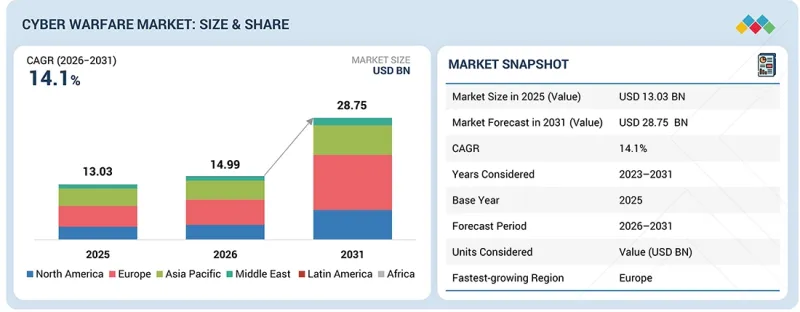
사이버 전쟁 시장 규모는 예측 기간 동안 CAGR 14.1%로 확대되어, 2026년 149억 9,000만 달러에서 2031년에는 287억 5,000만 달러에 달할 것으로 전망됩니다.
| 조사 범위 | |
|---|---|
| 조사 대상 기간 | 2021-2031년 |
| 기준 연도 | 2025년 |
| 예측 기간 | 2026-2031년 |
| 단위 | 금액(달러) |
| 부문 | 유형, 제공, 솔루션, 지역별 |
| 대상 지역 | 북미, 유럽, 아시아태평양, 기타 지역 |
군사 네트워크, 지휘통제 시스템, 통신 시스템, 임무 플랫폼에 대한 사이버 위협의 증가는 시장의 주요 성장 촉진요인 중 하나입니다. 공격 및 방어용 사이버 역량에 대한 국방비 증가와 더불어, AI, 사이버 인텔리전스, 자동화된 위협 탐지, 사이버 레인지를 활용한 훈련의 확대도 시장 성장을 뒷받침하고 있습니다.
분야별로는 우주 부문이 예측 기간 동안 시장을 주도할 것으로 전망됩니다.
군용 통신, 항법, 정보, 감시, 지휘통제 분야에서 위성에 대한 의존도가 높아짐에 따라 사이버 보호의 필요성도 증가하고 있습니다. 방위 기관들은 위성 시스템의 보안 확보, 우주 기반 네트워크 보호, 사이버 위협 탐지, 임무 데이터 접근 유지 능력을 강화하기 위해 투자하고 있습니다. 커넥티드 우주 시스템 및 위성 기반 군사 서비스의 활용이 확대됨에 따라, 우주 영역에서의 사이버 전쟁 솔루션에 대한 수요는 더욱 증가할 것으로 예상됩니다.
유형별로는 방어적 사이버 작전 부문이 예측 기간 동안 두 번째로 높은 성장률을 보일 것으로 전망됩니다.
군사 네트워크 및 임무 시스템에 대한 사이버 공격이 증가함에 따라, 방위 기관은 위협 탐지, 네트워크 모니터링, 사고 대응, 시스템 보호 강화를 서둘러야 하는 상황에 직면해 있습니다. 또한, 연결된 군사 플랫폼의 증가에 따라 서로 다른 시스템에 걸쳐 있는 사이버 위협을 식별하고 대처할 필요성도 높아지고 있습니다. 위협 분석의 신속화, 지속적인 모니터링 및 자동 대응을 지원하기 위해 사이버 방어 도구에는 AI 및 자동화 기능이 점차 통합되고 있습니다.
중동은 예측 기간 동안 두 번째로 높은 연평균 성장률(CAGR)을 기록할 것으로 전망됩니다.
이러한 성장은 군 사이버 부대의 확대, 사이버 방어에 대한 지출 증가, 정부 및 국방 네트워크 보호를 위한 노력에 힘입은 것입니다. 이 지역 각국은 국가 사이버 전략 수립을 추진하는 한편, 사이버 위협 인텔리전스, 네트워크 보안, 사고 대응 시스템의 활용을 확대하고 있습니다. 군사 협력의 심화와 공동 사이버 훈련 프로그램의 실시 또한 사이버 전쟁 능력 도입을 더욱 촉진하고 있습니다.
본 보고서에서는 전 세계 사이버 전쟁 시장을 조사하여 시장 개요, 시장 성장에 영향을 미치는 다양한 요인에 대한 분석, 기술 및 특허 동향, 법규제 환경, 사례 연구, 시장 규모 추정 및 전망, 각종 분류·지역/주요 국가별 상세 분석, 경쟁 구도, 주요 기업 개요 등을 종합적으로 다루고 있습니다.
자주 묻는 질문
목차
제1장 소개
제2장 주요 요약
제3장 주요 인사이트
제4장 시장 개요
제5장 업계 동향
제6장 기술의 진보, AI의 영향, 특허, 혁신, 향후 응용
제7장 지속가능성과 규제 상황
제8장 고객 상황과 구매 행동
제9장 사이버 전쟁 시장 : 유형별
제10장 사이버 전쟁 시장 : 도입 방식별
제11장 사이버 전쟁 시장 : 제공별
제12장 사이버 전쟁 시장 : 솔루션별
제13장 사이버 전쟁 시장 : 영역별
제14장 사이버 전쟁 시장 : 지역별
제15장 경쟁 구도
제16장 기업 개요
제17장 조사 방법
제18장 부록
KSM 26.10.13The cyber warfare market is projected to grow from USD 14.99 billion in 2026 to USD 28.75 billion by 2031 at a CAGR of 14.1% during the forecast period.
| Scope of the Report | |
|---|---|
| Years Considered for the Study | 2021-2031 |
| Base Year | 2025 |
| Forecast Period | 2026-2031 |
| Units Considered | Value (USD Billion) |
| Segments | By Type, Offering, Solution and Region |
| Regions covered | North America, Europe, APAC, RoW |
Increasing cyber threats to military networks, command and control systems, communication systems, and mission platforms are among the key drivers of the market. Rising defense spending on offensive and defensive cyber capabilities, along with greater use of AI, cyber intelligence, automated threat detection, and cyber range training, is also supporting market growth.
The space segment is projected to lead the cyber warfare market by domain during the forecast period.
By domain, the space segment is projected to lead the cyber warfare market during the forecast period. Increasing dependence on satellites for military communications, navigation, intelligence, surveillance, and command and control is increasing the need for cyber protection. Defense organizations are investing in capabilities to secure satellite systems, protect space-based networks, detect cyber threats, and maintain access to mission data. The growing use of connected space systems and satellite-based military services is expected to further increase demand for cyber warfare solutions in the space domain.
Defensive cyber operations is projected to be the second fastest-growing segment in the cyber warfare market by type during the forecast period.
By type, the defensive cyber operations segment is projected to be the second fastest-growing segment in the cyber warfare market during the forecast period. Increasing cyberattacks on military networks and mission systems are driving defense organizations to strengthen threat detection, network monitoring, incident response, and system protection. The growing number of connected military platforms is also increasing the need to identify and address cyber threats across different systems. AI and automation are being added to cyber defense tools to support faster threat analysis, continuous monitoring, and automated response.
Middle East is projected to register the second-highest CAGR in the cyber warfare market during the forecast period.
By region, the Middle East is projected to register the second-highest CAGR in the cyber warfare market during the forecast period. Growth is supported by the expansion of military cyber units, increased spending on cyber defense, and efforts to protect government and defense networks. Countries in the region are also developing national cyber strategies and increasing the use of cyber threat intelligence, network security, and incident response systems. Growing military cooperation and joint cyber training programs are further supporting the adoption of cyber warfare capabilities.
The breakdown of profiles for primary participants in the cyber warfare market is provided below:
- By Company Type: Tier 1 - 40%, Tier 2 - 30%, and Tier 3 - 30%
- By Designation: C-Level - 20%, Director-Level - 10%, and Others -70%
- By Region: North America - 25%, Europe - 25%, Asia Pacific - 20%, Middle East - 18%, Latin America- 7% , Africa-5%.
Research Coverage:
This market study covers the cyber warfare market across various segments and subsegments. It aims to estimate the size and growth potential of this market across different regions. This study also includes an in-depth competitive analysis of the key players in the market, their company profiles, key observations related to their products and business offerings, recent developments, and key market strategies they adopted.
Reasons to Buy This Report:
The report will help market leaders/new entrants with information on the closest approximations of the revenue numbers for the overall cyber warfare market. It will also help stakeholders understand the competitive landscape and gain more insights to position their businesses better and plan suitable go-to-market strategies. The report will also help stakeholders understand the market pulse and will provide information on key market drivers, restraints, challenges, and opportunities.
The report provides insights into the following pointers:
- Market drivers (codified interoperability mandates, doctrinal shift to continuous forward friction), restraints (security clearance and classification secrecy ceilings), opportunities (multi-domain kinetic and electronic warfare convergence, telemetry integration into institutional risk underwriting frameworks), challenges (acute technical personnel deficits, rapid asset obsolescence via signature exposure)
- Market Penetration: Comprehensive information on cyber warfare offered by the top players in the market
- Product Development/Innovation: Detailed insights into upcoming technologies, research & development activities, and product launches in the cyber warfare market
- Market Development: Comprehensive information about lucrative markets across varied regions
- Market Diversification: Exhaustive information about new products, untapped geographies, recent developments, and investments in the cyber warfare market
- Competitive Assessment: In-depth assessment of market share, growth strategies, products, and manufacturing capabilities of leading players in the cyber warfare market
TABLE OF CONTENTS
1 INTRODUCTION
- 1.1 STUDY OBJECTIVES
- 1.2 MARKET DEFINITION
- 1.3 STUDY SCOPE
- 1.3.1 MARKET SEGMENTATION AND REGIONAL SNAPSHOT
- 1.3.2 INCLUSIONS AND EXCLUSIONS
- 1.4 YEARS CONSIDERED
- 1.5 CURRENCY CONSIDERED
- 1.6 STAKEHOLDERS
2 EXECUTIVE SUMMARY
- 2.1 KEY INSIGHTS AND MARKET HIGHLIGHTS
- 2.2 KEY MARKET PARTICIPANTS: RIGHT-TO-WIN
- 2.3 STRATEGIC DEMAND SIGNALS DRIVING CYBER WARFARE SPENDING
- 2.4 HIGH GROWTH SEGMENTS
- 2.4.1 HIGH-GROWTH POTENTIAL SEGMENTS
- 2.4.2 HIGH-GROWTH POTENTIAL REGIONAL MARKET
- 2.5 HIGH-GROWTH USE CASES IN CYBER WARFARE MARKET
3 PREMIUM INSIGHTS
- 3.1 ATTRACTIVE OPPORTUNITIES FOR PLAYERS IN CYBER WARFARE MARKET
- 3.2 CYBER WARFARE MARKET, BY TYPE
- 3.3 CYBER WARFARE MARKET, BY SOLUTION
- 3.4 CYBER WARFARE MARKET, BY DOMAIN
- 3.5 CYBER WARFARE MARKET, BY DEPLOYMENT
4 MARKET OVERVIEW
- 4.1 INTRODUCTION
- 4.2 MARKET DYNAMICS
- 4.2.1 DRIVERS
- 4.2.1.1 Codified interoperability mandates
- 4.2.1.2 Doctrinal shift to continuous forward friction
- 4.2.1.3 Structural expansion of tactical network surfaces
- 4.2.2 RESTRAINTS
- 4.2.2.1 Security clearance and classification secrecy ceilings
- 4.2.3 OPPORTUNITIES
- 4.2.3.1 Multi-domain kinetic and electronic warfare convergence
- 4.2.3.2 Telemetry integration into institutional risk underwriting frameworks
- 4.2.4 CHALLENGES
- 4.2.4.1 Acute technical personnel deficits
- 4.2.4.2 Rapid asset obsolescence via signature exposure
- 4.2.1 DRIVERS
- 4.3 INTER-CONNECTED MARKETS AND CROSS-SECTOR OPPORTUNITIES
- 4.4 UNMET NEEDS & WHITE SPACES
- 4.5 STRATEGIC MOVES BY TIER 1/2/3 PLAYERS
5 INDUSTRY TRENDS
- 5.1 ECOSYSTEM ANALYSIS
- 5.1.1 SOLUTION PROVIDERS FOR OFFENSIVE CYBER OPERATIONS
- 5.1.2 SOLUTION PROVIDERS FOR DEFENSIVE CYBER OPERATIONS
- 5.1.3 SERVICE PROVIDERS FOR CYBER RANGE & TRAINING SERVICE
- 5.1.4 END USERS
- 5.2 VALUE CHAIN ANALYSIS
- 5.2.1 RESEARCH, THREAT INTELLIGENCE, AND MISSION REQUIREMENT DEVELOPMENT
- 5.2.2 HARDWARE, SOFTWARE, AND CYBER PLATFORM DEVELOPMENT
- 5.2.3 SOLUTION PACKAGING, INTEGRATION, AND MISSION ENVIRONMENT BUILDOUT
- 5.2.4 DEPLOYMENT, OPERATIONAL SUPPORT, AND TRAINING DELIVERY
- 5.2.5 LIFECYCLE SUPPORT, MANAGED SERVICES, AND CONTINUOUS UPGRADES
- 5.3 CASE STUDY ANALYSIS
- 5.3.1 JOINT COMMON ACCESS PLATFORM (JCAP) - U.S. CYBER COMMAND
- 5.3.1.1 Case background
- 5.3.1.2 Market problem addressed
- 5.3.1.3 Market interpretation
- 5.3.2 HUNT FORWARD OPERATIONS
- 5.3.2.1 Case background
- 5.3.2.2 Market problem addressed
- 5.3.2.3 Market interpretation
- 5.3.3 PERSISTENT CYBER TRAINING ENVIRONMENT (PCTE)
- 5.3.3.1 Case background
- 5.3.3.2 Procurement signal
- 5.3.3.3 Market interpretation
- 5.3.1 JOINT COMMON ACCESS PLATFORM (JCAP) - U.S. CYBER COMMAND
- 5.4 TRENDS/DISRUPTIONS IMPACTING CUSTOMER BUSINESS
- 5.5 KEY CONFERENCES AND EVENTS, 2026-2027
- 5.6 BUSINESS MODELS
- 5.6.1 PLATFORM & SYSTEMS INTEGRATION MODEL
- 5.6.2 MANAGED DEFENSIVE CYBER OPERATIONS MODEL
- 5.6.3 DEPLOYABLE CYBER KIT MODEL
- 5.6.4 CYBER RANGE & TRAINING PLATFORM MODEL
- 5.6.5 THREAT INTELLIGENCE & CYBER SUPPORT SUBSCRIPTION MODEL
6 TECHNOLOGICAL ADVANCEMENTS, AI-DRIVEN IMPACT, PATENTS, INNOVATIONS, AND FUTURE APPLICATIONS
- 6.1 KEY TECHNOLOGIES
- 6.1.1 AUTOMATED THREAT DETECTION AND RESPONSE
- 6.1.2 ZERO TRUST EDGE ARCHITECTURE
- 6.1.3 CYBER-ELECTROMAGNETIC CONVERGENCE
- 6.2 COMPLEMENTARY TECHNOLOGIES
- 6.2.1 QUANTUM KEY DISTRIBUTION (QKD) SYSTEMS
- 6.2.2 IMMUTABLE DISTRIBUTED LEDGER SYSTEMS
- 6.2.3 CONFIDENTIAL COMPUTING AND HARDWARE ENCLAVES
- 6.3 ADJACENT TECHNOLOGIES
- 6.3.1 EDGE CLOUD INFRASTRUCTURE AND RUGGEDIZED COMPUTE HARMONIZATION
- 6.3.2 SOFTWARE-DEFINED RADIO (SDR) PLATFORMS
- 6.3.3 COGNITIVE RADAR AND SPECTRUM-AWARENESS HARDWARE
- 6.4 TECHNOLOGY ROADMAP
- 6.5 IMPACT OF AI/ GENERATIVE AI
- 6.5.1 TOP USE CASES AND MARKET POTENTIAL
- 6.5.2 BEST PRACTICES
- 6.5.3 CASE STUDIES OF AI IMPLEMENTATION
- 6.5.4 INTERCONNECTED ECOSYSTEM AND IMPACT ON MARKET PLAYERS
- 6.5.5 CLIENTS' READINESS TO ADOPT GENERATIVE AI
- 6.6 PATENT ANALYSIS
- 6.7 FUTURE APPLICATIONS
- 6.8 SUCCESS STORIES AND REAL-WORLD APPLICATIONS
- 6.8.1 LOCKHEED MARTIN: SECURE TACTICAL AVIATION CYBER-RESILIENCE THROUGH CONTINUOUS COMPLIANCE
- 6.8.2 RTX: AUTOMATED MULTI-DOMAIN THREAT MITIGATION THROUGH STOCHASTIC MODELING
- 6.8.3 NORTHROP GRUMMAN: UNIFIED MISSION ASSURANCE FOR INTEGRATED COMMAND AND CONTROL
- 6.8.4 LEONARDO: NATO-WIDE CYBER INCIDENT RESPONSE CAPABILITY DEPLOYMENT
7 SUSTAINABILITY AND REGULATORY LANDSCAPE
- 7.1 REGIONAL REGULATIONS AND COMPLIANCE
- 7.1.1 REGULATORY BODIES, GOVERNMENT AGENCIES, AND OTHER ORGANIZATIONS
- 7.2 INDUSTRY STANDARDS
- 7.3 IMPACT OF REGULATORY POLICIES ON SUSTAINABLE INITIATIVES
- 7.3.1 ENFORCED ENERGY EFFICIENCY AND LOW-POWER COMPUTING BASELINES
- 7.3.2 MANDATED CLOUD CONSOLIDATION AND ENERGY-EFFICIENT DEPLOYMENT MODELS
- 7.3.3 INTEGRATION OF LIFE-CYCLE COST ASSESSMENTS INTO PROCUREMENT SELECTION
- 7.3.4 SUPPLY CHAIN ACCOUNTABILITY AND CRITICAL INFRASTRUCTURE ESG REGULATIONS
8 CUSTOMER LANDSCAPE AND BUYER BEHAVIOR
- 8.1 INTRODUCTION
- 8.2 BUDGET, INVESTMENT, AND FUNDING SCENARIO BY CUSTOMERS
- 8.3 SEGMENT-LEVEL BUDGET INTERPRETATION
- 8.3.1 OFFENSIVE CYBER OPERATIONS
- 8.3.2 DEFENSIVE CYBER OPERATIONS
- 8.3.3 CYBER RANGES & TRAINING
- 8.4 CUSTOMER PROCUREMENT CHANNELS
- 8.4.1 DIRECT PROCUREMENT
- 8.4.2 INDIRECT PROCUREMENT
- 8.5 CUSTOMER CONCENTRATION AND STAGE OF MATURITY, BY REGION
- 8.6 CUSTOMER GROUPS PRIORITIZATION MATRIX
- 8.6.1 NATIONAL AGENCIES
- 8.6.2 PRIVATE OPERATORS / SYSTEM INTEGRATORS
- 8.7 ADOPTION BARRIERS AND INTERNAL CHALLENGES
9 CYBER WARFARE MARKET, BY TYPE (MARKET SIZE & FORECAST TO 2031 (USD MILLION))
- 9.1 INTRODUCTION
- 9.2 DEFENSIVE CYBER OPERATIONS
- 9.3 OFFENSIVE CYBER OPERATIONS
- 9.4 CYBER RANGE & TRAINING SERVICES
10 CYBER WARFARE MARKET, BY DEPLOYMENT (MARKET SIZE & FORECAST TO 2031 (USD MILLION))
- 10.1 INTRODUCTION
- 10.2 ON-PREMISES
- 10.3 CLOUD
11 CYBER WARFARE MARKET, BY OFFERING (MARKET SIZE & FORECAST TO 2031 (USD MILLION))
- 11.1 INTRODUCTION
- 11.2 HARDWARE
- 11.3 SERVICES
- 11.4 SOFTWARE
12 CYBER WARFARE MARKET, BY SOLUTION (MARKET SIZE & FORECAST TO 2031 (USD MILLION))
- 12.1 INTRODUCTION
- 12.2 NETWORK SECURITY
- 12.3 ENDPOINT SECURITY
- 12.4 APPLICATION SECURITY
- 12.5 CLOUD-BASED SECURITY
- 12.6 DATA SECURITY
- 12.7 CYBER WARFARE SOLUTIONS
13 CYBER WARFARE MARKET, BY DOMAIN (MARKET SIZE & FORECAST TO 2031 (USD MILLION))
- 13.1 INTRODUCTION
- 13.2 LAND
- 13.3 NAVAL
- 13.4 AIRBORNE
- 13.5 SPACE
- 13.6 CYBER
14 CYBER WARFARE MARKET, BY REGION (MARKET SIZE & FORECAST TO 2031 (USD MILLION))
- 14.1 INTRODUCTION
- 14.2 NORTH AMERICA
- 14.2.1 US
- 14.2.1.1 Investments in defense, availability, reliability, and resilience of cyber networks to drive market
- 14.2.2 CANADA
- 14.2.2.1 Expansion of foreign cyber operations to drive market
- 14.2.1 US
- 14.3 EUROPE
- 14.3.1 GERMANY
- 14.3.1.1 System integration and critical infrastructure to drive market
- 14.3.2 UK
- 14.3.2.1 Warfighting readiness mandates and strategic fiscal transition drive the UK Cyber Warfare Market
- 14.3.3 FRANCE
- 14.3.3.1 Sovereign doctrines and disruptive technology priorities to drive market
- 14.3.4 ITALY
- 14.3.4.1 Intensified threat exposure and data convergence to drive market
- 14.3.5 SPAIN
- 14.3.5.1 Institutional realignment and multilateral expenditure targets to drive market
- 14.3.6 POLAND
- 14.3.6.1 Pipeline to acquire next-generation intelligence networks to drive market
- 14.3.7 RUSSIA
- 14.3.7.1 Asymmetric warfare realities and classified spending surge to drive market
- 14.3.8 NORDIC COUNTRIES
- 14.3.8.1 Reconfigured strategic alliances and integrated defense funding to drive market
- 14.3.9 NATO AS AN ORGANIZATION
- 14.3.9.1 Alliance common-fund data structure to drive market
- 14.3.10 REST OF EUROPE (UKRAINE, NETHERLANDS, BELGIUM, ROMANIA, GREECE, SWITZERLAND, CZECHIA, AND AUSTRIA)
- 14.3.1 GERMANY
- 14.4 ASIA PACIFIC
- 14.4.1 CHINA
- 14.4.1.1 Long-term capital allocation within national defense framework to drive market
- 14.4.2 SINGAPORE
- 14.4.2.1 Institutional integration and strategic expansion to drive market
- 14.4.3 MALAYSIA
- 14.4.3.1 Hybrid threat responses and sovereign structural alignment to drive market
- 14.4.4 JAPAN
- 14.4.4.1 Active cyber defense investments to drive market
- 14.4.5 INDIA
- 14.4.5.1 Rising defense digitalization and cross-domain security needs to drive market
- 14.4.6 AUSTRALIA
- 14.4.6.1 Digital transformation and allied cyber integration to drive market
- 14.4.7 REST OF ASIA PACIFIC (SOUTH KOREA, TAIWAN, INDONESIA, VIETNAM, PAKISTAN, AND PHILIPPINES)
- 14.4.1 CHINA
- 14.5 MIDDLE EAST
- 14.5.1 SAUDI ARABIA
- 14.5.1.1 Critical infrastructure protection and defense digitalization to drive market
- 14.5.2 UAE
- 14.5.2.1 National cybersecurity expansion and defense modernization to drive market
- 14.5.3 REST OF MIDDLE EAST (ISRAEL, TURKEY, KUWAIT, IRAN, AND IRAQ)
- 14.5.1 SAUDI ARABIA
- 14.6 LATIN AMERICA
- 14.6.1 BRAZIL
- 14.6.1.1 Continued investment in defense modernization and indigenous technology development to drive market
- 14.6.2 ARGENTINA
- 14.6.2.1 Increasing cyber threats targeting government agencies, financial institutions, and public infrastructure to drive market
- 14.6.3 MEXICO
- 14.6.3.1 Critical infrastructure security and defense network modernization to drive market
- 14.6.4 REST OF LATIN AMERICA (COLOMBIA, CHILE, ECUADOR, PERU, AND URUGUAY)
- 14.6.1 BRAZIL
- 14.7 AFRICA
- 14.7.1 NORTH AFRICA
- 14.7.1.1 Border security priorities and expanding defense networks to market
- 14.7.2 REST OF AFRICA (SOUTH AFRICA, KENYA, ANGOLA, AND UGANDA )
- 14.7.1 NORTH AFRICA
15 COMPETITIVE LANDSCAPE
- 15.1 INTRODUCTION
- 15.2 KEY PLAYER STRATEGIES/RIGHT TO WIN, 2023-2025
- 15.3 REVENUE ANALYSIS, 2023-2025
- 15.4 MARKET SHARE ANALYSIS, 2025
- 15.5 BRAND/PRODUCT COMPARISON
- 15.6 COMPANY VALUATION AND FINANCIAL METRICS
- 15.7 COMPANY EVALUATION MATRIX: PLAYERS, 2025
- 15.7.1 STARS
- 15.7.2 EMERGING LEADERS
- 15.7.3 PERVASIVE PLAYERS
- 15.7.4 PARTICIPANTS
- 15.7.5 COMPANY FOOTPRINT
- 15.7.5.1 Company footprint
- 15.8 COMPETITIVE SCENARIO
- 15.8.1 PRODUCT LAUNCHES
- 15.8.2 DEALS
- 15.8.3 OTHER DEVELOPMENTS
16 COMPANY PROFILES
- 16.1 KEY PLAYERS
- 16.1.1 BOOZ ALLEN HAMILTON INC.
- 16.1.1.1 Business overview
- 16.1.1.2 Products/Solutions/Services offered
- 16.1.1.3 Recent developments
- 16.1.1.3.1 Product Launches
- 16.1.1.3.2 Deals
- 16.1.1.3.3 Other developments
- 16.1.1.4 MnM view
- 16.1.1.4.1 Right to win
- 16.1.1.4.2 Strategic choices
- 16.1.1.4.3 Weaknesses and competitive threats
- 16.1.2 GENERAL DYNAMICS CORPORATION
- 16.1.2.1 Business overview
- 16.1.2.2 Products/Solutions/Services offered
- 16.1.2.3 Recent developments
- 16.1.2.3.1 Product Launches
- 16.1.2.3.2 Other developments
- 16.1.2.4 MnM view
- 16.1.2.4.1 Right to win
- 16.1.2.4.2 Strategic choices
- 16.1.2.4.3 Weaknesses and competitive threats
- 16.1.3 MICROSOFT
- 16.1.3.1 Business overview
- 16.1.3.2 Products/Solutions/Services offered
- 16.1.3.3 Recent developments
- 16.1.3.3.1 Deals
- 16.1.3.4 MnM view
- 16.1.3.4.1 Right to win
- 16.1.3.4.2 Strategic choices
- 16.1.3.4.3 Weaknesses and competitive threats
- 16.1.4 THALES
- 16.1.4.1 Business overview
- 16.1.4.2 Products/Solutions/Services offered
- 16.1.4.3 Recent developments
- 16.1.4.3.1 Deals
- 16.1.4.3.2 Other developments
- 16.1.4.4 MnM view
- 16.1.4.4.1 Right to win
- 16.1.4.4.2 Strategic choices
- 16.1.4.4.3 Weaknesses and competitive threats
- 16.1.5 CISCO SYSTEMS, INC.
- 16.1.5.1 Business overview
- 16.1.5.2 Products/Solutions/Services offered
- 16.1.5.3 Recent developments
- 16.1.5.3.1 Other developments
- 16.1.5.4 MnM view
- 16.1.5.4.1 Right to win
- 16.1.5.4.2 Strategic choices
- 16.1.5.4.3 Weaknesses and competitive threats
- 16.1.6 BAE SYSTEMS
- 16.1.6.1 Business overview
- 16.1.6.2 Products/Solutions/Services offered
- 16.1.6.3 Recent developments
- 16.1.6.3.1 Product launches
- 16.1.6.3.2 Deals
- 16.1.7 CACI INTERNATIONAL INC
- 16.1.7.1 Business overview
- 16.1.7.2 Products/Solutions/Services offered
- 16.1.7.3 Recent developments
- 16.1.7.3.1 Deals
- 16.1.7.3.2 Other developments
- 16.1.8 LEIDOS
- 16.1.8.1 Business overview
- 16.1.8.2 Products/Solutions/Services offered
- 16.1.8.3 Recent developments
- 16.1.8.3.1 Product launches
- 16.1.8.3.2 Deals
- 16.1.8.3.3 Other developments
- 16.1.9 LOCKHEED MARTIN CORPORATION
- 16.1.9.1 Business overview
- 16.1.9.2 Products/Solutions/Services offered
- 16.1.9.3 Recent developments
- 16.1.9.3.1 Deals
- 16.1.9.3.2 Other developments
- 16.1.10 PERATON
- 16.1.10.1 Business overview
- 16.1.10.2 Products/Solutions/Services offered
- 16.1.10.3 Recent developments
- 16.1.10.3.1 Other developments
- 16.1.11 RTX
- 16.1.11.1 Business overview
- 16.1.11.2 Products/Solutions/Services offered
- 16.1.11.3 Recent developments
- 16.1.11.3.1 Product launches
- 16.1.11.3.2 Other developments
- 16.1.12 MANTECH
- 16.1.12.1 Business overview
- 16.1.12.2 Products/Solutions/Services offered
- 16.1.12.3 Recent developments
- 16.1.12.3.1 Other developments
- 16.1.13 AMAZON.COM, INC.
- 16.1.13.1 Business overview
- 16.1.13.2 Products/Solutions/Services offered
- 16.1.13.3 Recent developments
- 16.1.13.3.1 Deals
- 16.1.13.3.2 Other developments
- 16.1.14 ATOS GROUP
- 16.1.14.1 Business overview
- 16.1.14.2 Recent developments
- 16.1.14.2.1 Other developments
- 16.1.15 SAIC
- 16.1.15.1 Business overview
- 16.1.15.2 Products/Solutions/Services offered
- 16.1.15.3 Recent developments
- 16.1.15.3.1 Other developments
- 16.1.1 BOOZ ALLEN HAMILTON INC.
- 16.2 OTHER PLAYERS
- 16.2.1 LEONARDO S.P.A.
- 16.2.2 L3HARRIS TECHNOLOGIES, INC.
- 16.2.3 HII
- 16.2.4 PARSONS CORPORATION
- 16.2.5 QINETIQ
- 16.2.6 AIRBUS
- 16.2.7 ISRAEL AEROSPACE INDUSTRIES
- 16.2.8 KRATOS DEFENSE & SECURITY SOLUTIONS, INC
- 16.2.9 ROHDE & SCHWARZ
- 16.2.10 ELBIT SYSTEMS LTD.
17 RESEARCH METHODOLOGY
- 17.1 RESEARCH DATA
- 17.1.1 SECONDARY DATA
- 17.1.1.1 Secondary sources
- 17.1.2 PRIMARY DATA
- 17.1.2.1 Key data from primary sources
- 17.1.1 SECONDARY DATA
- 17.2 FACTOR ANALYSIS
- 17.2.1 INTRODUCTION
- 17.2.2 DEMAND-SIDE INDICATORS
- 17.2.3 SUPPLY-SIDE INDICATORS
- 17.2.3.1 Financial trends of major defense contractors
- 17.3 MARKET SIZE ESTIMATION
- 17.3.1 BOTTOM-UP APPROACH
- 17.3.2 TOP-DOWN APPROACH
- 17.4 DATA TRIANGULATION
- 17.5 RESEARCH ASSUMPTIONS
- 17.6 RESEARCH LIMITATIONS
- 17.7 RISK ASSESSMENT
18 APPENDIX
- 18.1 DISCUSSION GUIDE
- 18.2 KNOWLEDGESTORE: MARKETSANDMARKETS' SUBSCRIPTION PORTAL
- 18.3 CUSTOMIZATION OPTIONS
- 18.4 RELATED REPORTS
- 18.5 AUTHOR DETAILS


