

|
시장보고서
상품코드
2149765
식품용 효소 시장 : 유형, 용도, 원료, 제형, 기능적 역할, 지역별 - 세계 예측(-2031년)Food Enzymes Market by Type (Carbohydrases, Proteases, Lipases, Polymerases, Nucleases), Application (Food, Beverages), Source (Microorganisms, Animals, Plants), Formulation, Functional Role, and Region - Global Forecast to 2031 |
||||||

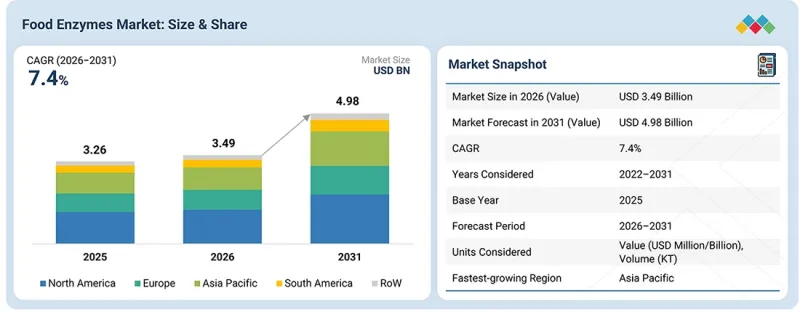
식품용 효소 시장은 2026년에 34억 9,000만 달러로 추산되며, 2031년까지 연평균 성장률(CAGR) 7.4%를 기록하며 49억 8,000만 달러에 달할 것으로 전망됩니다.
식품용 효소 시장은 제빵·제과, 유제품, 음료, 양조, 전분·설탕 가공, 육류 가공 및 기타 식품 용도 분야에서 효율적이고 지속가능하며 비용 효율적인 가공 솔루션에 대한 수요가 증가함에 따라 강력한 성장이 예상됩니다.
| 조사 범위 | |
|---|---|
| 조사 대상 기간 | 2022-2031년 |
| 기준 연도 | 2025년 |
| 예측 기간 | 2026-2031년 |
| 산정 단위 | 금액(백만/십억 달러) 및 수량(천 톤) |
| 부문 | 유형, 원료, 용도, 기능적 역할, 제형 및 지역별 |
| 대상 지역 | 북미, 유럽, 아시아태평양, 남미, 기타 지역 |
가공식품 및 편의식품, 클린 라벨 제품에 대한 수요 증가, 제품 품질 향상, 그리고 에너지, 물, 원자재 소비를 줄이면서 가공 효율을 높여야 할 필요성이 효소 도입을 촉진하고 있습니다.
각 제조사는 진화하는 식품 업계의 요구 사항에 대응하기 위해 효소 공학, 안정성 및 특이성 향상, 용도에 특화된 제형, 그리고 첨단 발효 기술에 점점 더 주력하고 있습니다. 화학적 가공 보조제의 대체재로서 효소의 활용 확대에 더해, 클린 라벨 가공, 유통기한 연장, 식감 개선, 수율 향상과 같은 용도의 확대가 식품 효소 시장에 진출한 기업들에게 새로운 기회를 창출하고 있습니다.
“유형별로는 예측 기간 동안 폴리메라제 및 뉴클레아제가 식품용 효소 중 가장 높은 성장률을 보일 것으로 예상됩니다.”
폴리머라제 및 뉴클레아제 부문은 첨단 식품 가공, 생명공학 및 식품 분석 용도에서 특수 효소의 채택 확대에 힘입어 식품 효소 시장에서 가장 높은 성장률을 보일 것으로 예측됩니다. 폴리메라제 및 뉴클레아제는 핵산의 변형, 합성 또는 분해를 촉진하며, 식품 제조업체와 생명공학 기업이 정밀하고 용도에 특화된 공정을 위해 효소 기반 기술을 점점 더 많이 채택함에 따라 그 중요성이 커지고 있습니다. 이 부문의 성장은 효소 공학, 분자 생물학, 생명공학의 발전에 의해 더욱 가속화되고 있으며, 이를 통해 특이성과 성능이 향상된 효소의 개발이 가능해졌습니다. 식품 품질 분석, 원료 개발, 발효 연구 및 기타 신흥 식품 생명공학 공정에서의 응용 분야 확대가 폴리머라제 및 뉴클레아제에 더 많은 기회를 가져다줄 것으로 예상됩니다. 이러한 동향으로 인해 예측 기간 동안 해당 부문의 급속한 성장이 촉진될 것으로 전망됩니다.
“원료별로는 예측 기간 동안 식물 유래 식품 효소가 큰 시장 점유율을 차지할 것으로 예상됩니다.”
식물 유래 부문은 지속가능하고 채식주의자용이며 클린 라벨 식품에 대한 수요 증가에 힘입어 식품용 효소 시장에서 큰 점유율을 차지하고 있습니다. 파파인, 브로멜라인, 프로테아제 등의 식물 유래 효소는 천연 유래이며 소비자에게 수용되기 쉬운 특성을 가지고 있어 제빵, 유제품 대체품, 식물성 단백질 함유 제품 등에서 널리 사용되고 있습니다. 각 제조사들은 비건 제품과의 친화성 및 전 세계 시장의 규제 승인을 이유로 식물 유래 효소를 점점 더 많이 선택하고 있습니다. 이 부문의 성장은 식물 유래 식품의 풍미와 식감을 향상시키는 Biocatalysts Ltd.의 ‘PlantPro’ 시리즈(영국, 2024년)와 같은 혁신에 의해 더욱 가속화되고 있습니다.
“예측 기간 동안 아시아태평양은 식품용 효소 시장에서 가장 빠르게 성장하는 지역이 될 것으로 예상됩니다.”
아시아태평양은 식품 가공 부문의 급속한 확대, 기능성 식품 및 클린 라벨 식품에 대한 수요 증가, 그리고 강력한 규제적 지원에 힘입어 전 세계 식품 효소 산업에서 가장 빠르게 성장하는 시장으로 인식되고 있습니다. 중국, 인도, 일본 등의 국가들은 선진적인 생명공학 인프라와 건강 지향 및 지속가능한 식품에 대한 소비자 선호도의 변화에 힘입어 이러한 성장의 최전선에 서 있습니다. 이 지역에서는 제빵, 유제품, 음료 등 주요 용도 분야에서 혁신적인 효소 기술의 도입이 가속화되고 있으며, 이는 제품의 품질, 유통기한, 영양가 향상을 뒷받침하고 있습니다. 이 지역의 규제 당국은 혁신과 제품 상용화를 촉진하는 데 있어 매우 중요한 역할을 하고 있습니다. ISAAA가 2025년 6월에 발표한 기사에 따르면, 최근 사례로 중국이 식품 가공 용도로 3종류의 유전자 변형 미생물(GMM) 유래 효소-퍼옥시다제, 자일라나제, 락토-N-네오테트라오스-의 사용을 승인한 것이 최근 사례로 꼽히며, 식품 생산 분야에서 생명공학의 수용이 확대되고 있음을 여실히 보여주고 있습니다. 또한, 미생물 발효 및 효소 고정화 등의 기술적 진보가 주요 시장 전반에서 적극적으로 활용되고 있습니다. 이러한 발전이 맞물려 아시아태평양은 식품 효소 시장에서 가장 역동적이고 빠르게 진화하는 지역으로서의 위상을 확립하고 있으며, 세계 및 지역 기업들에게 광범위한 비즈니스 기회를 제공하고 있습니다.
- 기업 유형별 : Tier 1 - 30%, Tier 2 - 25%, Tier 3 - 45%
- 직책별 : CXO - 25%, 관리자 - 35%, 기타 - 40%
- 지역별 : 북미 - 20%, 유럽 - 30%, 아시아태평양 - 35%, 남미 - 10%, 기타 지역 - 5%
조사 범위
본 조사 보고서에서는 식품용 효소 시장을 유형(탄수화물 분해 효소, 단백질 분해 효소, 지방 분해 효소, 폴리머라제 및 뉴클레아제, 기타), 원료(미생물, 동물, 식물), 용도(음식·음료), 제형(동결건조 분말, 액체, 기타 제형), 기능적 역할(가수분해, 육질 연화, 유통기한 연장, 기타), 및 지역(북미, 유럽, 아시아태평양, 남미, 기타 지역)에 따라 분류하고 있습니다.
본 보고서의 조사 범위에는 식품 효소 산업의 성장에 영향을 미치는 주요 요인(촉진요인, 제약요인, 과제 및 기회 등)에 대한 상세한 정보가 포함되어 있습니다. 주요 업계 플레이어에 대한 철저한 분석을 통해 그들의 사업, 서비스, 주요 전략, 계약, 제휴, 합의, 제품 출시, 합병 및 인수, 그리고 식품 효소 시장과 관련된 최근 동향에 대한 인사이트를 제공합니다. 본 보고서에는 식품 효소 시장의 생태계에서 두각을 나타내고 있는 스타트업 기업에 대한 경쟁 분석도 수록되어 있습니다. 또한, 본 조사에서는 기술 분석, 생태계 및 시장 매핑, 특허·규제 현황 등 업계 특유의 동향에 대해서도 포괄적으로 다루고 있습니다.
본 보고서를 구매해야 하는 이유
본 보고서는 시장 선도 기업 및 신규 진입 기업에게 식품 효소 시장 전체 및 그 하위 부문의 매출에 대한 가장 정확한 추정치를 제공합니다. 이를 통해 이해관계자는 경쟁 구도를 이해하고, 자사의 비즈니스를 더 나은 위치로 이끌며, 적절한 시장 진입 전략을 수립하기 위한 추가적인 인사이트를 얻을 수 있습니다. 또한, 본 보고서는 이해관계자가 시장 동향을 파악하는 데 도움이 되며, 주요 시장 촉진요인, 억제요인, 과제 및 기회에 대한 정보를 제공합니다.
본 보고서는 다음 사항에 대한 인사이트를 제공합니다:
- 식품 효소 시장의 성장에 영향을 미치는 주요 촉진요인(클린 라벨 및 천연 원료 동향의 확대), 제약요인(효소의 불안정성), 성장 기회(기능성·영양 강화 식품의 혁신), 과제(효소 기능 유지의 어려움)에 대한 분석
- 제품 개발 및 혁신 : 식품 효소 시장의 연구 개발 활동 및 신제품 출시에 대한 상세한 인사이트
- 시장 개발 : 다양한 지역에서 식품용 효소의 수익성 높은 시장 분석에 관한 종합적인 정보
- 시장 다각화 : 식품 효소 시장의 신제품 유형, 미개척 지역, 최근 동향 및 투자에 관한 종합적인 정보
- 경쟁 평가 : 주요 기업의 시장 점유율, 성장 전략, 제품 라인업, 브랜드 및 제품 비교, 그리고 식품용 효소 시장 내 제품 전개 현황에 대한 상세한 평가
자주 묻는 질문
목차
제1장 서론
제2장 조사 방법
제3장 요약
제4장 주요 인사이트
- 식품 효소 시장에서 사업자에게 매력적인 비즈니스 기회
- 식품용 효소 시장 : 북미 지역별·용도별
- 식품용 효소 시장 : 용도별·지역별
- 식품용 효소 시장 : 유형별
- 식품용 효소 시장 : 원료별
- 식품용 효소 시장 : 제형별
- 식품용 효소 시장 : 주요 지역별 하위 시장 점유율
제5장 시장 개요
- 거시경제 지표
- 소매 매출 증가
- 시장 역학
- 성장 촉진요인
- 성장 억제요인
- 기회
- 과제
- AI/범용 AI가 식품용 효소 시장에 미치는 영향
- 식품용 효소 시장에서 생성형 AI의 활용
- 사례 연구 분석
- 식품용 효소 시장에 미치는 영향
- 생성형 AI를 다루는 관련 생태계
제6장 업계 동향
- 공급망 분석
- 밸류체인 분석
- 무역 분석
- 수입 시나리오 - HS 코드 : 350790 효소 및 조제 효소, 기타(렌넷 및 그 농축물 제외)
- 수출 시나리오 - HS 코드 : 350790 효소 및 조제 효소, 기타(렌넷 및 그 농축물 제외)
- 기술 분석
- 주요 기술
- 보완 기술
- 인접 기술
- 고객의 사업에 영향을 미치는 동향/디스럽션
- 규제 현황
- 규제 기관, 정부 기관 및 기타 조직
- 규제
- 특허 분석
- 가격 분석
- 주요 기업의 제품 유형별 참고 판매 가격
- 유형별 평균 판매 가격 동향 분석
- 지역별 평균 판매 가격 동향 분석
- 생태계 분석
- 수요 측면
- 공급 측면
- Porter's Five Forces 분석
- 경쟁 기업 간의 적대적 관계
- 공급 기업의 협상력
- 구매자의 협상력
- 대체품의 위협
- 신규 진입자의 위협
- 주요 이해관계자와 구매 기준
- 구매 프로세스 내 주요 이해관계자
- 구매 기준
- 2025-2026년 주요 회의 및 행사
- 사례 연구 분석
- INTERNATIONAL FLAVORS & FRAGRANCES INC.는 제품 라인업 확충을 위해 KEMIRA와 제휴했습니다
- DSM-FIRMENICH는 양조업체의 부원료 양조를 지원하는 새로운 효소를 출시했습니다
- INTERNATIONAL FLAVORS & FRAGRANCES INC.(미국)는 유제품용 새로운 효소를 출시하여 유당 함량을 낮추는 동시에 균형 잡힌 단맛을 구현했습니다
- 투자 및 자금 조달 동향
- 2025년 미국 관세가 식품용 효소 시장에 미치는 영향
- 주요 관세율
- 가격에 미치는 영향 분석
- 국가 및 지역별 영향
- 최종 이용 산업에 미치는 영향
제7장 식품용 효소 시장 : 유형별
- 탄수화물 분해 효소
- 프로테아제
- 리파제
- 폴리머라제 및 뉴클레아제
- 기타 종류
제8장 식품용 효소 시장 : 용도별
- 식품
- 음료
제9장 식품용 효소 시장 : 원료별
- 미생물
- 식물
- 동물
제10장 식품용 효소 시장 : 제형별
- 동결건조 분말
- 액체
- 기타 제형
제11장 식품용 효소 시장 : 기능별
- 가수분해
- 육질 연화
- 유통기한 연장
- 기타
제12장 식품용 효소 시장 : 기술별
- 고상 발효
- 침지 발효
- 재조합 DNA(RDNA) 기술
- 천연 자원으로부터의 추출
- 고정화 효소 기술
제13장 식품용 효소 시장 : 지역별
- 북미
- 미국
- 캐나다
- 멕시코
- 유럽
- 독일
- 이탈리아
- 프랑스
- 스페인
- 영국
- 기타 유럽
- 아시아태평양
- 중국
- 인도
- 일본
- 말레이시아
- 싱가포르
- 인도네시아
- 베트남
- 필리핀
- 한국
- 호주·뉴질랜드
- 기타 아시아태평양
- 남미
- 브라질
- 아르헨티나
- 기타 남미
- 중동
- 아프리카
제14장 경쟁 현황
- 개요
- 주요 참여 기업의 전략/강점, 2021-2024년
- 수익 분석, 2022-2024년
- 시장 점유율 분석(2024년)
- 시장 순위 분석
- 기업 가치 평가 및 재무 지표
- 브랜드 및 제품 비교
- 기업 평가 매트릭스 : 주요 기업, 2024년
- 스타 기업
- 신흥 리더
- 광범위한 영향력을 가진 기업
- 진출 기업
- 기업의 사업 전개 : 주요 기업, 2024년
- 기업 평가 매트릭스 : 스타트업/중소기업, 2024년
- 선도적인 기업
- 대응력이 뛰어난 기업
- 역동적인 기업
- 출발점
- 경쟁사 벤치마킹 : 스타트업/중소기업, 2024년
- 경쟁 시나리오 및 동향
- 신제품 출시
- 거래
- 사업 확장
제15장 기업 개요
- 주요 기업
- INTERNATIONAL FLAVORS &FRAGRANCES INC.
- ASSOCIATED BRITISH FOODS PLC
- DSM-FIRMENICH
- NOVONESIS
- KERRY GROUP PLC
- ADM
- ADVANCED ENZYME TECHNOLOGIES
- BOLI BIOPRODUCTS
- AMANO ENZYME INC.
- LESAFFRE CORPORATION
- MEGAZYME LTD.
- ENZYME DEVELOPMENT CORPORATION
- LALLEMAND INC
- K-GENIX GROUP
- BIOCATALYSTS
- 기타 주요 기업
- SUNSON INDUSTRY GROUP CO., LTD
- AUMGENE BIOSCIENCES
- CREATIVE ENZYMES
- XIKE ENZYMES
- ULTREZE ENZYMES
- INFINITA BIOTECH PRIVATE LIMITED
- FUTURA INGREDIENTS
- LEVEKING
- ANTOZYME BIOTECH PVT. LTD.
- AUMENZYMES
제16장 인접 시장 및 관련 시장
- 본 조사의 한계
- 산업용 효소 시장
- 시장의 정의
- 시장 개요
- 효소 시장
- 시장의 정의
- 시장 개요
- 특수 효소 시장
- 시장 정의
- 시장 개요
제17장 부록
KSM 26.10.26The food enzymes market is estimated to be USD 3.49 billion in 2026 and is projected to reach USD 4.98 billion by 2031, at a CAGR of 7.4%. The food enzymes market is expected to witness strong growth, driven by increasing demand for efficient, sustainable, and cost-effective processing solutions across bakery & confectionery, dairy, beverages, brewing, starch & sugar processing, meat processing, and other food applications.
| Scope of the Report | |
|---|---|
| Years Considered for the Study | 2022-2031 |
| Base Year | 2025 |
| Forecast Period | 2026-2031 |
| Units Considered | Value (USD Million/Billion) and Volume (KT) |
| Segments | By Type, Source, Application, Functional Role, Formulation, and Region |
| Regions covered | North America, Europe, Asia Pacific, South America, RoW |
Growing demand for processed and convenience foods, clean-label products, improved product quality, and the need to enhance processing efficiency while reducing energy, water, and raw material consumption are supporting enzyme adoption.
Manufacturers are increasingly focusing on enzyme engineering, improved stability and specificity, application-specific formulations, and advanced fermentation technologies to address evolving food industry requirements. The growing use of enzymes as alternatives to chemical processing aids, together with expanding applications in clean-label processing, shelf-life extension, texture improvement, and yield enhancement, is creating new opportunities for food enzymes market participants.
"By type, polymerases & nucleases are expected to be the fastest-growing food enzyme type during the forecast period"
The polymerases & nucleases segment is projected to exhibit the highest growth rate in the Food Enzymes Market, supported by increasing adoption of specialized enzymes in advanced food processing, biotechnology, and food analysis applications. Polymerases and nucleases facilitate the modification, synthesis, or breakdown of nucleic acids and are gaining relevance as food manufacturers and biotechnology companies increasingly adopt enzyme-based technologies for precise and application-specific processes. The segment's growth is further supported by advances in enzyme engineering, molecular biology, and biotechnology, which are enabling the development of enzymes with improved specificity and performance. Increasing applications in food quality analysis, ingredient development, fermentation research, and other emerging food biotechnology processes are expected to create additional opportunities for polymerases and nucleases. These developments are expected to support the rapid expansion of the segment during the forecast period.
"By source, plant is expected to hold a significant market share in food enzymes during the forecast period."
The plant source segment holds a significant share in the food enzymes market, driven by the growing demand for sustainable, vegetarian, and clean-label food products. Enzymes derived from plants, such as papain, bromelain, and proteases, are widely used in baking, dairy alternatives, and plant-based protein formulations due to their natural origin and consumer-friendly profile. Manufacturers are increasingly opting for plant-based enzymes due to their compatibility with vegan products and regulatory acceptance across global markets. This segment's growth is further supported by innovations like Biocatalysts Ltd.'s PlantPro range (UK, 2024), which enhances flavor and texture in plant-based foods.
"Asia Pacific is expected to be the fastest-growing region in the food enzymes market during the forecast period."
The Asia Pacific region is recognized as the fastest-growing market in the global food enzymes industry, fueled by the rapid expansion of the food processing sector, increasing demand for functional and clean-label foods, and strong regulatory support. Countries such as China, India, and Japan are at the forefront of this growth, driven by advanced biotechnology infrastructure and shifting consumer preferences toward health-focused and sustainable food products. The region is witnessing accelerated adoption of innovative enzyme technologies in key applications, such as bakery, dairy, and beverages, supporting enhanced product quality, shelf life, and nutritional value. Regulatory bodies in the region are playing a pivotal role in encouraging innovation and product commercialization. According to an article published by ISAAA in June 2025, a recent example includes China's approval of three genetically modified microorganisms (GMM)-derived enzymes-peroxidase, xylanase, and lacto-N-neotetraose-for use in food processing, highlighting the growing acceptance of biotechnology in food production. Additionally, advancements such as microbial fermentation and enzyme immobilization are being actively leveraged across major markets. These developments collectively position Asia Pacific as the most dynamic and rapidly evolving region in the food enzymes market, offering vast opportunities for global and regional players.
In-depth interviews have been conducted with chief executive officers (CEOs), directors, and other executives from various key organizations operating in the Food Enzymes Market.
- By Company Type: Tier 1 - 30%, Tier 2 - 25%, and Tier 3 - 45%
- By Designation: CXOs - 25%, Managers - 35%, Others - 40%
- By Region: North America - 20%, Europe - 30%, Asia Pacific - 35%, South America - 10%, and Rest of the World -5%
Prominent companies in the market include ADM (US), International Flavors & Fragrances Inc. (US), dsm-firmenich (Switzerland), Associated British Foods plc (UK), Novonesis Group, and others.
Research Coverage
This research report categorizes the Food Enzymes Market by type (carbohydrases, proteases, lipases, polymerases & nucleases, and other types), source (microorganisms, animals, and plants), application (food and beverages), formulation (lyophilized powder, liquid, and other formulations), functional role (hydrolysis, tenderization, shelf-life enhancement, and others), and region (North America, Europe, Asia Pacific, South America, and Rest of the World).
The report's scope encompasses detailed information on the major factors, including drivers, restraints, challenges, and opportunities, that influence the growth of the food enzyme industry. A thorough analysis of the key industry players has been carried out to provide insights into their business, services, key strategies, contracts, partnerships, agreements, product launches, mergers & acquisitions, and recent developments associated with the food enzymes market. This report provides a competitive analysis of emerging startups in the food enzymes market ecosystem. Furthermore, the study covers industry-specific trends, including technology analysis, ecosystem & market mapping, and patent & regulatory landscape, among others.
Reasons to Buy This Report
The report provides market leaders/new entrants with information on the closest approximations of revenue numbers for the overall food enzymes market and its subsegments. It will help stakeholders understand the competitive landscape and gain more insights to better position their businesses and plan suitable go-to-market strategies. The report also helps stakeholders understand the pulse of the market and provides them with information on key market drivers, restraints, challenges, and opportunities.
The report provides insights into the following pointers:
- Analysis of key drivers (growth in clean-label & natural ingredient trends), restraints (enzyme instability), opportunities (functional/fortified food innovations), and challenges (difficulty of preserving enzyme functionality) influencing the growth of the food enzymes market
- Product Development/Innovation: Detailed insights into research & development activities and new product launches in the food enzymes market
- Market Development: Comprehensive information about lucrative market analysis of food enzymes across varied regions
- Market Diversification: Exhaustive information about new product types, untapped geographies, recent developments, and investments in the food enzymes market
- Competitive Assessment: In-depth assessment of market shares, growth strategies, product offerings, brand/product comparison, and product footprints of leading players such as International Flavors and Fragrances Inc. (US), Associated British Foods plc (UK), dsm-firmenich (Netherlands), Novonesis Group (Denmark), Kerry Group plc (Ireland), ADM (US), Advanced Enzyme Technologies (India), Boli Bioproducts (China), Amano Enzyme Inc. (Japan), Lesaffre Corporation (France), Neogen Corporation (US), Enzyme Development Corporation (US), Lallemand Inc (Canada), K-Genix Group (India), and Biocatalysts (UK) in the food enzymes market
TABLE OF CONTENTS
1 INTRODUCTION
- 1.1 STUDY OBJECTIVES
- 1.2 MARKET DEFINITION
- 1.3 STUDY SCOPE
- 1.3.1 MARKET SEGMENTATION AND REGIONS COVERED
- 1.3.2 INCLUSIONS AND EXCLUSIONS
- 1.3.3 YEARS CONSIDERED
- 1.4 UNITS CONSIDERED
- 1.4.1 CURRENCY CONSIDERED
- 1.5 STAKEHOLDERS
- 1.6 SUMMARY OF CHANGES
2 RESEARCH METHODOLOGY
- 2.1 RESEARCH DATA
- 2.1.1 SECONDARY DATA
- 2.1.1.1 Key data from secondary sources
- 2.1.2 PRIMARY DATA
- 2.1.2.1 Key data from primary sources
- 2.1.2.2 Breakdown of primary interviews
- 2.1.2.3 Key insights from industry experts
- 2.1.1 SECONDARY DATA
- 2.2 MARKET SIZE ESTIMATION
- 2.2.1 TOP-DOWN APPROACH
- 2.2.2 SUPPLY-SIDE ANALYSIS
- 2.2.3 BOTTOM-UP APPROACH
- 2.3 DATA TRIANGULATION
- 2.4 RESEARCH ASSUMPTIONS
- 2.5 RESEARCH LIMITATIONS AND RISK ASSESSMENT
3 EXECUTIVE SUMMARY
4 PREMIUM INSIGHTS
- 4.1 ATTRACTIVE OPPORTUNITIES FOR PLAYERS IN FOOD ENZYMES MARKET
- 4.2 NORTH AMERICA: FOOD ENZYMES MARKET, BY APPLICATION AND COUNTRY
- 4.3 FOOD ENZYMES MARKET, BY APPLICATION AND REGION
- 4.4 FOOD ENZYMES MARKET, BY TYPE
- 4.5 FOOD ENZYMES MARKET, BY SOURCE
- 4.6 FOOD ENZYMES MARKET, BY FORMULATION
- 4.7 FOOD ENZYMES MARKET: SHARE OF MAJOR REGIONAL SUBMARKETS
5 MARKET OVERVIEW
- 5.1 INTRODUCTION
- 5.2 MACROECONOMIC INDICATORS
- 5.2.1 INCREASE IN RETAIL SALES
- 5.3 MARKET DYNAMICS
- 5.3.1 DRIVERS
- 5.3.1.1 Rising demand for plant-based foods
- 5.3.1.2 Driving sustainability through enzyme innovation
- 5.3.1.3 Use of enzymes in various industries
- 5.3.1.4 Rising global demand for clean-label ingredients
- 5.3.2 RESTRAINTS
- 5.3.2.1 Actions of enzymes restricted to various external factors
- 5.3.2.2 Stringent regulatory guidelines for manufacturers
- 5.3.2.3 High costs incurred by SMEs who adapt to new technologies
- 5.3.3 OPPORTUNITIES
- 5.3.3.1 Demand for natural substitutes of synthetic chemicals
- 5.3.3.2 Innovations in technologies and a wide industry scope
- 5.3.3.3 Development of enzymes with longer shelf life
- 5.3.3.3.1 Encapsulation to enhance shelf life
- 5.3.4 CHALLENGES
- 5.3.4.1 Excessive costs of raw materials limiting enzyme usage
- 5.3.4.2 Concerns over quality used in food & beverages
- 5.3.4.3 Lack of transparency in patent protection laws
- 5.3.1 DRIVERS
- 5.4 IMPACT OF AI/GEN AI ON FOOD ENZYMES MARKET
- 5.4.1 USE OF GEN AI IN FOOD ENZYMES MARKET
- 5.4.2 CASE STUDY ANALYSIS
- 5.4.2.1 AI to discover new and fast enzyme production
- 5.4.2.2 AI Optimization for Enzyme Selection
- 5.4.3 IMPACT ON FOOD ENZYMES MARKET
- 5.4.4 ADJACENT ECOSYSTEM WORKING ON GENERATIVE AI
6 INDUSTRY TRENDS
- 6.1 INTRODUCTION
- 6.2 SUPPLY CHAIN ANALYSIS
- 6.3 VALUE CHAIN ANALYSIS
- 6.4 TRADE ANALYSIS
- 6.4.1 IMPORT SCENARIO - HS CODE: 350790 ENZYMES AND PREPARED ENZYMES, N.E.S. (EXCL. RENNET AND CONCENTRATES THEREOF)
- 6.4.2 EXPORT SCENARIO - HS CODE: 350790 ENZYMES AND PREPARED ENZYMES, N.E.S. (EXCL. RENNET AND CONCENTRATES THEREOF)
- 6.5 TECHNOLOGY ANALYSIS
- 6.5.1 KEY TECHNOLOGIES
- 6.5.1.1 Artificial intelligence in enzyme design
- 6.5.1.2 Precision fermentation
- 6.5.2 COMPLEMENTARY TECHNOLOGIES
- 6.5.2.1 Food enzymes and encapsulation
- 6.5.3 ADJACENT TECHNOLOGIES
- 6.5.3.1 Solid-state fermentation
- 6.5.1 KEY TECHNOLOGIES
- 6.6 TRENDS/DISRUPTIONS IMPACTING CUSTOMER BUSINESS
- 6.7 REGULATORY LANDSCAPE
- 6.7.1 REGULATORY BODIES, GOVERNMENT AGENCIES, AND OTHER ORGANIZATIONS
- 6.7.2 REGULATIONS
- 6.7.2.1 North America
- 6.7.2.1.1 US
- 6.7.2.1.2 Canada
- 6.7.2.1.3 Mexico
- 6.7.2.2 Europe
- 6.7.2.2.1 EU legislation relevant to food enzymes
- 6.7.2.3 Asia Pacific
- 6.7.2.3.1 India
- 6.7.2.3.2 China
- 6.7.2.3.3 Australia & New Zealand
- 6.7.2.3.4 Japan
- 6.7.2.1 North America
- 6.8 PATENT ANALYSIS
- 6.9 PRICING ANALYSIS
- 6.9.1 INDICATIVE SELLING PRICE OF KEY PLAYERS, BY TYPE
- 6.9.2 AVERAGE SELLING PRICE TREND ANALYSIS, BY TYPE
- 6.9.3 AVERAGE SELLING PRICE TREND ANALYSIS, BY REGION
- 6.10 ECOSYSTEM ANALYSIS
- 6.10.1 DEMAND SIDE
- 6.10.2 SUPPLY SIDE
- 6.11 PORTER'S FIVE FORCES ANALYSIS
- 6.11.1 INTENSITY OF COMPETITIVE RIVALRY
- 6.11.2 BARGAINING POWER OF SUPPLIERS
- 6.11.3 BARGAINING POWER OF BUYERS
- 6.11.4 THREAT OF SUBSTITUTES
- 6.11.5 THREAT OF NEW ENTRANTS
- 6.12 KEY STAKEHOLDERS AND BUYING CRITERIA
- 6.12.1 KEY STAKEHOLDERS IN BUYING PROCESS
- 6.12.2 BUYING CRITERIA
- 6.13 KEY CONFERENCES AND EVENTS, 2025-2026
- 6.14 CASE STUDY ANALYSIS
- 6.14.1 INTERNATIONAL FLAVORS & FRAGRANCES INC. PARTNERED WITH KEMIRA TO EXPAND PRODUCT RANGE
- 6.14.2 DSM-FIRMENICH COMPANY LAUNCHED NEW ENZYME TO AID BREWERS IN ADJUNCT BREWING
- 6.14.3 INTERNATIONAL FLAVORS & FRAGRANCES INC. (US) LAUNCHED A NEW ENZYME FOR DAIRY PRODUCTS TO REDUCE LACTOSE LEVELS AND BRING BALANCED SWEETNESS
- 6.15 INVESTMENT AND FUNDING SCENARIO
- 6.16 2025 US TARIFF IMPACT ON FOOD ENZYMES MARKET
- 6.16.1 INTRODUCTION
- 6.16.2 KEY TARIFF RATES
- 6.16.3 PRICE IMPACT ANALYSIS
- 6.16.4 IMPACT ON COUNTRY/REGION
- 6.16.4.1 North America
- 6.16.4.2 Europe
- 6.16.4.3 Asia Pacific
- 6.16.5 IMPACT ON END-USE INDUSTRIES
7 FOOD ENZYMES MARKET, BY TYPE
- 7.1 INTRODUCTION
- 7.2 CARBOHYDRASES
- 7.2.1 AMYLASE
- 7.2.1.1 Increasing demand for efficient starch conversion and clean-label bakery & brewing solutions
- 7.2.2 CELLULASE
- 7.2.2.1 Growing demand for improved texture, stability, and fiber modification in bakery and beverage products
- 7.2.3 LACTASE
- 7.2.3.1 Rising demand for lactose-free dairy products to address intolerance and support digestive health
- 7.2.4 PECTINASE
- 7.2.4.1 Rising consumption of premium clear juices and stable fruit-based beverages boosts pectinase demand
- 7.2.5 OTHER CARBOHYDRASES
- 7.2.1 AMYLASE
- 7.3 PROTEASE
- 7.3.1 RISING DEMAND FOR TENDERIZED MEAT, CHEESE TEXTURE ENHANCEMENT, AND PROTEIN HYDROLYSIS IN FUNCTIONAL FOODS
- 7.3.2 SERINE PROTEASES
- 7.3.2.1 Broad industrial application in food processing, driven by high catalytic efficiency and stability
- 7.3.3 CYSTEINE PROTEASES
- 7.3.3.1 Increased use in meat tenderization and plant-based enzyme applications supporting clean-label trends
- 7.3.4 ASPARTIC PROTEASES
- 7.3.4.1 Rising demand for dairy applications utilizing aspartic proteases for efficient milk coagulation
- 7.3.5 METALLOPROTEASES
- 7.3.5.1 Expanding utilization in protein hydrolysis for nutritional supplements and functional food applications
- 7.4 LIPASE
- 7.4.1 EXPANDING ROLE OF LIPASES IN FLAVOR ENHANCEMENT, FAT MODIFICATION, AND CLEAN-LABEL DAIRY INNOVATION
- 7.4.2 MICROBIAL LIPASES
- 7.4.2.1 Growing preference for cost-efficient, stable microbial lipases in dairy, bakery, and flavor industries
- 7.4.3 ANIMAL-DERIVED LIPASES
- 7.4.3.1 Continued niche application of animal lipases in traditional dairy and meat-based flavor formulations
- 7.4.4 RECOMBINANT LIPASES
- 7.4.4.1 Advancements in genetic engineering driving growth of high-performance recombinant lipases for food applications
- 7.5 POLYMERASE & NUCLEASE
- 7.5.1 PRECISION FARMING, HYDROPONICS, AND SOLAR SOLUTIONS DRIVING SUSTAINABLE HORTICULTURE
- 7.5.2 DNA POLYMERASES
- 7.5.2.1 Expanding use of DNA polymerases in functional foods and precision fermentation-based enzyme applications
- 7.5.3 RNA POLYMERASES
- 7.5.3.1 Rising integration of RNA polymerases in microbial engineering and enzyme expression optimization
- 7.5.4 DNASES
- 7.5.4.1 Expanding utilization of DNases in food safety, processing hygiene, and allergen reduction applications
- 7.6 OTHER TYPES
8 FOOD ENZYMES MARKET, BY APPLICATION
- 8.1 INTRODUCTION
- 8.2 FOOD
- 8.2.1 MEAT PRODUCTS
- 8.2.1.1 Red Meat
- 8.2.1.1.1 Rising demand for tenderized red meat with improved texture, flavor, and processing efficiency
- 8.2.1.2 Poultry
- 8.2.1.2.1 Increasing demand for tender, flavorful poultry products with enhanced processing efficiency and consistency
- 8.2.1.3 Processed/Cured Meat
- 8.2.1.3.1 Growing demand for consistent quality, flavor, and extended shelf life in processed and cured meats
- 8.2.1.1 Red Meat
- 8.2.2 DAIRY PRODUCTS
- 8.2.2.1 Milk
- 8.2.2.1.1 Rising demand for lactose-free and functional milk products to meet diverse consumer dietary needs
- 8.2.2.2 Cheese
- 8.2.2.2.1 Expanding global cheese consumption and preference for consistent quality through enzyme applications
- 8.2.2.3 Yogurt
- 8.2.2.3.1 Rising demand for probiotic and functional yogurts with improved texture and digestibility
- 8.2.2.4 Ice Cream
- 8.2.2.4.1 Increasing demand for premium ice creams with superior texture and reduced sugar formulations
- 8.2.2.1 Milk
- 8.2.3 BAKERY & CONFECTIONERY PRODUCTS
- 8.2.3.1 Bread
- 8.2.3.1.1 Rising consumer preference for fresh, soft bread with extended shelf life and reduced additives
- 8.2.3.2 Cakes & Pastries
- 8.2.3.2.1 Growing demand for premium, indulgent bakery products with improved texture, stability, and clean-label formulations
- 8.2.3.3 Biscuits & Cookies
- 8.2.3.3.1 Increasing production of consistent, crispy biscuits and cookies with enhanced process efficiency
- 8.2.3.4 Chocolate & Candies
- 8.2.3.4.1 Rising demand for reduced-sugar and functional confectionery supported by enzymatic innovations
- 8.2.3.1 Bread
- 8.2.4 NUTRACEUTICALS
- 8.2.4.1 Functional Foods
- 8.2.4.1.1 Rising demand for functional foods enriched with bioactive compounds and improved digestibility
- 8.2.4.2 Dietary Supplements
- 8.2.4.2.1 Expanding global demand for enzyme-based dietary supplements to support digestion and nutrient absorption
- 8.2.4.3 Protein Hydrolysates
- 8.2.4.3.1 Growing demand for hydrolyzed proteins in sports nutrition, infant formula, and clinical nutrition
- 8.2.4.1 Functional Foods
- 8.2.5 OTHER FOOD PRODUCTS
- 8.2.5.1 Ready-to-Eat (RTE) Meals
- 8.2.5.1.1 Rising demand for convenient, ready-to-eat meals with improved quality, stability, and shelf life
- 8.2.5.2 Sauces and Dressings
- 8.2.5.2.1 Expanding consumer preference for clean-label sauces and dressings with consistent flavor and texture
- 8.2.5.3 Packaged Foods
- 8.2.5.3.1 Rising demand for high-quality packaged foods with natural preservation and extended shelf life
- 8.2.5.1 Ready-to-Eat (RTE) Meals
- 8.2.1 MEAT PRODUCTS
- 8.3 BEVERAGES
- 8.3.1 JUICES
- 8.3.1.1 Apple
- 8.3.1.1.1 Growing demand for clear, premium apple juices with improved clarity and extraction efficiency
- 8.3.1.2 Citrus
- 8.3.1.2.1 Rising consumer demand for high-quality citrus juices with longer shelf life and stable clarity
- 8.3.1.3 Berry-based Juices
- 8.3.1.3.1 Increasing demand for antioxidant-rich berry juices with enhanced color, stability, and bioactive release
- 8.3.1.1 Apple
- 8.3.2 BREWING
- 8.3.2.1 Beer
- 8.3.2.1.1 Rising global beer consumption and need for efficient, high-quality brewing processes
- 8.3.2.2 Ale
- 8.3.2.2.1 Expanding craft ale market driven by diverse flavor profiles and artisanal brewing innovation
- 8.3.2.3 Low-/Alcohol-free Beverages
- 8.3.2.3.1 Rising health-conscious consumer demand for low-calorie, low-alcohol, and alcohol-free beers
- 8.3.2.1 Beer
- 8.3.3 OTHER BEVERAGES
- 8.3.1 JUICES
9 FOOD ENZYMES MARKET, BY SOURCE
- 9.1 INTRODUCTION
- 9.2 MICROORGANISMS
- 9.2.1 BACTERIA
- 9.2.1.1 Rising adoption of Bacillus-derived enzymes for high-yield, stable, and cost-efficient food processing
- 9.2.2 FUNGI
- 9.2.2.1 Increasing reliance on fungal enzymes for efficient juice clarification, lactose hydrolysis, and flavor development
- 9.2.3 RECOMBINANT/ENGINEERED MICROORGANISMS
- 9.2.3.1 Growing adoption of recombinant strains for high-yield, stable, and customizable food enzyme production
- 9.2.1 BACTERIA
- 9.3 PLANTS
- 9.3.1 PAPAIN
- 9.3.1.1 Rising demand for natural plant-based enzymes supporting clean-label meat processing and functional foods
- 9.3.2 BROMELAIN
- 9.3.2.1 Expanding use of bromelain in food processing and nutraceuticals for multifunctional health benefits
- 9.3.3 OTHER PLANT PROTEASES
- 9.3.1 PAPAIN
- 9.4 ANIMALS
- 9.4.1 SHIFT FROM TRADITIONAL ANIMAL-DERIVED ENZYMES TO MICROBIAL AND RECOMBINANT ALTERNATIVES IN FOOD PROCESSING
- 9.4.2 RENNET
- 9.4.2.1 Shift from animal rennet to microbial and recombinant chymosin for scalable, ethical cheese production
- 9.4.3 PEPSIN, TRYPSIN, AND LIPASE
- 9.4.3.1 Continued relevance of animal proteases for specialized food applications despite microbial alternatives emerging
10 FOOD ENZYMES MARKET, BY FORMULATION
- 10.1 INTRODUCTION
- 10.2 LYOPHILIZED POWDER
- 10.2.1 DEMAND FOR HIGH-STABILITY, HIGH-PURITY ENZYME POWDERS IN SPECIALTY NUTRITION & FUNCTIONAL SECTORS
- 10.3 LIQUID
- 10.3.1 GROWING DEMAND FOR EFFICIENT, CONTINUOUS DAIRY & BEVERAGE OPERATIONS
- 10.4 OTHER FORMULATIONS
11 FOOD ENZYMES MARKET, BY FUNCTIONAL ROLE
- 11.1 INTRODUCTION
- 11.2 HYDROLYSIS
- 11.2.1 RISING DEMAND FOR EFFICIENT DIGESTION AND FERMENTATION ACROSS FOOD & BEVERAGES
- 11.3 TENDERIZATION
- 11.3.1 CONSISTENT PRODUCT QUALITY AND ACCELERATED MEAT PROCESSING DEMANDS INCREASED ENZYME USE
- 11.4 SHELF-LIFE ENHANCEMENT
- 11.4.1 GROWING FOCUS ON REDUCING FOOD WASTE AND REPLACING SYNTHETIC PRESERVATIVES WITH NATURAL ENZYME SOLUTIONS
- 11.5 OTHERS
12 FOOD ENZYMES MARKET, BY TECHNOLOGY
- 12.1 INTRODUCTION
- 12.2 SOLID-STATE FERMENTATION
- 12.2.1 REDUCING WATER USAGE IN ENZYME MANUFACTURING
- 12.3 SUBMERGED FERMENTATION
- 12.3.1 SCALING ENZYME PRODUCTION WITH LIQUID FERMENTATION
- 12.4 RECOMBINANT DNA (RDNA) TECHNOLOGY
- 12.4.1 OPTIMIZING PROTEIN EXPRESSION FOR FOOD APPLICATIONS
- 12.5 EXTRACTION FROM NATURAL SOURCES
- 12.5.1 APPLYING NOVEL EXTRACTION METHODS FOR HIGHER YIELD
- 12.6 IMMOBILIZED ENZYME TECHNOLOGY
- 12.6.1 STABILIZING ENZYMES FOR CONTINUOUS INDUSTRIAL USE
13 FOOD ENZYMES MARKET, BY REGION
- 13.1 INTRODUCTION
- 13.2 NORTH AMERICA
- 13.2.1 US
- 13.2.1.1 Growing popularity of no- and low-alcohol (NOLO) beverages-driven by health-conscious consumers drives market
- 13.2.2 CANADA
- 13.2.2.1 Growing bakery applications drive market demand
- 13.2.3 MEXICO
- 13.2.3.1 Rise of brewing industry to drive market
- 13.2.1 US
- 13.3 EUROPE
- 13.3.1 GERMANY
- 13.3.1.1 Rising demand for processed food and high-quality food products to drive demand for industrial enzymes
- 13.3.2 ITALY
- 13.3.2.1 Multifunctionality of enzymes in various application sectors to fuel demand
- 13.3.3 FRANCE
- 13.3.3.1 Rising brewery sector drives demand for brewing enzymes in France
- 13.3.4 SPAIN
- 13.3.4.1 Rising demand from bakery, dairy, and processed food sectors to drive market
- 13.3.5 UK
- 13.3.5.1 Key players' expansion in emerging regions shows market demand
- 13.3.6 REST OF EUROPE
- 13.3.1 GERMANY
- 13.4 ASIA PACIFIC
- 13.4.1 CHINA
- 13.4.1.1 Government approvals of enzymes in food market show rising demand
- 13.4.2 INDIA
- 13.4.2.1 Rising demand for packaged sweets and bakery products drives market growth
- 13.4.3 JAPAN
- 13.4.3.1 Increasing demand for food & beverages fuels market growth
- 13.4.4 MALAYSIA
- 13.4.4.1 Increasing food processing sector demand fuels market growth
- 13.4.5 SINGAPORE
- 13.4.5.1 Key players' collaborations showing market potential
- 13.4.6 INDONESIA
- 13.4.6.1 Expanding food processing industry and increasing consumer demand for baked goods drive market growth
- 13.4.7 VIETNAM
- 13.4.7.1 Expanding food processing industry and increasing consumer demand for baked goods drive market growth
- 13.4.8 PHILIPPINES
- 13.4.8.1 Rising obesity rates in country drive market growth
- 13.4.9 SOUTH KOREA
- 13.4.9.1 Rising demand for enzyme-based nutraceutical products drives market growth
- 13.4.10 AUSTRALIA & NEW ZEALAND
- 13.4.10.1 Rising demand for processed food and governments' approvals for new enzymes drive market
- 13.4.11 REST OF ASIA PACIFIC
- 13.4.1 CHINA
- 13.5 SOUTH AMERICA
- 13.5.1 BRAZIL
- 13.5.1.1 Growing beer industry in Brazil to boost market
- 13.5.2 ARGENTINA
- 13.5.2.1 Increasing advancements in meat processing and dairy industries to drive market
- 13.5.3 REST OF SOUTH AMERICA
- 13.5.1 BRAZIL
- 13.6 MIDDLE EAST
- 13.7 AFRICA
14 COMPETITIVE LANDSCAPE
- 14.1 OVERVIEW
- 14.2 KEY PLAYER STRATEGIES/RIGHT TO WIN, 2021-2024
- 14.3 REVENUE ANALYSIS, 2022-2024
- 14.4 MARKET SHARE ANALYSIS, 2024
- 14.5 MARKET RANKING ANALYSIS
- 14.6 COMPANY VALUATION AND FINANCIAL METRICS
- 14.7 BRAND/PRODUCT COMPARISON
- 14.8 COMPANY EVALUATION MATRIX: KEY PLAYERS, 2024
- 14.8.1 STARS
- 14.8.2 EMERGING LEADERS
- 14.8.3 PERVASIVE PLAYERS
- 14.8.4 PARTICIPANTS
- 14.8.5 COMPANY FOOTPRINT: KEY PLAYERS, 2024
- 14.8.5.1 Company footprint
- 14.8.5.2 Regional footprint
- 14.8.5.3 Type footprint
- 14.8.5.4 Application footprint
- 14.8.5.5 Source footprint
- 14.9 COMPANY EVALUATION MATRIX: STARTUPS/SMES, 2024
- 14.9.1 PROGRESSIVE COMPANIES
- 14.9.2 RESPONSIVE COMPANIES
- 14.9.3 DYNAMIC COMPANIES
- 14.9.4 STARTING BLOCKS
- 14.9.5 COMPETITIVE BENCHMARKING, STARTUPS/SMES, 2024
- 14.9.5.1 Detailed list of key startups/SMEs
- 14.9.5.2 Competitive benchmarking of key startups/SMEs
- 14.10 COMPETITIVE SCENARIO AND TRENDS
- 14.10.1 PRODUCT LAUNCHES
- 14.10.2 DEALS
- 14.10.3 EXPANSIONS
15 COMPANY PROFILES
- 15.1 KEY PLAYERS
- 15.1.1 INTERNATIONAL FLAVORS & FRAGRANCES INC.
- 15.1.1.1 Business overview
- 15.1.1.2 Products/Solutions/Services offered
- 15.1.1.3 Recent developments
- 15.1.1.3.1 Product launches
- 15.1.1.3.2 Deals
- 15.1.1.4 MnM view
- 15.1.1.4.1 Key strengths
- 15.1.1.4.2 Strategic choices
- 15.1.1.4.3 Weaknesses and competitive threats
- 15.1.2 ASSOCIATED BRITISH FOODS PLC
- 15.1.2.1 Business overview
- 15.1.2.2 Products/Solutions/Services offered
- 15.1.2.3 Recent developments
- 15.1.2.3.1 Product launches
- 15.1.2.3.2 Deals
- 15.1.2.4 MnM view
- 15.1.2.4.1 Key strengths
- 15.1.2.4.2 Strategic choices
- 15.1.2.4.3 Weaknesses and competitive threats
- 15.1.3 DSM-FIRMENICH
- 15.1.3.1 Business overview
- 15.1.3.2 Products/Solutions/Services offered
- 15.1.3.3 Recent developments
- 15.1.3.3.1 Product launches
- 15.1.3.4 MnM view
- 15.1.3.4.1 Key strengths
- 15.1.3.4.2 Strategic choices
- 15.1.3.4.3 Weaknesses and competitive threats
- 15.1.4 NOVONESIS
- 15.1.4.1 Business overview
- 15.1.4.2 Products/Solutions/Services offered
- 15.1.4.3 Recent developments
- 15.1.4.3.1 Product launches
- 15.1.4.3.2 Deals
- 15.1.4.3.3 Expansions
- 15.1.4.4 MnM view
- 15.1.4.4.1 Right to win
- 15.1.4.4.2 Strategic choices
- 15.1.4.4.3 Weaknesses and competitive threats
- 15.1.5 KERRY GROUP PLC
- 15.1.5.1 Business overview
- 15.1.5.2 Products/Solutions/Services offered
- 15.1.5.3 Recent developments
- 15.1.5.3.1 Product launches
- 15.1.5.3.2 Deals
- 15.1.5.3.3 Expansions
- 15.1.5.4 MnM view
- 15.1.5.4.1 Right to win
- 15.1.5.4.2 Strategic choices
- 15.1.5.4.3 Weaknesses and competitive threats
- 15.1.6 ADM
- 15.1.6.1 Business overview
- 15.1.6.2 Products/Solutions/Services offered
- 15.1.6.3 Recent developments
- 15.1.6.4 MnM view
- 15.1.7 ADVANCED ENZYME TECHNOLOGIES
- 15.1.7.1 Business overview
- 15.1.7.2 Products/Solutions/Services offered
- 15.1.7.3 Recent developments
- 15.1.7.3.1 Deals
- 15.1.7.4 MnM view
- 15.1.8 BOLI BIOPRODUCTS
- 15.1.8.1 Business overview
- 15.1.8.2 Products/Solutions/Services offered
- 15.1.8.3 Recent developments
- 15.1.8.4 MnM view
- 15.1.9 AMANO ENZYME INC.
- 15.1.9.1 Business overview
- 15.1.9.2 Products/Solutions/Services offered
- 15.1.9.3 Recent developments
- 15.1.9.3.1 Product launches
- 15.1.9.3.2 Deals
- 15.1.9.3.3 Expansions
- 15.1.9.4 MnM view
- 15.1.10 LESAFFRE CORPORATION
- 15.1.10.1 Business overview
- 15.1.10.2 Products/Solutions/Services offered
- 15.1.10.3 Recent developments
- 15.1.10.4 MnM view
- 15.1.11 MEGAZYME LTD.
- 15.1.11.1 Business overview
- 15.1.11.2 Products/Services/Solutions offered
- 15.1.11.3 Recent developments
- 15.1.11.4 MnM view
- 15.1.12 ENZYME DEVELOPMENT CORPORATION
- 15.1.12.1 Business overview
- 15.1.12.2 Products/Services/Solutions offered
- 15.1.12.3 Recent developments
- 15.1.12.4 MnM view
- 15.1.13 LALLEMAND INC
- 15.1.13.1 Business overview
- 15.1.13.2 Products/Services/Solutions offered
- 15.1.13.3 Recent developments
- 15.1.13.3.1 Deals
- 15.1.13.4 MnM view
- 15.1.14 K-GENIX GROUP
- 15.1.14.1 Business overview
- 15.1.14.2 Products/Solutions/Services offered
- 15.1.14.3 Recent developments
- 15.1.14.4 MnM view
- 15.1.15 BIOCATALYSTS
- 15.1.15.1 Business overview
- 15.1.15.2 Products/Solutions/Services offered
- 15.1.15.3 Recent developments
- 15.1.15.3.1 Deals
- 15.1.15.4 MnM view
- 15.1.1 INTERNATIONAL FLAVORS & FRAGRANCES INC.
- 15.2 OTHER PLAYERS
- 15.2.1 SUNSON INDUSTRY GROUP CO., LTD
- 15.2.1.1 Business overview
- 15.2.1.2 Products/Solutions/Services offered
- 15.2.1.3 Recent developments
- 15.2.1.3.1 Product launches
- 15.2.1.4 MnM view
- 15.2.2 AUMGENE BIOSCIENCES
- 15.2.2.1 Business overview
- 15.2.2.2 Products/Solutions/Services offered
- 15.2.2.3 Recent developments
- 15.2.2.4 MnM view
- 15.2.3 CREATIVE ENZYMES
- 15.2.3.1 Business overview
- 15.2.3.2 Products/Services/Solutions offered
- 15.2.3.3 Recent developments
- 15.2.3.3.1 Product launches
- 15.2.3.4 MnM view
- 15.2.4 XIKE ENZYMES
- 15.2.4.1 Business overview
- 15.2.4.2 Products/Solutions/Services offered
- 15.2.4.3 Recent developments
- 15.2.4.4 MnM view
- 15.2.5 ULTREZE ENZYMES
- 15.2.5.1 Business overview
- 15.2.5.2 Products/Solutions/Services offered
- 15.2.5.3 Recent developments
- 15.2.5.4 MnM view
- 15.2.6 INFINITA BIOTECH PRIVATE LIMITED
- 15.2.7 FUTURA INGREDIENTS
- 15.2.8 LEVEKING
- 15.2.9 ANTOZYME BIOTECH PVT. LTD.
- 15.2.10 AUMENZYMES
- 15.2.1 SUNSON INDUSTRY GROUP CO., LTD
16 ADJACENT AND RELATED MARKETS
- 16.1 INTRODUCTION
- 16.2 LIMITATIONS
- 16.3 INDUSTRIAL ENZYMES MARKET
- 16.3.1 MARKET DEFINITION
- 16.3.2 MARKET OVERVIEW
- 16.4 ENZYMES MARKET
- 16.4.1 MARKET DEFINITION
- 16.4.2 MARKET OVERVIEW
- 16.5 SPECIALTY ENZYMES MARKET
- 16.5.1 MARKET DEFINITION
- 16.5.2 MARKET OVERVIEW
17 APPENDIX
- 17.1 DISCUSSION GUIDE
- 17.2 KNOWLEDGESTORE: MARKETSANDMARKETS' SUBSCRIPTION PORTAL
- 17.3 CUSTOMIZATION OPTIONS
- 17.4 RELATED REPORTS
- 17.5 AUTHOR DETAILS


