

|
시장보고서
상품코드
2151262
폐열 회수 시스템 시장 : 용도, 최종 이용 산업, 지역별 - 세계 예측(-2031년)Waste Heat Recovery Systems Market by Application (Preheating, Steam & Electricity Generation, Others), End-use Industry (Petroleum Refining, Metal Production, Cement, Chemical, Paper & Pulp, Other End-use Industry), & Region - Global Forecast to 2031 |
||||||

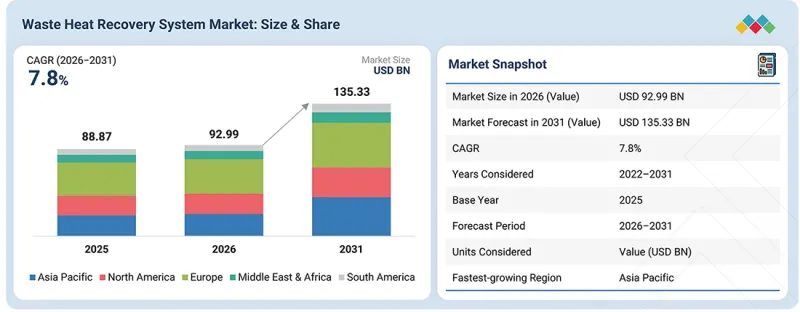
폐열 회수 시스템 시장은 2026년 929억 9,000만 달러에서 2031년에는 1,353억 3,000만 달러에 달할 것으로 예상되며, 연평균 성장률(CAGR)은 7.8%를 기록할 전망입니다.
| 조사 범위 | |
|---|---|
| 조사 기간 | 2022-2031년 |
| 기준 연도 | 2025년 |
| 예측 기간 | 2026-2031년 |
| 산정 단위 | 금액(백만/십억 달러) 및 톤 |
| 부문 | 유형, 최종 이용 산업 및 지역 |
| 대상 지역 | 종류, 조성, 용도 및 지역 |
수요 증가는 산업용 에너지 요금 급등 및 엄격한 Scope 1 배출량에 대한 제재와 같은 전 세계적인 압박이 복합적으로 작용한 결과이며, 이로 인해 공장들은 영업이익률을 유지하기 위한 생존적 필요성으로 열 재활용에 나서지 않을 수 없게 되었습니다.

“예열 용도 부문은 예측 기간 동안 시장 점유율 2위를 차지할 것으로 전망됩니다.”
예열 용도 부문은 에너지 집약적인 제조 활동에서 널리 활용되고 있기 때문에 예측 기간 동안 폐열 회수 시스템 시장에서 두 번째로 큰 점유율을 차지할 것으로 전망됩니다. 예열에서는 용광로, 배기가스, 가마 연기 등에서 발생하는 배기가스나 기타 고온 열원에서 추출된 에너지를 이용하여, 생산 공정의 다음 단계로 넘어가기 전에 연소 공기, 급수, 원자재 및 기타 투입물의 온도를 높입니다. 이러한 회수 공정을 통해 열 이용을 극대화하고 후속 공정에서의 에너지 소비를 줄임으로써 시스템 전체의 효율이 향상됩니다. 이로 인해 가동에 필요한 온도를 달성하기 위한 1차 연료 수요가 감소하고, 공정 전체의 열효율이 향상됩니다. 시멘트, 철강 생산, 석유 정제, 화학 처리, 유리 제조, 비철금속 가공에 종사하는 산업 시설에는 예열 기술을 도입할 큰 잠재력이 있습니다. 이러한 공정에서는 항상 고온의 배기가스가 발생하므로, 이 열에너지를 회수·활용할 기회가 생깁니다. 예열에는 다양한 첨단 기술을 활용할 수 있어, 기존 시스템의 개조와 신규 설비 설계 모두에서 효과적인 솔루션을 구현합니다. 소비된 에너지를 시스템에 환원하는 방식이 아니기 때문에 보조 장치에 대한 의존도가 낮아집니다.
“화학 산업은 예측 기간 동안 두 번째로 큰 시장 점유율을 차지할 것으로 전망됩니다.”
화학 산업은 화학 제조 공정의 연속적인 특성과 자원 집약적인 특성으로 인해, 예측 기간 동안 폐열 회수 시스템 시장에서 2위의 점유율을 확보할 것으로 예측됩니다. 화학 제조 시설에서는 엔진, 반응기, 용광로, 크래커, 보일러, 배기 시스템 등에서 회수 가능한 대량의 열을 발생시킬 수 있습니다. 회수된 열 에너지는 이코노마이저, 열회수 보일러, 열교환기, 증기 발생기 등을 활용하여 원료 예열, 증기 생성, 가열 공정, 혹은 향후 발전 용도로 활용될 가능성이 있습니다. 석유 제품 제조 플랜트의 가동은 안정적인 열 흐름 공급과 설비의 높은 효율성을 갖추고 있어 WHR 시스템과의 궁합이 매우 좋다고 할 수 있습니다. 이 부문의 또 다른 중요한 점은 열 통합의 가능성을 통해 특정 유닛에서 회수된 열 에너지를 다른 생산 유닛에서 활용할 수 있어, 결과적으로 연료 비용 절감으로 이어진다는 것입니다. 또한, 일부 기존 시설에서는 최근 생산 공정의 변경을 최소화하면서 에너지 효율을 대폭 향상시키고 운영 비용을 절감하고 있습니다. 높은 공정 온도, 연속 생산, 그리고 여러 내부 열 수요 지점을 수반하는 연속 가동 생산 공정의 복합체는 WHR 도입을 크게 뒷받침할 것으로 예상되며, 이는 이 부문이 2위 최종 이용 산업으로서의 지위를 유지하는 데 기여할 것입니다.
“아시아태평양은 예측 기간 동안 폐열 회수 시스템 시장에서 2위 규모를 차지할 것으로 전망됩니다.”
아시아태평양은 대규모 제조 거점과 에너지 집약적 산업의 존재로 인해, 평가 기간 동안 폐열 회수 시스템 시장에서 2위의 점유율을 차지할 것으로 예상됩니다. 중국, 인도, 일본, 한국, 동남아시아 등의 국가에서는 시멘트, 철강, 화학제품, 석유 제품의 생산능력이 높고, 또한 제지 생산도 활발하기 때문에 대량의 열이 발생하고 있습니다. 가마, 용광로, 보일러 및 각종 공정의 연속 가동으로 인해 폐열 보일러, 열교환기, 이코노마이저, 유기 랭킨 사이클(ORC) 시스템에 충분한 열이 공급됩니다. 이 지역의 생산량이 더욱 증가함에 따라 제조업체들은 연료 소비 효율을 높이고 에너지 손실을 줄여야 할 필요성에 직면해 있습니다. 또한, 구식 생산 시설의 현대화를 통해 기존 설비의 개조 가능성이 생겨나는 한편, 신설 플랜트에서는 설계 단계부터 폐열 회수(WHR)를 활용할 기회가 생기고 있습니다. 특히 시멘트 및 금속 산업은 배기가스의 온도 특성상 폐열 회수가 매우 중요합니다. 전력 수요 증가에 따라 폐열을 이용한 발전 및 증기 생산의 필요성도 높아지고 있습니다. 이러한 추세에 따라 아시아태평양 전체에서 폐열 회수 시스템의 도입은 앞으로도 계속될 것입니다.
본 조사에는 부품 공급업체부터 OEM에 이르기까지 다양한 업계 전문가들의 인사이트이 담겨 있습니다. 주요 참여 기업의 내역은 다음과 같습니다:
기업 규모별 : Tier 1 : 25%, Tier 2 : 42%, Tier 3 : 33%
직책별 : C레벨 임원 : 20%, 이사 : 30%, 기타 : 50%
지역별 : 북미 : 20%, 유럽 : 10%, 아시아태평양 : 40%, 남미 : 10%, 중동 및 아프리카 : 20%
참고 : 기타 직책에는 영업, 마케팅 및 제품 관리자가 포함됩니다.
Tier 1 : 10억 달러 초과, Tier 2 : 5억 달러-10억 달러, Tier 3 : 5억 달러 미만
본 조사에서는 폐열 회수 시스템 시장의 주요 기업들에 대해 기업 개요, 최근 동향 및 주요 시장 전략을 포함한 상세한 경쟁 분석을 수행하고 있습니다.
조사 범위
본 조사 보고서에서는 폐열 회수 시스템 시장을 용도(예열, 증기·발전, 기타 용도), 최종 이용 산업(석유 정제, 금속 생산, 시멘트, 화학, 제지·펄프, 기타 최종 이용 산업), 지역(북미, 유럽, 아시아태평양, 중동 및 아프리카, 남미)에 따라 분류하고 있습니다. 본 보고서의 범위에는 폐열 회수 시스템 시장의 성장에 영향을 미치는 촉진요인, 제약요인, 과제 및 기회에 대한 상세한 정보가 포함되어 있습니다. 주요 업계 플레이어에 대한 상세한 분석을 통해 사업 개요, 제공 제품, 그리고 폐열 회수 시스템 시장과 관련된 파트너십, 제휴, 제품 출시, 사업 확장, 인수합병(M&A) 등의 주요 전략에 대한 인사이트를 제공합니다. 또한, 본 보고서에서는 폐열 회수 시스템 생태계 내 신생 스타트업 기업의 경쟁 동향에 대한 인사이트도 다루고 있습니다.
본 보고서를 구매해야 하는 이유
본 보고서는 시장 선도 기업 및 신규 진입 기업에게 폐열 회수 시스템 시장 전체 및 각 하위 부문의 매출에 대한 가장 정확한 추정치를 제공합니다. 본 보고서는 이해관계자가 경쟁 구도를 이해하고, 자사의 사업 포지셔닝을 최적화하기 위한 추가적인 인사이트를 얻어 적절한 시장 진입 전략을 수립하는 데 도움이 됩니다. 또한, 시장 동향을 파악하고 주요 시장 촉진요인, 억제요인, 과제 및 기회에 대한 정보를 제공합니다.
본 보고서는 다음 사항에 대한 인사이트를 제공합니다:
주요 촉진요인(에너지 집약형 산업의 에너지 비용 상승, 제철로 및 재가열 공정에서의 회수량 증가, 시멘트 및 금속 제조업체의 배출 감축에 대한 관심 증가), 제약요인(폐열 회수 시스템 도입에 필요한 막대한 설비 투자, 기존 플랜트 인프라와의 통합 복잡성), 기회(데이터센터 냉각 인프라와 폐열 회수 시스템의 통합이 진행되고 있음, 폐열의 효율적 활용을 위한 산업용 히트 펌프 도입 확대, 저·중온 폐열 회수를 위한 ORC 시스템 도입 증가), 및 과제(고온 폐열 회수 설비에서의 부식 및 오염 위험, 생산 부하 변동에 따른 폐열 발생량 변동)에 대해 분석하고 있습니다.
- 제품 개발/혁신 : 폐열 회수 시스템 시장의 향후 기술, 연구 개발 활동, 그리고 제품 및 서비스 출시에 관한 상세한 인사이트.
- 시장 개발 : 수익성이 높은 시장에 대한 종합적인 정보 - 본 보고서에서는 다양한 지역의 폐열 회수 시스템 시장을 분석하고 있습니다.
시장 다각화 : 폐열 회수 시스템 시장의 신제품 및 서비스, 미개척 지역, 최근 동향 및 투자에 관한 종합적인 정보.
- 경쟁사 평가 : 주요 기업의 시장 점유율, 성장 전략 및 서비스 제공 내용에 대한 상세한 평가.
자주 묻는 질문
목차
제1장 서론
제2장 요약
제3장 주요 인사이트
- 폐열 회수 시스템 시장에서 사업자에게 매력적인 기회
- 폐열 회수 시스템 시장 : 용도별 및 최종 이용 산업별
- 폐열 회수 시스템 시장 : 국가별
제4장 시장 개요
- 시장 역학
- 성장 촉진요인
- 성장 억제요인
- 기회
- 과제
- 미충족 수요와 미개척 분야
- 미충족 수요
- 미개척 분야
- 상호 연관된 시장과 부문 간 기회
- 부문 간 기회
- Tier 1/2/3 주요 기업들의 전략적 움직임
제5장 업계 동향
- Porter's Five Forces 분석
- 신규 진입자의 위협
- 대체품의 위협
- 공급업체의 협상력
- 구매자의 협상력
- 경쟁 기업 간의 적대 관계의 격렬함
- 거시경제 분석
- GDP 동향 및 전망
- 가치사슬 분석
- 생태계 분석
- 가격 책정 분석
- 2026년 가격 변동
- 무역 분석
- HS 코드 841950의 수출 데이터
- HS 코드 841950의 수입 데이터
- 2026-2027년 주요 회의 및 행사
- 고객의 비즈니스에 영향을 미치는 동향 및 변화
- 투자 및 자금 조달 시나리오
- 사례 연구 분석
- THERMAX - 멕시코 그린필드 정유소 : 멕시코 정유소의 통합형 폐열 회수
- MITSUBISHI HEAVY INDUSTRIES - 선박용 폐열 회수·ORC 시스템 : 선박용 엔진을 위한 차세대 폐열 회수 시스템
- ALFA LAVAL - 핀란드 아우토쿰프 : 스테인리스강 용광로에서 발생하는 폐열 회수
- 2025년 미국 관세가 폐열 회수 시스템 시장에 미치는 영향
- 가격에 미치는 영향 분석
- 각 지역에 미치는 주요 영향
- 최종 용도 부문에 미치는 영향
제6장 기술, 특허, 디지털화, AI 도입에 따른 전략적 변혁
- 주요 신흥 기술
- 유기 랭킨 사이클(ORC)
- 배열회수보일러(WHRB)
- 열회수 증기 발생기(HRSG)
- 보완 기술
- 열교환기 기술
- 열 에너지 저장(TES)
- 관련 기술
- 초임계 CO2(SCO2) 발전 사이클
- 열화학적 열 회수
- 기술·제품 로드맵
- 단기(2025-2027년)|효율 최적화 및 디지털화 단계
- 중기(2027-2030년) : 첨단 열 회수 및 통합 에너지 관리 단계
- 장기(2030-2035년 이후) : 지능형 차세대 열 회수 생태계 단계
- 특허 분석
- 접근 방식
- 주요 출원인
- 관할 구역 분석
- 향후 응용 분야
- 열전 직접 발전
- 열광 발전을 통한 폐열 발전
- 막식 잠열 회수
- 폐열을 이용한 산업용 냉각
- 폐열을 이용한 산업용 탈염
- AI/생성형 AI가 폐열 회수 시스템 시장에 미치는 영향
- 주요 활용 사례 및 시장 잠재력
- 폐열 회수 시스템 분야에서 제조사/OEM이 실천하는 모범 사례
- 폐열 회수 시스템 시장에서 AI 도입 사례 연구
- 상호 연계된 생태계와 시장 참여자에 미치는 영향
- AI 통합형 폐열 회수 시스템 도입에 대한 고객의 준비 현황
제7장 지속가능성과 규제 현황
- 지역별 규제 및 규정 준수
- 규제 기관, 정부 기관 및 기타 조직
- 업계 표준
- 지속가능성을 위한 노력
- 탄소 배출 감축 노력
- 폐열 회수 시스템의 친환경 적용 사례
- 규제 정책이 지속가능성 노력에 미치는 영향
- 인증, 표시, 환경 기준
제8장 고객 동향과 구매 행동
- 의사결정 과정
- 구매 과정에 관여하는 주요 이해관계자와 그 평가 기준
- 구매 과정에 관여하는 주요 이해관계자
- 구매 기준
- 도입 장벽과 사내 과제
- 다양한 최종 이용 산업 분야의 미충족 수요
- 시장의 수익성
- 수익 창출 가능성
- 비용 동향
- 최종 이용 산업별 이익률 기회
- 석유 정제
- 금속 생산
- 시멘트
- 화학
- 제지·펄프
제9장 폐열 회수 시스템 시장 : 용도별
- 예열
- 증기·발전
- 기타 용도
제10장 폐열 회수 시스템 시장 : 최종 이용 산업별
- 석유 정제
- 금속 생산
- 시멘트
- 화학
- 제지·펄프
- 기타 최종 이용 산업
제11장 폐열 회수 시스템 시장 : 지역별
- 아시아태평양
- 중국
- 인도
- 일본
- 한국
- 인도네시아
- 기타 아시아태평양
- 유럽
- 독일
- 프랑스
- 영국
- 이탈리아
- 스페인
- 벨기에
- 스웨덴
- 러시아
- 폴란드
- 기타 유럽
- 북미
- 미국
- 캐나다
- 멕시코
- 중동 및 아프리카
- GCC 국가들
- 남아프리카
- 기타 중동 및 아프리카
- 남미
- 브라질
- 아르헨티나
- 기타 남미
제12장 경쟁 현황
- 개요
- 주요 진입 기업의 전략/강점
- 수익 분석(2021-2025년)
- 시장 점유율 분석(2025년)
- 브랜드 비교
- 기업 평가 매트릭스 : 주요 기업, 2025년
- 스타 기업
- 신흥 리더
- 광범위한 업체
- 진입 기업
- 기업의 사업 전개 : 주요 기업, 2026년
- 기업 평가 매트릭스 : 스타트업/중소기업, 2026년
- 선도적인 기업
- 대응력이 뛰어난 기업
- 역동적인 기업
- 출발점
- 경쟁사 벤치마킹 : 스타트업/중소기업, 2025년
- 기업 평가
- 재무 지표
- 경쟁 시나리오
- 제품 출시
- 거래
- 사업 확장
제13장 기업 개요
- 주요 기업
- SIEMENS ENERGY AG
- GE VERNOVA INC.
- MITSUBISHI HEAVY INDUSTRIES, LTD.
- ABB LTD
- SHANGHAI ELECTRIC GROUP CO., LTD.
- KAWASAKI HEAVY INDUSTRIES, LTD.
- DOOSAN ENERBILITY CO., LTD.
- IHI CORPORATION
- WARTSILA CORPORATION
- THERMAX LIMITED
- 기타 주요 기업
- BHARAT HEAVY ELECTRICALS LIMITED(BHEL)
- BABCOCK &WILCOX ENTERPRISES, INC.
- ORMAT TECHNOLOGIES, INC.
- ISGEC HEAVY ENGINEERING LTD.
- FORBES MARSHALL PVT. LTD.
- CAIN INDUSTRIES, INC.
- DONGFANG ELECTRIC CORPORATION LTD.
- HARBIN ELECTRIC COMPANY LIMITED
- XIZI CLEAN ENERGY EQUIPMENT MANUFACTURING CO., LTD.
- SPIRAX-SARCO ENGINEERING PLC(SPIRAX GROUP)
- JOHN COCKERILL GROUP
- ORCAN ENERGY AG
- VICTORY ENERGY OPERATIONS, LLC
- THERMODYNE ENGINEERING SYSTEMS
- CLEAN ENERGY TECHNOLOGIES, INC.(CETY)
제14장 조사 방법론
제15장 부록
KSM 26.10.26The waste heat recovery system market is projected to reach USD 135.33 billion in 2031 from USD 92.99 billion in 2026, at a CAGR of 7.8%.
| Scope of the Report | |
|---|---|
| Years Considered for the Study | 2022-2031 |
| Base Year | 2025 |
| Forecast Period | 2026-2031 |
| Units Considered | Value (USD Million/Billion) and Volume (Ton) |
| Segments | Type, End-use Industry, and Region |
| Regions covered | Type, Composition, Application, and Region |
The increasing demand is attributed to compounding global pressures from skyrocketing industrial energy tariffs and strict Scope 1 emission penalties, which force factories to treat thermal recycling as a survival necessity for protecting operational margins.
"The preheating application segment is projected to account for the second-largest market share throughout the forecast period"
The preheating application segment is projected to account for the second-largest share of the waste heat recovery systems market during the forecast period due to its wide usage in energy-intensive manufacturing activities. Preheating utilizes the energy extracted from flue gases generated by furnaces, exhaust emissions, and kiln smoke, along with other high-temperature sources, to elevate the temperature of combustion air, feed water, raw materials, and other inputs prior to their progression to subsequent stages in the production process. This recovery process enhances overall system efficiency by maximizing heat utilization and reducing energy consumption in subsequent operations. This will reduce the need for primary fuel for achieving temperature for the operation, which results in greater thermal efficiency of the process in general. Industrial facilities engaged in cement, steel production, oil refining, chemical processing, glass manufacturing, and non-ferrous metal processing have significant potential for integrating preheating technologies. These operations consistently generate high-temperature emissions, creating opportunities to capture and utilize this thermal energy. Various advanced technologies are available for preheating, enabling effective solutions for both retrofitting existing systems and designing new installations. Since it does not contribute energy back to the system that has been expended, it has a reduced reliance on supplementary devices.
"The chemicals industry is projected to capture the second-largest market share over the forecast period."
The chemicals industry is projected to secure the second-largest share of the waste heat recovery systems market during the forecast period, due to the ongoing nature and resource-intensive characteristics of chemical production processes. Chemical production facilities are able to produce large amounts of heat that can be recovered from engines, reactors, furnaces, crackers, boilers, and exhaust systems. The recovered thermal energy can be harnessed with the help of economizers, heat recovery boilers, heat exchangers, and steam generators and utilized for pre-heating of raw materials, generating steam, heating processes or generating electricity in the future. The operations of petrol products manufacturing plants can be seen as an ideal match for WHR systems, since such facilities provide constant availability of heat flow and high effectiveness of equipment. Another significant aspect of this segment is that the possibility of heat integration allows recovered thermal energy from one unit to be used in other production units, leading to lower fuel costs. In addition, some existing facilities have become highly energy-efficient recently and reduced operational costs with minimum changes to their production processes. The complex of continuously running production processes with high process temperatures, continuous production, and multiple internal heat-demand points is expected to sustain significant WHR deployment, supporting the segment's position as the second-largest end-use industry.
"Asia Pacific is projected to be the second-largest market for heat recovery systems during the forecast period."
Asia Pacific is expected to hold the second-largest share of the waste heat recovery systems market during the evaluation period due to its large manufacturing base and energy-intensive industries. Countries such as China, India, Japan, South Korea, and Southeast Asia have capable production of cement, steel, chemicals, and petroleum products, along with the production of paper that results in the realization of a large amount of heat. The continuous operation of kilns, furnaces, boilers, and processes provides enough heat for the waste heat boilers, heat exchangers, economizers, and organic Rankine cycle systems. Further increasing production in the region encourages manufacturers to enhance their fuel consumption and lower their energy losses. Moreover, the modernization of old production facilities creates possibilities for retrofitting installations, while new plants have opportunities to utilize WHR in their design. Cement and metal industries are especially essential due to the temperature profile of exhaust gases. Increasing electricity requirements result in a growing need to use waste heat to generate electricity and steam. These trends will keep the deployment of WHR systems across Asia Pacific.
The study contains insights from various industry experts, from component suppliers to OEMs. The breakdown of the primary participants is as follows:
By Company Type: Tier 1: 25%, Tier 2: 42%, and Tier 3: 33%
By Designation: C-level Executives: 20%, Directors: 30%, and Others: 50%
By Region: North America: 20%, Europe: 10%, Asia Pacific: 40%, South America: 10%, and Middle East & Africa: 20%
Notes: Other designations include sales, marketing, and product managers.
Tier 1: >USD 1 billion; Tier 2: USD 500 million-1 billion; and Tier 3: <USD 500 million
Companies Covered: Siemens Energy AG (Germany), GE Vernova Inc. (US), Mitsubishi Heavy Industries, Ltd. (Japan), ABB Ltd. (Switzerland), Shanghai Electric Group Co., Ltd. (China), Kawasaki Heavy Industries, Ltd. (Japan), Doosan Enerbility Co., Ltd. (South Korea), IHI Corporation (Japan), Wartsila Corporation (Finland), Bharat Heavy Electricals Limited (BHEL) (India), among others, are covered in the report.
The study includes an in-depth competitive analysis of these key players in the waste heat recovery system market, with their company profiles, recent developments, and key market strategies.
Research Coverage
This research report categorizes the waste heat recovery system market based on application (preheating, steam & electricity generation, other applications), end-use industry (petroleum refining, metal production, cement, chemical, paper & pulp, other end-use industries), region (North America, Europe, Asia Pacific, Middle East & Africa, and South America). The report's scope covers detailed information regarding the drivers, restraints, challenges, and opportunities influencing the growth of the waste heat recovery system market. A detailed analysis of the key industry players has been done to provide insights into their business overview, products offered, and key strategies, such as partnerships, collaborations, product launches, expansions, and acquisitions, associated with the waste heat recovery system market. This report covers a competitive analysis of upcoming startups in the waste heat recovery system ecosystem.
Reasons to Buy the Report
The report will offer market leaders/new entrants information on the closest approximations of the revenue numbers for the overall waste heat recovery system market and the subsegments. This report will help stakeholders understand the competitive landscape, gain more insights into positioning their businesses better, and plan suitable go-to-market strategies. The report will help stakeholders understand the pulse of the market and provide them with information on key market drivers, restraints, challenges, and opportunities.
The report provides insights into the following points:
Analysis of key drivers (rising energy costs across energy-intensive industries, increasing recovery from steel furnace and reheating operations, increasing focus of cement and metals producers on emission reduction), restraints (high capital requirement for installing waste heat recovery systems, complex integration of waste heat recovery systems with existing plant infrastructure), opportunities (increasing integration of waste heat recovery systems with data center cooling infrastructure, growing deployment of industrial heat pumps for waste heat valorization, rising deployment of orc systems for low- and medium-temperature waste heat recovery), and challenges (corrosion and fouling risks in high-temperature waste heat recovery equipment, fluctuating production loads causing variations in waste heat generation).
- Product Development/Innovation: Detailed insights into upcoming technologies, research & development activities, and product & service launches in the waste heat recovery system market.
- Market Development: Comprehensive information about profitable markets - the report analyzes the waste heat recovery system market across varied regions.
Market Diversification: Exhaustive information about new products & services, untapped geographies, recent developments, and investments in the waste heat recovery system market.
- Competitive Assessment: In-depth assessment of market shares, growth strategies, and service offerings of leading players: Siemens Energy AG (Germany), GE Vernova Inc. (US), Mitsubishi Heavy Industries, Ltd. (Japan), ABB Ltd. (Switzerland), Shanghai Electric Group Co., Ltd. (China), Kawasaki Heavy Industries, Ltd. (Japan), Doosan Enerbility Co., Ltd. (South Korea), IHI Corporation (Japan), Wartsila Corporation (Finland), Bharat Heavy Electricals Limited (BHEL) (India).
TABLE OF CONTENTS
1 INTRODUCTION
- 1.1 STUDY OBJECTIVES
- 1.2 MARKET DEFINITION
- 1.3 STUDY SCOPE
- 1.3.1 MARKETS COVERED & REGIONAL SCOPE
- 1.3.2 INCLUSIONS & EXCLUSIONS
- 1.3.3 YEARS CONSIDERED
- 1.3.4 CURRENCY CONSIDERED
- 1.3.5 STAKEHOLDERS
- 1.4 SUMMARY OF STRATEGIC CHANGES IN MARKET
2 EXECUTIVE SUMMARY
- 2.1 KEY INSIGHTS AND MARKET HIGHLIGHTS
- 2.2 KEY MARKET PARTICIPANTS: SHARE INSIGHTS AND STRATEGIC DEVELOPMENTS
- 2.3 DISRUPTIVE TRENDS SHAPING MARKET
- 2.4 HIGH-GROWTH SEGMENTS & EMERGING FRONTIERS
- 2.5 SNAPSHOT: GLOBAL MARKET SIZE, GROWTH RATE, AND FORECAST
3 PREMIUM INSIGHTS
- 3.1 ATTRACTIVE OPPORTUNITIES FOR PLAYERS IN WASTE HEAT RECOVERY SYSTEM MARKET
- 3.2 WASTE HEAT RECOVERY SYSTEM MARKET, BY APPLICATION AND END-USE INDUSTRY
- 3.3 WASTE HEAT RECOVERY SYSTEM MARKET, BY COUNTRY
4 MARKET OVERVIEW
- 4.1 INTRODUCTION
- 4.2 MARKET DYNAMICS
- 4.2.1 DRIVERS
- 4.2.1.1 Rising energy costs across energy-intensive industries
- 4.2.1.2 Increasing recovery from steel furnace and reheating operations
- 4.2.1.3 Increasing focus of cement and metals producers on emission reduction
- 4.2.2 RESTRAINTS
- 4.2.2.1 High capital requirement for installing waste heat recovery systems
- 4.2.2.2 Complex integration of waste heat recovery systems with existing plant infrastructure
- 4.2.3 OPPORTUNITIES
- 4.2.3.1 Increasing integration of waste heat recovery systems with data center cooling infrastructure
- 4.2.3.2 Growing deployment of industrial heat pumps for waste heat valorization
- 4.2.3.3 Rising deployment of ORC systems for low- and medium-temperature waste heat recovery
- 4.2.4 CHALLENGES
- 4.2.4.1 Corrosion and fouling risks in high-temperature waste heat recovery equipment
- 4.2.4.2 Fluctuating production loads cause variations in waste heat generation
- 4.2.1 DRIVERS
- 4.3 UNMET NEEDS AND WHITE SPACES
- 4.3.1 UNMET NEEDS
- 4.3.1.1 Economically viable recovery of low temperature waste heat below 150°C
- 4.3.1.2 Long-life high-temperature equipment under corrosive and fouling conditions
- 4.3.2 WHITE SPACES
- 4.3.2.1 Modular WHRS platforms designed for highly variable industrial production loads
- 4.3.2.2 Integrated waste heat to process heat systems that monetize low-grade energy
- 4.3.1 UNMET NEEDS
- 4.4 INTERCONNECTED MARKETS AND CROSS-SECTOR OPPORTUNITIES
- 4.4.1 CROSS-SECTOR OPPORTUNITIES
- 4.5 STRATEGIC MOVES BY TIER 1/2/3 PLAYERS
5 INDUSTRY TRENDS
- 5.1 PORTER'S FIVE FORCES ANALYSIS
- 5.1.1 THREAT OF NEW ENTRANTS
- 5.1.2 THREAT OF SUBSTITUTES
- 5.1.3 BARGAINING POWER OF SUPPLIERS
- 5.1.4 BARGAINING POWER OF BUYERS
- 5.1.5 INTENSITY OF COMPETITIVE RIVALRY
- 5.2 MACROECONOMIC ANALYSIS
- 5.2.1 INTRODUCTION
- 5.2.2 GDP TRENDS AND FORECASTS
- 5.3 VALUE CHAIN ANALYSIS
- 5.4 ECOSYSTEM ANALYSIS
- 5.5 PRICING ANALYSIS
- 5.5.1 CHANGES IN PRICING IN 2026
- 5.6 TRADE ANALYSIS
- 5.6.1 EXPORT DATA FOR HS CODE 841950
- 5.6.2 IMPORT DATA FOR HS CODE 841950
- 5.7 KEY CONFERENCES AND EVENTS, 2026-2027
- 5.8 TRENDS AND DISRUPTIONS IMPACTING CUSTOMER BUSINESS
- 5.9 INVESTMENT AND FUNDING SCENARIO
- 5.10 CASE STUDY ANALYSIS
- 5.10.1 THERMAX - GREENFIELD REFINERY, MEXICO: INTEGRATED WASTE HEAT RECOVERY FOR A MEXICAN REFINERY
- 5.10.2 MITSUBISHI HEAVY INDUSTRIES - MARINE WHR-ORC SYSTEM: NEXT-GENERATION WASTE HEAT RECOVERY FOR MARINE ENGINES
- 5.10.3 ALFA LAVAL - OUTOKUMPU, FINLAND: WASTE HEAT RECOVERY FROM STAINLESS STEEL FURNACES
- 5.11 IMPACT OF 2025 US TARIFF ON WASTE HEAT RECOVERY SYSTEMS MARKET
- 5.11.1 INTRODUCTION
- 5.11.2 PRICE IMPACT ANALYSIS
- 5.11.3 KEY IMPACT ON VARIOUS REGIONS
- 5.11.3.1 US
- 5.11.3.2 Europe
- 5.11.3.3 Asia Pacific
- 5.11.4 END-USE SECTOR IMPACT
6 STRATEGIC DISRUPTION THROUGH TECHNOLOGY, PATENTS, DIGITAL, AND AI ADOPTIONS
- 6.1 KEY EMERGING TECHNOLOGIES
- 6.1.1 ORGANIC RANKINE CYCLE (ORC)
- 6.1.2 WASTE HEAT RECOVERY BOILERS (WHRB)
- 6.1.3 HEAT RECOVERY STEAM GENERATORS (HRSG)
- 6.2 COMPLEMENTARY TECHNOLOGIES
- 6.2.1 HEAT EXCHANGER TECHNOLOGY
- 6.2.2 THERMAL ENERGY STORAGE (TES)
- 6.3 ADJACENT TECHNOLOGIES
- 6.3.1 SUPERCRITICAL CO2 (SCO2) POWER CYCLES
- 6.3.2 THERMOCHEMICAL HEAT RECOVERY
- 6.4 TECHNOLOGY/PRODUCT ROADMAP
- 6.4.1 SHORT-TERM (2025-2027) | EFFICIENCY OPTIMIZATION & DIGITALIZATION PHASE
- 6.4.2 MID-TERM (2027-2030): ADVANCED HEAT RECOVERY & INTEGRATED ENERGY MANAGEMENT PHASE
- 6.4.3 LONG-TERM (2030-2035+): INTELLIGENT & NEXT-GENERATION HEAT RECOVERY ECOSYSTEM PHASE
- 6.5 PATENT ANALYSIS
- 6.5.1 INTRODUCTION
- 6.5.2 APPROACH
- 6.5.3 TOP APPLICANTS
- 6.5.4 JURISDICTION ANALYSIS
- 6.6 FUTURE APPLICATIONS
- 6.6.1 THERMOELECTRIC DIRECT ELECTRICITY GENERATION
- 6.6.2 THERMOPHOTOVOLTAIC WASTE HEAT GENERATION
- 6.6.3 MEMBRANE LATENT HEAT RECOVERY
- 6.6.4 WASTE HEAT POWERED INDUSTRIAL COOLING
- 6.6.5 WASTE HEAT DRIVEN INDUSTRIAL DESALINATION
- 6.7 IMPACT OF AI/GEN AI ON WASTE HEAT RECOVERY SYSTEMS MARKET
- 6.7.1 TOP USE CASES AND MARKET POTENTIAL
- 6.7.2 BEST PRACTICES FOLLOWED BY MANUFACTURERS/OEMS IN WASTE HEAT RECOVERY SYSTEMS
- 6.7.3 CASE STUDIES OF AI IMPLEMENTATION IN WASTE HEAT RECOVERY SYSTEMS MARKET
- 6.7.4 INTERCONNECTED ECOSYSTEM AND IMPACT ON MARKET PLAYERS
- 6.7.5 CLIENTS' READINESS TO ADAPT AI-INTEGRATED WASTE HEAT RECOVERY SYSTEMS
7 SUSTAINABILITY AND REGULATORY LANDSCAPE
- 7.1 REGIONAL REGULATIONS AND COMPLIANCE
- 7.1.1 REGULATORY BODIES, GOVERNMENT AGENCIES, AND OTHER ORGANIZATIONS
- 7.1.2 INDUSTRY STANDARDS
- 7.2 SUSTAINABILITY INITIATIVES
- 7.2.1 CARBON IMPACT REDUCTION INITIATIVES
- 7.2.1.1 Increase use of lower carbon steel and recycled metallic content
- 7.2.1.2 Replace high-impact insulation inputs with lower-carbon alternatives
- 7.2.1.3 Reduce manufacturing emissions through renewable energy and heat reuse
- 7.2.2 ECO APPLICATIONS IN WASTE HEAT RECOVERY SYSTEMS
- 7.2.2.1 Use recovered industrial heat for panel manufacturing processes
- 7.2.2.2 Upgrade low temperature waste heat using industrial heat pumps
- 7.2.2.3 Combine waste heat recovery with thermal energy storage
- 7.2.1 CARBON IMPACT REDUCTION INITIATIVES
- 7.3 IMPACT OF REGULATORY POLICIES ON SUSTAINABILITY INITIATIVES
- 7.4 CERTIFICATIONS, LABELING, ECO-STANDARDS
8 CUSTOMER LANDSCAPE AND BUYER BEHAVIOR
- 8.1 DECISION-MAKING PROCESS
- 8.2 KEY STAKEHOLDERS INVOLVED IN BUYING PROCESS AND THEIR EVALUATION CRITERIA
- 8.2.1 KEY STAKEHOLDERS IN BUYING PROCESS
- 8.2.2 BUYING CRITERIA
- 8.3 ADOPTION BARRIERS & INTERNAL CHALLENGES
- 8.4 UNMET NEEDS FROM VARIOUS END-USE INDUSTRIES
- 8.5 MARKET PROFITABILITY
- 8.5.1 REVENUE POTENTIAL
- 8.5.2 COST DYNAMICS
- 8.6 MARGIN OPPORTUNITIES, BY END USE INDUSTRY
- 8.6.1 PETROLEUM REFINING
- 8.6.2 METAL PRODUCTION
- 8.6.3 CEMENT
- 8.6.4 CHEMICAL
- 8.6.5 PAPER & PULP
9 WASTE HEAT RECOVERY SYSTEM MARKET, BY APPLICATION
- 9.1 INTRODUCTION
- 9.2 PREHEATING
- 9.2.1 PREHEATING APPLICATIONS EXPANDING THROUGH DIRECT THERMAL INTEGRATION ACROSS INDUSTRIAL PROCESSES
- 9.3 STEAM & ELECTRICITY GENERATION
- 9.3.1 STEAM GENERATION
- 9.3.2 ELECTRICITY GENERATION
- 9.3.2.1 Steam Rankine cycle
- 9.3.2.2 Organic Rankine cycle (ORC)
- 9.3.2.3 Kalina cycle
- 9.4 OTHER APPLICATIONS
10 WASTE HEAT RECOVERY SYSTEMS MARKET, BY END-USE INDUSTRY
- 10.1 INTRODUCTION
- 10.2 PETROLEUM REFINING
- 10.2.1 PETROLEUM REFINING IS EXPANDING WASTE HEAT RECOVERY ACROSS COMPLEX HIGH-TEMPERATURE PROCESS STREAMS
- 10.3 METAL PRODUCTION
- 10.3.1 ADVANCING HEAT RECOVERY THROUGH FURNACE-SPECIFIC THERMAL INTEGRATION
- 10.4 CEMENT
- 10.4.1 INCREASING WASTE HEAT RECOVERY ACROSS KILN AND CLINKER COOLING OPERATIONS
- 10.5 CHEMICAL
- 10.5.1 EXPANDING HEAT RECOVERY ACROSS REACTION AND ACID PRODUCTION PROCESSES
- 10.6 PAPER & PULP
- 10.6.1 EXPANDING HEAT RECOVERY ACROSS RECOVERY BOILERS AND DRYING SYSTEMS
- 10.7 OTHER END-USE INDUSTRIES
11 WASTE HEAT RECOVERY SYSTEMS MARKET, BY REGION
- 11.1 INTRODUCTION
- 11.2 ASIA PACIFIC
- 11.2.1 CHINA
- 11.2.1.1 Expansive industrial base increasing demand
- 11.2.2 INDIA
- 11.2.2.1 Energy-intensive industrial expansion strengthening demand
- 11.2.3 JAPAN
- 11.2.3.1 Stable industrial operations sustaining waste heat recovery demand
- 11.2.4 SOUTH KOREA
- 11.2.4.1 Refining and heavy industry base supporting WHRS demand
- 11.2.5 INDONESIA
- 11.2.5.1 Expanding processing base supporting demand
- 11.2.6 REST OF ASIA PACIFIC
- 11.2.1 CHINA
- 11.3 EUROPE
- 11.3.1 GERMANY
- 11.3.1.1 Industrial recovery strengthening demand for waste heat recovery systems
- 11.3.2 FRANCE
- 11.3.2.1 Manufacturing strength supporting demand growth
- 11.3.3 UK
- 11.3.3.1 Industrial activities increasing demand
- 11.3.4 ITALY
- 11.3.4.1 Industrial energy dependence accelerating demand
- 11.3.5 SPAIN
- 11.3.5.1 Expanding industrial output increasing opportunities for players
- 11.3.6 BELGIUM
- 11.3.6.1 Belgium's concentrated heavy industry is strengthening demand for waste heat recovery systems
- 11.3.7 SWEDEN
- 11.3.7.1 Export-oriented industrial base supporting demand for waste heat recovery systems
- 11.3.8 RUSSIA
- 11.3.8.1 Large industrial base strengthening demand for waste heat recovery systems
- 11.3.9 POLAND
- 11.3.9.1 Expanding energy-intensive industries increasing demand
- 11.3.10 REST OF EUROPE
- 11.3.1 GERMANY
- 11.4 NORTH AMERICA
- 11.4.1 US
- 11.4.1.1 Industrial expansion increasing demand
- 11.4.2 CANADA
- 11.4.2.1 Canada's Refining and Manufacturing Activity Supports Waste Heat Recovery Demand
- 11.4.3 MEXICO
- 11.4.3.1 Industrial expansion increasing demand
- 11.4.1 US
- 11.5 MIDDLE EAST & AFRICA
- 11.5.1 GCC COUNTRIES
- 11.5.1.1 Saudi Arabia
- 11.5.1.1.1 Expanding industrial base accelerating demand
- 11.5.1.2 UAE
- 11.5.1.2.1 Expanding non-oil industries strengthening demand
- 11.5.1.3 Rest of GCC countries
- 11.5.1.1 Saudi Arabia
- 11.5.2 SOUTH AFRICA
- 11.5.2.1 Industrial production growth increasing demand
- 11.5.3 REST OF MIDDLE EAST & AFRICA
- 11.5.1 GCC COUNTRIES
- 11.6 SOUTH AMERICA
- 11.6.1 BRAZIL
- 11.6.1.1 Expanding industrial output increasing demand
- 11.6.2 ARGENTINA
- 11.6.2.1 Expanding industrial production increasing demand
- 11.6.3 REST OF SOUTH AMERICA
- 11.6.1 BRAZIL
12 COMPETITIVE LANDSCAPE
- 12.1 OVERVIEW
- 12.2 KEY PLAYER STRATEGIES/RIGHT TO WIN
- 12.3 REVENUE ANALYSIS, 2021-2025
- 12.4 MARKET SHARE ANALYSIS, 2025
- 12.5 BRAND COMPARISON
- 12.6 COMPANY EVALUATION MATRIX: KEY PLAYERS, 2025
- 12.6.1 STARS
- 12.6.2 EMERGING LEADERS
- 12.6.3 PERVASIVE PLAYERS
- 12.6.4 PARTICIPANTS
- 12.6.5 COMPANY FOOTPRINT: KEY PLAYERS, 2026
- 12.6.5.1 Company footprint
- 12.6.5.2 Region footprint
- 12.6.5.3 Application footprint
- 12.6.5.4 End-use industry footprint
- 12.7 COMPANY EVALUATION MATRIX: STARTUPS/SMES, 2026
- 12.7.1 PROGRESSIVE COMPANIES
- 12.7.2 RESPONSIVE COMPANIES
- 12.7.3 DYNAMIC COMPANIES
- 12.7.4 STARTING BLOCKS
- 12.7.5 COMPETITIVE BENCHMARKING: STARTUPS/SMES, 2025
- 12.7.5.1 List of key startups/SMEs
- 12.7.5.2 Competitive benchmarking of key startups/SMEs
- 12.8 COMPANY VALUATION
- 12.9 FINANCIAL METRICS
- 12.10 COMPETITIVE SCENARIO
- 12.10.1 PRODUCT LAUNCHES
- 12.10.2 DEALS
- 12.10.3 EXPANSIONS
13 COMPANY PROFILES
- 13.1 KEY PLAYERS
- 13.1.1 SIEMENS ENERGY AG
- 13.1.1.1 Business overview
- 13.1.1.2 Products offered
- 13.1.1.3 Recent developments
- 13.1.1.3.1 Expansions
- 13.1.1.4 MnM view
- 13.1.1.4.1 Right to win
- 13.1.1.4.2 Strategic choices
- 13.1.1.4.3 Weakness and competitive threats
- 13.1.2 GE VERNOVA INC.
- 13.1.2.1 Business overview
- 13.1.2.2 Products offered
- 13.1.2.3 MnM view
- 13.1.2.3.1 Right to win
- 13.1.2.3.2 Strategic choices
- 13.1.2.3.3 Weakness and competitive threats
- 13.1.3 MITSUBISHI HEAVY INDUSTRIES, LTD.
- 13.1.3.1 Business overview
- 13.1.3.2 Products offered
- 13.1.3.3 Recent developments
- 13.1.3.3.1 Product launches
- 13.1.3.3.2 Deals
- 13.1.3.4 MnM view
- 13.1.3.4.1 Right to win
- 13.1.3.4.2 Strategic choices
- 13.1.3.4.3 Weakness and competitive threats
- 13.1.4 ABB LTD
- 13.1.4.1 Business overview
- 13.1.4.2 Products offered
- 13.1.4.3 Recent developments
- 13.1.4.3.1 Expansions
- 13.1.4.4 MnM view
- 13.1.4.4.1 Right to win
- 13.1.4.4.2 Strategic choices
- 13.1.4.4.3 Weakness and competitive threats
- 13.1.5 SHANGHAI ELECTRIC GROUP CO., LTD.
- 13.1.5.1 Business overview
- 13.1.5.2 Products offered
- 13.1.5.3 Recent developments
- 13.1.5.3.1 Deals
- 13.1.5.3.2 Expansions
- 13.1.5.4 MnM view
- 13.1.5.4.1 Right to win
- 13.1.5.4.2 Strategic choices
- 13.1.5.4.3 Weakness and competitive threats
- 13.1.6 KAWASAKI HEAVY INDUSTRIES, LTD.
- 13.1.6.1 Business overview
- 13.1.6.2 Products offered
- 13.1.6.3 Recent developments
- 13.1.6.3.1 Product launches
- 13.1.6.3.2 Deals
- 13.1.6.4 MnM view
- 13.1.7 DOOSAN ENERBILITY CO., LTD.
- 13.1.7.1 Business overview
- 13.1.7.2 Products offered
- 13.1.7.3 Recent developments
- 13.1.7.3.1 Deals
- 13.1.7.3.2 Expansions
- 13.1.7.4 MnM view
- 13.1.8 IHI CORPORATION
- 13.1.8.1 Business overview
- 13.1.8.2 Products offered
- 13.1.8.3 Recent developments
- 13.1.8.3.1 Deals
- 13.1.8.4 MnM view
- 13.1.9 WARTSILA CORPORATION
- 13.1.9.1 Business overview
- 13.1.9.2 Products offered
- 13.1.9.3 Recent developments
- 13.1.9.3.1 Deals
- 13.1.9.3.2 Expansions
- 13.1.9.4 MnM view
- 13.1.10 THERMAX LIMITED
- 13.1.10.1 Business overview
- 13.1.10.2 Products offered
- 13.1.10.3 Recent developments
- 13.1.10.3.1 Product launches
- 13.1.10.3.2 Deals
- 13.1.10.4 MnM view
- 13.1.1 SIEMENS ENERGY AG
- 13.2 OTHER PLAYERS
- 13.2.1 BHARAT HEAVY ELECTRICALS LIMITED (BHEL)
- 13.2.2 BABCOCK & WILCOX ENTERPRISES, INC.
- 13.2.3 ORMAT TECHNOLOGIES, INC.
- 13.2.4 ISGEC HEAVY ENGINEERING LTD.
- 13.2.5 FORBES MARSHALL PVT. LTD.
- 13.2.6 CAIN INDUSTRIES, INC.
- 13.2.7 DONGFANG ELECTRIC CORPORATION LTD.
- 13.2.8 HARBIN ELECTRIC COMPANY LIMITED
- 13.2.9 XIZI CLEAN ENERGY EQUIPMENT MANUFACTURING CO., LTD.
- 13.2.10 SPIRAX-SARCO ENGINEERING PLC (SPIRAX GROUP)
- 13.2.11 JOHN COCKERILL GROUP
- 13.2.12 ORCAN ENERGY AG
- 13.2.13 VICTORY ENERGY OPERATIONS, LLC
- 13.2.14 THERMODYNE ENGINEERING SYSTEMS
- 13.2.15 CLEAN ENERGY TECHNOLOGIES, INC. (CETY)
14 RESEARCH METHODOLOGY
- 14.1 RESEARCH DATA
- 14.2 SECONDARY DATA
- 14.2.1 KEY DATA FROM SECONDARY SOURCES
- 14.3 PRIMARY DATA
- 14.3.1 KEY DATA FROM PRIMARY SOURCES
- 14.3.2 KEY INDUSTRY INSIGHTS
- 14.3.3 BREAKDOWN OF INTERVIEWS WITH EXPERTS
- 14.4 MARKET SIZE ESTIMATION
- 14.5 GROWTH FORECAST
- 14.6 DATA TRIANGULATION
- 14.7 RESEARCH ASSUMPTIONS
- 14.8 RISK ASSESSMENT
- 14.9 FACTOR ANALYSIS
- 14.10 RESEARCH LIMITATIONS
15 APPENDIX
- 15.1 DISCUSSION GUIDE
- 15.2 KNOWLEDGESTORE: MARKETSANDMARKETS' SUBSCRIPTION PORTAL
- 15.3 CUSTOMIZATION OPTIONS
- 15.4 RELATED REPORTS
- 15.5 AUTHOR DETAILS


