

|
시장보고서
상품코드
2151265
에폭시화 대두유 시장 : 원료, 용도, 최종 이용 산업, 지역별 - 세계 예측(-2031년)Epoxidized Soybean Oil Market by Raw Material (Soybean Oil, Hydrogen Peroxide), Application (Plasticizers, UV Cure Applications, Others), End-use Industry (Foods & Beverages, Adhesives & Sealants, Automotives) & Region - Global Forecast to 2031 |
||||||

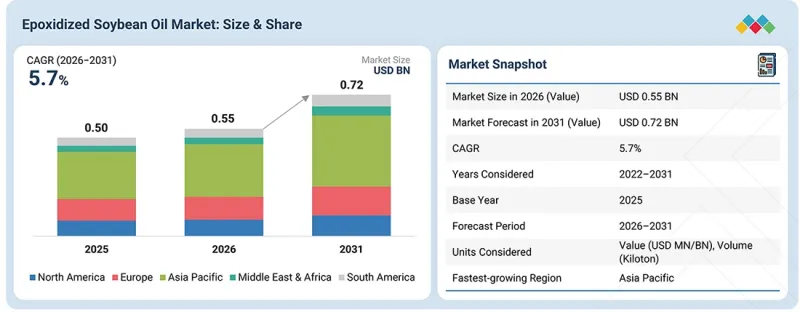
에폭시화 대두유(ESBO) 시장은 2026년 5억 5,000만 달러에서 2031년까지 7억 2,000만 달러에 달할 것으로 예상되며, 2026년부터 2031년까지 연평균 성장률(CAGR)은 5.7%를 기록할 전망입니다.
| 조사 범위 | |
|---|---|
| 조사 기간 | 2022-2031년 |
| 기준 연도 | 2025년 |
| 예측 기간 | 2026-2031년 |
| 산정 단위 | 금액(백만/십억 달러)/킬로톤 |
| 부문 | 원자재, 용도, 최종 이용 산업 및 지역 |
| 대상 지역 | 북미, 아시아태평양, 유럽, 중동 및 아프리카, 남미 |
수요를 견인하고 있는 요인은 친환경 가소제에 대한 수요 증가, 바이오 유래 윤활유의 사용 확대, 다른 바이오 유래 오일과 비교한 ESBO의 가격 경쟁력과 입수 용이성, 그리고 더 폭넓은 용도로의 적용을 가능하게 하는 뛰어난 성능 특성입니다.
“예측 기간 동안 과산화수소는 두 번째로 큰 원료 부문이 될 것으로 전망됩니다.”
원료별로 보면 과산화수소 부문은 대두유를 ESBO로 전환하는 데 사용되는 기존의 에폭시화 공정에서 필수적인 산화제이기 때문에 ESBO 시장에서 두 번째로 큰 점유율을 차지할 것으로 추정됩니다. 산업 공정에서는 과산화수소를 포름산 또는 아세트산과 반응시켜 그 자리에서 과산화물을 생성하고, 이것이 대두유의 불포화 이중 결합과 반응하여 에폭시기를 형성합니다. 이러한 중요성은 과산화수소를 상업적으로 활용하는 공정이 존재하며, 그 이용률과 공정 효율 향상을 위한 연구가 현재도 진행 중이라는 사실로도 강조되고 있습니다. 과산화수소를 이용한 에폭시화는 균일계(기존형 과산) 및 비균일계(촉매) 모두에서 가능한 것으로 밝혀졌으며, 후자는 사용되는 과산화수소의 양과 환경에 미치는 영향을 최소화하도록 설계되었습니다. 과산화수소를 사용하는 또 다른 장점은 반응 시 물로 분해되는 비교적 깨끗한 산화제로서 상대적인 순도가 높다는 점이지만, 에폭시화 반응 시 발열량이 크기 때문에 산업적 반응에서는 신중한 제어가 필요합니다. 공정의 기능성, 기존 산업 화학, 입수 용이성, 다양한 촉매 시스템과의 호환성, 그리고 보다 깨끗한 처리 가능성이 결합되어 ESBO 생산에 과산화수소가 널리 사용되고 있습니다.
“예측 기간 동안 기능성 유체가 두 번째로 큰 응용 분야가 될 것으로 전망됩니다.”
ESBO의 두 번째로 큰 용도는 기능성 유체이며, 그 유도체는 윤활성이나 화학적 기능성 등 바람직한 특성을 제공할 수 있습니다. 또한, 재생 가능한 유체를 유체나 윤활제의 배합에 사용하는 것도 가능합니다. 바이오 기반 윤활제 및 윤활제 중간체로서의 ESBO(에폭시화 대두유)에 대한 연구가 진행되고 있으며, 보다 진보된 유체 시스템을 구축하기 위해 그 에폭시 관능기에 초점이 맞춰지고 있습니다. 과학 문헌에서는 에폭시화 식물유가 윤활유 및 기타 화학제품에 적합한 지속가능한 원료로 인식되고 있습니다. ESBO에 포함된 긴 지방산 사슬로 인해 소수성 분자가 되므로 윤활 용도에 이상적입니다. 에폭시화 공정을 통해 오일의 화학적 특성이 향상되어, 미개질 식물성 오일에 비해 산화 안정성 및 열 안정성이 개선될 가능성이 있습니다. 또한, 이 조사에서는 에폭시화 식물성 오일이 기존의 PVC 가소제를 대체할 수 있는 재생 가능한 대안이 될 수 있음을 보여주고 있습니다. 바이오 유래 및 재생 가능한 윤활유 첨가제에 대한 수요가 증가하고 있으며, 특히 제조업체들이 석유 유래 원료를 대체할 대안을 모색하고 있는 만큼, 이 분야의 가치는 더욱 높아질 것으로 예상됩니다. 그러나 ESBO의 주요 용도는 여전히 PVC 가소제 및 공동 안정제로서의 활용입니다. 이러한 관점에서 기능성 유체는 윤활성, 재생 가능성, 화학적 다용도성, 그리고 추가적인 기능화 가능성 등의 특성을 활용한 중요한 2차 용도로 자리 잡고 있습니다.
“예측 기간 동안 식음료 산업은 두 번째로 큰 최종 이용 산업 부문이 될 것으로 전망됩니다.”
2위 최종 이용 산업은 식음료입니다. ESBO는 식음료 접촉 재료 및 PVC 기반 포장 용도에 사용되며, 그 가소화 특성과 안정화 특성이 유용하게 활용되고 있습니다. 에폭시화 대두유는 연방규정집(21 CFR)의 여러 조항에 규정된 바와 같이, 폴리머 및 식품·음료 접촉 재료와 관련된 용도를 포함하여 다양한 식품·음료 접촉 용도에 대해 미국 FDA로부터 특별히 승인받았습니다. 또한, FDA 기록에 따르면 에폭시화 대두유는 배합 보조제, 윤활제 또는 이형제, 안정제 또는 증점제 등 몇 가지 기술적 용도에서 식품 관련 시스템에 활용되어 왔습니다. 이는 식품 관련 분야에서 폭넓은 용도가 있음을 시사합니다.
재생 가능한 원료에서 유래했기 때문에 유연 포장 및 기타 폴리머계 식품 접촉 용도에 대한 적합성은 더욱 높아지고 있습니다. 또한, 에폭시화 대두유는 PVC의 가소제 및 2차 안정제로도 효과적으로 사용되고 있습니다. PVC 용도에서의 그 중요성은 가소제 역할을 하는 동시에 가공 중 폴리머의 열화를 방지하는 안정화 작용도 수행한다는 이중적인 역할로 인해 특히 주목할 만합니다. 식음료 분야는 ESBO에게 유력한 최종 용도 부문이며, 식품 접촉에 관한 규제 승인, 가소화 및 안정화 기능, 그리고 포장 재료로서의 적합성과 수요 덕분에 폴리머 관련 최종 용도 시장에 이어 두 번째로 큰 규모를 차지하고 있습니다.
“예측 기간 동안 유럽은 금액 기준으로 2위 지역 시장이 될 것으로 전망됩니다.”
유럽은 확립된 플라스틱 가공 산업, PVC 제품에 대한 막대한 국내 수요, 그리고 보다 친환경적이고 안전한 첨가물을 요구하는 정부 규제의 뒷받침을 받아 ESBO의 지역별 시장 중 2위 규모를 기록할 것으로 추정됩니다. 2024년 유럽의 플라스틱 수요는 5,280만 톤에 달할 것으로 예상되며, 이 중 34.9%는 포장, 23.4%는 건축·건설, 9.0%는 자동차 용도가 차지하여, 유럽 내 가소제 및 폴리머 첨가제에 광범위한 다운스트림 시장을 제공하고 있습니다. PVC는 유럽의 건설, 포장, 의료 제품, 전기 절연, 자동차 각 부문에서 널리 사용되고 있기 때문에 ESBO에 특히 중요합니다. 또한, 식품 접촉 재료에 관한 EU 규격에는 안전성 및 이온 이동량 관리, 추적성, 우수 제조 기준(GMP) 요건이 포함되어 있어, 특성이 충분히 규명된 첨가제의 사용을 강력히 뒷받침하고 있습니다. 포장, 건설, 의료 분야에서 폴리머 기반의 사용량으로 인해 ESBO 소비량이 많기 때문에 유럽은 ESBO에게 두 번째로 큰 시장이 되었습니다.
기업 규모별 : Tier 1 : 25%, Tier 2 : 42%, Tier 3 : 33%
직책별 : C레벨 임원 : 20%, 이사 : 30%, 기타 직책 : 50%
지역별 : 북미 : 20%, 유럽 : 10%, 아시아태평양 : 40%, 남미 : 10%, 중동 및 아프리카 : 20%
참고 : Tier 1 : 10억 달러 초과, Tier 2 : 5억 달러-10억 달러, Tier 3 : 5억 달러 미만. 기타 직책에는 영업, 마케팅, 제품 매니저 등이 포함됩니다.
본 조사에서는 에폭시화 대두유 시장의 주요 기업에 대해 기업 개요, 최근 동향 및 주요 시장 전략을 포함한 상세한 경쟁 분석을 수록하고 있습니다.
조사 범위
본 조사 보고서에서는 에폭시화 대두유 시장을 원재료(대두유, 과산화수소, 기타 원재료), 용도(가소제, 안료 분산제, 향료·방향제, 기능성 유체, UV 경화 용도, 연료 첨가제, 기타 용도), 최종 이용 산업(식음료, 퍼스널케어·헬스케어, 접착제·실런트, 자동차·운송 및 기타 최종 이용 산업)과 지역(북미, 유럽, 아시아태평양, 중동 및 아프리카, 남미)을 기준으로 에폭시화 대두유 시장을 분류하고 있습니다. 본 보고서의 조사 범위에는 시장 성장에 영향을 미치는 촉진요인, 제약요인, 과제 및 기회에 대한 상세한 정보가 포함되어 있습니다. 주요 업계 플레이어에 대한 상세한 분석을 통해 사업 개요, 제공 제품, 그리고 에폭시화 대두유 시장과 관련된 파트너십, 제휴, 제품 출시, 사업 확장, 인수합병(M&A) 등의 주요 전략에 대한 인사이트를 제공합니다. 또한, 본 보고서에서는 에폭시화 대두유 시장의 생태계에서 두각을 나타내고 있는 스타트업 기업의 경쟁 분석에 대해서도 다루고 있습니다.
이 보고서를 구매해야 하는 이유
본 보고서는 시장 선도 기업 및 신규 진입 기업에게 에폭시화 대두유 시장 전체 및 각 하위 부문의 매출에 대한 가장 정확한 추정치를 제공합니다. 본 보고서는 이해관계자가 경쟁 구도를 이해하고, 자사의 사업 포지셔닝을 최적화하기 위한 인사이트를 심화하며, 적절한 시장 진입 전략을 수립하는 데 도움이 됩니다. 또한 시장 동향을 파악하고, 주요 시장 촉진요인, 억제요인, 과제 및 기회에 대한 정보를 제공합니다.
본 보고서는 다음 사항에 대한 인사이트를 제공합니다:
주요 촉진요인 분석(친환경 가소제 및 생체적합성 윤활유에 대한 수요 증가 - 광물유 기반 윤활유를 대체할 새로운 대안, 에폭시화 대두유(ESBO)의 대량 및 저가 공급 용이성, 다른 바이오 유래 오일에 대한 경쟁 우위, 수요를 뒷받침하는 우수한 성능 특성), 제약요인(원자재 가격 변동, 식음료 업계에서 ESBO의 과다 사용으로 인한 건강 위험), 기회(프탈레이트 무첨가 안정제의 중요성이 높아지면서 PVC 용도 분야에서 ESBO 생산자에게 기회를 제공하고 있음), 그리고 과제(다른 바이오 유래 가소제와의 경쟁)에 대해 인사이트를 제공합니다.
- 제품 개발/혁신 : 에폭시화 대두유 시장의 향후 기술, 연구 개발 활동 및 제품·서비스 출시에 대한 상세한 인사이트.
- 시장 개발 : 수익성이 높은 시장에 대한 종합적인 정보 - 본 보고서는 다양한 지역의 에폭시화 대두유 시장을 분석합니다.
시장 다각화 : 에폭시화 대두유 시장의 신제품 및 서비스, 미개척 지역, 최근 동향 및 투자에 관한 종합적인 정보.
- 경쟁 평가 : 주요 기업의 시장 점유율, 성장 전략 및 서비스 제공 내용에 대한 상세한 평가를 수행합니다.
자주 묻는 질문
목차
제1장 서론
제2장 요약
제3장 주요 인사이트
- 에폭시화 대두유 시장에서 사업자에게 매력적인 기회
- 에폭시화 대두유 시장 : 아시아태평양(최종 이용 산업별·국가별)
- 에폭시화 대두유 시장 : 원료별
- 에폭시화 대두유 시장 : 용도별
- 에폭시화 대두유 시장 : 최종 이용 산업별
- 에폭시화 대두유 시장 : 국가별
제4장 시장 개요
- 시장 역학
- 성장 촉진요인
- 성장 억제요인
- 기회
- 과제
- 미충족 수요 및 미개척 분야
- 에폭시화 대두유 시장의 미충족 수요
- 미개척 시장의 기회
- 상호 연관된 시장 및 부문 간 기회
- 상호 연관된 시장
- 부문 간 기회
- Tier 1/2/3 주요 기업들의 전략적 움직임
- Tier 1 기업 : 업계 재편과 혁신을 주도하는 세계 리더
- Tier 2 기업 : 지역 내 혁신가 및 틈새 시장 리더
- Tier 3 기업 : 기술을 통한 현대화
제5장 업계 동향
- Porter's Five Forces 분석
- 공급업체의 협상력
- 신규 진입자의 위협
- 대체품의 위협
- 구매자의 협상력
- 경쟁 기업 간의 적대 관계의 격렬함
- 거시경제 분석
- GDP 동향 및 전망
- 가치사슬 분석
- 원자재 공급업체
- 에폭시화 대두유 제조업체
- 제품 제조업체
- 최종 이용 산업
- 생태계 지도
- 가격 분석
- 주요 기업의 용도별 평균 판매 가격 동향
- 지역별 에폭시화 대두유 판매 가격대(2021-2028년)
- 대두유 판매 가격대(2019-2028년)(달러/파운드)
- 에폭시화 대두유의 판매 가격대(2019-2028년)(달러/파운드)
- 무역 분석
- 수출 시나리오(HS 코드 151800)
- 수입 시나리오(HS 코드 151800)
- 주요 회의 및 행사, 2026-2027년
- 고객의 비즈니스에 영향을 미치는 동향 및 변화
- 투자 및 자금 조달 시나리오
- 사례 연구 분석
- 사례 연구 1 : 에폭시화 및 비에폭시화 변형을 고려한 해바라기유, 대두유, 올리브유에 대한 자외선 조사 영향에 관한 비교 조사
- 사례 연구 2 : 가소제로 에폭시화 대두유를 배합했을 때, 폴리염화비닐의 물리적, 기계적 및 열적 특성에 미치는 영향에 관한 조사
- 2025년 미국 관세의 영향 : 에폭시화 대두유 시장
- 주요 관세율
- 가격에 미치는 영향 분석
- 국가 및 지역에 미치는 영향
- 최종 이용 산업에 미치는 영향
제6장 기술 발전, AI의 영향, 특허, 혁신 및 향후 응용
- 주요 기술
- 친환경 에폭시화 공정
- 대두유의 효소적 에폭시화
- 기능화된 에폭시화 대두유
- 보완 기술
- UV 경화형 에폭시화 대두유
- 에폭시화 대두유에 적용된 나노기술
- 관련 기술
- 인공지능을 활용한 대두유 에폭시화 공정의 최적화
- 기술 로드맵
- 단기(2026-2028년) | 공정 최적화 및 친환경 에폭시화
- 중기(2028-2030년) | 고도화된 기능화 및 성능 향상
- 장기(2030-2035년 이후) | 차세대 바이오 기반 소재 및 지능형 제조
- 특허 분석
- 조사 방법
- 에폭시화 대두유 시장, 특허 분석, 2016-2025년
- 향후 용도
- 나노복합재 및 고성능 바이오 기반 소재
- 차세대 배터리용 바이오 유래 폴리머 전해질
- 소프트 로보틱스 및 적응형 디바이스용 스마트 바이오 기반 소재
- AI/생성형 AI가 에폭시화 대두유 시장에 미치는 영향
- 주요 사용 사례 및 시장 잠재력
- 에폭시화 대두유 가공의 모범 사례
- 에폭시화 대두유 시장에서 AI 도입 사례 연구
- 상호 연계된 생태계와 시장 참여자에 미치는 영향
- 에폭시화 대두유 시장에서 생성형 AI 도입에 대한 고객의 준비 현황
제7장 지속가능성과 규제 현황
- 지역별 규제 및 규정 준수
- 규제 기관, 정부 기관 및 기타 조직
- 업계 표준
- 지속가능성 추진 활동
- PVC 재활용 및 순환형 사회를 위한 노력
- 바이오 기반 산업 제품에 대한 대두유 활용 확대
- 규제 정책이 지속가능성 노력에 미치는 영향
제8장 고객 동향과 구매 행동
- 의사결정 과정
- 구매 담당자의 이해관계자와 구매 평가 기준
- 구매 과정에서 주요 이해관계자
- 구매 기준
- 도입 장벽 및 사내 과제
- 다양한 최종 이용 산업 분야의 미충족 수요
- 시장의 수익성
- 수익 창출 가능성
- 비용 동향
제9장 에폭시화 대두유 시장 : 원재료별
- 대두유
- 과산화수소
- 기타 원재료
제10장 에폭시화 대두유 시장 : 용도별
- 가소제
- 안료 분산제
- 향료·방향제
- 기능성 유체
- UV 경화 용도
- 연료 첨가제
- 기타 용도
제11장 에폭시화 대두유 시장 : 최종 이용 산업별
- 식음료
- 퍼스널케어·헬스케어
- 접착제·실란트
- 자동차·운송
- 기타 최종 이용 산업
제12장 에폭시화 대두유 시장 : 지역별
- 북미
- 미국
- 캐나다
- 멕시코
- 유럽
- 독일
- 프랑스
- 영국
- 이탈리아
- 러시아
- 기타 유럽
- 아시아태평양
- 중국
- 인도
- 일본
- 한국
- 인도네시아
- 기타 아시아태평양
- 중동 및 아프리카
- GCC 국가들
- 남아프리카
- 기타 중동 및 아프리카
- 남미
- 브라질
- 아르헨티나
- 기타 남미
제13장 경쟁 현황
- 개요
- 주요 진입 기업의 전략/강점
- 수익 분석
- 시장 점유율 분석
- 기업 가치 평가 및 재무 지표
- 기업 가치 평가
- 재무 지표
- 브랜드/제품 비교
- 기업 평가 매트릭스 : 주요 기업, 2025년
- 스타
- 신흥 리더
- 광범위한 참여 기업
- 진입 기업
- 기업 사업 전개 : 주요 기업, 2025년
- 기업 평가 매트릭스 : 스타트업/중소기업, 2025년
- 선도적인 기업
- 대응력이 뛰어난 기업
- 역동적인 기업
- 출발점
- 경쟁사 벤치마킹 : 스타트업/중소기업, 2025년
- 경쟁 시나리오
- 거래
- 사업 확장
제14장 기업 개요
- 주요 기업
- CHS INC.
- NAN YA PLASTICS CORPORATION
- ADEKA CORPORATION
- CARGILL
- VALTRIS
- PRAANA GROUP
- HAIRMA CHEMICALS(GZ)LTD.
- SHANDONG LONGKOU LONGDA CHEMICAL INDUSTRY CO., LTD.
- GUANGZHOU XINJINLONG CHEMICAL ADDITIVES CO. LTD.
- INBRA INDUSTRIAS QUIMICAS, LTDA.
- 기타 주요 기업
- SHANDONG SHENGBANG IMPORT AND EXPORT CO., LTD.
- ANHUI TIANYI ENVIRONMENTAL PROTECTION TECH. CO., LTD.
- DHANRAJ ORGANIC PVT. LTD.
- AMIK ITALIA SPA
- HALLSTAR
- AJAY POLY PVT LTD(APPL)
- VIZAG CHEMICAL
- PURITZ CHEM PRIVATE LIMITED
- CHANG CHUN PETROCHEMICAL CO., LTD.
- MAKWELL PLASTICIZERS PVT LTD.,
- HEBEI JINGU PLASTICIZER CO., LTD.
- THE CHEMICAL COMPANY(TCC)
- ATAMAN KIMYA A.S.
- FAITH INDUSTRIES LTD.
- PRAKASH CHEMICALS INTERNATIONAL PRIVATE LIMITED(PCIPL)
제15장 조사 방법론
제16장 부록
KSM 26.10.26The epoxidized soybean oil (ESBO) market is projected to reach USD 0.72 billion by 2031 from USD 0.55 billion in 2026, at a CAGR of 5.7% from 2026 to 2031.
| Scope of the Report | |
|---|---|
| Years Considered for the Study | 2022-2031 |
| Base Year | 2025 |
| Forecast Period | 2026-2031 |
| Units Considered | Value (USD Million/Billion) / Volume (Kiloton) |
| Segments | Raw Material, Application, End-Use Industry, and Region |
| Regions covered | North America, Asia Pacific, Europe, the Middle East & Africa, and South America |
Demand is driven by an increasing need for environmentally friendly plasticizers, a rising use of bio-based lubricants, the favorable pricing and widespread accessibility of ESBO in relation to other bio-based oils, as well as its enhanced performance characteristics that facilitate its application across a broader array of uses.
"Hydrogen peroxide projected to be the second-largest raw material segment during the forecast period"
By raw material, the hydrogen peroxide segment is estimated to account for the second-largest share of the ESBO market as it is an essential oxidizing agent in the conventional epoxidation route used for the conversion of soybean oil into ESBO. In the industrial process, hydrogen peroxide is reacted with formic or acetic acid to generate a peroxyacid in situ that will react with the unsaturated double bonds of soybean oil to form epoxy groups. This importance is also emphasized by the fact that there are processes to use hydrogen peroxide commercially, and research is still ongoing to enhance the utilization and process efficiency. The epoxidation with hydrogen peroxide has been shown to be possible in both homogeneous (conventional peracid) and heterogeneous (catalysts) systems, with the latter designed to minimize the amount of peroxide used and its impact on the environment. A further advantage of using hydrogen peroxide is its relative purity as a relatively clean oxidant that decomposes into water upon reaction, but it requires careful control in the industrial reaction due to its high exothermicity when reacting in epoxidation. The combination of process functionality, existing industrial chemistry, availability, compatibility with various catalytic systems, and the potential for cleaner processing results in significant use of hydrogen peroxide in ESBO production.
"Functional fluids projected to be the second-largest application segment during the forecast period."
The second-largest application of ESBO is in functional fluids, where its derivatives can provide desirable properties like lubricity and chemical functionality. Additionally, renewable fluids can be used in the formulation of fluids and lubricants. The study of ESBO (epoxidized soybean oil) as a bio-based lubricant and lubricant intermediate has been conducted, focusing on its epoxy functionality to create more advanced fluid systems. Scientific literature recognizes epoxidized vegetable oils as suitable and sustainable feedstocks for lubricants and other chemicals. The long fatty acid chains in ESBO make it a hydrophobic molecule, making it ideal for lubricating applications. The epoxidation process enhances the oil's chemical properties, potentially improving its oxidative and thermal stability compared to unmodified vegetable oils. The study also indicates that epoxidized vegetable oils can serve as renewable alternatives to conventional PVC plasticizers. This segment is expected to gain further value due to the growing demand for bio-based and renewable lubricant additives, especially as manufacturers seek alternatives to petroleum-based feedstocks. However, the primary use of ESBO remains as a PVC plasticizer and co-stabilizer. From this perspective, functional fluids represent a significant secondary application, leveraging properties such as lubricity, renewability, chemical versatility, and potential for further functionalization.
"Food & beverages projected to be the second-largest end-use industry segment during the forecast period."
The second-largest end-use industry is food & beverages. ESBO is used in food contact materials and in PVC-based packaging applications, where its plasticizing and stabilizing properties are beneficial. Epoxidized soybean oil has been specifically approved by the US FDA for various food-contact uses, as outlined in multiple sections of the Code of Federal Regulations (21 CFR), including applications related to polymers and food-contact materials. Additionally, FDA records indicate that epoxidized soybean oil has been utilized in food-related systems for several technical purposes, such as a formulation aid, lubricant or release agent, and stabilizer or thickener. This suggests a broad range of applications in food-related contexts.
Its suitability for flexible packaging and other polymeric food-contact applications is further enhanced by its renewable origin. Epoxidized soybean oil has also been effectively used as a plasticizer for PVC and as a secondary stabilizer. Its importance in PVC applications is particularly noteworthy due to its dual role: it acts as a plasticizer and helps stabilize the polymer against degradation during processing. Food & beverage is a strong end-use segment for ESBO, trailing only the polymer-related end-use market due to its food contact regulatory acceptance, plasticizing/stabilizing functionality, and its suitability and demand for packaging materials.
"Europe projected to be the second-largest regional segment in terms of value during the forecast period."
Europe is estimated to be the second-largest regional market for ESBO, driven by its well-established plastics processing industry, significant domestic demand for PVC products, and government regulations for more environmentally friendly and safer additives. Europe's plastic demand in 2024 reached 52.8 million tonnes, of which 34.9% was for packaging, 23.4% for building and construction, and 9.0% for automotive applications, providing a wide downstream market for plasticizers and polymer additives in Europe. PVC is especially important for ESBO, as its use is widely spread throughout the European construction, packaging, medical product, electrical insulation, and automotive sectors. Furthermore, EU specifications for food contact materials include the requirement for safety and control of migration, traceability, and good manufacturing practices, which strongly promote the use of well-characterized additives. With the high consumption of ESBO due to the volume of polymer base usage in packaging, construction, and healthcare, Europe is the second-largest market for ESBO.
By Company Type: Tier 1: 25%, Tier 2: 42%, and Tier 3: 33%
By Designation: C-level Executives: 20%, Directors: 30%, and Other Designations: 50%
By Region: North America: 20%, Europe: 10%, Asia Pacific: 40%, South America: 10%, and Middle East & Africa 20%
Note: Tier 1: >USD 1 billion; Tier 2: USD 500 million-1 billion; and Tier 3: <USD 500 million. Other designations include sales, marketing, and product managers.
Companies Covered: CHS Inc. (US), Nan Ya Plastics Corporation (Taiwan), Adeka Corporation (Japan), Cargill (US), Valtris (US), Galata Chemicals LLC (US), Hairma Chemicals (GZ) Ltd. (China), Shandong Longkou Longda Chemical Industry Co., Ltd. (China), Guangzhou Xinjinlong Chemical Additives Co., Ltd. (China), and Inbra Industrias Quimicas, Ltda. (Brazil), among others, are covered in the report.
The study includes an in-depth competitive analysis of key players in the epoxidized soybean oil market, with their company profiles, recent developments, and key market strategies.
Research Coverage
This research report categorizes the epoxidized soybean oil market based on raw material (Soybean Oil, Hydrogen Peroxide, and Other Raw Materials), application (Plasticizers, Pigment Dispersion Agents, Flavors & Fragrances, Functional Fluids, UV Cure Applications, Fuel Additives, and Other Applications), end-use industry (Food & Beverages, Personal & Healthcare, Adhesives & Sealants, Automotive & Transportation, and Other End-use Industries), and region (North America, Europe, Asia Pacific, Middle East & Africa, and South America). The report's scope covers detailed information regarding the drivers, restraints, challenges, and opportunities influencing the growth of the market. A detailed analysis of the key industry players has been done to provide insights into their business overview, products offered, and key strategies, such as partnerships, collaborations, product launches, expansions, and acquisitions, associated with the epoxidized soybean oil market. This report also covers a competitive analysis of upcoming startups in the epoxidized soybean oil market ecosystem.
Reasons to Buy the Report
The report will offer market leaders/new entrants with information on the closest approximations of the revenue numbers for the overall epoxidized soybean oil market and the subsegments. This report will help stakeholders understand the competitive landscape, gain more insights into positioning their businesses better, and plan suitable go-to-market strategies. The report will help stakeholders understand the pulse of the market and provide them with information on key market drivers, restraints, challenges, and opportunities.
The report provides insights into the following points:
Analysis of key drivers (rising demand for eco-friendly plasticizers, biocompatible lubricants - emerging alternative for mineral oil-based lubricants, easy availability of ESBO in large volumes and at low prices, competitive advantage over other bio-based oils, superior performance properties augmenting demand), restraints (fluctuating raw material prices, hazardous to health due to excess usage of ESBO in food & beverage industry), opportunities (growing prominence of phthalate-free stabilizers providing opportunities for ESBO producers in PVC applications), and challenges (competition from other bio-based plasticizers).
- Product Development/Innovation: Detailed insights into upcoming technologies, research & development activities, and product & service launches in the epoxidized soybean oil market.
- Market Development: Comprehensive information about profitable markets - the report analyzes the epoxidized soybean oil market across varied regions.
Market Diversification: Exhaustive information about new products & services, untapped geographies, recent developments, and investments in the epoxidized soybean oil market.
- Competitive Assessment: In-depth assessment of market shares, growth strategies, and service offerings of leading players, such as CHS Inc. (US), Nan Ya Plastics Corporation (Taiwan), Adeka Corporation (Japan), Cargill (US), Valtris (US), Galata Chemicals LLC (US), Hairma Chemicals (GZ) Ltd. (China), Shandong Longkou Longda Chemical Industry Co., Ltd. (China), Guangzhou Xinjinlong Chemical Additives Co., Ltd. (China), and Inbra Industrias Quimicas, Ltda. (Brazil).
TABLE OF CONTENTS
1 INTRODUCTION
- 1.1 STUDY OBJECTIVES
- 1.2 MARKET DEFINITION
- 1.3 STUDY SCOPE
- 1.3.1 MARKETS COVERED & REGIONAL SCOPE
- 1.3.2 INCLUSIONS & EXCLUSIONS
- 1.3.3 YEARS CONSIDERED
- 1.4 CURRENCY CONSIDERED
- 1.5 UNIT CONSIDERED
- 1.6 STAKEHOLDERS
- 1.7 RESEARCH LIMITATIONS
- 1.8 SUMMARY OF STRATEGIC CHANGES IN MARKET
2 EXECUTIVE SUMMARY
- 2.1 KEY INSIGHTS AND MARKET HIGHLIGHTS
- 2.2 KEY MARKET PARTICIPANTS: SHARE INSIGHTS AND STRATEGIC DEVELOPMENTS
- 2.3 DISRUPTIVE TRENDS SHAPING THE MARKET
- 2.4 HIGH-GROWTH SEGMENTS & EMERGING FRONTIERS
- 2.5 SNAPSHOT: GLOBAL MARKET SIZE, GROWTH RATE, AND FORECAST
3 PREMIUM INSIGHTS
- 3.1 ATTRACTIVE OPPORTUNITIES FOR PLAYERS IN EPOXIDIZED SOYBEAN OIL MARKET
- 3.2 ASIA PACIFIC: EPOXIDIZED SOYBEAN OIL MARKET, BY END-USE INDUSTRY AND COUNTRY
- 3.3 EPOXIDIZED SOYBEAN OIL MARKET, BY RAW MATERIAL
- 3.4 EPOXIDIZED SOYBEAN OIL MARKET, BY APPLICATION
- 3.5 EPOXIDIZED SOYBEAN OIL MARKET, BY END-USE INDUSTRY
- 3.6 EPOXIDIZED SOYBEAN OIL MARKET, BY COUNTRY
4 MARKET OVERVIEW
- 4.1 INTRODUCTION
- 4.2 MARKET DYNAMICS
- 4.2.1 DRIVERS
- 4.2.1.1 Rising demand for eco-friendly plasticizers
- 4.2.1.2 Biocompatible lubricants - emerging alternative to mineral oil-based lubricants
- 4.2.1.3 Easy availability of epoxidized soybean oil in large volumes at low prices
- 4.2.1.4 Superior performance properties augmenting demand
- 4.2.2 RESTRAINTS
- 4.2.2.1 Fluctuating raw material prices
- 4.2.2.2 Hazardous to health due to excessive use of epoxidized soybean oil in food & beverage industry
- 4.2.3 OPPORTUNITIES
- 4.2.3.1 Growing prominence of phthalate-free stabilizers in PVC applications
- 4.2.4 CHALLENGES
- 4.2.4.1 Competition from other bio-based plasticizers
- 4.2.1 DRIVERS
- 4.3 UNMET NEEDS AND WHITE SPACES
- 4.3.1 UNMET NEEDS IN THE EPOXIDIZED SOYBEAN OIL MARKET
- 4.3.2 WHITE SPACE OPPORTUNITIES
- 4.4 INTERCONNECTED MARKETS AND CROSS-SECTOR OPPORTUNITIES
- 4.4.1 INTERCONNECTED MARKETS
- 4.4.2 CROSS-SECTOR OPPORTUNITIES
- 4.4.2.1 Food & beverage ↔ personal & healthcare
- 4.4.2.2 Adhesives & sealants ↔ automotive & transportation
- 4.5 STRATEGIC MOVES BY TIER-1/2/3 PLAYERS
- 4.5.1 TIER 1 PLAYERS: GLOBAL LEADERS DRIVING CONSOLIDATION AND INNOVATION
- 4.5.1.1 CHS Inc.'s expansion FACILITY of soybean processing in Wisconsin
- 4.5.1.2 Cargill's expansion and modernization of Ohio facility
- 4.5.2 TIER 2 PLAYERS: REGIONAL INNOVATORS AND NICHE LEADERS
- 4.5.2.1 Praana's expansion in the epoxidized soybean oil market through galata chemicals
- 4.5.3 TIER 3 PLAYERS: MODERNIZATION THROUGH TECHNOLOGY
- 4.5.3.1 Puritz chem private limited implements latest technologies and automation for production of ESBO
- 4.5.1 TIER 1 PLAYERS: GLOBAL LEADERS DRIVING CONSOLIDATION AND INNOVATION
5 INDUSTRY TRENDS
- 5.1 PORTER'S FIVE FORCES ANALYSIS
- 5.1.1 BARGAINING POWER OF SUPPLIERS
- 5.1.2 THREAT OF NEW ENTRANTS
- 5.1.3 THREAT OF SUBSTITUTES
- 5.1.4 BARGAINING POWER OF BUYERS
- 5.1.5 INTENSITY OF COMPETITIVE RIVALRY
- 5.2 MACROECONOMIC ANALYSIS
- 5.2.1 INTRODUCTION
- 5.2.2 GDP TRENDS AND FORECASTS
- 5.3 VALUE CHAIN ANALYSIS
- 5.3.1 RAW MATERIAL SUPPLIERS
- 5.3.2 EPOXIDIZED SOYBEAN OIL MANUFACTURERS
- 5.3.3 PRODUCT MANUFACTURERS
- 5.3.4 END-USE INDUSTRIES
- 5.4 ECOSYSTEM MAP
- 5.5 PRICING ANALYSIS
- 5.5.1 AVERAGE SELLING PRICE TREND OF KEY PLAYERS, BY APPLICATION
- 5.5.2 SELLING PRICE RANGE OF EPOXIDIZED SOYBEAN OIL, BY REGION, 2021-2028
- 5.5.3 SELLING PRICE RANGE OF SOYBEAN OIL, 2019-2028 (USD/LBS)
- 5.5.4 SELLING PRICE RANGE OF EPOXIDIZED SOYBEAN OIL, 2019-2028 (USD/LBS)
- 5.6 TRADE ANALYSIS
- 5.6.1 EXPORT SCENARIO (HS CODE 151800)
- 5.6.2 IMPORT SCENARIO (HS CODE 151800)
- 5.7 KEY CONFERENCES AND EVENTS, 2026-2027
- 5.8 TRENDS/DISRUPTIONS IMPACTING CUSTOMER BUSINESS
- 5.9 INVESTMENT AND FUNDING SCENARIO
- 5.10 CASE STUDY ANALYSIS
- 5.10.1 CASE STUDY 1: COMPARATIVE INVESTIGATION OF ULTRAVIOLET IRRADIATION EFFECTS ON SUNFLOWER, SOYBEAN, AND OLIVE OILS, CONSIDERING BOTH EPOXIDIZED AND NON-EPOXIDIZED VARIANTS
- 5.10.2 CASE STUDY 2: INVESTIGATING IMPACT OF INCORPORATING EPOXIDIZED SOYBEAN OIL AS A PLASTICIZER ON PHYSICAL, MECHANICAL, AND THERMAL CHARACTERISTICS OF POLYVINYL CHLORIDE
- 5.11 IMPACT OF 2025 US TARIFF: EPOXIDIZED SOYBEAN OIL MARKET
- 5.11.1 KEY TARIFF RATES
- 5.11.2 PRICE IMPACT ANALYSIS
- 5.11.3 IMPACT ON COUNTRY/REGION
- 5.11.3.1 US
- 5.11.3.2 Europe
- 5.11.3.3 Asia Pacific
- 5.11.4 END-USE INDUSTRY IMPACT
6 TECHNOLOGICAL ADVANCEMENTS, AI-DRIVEN IMPACT, PATENTS, INNOVATIONS, AND FUTURE APPLICATIONS
- 6.1 KEY TECHNOLOGIES
- 6.1.1 GREEN EPOXIDATION PROCESSES
- 6.1.2 ENZYMATIC EPOXIDATION OF SOYBEAN OIL
- 6.1.3 FUNCTIONALIZED EPOXIDIZED SOYBEAN OIL
- 6.2 COMPLEMENTARY TECHNOLOGIES
- 6.2.1 UV CURABLE EPOXIDIZED SOYBEAN OIL
- 6.2.2 NANOTECHNOLOGY IN EPOXIDIZED SOYBEAN OIL
- 6.3 ADJACENT TECHNOLOGIES
- 6.3.1 OPTIMIZING SOYBEAN OIL EPOXIDATION PROCESS BY MEANS OF ARTIFICIAL INTELLIGENCE
- 6.4 TECHNOLOGY ROADMAP
- 6.4.1 SHORT-TERM (2026-2028) | PROCESS OPTIMIZATION AND GREEN EPOXIDATION
- 6.4.2 MID-TERM (2028-2030) | ADVANCED FUNCTIONALIZATION AND PERFORMANCE ENHANCEMENT
- 6.4.3 LONG-TERM (2030-2035+) | NEXT-GENERATION BIO-BASED MATERIALS AND INTELLIGENT MANUFACTURING
- 6.5 PATENT ANALYSIS
- 6.5.1 INTRODUCTION
- 6.5.2 METHODOLOGY
- 6.5.3 EPOXIDIZED SOYBEAN OIL MARKET, PATENT ANALYSIS, 2016-2025
- 6.6 FUTURE APPLICATIONS
- 6.6.1 NANOCOMPOSITES AND HIGH-PERFORMANCE BIO-BASED MATERIALS
- 6.6.2 BIO-BASED POLYMER ELECTROLYTES FOR NEXT-GENERATION BATTERIES
- 6.6.3 SMART BIO-BASED MATERIALS FOR SOFT ROBOTICS AND ADAPTIVE DEVICES
- 6.7 IMPACT OF AI/GEN AI ON EPOXIDIZED SOYBEAN OIL MARKET
- 6.7.1 TOP USE CASES AND MARKET POTENTIAL
- 6.7.2 BEST PRACTICES IN EPOXIDIZED SOYBEAN OIL PROCESSING
- 6.7.3 CASE STUDIES OF AI IMPLEMENTATION IN EPOXIDIZED SOYBEAN OIL MARKET
- 6.7.4 INTERCONNECTED ECOSYSTEM AND IMPACT ON MARKET PLAYERS
- 6.7.5 CLIENTS' READINESS TO ADOPT GENERATIVE AI IN EPOXIDIZED SOYBEAN OIL MARKET
7 SUSTAINABILITY AND REGULATORY LANDSCAPE
- 7.1 REGIONAL REGULATIONS AND COMPLIANCE
- 7.1.1 REGULATORY BODIES, GOVERNMENT AGENCIES, AND OTHER ORGANIZATIONS
- 7.1.2 INDUSTRY STANDARDS
- 7.2 SUSTAINABILITY INITIATIVES
- 7.2.1 SUPPORTING PVC RECYCLING AND CIRCULARITY
- 7.2.2 EXPANSION OF SOYBEAN OIL INTO BIO-BASED INDUSTRIAL PRODUCTS
- 7.3 IMPACT OF REGULATORY POLICY ON SUSTAINABILITY INITIATIVES
8 CUSTOMER LANDSCAPE & BUYER BEHAVIOR
- 8.1 DECISION-MAKING PROCESS
- 8.2 BUYER STAKEHOLDERS AND BUYING EVALUATION CRITERIA
- 8.2.1 KEY STAKEHOLDERS IN THE BUYING PROCESS
- 8.2.2 BUYING CRITERIA
- 8.3 ADOPTION BARRIERS & INTERNAL CHALLENGES
- 8.4 UNMET NEEDS FROM VARIOUS END-USE INDUSTRIES
- 8.5 MARKET PROFITABILITY
- 8.5.1 REVENUE POTENTIAL
- 8.5.2 COST DYNAMICS
9 EPOXIDIZED SOYBEAN OIL MARKET, BY RAW MATERIAL
- 9.1 INTRODUCTION
- 9.2 SOYBEAN OIL
- 9.2.1 ECONOMICAL AND WIDE AVAILABILITY TO DRIVE MARKET
- 9.3 HYDROGEN PEROXIDE
- 9.3.1 COST-EFFECTIVENESS AND SUPERIOR PERFORMANCE OF TECHNOLOGY TO DRIVE MARKET
- 9.4 OTHER RAW MATERIALS
10 EPOXIDIZED SOYBEAN OIL MARKET, BY APPLICATION
- 10.1 INTRODUCTION
- 10.2 PLASTICIZERS
- 10.2.1 ENHANCEMENT OF FLEXIBILITY, PLASTICITY, AND OVERALL USABILITY OF PLASTICS TO DRIVE DEMAND
- 10.3 PIGMENT DISPERSION AGENTS
- 10.3.1 UNIFORMITY OF COLOR, CONSISTENCY, AND PERFORMANCE IN PAINTS & COATINGS, INKS, PLASTICS, AND COSMETICS TO DRIVE MARKET
- 10.4 FLAVORS & FRAGRANCES
- 10.4.1 SUSTAINABILITY AND ENHANCEMENT OF STABILITY AND PERFORMANCE OF SENSORY-DRIVEN PRODUCTS TO DRIVE MARKET
- 10.5 FUNCTIONAL FLUIDS
- 10.5.1 LOW VOLATILITY, HIGH VISCOSITY, SHEAR-STABILITY, ABSORPTION ON METAL SURFACES, AND GOOD SOLUBILITY WITH OIL ADDITIVES TO DRIVE MARKET
- 10.6 UV CURE APPLICATIONS
- 10.6.1 RISING DEMAND FOR ECO-FRIENDLY AND HIGH-PERFORMANCE FORMULATIONS TO DRIVE MARKET
- 10.7 FUEL ADDITIVES
- 10.7.1 OVERALL EFFECTIVENESS AND ENVIRONMENTAL COMPATIBILITY TO DRIVE DEMAND
- 10.8 OTHER APPLICATIONS
11 EPOXIDIZED SOYBEAN OIL MARKET, BY END-USE INDUSTRY
- 11.1 INTRODUCTION
- 11.2 FOOD & BEVERAGE
- 11.2.1 RISING DEMAND FOR NON-PHTHALATE PVC PLASTICIZERS FOR FOOD PACKAGE MATERIALS AND BEVERAGE CAN COATINGS
- 11.3 PERSONAL & HEALTHCARE
- 11.3.1 APPLICATIONS IN FABRICATION OF MEDICAL DEVICES, PHARMACEUTICAL PACKAGING, AND PERSONAL CARE PRODUCTS TO DRIVE MARKET
- 11.4 ADHESIVES & SEALANTS
- 11.4.1 ENHANCEMENT OF FLEXIBILITY, DURABILITY, AND OVERALL PERFORMANCE OF ADHESIVE FORMULATIONS TO DRIVE MARKET
- 11.5 AUTOMOTIVE & TRANSPORTATION
- 11.5.1 INCREASE IN FLEXIBILITY, IMPACT RESISTANCE, AND THERMAL STABILITY OF PVC FORMULATIONS TO DRIVE MARKET
- 11.6 OTHER END-USE INDUSTRIES
12 EPOXIDIZED SOYBEAN OIL MARKET, BY REGION
- 12.1 INTRODUCTION
- 12.2 NORTH AMERICA
- 12.2.1 US
- 12.2.1.1 Expanding construction and food & beverage industries to drive market
- 12.2.2 CANADA
- 12.2.2.1 Surging demand for replacement of non-sustainable materials in PVC plastics and natural polyols to drive market
- 12.2.3 MEXICO
- 12.2.3.1 Demand for bio-based plasticizers in PVC compounds for packaging applications to drive market
- 12.2.1 US
- 12.3 EUROPE
- 12.3.1 GERMANY
- 12.3.1.1 Growing potential in adhesives & sealants, coatings, and polymer sectors to drive market
- 12.3.2 FRANCE
- 12.3.2.1 High safety standards and environmental regulations to drive market
- 12.3.3 UK
- 12.3.3.1 Use as plasticizer and additive for packaging products to drive market
- 12.3.4 ITALY
- 12.3.4.1 Increased investments in polymer industry and environmental concerns to drive market
- 12.3.5 RUSSIA
- 12.3.5.1 Growing PVC industry to drive market
- 12.3.6 REST OF EUROPE
- 12.3.1 GERMANY
- 12.4 ASIA PACIFIC
- 12.4.1 CHINA
- 12.4.1.1 Growing economy and rapidly expanding end-use industries to drive market
- 12.4.2 INDIA
- 12.4.2.1 Government initiatives to drive market
- 12.4.3 JAPAN
- 12.4.3.1 PVC industry and high-end applications to drive market
- 12.4.4 SOUTH KOREA
- 12.4.4.1 Increasing potential in food & beverage and personal care & healthcare sectors to drive market
- 12.4.5 INDONESIA
- 12.4.5.1 Increasing potential in agriculture industry to drive market
- 12.4.6 REST OF ASIA PACIFIC
- 12.4.1 CHINA
- 12.5 MIDDLE EAST & AFRICA
- 12.5.1 GCC COUNTRIES
- 12.5.1.1 Growing end-use industries to drive market
- 12.5.1.2 Saudi Arabia
- 12.5.1.2.1 Regulatory support and propelling construction industry to drive market
- 12.5.1.3 UAE
- 12.5.1.3.1 Industrial growth and tourism to drive market
- 12.5.1.4 Rest of GCC countries
- 12.5.2 SOUTH AFRICA
- 12.5.2.1 Increasing urbanization and robust soybean industry to drive market
- 12.5.3 REST OF MIDDLE EAST & AFRICA
- 12.5.1 GCC COUNTRIES
- 12.6 SOUTH AMERICA
- 12.6.1 BRAZIL
- 12.6.1.1 Increasing demand for personal & healthcare products to drive market
- 12.6.2 ARGENTINA
- 12.6.2.1 Significant soybean production to drive market
- 12.6.3 REST OF SOUTH AMERICA
- 12.6.1 BRAZIL
13 COMPETITIVE LANDSCAPE
- 13.1 OVERVIEW
- 13.2 KEY PLAYER STRATEGIES/RIGHT TO WIN
- 13.3 REVENUE ANALYSIS
- 13.4 MARKET SHARE ANALYSIS
- 13.5 COMPANY VALUATION AND FINANCIAL METRICS
- 13.5.1 COMPANY VALUATION
- 13.6 FINANCIAL METRICS
- 13.7 BRAND/PRODUCT COMPARISON
- 13.8 COMPANY EVALUATION MATRIX: KEY PLAYERS, 2025
- 13.8.1 STARS
- 13.8.2 EMERGING LEADERS
- 13.8.3 PERVASIVE PLAYERS
- 13.8.4 PARTICIPANTS
- 13.8.5 COMPANY FOOTPRINT: KEY PLAYERS, 2025
- 13.8.5.1 Company footprint
- 13.8.5.2 Region footprint
- 13.8.5.3 Raw material footprint
- 13.8.5.4 End-use industry footprint
- 13.9 COMPANY EVALUATION MATRIX: STARTUPS/SMES, 2025
- 13.9.1 PROGRESSIVE COMPANIES
- 13.9.2 RESPONSIVE COMPANIES
- 13.9.3 DYNAMIC COMPANIES
- 13.9.4 STARTING BLOCKS
- 13.9.5 COMPETITIVE BENCHMARKING: STARTUPS/SMES, 2025
- 13.9.5.1 Detailed list of key startups/SMEs
- 13.9.5.2 Competitive benchmarking of key startups/SMEs
- 13.10 COMPETITIVE SCENARIO
- 13.10.1 DEALS
- 13.10.2 EXPANSIONS
14 COMPANY PROFILES
- 14.1 KEY PLAYERS
- 14.1.1 CHS INC.
- 14.1.1.1 Business overview
- 14.1.1.2 Products/Solutions/Services offered
- 14.1.1.3 Recent developments
- 14.1.1.4 MnM view
- 14.1.1.4.1 Right to win
- 14.1.1.4.2 Strategic choices
- 14.1.1.4.3 Weaknesses and competitive threats
- 14.1.2 NAN YA PLASTICS CORPORATION
- 14.1.2.1 Business overview
- 14.1.2.2 Products/Solutions/Services offered
- 14.1.2.3 MnM view
- 14.1.2.3.1 Right to win
- 14.1.2.3.2 Strategic choices
- 14.1.2.3.3 Weaknesses and competitive threats
- 14.1.3 ADEKA CORPORATION
- 14.1.3.1 Business overview
- 14.1.3.2 Products/Solutions/Services offered
- 14.1.3.3 MnM view
- 14.1.3.3.1 Right to win
- 14.1.3.3.2 Strategic choices
- 14.1.3.3.3 Weaknesses and competitive threats
- 14.1.4 CARGILL
- 14.1.4.1 Business overview
- 14.1.4.2 Products/Solutions/Services offered
- 14.1.4.3 Recent developments
- 14.1.4.4 MnM view
- 14.1.4.4.1 Right to win
- 14.1.4.4.2 Strategic choices
- 14.1.4.4.3 Weaknesses and competitive threats
- 14.1.5 VALTRIS
- 14.1.5.1 Business overview
- 14.1.5.2 Products/Solutions/Services offered
- 14.1.5.3 MnM view
- 14.1.5.3.1 Right to win
- 14.1.5.3.2 Strategic choices
- 14.1.5.3.3 Weaknesses and competitive threats
- 14.1.6 PRAANA GROUP
- 14.1.6.1 Business overview
- 14.1.6.2 Products/Solutions/Services offered
- 14.1.6.3 MnM view
- 14.1.7 HAIRMA CHEMICALS (GZ) LTD.
- 14.1.7.1 Business overview
- 14.1.7.2 Products/Solutions/Services offered
- 14.1.7.3 MnM view
- 14.1.8 SHANDONG LONGKOU LONGDA CHEMICAL INDUSTRY CO., LTD.
- 14.1.8.1 Business overview
- 14.1.8.2 Products/Solutions/Services offered
- 14.1.8.3 MnM view
- 14.1.9 GUANGZHOU XINJINLONG CHEMICAL ADDITIVES CO. LTD.
- 14.1.9.1 Business overview
- 14.1.9.2 Products/Solutions/Services offered
- 14.1.9.3 MnM view
- 14.1.10 INBRA INDUSTRIAS QUIMICAS, LTDA.
- 14.1.10.1 Business overview
- 14.1.10.2 Products/Solutions/Services offered
- 14.1.10.3 MnM view
- 14.1.1 CHS INC.
- 14.2 OTHER PLAYERS
- 14.2.1 SHANDONG SHENGBANG IMPORT AND EXPORT CO., LTD.
- 14.2.2 ANHUI TIANYI ENVIRONMENTAL PROTECTION TECH. CO., LTD.
- 14.2.3 DHANRAJ ORGANIC PVT. LTD.
- 14.2.4 AMIK ITALIA SPA
- 14.2.5 HALLSTAR
- 14.2.6 AJAY POLY PVT LTD (APPL)
- 14.2.7 VIZAG CHEMICAL
- 14.2.8 PURITZ CHEM PRIVATE LIMITED
- 14.2.9 CHANG CHUN PETROCHEMICAL CO., LTD.
- 14.2.10 MAKWELL PLASTICIZERS PVT LTD.,
- 14.2.11 HEBEI JINGU PLASTICIZER CO., LTD.
- 14.2.12 THE CHEMICAL COMPANY (TCC)
- 14.2.13 ATAMAN KIMYA A.S.
- 14.2.14 FAITH INDUSTRIES LTD.
- 14.2.15 PRAKASH CHEMICALS INTERNATIONAL PRIVATE LIMITED (PCIPL)
15 RESEARCH METHODOLOGY
- 15.1 RESEARCH DATA
- 15.1.1 SECONDARY DATA
- 15.1.1.1 Key data from secondary sources
- 15.1.2 PRIMARY DATA
- 15.1.2.1 Key data from primary sources
- 15.1.2.2 Key industry insights
- 15.1.1 SECONDARY DATA
- 15.2 MARKET SIZE ESTIMATION
- 15.3 DATA TRIANGULATION
- 15.4 RESEARCH ASSUMPTIONS
- 15.5 RESEARCH LIMITATIONS
- 15.6 RISK ASSESSMENT
- 15.7 GROWTH RATE ASSUMPTIONS
16 APPENDIX
- 16.1 DISCUSSION GUIDE
- 16.2 KNOWLEDGESTORE: MARKETSANDMARKETS' SUBSCRIPTION PORTAL
- 16.3 CUSTOMIZATION OPTIONS
- 16.4 RELATED REPORTS
- 16.5 AUTHOR DETAILS


