

|
시장보고서
상품코드
2158074
파력 에너지 변환기 시장 예측(-2031년) : 기술, 로케이션, 용도, 지역별Wave Energy Converter Market by Technology (Oscillating Water Column, Oscillating Body Converters, Overtopping Devices, Others), Location (Shoreline, Nearshore, Offshore), Application, and Region - Global Forecast to 2031 |
||||||

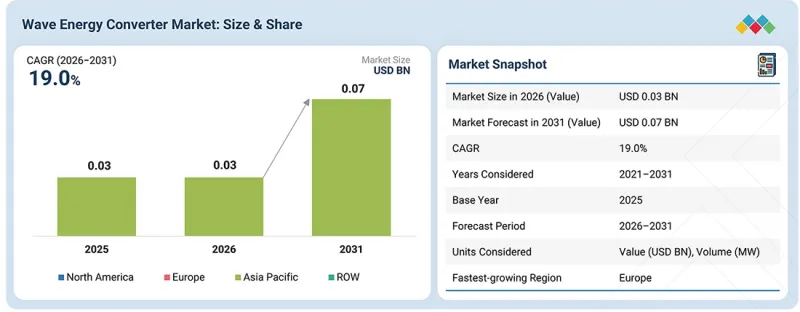
전 세계 파력 에너지 변환기 시장은 2026년 3,000만 달러에서 2031년까지 7,000만 달러로 성장할 것으로 예상되며, 연평균 성장률(CAGR)은 19.0%에 달할 것으로 전망됩니다.
이러한 시장 성장은 해양 에너지에 대한 연구개발 및 실증 프로젝트에 대한 정부 자금 지원 확대, 외해 시험 인프라 확충, 그리고 장비의 신뢰성, 내구성, 에너지 회수율 및 균등화 발전 비용 개선을 목표로 한 지속적인 기술 개발에 힘입고 있습니다.
| 조사 범위 | |
|---|---|
| 조사 대상 기간 | 2022-2024년 |
| 기준 연도 | 2025년 |
| 예측 기간 | 2026-2031년 |
| 산정 단위 | 금액(10억 달러), 수량(MW) |
| 부문 | 기술별, 지역별, 용도별 |
| 대상 지역 | 북미, 유럽, 아시아태평양, 기타 지역 |
미국 에너지부는 해상 시험 및 시스템 검증 프로그램을 통해 파력 에너지의 상용화를 지속적으로 지원하고 있으며, 한편 오리건주의 PacWave 시설에서는 계통 연계형 파력 발전의 실현을 향해 진전이 보이고 있습니다.
제조사와 기술 개발자들은 다양한 파도 조건과 설치 환경에서 에너지 회수 효율을 높이기 위해 포인트 흡수기, 진동식 파도 서지 변환기, 진동 수주, 감쇠 장치, 월류 장치 및 기타 파력 발전 아키텍처 개발을 추진하고 있습니다. 모듈식 파력 발전 어레이, 첨단 동력 추출 시스템, 지능형 제어, 최적화된 계류 시스템 및 내장애성 메커니즘의 활용 확대는 시제품 개발에서 대규모 실증 및 상업 프로젝트로의 전환을 지원하고 있습니다. 또한 개발 기업은 기존의 계통 연계 전력 공급 외에도 해수 담수화, 해상 인프라, 외딴 지역 및 도서 지역 전력 공급, 수산양식, 해양 모니터링 등의 용도를 목표로 삼고 있으며, 파력 에너지 기술에 더 많은 기회를 창출하고 있습니다.
"진동형 파력 에너지 변환기는 예측 기간 중 주도적인 위치를 유지할 것으로 전망됩니다."
포인트 흡수기, 감쇠기, 진동식 파도 서지 변환기, 수중 압력차 장치 및 관련 구성 요소를 포함하는 진동체 변환기는 부유식, 수중식 또는 해저에 고정된 구성 요소 간의 상대적 움직임을 통해 파동을 포착할 수 있는 능력을 갖추고 있으며, 지속적인 개발이 진행될 것으로 예상됩니다. 포인트 흡수기는 기술 개발 측면에서 큰 주목을 받고 있으며, CorPower Ocean, Carnegie Clean Energy, Ocean Power Technologies, CalWave, Oscilla Power와 같은 기업이 파력 에너지 변환을 위한 다양한 접근 방식을 개발하고 있습니다. 예를 들어 Carnegie사의 CETO 기술은 완전히 수중에 잠긴 포인트 흡수기를 채택하고 있는 반면, CorPower Ocean사는 유틸리티 규모의 파력 발전소를 위한 소형 포인트 흡수기 시스템을 개발했습니다.
"예측 기간 중 발전 분야가 시장을 주도할 것으로 전망됩니다."
각 개발사가 계통 연계형 및 분산형 재생 가능 전력 시장을 목표로 하고 있으므로 파력 에너지 변환기의 주요 용도는 여전히 발전 분야입니다. 파력 발전 프로젝트는 연안 송전망, 도서 지역, 외딴 지역 사회, 항만, 그리고 예측 가능한 해양 자원이 다른 재생 가능 에너지원을 보완할 수 있는 해상 용도를 위해 개발되고 있습니다. 미국의 PacWave 시설은 이 분야의 중요한 진전으로, 2026년부터 파력 발전으로 생산된 전력을 미국 송전망에 공급할 수 있도록 하는 전력 구매 계약이 체결되었습니다.
1차 조사 내역:
주요 업계 관계자, 분야별 전문가, 주요 시장 참여 기업의 경영진, 프로젝트 개발자, 기술 전문가, 이사 등 다양한 전문가를 대상으로 심층 인터뷰를 실시하여 중요한 정성적·정량적 정보를 수집·검증함과 동시에 향후 시장 전망을 평가했습니다. 주요인터뷰 내역은 다음과 같습니다. :
기업 유형별: Tier 1-65%, Tier 2-24%, Tier 3-11%
직책별: C레벨 임원-30%, 이사-25%, 기타-45%
지역별: 북미 - 25%, 유럽 - 40%, 아시아태평양 - 25%, 기타 지역 - 10%.
참고: ‘기타’에는 영업 매니저, 엔지니어링 매니저, 프로젝트 매니저, 기술 전문가, 지역 매니저 등이 포함됩니다.
Tier 1 기업: 2025년 기업 매출이 50억 달러 이상, Tier 2 기업: 기업 매출이 10억 달러 이상 50억 달러 미만, Tier 3 기업: 기업 매출이 10억 달러 미만.
파력 에너지 변환기 시장은 정평이 나 있는 기술 개발 기업, 해양 에너지 기업, 엔지니어링 회사 및 재생 가능 에너지 전문 기업이 주로 구성하고 있습니다. 이들 기업의 기술 포트폴리오, 실증 프로젝트, 외해 시험, 전략적 제휴 및 지역적 확장이 경쟁 구도를 지속적으로 형성하고 있습니다.
조사 범위:
이 보고서에서는 파력 에너지 변환기 시장에 대해 기술별(진동 수주식, 진동체식, 오버플로식, 기타), 진동체 하위 기술(포인트 흡수기, 어테네이터, 진동식 파도 서지 변환 장치, 수중 압력차 장치), 설치 장소(해안선, 연안, 외해), 용도(발전, 해수 담수화, 기타) 및 지역(북미, 유럽, 아시아태평양, 기타 지역)별로 파력 에너지 변환기 시장에 대한 포괄적인 정의, 설명 및 예측을 제공합니다. 또한 시장 촉진요인, 억제요인, 기회, 과제에 대한 정성적 및 정량적 분석도 제시하고 있습니다. 아울러, 본 조사에서는 경쟁 구도 평가 시장 규모 추산 및 예측, 기술 동향, 생태계 분석, 상용화 사례, 기업 벤치마킹, 프로젝트/도입 분석 및 최근 동향을 포괄적으로 다루어 파력 에너지 변환기 시장에 대한 포괄적인 인사이트를 제공합니다.
이 보고서를 구매할 때의 주요 이점
이 보고서는 WEC 기술 개발자, 재생에너지 기업, 전력 회사, 프로젝트 개발자, 투자자, 정책 입안자, 해양 엔지니어링 기업 및 기타 이해관계자가 지속적으로 진화하는 파력 에너지 변환기 시장을 이해하는 데 도움이 됩니다. 주요 기술, 출력 정격, 입지, 용도 및 지역 부문에 걸친 시장 전망을 제공하는 동시에, 기술의 성숙도, 도입 동향, 경쟁 포지셔닝 및 상용화 기회에 대한 인사이트도 제공합니다. 이 보고서는 상세한 시장 정보와 전략적 분석을 통해 이해관계자들이 정보에 기반한 비즈니스 의사결정을 내릴 수 있도록 지원합니다.
- 주요 시장 역학 동향 분석: 촉진요인(해양 에너지에 대한 정부 지원 확대, 재생 가능 에너지 다각화의 진전, 예측 가능한 연안 및 도서 지역의 전력 수요 증가), 제약 요인(높은 자본 비용, 상업적 규모의 도입이 제한적임, 까다로운 해상 설치 및 유지보수 요건), 기회(해수 담수화, 외딴 지역 및 도서 지역의 전력 공급, 해상 인프라, 하이브리드 재생에너지 시스템과의 통합) 및 과제(기술의 내구성, 기존 재생 가능 에너지에 비해 높은 LCOE, 해양 관련 인허가 요건, 제한된 공급망 및 시험 인프라) 등, 시장 성장에 영향을 미치는 요인들을 분석하고 있습니다. 미국 에너지부(DOE)의 자금 지원 프로그램 및 해양 에너지 시험 인프라는 기술 검증과 상용화를 위한 노력을 지속적으로 지원하고 있습니다.
- 기술 및 제품 혁신: 파력 에너지 개발을 혁신하고 있는 포인트 흡수기, 진동식 파도 서지 변환기, 진동식 수주, 첨단 동력 추출 시스템, 지능형 제어, 최적화된 계류 시스템, 모듈식 파력 발전 어레이, 그리고 폭풍우 저항 기술 분야의 진전에 대해 살펴봅니다. 각 개발사는 에너지 회수 효율과 운영 성능을 향상시키기 위해 AI를 활용한 제어, 디지털 모니터링, 그리고 첨단 유체역학적 최적화를 점점 더 많이 도입하고 있습니다. 예를 들어 카네기(Carnegie)사는 자사의 CETO 시스템 최적화 과정에서 AI 및 전기 기계 기술을 중시하고 있습니다.
- 시장 개발: 정부의 해양 에너지 프로그램, 외해 시험 시설, 상업적 실증 프로젝트, 계통 연계 도입, 그리고 기술 개발자, 전력 회사, 항만, 연구 기관 간의 파트너십이 파력 에너지 개발을 어떻게 가속화하고 있는지를 강조하고 있습니다. PacWave와 같은 시험 시설의 설립 및 확장은 실험실이나 시제품을 통한 시험에서 실제 규모 검증으로의 전환을 지원하고 있습니다.
- 시장 다각화: 파력 에너지 변환 장치(WEC)의 용도가 기존의 계통 연계 발전에 그치지 않고, 해수 담수화, 외딴 지역 및 도서 지역 전력 공급, 연안 양식, 해양 모니터링, 연안 인프라, 마이크로그리드, 기타 자율형 해양 용도로 확대되고 있음을 높이 평가하며, 시장 진입 기업에게 더 많은 수익 기회가 창출되고 있음을 보여줍니다. 예를 들어 카네기(Carnegie)사의 CETO 기술은 발전과 담수 생산을 모두 지원하도록 설계되어 있으며, 또한 일부 WEC 개발 기업은 원격지나 해상에서의 용도를 목표로 하고 있습니다.
- 경쟁 분석: 주요 기업의 기술 포트폴리오, 제품 및 프로젝트 개발 현황, 도입 장소, 전략적 노력, 기술력, 파트너십, 그리고 경쟁사와의 위치에 대해 해설하고 있습니다.
자주 묻는 질문
목차
제1장 서론
제2장 요약
제3장 주요 인사이트
- 파력 에너지 변환기 시장의 참여자들에게 매력적인 비즈니스 기회
- 파력 에너지 변환기 시장: 용도별·지역별
- 파력 에너지 변환기 시장: 용도별
- 파력 에너지 변환기 시장: 지역별
- 파력 에너지 변환기 시장: 기술별
- 파력 에너지 변환기 시장: 국가별
제4장 시장 개요
- 시장 역학
- 촉진요인
- 억제요인
- 기회
- 과제
- 상호 연관된 시장 및 부문 간 기회
- Tier 1/2/3 주요 기업의 전략적 움직임
제5장 업계 동향
- Porter's Five Forces 분석
- 신규 진입자의 위협
- 대체품의 위협
- 공급업체의 협상력
- 구매자의 협상력
- 경쟁 기업 간의 적대적 관계
- 거시경제 전망
- GDP 동향 및 전망
- 세계 해상 재생에너지 산업의 동향
- 세계 해양·연안 인프라 산업의 동향
- 공급망 분석
- 생태계 분석
- 가격 분석
- 주요 기업이 제공하는 파력 에너지 변환기의 가격(용도별)
- 지역별 파력 에너지 변환기 평균 판매 가격 동향(2023-2025년)
- 무역 분석
- 수입 시나리오(HS 코드 850239)
- 수출 시나리오(HS 코드 850239)
- 주요 회의 및 행사(2026-2027년)
- 고객의 사업에 영향을 미치는 동향/파괴적 변화
- 투자 및 자금 조달 시나리오
- 사례 연구 분석
- 장기 해양 관측을 지원하는 선구적인 파력 에너지 변환 장치 도입
- 자율무인잠수정(AUV) 충전을 목적으로 한 파력 에너지 변환기 도입
- 육상 파력 발전을 실증하는 ‘에코 웨이브 파워 로스앤젤레스 항’ 프로젝트
- 미국 관세가 파력 에너지 변환기 시장에 미치는 영향
- 주요 관세율
- 가격에 미치는 영향 분석
- 국가·지역에 미치는 영향
- 최종사용자에 미치는 영향
제6장 기술 발전, AI의 영향, 특허, 혁신 및 향후 응용
- 주요 기술
- 첨단 동력 인출(PTO) 시스템
- 보완 기술
- 해상 풍력 및 하이브리드 재생에너지 플랫폼
- 디지털 트윈, 센서 및 상태 모니터링 시스템
- 관련 기술
- 해상 풍력 및 기타 해양 재생에너지
- 에너지 저장 및 마이크로그리드 기술
- 해수 담수화 및 수처리
- 해양 센싱, 해양 모니터링 및 자율 시스템
- 해상 양식 및 해양 인프라
- 기술 로드맵
- 파력 에너지의 기초적 활용
- 첨단 동력 추출 및 에너지 변환
- 적응 제어 및 PTO 제어의 공동 설계
- 신뢰성, 내결함성 및 첨단 소재
- 디지털화된 파력 발전 시스템
- AI를 활용한 적응형 운영
- 하이브리드 파력·풍력 및 다목적 해상 플랫폼
- 상업용 규모의 WEC 어레이 및 표준화 제품
- 특허 분석
- 미래의 응용
- AI/생성형 AI가 파력 에너지 변환기 시장에 미치는 영향
- 주요 사용 사례 및 시장 잠재력
- 파력 에너지 변환기 시장에서 제조사/OEM이 채택하고 있는 베스트 프랙티스
- 파력 에너지 변환기 시장에서 AI/생성형 AI 도입에 관한 사례 연구
- 상호 연계된 생태계와 시장 관계자에 미치는 영향
- AI/생성형 AI를 통합한 파력 에너지 변환기 도입에 대한 고객의 준비 현황
제7장 규제 현황
- 지역별 규제 및 규정 준수
- 규제기관, 정부 기관 및 기타 조직
- 업계 표준
제8장 고객 현황과 구매 행동
- 의사결정 과정
- 도입 필요성과 프로젝트 파악
- 입지 및 파력 자원 평가
- 기술적 실현 가능성 및 기술 평가
- 기술 및 공급업체 선정
- 경제성 및 총소유비용(TCO) 평가
- 환경·규제·허가 관련 평가
- 자금 조달, 상업적 구조 및 최종 조달
- 조달 프로세스에 관련된 주요 이해관계자 및 그 평가 기준
- 조달 프로세스내 주요 이해관계자
- 조달 기준
- 도입 장벽 및 내부 과제
- 개요
- 막대한 초기 투자 및 프로젝트 비용
- 장기적인 운영 실적이 제한적임
- 신뢰성 및 생존성에 대한 우려
- 설치 및 유지보수의 복잡성
- 지원 인프라의 부족
- 허가 및 환경 요건
- 자금 조달 및 투자의 불확실성
- 해수 담수화 사업의 경제성에 대한 불확실성
- 시험·인증 인프라의 부족
- 다양한 최종사용자의 충족되지 않은 요구
- 시장의 수익성
제9장 파력 에너지 변환기 시장: 기술별
- 진동 수주식
- 진동형 변환기
- 오버플로우식 장치
- 기타 기술
제10장 파력 에너지 변환기 시장: 지역별
- 해안선
- 연안 지역
- 외해
제11장 파력 에너지 변환기 시장: 용도별
- 발전
- 해수 담수화
- 기타 용도
제12장 파력 에너지 변환기 시장: 지역별
- 북미
- 미국
- 캐나다
- 멕시코
- 유럽
- 영국
- 포르투갈
- 프랑스
- 스페인
- 기타 유럽
- 아시아태평양
- 중국
- 일본
- 기타 아시아태평양
- 세계의 기타 지역
- 브라질
- 칠레
- 이스라엘
제13장 경쟁 현황
- 개요
- 주요 진입 기업의 전략/강점, 2023년 1월-2026년 8월
- 시장 점유율 분석, 2025년
- 수익 분석, 2021-2025년
- 브랜드 비교
- OCEAN POWER TECHNOLOGIES, INC.(US)
- CORPOWER OCEAN(SWEDEN)
- ECO WAVE POWER GLOBAL AB(ISRAEL)
- CARNEGIE CLEAN ENERGY LTD.(AUSTRALIA)
- CALWAVE, INC.(US)
- 기업 평가 및 재무 지표
- 기업 평가 매트릭스: 주요 기업, 2025년
- 스타 기업
- 신흥 리더
- 침투형 기업
- 진입 기업
- 기업의 사업 전개: 주요 기업, 2025년
- 기업 평가 매트릭스: 스타트업/중소기업, 2025년
- 선도적인 기업
- 대응력이 뛰어난 기업
- 역동적인 기업
- 출발점
- 경쟁사 벤치마킹: 스타트업/중소기업, 2025년
- 경쟁 시나리오
- 제품 출시
- 거래
- 사업 확장
- 기타 동향
제14장 기업 개요
- 주요 기업
- OCEAN POWER TECHNOLOGIES
- ECO WAVE POWER GLOBAL AB
- CARNEGIE CLEAN ENERGY
- CORPOWER OCEAN
- MARINE POWER SYSTEMS
- INGINE INC.
- AMOG CONSULTING
- SINN POWER
- AQUANET POWER
- SEABASED
- WAVEPISTON
- OCEANENERGY
- OSCILLA POWER
- AWS OCEAN ENERGY
- CALWAVE
- 기타 주요 기업
- EXOWAVE
- WAVE DRAGON APS
- CHECKMATE SEAENERGY LTD.
- MOCEAN ENERGY
- WAVE SWELL
- ARRECIFE ENERGY SYSTEM
- BOMBORA WAVE POWER
- ACCUMULATED OCEAN ENERGY INC.
- HANN-OCEAN CO., LTD.
- ATARGIS ENERGY CORPORATION
제15장 조사 방법론
제16장 부록
KSA 26.11.03The global wave energy converter market is projected to grow from USD 0.03 billion in 2026 to USD 0.07 billion by 2031, at a CAGR of 19.0%. Market growth is supported by increasing government funding for marine energy research and demonstration projects, expansion of open-water testing infrastructure, and continued technology development aimed at improving device reliability, survivability, energy capture, and levelized cost of energy.
| Scope of the Report | |
|---|---|
| Years Considered for the Study | 2022-2024 |
| Base Year | 2025 |
| Forecast Period | 2026-2031 |
| Units Considered | Value (USD Billion), Volume (MW) |
| Segments | By Technology, Location and Application |
| Regions covered | North America, Europe, Asia Pacific, Rest of the World |
The US Department of Energy has continued to support wave energy commercialization through open-water testing and system-validation programs, while the PacWave facility in Oregon has progressed toward grid-connected wave energy generation.
Manufacturers and technology developers are advancing point absorbers, oscillating wave surge converters, oscillating water columns, attenuators, overtopping devices, and other wave energy architectures to improve energy capture under different wave conditions and deployment environments. The growing use of modular WEC arrays, advanced power-take-off systems, intelligent controls, optimized mooring systems, and survivability mechanisms is supporting the transition from prototype development to larger-scale demonstration and commercial projects. Developers are also targeting applications beyond conventional grid-connected electricity, including desalination, offshore infrastructure, remote and island power, aquaculture, and marine monitoring, creating additional opportunities for wave energy technologies.
"Oscillating body converters are expected to maintain a leading position throughout the forecast period."
Oscillating body converters, including point absorbers, attenuators, oscillating wave surge converters, submerged pressure differential devices, and related configurations, are expected to witness continued development because of their ability to capture wave motion through relative movement between floating, submerged, or seabed-connected components. Point absorbers have attracted significant technology-development activity, with companies such as CorPower Ocean, Carnegie Clean Energy, Ocean Power Technologies, CalWave, and Oscilla Power developing different approaches to wave-energy conversion. Carnegie's CETO technology, for example, uses a fully submerged point absorber, while CorPower Ocean has developed a compact point-absorber system for utility-scale wave farms.
"The power generation segment is expected to dominate the market during the forecast period."
Power generation remains the primary application for wave energy converters as developers target grid-connected and distributed renewable electricity markets. Wave energy projects are being developed for coastal grids, islands, remote communities, ports, and offshore applications where predictable ocean resources can complement other renewable sources. The US PacWave facility represents an important development in this area, with a power purchase agreement enabling the delivery of wave-generated electricity to the US grid from 2026.
Breakdown of Primaries:
In-depth interviews with key industry participants, subject-matter experts, C-level executives of key market players, project developers, technology specialists, and directors, among other experts, were conducted to obtain and verify critical qualitative and quantitative information, as well as to assess future market prospects. The primary interviews were distributed as follows:
By Company Type: Tier 1 - 65%, Tier 2 - 24%, and Tier 3 - 11%
By Designation: C-Level Executives - 30%, Directors - 25%, and Others - 45%
By Region: North America - 25%, Europe - 40%, Asia Pacific - 25%, and ROW - 10%.
Note: Others include sales managers, engineering managers, project managers, technology specialists, and regional managers.
Tier 1 company: revenue >USD 5 billion; Tier 2 company: revenue between USD 1 billion and USD 5 billion; and Tier 3 company: revenue <USD 1 billion in 2025.
Well-established technology developers, marine-energy companies, engineering firms, and renewable-energy specialists predominantly shape the wave energy converter market. Key players profiled in the report include Ocean Power Technologies (US), Eco Wave Power Global (Israel), Carnegie Clean Energy (Australia), CorPower Ocean (Sweden), Mocean Energy (UK), Wave Swell Energy (Australia), CalWave (US), AWS Ocean Energy (UK), Oscilla Power (US), OceanEnergy (Ireland), Wavepiston (Denmark), Exowave (France), Checkmate SeaEnergy (UK), Wave Dragon (Denmark), Marine Power Systems (UK), Bombora Wave Power (Australia), INGINE (South Korea), AMOG Consulting (Australia), Atargis Energy Corporation (US), Hann-Ocean Energy (South Korea), Accumulated Ocean Energy (UK), Aquanet Power (UK), Arrecife Energy Systems (Spain), and SINN Power (Germany). Their technology portfolios, demonstration projects, open-water testing, strategic partnerships, and geographic expansion continue to shape the competitive landscape. Carnegie operates the CETO technology, Eco Wave Power focuses on onshore wave energy systems integrated with coastal infrastructure, while CorPower Ocean is advancing point-absorber technology toward commercial-scale wave farms.
Research Coverage:
The report provides a comprehensive definition, description, and forecast of the wave energy converter market by technology (oscillating water columns, oscillating body converters, overtopping devices, and others), oscillating body sub-technology (point absorbers, attenuators, oscillating wave surge converters, and submerged pressure differential devices), location (shoreline, nearshore, and offshore), application (power generation, desalination, and others), and region (North America, Europe, Asia Pacific, and the Rest of the World). It delivers qualitative and quantitative analysis of market drivers, restraints, opportunities, and challenges. The study also includes competitive landscape assessment, market sizing and forecasts, technology trends, ecosystem analysis, commercial use cases, company benchmarking, project/deployment analysis, and recent developments to provide a comprehensive view of the wave energy converter market.
Key Benefits of Buying the Report
The report supports WEC technology developers, renewable energy companies, utilities, project developers, investors, policymakers, marine engineering companies, and other stakeholders in understanding the evolving wave energy converter market. It provides market forecasts across major technology, power rating, location, application, and regional segments while delivering insights into technology maturity, deployment activity, competitive positioning, and commercialization opportunities. The report enables stakeholders to make informed business decisions through detailed market intelligence and strategic analysis.
- Analysis of key market dynamics: Drivers (increasing government support for marine energy, growing renewable-energy diversification, rising demand for predictable coastal and island power), restraints (high capital costs, limited commercial-scale deployment, challenging offshore installation and maintenance requirements), opportunities (desalination, remote and island power, offshore infrastructure, integration with hybrid renewable-energy systems), and challenges (technology survivability, high LCOE relative to established renewables, marine permitting requirements, limited supply-chain and testing infrastructure) influencing market growth. US DOE funding programs and marine energy test infrastructure continue to support technology validation and commercialization efforts.
- Technology and Product Innovation: Examines advancements in point absorbers, oscillating wave surge converters, oscillating water columns, advanced power-take-off systems, intelligent controls, optimized mooring systems, modular WEC arrays, and storm-survivability technologies that are transforming wave-energy development. Developers are increasingly incorporating AI-assisted control, digital monitoring, and advanced hydrodynamic optimization to improve energy capture and operational performance. Carnegie, for example, highlights AI and electric-machine technologies in the optimization of its CETO system.
- Market Development: Highlights how government marine energy programs, open-water testing facilities, commercial demonstration projects, grid-connected deployments, and partnerships between technology developers, utilities, ports, and research organizations are accelerating wave-energy development. The establishment and expansion of testing facilities such as PacWave are supporting the transition from laboratory and prototype testing toward full-scale validation.
- Market Diversification: Evaluates expanding wave energy converter applications beyond conventional grid-connected power generation into desalination, remote and island power, offshore aquaculture, marine monitoring, coastal infrastructure, microgrids, and other autonomous marine applications, creating additional revenue opportunities for market participants. Carnegie's CETO technology, for example, is designed to support both electricity generation and freshwater production, while several WEC developers are targeting remote and offshore applications.
- Competitive Assessment: Provides detailed analysis of leading companies, including Ocean Power Technologies (US), Eco Wave Power Global (Israel), Carnegie Clean Energy (Australia), CorPower Ocean (Sweden), Mocean Energy (UK), Wave Swell Energy (Australia), CalWave (US), AWS Ocean Energy (UK), Oscilla Power (US), OceanEnergy (Ireland), Wavepiston (Denmark), Exowave (France), Checkmate SeaEnergy (UK), Wave Dragon (Denmark), Marine Power Systems (UK), Bombora Wave Power (Australia), INGINE (South Korea), AMOG Consulting (Australia), Atargis Energy Corporation (US), Hann-Ocean Energy (Singapore), Accumulated Ocean Energy (UK), Aquanet Power (Taiwan), Arrecife Energy Systems (Spain), and SINN Power (Germany), covering their technology portfolios, product and project developments, deployment locations, strategic initiatives, technological capabilities, partnerships, and competitive positioning.
TABLE OF CONTENTS
1 INTRODUCTION
- 1.1 STUDY OBJECTIVES
- 1.2 MARKET DEFINITION
- 1.3 MARKET SCOPE
- 1.3.1 MARKET SEGMENTATION AND REGIONAL SCOPE
- 1.3.2 INCLUSIONS AND EXCLUSIONS
- 1.3.3 YEARS CONSIDERED
- 1.4 CURRENCY CONSIDERED
- 1.5 UNIT CONSIDERED
- 1.6 LIMITATIONS
- 1.7 STAKEHOLDERS
- 1.8 SUMMARY OF CHANGES
2 EXECUTIVE SUMMARY
- 2.1 MARKET HIGHLIGHTS AND KEY INSIGHTS
- 2.2 KEY MARKET PARTICIPANTS: MAPPING OF STRATEGIC DEVELOPMENTS
- 2.3 DISRUPTIVE TRENDS IN WAVE ENERGY CONVERTER MARKET
- 2.4 HIGH-GROWTH SEGMENTS
- 2.5 REGIONAL SNAPSHOT: MARKET SIZE, GROWTH RATE, AND FORECAST
3 PREMIUM INSIGHTS
- 3.1 ATTRACTIVE OPPORTUNITIES FOR WAVE ENERGY CONVERTER MARKET PLAYERS
- 3.2 WAVE ENERGY CONVERTER MARKET, BY APPLICATION & REGION
- 3.3 WAVE ENERGY CONVERTER MARKET, BY APPLICATION
- 3.4 WAVE ENERGY CONVERTER MARKET, BY LOCATION
- 3.5 WAVE ENERGY CONVERTER MARKET, BY TECHNOLOGY
- 3.6 WAVE ENERGY CONVERTER MARKET, BY COUNTRY
4 MARKET OVERVIEW
- 4.1 INTRODUCTION
- 4.2 MARKET DYNAMICS
- 4.2.1 DRIVERS
- 4.2.1.1 Growing focus on marine renewable energy supports demand for wave energy converters
- 4.2.1.2 Increasing decarbonization targets support development of wave energy technologies
- 4.2.2 RESTRAINTS
- 4.2.2.1 High upfront capital expenditure limits commercial deployment of wave energy converters
- 4.2.2.2 Limited commercial-scale deployment of wave energy converters
- 4.2.3 OPPORTUNITIES
- 4.2.3.1 Integration with offshore infrastructure creates opportunities for wave energy converter deployment
- 4.2.3.2 Government funding and programs support wave energy converter commercialization
- 4.2.4 CHALLENGES
- 4.2.4.1 Complex offshore installation and maintenance increases operational complexity of wave energy projects
- 4.2.1 DRIVERS
- 4.3 INTERCONNECTED MARKETS AND CROSS-SECTOR OPPORTUNITIES
- 4.4 STRATEGIC MOVES BY TIER-1/2/3 PLAYERS
5 INDUSTRY TRENDS
- 5.1 PORTER'S FIVE FORCES ANALYSIS
- 5.1.1 THREAT OF NEW ENTRANTS
- 5.1.2 THREAT OF SUBSTITUTES
- 5.1.3 BARGAINING POWER OF SUPPLIERS
- 5.1.4 BARGAINING POWER OF BUYERS
- 5.1.5 INTENSITY OF COMPETITIVE RIVALRY
- 5.2 MACROECONOMIC OUTLOOK
- 5.2.1 INTRODUCTION
- 5.2.2 GDP TRENDS AND FORECAST
- 5.2.3 TRENDS IN GLOBAL OFFSHORE RENEWABLE ENERGY INDUSTRY
- 5.2.4 TRENDS IN GLOBAL MARINE AND COASTAL INFRASTRUCTURE INDUSTRY
- 5.3 SUPPLY CHAIN ANALYSIS
- 5.4 ECOSYSTEM ANALYSIS
- 5.5 PRICING ANALYSIS
- 5.5.1 PRICING OF WAVE ENERGY CONVERTERS OFFERED BY KEY PLAYERS, BY APPLICATION
- 5.5.2 AVERAGE SELLING PRICE TREND OF WAVE ENERGY CONVERTERS, BY REGION, 2023-2025
- 5.6 TRADE ANALYSIS
- 5.6.1 IMPORT SCENARIO (HS CODE 850239)
- 5.6.2 EXPORT SCENARIO (HS CODE 850239)
- 5.7 KEY CONFERENCES AND EVENTS, 2026-2027
- 5.8 TRENDS/DISRUPTIONS IMPACTING CUSTOMER BUSINESS
- 5.9 INVESTMENT AND FUNDING SCENARIO
- 5.10 CASE STUDY ANALYSIS
- 5.10.1 PIONEER WAVE ENERGY CONVERTER DEPLOYMENT TO SUPPORT LONG-DURATION OCEAN OBSERVATION
- 5.10.2 WAVE ENERGY CONVERTER DEPLOYMENT FOR AUTONOMOUS UNDERWATER VEHICLE CHARGING
- 5.10.3 ECO WAVE POWER PORT OF LOS ANGELES PROJECT TO DEMONSTRATE ONSHORE WAVE ENERGY
- 5.11 IMPACT OF US TARIFF - WAVE ENERGY CONVERTER MARKET
- 5.11.1 INTRODUCTION
- 5.11.2 KEY TARIFF RATES
- 5.11.3 PRICE IMPACT ANALYSIS
- 5.11.4 IMPACT ON COUNTRIES/REGIONS
- 5.11.4.1 US
- 5.11.4.2 Europe
- 5.11.4.3 Asia Pacific
- 5.11.4.4 Rest of the World
- 5.11.5 IMPACT ON END USERS
6 TECHNOLOGICAL ADVANCEMENTS, AI-DRIVEN IMPACT, PATENTS, INNOVATIONS, AND FUTURE APPLICATIONS
- 6.1 KEY TECHNOLOGIES
- 6.1.1 ADVANCED POWER TAKE-OFF (PTO) SYSTEMS
- 6.2 COMPLEMENTARY TECHNOLOGIES
- 6.2.1 OFFSHORE WIND & HYBRID RENEWABLE PLATFORMS
- 6.2.2 DIGITAL TWIN, SENSORS, & CONDITION-MONITORING SYSTEMS
- 6.3 ADJACENT TECHNOLOGIES
- 6.3.1 OFFSHORE WIND & OTHER MARINE RENEWABLES
- 6.3.2 ENERGY STORAGE & MICROGRID TECHNOLOGIES
- 6.3.3 DESALINATION & WATER TREATMENT
- 6.3.4 MARINE SENSING, OCEAN MONITORING, & AUTONOMOUS SYSTEMS
- 6.3.5 OFFSHORE AQUACULTURE & MARINE INFRASTRUCTURE
- 6.4 TECHNOLOGY ROADMAP
- 6.4.1 FUNDAMENTAL WAVE-ENERGY CAPTURE
- 6.4.2 ADVANCED POWER TAKE-OFF AND ENERGY CONVERSION
- 6.4.3 ADAPTIVE CONTROLS AND PTO-CONTROL CO-DESIGN
- 6.4.4 RELIABILITY, SURVIVABILITY, AND ADVANCED MATERIALS
- 6.4.5 DIGITALIZED WEC SYSTEMS
- 6.4.6 AI-ENABLED ADAPTIVE OPERATION
- 6.4.7 HYBRID WAVE-WIND AND MULTI-USE OFFSHORE PLATFORMS
- 6.4.8 COMMERCIAL-SCALE WEC ARRAYS AND STANDARDIZED PRODUCTS
- 6.5 PATENT ANALYSIS
- 6.6 FUTURE APPLICATIONS
- 6.7 IMPACT OF AI/GEN AI ON WAVE ENERGY CONVERTER MARKET
- 6.7.1 TOP USE CASES AND MARKET POTENTIAL
- 6.7.2 BEST PRACTICES FOLLOWED BY MANUFACTURERS/OEMS IN WAVE ENERGY CONVERTER MARKET
- 6.7.3 CASE STUDIES RELATED TO AI/GEN AI IMPLEMENTATION IN WAVE ENERGY CONVERTER MARKET
- 6.7.4 INTERCONNECTED ECOSYSTEMS AND IMPACT ON MARKET PLAYERS
- 6.7.5 CLIENTS' READINESS TO ADOPT AI/GEN AI-INTEGRATED WAVE ENERGY CONVERTERS
7 REGULATORY LANDSCAPE
- 7.1 REGIONAL REGULATIONS AND COMPLIANCE
- 7.1.1 REGULATORY BODIES, GOVERNMENT AGENCIES, AND OTHER ORGANIZATIONS
- 7.1.2 INDUSTRY STANDARDS
8 CUSTOMER LANDSCAPE AND BUYER BEHAVIOR
- 8.1 DECISION-MAKING PROCESS
- 8.1.1 APPLICATION NEED AND PROJECT IDENTIFICATION
- 8.1.2 SITE AND WAVE-RESOURCE ASSESSMENT
- 8.1.3 TECHNICAL FEASIBILITY AND TECHNOLOGY ASSESSMENT
- 8.1.4 TECHNOLOGY AND SUPPLIER SELECTION
- 8.1.5 ECONOMIC AND TOTAL-COST-OF-OWNERSHIP EVALUATION
- 8.1.6 ENVIRONMENTAL, REGULATORY, AND PERMITTING ASSESSMENT
- 8.1.7 FINANCING, COMMERCIAL STRUCTURE, AND FINAL PROCUREMENT
- 8.2 KEY STAKEHOLDERS INVOLVED IN BUYING PROCESS AND THEIR EVALUATION CRITERIA
- 8.2.1 KEY STAKEHOLDERS IN BUYING PROCESS
- 8.2.2 BUYING CRITERIA
- 8.3 ADOPTION BARRIERS AND INTERNAL CHALLENGES
- 8.3.1 OVERVIEW
- 8.3.2 HIGH UPFRONT CAPITAL AND PROJECT COSTS
- 8.3.3 LIMITED LONG-TERM OPERATIONAL TRACK RECORD
- 8.3.4 RELIABILITY AND SURVIVABILITY CONCERNS
- 8.3.5 COMPLEX INSTALLATION AND MAINTENANCE
- 8.3.6 LIMITED SUPPORTING INFRASTRUCTURE
- 8.3.7 PERMITTING AND ENVIRONMENTAL REQUIREMENTS
- 8.3.8 FINANCING AND INVESTMENT UNCERTAINTY
- 8.3.9 UNCERTAINTY IN DESALINATION ECONOMICS
- 8.3.10 LIMITED AVAILABILITY OF TESTING AND CERTIFICATION INFRASTRUCTURE
- 8.4 UNMET NEEDS OF VARIOUS END USERS
- 8.5 MARKET PROFITABILITY
9 WAVE ENERGY CONVERTER MARKET, BY TECHNOLOGY
- 9.1 INTRODUCTION
- 9.2 OSCILLATING WATER COLUMNS
- 9.2.1 ADVANCED GRID-CONNECTED OPERATION AND TURBINE INNOVATION TO DRIVE MARKET
- 9.3 OSCILLATING BODY CONVERTERS
- 9.3.1 POINT ABSORBERS
- 9.3.1.1 Power take-off efficiency and array scalability to drive market
- 9.3.2 ATTENUATORS
- 9.3.2.1 Articulated joint design and control strategies to drive market
- 9.3.3 OSCILLATING WAVE SURGE CONVERTERS
- 9.3.3.1 Hinged-flap survivability and power take-off efficiency to propel market
- 9.3.4 SUBMERGED PRESSURE DIFFERENTIAL DEVICES
- 9.3.4.1 Subsea survivability and simplified installation to support market growth
- 9.3.1 POINT ABSORBERS
- 9.4 OVERTOPPING DEVICES
- 9.4.1 HYDRAULIC ENERGY STORAGE AND LOW-HEAD TURBINE EFFICIENCY TO DRIVE MARKET
- 9.5 OTHER TECHNOLOGIES
10 WAVE ENERGY CONVERTER MARKET, BY LOCATION
- 10.1 INTRODUCTION
- 10.2 SHORELINE
- 10.2.1 INTEGRATION WITH COASTAL INFRASTRUCTURE SUPPORTS DEPLOYMENT
- 10.3 NEARSHORE
- 10.3.1 GROWING DEPLOYMENT POTENTIAL FOR POWER GENERATION AND OTHER APPLICATIONS TO PROPEL MARKET
- 10.4 OFFSHORE
- 10.4.1 POTENTIAL TO SUPPLY RENEWABLE ELECTRICITY DIRECTLY TO REMOTE OFFSHORE INFRASTRUCTURE TO DRIVE MARKET
11 WAVE ENERGY CONVERTER MARKET, BY APPLICATION
- 11.1 INTRODUCTION
- 11.2 POWER GENERATION
- 11.2.1 CONTINUED DEVELOPMENT OF GRID-CONNECTED AND REMOTE-POWER WEC PROJECTS TO SUPPORT MARKET GROWTH
- 11.3 DESALINATION
- 11.3.1 INCREASING NEED FOR FRESHWATER TO SUPPORT ADOPTION
- 11.4 OTHER APPLICATIONS
12 WAVE ENERGY CONVERTER MARKET, BY REGION
- 12.1 INTRODUCTION
- 12.2 NORTH AMERICA
- 12.2.1 US
- 12.2.1.1 Growing focus on coastal and marine energy applications to drive market
- 12.2.2 CANADA
- 12.2.2.1 Advancing wave energy technology and commercialization readiness to support market growth
- 12.2.3 MEXICO
- 12.2.3.1 Emerging potential for wave energy development and resource assessment to offer growth opportunities
- 12.2.1 US
- 12.3 EUROPE
- 12.3.1 UK
- 12.3.1.1 Strong marine energy R&D ecosystem to propel market
- 12.3.2 PORTUGAL
- 12.3.2.1 Established marine energy testing infrastructure and growing pipeline of commercial-scale projects to drive market
- 12.3.3 FRANCE
- 12.3.3.1 Development of next-generation marine-energy systems to support market growth
- 12.3.4 SPAIN
- 12.3.4.1 Expanding real-sea testing to support market growth
- 12.3.5 REST OF EUROPE
- 12.3.1 UK
- 12.4 ASIA PACIFIC
- 12.4.1 CHINA
- 12.4.1.1 Moving toward MW-scale wave energy demonstration and marine-energy integration to propel market
- 12.4.2 JAPAN
- 12.4.2.1 Renewed government support for wave energy technology development to drive market
- 12.4.3 REST OF ASIA PACIFIC
- 12.4.1 CHINA
- 12.5 REST OF THE WORLD
- 12.5.1 BRAZIL
- 12.5.1.1 National platform for wave energy technology development to support market growth
- 12.5.2 CHILE
- 12.5.2.1 Real-sea testing and marine energy research to support market growth
- 12.5.3 ISRAEL
- 12.5.3.1 Demonstrating grid-connected wave energy and advancing commercial scalability
- 12.5.1 BRAZIL
13 COMPETITIVE LANDSCAPE
- 13.1 OVERVIEW
- 13.2 KEY PLAYER COMPETITIVE STRATEGIES/RIGHT TO WIN, JANUARY 2023-AUGUST 2026
- 13.3 MARKET SHARE ANALYSIS, 2025
- 13.4 REVENUE ANALYSIS, 2021-2025
- 13.5 BRAND COMPARISON
- 13.5.1 OCEAN POWER TECHNOLOGIES, INC. (US)
- 13.5.2 CORPOWER OCEAN (SWEDEN)
- 13.5.3 ECO WAVE POWER GLOBAL AB (ISRAEL)
- 13.5.4 CARNEGIE CLEAN ENERGY LTD. (AUSTRALIA)
- 13.5.5 CALWAVE, INC. (US)
- 13.6 COMPANY VALUATION AND FINANCIAL METRICS
- 13.7 COMPANY EVALUATION MATRIX: KEY PLAYERS, 2025
- 13.7.1 STARS
- 13.7.2 EMERGING LEADERS
- 13.7.3 PERVASIVE PLAYERS
- 13.7.4 PARTICIPANTS
- 13.7.5 COMPANY FOOTPRINT: KEY PLAYERS, 2025
- 13.7.5.1 Company footprint
- 13.7.5.2 Region footprint
- 13.7.5.3 Technology footprint
- 13.7.5.4 Location footprint
- 13.7.5.5 Application footprint
- 13.8 COMPANY EVALUATION MATRIX: STARTUPS/SMES, 2025
- 13.8.1 PROGRESSIVE COMPANIES
- 13.8.2 RESPONSIVE COMPANIES
- 13.8.3 DYNAMIC COMPANIES
- 13.8.4 STARTING BLOCKS
- 13.8.5 COMPETITIVE BENCHMARKING: STARTUPS/SMES, 2025
- 13.8.5.1 Detailed list of key startups/SMEs
- 13.8.5.2 Competitive benchmarking of key startups/SMEs
- 13.9 COMPETITIVE SCENARIO
- 13.9.1 PRODUCT LAUNCHES
- 13.9.2 DEALS
- 13.9.3 EXPANSIONS
- 13.9.4 OTHER DEVELOPMENTS
14 COMPANY PROFILES
- 14.1 KEY PLAYERS
- 14.1.1 OCEAN POWER TECHNOLOGIES
- 14.1.1.1 Business overview
- 14.1.1.2 Products/Services offered
- 14.1.1.3 Recent developments
- 14.1.1.3.1 Product launches
- 14.1.1.3.2 Expansions
- 14.1.1.3.3 Other developments
- 14.1.1.4 MnM view
- 14.1.1.4.1 Right to win
- 14.1.1.4.2 Strategic choices
- 14.1.1.4.3 Weaknesses & competitive threats
- 14.1.2 ECO WAVE POWER GLOBAL AB
- 14.1.2.1 Business overview
- 14.1.2.2 Products/Services offered
- 14.1.2.3 Recent developments
- 14.1.2.3.1 Product launches
- 14.1.2.3.2 Deals
- 14.1.2.3.3 Expansions
- 14.1.2.3.4 Other developments
- 14.1.2.4 MnM view
- 14.1.2.4.1 Right to win
- 14.1.2.4.2 Strategic choices
- 14.1.2.4.3 Weaknesses & competitive threats
- 14.1.3 CARNEGIE CLEAN ENERGY
- 14.1.3.1 Business overview
- 14.1.3.2 Products/Services offered
- 14.1.3.3 Recent developments
- 14.1.3.3.1 Product launches
- 14.1.3.3.2 Expansions
- 14.1.3.3.3 Other developments
- 14.1.3.4 MnM view
- 14.1.3.4.1 Right to win
- 14.1.3.4.2 Strategic choices
- 14.1.3.4.3 Weaknesses & competitive threats
- 14.1.4 CORPOWER OCEAN
- 14.1.4.1 Business overview
- 14.1.4.2 Products/Services offered
- 14.1.4.3 Recent developments
- 14.1.4.3.1 Product launches
- 14.1.4.3.2 Deals
- 14.1.4.3.3 Expansions
- 14.1.4.3.4 Other developments
- 14.1.4.4 MnM view
- 14.1.4.4.1 Right to win
- 14.1.4.4.2 Strategic choices
- 14.1.4.4.3 Weaknesses & competitive threats
- 14.1.5 MARINE POWER SYSTEMS
- 14.1.5.1 Business overview
- 14.1.5.2 Products/Services offered
- 14.1.5.3 MnM view
- 14.1.5.3.1 Right to win
- 14.1.5.3.2 Strategic choices
- 14.1.5.3.3 Weaknesses & competitive threats
- 14.1.6 INGINE INC.
- 14.1.6.1 Business overview
- 14.1.6.2 Products/Services offered
- 14.1.6.3 Recent developments
- 14.1.6.3.1 Other developments
- 14.1.7 AMOG CONSULTING
- 14.1.7.1 Business overview
- 14.1.7.2 Products/Services offered
- 14.1.8 SINN POWER
- 14.1.8.1 Business overview
- 14.1.8.2 Products/Services offered
- 14.1.8.3 Recent developments
- 14.1.8.3.1 Other developments
- 14.1.9 AQUANET POWER
- 14.1.9.1 Business overview
- 14.1.9.2 Products/Services offered
- 14.1.10 SEABASED
- 14.1.10.1 Business overview
- 14.1.10.2 Products/Services offered
- 14.1.10.2.1 DEALS
- 14.1.11 WAVEPISTON
- 14.1.11.1 Business overview
- 14.1.11.2 Products/Services offered
- 14.1.11.3 Recent developments
- 14.1.11.3.1 Deals
- 14.1.11.3.2 Other developments
- 14.1.12 OCEANENERGY
- 14.1.12.1 Business overview
- 14.1.12.2 Products/Services offered
- 14.1.12.2.1 Deals
- 14.1.12.2.2 Other developments
- 14.1.13 OSCILLA POWER
- 14.1.13.1 Business overview
- 14.1.13.2 Products/Services offered
- 14.1.13.2.1 Other developments
- 14.1.14 AWS OCEAN ENERGY
- 14.1.14.1 Business overview
- 14.1.14.2 Products/Services offered
- 14.1.14.3 Recent developments
- 14.1.14.3.1 Deals
- 14.1.15 CALWAVE
- 14.1.15.1 Business overview
- 14.1.15.2 Products/Services offered
- 14.1.15.3 Recent developments
- 14.1.15.3.1 Expansions
- 14.1.15.3.2 Other developments
- 14.1.1 OCEAN POWER TECHNOLOGIES
- 14.2 OTHER PLAYERS
- 14.2.1 EXOWAVE
- 14.2.2 WAVE DRAGON APS
- 14.2.3 CHECKMATE SEAENERGY LTD.
- 14.2.4 MOCEAN ENERGY
- 14.2.5 WAVE SWELL
- 14.2.6 ARRECIFE ENERGY SYSTEM
- 14.2.7 BOMBORA WAVE POWER
- 14.2.8 ACCUMULATED OCEAN ENERGY INC.
- 14.2.9 HANN-OCEAN CO., LTD.
- 14.2.10 ATARGIS ENERGY CORPORATION
15 RESEARCH METHODOLOGY
- 15.1 RESEARCH DATA
- 15.2 SECONDARY AND PRIMARY RESEARCH
- 15.2.1 SECONDARY DATA
- 15.2.1.1 List of key secondary sources
- 15.2.1.2 Key data from secondary sources
- 15.2.2 PRIMARY DATA
- 15.2.2.1 List of primary interview participants
- 15.2.2.2 Key industry insights
- 15.2.2.3 Breakdown of primaries
- 15.2.2.4 Key data from primary sources
- 15.2.1 SECONDARY DATA
- 15.3 MARKET SIZE ESTIMATION
- 15.3.1 BOTTOM-UP APPROACH
- 15.3.2 TOP-DOWN APPROACH
- 15.4 MARKET FORECAST APPROACH
- 15.4.1 DEMAND-SIDE
- 15.4.1.1 Demand-side assumptions
- 15.4.1.2 Demand-side calculations
- 15.4.2 SUPPLY-SIDE
- 15.4.2.1 Supply-side assumptions
- 15.4.2.2 Supply-side calculations
- 15.4.1 DEMAND-SIDE
- 15.5 DATA TRIANGULATION
- 15.6 RESEARCH LIMITATIONS
16 APPENDIX
- 16.1 INSIGHTS FROM INDUSTRY EXPERTS
- 16.2 DISCUSSION GUIDE
- 16.3 KNOWLEDGESTORE: MARKETSANDMARKETS' SUBSCRIPTION PORTAL
- 16.4 CUSTOMIZATION OPTIONS
- 16.5 RELATED REPORTS
- 16.6 AUTHOR DETAILS


