|
시장보고서
상품코드
1521496
항균제 내성 감시 시장 : 시장 점유율 분석, 산업 동향 및 통계, 성장 예측(2024-2029년)Antimicrobial Resistance Surveillance - Market Share Analysis, Industry Trends & Statistics, Growth Forecasts (2024 - 2029) |
||||||
 Mordor Intelligence
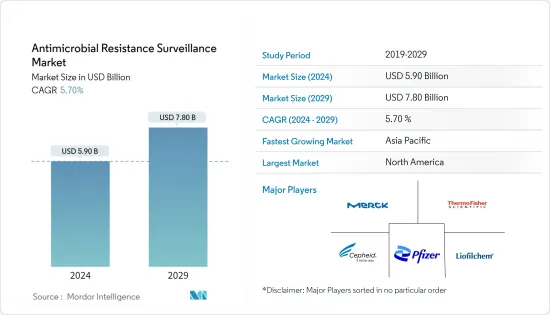
항균제 내성 감시 시장 규모는 2024년에 59억 달러로 추정되고, 2029년에는 78억 달러에 이를 것으로 예측되며, 예측 기간 중(2024-2029년) CAGR은 5.70%로 성장할 전망입니다.

COVID-19 팬데믹의 출현은 항균제 내성 감시 시장에 다양한 영향을 미쳤습니다. 팬데믹 기간 동안 의료 서비스의 과부하로 인해 시장이 영향을 받았으며 대부분의 진단 실험실은 COVID-19 시험에 힘을 쏟았기 때문에 팬데믹 기간 동안 항균제 내성균의 확인과 추적이 감소했습니다. 세계보건기구(WHO)의 Global Antimicrobial Resistance and Use Surveillance System(GLASS) Report 2022에 따르면 COVID-19는 팬데믹의 첫 번째 파동에서 항균제 감시에 큰 영향을 미쳤습니다. WHO의 GLASS 데이터베이스에 항균제 내성 감시 데이터를 제공하는 대부분의 국가는 유행의 최고점에서 데이터를 제공할 수 없습니다. 그러나 이 보고서에 의하면 많은 국가들이 팬데믹 후 시험능력을 높이고 다른 항균제 감시 시스템 강화 노력을 하고 있습니다. 이것은 예측 기간 동안 항균제 내성 감시 시장을 가속시킬 것으로 예상됩니다.
시장을 견인하는 주요 요인은 약물 내성 미생물에 의한 감염증의 유병률의 상승, 각국 정부에 의한 감염증 대책에 대한 대처의 고조, 약물 남용에 의한 다제 내성의 출현 등입니다. WHO는 항균제 내성이 인류에게 큰 위협이라고 선언합니다. 유럽 질병 예방 관리 센터(ECDC)의 2023년 보고서에 따르면, 유럽 연합(EU) 지역에서는 매년 항균제에 내성을 가진 세균에 의한 감염이 67만 건 이상 발생하고 있습니다. 이 감염의 발생은 항생제의 과도한 사용과 오용이 주요 원인입니다. 또한 경제협력개발기구(OECD)의 2023년 데이터에 따르면 유럽연합은 항균제 내성 감염(AMR) 대책에 매년 11억 달러를 소비하고 있습니다. 항균제의 오용 및 과도한 사용을 줄이려면 AMR의 적절한 감시가 필요하며 의사와 환자가 AMR 치료 옵션에 대한 충분한 정보를 얻은 후 의사 결정할 수 있도록 최신 정보를 수집해야 합니다. 거기서 WHO는 세계 190개국으로부터 항균제 내성 미생물의 데이터를 매년 수집하는 세계 항균제 내성 및 사용 서베이런스 시스템(GLASS)을 도입했습니다. 이와 같이 항균제 내성 감염증의 유병률 증가나 항균제 내성 미생물과 싸우기 위한 WHO의 AMR 대책을 위한 서베이런스의 가속은 항균제 내성 서베이런스 시장을 견인할 것으로 기대되고 있습니다.
또한, 전염병을 다루는 정부에 의한 이니셔티브 증가는 시장을 가속화할 가능성이 높습니다. 세계 여러 나라가 항균제 내성(AMR)의 복잡한 문제를 제어하기 위해서, 서베이런스 대책의 강화, 연구개발 활동의 추진, 항균제 내성균 제어를 위한 공동 행동 등의 이니셔티브를 있습니다. 예를 들어 미국은 “2020-2025년 항생물질 내성균 대책을 위한 국가 행동 계획(CARB)”을 시작했습니다. 정부의 이 이니셔티브는 다섯 가지 목표에 중점을 둡니다. 항균제 내성균 감염으로 인한 유병률과 사망률을 억제하기 위해 감시를 강화하는 것이 주요 목표 중 하나입니다. 게다가 인도와 같은 아시아 국가들은 항균제 내성에 관한 국가 행동 계획(NAP)을 시작하고 항생제 내성 미생물의 감시에도 초점을 맞추었습니다. 따라서 각국 정부의 총력을 꼽은 노력이 항균제 내성균 서베이런스 시장을 가속시킬 것으로 예상됩니다.
또한, 약물 남용으로 인한 다제 내성의 출현은 긴급 위기를 초래합니다. 다제 내성을 유발할 수 있는 감염 인자(박테리아, 곰팡이, 바이러스, 기생충 등)는 다수 존재하며, 이러한 미생물은 '슈퍼버그'로 알려져 있습니다. MDR의 주요 원인은 일반 항생제의 과도한 사용과 불충분한 위생 환경 유지입니다. 예를 들어 Springer Nature Report 2023에 따르면 2021년 MDR의 유병률은 45만 건으로 전년 43만 건에서 증가하고 있습니다. 따라서, 다제 내성의 출현은 높은 감시 노력으로 이어질 것으로 예상되며, 항균제 내성 감시 시장을 견인할 가능성이 높습니다.
그러나 항균제 내성 감시 시스템 및 키트 비용이 높기 때문에 항균제 내성 감시 시장의 성장이 억제될 가능성이 높습니다.
항균제 내성 감시 시장 동향
응용 분야의 임상 진단이 시장에서 큰 점유율을 차지할 전망
ESKAPE(장구균, 황색 포도상 구균, 폐렴 간균, 아시네토박터 바우만니, 녹농균, 엔테로박터속)과 같은 항균제 감염증은 인체에 큰 위협이기 때문에 항균제 내성 미생물 감염증의 만연율 증가와 항균제 감염으로 고통받는 환자의 결과를 개선하는 것이 급선무로 되어 임상 진단제가 큰 시장 점유율을 차지하고 있습니다. 또한, 임상 진단센터의 작업 능력을 향상시키기 위한 정부의 이니셔티브도 시장을 견인할 것으로 예상됩니다. 예를 들어, Department of Finance Canada Report 2022에 따르면, 연방 정부는 법안 C-17을 도입하고 약물 내성 미생물에 의한 감염과 같은 다양한 질병을 조절하는 임상 진단 활동을 개선하기 위해 국내 다양한 주와 준주에 20억 캐나다 달러를 제공하기로 되어 있습니다. 또한 2021년에는 유럽연합(EU) 25개국도 항균제 내성을 다루기 위한 국가행동계획을 시작하여 EU지역 전체의 시험실 네트워크의 능력 강화를 통해 AMR의 지속적인 감시를 지원하기 위해 14억 유로를 투자했습니다.
따라서, 항균제 내성 감염의 높은 유병률, 환자의 결과를 개선하는 긴급한 필요성, 정부의 투자는 예측 기간 동안 큰 성장을 확인할 것으로 추정되는 임상 진단 부문을 뒷받침할 것으로 예상됩니다.
북미가 항균제 내성 감시 시장을 독점할 전망
북미는 감염증에 대한 항균제 내성이 높은 인식 및 보급률, 동지역에서의 항생제 내성과 싸우기 위한 정부의 대처, 동지역에서 주요 시장 진입기업의 존재 등의 요인에 의해 시장을 독점할 것으로 예측됩니다. 미국 질병 예방 관리 센터(CDC)의 데이터베이스 2023에 따르면, 미국에서는 매년 280만 명 이상의 항균제 내성 감염(ARI)이 발생하고 있습니다. ARI의 만연률에 대항하기 위해 미국 정부는 2023년에 1억 9,700만 달러(USD)를 투자하고 있습니다. CDC에 의하면 이러한 투자는 CDC의 항균제 내성 실험실 네트워크(AR Lab Network) 네트워크에서 항생제 내성 감염의 예방적 해결책과 효과적인 진단·감시의 개발에 사용될 전망입니다. 이러한 최첨단 시험 시설은 항균제 내성에 관한 데이터를 신속하게 검출 및 보존하고 의사가 치료에 관한 충분한 정보에 근거한 판단을 내리는데 도움이 될 것으로 예상됩니다.
따라서 항균제 내성 미생물 감염의 높은 유병률로 인해 새로운 시험 시설을 확립함으로써 ARI와 싸우는 투자 증가가 북미 시장을 견인할 것으로 예상됩니다.
항균제 내성 감시 산업 개요
항균제 내성 감시 시장은 많은 진출기업이 존재하기 때문에 적당히 통합되고 경쟁하고 있습니다. 시장의 주요 기업은 합작 투자, 전략적 제휴, 신제품 도입, 신흥국 시장 및 경제적으로 유리한 지역으로의 지리적 성장에 주력하고 있습니다. 주요 진출기업은 Thermo Fisher Scientific, Pfizer Inc., Cepheid, Accelerate Diagnostics, In, Liofilchem Srl, Becton Dickinson and Company, Biomerieux, Bruker, Merck KgaA, Bio-Rad Laboratories, Inc., Qiagen, Synt Inostics, Guardant Health, Inc, Exact Sciences Corporation 등이 있습니다.
기타 혜택 :
- 엑셀 형식 시장 예측(ME) 시트
- 3개월간의 애널리스트 서포트
목차
제1장 서론
- 조사의 전제조건 및 시장 정의
- 조사 범위
제2장 조사 방법
제3장 주요 요약
제4장 시장 역학
- 시장 개요
- 시장 성장 촉진요인
- 약제 내성 미생물에 의한 감염증 증가
- 각국 정부에 의한 감염증 대책에의 대처의 고조
- 약제 남용에 의한 다제 내성의 출현
- 시장 성장 억제요인
- 항균제 내성 감시 시스템 및 키트의 비용 상승
- Porter's Five Forces 분석
- 공급기업의 협상력
- 구매자 및 소비자의 협상력
- 신규 진입업자의 위협
- 대체품의 위협
- 경쟁 기업간 경쟁 관계의 강도
제5장 시장 세분화(시장 규모-달러)
- 솔루션별
- 키트
- 시스템
- 감시 소프트웨어
- 감시 서비스
- 용도별
- 임상 진단
- 공중위생 감시
- 기타
- 최종 사용자별
- 병원 및 클리닉
- 진단센터
- 기타
- 지역별
- 북미
- 미국
- 캐나다
- 멕시코
- 유럽
- 독일
- 영국
- 프랑스
- 이탈리아
- 스페인
- 기타 유럽
- 아시아태평양
- 중국
- 일본
- 인도
- 호주
- 한국
- 기타 아시아태평양
- 중동 및 아프리카
- GCC 국가
- 남아프리카
- 기타 중동 및 아프리카
- 남미
- 브라질
- 아르헨티나
- 기타 남미
- 북미
제6장 경쟁 구도
- 기업 프로파일
- DiaSorin SpA
- Thermo Fisher Scientific
- Pfizer Inc.
- Cepheid
- Accelerate Diagnostics, In
- Liofilchem Srl
- Becton Dickinson and Company
- Biomerieux
- Bruker
- SyntBioLab INC.
- Merck KgaA
- Bio-Rad
- Qiagen
제7장 시장 기회 및 향후 동향
AJY 24.08.05The Antimicrobial Resistance Surveillance Market size is estimated at USD 5.90 billion in 2024, and is expected to reach USD 7.80 billion by 2029, growing at a CAGR of 5.70% during the forecast period (2024-2029).
The emergence of the COVID-19 pandemic had a mixed impact on the antimicrobial resistance surveillance market. The market was impacted during the pandemic owing to the overload of healthcare services, and most diagnostic labs diverted their complete focus to COVID-19 tests, which led to a reduction in the identification and tracking of antimicrobial-resistant bacteria during the pandemic period. According to the World Health Organization (WHO) Global Antimicrobial Resistance and Use Surveillance System (GLASS) Report 2022, COVID-19 significantly impacted antimicrobial surveillance during the first wave of the pandemic. Most countries that contribute antimicrobial resistance surveillance data to the WHO GLASS database cannot provide data during the peak stage of the pandemic. However, according to the same report, many countries have increased their laboratory capabilities and other antimicrobial surveillance system-strengthening efforts post-pandemic. This is expected to accelerate the antimicrobial resistance surveillance market during the forecasted period.
The major factors driving the market are the rising prevalence of infections caused by drug-resistant microbes, rising initiatives by governments to tackle infectious diseases, and emerging multi-drug resistance due to drug abuse. The WHO has declared antimicrobial resistance as a major threat to humanity. According to The European Centre for Disease Prevention and Control (ECDC) 2023 Report, each year, more than 670,000 infections occur in the European Union region due to bacteria resistant to antibiotics. This infection outbreak is majorly due to overuse or misuse of antibiotics. Furthermore, according to the Organization for Economic Cooperation and Development (OECD) 2023 data, the European Union spends 1.1 billion every year to combat antimicrobial Resistance infections (AMR). To reduce misuse and overuse of antimicrobial agents' proper surveillance of AMR is needed to collect up-to-date information which helps doctors and patients make informed decisions about AMR treatment options; hence, WHO introduced the Global Antimicrobial Resistance and Use Surveillance System (GLASS), which collects antimicrobial resistance microbes' data from 190 countries across the world every year. Thus, increasing the prevalence rate of antimicrobial resistance infections and accelerated surveillance to control AMR efforts of WHO to combat antimicrobial resistance microbes are expected to drive the antimicrobial resistance surveillance market.
Moreover, rising initiatives by governments to tackle infectious diseases will likely accelerate the market. Different nations across the world have taken initiatives to control the complex problem of antimicrobial resistance (AMR) by enhancing surveillance measures, promoting research and development activities, and collaborative actions to control antimicrobial resistance agents. For instance, the United States has launched the National Action Plan for Combating Antibiotic-Resistant Bacteria (CARB), 2020-2025. This initiative by the government will focus on five objectives: increasing stringing surveillance is one major objective to control the prevalence rate and mortality rate due to antimicrobial resistance infections. In addition, Asian countries like India also launched a Nation Action Plan (NAP) for antimicrobial resistance, which also focuses on the surveillance of antibiotic-resistant microbes. Hence, collective efforts of governments are expected to accelerate the antimicrobial resistance surveillance market.
Furthermore, the emergence of multi-drug resistance due to drug abuse is leading to an emergency crisis. There are many infecting agents (e.g., bacteria, fungi, viruses, and parasites) that can cause Multi-Drug Resistance such microbes are known as 'superbugs.' The major cause of MDR is overuse of OTC antibiotics and inadequate sanitary conditions maintenance. For Instance, According to Springer Nature Report 2023, the prevalence rate of MDR is 450,000 in 2021, which increased from 430,000 cases from the previous year. Hence, the emergence of multi-drug resistance is expected to lead to high surveillance efforts, which will likely drive the Antimicrobial Resistance Surveillance Market.
However, the higher cost of antimicrobial resistance surveillance systems and kits will likely restrain the growth of the antimicrobial resistance surveillance market.
Antimicrobial Resistance Surveillance Market Trends
The Clinical Diagnostics Under Application Segment is Expected to Hold a Significant Share in the Market
Clinical diagnostics occupy a significant market share due to the increased prevalence rate of antimicrobial resistance microbial infections and the urgent need to improve patient outcomes for those suffering from antimicrobial infections like ESKAPE (Enterococcus faecium, Staphylococcus aureus, Klebsiella pneumoniae, Acinetobacter baumannii, Pseudomonas aeruginosa, and Enterobacter species) because they represent the great threat to humans. In addition, the government's initiatives to improve clinical diagnostics centers working capabilities are also expected to drive the market. For example, according to the Department of Finance Canada Report 2022, the federal government introduced Bill C-17, which was to provide 2 billion (CAD) to different provinces and territories of the country to improve clinical diagnostic activities to control various diseases like infections caused by drug-resistant microbes. Additionally, in 2021, 25 European Union countries also launched national action plans to tackle antimicrobial resistance by investing 1.4 billion (EUR) to support ongoing surveillance of AMR through enhanced laboratory network capacity across the EU region.
Therefore, the higher prevalence rate of antimicrobial resistance infection, the urgent need to improve patient outcomes, and government investments are expected to boost the clinical diagnostic segment, which is estimated to witness significant growth over the forecast period.
North America is Expected to Dominate the Antimicrobial Resistance Surveillance Market
North America is expected to dominate the market owing to factors such as high awareness and prevalence rate of antimicrobial resistance to infectious diseases, government initiatives in the region to combat antibiotic resistance, and the presence of key market players in the region. According to the Centers for Disease Control and Prevention (CDC) database 2023, in the United States, more than 2.8 million antimicrobial-resistant infections (ARI) occur every year. To combat the prevalence rate of ARI, the United States government has invested 197 million (USD) in 2023. According to the CDC, these investments are expected to be used to develop preventive solutions and effective diagnosis and surveillance of antibiotic-resistant infections in the CDC's Antimicrobial Resistance Laboratory Network networks (AR Lab Network). These cutting-edge laboratory facilities rapidly detect and store data about antimicrobial resistance, which will likely help doctors make informed decisions about the treatment.
Therefore, owing to the high prevalence rate of antimicrobial resistance microbial infections, increased investments to fight ARI by establishing new laboratory facilities are expected to drive the market in the North American region.
Antimicrobial Resistance Surveillance Industry Overview
The antimicrobial resistance surveillance market is moderately consolidated and competitive due to the presence of many players. The market's major players are concentrating on joint ventures, strategic alliances, introducing new products, and geographic growth into developing and economically advantageous areas. Some of the major players include Thermo Fisher Scientific, Pfizer Inc., Cepheid, Accelerate Diagnostics, In, Liofilchem S.r.l., Becton Dickinson and Company, Biomerieux, Bruker, Merck KgaA, Bio-Rad Laboratories, Inc., Qiagen, SyntBioLab INC, Sysmex Inostics, Guardant Health, Inc, Exact Sciences Corporation.
Additional Benefits:
- The market estimate (ME) sheet in Excel format
- 3 months of analyst support
TABLE OF CONTENTS
1 INTRODUCTION
- 1.1 Study Assumptions and Market Definition
- 1.2 Scope of the Study
2 RESEARCH METHODOLOGY
3 EXECUTIVE SUMMARY
4 MARKET DYNAMICS
- 4.1 Market Overview
- 4.2 Market Drivers
- 4.2.1 Rising Prevalence of Infections Caused by Drug-resistance Microbes
- 4.2.2 Rising Initiatives by Governments to Tackle Infectious Diseases
- 4.2.3 Emerging of Multi-Drug Resistance Due to Drug Abuse
- 4.3 Market Restraints
- 4.3.1 Higher Costs of Antimicrobial Resistance Surveillance systems and kits
- 4.4 Porter's Five Forces Analysis
- 4.4.1 Bargaining Power of Suppliers
- 4.4.2 Bargaining Power of Buyers/Consumers
- 4.4.3 Threat of New Entrants
- 4.4.4 Threat of Substitute Products
- 4.4.5 Intensity of Competitive Rivalry
5 MARKET SEGMENTATION (Market Size by Value-USD)
- 5.1 By Solution
- 5.1.1 Kits
- 5.1.2 System
- 5.1.3 Surveillance Software
- 5.1.4 Surveillance Service
- 5.2 By Application
- 5.2.1 Clinical Diagnostics
- 5.2.2 Public Health Surveillance
- 5.2.3 Other Applications
- 5.3 By End-User
- 5.3.1 Hospitals and Clinics
- 5.3.2 Diagnostic Centers
- 5.3.3 Other End-Users
- 5.4 Geography
- 5.4.1 North America
- 5.4.1.1 United States
- 5.4.1.2 Canada
- 5.4.1.3 Mexico
- 5.4.2 Europe
- 5.4.2.1 Germany
- 5.4.2.2 United Kingdom
- 5.4.2.3 France
- 5.4.2.4 Italy
- 5.4.2.5 Spain
- 5.4.2.6 Rest of Europe
- 5.4.3 Asia-Pacific
- 5.4.3.1 China
- 5.4.3.2 Japan
- 5.4.3.3 India
- 5.4.3.4 Australia
- 5.4.3.5 South Korea
- 5.4.3.6 Rest of Asia-Pacific
- 5.4.4 Middle East and Africa
- 5.4.4.1 GCC
- 5.4.4.2 South Africa
- 5.4.4.3 Rest of Middle East and Africa
- 5.4.5 South America
- 5.4.5.1 Brazil
- 5.4.5.2 Argentina
- 5.4.5.3 Rest of South America
- 5.4.1 North America
6 COMPETITIVE LANDSCAPE
- 6.1 Company Profiles
- 6.1.1 DiaSorin S.p.A.
- 6.1.2 Thermo Fisher Scientific
- 6.1.3 Pfizer Inc.
- 6.1.4 Cepheid
- 6.1.5 Accelerate Diagnostics, In
- 6.1.6 Liofilchem S.r.l.
- 6.1.7 Becton Dickinson and Company
- 6.1.8 Biomerieux
- 6.1.9 Bruker
- 6.1.10 SyntBioLab INC.
- 6.1.11 Merck KgaA
- 6.1.12 Bio-Rad
- 6.1.13 Qiagen