|
시장보고서
상품코드
1521857
지질 나노입자 : 시장 점유율 분석, 산업 동향 및 통계, 성장 예측(2024-2029년)Lipid Nanoparticles - Market Share Analysis, Industry Trends & Statistics, Growth Forecasts (2024 - 2029) |
||||||
 Mordor Intelligence
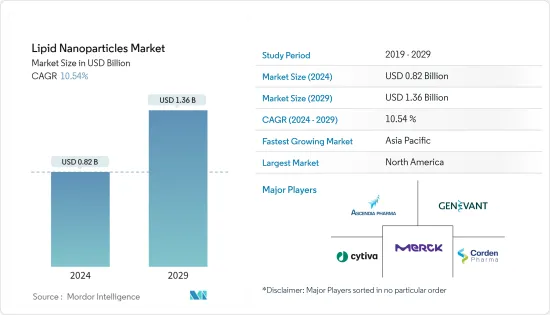
지질 나노입자(LNP, Lipid Nanoparticles) 시장 규모는 2024년에 8억 2,000만 달러로 추정되고, 2029년에는 13억 6,000만 달러에 이를 것으로 예측되며, 예측 기간(2024-2029년)의 CAGR은 10.54%로 추이하며 성장 할 것으로 예상됩니다.
지질 나노입자는 지질로 구성된 구형 소포입니다. 이러한 나노입자는 약물 보호, 용해도 및 효능 향상, 표적 약물 전달, 약물 방출 조절, 약물 생체 분포 변화 등 여러 가지 이점을 제공합니다. 이러한 나노 입자는 특정 약물 특성 및 치료 요건에 따라 변형될 수 있으므로 종양학, 신경 장애, 피부과, 전염병 및 기타 치료 분야의 다양한 응용 분야에 잠재적인 운반체가 될 수 있습니다.
만성 질환 부담 증가와 효과적인 치료 수단에 대한 수요 증가에 대처하기 위한 새로운 치료법의 도입을 위한 시장 관계자의 투자 증가는 시장 성장에 영향을 미치는 중요한 요인입니다. 예를 들어, 2024년 4월에 발표된 국제암 연구기관의 2022년 보고서에 따르면, 2022년에 세계에서 보고된 신규 암 증례는 추정 2,000만건이며, 이 질병 부담은 77% 증가 2050년에는 세계에서 신규 암 증례 3,500만건 이상에 달할 것으로 예측되고 있습니다. 또한, 암 치료는 약물 전달에서 지질 나노 입자(LNP)의 가장 광범위한 응용입니다. 이러한 나노입자들은 표적화된 약물 전달을 통해 치료 결과를 개선하기 때문에 다양한 만성 질환의 치료에 대한 수요가 급증하고 시장 성장을 가속할 것으로 예상됩니다.
게다가 의료의 혁신을 촉진하기 위한 정부 이니셔티브 증가와 새로운 치료법 개척을 위한 기술적으로 첨단 플랫폼을 제공하려는 시장 관계자들의 관심이 높아짐에 따라 시장 성장을 뒷받침 하고 있습니다. 예를 들어, 미국 국립위생연구소(NIH)는 나노기술 연구에 매년 2억 달러를 투자하고 있습니다. 복잡한 구조를 갖는 지질 나노입자는 개인화된 의료가 요구하는 개별 환자 및 질병 상태에 특유한 생물학적 장벽을 극복하도록 설계되었습니다. 예를 들어, 2023년 6월, Hopewell Therapeutic은 유전체 의약품의 표적 전달을 위한 차세대 지질 나노입자의 개발을 진행하기 위해 2,500만 달러의 자금을 조달했습니다. 따라서, 나노기술의 응용이 확대되고, 신규 치료법의 개발에 이 기술을 도입하기 위해 시장 관계자에 의한 투자가 증가하고 있는 것이 향후 5년간 시장 성장을 가속할 것으로 예측됩니다.
그러나 제형 개발과 관련된 높은 비용, 제한된 충전 용량 및 엄격한 규정 준수가 시장 성장을 억제할 수 있습니다.
지질 나노입자 시장 동향
치료 부문은 예측 기간 동안 상당한 성장이 예상
- 지질 나노입자(LNP)는 다양한 치료를 전달하는 유망한 차량으로 제약 업계 전반에 걸쳐 상승하고 있습니다. 이러한 나노입자는 치료를 캡슐화하여 신체의 특정 위치에 전달하여 원하는 시점에 내용물을 방출합니다. 약물 전달, 의료 이미징, 화장품 등에서 지질 나노입자의 치료 응용은 향후 수년간 성장할 것으로 예측됩니다. 예를 들어, 2023년 7월에 Pharmaceuticals Journal이 발표한 연구에 따르면, 지질 기반 나노시스템은 유방암 치료 중에 종양 세포로의 siRNA 전달을 대폭 개선했습니다. 이러한 연구는 표적 약물 전달에 지질 나노입자를 사용함으로써 치료 성적이 향상됨을 강조하고 있으며, 향후 수년간 그 수요를 견인할 가능성이 높습니다.
- 게다가 나노기술의 지속적인 발전과 생명공학과 의료의 진보로 약물전달용 나노입자를 대상으로 한 임상시험의 수가 급속히 증가하고 있습니다. 예를 들어, 2023년 1월에 International Journal of Molecular Sciences가 발표한 연구에 따르면, 지질 기반 나노입자 의약품은 미국 식품의약국(FDA)이 승인한 나노입자 의약품의 21%를 차지합니다. 따라서 폭넓은 만성 질환의 치료에 대한 규제 당국의 승인 증가는 예측 기간 동안 동일한 부문의 성장에 기여할 것으로 예상됩니다.
- COVID-19의 mRNA 백신 전달에 지질 나노입자를 사용하는 최근의 혁신은 세계 여러 제약 회사의 관심에 영향을 미치고 있습니다. 예를 들어, 2022년 1월, Pfizer Inc.는 Acuitas Therapeutics와 mRNA 백신 및 치료 개발에 Acuitas의 지질 나노입자 제제 기술을 사용하는 계약을 체결했습니다. 또한 시장 관계자는 인공지능과 머신러닝을 통합하여 지질 나노 입자의 설계 및 최적화에 영향을 미치는 데 점점 더 많은 노력을 기울이고 있습니다. 이러한 전략적 이니셔티브는 다양한 치료 부문에서 지질 나노입자의 응용을 확대하는 성장 기회를 제공하고 이후 시장 성장을 가속합니다.
- 따라서, 치료 부문은 지질 나노입자가 기존 방법보다 약물전달에 제공하는 치료 이점으로 인해 향후 수년간 성장할 것으로 예상됩니다.
북미가 지질 나노입자 시장을 독점할 전망
- 북미는 의료 인프라 발달, R&D 활동 투자 증가, 만성 질환 유병률 증가, 약물 전달의 지속적인 기술 진보, 신제품 출시, 동지역의 기존 기업 등 요인으로 인해 시장을 독점할 것으로 예상됩니다. 예를 들어, 2022년 4월에 발표된 미국 만성질환 담당자 협회의 데이터에 따르면, 미국에서는 성인 인구의 약 60%가 적어도 하나의 만성 질환을 앓고 있으며, 그 중에서도 암, 당뇨병, 심혈관 질환 가 상위를 차지하고 있습니다.
- 2023년 캐나다 암 통계에 따르면 캐나다인의 약 5명 중 2명이 평생 암에 걸릴 것으로 예상됩니다. 이러한 사례는 표적 전달을 위한 지질 나노입자의 개발을 추진하고, 질병 부담을 경감시키는 정밀의료에 대한 수요를 급증시키고, 이 지역 시장 성장에 영향을 주고 있습니다. 게다가 차세대 의료의 연구개발을 지원하는 정부의 대처가 활발해지고 있는 것도 시장을 견인하고 있습니다. 예를 들어 2023년 4월 마길 대학은 차세대 의약품 연구를 지원하기 위해 캐나다 정부로부터 1억 6,500만 달러를 받았습니다. 따라서 이러한 노력은 만성질환의 부담을 경감하기 위한 신규 치료에 대한 수요가 높아지므로 예측 기간 동안 지질 나노입자 수요가 촉진될 것으로 예상됩니다.
- 시장 진출기업은 미개척 시장의 지리적 존재와 성장 기회를 확대하기 위해 전략적 제휴를 맺어 자사의 포트폴리오를 강화하는 데 주력하고 있으며, 이에 따라 이 지역 시장 성장에 영향 제공합니다. 예를 들어 미국을 기반으로 한 임상 단계의 생명 공학 회사 인 Serina Therapeutics Inc.는 2023년 8월 AgeX Therapeutics Inc. Serina의 지질 나노 입자와 항체 약물 복합체를 추진했습니다. 첨단 치료 수단을 도입하려는 시장 진출기업의 이러한 전략적 이니셔티브는 시장 성장에 기여할 것으로 예상됩니다.
- 그러므로 맞춤형 의료에 대한 관심 증가와 시장 관계자들의 나노기술 투자 증가로 인해 북미는 향후 수년간 성장할 것으로 예상됩니다.
지질 나노입자 산업 개요
지질 나노입자 시장은 세계적으로 그리고 지역적으로 사업을 전개하는 주요 기업이 존재하기 때문에 반고체화하고 있습니다. 경쟁 구도에는 상당한 시장 점유율이 있으며 잘 알려진 여러 국제 기업 및 지역 기업의 분석이 포함됩니다. 여기에는 Merck KGaA, Croda International PLC, Cytiva, BIOVECTRA, Acuitas Therapeutics, CordenPharma, Genevant Sciences Corporation, Arcturus Therapeutics Inc., Ascendia Pharmaceuticals, CD Bioparticles가 포함됩니다.
기타 혜택 :
- 엑셀 형식 시장 예측(ME) 시트
- 3개월간의 애널리스트 서포트
목차
제1장 서론
- 조사 전제 조건 및 시장 정의
- 조사 범위
제2장 조사 방법
제3장 주요 요약
제4장 시장 역학
- 시장 개요
- 시장 성장 촉진요인
- 만성 질환 증가
- 맞춤형 의료에 대한 주목의 고조
- 나노기술의 연구개발에 대한 투자 확대
- 시장 성장 억제요인
- 엄격한 규제 준수
- 고가의 제제와 한정된 충전 능력
- Porter's Five Forces 분석
- 신규 진입업자의 위협
- 구매자/소비자의 협상력
- 공급기업의 협상력
- 대체품의 위협
- 경쟁 기업간 경쟁 관계 강도
제5장 시장 세분화(시장 규모-달러)
- 유형별
- 고체 지질 나노입자
- 나노구조 지질 캐리어
- 기타
- 용도별
- 연구
- 치료
- 최종 사용자별
- 제약·바이오테크놀러지 기업
- 개발·제조 수탁 기관
- 기타
- 지역별
- 북미
- 미국
- 캐나다
- 멕시코
- 유럽
- 독일
- 영국
- 프랑스
- 이탈리아
- 스페인
- 기타 유럽
- 아시아 태평양
- 중국
- 일본
- 인도
- 호주
- 한국
- 기타 아시아 태평양
- 기타
- 북미
제6장 경쟁 구도
- 기업 프로파일
- Merck KGaA
- Croda International PLC
- Cytiva
- BIOVECTRA
- Acuitas Therapeutics
- CordenPharma
- Genevant Sciences Corporation
- Arcturus Therapeutics Inc.
- Ascendia Pharmaceuticals
- CD Bioparticles
제7장 시장 기회 및 향후 동향
LYJThe Lipid Nanoparticles Market size is estimated at USD 0.82 billion in 2024, and is expected to reach USD 1.36 billion by 2029, growing at a CAGR of 10.54% during the forecast period (2024-2029).
Lipid nanoparticles are spherical vesicles composed of lipids. These nanoparticles offer several benefits, such as safeguarding drugs, boosting their solubility and efficacy, enabling targeted drug delivery, regulating drug release, and altering drug biodistribution. These nanoparticles can be modified based on the specific drug properties and therapeutic requirements, making potential carriers for various applications in oncology, neurological disorders, dermatology, infectious diseases, and other therapeutic areas.
The growing burden of chronic diseases and increasing investment by market players to introduce novel therapies to address this rising demand for effective therapeutic measures are significant factors influencing market growth. For instance, according to the International Agency for Research on Cancer's 2022 report published in April 2024, there were an estimated 20 million new cancer cases reported in 2022 globally, and this disease burden is projected to increase by 77% to reach over 35 million new cancer cases in 2050 globally. In addition, cancer treatment is the most extensive application of lipid nanoparticles (LNPs) in drug delivery. These nanoparticles improve treatment outcomes through targeted drug delivery, which is anticipated to surge its demand for treating various chronic diseases, thereby driving market growth.
Furthermore, increasing government initiatives to promote innovation in healthcare and the growing focus of market players to provide technologically advanced platforms for developing novel therapies are fueling market growth. For instance, the National Institutes of Health (NIH) invests USD 200 million yearly in nanotechnology research. Lipid nanoparticles with complex structures are designed to overcome biological barriers specific to individual patients or disease status as demanded by personalized medicine. For instance, in June 2023, Hopewell Therapeutic raised USD 25 million in financing to advance the development of next-generation lipid nanoparticles for targeted delivery of genomic medicines. Hence, the growing application of nanotechnology and increasing investment by market players to incorporate this technology in developing novel therapies are projected to drive market growth over the next five years.
However, the high cost associated with formulation development, limited loading capacity, and stringent regulatory compliance may restrain the market's growth.
Lipid Nanoparticles Market Trends
Therapeutics Segment is Expected to Witness Significant Growth During the Forecast Period
- Lipid nanoparticles (LNPs) are emerging across the pharmaceutical industry as promising vehicles to deliver a variety of therapeutics. These nanoparticles encapsulate and deliver therapeutics to specific locations within the body and release their contents at a desired time. The therapeutic application of lipid nanoparticles in drug delivery, medical imaging, cosmetics, and others is projected to grow in the upcoming years. For instance, according to a study published by the Pharmaceuticals Journal in July 2023, lipid-based nanosystems significantly improved siRNA delivery to tumor cells during breast cancer therapy. Such studies highlight that using lipid nanoparticles for targeted drug delivery enhances treatment outcomes and will likely drive its demand in the coming years.
- In addition, the number of clinical trials devoted to nanoparticles for drug delivery is increasing rapidly due to the continuous development of nanotechnology and advancements in biotechnology and medicine. For instance, per a study published by the International Journal of Molecular Sciences in January 2023, lipid-based nanoparticle drugs accounted for 21% of the US Food and Drug Administration (FDA) approved nanoparticle drugs. Hence, the increasing regulatory approvals for treating a wide range of chronic diseases are expected to contribute to the segment's growth during the forecast period.
- The recent breakthrough in using lipid nanoparticles for mRNA vaccine delivery for COVID-19 has influenced the interest of several pharmaceutical companies worldwide. For instance, in January 2022, Pfizer Inc. entered an agreement with Acuitas Therapeutics to use the lipid nanoparticle formulation technology of Acuitas for developing mRNA vaccines and therapeutics. Moreover, market players are increasingly focusing on influencing the design and optimization of lipid nanoparticles by incorporating artificial intelligence and machine learning. Such strategic initiatives offer growth opportunities to expand lipid nanoparticle applications in various therapeutic areas, subsequently driving market growth.
- Hence, the therapeutic segment is expected to grow in the coming years due to the treatment benefits lipid nanoparticles offer in drug delivery over conventional methods.
North America is Expected to Dominate the Lipid Nanoparticles Market
- North America is expected to dominate the market owing to factors such as developed healthcare infrastructure, growing investment in research and development activities, increasing prevalence of chronic diseases, continuous technological advancement in drug delivery, new product launches, and established players in the region. For instance, according to the National Association of Chronic Disease Directors data published in April 2022, around 60% of the adult American population had at least one chronic disease, among which cancer, diabetes, and cardiovascular disease ranked highest in the United States.
- As per the Canadian Cancer Statistics 2023, about two in five Canadians are expected to develop cancer in their lifetime. Such instances surge the demand for precision medicine to advance the development of lipid nanoparticles for targeted delivery and reduce the burden of diseases, thus influencing market growth in the region. Furthermore, the market is driven by increased government initiatives to support research and development of next-generation medicine. For instance, in April 2023, McGill University received USD 165 million from the government of Canada to support research on next-generation medicines. Hence, these initiatives are expected to fuel the demand for novel therapies to reduce chronic disease burden, subsequently driving the demand for lipid nanoparticles during the forecast period.
- Market players are focusing on strengthening their portfolios by making strategic alliances to expand their geographical presence and growth opportunities in the untapped market, thereby influencing market growth in the region. For instance, in August 2023, Serina Therapeutics Inc., a US-based clinical-stage biotechnology company, signed a merger agreement with AgeX Therapeutics Inc. to advance Serina's lipid nanoparticles and antibody-drug conjugates, which are under clinical study for the treatment of Parkinson's disease and other neurological diseases. Such strategic initiatives by market players to introduce advanced therapeutic measures are expected to contribute to market growth.
- Therefore, the North American region is anticipated to witness growth in the coming years due to the growing focus on personalized medicine and increasing investments by market players in nanotechnology.
Lipid Nanoparticles Industry Overview
The lipid nanoparticles market is semi-consolidated in nature due to the presence of some key players operating globally as well as regionally. The competitive landscape includes an analysis of a few international and local companies that hold considerable market share and are well known. They include Merck KGaA, Croda International PLC, Cytiva, BIOVECTRA, Acuitas Therapeutics, CordenPharma, Genevant Sciences Corporation, Arcturus Therapeutics Inc., Ascendia Pharmaceuticals, and CD Bioparticles.
Additional Benefits:
- The market estimate (ME) sheet in Excel format
- 3 months of analyst support
TABLE OF CONTENTS
1 INTRODUCTION
- 1.1 Study Assumptions and Market Definition
- 1.2 Scope of the Study
2 RESEARCH METHODOLOGY
3 EXECUTIVE SUMMARY
4 MARKET DYNAMICS
- 4.1 Market Overview
- 4.2 Market Drivers
- 4.2.1 Increasing Prevalence of Chronic Diseases
- 4.2.2 Rising Focus Towards Personalized Medicine
- 4.2.3 Growing Investment for Research and Development of Nanotechnology
- 4.3 Market Restraints
- 4.3.1 Stringent Regulatory Compliance
- 4.3.2 Expensive Formulation with Limited Loading Capacity
- 4.4 Porter's Five Forces Analysis
- 4.4.1 Threat of New Entrants
- 4.4.2 Bargaining Power of Buyers/Consumers
- 4.4.3 Bargaining Power of Suppliers
- 4.4.4 Threat of Substitute Products
- 4.4.5 Intensity of Competitive Rivalry
5 MARKET SEGMENTATION (Market Size by Value - USD)
- 5.1 By Type
- 5.1.1 Solid Lipid Nanoparticles
- 5.1.2 Nanostructured Lipid Carriers
- 5.1.3 Other Types
- 5.2 By Application
- 5.2.1 Research
- 5.2.2 Therapeutics
- 5.3 By End User
- 5.3.1 Pharmaceutical and Biotechnology Companies
- 5.3.2 Contract Development and Manufacturing Organizations
- 5.3.3 Other End Users
- 5.4 By Geography
- 5.4.1 North America
- 5.4.1.1 United States
- 5.4.1.2 Canada
- 5.4.1.3 Mexico
- 5.4.2 Europe
- 5.4.2.1 Germany
- 5.4.2.2 United Kingdom
- 5.4.2.3 France
- 5.4.2.4 Italy
- 5.4.2.5 Spain
- 5.4.2.6 Rest of Europe
- 5.4.3 Asia-Pacific
- 5.4.3.1 China
- 5.4.3.2 Japan
- 5.4.3.3 India
- 5.4.3.4 Australia
- 5.4.3.5 South Korea
- 5.4.3.6 Rest of Asia-Pacific
- 5.4.4 Rest of the World
- 5.4.1 North America
6 COMPETITIVE LANDSCAPE
- 6.1 Company Profiles
- 6.1.1 Merck KGaA
- 6.1.2 Croda International PLC
- 6.1.3 Cytiva
- 6.1.4 BIOVECTRA
- 6.1.5 Acuitas Therapeutics
- 6.1.6 CordenPharma
- 6.1.7 Genevant Sciences Corporation
- 6.1.8 Arcturus Therapeutics Inc.
- 6.1.9 Ascendia Pharmaceuticals
- 6.1.10 CD Bioparticles