|
시장보고서
상품코드
1628824
북미의 공장 자동화 및 산업 제어 : 시장 점유율 분석, 산업 동향 및 성장 예측(2025-2030년)North America Factory Automation and Industrial Controls - Market Share Analysis, Industry Trends & Statistics, Growth Forecasts (2025 - 2030) |
||||||
 Mordor Intelligence
■ 보고서에 따라 최신 정보로 업데이트하여 보내드립니다. 배송일정은 문의해 주시기 바랍니다.
가격
※ 부가세 별도
한글목차
영문목차
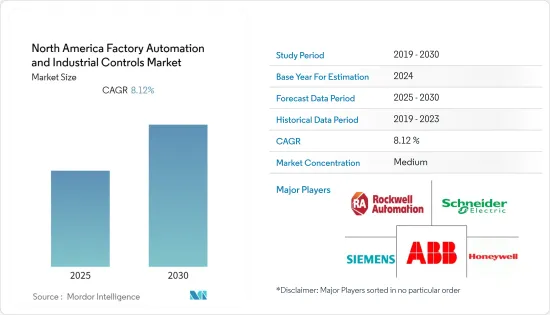
북미의 공장 자동화 및 산업 제어 시장은 예측 기간 동안 8.12%의 연평균 복합 성장률(CAGR)을 나타낼 것으로 예상됩니다.
주요 하이라이트
-
<
- > 에너지 절약과 비용 효율성을 위해 이 지역에서는 공장 자동화 및 산업 제어 시스템 동향이 활발히 진행되고 있으며, Oxford Economics의 2019년보고서에 따르면 향후 10년동안 미국에서 150 만 개 이상의 일자리가 자동화로 인해 사라질 것으로 예상됩니다. 라고 합니다. 이 지역의 자동차 산업은 제조 공정에 로봇을 도입하는 데 있어 항상 선두를 달리고 있으며, John Deere와 같은 업계의 주요 제조업체는 자동화 기술을 제품과 프로세스 모두에 통합하기 위해 많은 투자를 하고 있습니다.
- 있다
- .
- 예를 들어, 2020년 3월 세계적인 스칼라 로봇 제조업체인 엡손 로봇(Epson Robots)은 미국 중서부 지역의 기술 지원을 강화하기 위한 노력의 일환으로 미국 기반의 자동화 솔루션 제공업체인 에어 오토메이션 엔지니어링(AAE)과 협력했습니다. 와 협력하여
- . 최근 캐나다 왕립은행(RBC)은 마이크로소프트와 협력하여 주로 캐나다 기업의 스마트 자동화 기술 및 클라우드 솔루션에 대한 투자를 지원하는 Go Digital 프로그램을 시작했습니다.
- "Advanced Manufacturing Partnership(AMP)"과 같은 이니셔티브는 지역 산업, 다양한 대학 및 연방정부가 신흥 자동화 기술에 투자하기 위해 점점 더 많은 노력을 기울이고 있습니다. 캐나다 정부는 제조 자동화 솔루션에 특화된 세계 기업 클러스터인 Automate Canada 프로그램을 설립했습니다.
- 그러나 새로운 자동화 제조 공장을 설립하려면 SCADA, DCS, RTU, PLC, HMI 등 새로운 자동화 기술 도입이 필수적입니다. 이러한 제조 공장을 설립하려면 장비, 소프트웨어, 교육에 많은 자본 투자가 필요합니다. 이러한 막대한 투자는 첫 공장을 설립하는 신규 진출기업에게는 어려운 일입니다.
북미 공장 자동화 및 산업 제어 시장 동향
센서 및 송신기 필드 디바이스가 시장 성장을 견인
- 산업 운영의 속도 처리 및 자재 취급이 발전하고 개선됨에 따라 산업계는 처리 및 취급 단계 전반에 걸쳐 동일한 수준의 효율성 향상을 가져오는 것이 중요해지고 있습니다. 이는 생산 라인과 그 이후의 병목현상을 피하고 줄이기 위해 산업에서 중요한 측면이 되어 수요를 주도하고 있습니다. 예를 들어, 자동차 산업은 시장 요구에 신속하게 대응하고, 제조 다운타임을 줄이고, 공급망 효율성을 높이고, 생산성을 확대할 수 있는 기회를 제공합니다.
- 근접 센서는 스마트 팩토리에서 다양한 용도로 사용되고 있습니다. 이러한 센서는 고속 컨베이어 시스템 및 자동화 로봇의 사용이 증가함에 따라 그 중요성이 커지고 있습니다. 또한, 정전식 센서는 민감도가 높아 상대적 위치 결정과 관련된 작업에 적합합니다.
- 광학 근접 센서는 작은 크기와 가혹한 조건에서 작동할 수 있는 능력으로 인해 광범위한 응용 분야를 찾고 있습니다. 그러나 일반적인 사용을 위해서는 암실에서의 적용이 필요하며, 다른 유형의 센서에 비해 가격이 비싸다는 단점이 있습니다.
- 스마트 팩토리와 관련된 프로세스는 기계가 원하는 입출력 속도를 유지할 수 있는지에 따라 크게 좌우됩니다. 이를 통해 이상적인 최소 시간과 최대 생산량을 보장하고 과밀 상태를 방지할 수 있습니다. 이러한 기능으로 인해 위치 및 속도 센서 시장은 조사 기간 동안 큰 성장을 보일 것으로 예상됩니다. 또한, 이 산업은 공장 관리를 위한 컴퓨터 도입이 증가함에 따라 디지털 시스템으로 전환될 것으로 예상됩니다.
미국이 큰 시장 점유율을 차지합니다.
- 미국은 전통적으로 주요 기술 혁신의 채택에 있어 선구적인 역할을 해왔습니다. 이러한 추세는 지금도 계속되고 있습니다. 최근 포드는 쾰른의 도장 공장에 코봇을 도입했는데, 6대의 코봇이 35초 만에 피에스타의 차체를 샌딩하여 제조 공정을 더욱 개선했습니다. 또한, 독일에는 업무 최적화를 위해 자동화를 도입하는 기업이 점점 더 많아지고 있습니다.
- 미국의 석유 및 가스 산업은 자동화 작업을 위한 PLC 시스템의 주요 수요 견인차 역할을 하고 있습니다. 자동화는 미국 내 석유 및 가스의 대량 생산을 가능하게 했을 뿐만 아니라, 미국 내 석유 제품의 원활한 유통을 가능하게 했습니다. 또한, Toyota Material Handling North America(TMHNA)는 TMHNA 대학 연구 프로그램을 통해 두 대학의 연구 제안서를 선정하여 자금을 지원하기로 했습니다.
- 또한, 중국은 최대 원유 생산국 중 하나이며, 석유 및 가스 산업에서 주목할 만한 진입자이기도 합니다. 예를 들어, EIA에 따르면 2019년 24.94 쿼드리리온 Btu의 원유를 생산했으며, 2030년까지 생산량은 30.01 쿼드리리온 Btu에 달할 것으로 예상됩니다. 또한, 미국 텍사스는 미국 내 원유 생산의 주요 점유율을 차지하고 있어 생산 설비에 대한 수요가 클 것으로 예상됩니다.
- 이러한 외자기업들은 대부분 제휴 및 인수 전략을 채택하고 있으며, 세계 수준에서의 도약도 기대되고 있습니다. 예를 들어, 2021년 5월 엠파이어 페트롤리엄(Empire Petroleum)은 미국 내 입지를 강화하기 위해 엑손모빌(ExxonMobil)의 미국 내 석유 및 가스 자산을 인수한다고 발표했습니다. 이 자산은 약 700개의 석유 및 가스 유정과 인젝터 유정으로 구성되어 있으며, 약 4만 에이커에 달하는 퍼미언 리스 홀드(Permian Leasehold)를 차지합니다.
북미의 공장 자동화 및 산업 제어 산업 개요
북미의 공장 자동화 및 산업 제어 시장은 여러 기업이 진입하면서 경쟁이 치열합니다. 진출기업들은 제품 개발, 파트너십, 합병, 인수 등의 전략적 활동에 참여하고 있습니다. 시장의 주요 발전은 다음과 같습니다.
- 2021년 2월 - ABB는 새로운 GoFa 및 SWIFTI 코봇 제품군을 출시하여 협동 로봇 포트폴리오를 확장한다고 발표했습니다. 이 로봇은 더 높은 중량과 속도를 제공하며 ABB의 로봇 라인업인 YuMi와 싱글 암 YuMi를 보완합니다. 이 로봇들은 전자, 의료, 소비재, 물류, 식음료 및 기타 산업을 위해 설계되었습니다.
- 2020년 3월 - Omron Corporation이 미국에 로봇 안전 자동화 사업본부를 신설했습니다. 이 새로운 시설에 1,000만 달러를 투자하여 로봇 및 안전 자동화 솔루션의 설계, 개발, 테스트 및 제조를 위해 로봇 및 안전 자동화 솔루션을 설계, 개발, 테스트 및 제조합니다.
기타 혜택
- 엑셀 형식 시장 예측(ME) 시트
- 3개월간의 애널리스트 지원
목차
제1장 서론
- 조사의 전제조건과 시장 정의
- 조사 범위
제2장 조사 방법
제3장 주요 요약
제4장 시장 역학
- 시장 개요
- 산업 밸류체인 분석
- 산업의 매력 - Porter의 Five Forces 분석
- 신규 진출업체의 위협
- 구매자/소비자의 교섭력
- 공급 기업의 교섭력
- 대체품의 위협
- 경쟁 기업간 경쟁 관계
- COVID-19산업에 대한 영향 평가
- 시장 성장 촉진요인
- 시장이 해결해야 할 과제
제5장 시장 세분화
- 유형별
- 산업 제어 시스템
- Distributed Control System (DCS)
- PLC (Programmable Logic Controller)
- Supervisory Control and Data Acquisition (SCADA)
- Product Lifecycle Management (PLM)
- Human Machine Interface (HMI)
- Manufacturing Execution System (MES)
- 필드 기기
- 머신 비전 시스템
- 로보틱스(산업용)
- 센서 및 트랜스미터
- 모터 및 드라이브
- 기타 필드 디바이스
- 산업 제어 시스템
- 최종사용자 산업별
- 석유 및 가스
- 화학제품 및 석유화학제품
- 전력 및 유틸리티
- 식품 및 음료
- 자동차
- 기타
- 국가별
- 미국
- 캐나다
제6장 경쟁 구도
- 기업 개요
- Schneider Electric SE
- Rockwell Automation Inc.
- Honeywell International Inc.
- Emerson Electric Company
- ABB Ltd.
- Mitsubishi Electric Corporation
- Siemens AG
- Omron Corporation
- Yokogawa Electric Corporation
- Yasakawa Electric Corporation
- KUKA AG(Midea Group)
- Fanuc Corporation
- Regal Beloit Corporation
- Nidec Motor Corporation
- Basler AG
제7장 투자 분석
제8장 시장의 미래
LSH 25.01.22The North America Factory Automation and Industrial Controls Market is expected to register a CAGR of 8.12% during the forecast period.
Key Highlights
- >
- Therefore, to save energy and to gain cost-benefit, the trend of factory automation and industrial control systems is gaining traction in the region. According to a 2019 report from Oxford Economics, the United States is projected to lose more than 1.5 million jobs to automation over the next decade.The regional automotive sector has always led the way in implementing robotics in their manufacturing processes. Key industry manufacturers, like John Deere, are making significant investments to integrate automated technology both into their products and processes.
- The region is witnessing increasing robotic technologies adoption. For instance, in March 2020, globally renowned SCARA robot manufacturer, Epson Robots, collaborated with the US-based automation solutions provider, Air Automation Engineering (AAE), as part of an initiative to increase its technical support in the Midwest United States.
- The adoption of factory automation solutions can help these manufacturers in cost savings, enhance productivity, and improve quality. Recently, Royal Bank of Canada (RBC) collaborated with Microsoft and launched the Go Digital program, mainly to help the Canadian businesses in investing in smart automation technologies and cloud solutions. Presently, the program is available to Canadian food manufacturers and will continue to expand to other industries over time.
- Initiatives, like 'Advanced Manufacturing Partnership (AMP)', are increasingly undertaken to make the regional industry, various universities, and the federal government to invest in the emerging automation technologies. The government in Canada created a program, Automate Canada, a global cluster of companies, specializing in manufacturing automation solutions. In the past, it also invested USD 230 million to help automate Ontario's manufacturing sector.
- However, establishment of new automated manufacturing plant mandates the deployment of emerging automation technologies Including SCADA, DCS, RTU, PLC, and HMI. The setting up of these manufacturing plants requires large capital investments for equipment, software, and training. Investing such a large amount is difficult for new entrants who are setting up their first plant.
North America Factory Automation and Industrial Controls Market Trends
Sensors and Transmitters Field Devices to Drive the Market Growth
- With the advancement and improvement in the processing of speed and material handling in the industrial operations, it has become important for the industries to bring similar level of efficiency improvement across the processing and handling stages. It has been an important aspect in the industry to avoid and reduce bottlenecks across the production line and beyond and has driven the demand. For instance, these offer opportunities to the automotive industry to react faster to market requirements, reduce manufacturing downtimes, enhance the efficiency of supply chains, and expand productivity.
- Proximity sensors are used in smart factory for varied applications. These sensors are becoming more important with the growing use of fast conveyer systems and automated robots. Capacitive sensors also have high sensitivity, making them a favorable choice for tasks related to relative positioning.
- Optical proximity sensors are finding an extensive use, owing to their small-size and ability to work in extreme conditions. However, their general use requires a dark room application, and they also come at a higher price point compared to other type of sensors.
- The processes involved in a smart factory are heavily dependent on the ability of machines to maintain desired rate of input and output. This ensures minimum ideal time and maximum output and avoids overcrowding. Due to these functions, the market for position and velocity sensors is expected to witness a significant growth during the study period. This industry is also projected to witness a shift toward digital systems, owing to increasing incorporation of computers for factory management.
United States Holds Significant Market Share
- The United States has traditionally been a forerunner in terms of adoption of key technological innovations. A continuation of these trends have been observed. Recently, Ford deployed cobots in its Cologne paint shop. The six cobots sand Fiesta bodies in 35 seconds, further improving the manufacturing process. Additionally, the country is home to various enterprises that are increasingly adopting automation to optimize operations.
- The US oil and gas industry has been a primary demand driver for PLC systems for automation tasks. Automation has not only enabled the high production of oil and gas in the country but also been responsible for the smooth distribution of oil products within the country. Further, Toyota Material Handling North America (TMHNA) selected two universities' research proposals to receive funding through the TMHNA University Research Program.
- Moreover, the country is one of the largest producers of crude oil and a prominent player in the oil and gas industry. For instance, according to EIA, the country produced 24.94 quadrillion Btu of Crude Oil in 2019, and by 2030, the production number is expected to reach 30.01 quadrillions Btu. Additionally, Texas (United States) produces the major share of crude oil in the country, and it is expected to hold a significant demand for production equipment.
- Most of these foreign players are adopting partnership and acquisition strategy, which is also bringing advancement at a global level. For instance, in May 2021, Empire Petroleum announced the acquisition of ExxonMobil's oil and gas assets in US to strengthen its presence in the United States. The assets comprise of about 700 oil, gas, and injector wells and accounts for 40,000 net acres of Permian leasehold, approximately.
North America Factory Automation and Industrial Controls Industry Overview
The North America factory automation and industrial controls market is competitive due to several players in the market. Players are involved in product development and strategic activities such as partnerships, mergers, and acquisitions. Some of the key developments in the market are:
- February 2021- ABB announced the expansion of its collaborative robot portfolio with the launch of its new GoFa and SWIFTI cobot families. These robots offer higher payloads and speeds, to complement YuMi and Single Arm YuMi in ABB's cobot line-up. These are designed to serve industries such as electronics, healthcare, consumer goods, logistics, food and beverage and others.
- March 2020 - Omron Corporation opened a new robotics and safety automation business headquarters in the United States. The company invested USD 10 million in the new facility, where it would design, develop, test, and manufacture robotic and safety automation solutions.
Additional Benefits:
- The market estimate (ME) sheet in Excel format
- 3 months of analyst support
TABLE OF CONTENTS
1 INTRODUCTION
- 1.1 Study Assumptions and Market Definition
- 1.2 Scope of the Study
2 RESEARCH METHODOLOGY
3 EXECUTIVE SUMMARY
4 MARKET DYNAMICS
- 4.1 Market Overview
- 4.2 Industry Value Chain Analysis
- 4.3 Industry Attractiveness - Porter's Five Forces Analysis
- 4.3.1 Threat of New Entrants
- 4.3.2 Bargaining Power of Buyers/Consumers
- 4.3.3 Bargaining Power of Suppliers
- 4.3.4 Threat of Substitute Products
- 4.3.5 Intensity of Competitive Rivalry
- 4.4 Assessment of Impact of COVID-19 on the Industry
- 4.5 Market Drivers
- 4.5.1 Launch of Stringent Energy Conservation Standards and Drive for Local Manufacturing
- 4.6 Market Challenges
- 4.6.1 Trade Tensions and Monetary Policy Tightening
5 MARKET SEGMENTATION
- 5.1 By Type
- 5.1.1 Industrial Control Systems
- 5.1.1.1 Distributed Control System (DCS)
- 5.1.1.2 PLC (Programmable Logic Controller)
- 5.1.1.3 Supervisory Control and Data Acquisition (SCADA)
- 5.1.1.4 Product Lifecycle Management (PLM)
- 5.1.1.5 Human Machine Interface (HMI)
- 5.1.1.6 Manufacturing Execution System (MES)
- 5.1.2 Field Devices
- 5.1.2.1 Machine Vision Systems
- 5.1.2.2 Robotics (Industrial)
- 5.1.2.3 Sensors and Transmitters
- 5.1.2.4 Motors and Drives
- 5.1.2.5 Other Field Devices
- 5.1.1 Industrial Control Systems
- 5.2 By End-user Industry
- 5.2.1 Oil and Gas
- 5.2.2 Chemical and Petrochemical
- 5.2.3 Power and Utilities
- 5.2.4 Food and Beverages
- 5.2.5 Automotive
- 5.2.6 Other End-user Industries
- 5.3 By Country
- 5.3.1 United States
- 5.3.2 Canada
6 COMPETITIVE LANDSCAPE
- 6.1 Company Profiles
- 6.1.1 Schneider Electric SE
- 6.1.2 Rockwell Automation Inc.
- 6.1.3 Honeywell International Inc.
- 6.1.4 Emerson Electric Company
- 6.1.5 ABB Ltd.
- 6.1.6 Mitsubishi Electric Corporation
- 6.1.7 Siemens AG
- 6.1.8 Omron Corporation
- 6.1.9 Yokogawa Electric Corporation
- 6.1.10 Yasakawa Electric Corporation
- 6.1.11 KUKA AG (Midea Group)
- 6.1.12 Fanuc Corporation
- 6.1.13 Regal Beloit Corporation
- 6.1.14 Nidec Motor Corporation
- 6.1.15 Basler AG