|
시장보고서
상품코드
1637838
창약용 실험실 자동화 시장 - 점유율 분석, 산업 동향, 통계, 성장 예측(2025-2030년)Lab Automation In Drug Discovery - Market Share Analysis, Industry Trends & Statistics, Growth Forecasts (2025 - 2030) |
||||||
 Mordor Intelligence
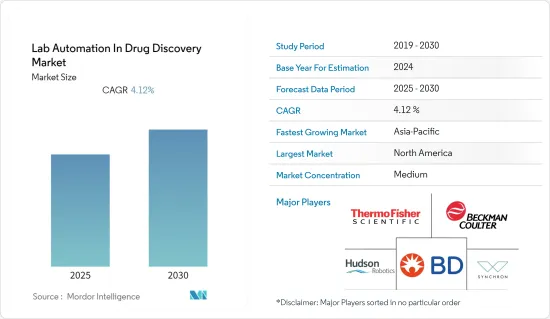
창약용 실험실 자동화 시장은 예측 기간 동안 CAGR 4.12%를 기록할 전망입니다.
주요 하이라이트
- 실험실 자동화는 주로 오류 감소와 비용 이익이라는 두 가지 주요 영향요인을 통해 수년 동안 창약에 변화를 가져왔습니다. 게다가, 자동화는 생명공학 혁명과 다수의 조합 기술을 통해 많은 대상을 확인할 수 있게 함으로써 기존의 약수처리 과정을 변화시키고 화합물 수집을 촉진했습니다. 또한, 제약 연구 기업은 완전한 솔루션, 헌신적인 고객 관리 및 거대한 투자에 대한 가치의 실현이 필요합니다. 게다가, 실험실은 소프트웨어를 최대한의 유연성을 기대하고 있습니다.
- 미국은 수년간 임상 연구의 선구자입니다. 이 나라는 Pfizer, Novartis, J&J, GlaxoSmithKline, Novartis와 같은 유명한 제약 회사의 거점이 되었습니다. 또한 CRO(의약품개발업무수탁기관)가 가장 집중하고 있는 국가이기도 합니다. IQVIA, Laboratory Corp. of America Holdings, Syneos Health, Parexel International Corp. 이러한 유력 기업이 산업에 존재하고 FDA의 규제가 엄격하기 때문에 이 나라의 연구 시장은 매우 경쟁이 심합니다. 이 나라의 기업은 경쟁사보다 우위를 차지하기 때문에 실험실에 로봇 공학과 자동화를 도입하고 있습니다.
- 또한, 의약 실험실에서는 속도와 정확성을 중시하는 경향이 있습니다. 따라서 생물학적 분석의 자동화는 HTS의 주요 요인이 되고 있습니다.
- 그러나 의약품에서 자동화 도입의 장애물로 작용하는 중요한 과제 중 하나는 문제의 학제적 특성입니다. 예를 들어, 기존 화학 측정 분석의 전문 지식뿐만 아니라 고급 장비, 잠재적으로 새로운 샘플링 및 로봇 기술, 머신러닝(ML) 및 인공지능(AI) 접근법의 최근 동향에 대한 지식도 필요합니다. 이 외에도 실험실에서 자동화를 사용하면 자동화가 검사실 환경에 오류나 부정확한 데이터를 초래할 수 있으므로 규정 준수 및 규제 문제를 일으킬 수 있습니다.
- 반대로, 유행은 창약 실험실에서 실험실 자동화의 필요성에 긍정적인 영향을 미쳤습니다. COVID-19와 SARS-COV-2의 만연은 세계에서 만연하는 바이러스에 대항하는 백신을 개발해야 한다는 제약 제조업체에 대한 압력을 증가시켰습니다. 이에 따라 Modernna, Johnson & Johnson, AstraZeneca, Catalent 등 주요 COVID-19 백신 진출기업과의 생산 계약이 증가했습니다. 이와 같이, 백신의약품 제조업체 전체의 실험실 자동화 수요를 견인하고 있습니다.
창약용 실험실 자동화 시장 동향
자동 액체 처리기가 최대 시장 점유율을 차지할 전망
- 액체 처리기는 일반적으로 생화학·화학 실험실에서 채용되고 있습니다. 창약 부문에서는 고성능 스크리닝의 요구가 높아지고 있어 액체 처리기 수요를 견인하고 있습니다. 그러나 실험실 공간은 전 세계적으로 실험실에 가장 설명적인 요인 중 하나이기 때문에 소형화는 창약의 주요 요인 중 하나가되고 있습니다.
- 주요 기술 기지에서는 실험실의 평방 피트 당 비용이 상승하고 있습니다. 연구자와 과학자들은 공간 절약으로 최적의 성능을 발휘하는 기기에 주목하고 있습니다. 소형화된 액체 처리기의 예시 중 하나는 플렉시 리퀴드 핸들링 플랫폼이며, 로봇 암, 스태커, 멀티 시스템 등 여러 시스템과 결합하도록 설계되었습니다.
- 따라서 이러한 플랫폼은 고성능 스크리닝에 사용되는 시약량을 줄여 비용을 절감시키고 있습니다. 또한 창약에 사용할 수 있는 시약의 양은 제한되어 있으며, 자동 액체 처리기는 소량의 시약으로 대규모 스크리닝을 수행하는 최종 사용자를 지원합니다.
- 시장 벤더는 신약을 위해 설립된 현대 실험실 요구 사항을 충족하기 위해 새로운 자동 액체 처리기를 도입하고 있습니다. 예를 들어, 2022년 2월, SPT Labtech는 4-in-1 자동 리퀴드 핸들링 사양의 살구 DC1 플랫폼 출시를 발표했습니다. 이 플랫폼은 4개의 독립형 피펫팅 툴을 1대의 탁상 유닛에 통합하여 창약 시에 사용되는 소량, 대량, 싱글, 멀티채널 피펫팅에 대응하는 듀얼 코어 피펫팅 기술을 가능하게 합니다.
- 또한, 소형화와는 별도로, 자동 액체 처리기는 샘플 추적 및 실험실 정보 관리 시스템의 통합을 자동화함으로써 실험실 표준화를 개선하는 것으로 입증되었습니다. 또한, 액체 처리기는 샘플 처리의 각 단계에 자동 바코드 스캐닝의 통합을 용이하게 합니다. 따라서 사용자는 수동으로 기록할 필요 없이 미리 정의된 작업 지침을 쉽게 진행할 수 있으며 관리 시스템으로 데이터를 가져올 수 있습니다.
- 게다가, 약물의 스크리닝 분석이 복잡해짐에 따라 최종 사용자의 초점은 속도 기반 성능에서 시스템 기반의 유연성과 데이터 무결성으로 변화하고 있습니다. 게다가, 수작업에 의한 액체 취급 공정에서 중요한 과제 중 하나는 시약 첨가의 순서와 타이밍, 일반적인 부피 성능(분석 처리)입니다. 따라서 시장 공급업체는 시약 첨가 시간 과정을 가능하게 하는 긍정적인 변위 분주 기술을 갖춘 자동 액체 처리기를 설계합니다.
- 또한 ClinalTrials.gov에 따르면 2022년 3월 현재 등록된 총 임상 검사 수는 409,300건입니다. 이러한 연구개발에 대한 관심 증가는 자동 액체 처리기 장치의 강화 요구를 세계적으로 촉진할 것으로 예상됩니다.
북미가 최대 시장 점유율을 차지할 전망
- 북미는 창약에 대한 투자가 활발한 미국의 존재로 인해 큰 점유율을 차지할 것으로 예상됩니다. 이 나라에는 Novartis, Pfizer, GlaxoSmithKline, J&J 등 주요 제약 회사가 있습니다.
- 게다가, 이 지역에는 중요한 시장 진출기업이 존재하기 때문에 창약에 대한 투자도 막대한 것이 되고 있습니다. 예를 들어, 2023년 7월 Pfizer와 벤처 기업인 Flagship Pioneering은 내과, 종양, 감염, 면역학 등의 부문에서 최대 10개의 신약 후보를 개발하기 위해 공동으로 1억 달러를 투자한다고 발표했습니다. 이 계약을 통해 Flagship이 지원하는 기업은 이 파트너십 하에서 발견 및 개발된 실험적 치료의 출시 및 판매가 성공할 경우 약 7억 달러의 이정표와 로열티를 받을 수 있습니다. 이는 이러한 시장 진출기업이 최신 자동화된 실험실을 보유함으로써 원하는 결과를 얻을 수 있기 때문에 연구 시장에 큰 기회가 됩니다.
- 이 외에도 지역에서의 의약품 승인 건수 증가도 이 나라에서의 창약의 지속적인 진화를 나타내며, 최적화된 오퍼레이션에 의해 정확한 결과와 신속한 성과를 가져오는 적절한 자동화 실험실의 중요성을 보여줍니다. 예를 들어, Nature Reviews Drug Discovery에 따르면, 2022년 FDA의 의약품 평가 연구센터(CDER)는 37개의 신약을 승인했습니다.
- 이 시장에서는 창약에 AI와 머신러닝 기술을 도입하는 투자도 확대되고 있으며, 이 지역의 실험실 자동화의 요구를 뒷받침하고 있습니다. 예를 들어 Google DeepMind의 AI 기술은 1차 서열에서 단백질의 3D 구조를 예측하는 g DL 알고리즘을 개발했습니다. 또한 Google은 Sanofi와 혁신 실험실 프로젝트를 시작하여 새로운 기술을 통해 창약을 개선하기 위해 노력하고 있습니다.
신약의 실험실 자동화 산업 개요
이 시장에는 Thermo Fisher Scientific, Beckman Coulter, Synchron Lab Automation과 같은 주요 기업이 진출하고 있으며 시장 경쟁은 치열합니다. 이러한 진출기업들은 R&D 활동, 전략적 파트너십, M&A를 통해 시장에서 강력한 골격을 구축할 수 있습니다.
2023년 2월 PerkinElmer는 차세대 스크리닝과 고성능 스크리닝(HTS) 용도(NGS)을 위한 두 가지 새로운 솔루션을 발표했습니다. 이 회사는 EnVision Nexus 시스템을 발표하고 까다로운 HTS 용도 및 의약품 개발 프로세스를 가속화하기 위해 노력했습니다. 이 시스템의 고성능, 신속한 듀얼 검출기로 연구자들은 수백만 개의 샘플을 보다 정확하고 신속하며 고감도로 스크리닝할 수 있습니다. 이 회사는 이 시스템을 완전 자동화하고 지속적인 프로세스 자동화를 위해 통합할 수 있습니다. 이 회사는 Zephyr G3 NGS iQ 워크스테이션도 발표했습니다. 이 워크스테이션은 최대 96개의 NGS 라이브러리를 자동으로 생산할 수 있는 통합 벤치탑 시스템입니다. 이 워크스테이션에는 고성능 액체 처리기, 통합 서모사이클러, 로봇 암, 모든 데크 액세서리 및 주변 장치가 포함되어 있으며, 실험실은 가장 복잡한 NGS 방법도 높은 재현성으로 자동화할 수 있어 생산 능력을 높이고 오류를 줄일 수 있습니다.
2022년 2월 BICO의 DISPENDIX에 따르면 I.DOT HT 비접촉 디스펜서와 L.DROP 액체 처리기가 SLAS 2022에서 발표되었습니다. I.DOT 비접촉식 디스펜서의 지난 수년간 성장에 힘입어 DISPENDIX는 전략적 R&D 투자와 산업과의 제휴를 실시하여 유전체학와 창약 연구를 위한 보다 종합적인 워크플로우 솔루션을 과학자 에 제공하는 두 가지 혁신적인 플랫폼을 개발했습니다. i.DOT HT는 i.DOT의 기본 기술을 발전시킨 것으로, 384 웰의 소스 웰 구성을 통해 대형 제약 회사와 소규모 생명 공학 회사에서 화학물질 라이브러리를 관리할 수 있습니다.
기타 혜택
- 엑셀 형식 시장 예측(ME) 시트
- 3개월의 애널리스트 서포트
목차
제1장 서론
- 조사의 전제조건과 시장 정의
- 조사 범위
제2장 조사 방법
제3장 주요 요약
제4장 시장 인사이트
- 시장 개요
- 산업의 매력 - Porter's Five Forces 분석
- 공급기업의 협상력
- 구매자의 협상력
- 신규 참가업체의 위협
- 대체품의 위협
- 경쟁 기업간 경쟁 관계의 강도
- 산업 밸류체인 분석
- 시장에 대한 COVID-19의 영향 평가
- 기술 개요
- 기술 스냅샷
- 산업용도
제5장 시장 역학
- 시장 성장 촉진요인
- 디바이스의 소형화와 처리량 향상을 가져오는 기술 혁신
- 시장의 과제
- 중소규모 실험실에서의 채용률 저하
제6장 시장 세분화
- 장치별
- 자동 액체 핸들러
- 자동 플레이트 핸들러
- 로봇 암
- 자동 보관·검색 시스템(AS/RS)
- 소프트웨어
- 분석장치
- 지역별
- 북미
- 유럽
- 아시아태평양
- 기타
제7장 경쟁 구도
- 기업 프로파일
- Thermo Fisher Scientific
- Beckman Coulter
- Hudson Robotics
- Becton Dickinson
- Synchron Lab Automation(MolGen)
- Agilent Technologies
- Siemens Healthcare
- Tecan Group Ltd.
- Perkinelmer
- Bio-Rad
- Roche Holding AG
- Eppendorf AG
- Shimadzu
- Aurora Biomed
제8장 투자 분석
제9장 시장 기회와 앞으로의 동향
JHS 25.02.06The Lab Automation In Drug Discovery Market is expected to register a CAGR of 4.12% during the forecast period.
Key Highlights
- Laboratory automation transformed drug discovery over the years, primarily through two major influential factors: error reduction and cost-benefit. Additionally, automation transformed the traditional drug discovery process by making it feasible to identify many targets through the biotechnology revolution and numerous combinatorial technologies, which fueled compound collection. Additionally, drug research companies require complete solutions, dedicated customer care, and realizing their value for huge investments. Furthermore, research laboratories expect maximum software flexibility so they can configure it themselves.
- The United States has been a pioneer in clinical research for years. This country is a hub for some prominent pharmaceutical companies, like Pfizer, Novartis, J&J, GlaxoSmithKline, and Novartis. The country also possesses the highest contract research organizations (CROs) concentration. Some of the significant CROs in the country are IQVIA, Laboratory Corp. of America Holdings, Syneos Health, and Parexel International Corp. Due to the presence of such prominent players in the industry and stringent FDA regulations, the studied market is very competitive in the country. Companies in the country are adopting robotics and automation in labs to gain an advantage over competitors.
- Furthermore, the journey in drug discovery laboratories has inclined to focus on speed and accuracy. Therefore, automation of biological assays is becoming the primary factor for HTS as the labs are mainly required to screen a large number of compounds, approximately 1-3 million.
- However, one of the significant challenges that act as a hurdle in the uptake of automation in pharmaceuticals has been the interdisciplinary nature of the problem. For instance, expertise in traditional chemometrics analysis is needed, as well as advanced instrumentation, potentially new sampling or robotics methods, and knowledge of the most recent developments in machine learning (ML) and artificial intelligence (AI) approaches. In addition to this, the use of automation in laboratories can result in issues with compliance and regulations as automation can introduce errors or incorrect data into the lab environment, further increasing the probability of potential for incorrect results or non-compliance with regulations.
- On the contrary, the pandemic positively impacted the need for lab automation in drug discovery laboratories. The spread of COVID-19 and SARS-COV-2 increased the pressure on drug manufacturers to develop vaccines to combat the spread of the virus across the world. Therefore, the production contracted with major COVID-19 vaccine players increased for players, including Moderna, Johnson & Johnson, & AstraZeneca, and Catalent. Thus driving the demand for lab automation across vaccine drug manufacturers.
Lab Automation in Drug Discovery Market Trends
Automated Liquid Handlers are Expected to Account for the Largest Market Share
- Liquid handlers are generally employed in biochemical and chemical laboratories. The need for high throughput screening in the drug discovery sector is increasing and is driving the demand for liquid handlers. However, miniaturization is becoming one of the main factors in drug discovery as the lab space is one of the most accountable factors for laboratories globally.
- The cost per square foot for laboratories is rising in major technology hubs. Researchers and scientists are focusing on instrumentation that takes a smaller amount of space and provides optimal performance. One such example of the miniaturized liquid handler is the flexi liquid handling platform, which is designed to combine with multiple systems, such as the robotic arm, stackers, and multiple systems, among others.
- Therefore, such platforms are increasing cost savings as there is an increased reduction in reagent volumes used in high throughput screening. Furthermore, the availability of reagent volumes in drug discovery is limited, and the automated liquid handlers are helping end users in large-scale screening with lower volumes of reagents.
- Vendors in the market have been introducing new automated liquid handlers to meet the requirements of modern laboratories established for drug discoveries. For instance, in February 2022, SPT Labtech announced the launch of their apricot DC1 platform, which serves 4-in-1 automated liquid handling specifications. The platform incorporates four separate pipetting tools in a single benchtop unit to enable dual-core pipetting technology for low-volume, high-volume, single, and multichannel pipetting used during drug discoveries.
- Furthermore, apart from miniaturization, automated liquid handlers are being proven to improve lab standardization by automating sample tracking and Laboratory Information Management Systems integrations. In addition, the liquid handlers facilitate the incorporation of automated barcode scanning into every step of sample processing. Thus, it makes it easy for the users to proceed with predefined work orders and import data into their management systems without requiring manual recordings.
- Moreover, the growing complexities of screening assays in drug discovery are shifting the focus of end users to incorporate speed-based performance toward system-based flexibility and data integrity. In addition, one of the significant challenges in the manual liquid handling process is the ordering and timing of reagent additions and general volumetric performance (for handling assays). Therefore, vendors in the market are designing automated liquid handlers with positive displacement dispensing technology that enables time-course reagent additions.
- Furthermore, according to ClinalTrials.gov, the total number of registered clinical studies as of March 2022 is 409,300. Such increased focus on research and development is expected to drive the need for enhancing the automated liquid handlers equipment globally.
North America is Expected to Hold the Largest Market Share
- North America is anticipated to register a significant share due to the United States' presence, a country with significant investments in drug discovery. This country is home to some major pharmaceutical companies, like Novartis, Pfizer, GlaxoSmithKline, J&J, and Novartis.
- Moreover, with the presence of significant market players in the region, the investment in drug discovery is also enormous in the region. For instance, in July 2023, Pfizer and venture firm Flagship Pioneering announced investing USD 100 million together to develop up to 10 new potential drugs for areas including internal medicine, oncology, infectious diseases, and immunology. Under the terms of the agreement, Flagship-backed companies can receive about USD 700 million in milestones and royalties upon the successful launch and sale of any of the experimental treatments discovered and developed under the partnership. This adds up to the opportunity for the market studied owing to the presence of updated and automated labs by these market players to get desired outcomes.
- In addition to this, the growing number of drug approvals in the region also showcases the continuous evolution of drug discovery in the country, which presents the importance of proper automated labs that can lead to accurate results and faster outcomes with optimized operations. For instance, according to Nature Reviews Drug Discovery, in 2022, the FDA's Center for Drug Evaluation and Research (CDER) approved 37 novel drugs.
- The market is also witnessing growing investments in incorporating AI and machine learning technologies in drug discoveries, driving the need for lab automation in the region. For instance, Google DeepMind's AI technology developed the g DL algorithm to predict the 3D structure of proteins from primary sequences. In addition, Google also began the Innovation Lab project with Sanofi to improve drug discovery with emerging technologies.
Lab Automation in Drug Discovery Industry Overview
The market offers strong competition to the operating players, owing to the presence of some key players in the market, such as Thermo Fisher Scientific, Beckman Coulter, and Synchron Lab Automation. Their ability to innovate their offerings has allowed the players to gain a competitive advantage over their competitors. These players can gain a strong foothold in the market through R&D activities, strategic partnerships, and mergers and acquisitions.
In February 2023, PerkinElmer unveiled two new solutions aimed at next-generation screening and high-throughput screening (HTS) applications (NGS). The company unveiled its EnVision Nexus system, intended for demanding HTS applications and to hasten the drug development process. Due to the system's high-throughput, quick dual detectors, researchers can screen millions of samples more accurately, quickly, and sensitively. The company has made it possible for the system to be totally automated and integrated for continuous process automation. The company also unveiled the Zephyr G3 NGS iQ workstation, an integrated benchtop system that permits the automated production of up to 96 NGS libraries. This workstation includes a high-performance liquid handler, an integrated thermocycler, a robotic arm, and all deck accessories and peripherals, allowing laboratories to automate even the most complex NGS methods with a higher level of reproducibility, thereby increasing capacity and reducing errors.
In February 2022, The I.DOT HT Non-contact Dispenser and the L.DROP Liquid Handler were unveiled at SLAS 2022, according to DISPENDIX, a BICO firm. Driven by the I.DOT non-contact Dispenser's growth over the past few years, DISPENDIX made strategic R&D investments and industry partnerships to develop two innovative platforms that would work together to give scientists more comprehensive workflow solutions for genomics and drug discovery research. The I.DOT HT expanded on the I.DOT's basic technology uses a 384-well source well configuration to manage chemical libraries at big pharma and more modest biotechnology firms.
Additional Benefits:
- The market estimate (ME) sheet in Excel format
- 3 months of analyst support
TABLE OF CONTENTS
1 INTRODUCTION
- 1.1 Study Assumptions and Market Definition
- 1.2 Scope of the Study
2 RESEARCH METHODOLOGY
3 EXECUTIVE SUMMARY
4 MARKET INSIGHTS
- 4.1 Market Overview
- 4.2 Industry Attractiveness - Porter's Five Forces Analysis
- 4.2.1 Bargaining Power of Suppliers
- 4.2.2 Bargaining Power of Buyers
- 4.2.3 Threat of New Entrants
- 4.2.4 Threat of Substitute Products and Services
- 4.2.5 Intensity of Competitive Rivalry
- 4.3 Industry Value Chain Analysis
- 4.4 Assessment Of Impact Of COVID-19 On The Market
- 4.5 Technology Overview
- 4.5.1 Technology Snapshot
- 4.5.2 Industry Applications
5 MARKET DYNAMICS
- 5.1 Market Drivers
- 5.1.1 Technological Innovations Leading to Device Miniaturization and Increased Throughput
- 5.2 Market Challenges
- 5.2.1 Slower Rate Of Adoption In Small And Medium Scale Labs
6 MARKET SEGMENTATION
- 6.1 By Equipment
- 6.1.1 Automated Liquid Handlers
- 6.1.2 Automated Plate Handlers
- 6.1.3 Robotic Arms
- 6.1.4 Automated Storage & Retrieval Systems (AS/RS)
- 6.1.5 Software
- 6.1.6 Analyzers
- 6.2 By Geography
- 6.2.1 North America
- 6.2.2 Europe
- 6.2.3 Asia-Pacific
- 6.2.4 Rest of the World
7 COMPETITIVE LANDSCAPE
- 7.1 Company Profiles
- 7.1.1 Thermo Fisher Scientific
- 7.1.2 Beckman Coulter
- 7.1.3 Hudson Robotics
- 7.1.4 Becton Dickinson
- 7.1.5 Synchron Lab Automation (MolGen)
- 7.1.6 Agilent Technologies
- 7.1.7 Siemens Healthcare
- 7.1.8 Tecan Group Ltd.
- 7.1.9 Perkinelmer
- 7.1.10 Bio-Rad
- 7.1.11 Roche Holding AG
- 7.1.12 Eppendorf AG
- 7.1.13 Shimadzu
- 7.1.14 Aurora Biomed